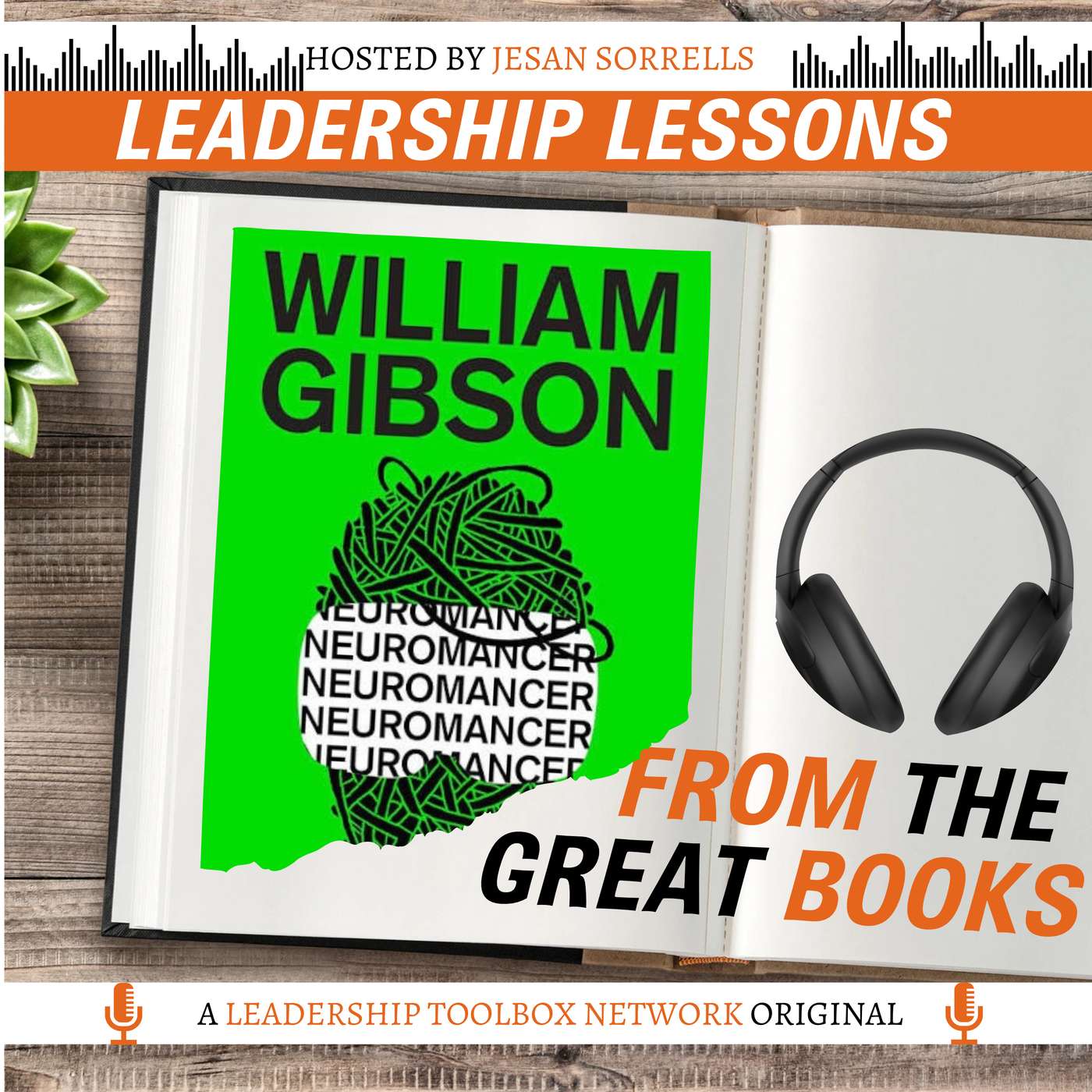
Neuromancer by William Gibson with John Hill and Jesan Sorrells
Neuromancer by William Gibson with John Hill and Jesan Sorrells
---
Jesan Sorrells and John Hill dive deep into William Gibson’s Neuromancer, unravelling how this seminal work predicted the psychological and societal ramifications of our fully networked times. They discuss the book’s dystopian tech vision, how its themes shaped tech leadership and culture, and why leaders must now confront meaning, value, and noise in a flattened digital world. Together, they examine Gibson’s influences, the enduring tension between art and commerce, and the urgent leadership challenge of integrating humanity and technology in the 21st century.
- Book: Neuromancer
- Author: William Gibson
- Guests: Jesan Sorrells, John Hill
---
Time-Stamped Overview
---
00:00 Observing tech use at the store
05:36 Post-Cold War tech realities
11:57 Reflecting on book rereads
17:52 Influence of Gibson on tech leaders
27:13 Gibson's shift from sci-fi
32:45 Struggling with overwhelming concerns
38:31 Sci-fi themes of immortality
43:09 Themes of timeless cultural issues
49:49 Tolkien's Influence on Fantasy Writers
52:51 Reflecting on cyberspace concepts
01:01:13 Discussing Neuromancer's Relevance Today
01:02:47 Discussion on demonizing new trends
01:11:43 Finding time for self-reflection
01:14:47 Discussing hierarchy of meaning
01:21:45 Expanding the franchise legally
01:27:45 Discussing human nature and warfare
---
- Opening theme composed by Felipe Sarro - Bach - Silotti - "Air" from Orchestra Suite No. 3, BWV 1068
- Closing theme composed by Brian Sanyshyn of Brian Sanyshyn Music.
---
- Pick up your copy of 12 Rules for Leaders: The Foundation of Intentional Leadership NOW on AMAZON!
- Check out the Leadership Lessons From the Great Books podcast reading list!
---
- Subscribe to the Leadership Lessons From The Great Books Podcast: https://bit.ly/LLFTGBSubscribe
- Check out Leadership ToolBox at: https://leadershiptoolbox.us/
0:00 Hello, my name is Jesan Sorrells, and this is the Leadership Lessons from the Great Books Podcast, episode number 203. So today, I will not be opening the show with a selection from the book. Instead, our guest co-host today, John Hill, will be opening up with a selection of the book because I did not bring my copy of the book today to the studio, to the show. So, John, pick a selection from chapter 1 and take it away. Oh, wow. Okay, hold on one second.
0:41 So this is going to be cliché, but I'm going to start kind of like right here in the beginning because for as much as I have to say about this book, there are things about how it is written that I think are very beautiful, very interesting turns of phrase, and very interesting choices around this, right? So The sky above the port was the color of television tuned to a dead channel. It's not like I'm using, Case heard someone say as he shouldered his way through the crowd around the door of the Chat.
1:10 It's like my body's developed this massive drug deficiency. It was a sprawl voice and a sprawl joke. The Chatsubo was a bar for professional expatriates who could drink there for a week and never hear 2 words in Japanese. And it's so interesting because like, this is my favorite thing about science fiction and like this pulpy style of science fiction. It's how hard of a drop can they drop you into this thing and how quickly can they build the world around you, right? And so I read this book when I was a kid and I was very excited to kind of come back to it.
1:47 And I had a very different experience with it this time, but that idea. You're going to get dropped into a thing and you're going to have to figure it out. This is the greatness of pulpy sci-fi. And you got to suspend some disbelief. You got to be willing to give them the benefit of the doubt. And you just have to dive in and start reading and just kind of give them some trust that it's going to be okay. And it kind of felt like coming back home because opening that thing up, I was like, oh, absolutely.
2:14 Now, very interesting experience reading through it again, 30-something years later and stuff like that. But Great place to open. Great place to open. And as a matter of fact, I never read this book before. We agreed to cover it on the podcast today. I'd heard of, of course, the author of this book. He floats around, his name floats around many circles that I am involved in. And of course, if you're going to read any kind of science fiction in this genre, you're eventually going to run up against this person.
2:50 I had a little bit of a different experience than, than John with this book, though. After I finished it, which was probably about a month and a half ago now, maybe, maybe about a couple months ago now, because I'm reading like 8,000 different things from a bunch of different projects that I'm involved in. I, I got into my car and I drove to my, my local, my local grocery store and Well, I was pulling into the parking lot, and this anecdote is sort of where I'm going to go with this book today, at least in my understanding of it.
3:21 When I was parking, I looked across the lot and I observed some of the pedestrians in the crosswalk, and I saw a small child, probably no more than maybe 3 or 4, walking behind his parents who were pushing a cart, looking very dejected and very upset that they had to go to the grocery store. And this little, this little man, uh, was holding, clutching underneath his arm quite tightly, a, uh, a tablet. Now, I could not see the brand of the tablet, but it didn't really matter. Kid couldn't have been more than 3 or 4 years old.
4:00 And in looking around, of course, getting out of the car, Looking around, I put my own, you know, communication addiction device in my own back pocket as I got out of the car and looked around and saw that everybody else was in varying stages of having their own communication addiction device either attached to their head or in their hand, or, you know, as they were walking through the store, attached to their head, actually using it for a phone.
4:29 Now, the movie The Matrix came out in 1999 when I had just graduated from high school. Right. And when it did, the internet that our author envisioned in 1984, that sort of set the table for how John opened us up today, that internet hadn't yet come to fruition, not in any kind of real meaningful way, not the way we think of the internet. But it was on its way. And The Matrix, at least the original movie, was a warning shot across the postmodern bow of the ship of culture and society of the late '90s.
5:04 Some of us, of course, heard the shot. That has been our author today. Others were confused by the sound of the shot, and many of us ignored it altogether and were completely and utterly surprised when we wound up in the space that we're in right now. Timothy Berners-Lee turned on the commercial internet in 1989. It was a seminal year that included the crushing of rebellion at Tiananmen Square and the falling of the Berlin Wall and the collapse of Soviet communism. And the beginnings of the post-Cold War peace dividend that the boomers had been promised by the generations that fought the Cold War and World War II and Korea and Vietnam before them.
5:45 37 years later, however, after all of that has happened, after social media and 240 characters and cryptocurrency and self-driving cars, instant shipping, and here we are right on the cusp of AI. We all live, even that kid in the grocery store lives now, in the fully realized backwash of the author of our book today's nightmare. We're in the backwash of the nightmare of this book. And yet, and I pointed this out to John when we were talking about this book and how we were going to approach it, yet I still have to load the dishwasher by hand.
6:25 And I did some data entry today. And I still had to switch between screens, and I'm doing stuff by hand. I'm still dealing with people that print off paper in order to edit things.
6:40 So today on the show, we are going to examine a book, John and I are, that was once blurbed by the Village Voice as, quote, a mind-bender of a read in 1983. But now that, to me at least, reads kind of flat and cold. We will try to pull lessons for leaders from Neuromancer by William Gibson.
7:08 Leaders, try not to bury the lead today. We're going to talk— this is going to be a wide range of conversations. So I'm going to try not to bury the lead today. But leaders, I think that for the 21st century, we need new myths. I think we need myths that take into account everything from this point forward in history, not myths that revisit all of the old horrors that we couldn't figure out how to deal with back in the '80s or '90s.
7:36 And I think this book points the way to how we maybe can do some of that. I already mentioned that our co-host today will be Jon Hill, and he opened us up with a selection from that book, the very famous, for First line, right? And this book is going to be turned into Neuromancer is going to be turned into an Apple TV show. So this is hitting, hitting right on time. I believe it comes out either this month or next month. I'm going to be streaming on Apple TV, which for the life of me, again, 37 years after the internet, I can't figure out why they're only doing it now.
8:07 Like, really? Like, really? It took you this long?
8:13 John, you said you read this book a long time ago when you were a young man. And you've had a lot more sort of meaty interaction with it. Talk to me about this book for you. Talk to us about sort of what does this book mean? And we'll talk a little about William Gibson and sort of who he is as an author. Um, because he's actually stopped writing science fiction books and has now moved on to, to more quote unquote serious literate literature. But, um, talk to me about this book and the impact that it had on you.
8:39 You were 15 and now you're not 15. Yeah. So like reading it, reading it then and reading it now. Well, it's, it's funny because, uh, reading it this time, I finished and I was kind of like, huh, right? I just kind of sat with it, right? Because I didn't have that, that moment of like triumph, right? Because like whenever I was a kid, I was probably— what year did this come out? I'm trying to remember exactly. Well, the version I have came out in '84. I mean, I was probably 13, 14, so '93, '94, right, when, when this was coming out.
9:18 And I'm reading everything I can in this sci-fi kind of vein that is more kind of about the character and the story. So I'm reading lots of Heinlein, lots of this stuff, things like that. And I've always been interested in tech right now. Mm-hmm. I'm gonna be honest, right? Being a— being an adolescent guy, right, it's more about the sex and the, the other aspects of this. And, and the tech was— it was an interesting kind of portal for me. Like, you know, I'm just gonna be honest about it. Right.
9:50 Um, but, uh, the idea of like cyberspace and you're loading into an environment and everything, like, this was compelling to me. Like, it seemed like direction that we were going to go, but it didn't seem so far off. Like, it, like, it just seemed like a normal leap versus some of the other sci-fi that I was reading at the time. More rocket ships, spaceship, we're colonizing other planets and stuff like this. That felt more like future, future, future state. This felt more just like near future kind of thing, right?
10:24 Which I couldn't really appreciate as an adolescent guy. But, you know, the internet was around enough. I had AOL. I'd seen— I'd heard of the movie Hackers. I don't think I'd seen it yet. Right. like that, that this idea that this is gonna grow and this was gonna be something we were gonna move into. Okay, I can get behind that, right? Yeah. And, you know, so read it probably 2 or 3 times because I was kind of like, oh, wow, this is really interesting. And then kind of moved on, right? It's always been on the shelf since then.
10:54 And then getting the opportunity to kind of go back to it because I've never really dug too much into the other William Gibson library, right? Like, this was the big one. And then I think I saw Johnny Mnemonic, which was just supposed to be a movie adaptation of a William Gibson thing. And that was pretty, pretty disappointing in my memory of it. Yeah. And then like fast forward, we get to The Matrix. The Matrix is a huge deal for me because I'm a martial arts nerd. Obviously we've talked about it.
11:21 And then this is the first time that it's like been tech but also looks cool. Like the tech meets the technology that we're able to capture it with. And that was a big deal for me at the time. And so once The Matrix got here, largely, I'd kind of forgotten about Gibson, right? And the idea that he was the first guy to use the word web space, right? I think, and stuff like this, right? So like, Yep. you know, looking at the impact he's had just on, on the culture at large was significant, right? Because I kind of like you, the minute you were like, The Matrix, I was like, oh yeah, The Matrix.
11:57 I was like, now wait a minute. It was easier for me to accept The Matrix and really geek out on The Matrix because I had read this book and I'd read so many other books in this kind of area and stuff like that. But coming back to it, I finished it and I was kind of like, huh, is this different just because I'm old and I've seen too much? Like, I know too much, you know? And so I decided to go get on Goodreads, right? Because I like going and looking at other people and how they think about the books.
12:25 And it was so fascinating because, like, looking at the reviews, there's a lot of people that read this annually and have, like, a different reflection on it annually. There's people that have had my experience. They come back to it later on and they're like, eh. And, you know, To me, that's what indicates that a book is like meaty enough, right? That there is such a wide-ranging opinion on it and people will come back to it. They will make it a reference thing and stuff like that. And other people can't, can't care for it at all.
12:55 Like, to me, that's, that's a signal of something, right? Mm-hmm. And so going through that and reading some of those reviews, I'm like, you know, I think I need to read it again in about a year. and like see how I feel about it then, right? Because you said the line that we're now living in that experience, right? And we kind of talked about it on text and chat and everything. Yeah. And like, you know, you're not, you're not reading, you're not reading the fantasy that's going to make it the next 35 years today because it hasn't shown itself to be that good, right?
13:30 And so that's the hard part, I think, of science fiction is you're writing for a fan, for a future that you don't know is going to come true. And we can only see as far as we can see, right? Like, it's really cool to go to, like, there's this— I think it's actually in Albuquerque, which is funny because we were talking about Albuquerque before we turned on the recording, the Museum for
13:52 Nuclear Bombs, right? Or the Nuclear Museum and everything. Oh, yeah. And they're talking about how, like, Robert A. Heinlein was talking about, like, debit cards and credit cards and how all of these science fiction people in the tapestry of our history have these things that have talked about coming true. Well, for every one of those that has come true, there's been 100 other hypotheses of like, oh, this is going to be and fit the story that has not ever come true. And that's something that, yeah, that's something that you're gliding or alighting across something that I want to get into a little bit, at least early.
14:28 So as usual, I have to go and look at Gibson because I'm not as familiar necessarily with him as I might have been with Asimov or Heinlein or any of those guys. So Gibson comes along, or he was born in 1948, and he began his writing career in the late '70s.
14:48 And his early works were noir, near-future stories. So he was very much focused on the near future, right? That explored the effects of technology, cybernetics, and of course, computer networks on humans. It's interesting, when he was writing, when he was writing this book, Neuromancer, he went and saw Blade Runner. And he almost didn't finish the movie because he was like, oh my— or finish the book because he walked out of Blade Runner in like 1982. I presume he was probably on his close to final draft of Neuromancer by that point.
15:20 Walked out of that movie and thought, oh my God, they'll think it's derivative of Blade Runner. like, they'll think that I'm just ripping this movie off. I'm just ripping off Philip K. Dick. And the,
15:35 the, the thing about Gibson is he was a shy teenager who didn't really, like, get along with everybody else in his community, or quite frankly, in his, in his high school. And he's even quoted as saying that he grew up in a, quote unquote, highly mono— highly a highly— what do you call it— a problematic monoculture, right? Mm-hmm. And you can see some of that reflected, his sort of rebellion against that. You could see that reflected in Neuromancer. He consciously rejected religion and took refuge in reading science fiction, starting with writers such as William Burroughs, who wrote Tarzan, and moving on, of course, into maybe more of your classical authors like a Henry Miller, you know.
16:18 And now Neuromancer is an interesting book because it became the first winner of the science fiction, quote unquote, Triple Crown. So that's like the 3 sort of, you know, awards that are given to a science fiction novel. So he won the Nebula Award, the Hugo Award, and the Philip K. Dick Award. And it eventually sold more than 6.5 million copies worldwide, right? Elon Musk for sure read this book. Peter Thiel read this book. Mark Zuckerberg read this book. Jeff Bezos, when he was in college in the '80s, read this book.
16:56 They did. They read this book like it landed like a freaking atomic— you talk about atomic bomb. This book landed like an atomic bomb. Marc Andreessen, who came up with the Netscape browser back in the '80s, or sorry, back in the early '90s when he was in college at like Southern Illinois University. He read this book when he was in high school in the '80s. Okay. I mean, like, everyone— Sam Altman, who's like running around right now begging Congress to please put handcuffs on me so I don't build the AI that's gonna kill us all while he's still building the AI that's quote unquote gonna kill us all.
17:34 He read this book in the '90s when he was in— when he was in high school. Corey Doctorow. Okay. who doesn't believe that the— I love this line from Corey. He's like, I don't know why we believe that the machine, that the word predicting machine is going to somehow wake up and attain consciousness. It's not. We're just idiots. Corey Doctorow read William Gibson. As a matter of fact, there's a picture of him floating around on the internet where he like went and had William Gibson sign his copy of Neuromancer, like back in the day.
18:04 Everybody, and Corey Doctorow is about as left-wing anarchist as you can get. From the left-wing anarchist Cory Doctorow to about as right-wing capitalist person as you can get, Jeff Bezos, they've all read this book. Every one of our modern tech titans understands what's in this. Well, maybe not understands, but read this book and was influenced by it. This is the power of William Gibson. And eventually, if you talk to them long enough, they'll bring up Neurolancer. So this book was huge, has been hugely influential.
18:33 And this is where I kind of— this is the thing I'm relighting over. I think it's been hugely influential, and Gibson has been hugely influential in building the thing out that he was describing, even though he was speculating about it. People took him seriously, even more so than they took Asimov seriously, or Bradbury, or even Philip K. Dick. They took him dead serious, and they said, we can go build that.
19:02 And now,
19:07 now we're here. And this is the part that drives me nuts. This is the part that drives me nuts. And I'm going to keep coming back to this over and over again, but this is the part driving us. You said we can only see as far as we can see. Yeah.
19:25 The bad stuff is in the book.
19:30 The downsides are in the book. They're all right there. It wasn't like Gibson just gave us the fantasy and it was like, and everybody lived happily ever after, the end. No, everybody doesn't live happily ever after. It's terrible. It's an ambiguous ending. Yeah. But it's kind of a terrible postmodern nihilistic ending. By the way, because Gibson doesn't understand the impact of religion and rejected it in his own life, there's no religious belief system anywhere in this book. Which at least Philip K. Dick at least gave a nod to that.
19:58 And he was up until this point, and we, and we read Do Androids Dream of Electric Sheep? On this podcast. I would think that Dick, Philip K., I thought up until Gibson, I met him in a dark alley. I thought Philip K. Dick was the most nihilistic science fiction writer I'd read. No, no. Gibson goes all the way down into the abyss. He's hanging out down there with Nietzsche, like all the way down at the bottom, expecting like supermen to rise. Interesting perspective. Yeah. Yeah. Expecting like supermen to rise.
20:21 And there's no, there's no Superman because we can't create our own values out of our own self, no matter how much we're jacked into the matrix. We just can't. We can't do it. We don't have the capacity inside of ourselves.
20:38 That's not my, my primary knock. That's not my primary critique against, against the book. My primary critique is all of the bad stuff is in there.
20:51 We have tech leaders that have read it, seem to have ignored the 90% of the bad stuff and just went, hey, wouldn't this really be cool if we could, like, jack into the internet and then, like, run around with no bodies, like hacking things? Yeah. Okay. Let's try that. Well, we tried it for— we've tried it for 37 years. We got— we've got Wade from Kim Possible running around the dark web stealing everybody's data. Like, like, that's what we've got. We've got that guy. That guy is here. We don't— what we don't have is a solution for that guy.
21:29 And I'm a solutions-oriented guy. I would love to have a solution for that guy. Because I think that guy's a real problem. This is a fascinating conversation to me because the— what I'm, what I'm hearing from you is that because, because he talks about the bad things, We should have taken a completely other route entirely. When have we ever done that? Yeah. When have we ever looked boldly and been like, oh, let's discern this and let's look at all the choices and all the tradeoffs and everything and like, look at it on it.
22:00 We don't ever do this, buddy. Like, and so, so, so, so in that mode, the only way that like these, these things that you're so concerned about don't come true is like there's no progress. Right. And, and, and, and the line in Oppenheimer, which I keep going back to that movie because that, that, I mean, Christopher Nolan sort of nailed it with this. The line from Cillian Murphy in Oppenheimer when he's in the scene. I don't know if you've seen the movie. I have seen it. Okay. So, you know, the scene where he goes and all of the, all of the communist or communist-coded scientists are having the meeting about whether or not they should keep working on the bomb.
22:39 And they're all like having this existential crisis because we beat— we already beat the Germans and we were building the bomb to drop on the Germans. And now we don't have to do it because like we're going to eventually beat the Japanese. Yeah. Okay. Spoken as people, by the way, who didn't have to like go into murder holes with the Japanese, purely like didn't have to do that at all or island hopping. Okay. Okay. So you're speaking from your own little window in your own little house. In a lab.
23:04 Yeah. In a lab, right? And what is it that he says? He says,
23:10 our fantasies, our dreams are their horrors, but they won't know that until we use it. They won't know to be horrified until we use it. That's the only way they're going to know. And by they, he means average Joe Schmo public who's not smart enough to be in the lab with him. He also said earlier in the movie, my other favorite line, which I always say on this podcast, I love this line, at a certain point you have to move from theory to practice. You got to move from the mathematics on the board to actually being out in the real world.
23:43 Mm-hmm. It isn't like, again, it isn't as if, if I had Gibson on the show, I think Gibson would agree with me. It isn't as if he didn't write about the downsides in Neuromancer. He did. He absolutely, I don't blame him at all. I don't, I don't lay— he did exactly what he was supposed to do as a writer. He laid out a fully realized world, and I think that's where people— what people really like is that it's a fully realized world that seems— that logically is consistent all the way to the end, which is good.
24:13 Okay.
24:16 And I've always been this way. Like, when I was in art school, I never really had a problem with Pablo Picasso, although Over the course of time, I've had more and more of a problem with that guy. Um, at a human level, not at an artistic level. Artistically, I think that's a whole other kind of thing, but at just a human being level, he was, he was not a good human being. Um, but the, the challenge is with the people who come after him, the people who look at what he did or do shop, right? And they go, oh, it was an upside down urinal.
24:49 So now I can put a shark in like formaldehyde and call that art. And I'm not saying a shark from formaldehyde is not art. I'm just saying like, that's where you get to, right? Or, you know, we can have a, we can have a, we can have a virgin. Yeah, a Virgin Mary made out of poo and call that art. Made out of cow dung. Like, we can have that. That's fine. Yeah. It's almost as if the followers miss the joke. And I think the followers of Gibson, the readers of Gibson, miss the joke.
25:26 And I don't know if this is the perennial tension. So you and I were talking about this a little bit in a different context, but maybe there's the perennial tension here between art and commerce. Maybe this is part of that tension as well. Mm-hmm. Or maybe it's the perennial tension at a deeper level between art and the viewer. Or the reader of the art. Because once you put something out there, like I know this, I've written 3 books, I'm working on a 4th one right now. The second you put a book out in the world, it's out of your control.
25:53 Yeah. You have no control over what people are going to think about that book. Um, and that's frustrating to me as an artist because I know what I wanted to put in that book and I tried my hardest to put it into the book or put it into my art or whatever, film, whatever. But then they're running around interpreting things all kinds of different ways, and I have zero control over that.
26:17 And that, that bothers you? As a, as a, as a Type A, as a Type AD artist? Yeah, yeah, it bothers me a little bit. I'm not gonna lie, it does. It bothers me. But there's a— but like, I do up to 200-some-odd episodes of this podcast. I have no idea what people think about every single episode. Yeah. That's fair. And, but I can kind of like let it go with this, but like if I'm making prints or I'm writing books, it seems more personal to me. And thus I, you know, I don't know. It's a weird sort of emotional, you know, like— I think, I think that's a, like, that's fascinating.
26:52 Like to me, content is content, right? If I'm, if I'm writing a post to put on social versus like publishing a book or putting out an episode of my thing, I, I think it's kind of my duty to be more or less the same person. in all those lanes? Oh, I show up as the same person. Mm-hmm. Um, however, where— what I've had to do just for myself, what I've had to do, and I don't— and I think Gibson eventually got to this point too, because he doesn't really talk about Neuromancer anymore. He's almost gotten to the point where he's like, actually, I think he has gotten to the point, um, where, because he's a— he sort of abandoned the science fiction genre because he wants to go off and do other different and has gone off and done other different things, particularly, and we just talked about Cosmopolis.
27:39 written by Don DeLillo on our last episode, which was written, written, gosh, right after 9/11 and then published like in 2003. 9/11 for Gibson was a linchpin moment where,
27:56 and I think he's been quoted as saying this, if I remember correctly, when I was looking at his bio, basically everything changed for him then because he was like, science fiction doesn't This doesn't mean anything. We need to be dealing with like the real world. Oh, wow. And that I understand as a, as an artist, but I, and I also understand, and this is how sort of I deal with attention, the idea of,
28:22 yes, what you see on the podcast or what you read in a LinkedIn post from me or what you read on a blog post from me or what you read in my book, that's my voice. That's me. That's all me, right? I sometimes compare when I used to tweet regularly. I, I said, I've always said this, about 26% of my tweets will get me canceled. That's about the number. It's about 26%. They're gonna piss off somebody like they just are. And if somebody comes back to me and is like, yeah, I absolutely thought that on that day at that time.
28:57 Well, you want to explain yourself? No, I don't owe you an explanation because see, the Hasan you get is that Hasan right there in the tweet. That's the Hasan you get. You don't get to get the other Hasan. You don't have, you don't have permission to get the other Hasan. So the Hasan that you get on the podcast, which by the way is the same as my other Hasan, but like it's the same person, but you get it in this context. You don't get it over there. You mentioned this in another way, and I thought it was super interesting actually.
29:24 You said this line that That, uh, that I owe you the performance. I don't, I don't, I don't owe you. How did you phrase that? Because, because I think you got it as a line from someone else, like from Sinatra. Sinatra. Yeah. What's the line? All I owe you is a good show. I don't owe you anything else. That's all. I don't, I don't owe you anything else. But we now live in, because of the William Gibson Neuromancer reality we all live in now, we think we owe either, either we fully lean into the show Right.
29:54 And that's where you have fake people running around all over the place doing stuff. Oh yeah. Fully have leaned into the show. Or you have people who struggle with cognitive dissonance who will, you know, protest for what we were just talking about, racial issues before we hit the, before we hit the, before we hit the button. They'll protest against racial issues, you know, in 1 hour, but then they'll go sign up to be, they'll go, they'll go fill out an application to work as a, as a consultant at McKinsey.
30:24 Like, you know, they'll talk about queering the Intifada at Columbia, but then they're gonna like go want to work at PricewaterhouseCoopers. Mm-hmm. And they don't seem to, they don't seem to recognize the cognitive dissonance there. And we have a lot of that. I think, I think part of that is because of the internet. And it's part of that ability. It's part of that, that inability of people to connect the thing they're doing with the thing they're saying, to your point about content. And then trying to figure out what's owed there.
30:53 I don't think people are working through that. Well, have you seen The Good Place? I've heard of it, and people tell me about it, but I've never seen it. Oh man, one of my— like, and I was super resistant to watching this show, and then I, and then I just sat down and watched it. I think it should be next on your list, right? The Good Place? Okay. Yeah, because it talks about this very concept. It talks about the idea that, like, it's kind of hard to know if you're doing good, right? Because I'm not gonna buy from this company.
31:21 I'm gonna buy from this company. Oh, well, it turns out that the people at the head of this company do this and this and this and rah, rah, rah. And since most companies are only owned by like a handful of like leadership teams and roll-ups anyway and stuff like this, it's always, you know, but The Good Place as a show talks about this idea that like everything you do has a value, right? Either positive or negative and everything. And so, well, if you just go do the right things, you will end up in the good place.
31:47 Right. But what if there is no one right, good way of doing these things? Because everything has trade-offs, everything has constraints and stuff like that. And the show does a really interesting job about that. And Kristen Bell is hilarious and Ted Danson is amazing. And I think you would probably really geek out on it. Because yeah, like, you know, it's hard to know how to vote with your feet. Right. And I talk about this all the time. Like, I don't really care what words you say, right? Like, on some level, I'm going to pay attention to them and everything else like this.
32:25 But the thing I'm more focused on, and this comes from like, like a martial arts thing, if I'm watching someone and they're going to teach me a martial arts thing, I'm not listening to what you were saying. I'm looking for like your, your elbows and your knees and where they are in relation to it. Like, I'm looking for other points, I could— you could be silent for all I care. Just show it to me. I'm going to be able to figure it out, right? Right. If anything, it's probably more helpful if you don't come up with some weird metaphor to try to land this for me.
32:50 Just show me what it looks like. We'll figure it out. And so, like, I don't do all the performative stuff, right? I'm so mad. I'm so mad. But not taking any action bothers me, right? And stuff like that. And that's my, my biggest frustration right now is that because there are so many things to care about, and maybe this is me being way too idealistic, and I'm curious as to your position on this. There's so many things to care about that it's hard to like really pick up something that has the weight for you to go have the impact, to go be like actually in the community standing up for what is right, because now there's 50 things to be worried about and everything.
33:31 And like, okay, you know, what are your thoughts on that idea? Is it, is it harder to be, uh, like a, like a caring citizen and being thoughtful?
33:44 I think it's harder because the level of— we talked about noise, right? The noise-to-signal ratio is all off in everybody's life. It's not just our social media feeds, it's our lives. The noise-to-signal ratio is off. So, yeah, if, if I'm, if I'm an adult human living and or married with another adult human, In in a in a square footage building called a house with a bunch of other small humans, you know, and each one of us as humans all has a device like this—a small triangle in our hand—that delivers us noise 24/7/365.
34:27 Every single time we unlock it, there's noise flooding after us. And there's noise coming at us from that big square box on our wall that used to be called a television. It's probably running 24/7 now. Probably running 24/7. Oh yeah, for sure.
34:45 And we have the internet in our refrigerators, in our stoves. I mean, we have the internet. There's no place where we are left alone, which is why Things like hiking and backpacking and outdoor stuff has become huge because that's the one place left, which is nature, where you could be left alone to actually do the thing you're talking about, which is have enough space, mental space, to create a judgment, discernment between what signal for yourself, what signal and what's noise, right? Yeah. So is it harder?
35:22 Yeah, it's harder because the signal to noise ratio is off. Oh. But it's also harder because— here's the other thing— it's also harder because, and this is what you see with Case in the book, yeah, he's an addict, yeah, he's unreliable. Gibson started with the— with, with an unreliable addict. Gibson didn't start with a middle-class person Yeah. Just hanging out, living their life. An addict— and I've known addicts in my time. Same. I have known serious addicts in my time. A serious addict has absolutely zero problem distinguishing signal from noise.
36:09 Zero problem.
36:13 They have zero problem because the signal is the drug. The noise is everything else around the drug, from interpersonal relationships to how you get the drug yourself. And you see this in Neuromancer too, when he's, when he goes to the resort, which we'll talk about that in just a second. When he goes to the resort and he's actually hanging out in the real world with people and he's like, what the hell is this? You know, because it's all noise. All of that stuff is noise, but that's an addict's brain.
36:37 Well, the— And we don't, we don't, we still have enough people in this society. We're just actually talking a little bit about substances before we also came on the show. You have enough people still left in our society who recognize the dopaminergic nature of our reactions with the internet and who are actively seeking to pull away from that. But it's hard because it is everywhere. Everywhere. Everywhere. Which again, the everywhere lesson is the lesson that everybody learned from Cory Doctorow to Jeff Bezos.
37:09 They learned the everywhere lesson. They didn't learn the signal-to-noise lesson. What I find funny is like, I not really thought about the impact that this book has had on, you know, some of the people that I wish were broke. Let's just put it that way, right? Yeah. But like, it's funny because like you were, you were talking about that and I was like, well, that's the same thing as The Wolf of Wall Street, right? I can't tell you how many people watch that movie and they're like, Oh yeah, I want to be just like that.
37:40 And I'm like, how much bigger do they have to paint the picture that this is not like an aspirational story? Right? Right. He even says that he was wrong and he shouldn't have done these things and stuff like this. But there's still going to be that. And this is, this is my, this is the same thing that I have against like Stoicism, right? Like, like this, like the sociopathic bros that want to kind of like cherry-pick some of the aspects of it and everything. And so if, you know, thinking about guys like Musk and like them reading this book and then being like, oh, well, look how smart he is.
38:15 He's not a hero though, like in any way, shape, or form. Like he's barely like making it through. But because he finishes the story, it's super easy to be like, well, you put me in there, right? And this is, in my opinion, the wrong with being too aspirational about yourself. It's going to be different for me. Right? You give me this tech, you give me this, this capability, and I'm— it's not going to corrupt me. It's going to be different for me because my choices are accurate, right? And to me, that was the thing that I thought was like so interesting, and it kind of opened me up to this like perspective that is, is like a common kind of a recurring theme in like a lot of sci-fi books that I read.
38:53 It's about this like, we want to live forever because we know the right way to do things. Right? And this is in Neuromancer. This is in— I mean, this is in Altered Car. I mean, I have seen it. I've seen every ilk of this idea, right? And it's around this idea that, like, like, I, I'm a big, huge believer in a good idea, right? Like, I'm a planner myself, you know, but you got to check back in occasionally, I would say, and be like, hey, is this, is this going according to plan? Are we hitting our goals?
39:21 Are we doing— are we— were we right? Right? And I love when they're talking about just how long this trajectory has been going with the family and the, and the sleep cycles and all of this other, like, in like reading it, I'm just like, they think they're right. Oh yeah. And again, I want to be very clear, I am not knocking Gibson. I think that he laid out, at least has laid out a cautionary tale here. When I got to the end of Neuromancer, I didn't feel good. When I got to the end of Neuromancer, I was like,
40:00 what the hell am I supposed to take from that? And it took me a while to sort of get on, get on the idea that I'm on today. Mm-hmm. Because it was the only conclusion I could come to because otherwise Neuromancer is the kind of book, again, reading it in 2026, not reading it in 1986. Not reading it even in 1996, reading it in 2026. Yeah. This is the kind of book that lands, again, for me, flat and cold, and will go right back on my shelf and I'll never open it again because I don't need to. I'm in it.
40:38 Give me something I can use, Bill. But you couldn't. You couldn't because you wrote it in 1984 and you're not going to go back and revisit it. I get it. Absolutely. I understand. It's like asking I picked on Picasso. Let me pick on somebody else. It's like asking Jackson Pollock to, like, not paint with house paint on, like, canvas anymore. Like, paint something else, Jackson, right? Okay, Jackson Pollock's not gonna do that. I don't have the expectation that William Gibson will. This is one of those books to me, and this is again why I'm surprised by the Apple TV show being done now.
41:08 This is one of those books that's frozen in time to me. Oh. Like, there are certain books that are just like Frozen in time. So you and I did Ben-Hur. Yeah. I think that the themes in Ben-Hur are going to be applicable across time. Now, will people cotton to those or pick the same things up from those themes across time? No. Neuromancer, I'm not quite sure that people in 100 years are going to be reading this book. But I'm pretty sure that people in 100 years will still be reading. It was easy for me to pick on Ben-Hur.
41:43 Let me pick another one. I'm pretty sure that people in 100 years will still be reading Shakespeare. And everybody goes, oh, well, yeah, because it's Shakespeare. Don't dismiss that. That's actually really hyper important. And I'm not saying that every single author that we bring on here was writing books for perpetuity. Mm-hmm. But I am saying that some books, just like some movies, for instance, Casablanca. Casablanca is a movie that can never, can never actually be remade. Never. It's frozen in time.
42:12 It is so hyper-specific, that movie. It is so hyper-specific that, that subject matter, Humphrey Bogart, all of it, it's so hyper-specific to that time. You can't go back and remake that movie. Another movie that can't be remade, although someone will try, is The Godfather. That also, that movie is frozen in time. By the way, just as a, as a side note on our other project, I actually went home and I realized, oh my God, I do have a copy of Godfather. Sitting right there on my shelf. I just never look on that shelf.
42:40 We're gonna have to get another one. Actually, we are good. But like, so there are certain things, there are certain types of art that are frozen in time, and that's okay. And I gotta— okay, I have a bone to pick with you though. Yeah, go ahead. Okay. I'm only as good as my sparring partners, so go ahead. That's fair. Let's go, baby. I'm gonna try to be the best sparring partner you can have then. Okay. Because here's the thing, you read non-business books to look for business themes to apply for business.
43:08 Okay. I do. And you're telling me that this book doesn't have any themes that are themes that are going to stand the test of time, right? Let's look at the over-indexation on tools. Let's look at the over-indexation on our plan is the right plan. And as long as we stay in power, everything is going to be okay because like we know what we're doing. Let's talk about the, the, the coping mechanisms, right, of like how, how just culture can get super weird in the body modification culture that talks about in that book of like chasing ideals of perfection that like, you know, to me there's like— it would be super easy to read the book, in my opinion, and be like, ah, I hate this because I'm living in it.
43:51 Okay, cool. I can respect that. But The idea that, like, and I'm just arguing about this one thing, that this book won't be here in 100 years because it's not deep enough, big enough, enough to me, I'm like, well,
44:10 I think if it's made it this far, I think I'd bet the other way. Okay. Personally, because I think we can, I mean, I, you know, we talked about being kind of like devil's advocate, right? And professional red team. I could argue that any book we have read probably shouldn't be in the topic or in the tapestry of our culture and stuff like this. Like, 2 people have come up to me since we did Ben-Hur, right? And they're like, oh my God, how did you make it through this book, dude? And I'm like, oh, you having fun?
44:42 You know? And they're like, I mean, Jon, you're not even a super religious person and you read this book. Right. So I was like, if Jon can read it. And I'm like, oh, I'm like, you know, you forgot the other part I'm actually a reader. Like, I do the work, right? I don't have to like it to read it, you know, kind of situation. Right. And so it's, it's, it's very interesting to me around this idea that like, because we are living in this version, right, or a version of it that is not super great, right?
45:09 And we can see it here. Like, I don't know, man. Like, to me, that makes it that it should stand out more. It should be a word of warning. It should be required reading. It should be a thing that everybody is reading. So that way, like, hey, Look what happened when we had a generation of guys that all thought they were too smart to be corrupted, read a book like this, and now look what's happening, right? Like, I mean, it should be a warning more than anything else.
45:35 So let's pick up another section from the book. Let's do that. So let's, I don't know, let's see. Let's go to, so I want to, there's another point I want to bring up. Part 2, maybe. Okay. Let's pick up something in Part 2.
45:56 Pick anything. The parts in this book, as I was reading through it this time and how he parsed things and how he separated them, right? So Part 2, The Shopping Expedition. This to me was probably the most confusing part of it, right? Because it seems like he's trying to force like a version of our normal geography into this future version of it. And it felt like a big freaking slog, if I'm being honest, right? Because he's like, he's trying to make transportation more effortless. And so you can go from Boston down to Atlanta and it's just like a hop, skip.
46:33 And I'm like, like, I couldn't go with him on that stuff, right? Right. Because that, because that is the other interesting part of this is about reading science fiction out of time. You're like, nope, still haven't figured that out. Look how dumb you were, right?
46:48 Again, I still have to load the dishwasher by hand, Bill. Yep. And I love, I love that, I love that you and the venerable William Gibson are close enough you can just call him Bill. Like, I love, I love that you guys are just on a first name basis about that. Let's see here. That is gonna be way too in the weeds. But hold on a second. There was a part in here that I thought was interesting.
47:14 Got it. Yeah, I think that this will be interesting to read. Let's go into this. Okay, you ready? All right. So picking up in the second part of this book, right, this part I thought was interesting. Once they entered the bazaar, the Finn brightened noticeably as though he were comforted by the crowd density and the sense of enclosure. They walked with the Armenian along a broad concourse beneath soot-stained sheets of plastic and green-painted ironwork out of the age of steel. steam. A thousand suspended ads writhed and flickered.
47:48 Hey, Christ, the Finn said, taking Case's arm. Look at that. He pointed. It's a horse, man. You ever see a horse? Case glanced at the embalmed animal and shook his head. It was displayed on a sort of pedestal near the entrance to a place that sold birds and monkeys. The thing's legs had been worn black and hairless by decades of passing hands. Saw one in Maryland once, the Finn said. And that was a good 3 years after the pandemic. There's Arabs still trying to code them up from the DNA, but they always croak.
48:22 Right? Like, the idea that, like, a horse is such, like, a rare instance, right? Yes. And, you know, the concept that they're talking about a pandemic and that things were significantly different after that and stuff like that, which is kind of, like, interesting. But, like, this idea that, like, I love when a book can take a thing like that, that is so like, I mean, I'm from Texas. You live in Texas, right? Horses are everywhere, right? When I tell people that I've never ridden a horse and they're from Texas, I get weird looks, right?
48:55 Yeah. I've never ridden a horse, right? So like, it's just part of the culture, right? So the idea that like you would only ever never see one outside of a museum, never see one not embalmed, was kind of like a very interesting attempt to build the world. Right? Because this is the thing I really appreciate about, like, really great writing is the world building is—
49:19 you don't have to do it. Right. Right? So the idea that you're choosing to do it, I wonder, I wonder how long he had to sit and kind of think about, like, how do I really seal how far ahead this is? Oh, a dead horse, right? Like, to me, that is very fascinating because I mean, with a, with a book like this, and there's so much content and there's so many ideas and everything, he didn't have to go into the worldbuilding the way that he did, right? So the choice to do so, I think, is really interesting.
49:49 Well, it's interesting. So I'm always fascinated, and this is sort of a Minority Report idea. I kind of brought it up earlier with, with sort of his opposition to, to religious themes and to religion. Okay.
50:04 I find it interesting what the writer leaves or what the, what the person, the artist leaves in and what the artist, you know, ignores, right? So I was kind of thinking a little bit about this this weekend, a different kind of context, but it works for this. So when you think about sort of the sci-fi that's at, or the fantasy that's at the top of the mountain, right? So Tolkien, please, let's, let's just be real. Okay, everybody, even Stephen King said this. Everybody is trying to climb to the top of the hill, top of the mountain to take on Tolkien because Tolkien as a linguist understood at a deep level, as a philology professor, sorry, and a linguist understood at a very deep level how myths and language and ideas all click together in a hierarchy.
50:55 And then from there, everything else spreads out like a tree with just multiple branches, and you could just keep going and going and going. That's why, you know, Tolkien was working on Lord of the Rings for his entire life. Like, that was the whole thing. He didn't need anything else, right?
51:11 Yeah. That is fundamentally, though, intimidating if you're a writer like Stephen King, right? Like, I'm, I'm a huge fan of the Dark Tower series. I think that that's That's one of the, one of the things that he actually has done, done well. But even the Dark Tower series, even the Dark Tower— I'm not going to go down Stephen King road. Please, somebody, somebody— I'm going to whisper this very softly to the internet. Somebody take away his cell phone and stop him from tweeting, please. Somebody.
51:42 We did not really— I've not seen his tweets. Oh, Lord. We did not really need to know what was in that man's mind anyway. The books are enough, Stephen. Really? We got it. Thank you. But like for Dark Tower, even like that book, that book series sort of starts to peter out right around with Song of Susanna, book 4. And then he, he's like, I have to finish it. And so he's like pushing it, right? But the world building has stopped, right? But he needed multiple volumes to get there. Or the example that proves the rule, and we haven't talked about this guy on this show ever up until now, which is kind of surprising, um, George R.R.
52:18 Martin. Like Game of Thrones will never, ever be done. The worst thing that ever happened to him was HBO. Like it just was. On the one hand, sure, you got famous and more people read the books. But then on the other hand, what is it? Song of Fire and Ice will never be done. The world building's over because the visuals came in. And this is the, this is the thing of a movie. Oh yeah. The visuals came in and killed it for you. Now, as a writer, you're stuck. Because how do you overcome those visuals that are already all in everybody's brain?
52:50 Dude, oh my gosh. Okay, so
52:54 reading this, this time I had this moment of feeling so like— because the thing I was looking forward to was like getting back into how they talk about cyberspace and the concept of ICE and, you know, viruses and how, how they interface with it and everything. Because like as a kid reading this, I thought it did a beautiful job about building that world. Now reading it this time, I was kind of— I was like, man, where's the depth? Where's this thing? And I had just enough presence of mind to be like, I wonder if I can appreciate this because this was a version of the internet and I'm used to our current version of the internet and stuff like this.
53:37 And so this just feels, you know, a bridge too far, a bridge to nowhere kind of thing. is where I was thinking about that. But I had this very specific kind of like idea of being let down about that side of it. And honestly, you know, as I was reading this, I was like, man, I want to go back and I'm going to rewatch like Hackers because it's been a very long time since I watched Hackers. And now after finishing it, I'm like, I don't think I want to go back and watch that movie, right? Because like, I don't think any of the cyber stuff, the computer stuff, the technical stuff, it'd be like going back and watching like Tron now, right?
54:10 Like, I mean, The Matrix doesn't hold up, and I loved that movie. It just doesn't hold up. It still does for me. It doesn't hold up for me, dude. Like, I— like, it might be more in the realm of nostalgia. Maybe I'll grant you that. I mean, so for me, the movie that holds up that was also released the same year, which everybody forgets, this is Fight Club. Fight Club holds up, and Fight Club holds up for a whole variety of different reasons. In The Matrix, it's comparing apples and oranges. Yeah.
54:35 And yet They both came out in that year. Also, by the way, American Beauty, another movie that doesn't hold up, came out in that year. Right? So you have American Beauty, which won a bunch of Oscars and everybody loved it. Kevin Spacey and Annette Bening doesn't hold up. Like the themes in that movie, every— you can't make that movie now. You know, the old guy who quits and then like he's hitting on the little girl and you forget it. You can't make that movie now. Yeah. Fight Club, weirdly enough, holds up because— I don't think you could make that movie now.
55:07 I think you would have to make— I think you'd have to make like a, like a such a— because like, to me, the beauty of that movie is the juxtaposition, right? Reading the book is tough. Oh, reading the book is hard. Oh yeah. Yeah, reading the book is really, really, really tough. I don't, I don't suggest that for most people. But like reading the— or I'm sorry, watching the movie, the thing about it is you get to see the juxtaposition and like that kind of seals it at the end. If they were going to make that now, The Tyler Durden version of today would be such a caricature.
55:39 He'd be Andrew Tate, basically. Times 10. Like, times 10. Like, Grant Cardone, Andrew Tate come together, they have offspring. That, that's what that would be. It would be a nightmare. Oh my God. Which is one of those reasons why I say Fight Club holds up, but because of the internet and because we live after 9/11, think about the last scene in the movie, there's all kinds of disjunctions in with that. Mm-hmm. Matrix, for me anyway, this is, this is my, this is my mileage, right? For me, I go back, like, I watch— I think I watched it like, uh, maybe 3 or 4 months ago again, and I barely got through half of it because I was like, okay, the martial arts stuff is cool because I'm a martial arts guy just like you, but like, after that
56:27 Like you, so, so here's the thing. Here's the thing. The guy who was, who was, who was pulled out of the internet, the— Cypher. Cypher, right? The, the, and I'm not the original, the originator of this idea. The point of The Matrix, just like the point, weirdly enough, I think of Neuromancer, because look at where we get to at the end of Neuromancer. At the end of Neuromancer, Case is not trying to live in the real world. Case is trying to get back into the machine. Same thing with The Matrix. And I heard that this is in the 4th movie that they just released like a couple of years ago, which I will not touch.
57:03 I will not go back and I won't watch that at all. I don't, I don't want to watch it. I didn't know there was a 4th. I don't think— Oh yeah, yeah, with Keanu Reeves. And they dug up Carrie-Anne Moss from somewhere. She still looks good. But she does. She looks good. Like, she looks good. He looks good. They don't look old. Like, it's amazing. Right? Um, they look exactly the same as they did in 1999, which is shocking. Um, but the thing with The Matrix is— the original Matrix is just like with Cypher.
57:33 Who really wants to be in the real world eating sludge at the bottom of an abyss in a burned-out planet? That's why Cypher wants to get back into The Matrix. Wait, what? wants to go back into the matrix. Case wants to go back into the matrix because in the section, I believe it's not the shopping expedition, but this is a good example. In the shopping expedition where he goes and looks at the horse, the horse doesn't have any meaning for him. The real world has no meaning. And I think that's just another interesting point that Gibson put in there and the why he focused on the horse, because that example of natural beauty, just like when he goes to the vacation spot.
58:11 And all these kids are jumping off and it's not real or it's partially real, but not fully real. Like there's no connection to actual reality because, and this is not a knock on either Case or Cypher. I think they're correct. The real world sucks. The Matrix is better. And that is the thing we're struggling with now with the internet. The internet is better. Outside of the internet, I wrote a blog post one time. You have the problem of poopy people. You have to deal with your body.
58:49 You have to deal with your obsessions and your appetites. You have to deal with consequences. You have to have conversations with people who, I mean, we're going back and forth. We're sparring partners, but like the conversations you have with people in your family who don't accept your identity or, or don't understand you. Like, we have all of this out here in the real world. And so of course people jack into the internet via their phones, via their devices. Of course they do. And now this goes back, of course, to what I'm— the point I made at the beginning with the 4-year-old with the tablet.
59:20 And we're getting younger and younger people in there. I mean, a 4-year-old with a tablet? Dear God. Like, I remember going to Disney World years and years and years ago, and I'm on the train. there with my kids. And I'm looking at everybody on the train in Disney World and all of the little 3 and 4-year-olds are on there on iPhones. And I looked at my wife and I went, this is not good. This is not, this, this, this is not going to have a good outcome. And this was years ago. Now those 3 and 4-year-olds are now 18, 19, and 20.
59:54 Oh yeah. Full on phone addictions. Full on phone addiction, full on in the internet. Because the internet is better. It's better than the real world, even though both cases point. And what does Cypher say in The Matrix? I know this steak isn't real. I know this wine isn't real and I don't care. Yeah. That's the thing. Ignorance is bliss. That's the thing we are, we're, we're struggling to overcome and we don't have a compelling, I'm going to use a big religious word here. We don't have a compelling eschatology or theology of reality for people for whom the Matrix, for whom the internet, for whom all of that is better.
1:00:37 We just don't have a compelling one because we never thought we would have to develop one until something came along that competed at a better level. And by the way, this is even before AI. Oh boy. Oh boy. Some of the things I've seen with AI, some of the things you've seen with AI, And this is the thing we're all worried about, but we don't know how to wrap our arms around it and get a solution. And by the way, Gibson doesn't offer a solution either. He just says— and neither does The Matrix, neither does any of science fiction.
1:01:07 They just go, well, here's your options, and then sort of shrug our shoulders and walk away. Mm-hmm. I don't think the shrugging our shoulders and walking away part is a good use of art at this moment. I think it's a fine use of art at the moment he wrote that book. And that's another reason why I don't think it ages well, because I don't think, I don't think any Gen Zer who's like 18 or 19 reading Neuromancer, if they're going to read Neuromancer, or watching the Apple TV show, which is probably more likely than not, is going to go, oh, hey, there's got to be a better solution for this.
1:01:42 I think they're going to go, yeah, of course it's great. Like, what's the critique here? I don't understand. And so I think we're in this weird cul-de-sac culturally and societally, mostly in America, where we don't— we can create, we can clone Dolly the sheep, or we can create a genetically engineered horse, but we can't give it any meaning for people who are looking for meaning. And that's what Case is looking for. That's what Cypher is looking for. Looking for meaning. Uh, interesting. So in—
1:02:21 I don't think,
1:02:27 I don't think the case for Cypher is looking for meaning personally, right? I think Cypher, I think Cypher is looking for ease, right? And I, and I think that that's like, in my opinion, the bigger part of this thing, right? The internet provides a great place to like not deal with your own problems. Okay. Yeah. But before the internet— That's what makes it better. That's part of what makes it better. There was sports, right? Like you could, you know, there was family. There's always been things of, you know, not looking at the horror and getting very fixated on the, on the things that you want to go do, right?
1:03:00 The internet is a version of that. And because it is so wide and because there's so many people that have a voice in it, there's, I would say, a lot more more of opportunity for it not to be aligned with any one person's ideas and thoughts and beliefs, right? But like, like the thing I always go back to is like way back in the day, uh,
1:03:21 and I, and I forget if it was, if it was books or if it was chess, but it was one of these two things. And they were, even that, they were looking for a reason to demonize it, to say that it's gonna, it's gonna pull focus away. It's going to make people dumber, right? And like, you know, we've heard that about TV, we've heard that about the internet, we've heard that about, about all of these things, right? And what I, what I'm fascinated by is like the historical precedence, right? Anything new, there's a lot of room for people to just like hate on it, cherry-pick things that make it bad, and to try to turn away from it and everything.
1:03:53 Like, and if we're going to say that like books are going to make you dumber or chess is going to make you dumb, like, let's just, let's just call it for what it is. Right? Like most people don't actually know the impact of what they're labeling as as positive or negative, and this is why the look back I think is is so important. How are we measuring any of these things? Right? So okay, so I have a question for you. Sure. So here's the question. Please.
1:04:20 How do we then chart a course?
1:04:30 Hmm. Out, not necessarily even out of, how do we chart a course of integration? There we go. Because the technologies you've mentioned, and I've said this before on the show, I want to be very clear. I want to be very transparent, consistent, right? Want to be consistent and transparent. I have said on this show, the same arguments we have about the internet as a technology, Are the exact same things that medieval— same arguments that medieval peasants were having in the 15th and 16th century about the book.
1:05:00 Except the outcome of that was, and we all get head up about this, about there being the religious part, but it actually wasn't the religious part. What drove the religious, the religious wars of the 16th and 17th century that, by the way, ultimately led to the Enlightenment, the Renaissance, and then the Enlightenment ultimately. which we're all post-Enlightenment creatures now, all of us. The technology that drove that was the book. Without the book, Martin Luther doesn't get anywhere. Without the book, the Catholic Church doesn't get threatened.
1:05:35 Without the book, hell, without the printing press, medieval peasants are not freed from having to know Latin and having to go talk to somebody about a book, which, by the way, if you were a medieval peasant, the likelihood of you seeing a book in your lifetime before the printing press, dead minimal. What a beautiful reminder, right? Because, like, my book collection is astounding. Like, I had to redo my, like, my particular, like, not even the main bookshelf, right? Like, I've got mine for the books that my wife doesn't want to display in our big shared one.
1:06:12 And I was redoing that and like, man, I'm surrounded by all these books and like, I can't even, I can't even fathom in existence that like the ability to self-serve. Right. Right. And to me, I think, I think this is the, I think this is the most interesting thing because the coolest thing to me about the internet is around like lanes of information exchange. Right. I live in Fort Worth, Texas, and there's this little bitty area here, and it's called White Settlement, right? And I hate the name. I've always hated the name.
1:06:44 It's, you know, it's every, you know, kind of thing. But I think about— By the way, just as a side note before he continues, there are a lot of Black people in White Settlement. Just— There are, right? Yes, for sure. There are a lot. And I think they voted to change the name like a few years ago. I heard this before when I moved here, like they voted to change the name, and apparently everybody was like, no, we're just going to keep it. It's fine. Yeah, I, I've never heard about that part of it, right?
1:07:07 But like, I'm, I'm just always thinking about, and not so much in the name of it being white, I'm just thinking small town Texas. Yeah, yeah, yeah. There's, there's one probably small newspaper. Yeah, right. And it is going to disseminate the ideas that it thinks are important. Absolutely. Yeah. So if you're only ever getting the Granbury Gazette, right, all of your information is being filtered by someone who thinks they know what's best for you. Right. And so what, what I for as much garbage of the internet brings, right?
1:07:43 The idea that I can go find as true of a source of information and education that as I'm willing to put effort into going to go find is available, right? Because like thinking about the amount of control that some people would love to have on what gets views and eyeballs and attention versus like, well, hey, we're not going to push this. We don't want this on our platform at all. And different things like that. And tied to like a, like a non-internet era, right? Where I'm only reading the White Settlement Tribune or something else like this, right?
1:08:20 Sure. And you might be, you might have to go be pretty highfalutin to get the New York Times on your, on your front desk, right? To have any other source of news. I love having the ability to choose, right? Okay. So that again, that I want to wrap up my question. And my core question to you is this. How do we take that idea of integration of technology that expands communication from the printing press to books to radio to television? All of these technologies we have eaten basically as humans. And we've, we've integrated them for good or ill into our existence.
1:09:04 But to get to that integration required, this is where I look at the failure of leadership, to get to that integration required leadership. It required people writing and talking about this intelligently. It required obviously people experimenting, all these things happening all at once. And then like the miasma works. It just all mashes together and it just works. Okay. The Matrix movie couldn't answer this question other than going back into the Matrix.
1:09:33 Neuromancer can't answer this question other than going back into the Matrix. I don't know that going back into the Matrix is the full answer to integration. So I want to know from, from you, what do you think the answer is for integration of this thing? Oh, God. Now that we are 37 years post, actually more than 37 years, but let's go to Timothy Berners-Lee's in 1989. We're 37 years post turning on this, this new technology that has, that seems to have from some people's perspective, and I have a lot of empathy for this perspective, seems to have become so ubiquitous, so iniquitous, so much noise and not any signal.
1:10:14 And by the way, No forgiveness, no ability to escape, no ability to, to, to measure what's real or what's not. And by the way, we're going to layer another layer on top of this of not knowing what's real or what's not. And we're going to call it all good. And we're just going to say, well, you all figure it out. What's the leadership? What's, what's the lead? What's the way to integrate this? That's my, that's, that's the question everybody's asking, I guess. What's the way to integrate this? Well, I think it goes back to a thing we were talking about before we, before we turned on the recording, right?
1:10:46 Because I was asking you a question and you were like, I don't have any confidence in the group. I will be fine. I can figure things out for myself, right? Yeah. And I think that that's the bigger kind of idea here. There's always gonna be people with other ideas, right? And this goes to the other thing we were talking about a second ago. You need to go be clean and clear enough on your own signal on what matters to you, right? Like, you and I are both reading Seneca, right? I think Seneca is the guy who talks about that the worst place to be before you know who you are is in a crowd.
1:11:17 Right. And the worst place to be after you know who you are is in that crowd. It's in that crowd. And so I think it's imperative on the individual to really go. Now, this also means you have to go find time to disconnect from all these things, right? Because one of the things that I did not appreciate is like how easy it is to create, to shove and load things into your day-to-day so that way you don't have a break. Right. Yeah. You get in the car, you listen to a podcast, you're at work, you've got your music on at lunch, you're going to go eat and you'll be around other, other— like, where are you going to find the time to figure out what the hell matters to you?
1:11:54 Right. You're always around all these people and they're, and they're bludgeoning you and stuff like this. And even if you're in community, you might be being washed over with aspects of the community message that don't really appeal to you. But because you're not spending any time for yourself sitting in silence and solitude, reflecting on these ideas, maybe journaling, you know, different things like this. You, you, you have to take it all. You don't have to take it all, right? You can like the internet and hate billionaires, right?
1:12:21 You can like aspects of AI and think that there better be, or there needs to be better safeguards around it, right? But the bigger concern for me is that, and maybe this is a thing that I get to see because I'm getting older and I've done this for myself, is like, I took a lot of time during the pandemic, and I'm glad now that I was forced away and everything, because, man, I don't know that I would have made this shift. I don't know that I would have come to grips with the things that matter to me and the peace that I think about in my decisions, the way that they come to me, because it does take a while, right?
1:12:57 And in the beginning, like, and looking back on that time, I didn't, I didn't realize that I was not creating space to go figure out things for myself and to sit with these ideas and figure out what matters to me. It's just always something to do, right? And smart people are smart people and smart people have great ideas. And if they're smart over here, then they must be smart over here. And every martial artist who's been in martial arts for a while knows that just because you're good at martial arts doesn't mean you're a great human being.
1:13:25 No, no, right? No. There's many, many black belts who are not a black belt at life. They may be a black belt at the yard, but they're— oh yeah, good Lord, they're white belts at everything else. Absolutely. Absolutely right. And so that, that whole baby with the bathwater and taking that time, but But this does go back to reinforcing your big problem. Like, since this thing is always in my pocket and always there, right? And I like to think I do a fairly good job of turning off all my notifications.
1:13:48 I don't let things come find me the way that other people do. And, you know, whenever I try to be thoughtful when I engage with my device, what do I want to go look at? What is important to me? How in touch am I? Or am I just allowing myself to be served whatever It wants to serve me kind of situation.
1:14:10 There's a bunch of other stuff in here in Neuromancer. There is. I want to be very clear. I'm not knocking it as a book that lacks depth. I'm not saying that. I merely say my— so one of the challenges that is going to be— I'll frame it this way. One of the challenges I think that's going to be coming down the pike And this is why, as a social and cultural phenomenon, transgenderism and transhumanism is interesting to me. Combine that with the parallel track of AI. I think those 2 tracks run in parallel.
1:14:46 Mm-hmm. And I don't think those 2 tracks running in parallel serves the individual well. I don't think so. For a whole variety of reasons. That don't have anything to do with the actual tactile material nature of those 2 tracks. I think it has to do with other things that are represented underneath those tracks in a particular hierarchy, a hierarchy of value and a hierarchy of meaning. And I think that that's about to get— those 2 tracks, we're actually watching those get layered on top of the internet, again, a place where meaning has sort of been diffused.
1:15:25 Right. Um, and, and then occasionally it comes back around to the group when something traumatic, like we were talking about before we hit record, when something traumatic or really shocking happens, but then it's diffused back out. Yeah. There's, and I think the challenge I would, I would say from my perspective in this integration question is how do we
1:15:52 Not reassert. We're going to build a hierarchy. We just are. People are going to build hierarchies. There are going to be hierarchies internally, to your point about getting space to actually think and figure out what's on top and then what's number 2 and what's number 3 and all the turtles all the way down. And of course, the deeper you go down, the better your hierarchy will be and the more clear you'll be whenever it is signal comes in versus noise. Mm-hmm.
1:16:18 But if you've never had the opportunity because it's always been diffused, then you have no internal hierarchy, and thus anything can be layered on top of you. You become a, you become a malleable man. And I mean malleable human, not a male, but a malleable human, right? I have zero problem with people's identities. Call yourself whatever you want. Be whatever you want to be. Cool. Go ahead. However, understand that there's hierarchies involved in this, and if we've never taken the time to examine those hierarchies of meaning because we haven't had the space to, if we've just been shoved into things or we've just gone along with the flow,
1:17:06 like I said, we don't have a good tail. A good. I use the word theology. The better word is teleology. We don't have a good teleology of what that means. We also don't have a good eschatology, meaning a good idea of how that ends, how that is resolved, right? Is it resolved into nothing and we just diffuse, which is of course nihilistic and what happens to Case at the end of, at the end of, at the end of Neuromancer, which I think Gibson was like, the only solution is just to diffuse back into the machine.
1:17:39 Which is ultimately where The Matrix winds up at too, the movie. Like, it just fuses back into the machine. Yeah, but like very different realms, I would say, right? Whereas Case kind of seems like he's— it's like, I don't like the ending of the book at all. Like, I feel like it's too easy. I feel like it's too blasé. I feel like it's just kind of like it didn't really feel like he was Thinking about what the ending could be. He was just like, here's an ending, deal with it. I got to get out of this, or I got to get out of this.
1:18:10 I got to get out of this, this manuscript somehow. I got to get out of this book. Yeah. And I'm reading it. It almost felt like, like, like a Neal Stephenson ending, just kind of like, and moving on kind of thing is what it felt like. And I'm not a big fan of how Neal Stephenson writes or wraps up his books either. So I am— Well, and he's also writing, you know, like 900-page tomes for like— Oh yeah, dude. You know, dude, like, come on. I started reading Seveneves and I never got to the end of it.
1:18:36 I was just like, dude, it's good. It's good. I can't get to the end of this. I can't get to the end. I liked it. But I think there has to be— human beings in the real world need better answers than just diffusion or nothing in order to have the meaning of the hierarchy make sense. It's so funny because like you were You know, I was trying to think of like an easy answer to the first question. How do we fix this? How do we fix this? How do we integrate it? Yeah. And my, and my number one thing, and because I'm such a nerd, is like standards, right?
1:19:07 But like, here's the thing, standards, you know, people don't like standards, right? Because— According to who, right? By whose authority? Exactly. Because we're after, we're after all of that sort of thing. Yeah. Yeah. You know, and so it's like, you know, if this is an opinion, should be clearly labeled as an opinion. Like much of much of the public have lost what the concept of an editorial is. Oh my gosh, yes. So they just read everything as fact, right? And this hot take from a journalist is accepted at the same weight and level as their, like, actual journalistic body of work, which then just means that, like, every journalist gets graded at the same, which is stupid and absurd and everything, which is why, like, People are like, oh, Rogan is doing great work on the show.
1:19:52 No, he's not. Let's just be honest about it. Or Stephen A. Smith can run for president. Yes. Like, oh God. Oh, please, dear God. Okay. Yeah, go ahead. I mean, anybody can, I guess, in America. It's fine. Sure. Go ahead. Anybody can. So don't, so don't object. Don't object when like the host of Call Her Daddy runs for president. Just don't object. I don't want to hear any objections. Yep. None. You have no room to talk. That's not okay. Yeah. Yeah. Okay, sure. Like, because like, that's the thing that I'm going to, right?
1:20:21 Because, you know, I don't know if this is where you were going, but like the minute somebody has something implanted and we have like cyborgs, like, think about, think about all the cultures that are going to get upgraded out of the basement, right? So like trans people, they're going to get, they're finally going to get some, some room and some space to just be themselves because now we have this new culture class to go after and demonize and they're the worst things ever and stuff like this, right?
1:20:46 Yeah. And then everybody is going to get like a little like kind of leg up because we have this new enemy. to all hate on and rail against and stuff like this. And it's like, to me, I'm like, I want to fix that pattern. I want to fix that thing. I want to fix that idea that newest, smallest group, ah, let's make them the enemy so everyone can all pile on. Like when they're just like trying to figure it out in their own unique way. Well, and we've got
1:21:16 We've got— so, DeRolo Nixon, when he comes in, talks about the Constitution with me. One of the interesting things about the American Constitution, and we gotta turn the corner and wrap up, and this isn't what— this is way beyond where we were gonna go in the script. So we've kind of actually been winging it for the last 45 minutes anyway, so it's fine. But he talks about— This is the best one we've done. Yeah, it is the best one we've done, actually. Your view count on this is going to way surpass Ben-Hur, bro.
1:21:45 It's going to rock it.
1:21:50 He talks a lot about expanding the franchise from a legal perspective. So what the Constitution is as a document in America, unlike other legal founding documents for other countries, is it allows for, it's elastic enough to allow for the ability of people to vote, which the, the, the, the 18th century Enlightenment, yes, white men thought that that was the biggest thing ever, was allowing people to vote because civic duty mattered. Okay. Civic duty was how you proved your value as a citizen. And I think at a certain level, that actually is true.
1:22:30 I think that's a bedrock reality, converse reality, fact that is actually built into not only our structure, but I actually think it's built into reality. Because if you don't have a way to participate in civic life, then you're just a slave. You're a slave of tyrants. Well, so I have a question about this idea for you. Okay. Hold on. Hold on to it. I'm just going to say this. So when you expand the franchise and you allow everybody and everybody continues to expand out and expand out and expand out over the course of time, at least it has in America.
1:23:03 You allow everybody the opportunity to participate at the bare minimum, which is what it's become in our time, civic life, which also means they have the ability to not participate at the bare minimum in civic life, which many folks don't participate in the bare minimum. I'm not talking about voting for president. Forget that. Just your school council, just your city council, your school board. I mean, less than 2, less than 1% of the available voting population shows up to vote for school board.
1:23:28 That's the lowest level you can get at, right? And it has the most impact because it's in your local community. These are people you see at H-E-B or, you know, Kroger or whatever. Like, you could vote for these people. They— you could have real impact. Okay. As we've expanded the franchise, though, this idea, what has wound up happening is the base of the hierarchical structure has expanded and the top has gotten narrower and narrower. And I think that are sharper and sharper. And I think that's also what people are objecting to.
1:24:00 And we don't know a way to move more people from the bottom of this expanding hierarchy further up the chain. There's material ways to do it. This is where affordability, and I'm not going to get into politics on this, but this is where affordability becomes the thing or ownership or whatever. But we're not talking about identity moving up the hierarchy, weirdly enough. We're not talking about that. Instead, we're talking about materialism moving up the hierarchy and identity just being hitched to that.
1:24:31 And that's fascinating to me because what the internet does is it flattens all hierarchies, just fundamentally. It just lays waste to them like an atomic bomb. Mm-hmm. And you see this in Neuromancer. Everything is flattened. There's no difference between the teenagers who are on drugs, and the girl that he goes back to the hotel room with, and the girl who's the assassin who's helping him hack in, and weirdly enough, the computer program who's working for him and the computer program who's working against him, who's also trying to manipulate him because it's trying to say that it was the manipulator all along.
1:25:07 It was the sort of God figure, right? Mm-hmm. All along. Everything is flattened, and so nothing has meaning.
1:25:15 Yeah. And I don't think humans in the real world can deal with that. Interesting. I think we have psychological and spiritual struggles when we wind up in that space. Well, this is interesting because, you know, we've had a number of religious conversations. And one of the things that I think about a lot, and I don't know where I read this, was around this idea that like the curse of being an atheist is you don't have anyone else to put it on. So therefore the weight all comes to you, right? Sure.
1:25:51 And I think about that idea like a lot, honestly. Right. But changing topics, I do not remember which author it was that put this idea in my head, but I read this as a little kid and it might have been Heinlein, it could have been Garold, it could have been someone else. Right. But in their version of the future, you could only vote if you've been in the military. Like, you had to actually— like, the concept— That sounds like Heinlein. That sounds like Starship Troopers. Yeah. Like, yes. And I think it came from that idea.
1:26:18 But like, it wasn't just in a one-off book. It was a recurring idea that showed up in a lot of his ideas right around this idea that like, if you wanted to vote, you needed to actually like participate. Like, you had to earn the right to vote. Right. And obviously that idea could be co-opted and manipulated and stuff like this. Right. But man, there's a lot of people who do not use these rectangular devices to go educate and inform themselves and everything else like this. They fall into the groupthink, they fall into the 24-hour news rotation and things like that.
1:26:54 So just as an idea, should there be like some sort of intelligence, like, quiz to vote? to participate in these ideas that have such big, huge impact on our day-to-day lives?
1:27:13 I'm going to let that question hang. Okay. And we're going to have to, we're going to have to close our episode today. Not because I don't have an answer to that question. I have an idea of where that question can go, where the answer to that question can go. And I'm not dodging it. I legitimately have to leave the studio because I've got to go look at a piece of land that I I'm not going to be able to buy.
1:27:37 We don't need to let the people know. Just, I mean, I'm probably not gonna. It's gonna be a thing.
1:27:45 But that is an excellent question
1:27:49 that goes to, I think, the core of
1:27:55 combining the flat, the expansion of the franchise The flattening of hierarchies and the innate human need to build one on any available territory possible. And if the civic territory isn't available, and if the economic territory isn't available, and if the technological territory is too flat and moving too fast, humans got to build somewhere. And the thing that is
1:28:21 unfortunately, tragically. The continuing circumstance throughout all human existence is, and Hyland gets to this in Starship Troopers, and you see a touch of it here in Neuromancer, but not a lot of it. The thing that is, that is consistent across all human times is, quite frankly, war. It's quite frankly warfare, which is interesting. When John will be joining us next, we will be discussing Erwin Rommel's book on infantry attacks. Mm-hmm. So perhaps we will pick up the answer to this question then.
1:28:57 Epic. I would like to thank my friend, John, for coming on the show today. This was a wide-ranging conversation. Um, rarely do I have a conversation with John where we don't resolve anything. We don't have a top 5 at the end, but we don't have a top 5 at the end today. We didn't resolve anything. All we did was bring more questions. And so as a leader, go read Neuromancer and go figure some things out for yourself. Go have questions for yourself. I encourage you to do that. And with that, well,
1:29:25 we're out.
 Apple Podcasts
 Castbox
 Castro
 Goodpods
 Moon FM
 Overcast
 Pocket Casts
 Podbean
 Podcast Addict
 Podcast Republic
 Spotify