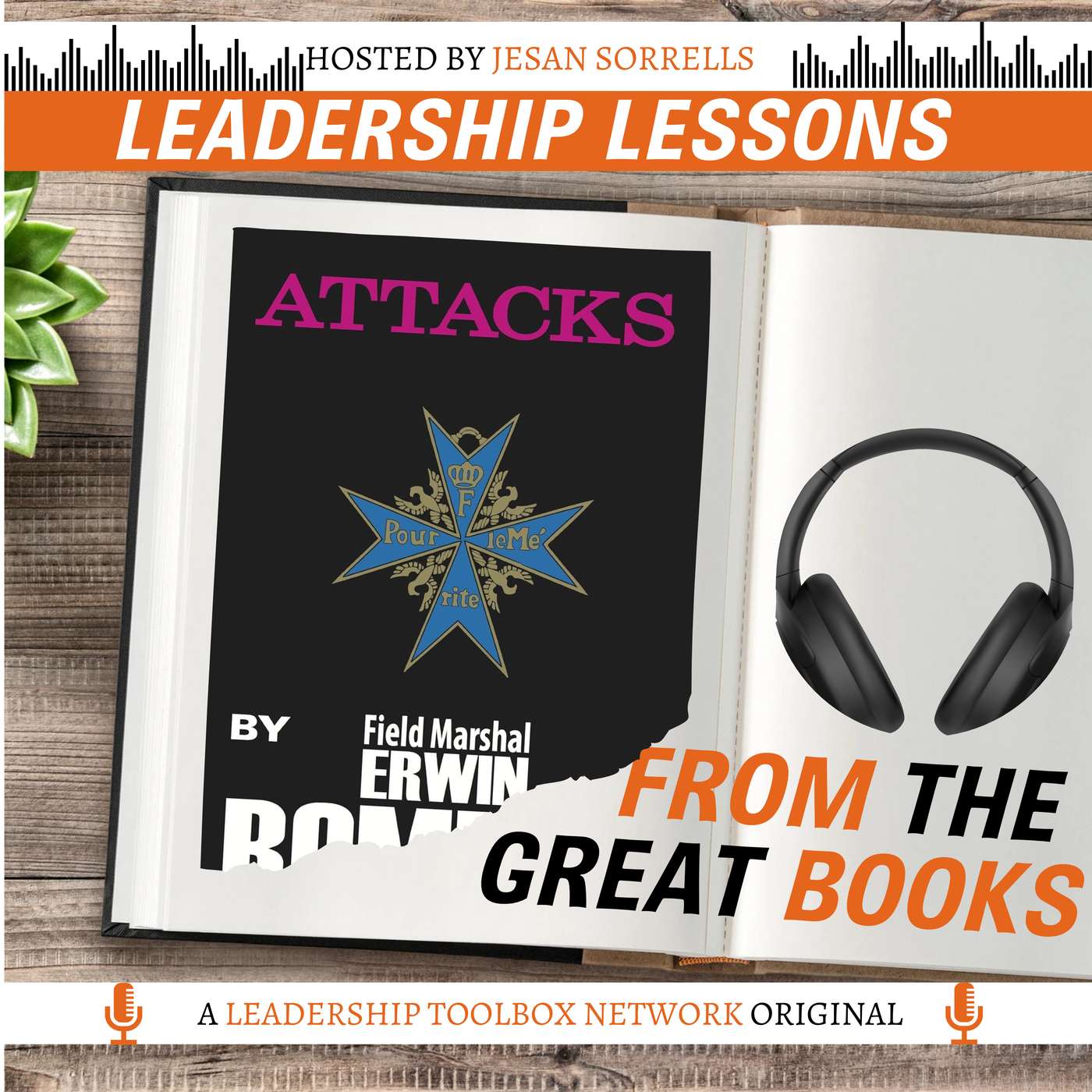
Infanterie Greift An. (Infantry Attacks) by Erwin Rommel w/John Hill and Jesan Sorrells
Infanterie Greift An. (Infantry Attacks) by Erwin Rommel
---
Examining what leaders in business and civic life can learn from Erwin Rommel’s classic military account, Infantry Attacks, this episode dives into the value of tactical thinking, the reality of self-selection in civic engagement, and why direct, “boots on the ground” leadership outperforms over-reliance on technology. The hosts challenge prevalent objections to leveraging military strategy in the business world, shed light on the pitfalls of single-issue focus, and discuss how excellence in any domain demands courage, humility, and willingness to do hard things. Key insights are illustrated with both historical context and modern management parallels, making the lessons actionable for today’s leaders.
- Book: Infantry Attacks by Erwin Rommel
- Guest: John Hill (Small Mountain)
- Host: Jesan Sorrells
---
Time-Stamped Overview
---
00:00 Applying Military Strategy to Business
07:09 Discussing legal vs. illegal immigration
13:07 Discussing intelligence tests for voting in elections
17:22 The peril of single-issue voting
24:09 Reflecting on underlying issues
28:01 Understanding customer desires in sales
36:54 Military career and controversies
41:28 Discussing a compelling book choice
48:52 Aggressive training mindset shift
53:10 Impact of WWI on Germany
55:49 Comparing business to martial arts
01:01:03 Comparing Patton and Rommel's leadership
01:09:52 Criticism of Sales Leadership Practices
01:16:21 Traits of Successful Salespeople
01:17:50 Measuring true progress and success
01:26:03 Drone operators and military tactics
01:32:47 Discussing societal and personal cowardice
01:35:23 The book's mysterious disappearance
---
- Opening theme composed by Felipe Sarro - Bach - Silotti - "Air" from Orchestra Suite No. 3, BWV 1068
- Closing theme composed by Brian Sanyshyn of Brian Sanyshyn Music.
---
- Pick up your copy of 12 Rules for Leaders: The Foundation of Intentional Leadership NOW on AMAZON!
- Check out the Leadership Lessons From the Great Books podcast reading list!
---
- Subscribe to the Leadership Lessons From The Great Books Podcast: https://bit.ly/LLFTGBSubscribe
- Check out Leadership ToolBox at: https://leadershiptoolbox.us/
0:00 Hello, my name is Jesan Sorrells, and this is the Leadership Lessons from the Great Books podcast, episode number 204. Opening up with, with our book today, I want to read a little bit from the very first chapter, some observations that the author of the book had when he was engaged in a war of movement in Belgium and northern France in the year of our Lord 1914. And I quote, observations facing the enemy, the reconnaissance detachment commander becomes conscious of his heavy responsibilities. Every mistake means casualties, perhaps the lives of his men.
1:00 Therefore, any advance must be made with extreme caution and deliberation. Taking advantage of all cover, the detachment should keep off of the roads and repeatedly examine the terrain with field glasses. The detachment should be organized in considerable depth. Before crossing open stretches of terrain, fire support must be arranged for. Entering a village, advance with part of the unit on the left, the rest on the right of the houses and with fingers on the triggers. Report observations rapidly, for delay lessens the value of any information.
1:33 Train in time of peace to maintain direction at night with the aid of a luminous dial compass. Train in difficult trackless wooded terrain. War makes extremely heavy demands on the soldier's strength, and nerves. For this reason, make heavy demands on your men in peacetime exercises.
2:00 Rommel, you magnificent bastard. I read your book.
2:11 Applying the lessons from military strategy and tactics to solving business problems is usually objected to by people in business for one of two main reasons. The first is that people in the civilian world are now, in the year of our Lord 2026, largely ignorant of the discipline, focus, and grit required to execute tactically in an environment defined primarily by violence and death. The second objection is that people in the civilian world are either unwilling or unable to subject themselves to the discipline, focus, and grit required to execute tactically in environments that feature just a little friction, much less the friction on a battlefield.
3:01 So the critics think, and concludes, what possible lessons could a leader in a civilian space glean from studying the tactics and strategies military commanders have recorded in their writings throughout history?
3:17 The core idea inherent in both objections is that there exists somewhere a field of study from which leaders cannot learn, or even worse, that there might be a field of study that leaders can safely ignore because the nature of the field itself may be unsavory. The people who have engaged in tactical practices in that field may have questionable ethics, or that the air of civilian life is so rare. And this is the one I think that drives most of us, that it does not require suggestions of improvement from the pedestrian.
3:48 Or even the banal. We reject the assumptions that exist under these ideas on this show, however, and we prove the continued commitment to such rejection every October and November when we read and glean what we can from books that address military strategy and tactics, like the book we're going to read and we're going to examine today. So today on the show, we will extract lessons for leaders from what is quite possibly one of the best books I've read in a while that pulls lessons from battle that can be applied to civilian business problems.
4:29 Infanterie greift an, or if you're going to do the English, attacks by Erwin
4:41 Rommel. Yes, that Erwin Rommel. Leaders, tactical thinking is what we are missing in so many areas of society and culture. And the best place to understand, or at least to begin to understand tactical thinking, is in the space of military strategy and tactics. At least that's what I think.
5:04 And back from episode number 203, the last episode, Uh, where we covered Neuromancer by William Gibson, where I left, uh, I left him hanging without an answer to the following question: should there be like some sort of intelligence quiz to vote to participate in these ideas that have such a big, huge impact on our day-to-day lives? Coming out of our observations about Robert Heinlein's 1959 military science fiction novel Starship Troopers, where the fact that government service most often military service, was a prerequisite to the right to vote,
5:43 is our now, I think, semi-regular host. I think you're a semi-regular host now, coming in back to back. John Hill, AKA, of course, Small Mountain. How you doing today, John? You're back. How you doing today? Dude, I'm good. Um, I, uh,
6:03 I had to create some space because you did leave me hanging last time, right? So I kind of forgot that, uh, that you did leave me hanging in such a profound manner, um, because like I had to go write in my journal about it, um, because I don't like open loops. So I don't know if we're gonna dig into this in this episode. We're gonna get to close this loop or not. Yeah, we're gonna close this loop. We're gonna close this loop right now. That way we can start clean with Rommel. Rommel would want us to close the loop.
6:26 So you want us to close the loop? Finish. He would want us to close the loop. He would. It is— well, it is a maneuver. Yes. Um, he would call it a defilade and retreat while fighting the Romanians. Um, okay. So should military— should there be sort of some sort of intelligence quiz to vote? So the answer to this question, at least from my opinion, is when you ask about intelligence quizzes to vote, now you're getting into the long history of poll quizzes and African Americans not being able to vote in the South under Jim Crow.
7:01 And so there's a lot of history underneath that question, and it's weighted with that history in an American context. You also have on the other side, as we are currently going through the royal in our country, as are people globally about immigration, you have the fact that when people legally— and yes, I am using this term as a distinction with a difference— legally migrate to the country and stand in line, and I know many people who have, when they do that, they have to take a test, a citizenship test, in order to participate in a democracy, which is what we claim we have.
7:40 By the way, when people illegally migrate to America by either jumping a border or coming over in a, uh, in a shipping container, like in the Port of LA. They don't do any of that. And because we have an open society, they're not allowed to vote. They are not allowed to participate in civic life, but they are, weirdly enough, given Social Security numbers and they are given benefits by states, some of which will remain nameless. Okay. So we have those 2 twin poles that vibrate in the national character around this question that you asked.
8:18 Then the other dynamic we have Is the concept of an IQ test. So IQ research—I don't know if you've ever researched IQ IQ findings—but the military actually has done a lot of research, particularly coming out of World War II and in Vietnam around IQ. And IQ research is brutal. It is utterly, completely demoralizing when you read it because what you realize is. most things are not about race or class or even social status beforehand in a person's life. Most things are about how much— and I frame it this way— how much horsepower a person has.
9:00 And then after that, all the other things just sort of come forth. And when you are thinking about a country that is as utopian as the United States, both conservative utopian and liberal utopian, it doesn't matter. We both operate underneath the same sort of Mindsets about how to how to create how to create heaven on earth here. The fact that some people are born with less horsepower than others disturbs us greatly, and we don't know what to do with it. So we just kind of it's like a little hole in the boat.
9:30 We just kind of ignore it, and we pretend that it's not there. And we do a whole lot of pretending by with education, with culture, even with racial strife, poll taxes, tests. Like my kid's going through standardized testing right now. She's gonna take the ACT, right? That's going to be a measure, whether we like it or not, of how much mental horsepower she has. Yeah. Now, part of that is— can be, can be, uh, what do you call it? Um, uh, well, it's the old argument of nature versus nurture, right?
9:59 So we have IQ, we have racial history, and we have immigrant history that goes into the answer to this question. So with that context, I'm going to answer the question this way. Should there be some sort of intelligence quiz to vote? Yes. Yes, there should be. And the reason why I say this is not because I want to keep people out, but because we already have an intelligence quiz to vote. And about 50% of the people in the country, and it's an increasing number going, I mean, going every year on year.
10:35 And I'm just gonna look at the presidential elections alone, an increasing number of people self-select out because they don't have the horsepower to keep up with the issues and the intricacies and all of this, or they don't have the interest, which is also driven by horsepower, to care about the issues. Yeah. And so it's a brutal question, and Heinlein got into it in Starship Troopers, um, but I get into it from the perspective of We already have it. So what are we— why are we pretending we don't?
11:16 And this is such a fascinating thing, because like, as soon as you're talking about some of these things, and I'm like, oh, yep, of course, we have— we've, we've done versions of this for the wrong limitations, right? And so then I was like, oh, yeah, of course, there has been really biased tests, or maybe the tests are only given to like certain people, right? But, um, yeah, I mean, uh, to, to me, there's a whole book— the whole thing— sorry, there's a— sorry, there's a whole book that we're going to cover at some point called McNamara's— like, it's like McNamara's Idiots or McNamara's Morons, where the Army basically decided after IQ testing from the '50s at the end of World War II all the way through the '70s that there were certain people that just— they were never going to take in the military.
12:13 Oh, interesting. Based on IQ research. And it's called McNamara's Morons because it really hit, hit in like the '60s and '70s with Vietnam because there was a draft. And so everybody had to go into the pool regardless. And, and the military was already integrated, had been integrated since the '50s. Truman did all that. So it wasn't an issue of race. It was an issue of horsepower or IQ. And the Army— say what you want about the US military— the Army was ridiculously brutal about this, and they just tested the hell out of it.
12:46 And at a certain point— and this is the reason, one of the reasons also why the Pentagon no longer wants a draft— they don't want people with low IQ, quite frankly.
12:57 Coming in. They'd rather have volunteers with high IQs. Yeah, absolutely. Right. So anyway, sorry, sorry. That's just a side note to that. Yeah. No, like, to me, the thing that always is hilarious is whenever I see a clip of someone who's interviewing just people on the street about the same questions from the immigration exam. Right. I'm not saying we need to go create a new exam or anything, because since we do already have one that is the standard, You know, we should— hey, before you walk in here and pull these handles and fill out these things, right, how many senators are there?
13:36 Oh, I have no idea. Okay, like, you know, like, there is a— like, and, and I've seen some stuff, and I've not researched this too deeply, about like how some— like, the whole formulation of IQ has been biased and loaded and different things like that. And, you know, but there is Capacity of this thing, right? And I really appreciate how you talk about it. Like, I do think some people have an affinity for this stuff and they like it, and then not everybody does, and that's totally okay. And so I think that that capacity has to be there because, you know, some of it is just preferences, right?
14:10 Some people don't want to spend their time reading really old books or looking for overlap or however these things are. I can totally respect that. I'm not saying that I don't want those people to vote. I like— I'm trying to get the people who don't know their head from the hole in the ground, right? And are just on the receiving end of a constant line of rhetoric. And they're just going in and just, well, red or blue, just straight down the column line kind of thing. There is no discerning thought.
14:38 That's the thing I would love to, like, not have personally. Well, and you and I both live in Texas. And currently, I'm sure you are receiving as well as I am endless text messages from candidates. Oh my God. So I like, I'm a sales guy and a business owner and marketing is a thing I am trying to get better at every day as a business owner. I loathe, I loathe all the text messages, all of it spamming. And because like, you know, at least from like a domain, I can go look up the domain and figure out who it is from a cold email perspective.
15:15 This can spoof numbers. Like, random people that spoof numbers for their outreach and stuff like that. So half of this stuff, you can't even tell if it's real or valid. But I'm getting 5 to 7 text messages a day, and I'm not signed up on any of these lists. Right. And I'm getting stuff from lists I wasn't even like— and I'm relatively politically active. Yes, folks, I do put my money where my mouth is. But at the same time, like, I'm getting things from people that I've never even— I've never even expressed an interest.
15:43 I've never even clicked on anything that even interested that I would even Well, I say that to say this. I was talking with somebody. I was at a jiu-jitsu tournament actually this weekend. We talked a little bit about that too. Actually worked out really well. I was coaching at a jiu-jitsu tournament, coaching kids, and I was talking to one of the other parents who's the wife of the owner of the school that I go to, and she's a single-issue voter. And then the other— the other coach who was there, one of the other coaches who was there, is also a single-issue voter.
16:13 And both of their issues are, of course, in the opposite direction as usual. And they are both ground into those single issues. And I— you would— you would love me. I literally laughed at both of them and I said, God bless the single-issue voter. I mean, God grant me the confidence of the single-issue voter. It's like, God grant me the confidence of a blue belt. You know how they say that in jiu-jitsu? God grant me the confidence of a blue belt. And I looked at both of them and said, God grant me the confidence of a single-issue voter.
16:39 Oh my God, you're going to bet everything on this with either one of these people, and then everything else is just going to be like away. Okay, that's fine. That's, that's fine. That's fine. And I just walked away because I couldn't, I couldn't handle the conversation anymore. Such a fascinating thing because I've never, I've never— And by the way, I get it. Like, I understand why people are single-issue voters. I get why. And at the same time, most politicians are not single-issue politicians.
17:07 They never are. They never are. And whatever your pet peeve issue is, and I'm not going to name any issues at all, just pick one out of the, out of the basket of things you've heard about. I guarantee you that politician does not care about it as much as you do. Not even close. Oh, yeah. Like, that's so— it's interesting because I've never really thought about this concept of, like, the single-issue voter as we're sitting here talking about it. Right. Because, like, hearing that term single-issue voter, part of me is like, it's like, okay, Like, are you trying to find only one thing that you care about, or is it like this one thing is such the big deal on top of the pile to you and stuff like that?
17:46 And, and, you know, I think that's such an interesting concept because like, do you just not know how the rest of the sauce gets made? Like, like, and, and I'm not trying to say it negatively or anything else like this, but it's like, it's like, do you think that the other points that other people do care about, like, don't matter, or they just don't care about to you, or different things. But yeah, the idea that, like— now, here's the thing. This is also kind of fascinating, right? Because, like, the label is not really the person, right?
18:17 Because, like, the people that are like, hey, I only care about immigration policy or war or religion or different— like, these are single-issue voters, right? Mm-hmm. They're— but yeah, that's an interesting thing because like I know a lot of people and they're like, well, I only really care about this, you know, kind of, kind of people, right? But I would imagine they don't see themselves as single-issue voters. They'd probably get a little offended even at that label. So the wife, the owner, the wife of the owner, she got so mad at me, she wouldn't talk to me for like 15 minutes.
18:53 She just got mad at me. I was like, And that's literally the sound I make. I don't know what, what, what. Like, number one, when, when, and this is just sort of a standard I have, when, when other grown men or grown women get mad at me, number one, with grown women, it's like, I'm not married to you. So like, we're on an even playing field anyway. Like, I'm not, I don't have to like live with you. Like, it doesn't matter. Like, we're just 2 adults having a conversation. If you're mad, well, that's a you problem, not a me problem.
19:22 I didn't say anything that you— I didn't say anything that was offensive. Now, if I do say something that offends, I own that. But if I don't say anything that offends, if I just say something that's a fact, or I say something that I think is funny, like humorous or whatever, then like, oh, okay, you got offended. I don't know, deal with it. But then like, if it's a grown man, and in general I'll have a different sort of— there will be a different sort of approach there. By the way, the guy, his single issue was so far, again, so far away from hers.
19:49 It was like night and day. He started laughing and he's like, oh, I'm still going to do the thing that I'm going to do. And he just walked away. Like, so 2 different people, 2 different responses, right, to this.
20:01 I will say that over the course of the last 20— no, I mean, I've been following politics in one form or another since I was 15 years old in this country, in various states and municipalities and places I've lived and all of that. And everywhere I go, there are single-issue voters who are rabidly, emotionally— and this is the keyword— emotionally committed to a position, and they cannot see anything else outside of that issue. And again, I'm making this very bipartisan. I want to be very clear, this is very, very partisan.
20:33 I don't care whether you're right or left. I've talked to libertarians, I've talked to socialists. Oh my God, the single-issue people, God bless them all. God bless you. But in a democracy where you're supposed to be informed, and this gets back to should there be a quiz to vote, you're supposed to be informed on a broad range of issues, not just one narrow one. Yeah. If we give you a test and you don't know anything about If you can't figure out contextually why terrorism and gun control and drug policy and, I don't know, LGBTQ race things— if you can't figure out how all this stuff clicks together, I'm worried.
21:15 And by the way, many people self-opt out. I want to be very clear. Many people self-opt out because they can't figure it out, which reveals how little horsepower they have without a test even being done. That's fair. Yeah. I'm fascinated by this idea though, because like, I wonder, I wonder if the, the more you hold a torch for that, for that single top line issue, the more, the more likely it is that you are going to be emotionally invested in it, like, like to the point of fanaticism, right? Because one of the lenses that I have over here on my, on my board behind me, like things that I try to use and look through with my client work is like, if I can't find the elephant in the room, right?
22:00 And usually as a sales guy, the elephant in the room is like, hey, you might be just fine. You might not need any changes. Everything could be hunky-dory. I don't know enough yet, right? If you can't find that lane, you are going to be the feverish acolyte. And then you get, you get tossed out. You don't get the trust. You don't get any of these things. All your questions look like bear trap questions and everything because— You can't even show up with an understanding like, hey, maybe some people don't need HubSpot.
22:28 Maybe some people are just fine on spreadsheets, right? Like, hey, maybe, like, and if that's not okay with you, you're, you're going to be the zealot. Just how it should be. If you can't spot the sucker at the table in the first 5 minutes, was this from Rounders? I love that. You are the sucker. I mean, you're the per— you're the one. And there are so many zealous people. And don't get me wrong, I, I want to be even clearer. I have been zealous in my time for single issues. This is how I know it's a problem.
22:58 This is how I know, right? I have been zealous for single issues. I have been emotionally unable to disconnect my personal emotional feelings about an issue from a larger hierarchical scale idea, right? And that is a huge trap that people fall into, but I don't even think they recognize it as a trap. Yeah. If I am opposed to
23:26 banning books in the public library, let's just pick one. Okay. Mm-hmm. All right. Which, it's a book podcast. This is an easy one, right? Most people who listen to this show or know me would be like, oh, well, he's— of course he's going to be anti-pulling books from the library. And 20 years ago, yeah, I would have absolutely had a knee-jerk reaction to that. When someone brings me a single issue though like that, it says sign up for this so we can impeach these people or get these people out for taking out the books, or oh my God, sign this thing so we can sign this petition so we can get these people out who are putting in the books.
24:05 Okay, either one, because both sides can both get signatures. Oh yeah. Okay, now I have to sit, and this is the wisdom that comes from time maybe, I have to sit with this and go, what's the real issue here? That's number one. What's the real battle that's happening? Is it really about the book coming in or the person coming out or whatever? Is it really about that? Or are there other underlying things that are here that a politician sees but doesn't say anything about, or a policymaker sees and doesn't say anything about, that they will then use to do something else?
24:42 And what is that something else? And I'm doing this on all kinds of issues. So I don't sign the petition because I don't have an opinion. And that's like, as I've gotten older, like, it sounds like if you listen to the show that I have an opinion about everything. I have a lot of opinions about a lot of things. I don't know if they're good or bad. I just have opinions. That's why I have a show and that's why I write books and do all the things I do. And I have no opinions about a lot of things. And that's okay.
25:08 It's fine. Does that sound like I'm knocking the no opinion, I don't know where to vote people because they're not single issue? No, I'm just saying you want to participate in a demos. You want to participate in a democracy, you should be tested on that. And if you fail, or if you don't meet whatever the minimum standard is— now, of course, we then get into who determines what the minimum standard is and how do we, you know, all those kinds of— the devil's always in the details. Um, and invariably it will be congressmen that determine— invariably it will be congressmen that determine what the minimum standard is.
25:40 Yeah. That benefits them. It will always be them. Um, but the question of should we actually have the thing Yeah, because it's a public acknowledgment of something we're already all privately doing and are just hypocritical about.
26:02 Say that again. We're already giving ourselves an internal test, and we are either opting in or opting out based on our own internal test, and then we're hypocritical about it because we say, oh no, there should be no testing because that's unfair or biased. Okay, I'm with you now. Okay, we're already there. Like, we're already fully in the— to me, we're already fully in the cul-de-sac at the end of the path. I, you know, so let's just say— and, and as I also have gotten older, I've gotten more and more into the just say the thing.
26:37 Just say the thing that's the thing. Just say it. Why are we shading it? Why are we hiding? Which is why I'm, I'm not— I mean, One thing, when they struggle with sales, I'm bad at sales because it's like, you're gonna buy a yellow car anyway, so just pick the yellow car. Just go buy it. Just go buy the yellow car. In what way, shape, or form does that make you bad at sales? Um, because I'm not— I'm unwilling to do the, the, the influence, pull along, tug along, draw along, drip thing, that, that kind of stuff.
27:12 Yeah, all of that. Hold on, I'm not going to turn this into a coaching session, but like, why, why is— why, why is your opinion that that's the job? Well, it's because I've been told that by other people. It's actually really not my opinion. I've been told that by other people. You're talking to people who don't understand the job, my friend, right? These are the same people that come to me and they're like, they're like, hey, can you get me someone who can like close all the deals? And I'm like, do you want a magician?
27:36 These— well, these are also some people who I am, uh,
27:42 Engaged in a lifetime commitment to have given me that feedback.
27:50 I mean, I mean, this is a fascinating conversation and— It is not. Yes, it has nothing to do with the book. You might need to come on my show so we can talk about this a little bit more. Yeah. But it's like, like if, if you really want a yellow car, like I really want to know why yellow is so important to you. I would love to understand that. But like, If I don't have a yellow card past that point and I can understand that this is there and it feels like you're familiar with the fact that like it's going to be hard to clean and you're familiar with the tradeoffs, every, every salesperson with their salt, they don't have a yellow card.
28:21 They just leave. Now it's everyone else playing at sales thinking they know what the job is, especially when they don't have to do it anymore. And they can just give someone else a bunch of like make busy busy work and go pest everyone else around and everything else like this. Because like, now that I'm not doing this anymore, you should just be so excited to go take over the world and have endless confidence. and waste your time and everything. And then like, why aren't you at gold? Because you didn't want it enough.
28:44 Like this, this is, these are the talk tracks from people who should not be giving anybody sales advice at all because it's, it's things, it's, it just reinforces the stigma. You got me a little excited. Put that down as a mark. We'll mark this moment. We are, we are, we're, yeah, we're like 20 minutes in. We'll mark this moment here. Just, just edit this part out.
29:09 Cutting room floor. We're keeping it all in. I don't cut. Keeping it all in. It's fine. All right, let's talk about the book. So I answered the question, I think. Yes, there should be a quiz. And yes, things have a big, huge impact on our day-to-day lives. And I think that people self-select out already. I think they give themselves that quiz and then they just automatically opt out. I think an actual manual quiz itself would make it really sharp for people. Now, what people would do with that sharpness, I don't know, because people are all over the place.
29:40 I think some people would rise to the challenge. And this is where I do have faith. I think that some people would rise to the challenge. So wait a minute, hold on. I was listening to an old-time radio show. This is the last thing I'll say. And a PSA ran for voting in the next presidential election. It was from like 1955. And the statistic that it gave was that less than 60% of the available voting population voted in the last presidential election, do your part. And I thought, holy crap, that number hasn't shifted since 1955.
30:13 Because guess what? It was the same back in 2024.
30:20 Interesting. That's interesting. So I have a question philosophically for you at this point. Yeah, because I am, I am myself. Okay, because, because I hear a statement like that, and part of me just starts like spinning, right? And so Part of me is like, okay, great, it hasn't changed. And then I'm like, okay, is that okay? Should we be putting effort proactively in so that way we're pushing that number up because we deem it as important to get an actual representative vote? Because I would say that 60% of our total population, like, only participating in these things is not an actual representative kind of like vote.
31:00 So is, is the thing like, oh, okay, cool. We're just level, so things aren't really getting better or worse because it's just level, or should we be trying to get more people to be voting? Like, like, what is Hasan's philosophical bent at with this idea? I think we have tried literally everything in the last 80 years to get more people to vote, with the exception of— well, and we've even tried this. We've tried dragging people out of their houses and putting them on buses. Like, we do that all the time.
31:30 We've tried literally everything. The only thing we haven't tried, because again, we have history with testing that's negative. The only thing we haven't really committed to trying is testing. We haven't committed, really committed to that because it feels icky. So case in point, when George Washington was running for president, I think the second time, if I remember correctly, because it was after the Shays' Rebellion. where all the old veterans were like, we don't want whatever it is they didn't want.
32:03 It was a big deal. It was a big deal, right?
32:07 And Washington's folks, and I think Jefferson ran against him the first time, if I remember correctly. And if I don't, correct me, folks. But whoever his opponent was, it was standard practice to put people on wagons take them to the pub, have them drink, and then take them and tell them where to vote. Like, that was standard practice. Wow. We've been dragging people to the polls since the beginning of this country, and it hasn't moved the needle. We've already tried everything except for the one thing that makes us feel icky.
32:48 And I see this, by the way, in conflict management. People will try everything to resolve the conflict except for the things that make them feel icky, because the things that make them feel icky are the things that actually work. But they can't get past their feelings about them. Preferences, yeah. They can't get past their preferences. And so I will have somebody come to me in the space of negotiating a conflict, and they will say, well, I've tried everything. And I will say, really, have you? Have you tried everything?
33:15 Because— and then we run down the list of things they've tried, and then I present all the other things they haven't. And they go, well, I haven't tried everything. And I go, I know, go try these things. Well, I feel it might make me feel better, make the other person feel better. And it's all the excuse, the Excuse piling up begins to happen. And I know you see this in sales. And at the end of it, you're like, well, do you really want to resolve the conflict? Do you really want to close the sale?
33:42 Do you really want to vote? Or do you just want to make a bunch of excuses?
33:47 Yeah, 100%. Like, I can't tell you how many times in a sales conversation where people are like, man, how do I close this deal? I'm like, well, you know, I'll do anything. I'll do anything to close this deal. How do I overcome this objection? Okay, well, first of all, what'd they tell you was the real problem? Well, John, you don't get it.
34:07 Well, okay, I think we're done. Right? Because like the most powerful thing you can do is like, hey, kind of sounds like maybe we— you don't need my help. I'm not really doing anything here. And that's totally okay. Is that where we are? Like, should we save the extra 25 minutes in this hour-long meeting? And I'm happy to give you some focus back. It doesn't feel like you're doing anything. It looks like my research was off. Is that, is that, is that real? You get to have a real conversation. And then if they're like, hey, I don't think you have yellow cars.
34:37 You know what? You're right. I don't have yellow cars. Like, sounds like that's really important to you. Why is it? Oh, that's our brand color. Oh, okay. Interesting. It sounds like it must be super important to you. Interesting. How do you get the budget to pay for the yellow cars? Like, I mean, we're still gonna have a delightful conversation, right? Right. People are just too zoomed in, right? And they don't want to fail, right? And I love how you're talking about this because it's, It's not the uncomfortable, it's like the things that make you feel icky, right?
35:03 If it makes you— if it— and this goes for, for us too, right? If it makes us feel icky, I'm gonna have to sit with for a second, right? And really kind of like look through a couple of lenses. Is this compromising you? Does this go against other things? But if it doesn't hit those big marks, I'm gonna try it before I judge it, right? Yeah. At least now in my older state, right? Whenever I was younger, I would come up with a whole list of excuses about why something wouldn't work because it was gonna to be hard or challenging before I'd even taken any positive action to go do it.
35:30 Meanwhile, I'm over here playing poker and, you know, trying to get really good at kung fu and just getting stomped over and over and over and over again and still getting a little bit better. And that's enough, right? So the biggest hypocrisy is that it's really okay in certain lanes, but abhorrent, and we can't even try in other lanes. Right, right. And maybe this is— well, this ties into our book. So let's— I mean, I opened up our episode today, if folks are still listening, now that we've gone through, you know, almost 30 minutes of the other conversation at the other end of the other episode.
36:07 You know, when we think about a guy like Rommel, okay, so Field Marshal Erwin Rommel was born in 1891, November 15th, 1891. Coming up here in about a month will be his birthday, the anniversary of his birth. And he died by suicide in 1944. He was known as the Desert Fox, and he was a German field marshal in World War II, probably the least political out of all of Hitler's field marshals. You read his book Attacks, which, by the way, he wrote in 1937 as the National Socialist Party was beginning to make its move really intentionally.
36:54 I mean, they started in the '20s, but they were really making their move in '30s. And so he wrote and published this book where he described the tactics and experiences he used in World War I to overcome and to defeat the Russians and various folks on the Eastern Front, and then also some, some of his Western Front activities.
37:19 He was implicated in 1944 as part of the Operation Valkyrie plot, to assassinate Hitler. And it's not really clear how much involvement he actually had with that, or whether he was just a name that people threw around because, you know, he was considered to be a good, quote unquote, German or good National Socialist.
37:46 His, his, his actions in World War I earned him the, the Pour le Mérite for his actions on the Italian front, which was like the highest honor you could get in, in World War I. And he,
38:05 he was able to parlay that into continuing to be engaged with the German military in the interwar period between the end of World War I and the beginning of World War II. As a matter of fact, he was He led several brigades and divisions, divisions with several brigades and troops into Berlin, actually, to put down riots. And he was called to put down riots of workers and former soldiers. And according to the history that I read, never once in any of those attempts, not attempts, but never once in any of those times where he actually had to put down people that he had formerly served with who were rioting in Berlin and other places in Germany during that interwar period, never once did he fire a shot.
38:50 He was able to actually talk people out of, you know, doing whatever it was they were doing. I think the guy was probably solid. And I don't mean solid in terms of character, although I think he did have that. You could read his book Attacks, and you see his character come through. I think the guy was just a solid human being who loved war. Like, that was the thing he was good at. And there are people who we've covered on this show where the thing they were good at was war, and they weren't good at anything else.
39:21 So Grant is the— Ulysses S. Grant. If you read about that guy, like, he failed at everything else, even the presidency, even the presidency, which was hard to fail at in the 1880s and the 1870s. Like, it was really hard. And he failed at that. He was no good at it. And he knew he was no good, by the way. But he did it because that was the next step thing that you were supposed to do when he was popular. And so how was he going to turn that down, right?
39:50 But Grant was like that. Sherman was like that. We're actually going to cover the book Empire of the Summer Moon about the Comanche coming up here with, with Tom Libby in our next episode. And Sherman was the guy that the US military threw with the Comanche. And Sherman knew exactly what it would take to break the Comanche. And he was very sorrowful about it. And he said, there's no other— just like with the burning of Atlanta, there's no other way we're going to be able to do this. And so it's gonna suck, and we're gonna do it anyway.
40:20 Rommel was in that line of those kinds of guys who had character all the way through, but understood that— they understood the tragedy and the triumph of war. And I don't think Rommel wanted warfare, but if warfare was going to come, he was going to be as excellent and as tactically brilliant and as strategically well-placed as he possibly could have, as he possibly could be, regardless under whose regime that war was going to run. I think you could take a guy like Rommel and you could put him in the Turkish army or the Russian military or the Japanese or the Brazilians or name any other military force during World War II, and he would have been the exact same guy.
41:04 And that's rare in warfare. I don't think you, you run across guys like that too, too often. Um, I was kind of surprised when you picked this book to read, another one just like Ben-Hur. It's like, oh, okay, I guess we're gonna do— I guess we're gonna do this. Um, what drew you to thinking that this might be a book that you would wanna— that you would wanna talk about? Um, honestly, uh, the name stood out, you know, because you, you shared the list of what you were going to read, and so I was like, oh, well, that would be at least interesting, right?
41:40 At least some— sometimes I just like to read things that force a perspective that I don't really think I could get to through any other. Because like, you know, I can sit and I can think and I can, okay, let me try to put myself in that person's shoes and stuff like that. But when it comes to this stuff, like, there's just a, you know, there's a limit to how far I can go for that stuff, right? And so like going back to reading these kinds of books and everything is super helpful for like forced perspective, right?
42:06 And that really drew
42:11 that to me on this thing. And to your point, like, it's such a— I love how you're talking about this because like, as I'm reading through this book, like, I'm kind of having this moment of like, this guy is just—
42:24 he like, he just wants to be the best that he can be in whatever his lane of greatness is, right? Mm-hmm. And I love how you're talking about that because like, I like, you know, there's some turns of phrase and we'll get into that here in a second. Um, but like, I was like, this guy would perform under anybody. Like, you know, like, oh yeah, he would, he would be a high performer. He would be someone we were hearing about no matter who he was serving under or what his thing is. Because, you know, um, someone said this about someone I worked with once, you know, 'cause he was like a top performer on the sales team and they're like, that guy's just gonna be a top performer anywhere he goes.
43:00 Yeah. It doesn't matter. Mm-hmm. He's just gonna figure it out, right? Mm-hmm. That to me sounds very much like, like Rommel, right? And to your point, like, I think, I think when they're trying to make a, like, a movie and the archetype is military, right? And they're trying to give him that, like, hey man, you're just, you're not that guy. You just, you just really want to be. I think, I think that Rommel is essentially the stereotype that they're trying to shoot for in that thing because He just wants to be tested.
43:29 He just wants to see how good he can do, right? But it seems like he is passionate about his, like, nation, but isn't really drinking all of this other Kool-Aid, or at least in, in, in this stuff here. Like, I don't know how much that changed after and stuff like that. So it's interesting, and I want to pick up something from the book here, from chapter, from chapter 3. But in chapter 1, right at the beginning, he says something, and I underlined it because he lays out, you know,
44:06 how he got to the frontier, right? How he got to— how he got to— oh, where was it he was going to? Yeah, Belgium and northern France, right? Right at the beginning of the war. And there's this great line in here, right in the very first chapter. He says, Early on August 19th, we moved to the southwest, passed under the cannon of the French fortress at Longueuil, and bivouacked at Dahlem. The first battle was near. My stomach gave me a great deal of trouble, and even a chocolate and Zwieback diet brought no relief.
44:36 And this is the line I underlined. I would not report sick, for I did not want to be looked upon as a shirker. Yeah, very much a thing. And I looked, I thought, I underlined that. And we've covered, and I'll kind of lean into this. John Keegan's First World War. We covered that with Tom Libby. Go back and listen to that episode. But Keegan is British. And so of course, he wrote the book from a British perspective, where he basically pumped up the French. He was sort of as even as he possibly could have been to the Germans, and then stared in puzzlement at the Russians and whatever the heck they were doing.
45:12 So I get it, like, I understand from a British perspective. But you read this and you realize And this was my stunning realization. The Germans might just have just been better at war in World War I. And that's what scared the hell out of everybody. They just might have been better. And you see it. And this is where I pick up in chapter 3,
45:34 where when he's talking about combat in the Argonne in chapter 2, and then he goes to the battle in chapter 3 of positional warfare, the war of movement in Romania. Everything comes down to— it comes down to how he observes and how he thinks. So in the very first battle, the occupation of Hill 1794, so I want to read this.
46:03 Observations. So he goes through the battle, he describes it in detail. He describes what he's doing with the Württemberg Mountain Battalion going into the Transylvanian Alps. By the way, weirdly enough, I'm also reading Bram Stoker's Dracula. So this is actually like a weird sort of overlap here. It's very interesting. Um, but observations. The occupation of Hill 1794 showed how high mountain weather can influence the efficiency and resistance of the troops, especially when the equipment is not suitable and complete and supply fails.
46:34 On the other hand, we saw what the soldier can endure in the presence of the enemy. Under certain circumstances, dry wood or charcoal must be furnished for troops living at an elevation of 6,000 feet. A few days later, on the southeastern slopes of the Vulcan Mountains, we were heating our tents with small charcoal fires built in suspended tin cans. Close quote. How do you beat people who are willing to do that? And that's the thing the French couldn't figure out. Like in the first 2 chapters, when he's describing what's going on in France and Belgium, the only solution the French have for the problem of the German military in World War I is they're just going to drop ordnance on them from the sky and hope to kill as many of them as possible.
47:14 And all they did was dig in. And even Keegan points this out in, um, in the First World War. They, the Germans figured out that if you dug the trenches deep enough, the, the ordnance wouldn't get to you. Mm-hmm. And somehow the French struggled to figure this out until like midway through the war. And the French were, I was saying this to somebody on Sunday, the French were the Germans' nearest near pure competitor on the continent. And they couldn't get close to the Germans. Well, it's interesting because like part of me, okay, this is such a fascinating kind of perspective, right?
47:50 Because like for anybody who's listening to this, right, I am prior service. I joined in 2001 before 9/11. So I've never deployed. I've never had to go anywhere or anything else like that. So this is with a lot of space not colored in by actual personal experience. Um, but the training that I went through
48:12 was— it was filled with guys like that. There was just like this joy and glee, right, of the hardest training you could possibly imagine, right? Like, they would talk about they wanted it raining, they wanted it wet, they wanted it garbage weather, because like that meant now we're really training, right? And we're all like But wouldn't it be better if it wasn't like wet, if it wasn't like water up to your knees and the foxholes and everything else like this, right? Like, and we're like, why don't we want to like, like easier training, right?
48:44 Because whenever I went through, like all of my basic training was, was in peacetime. So this is largely just an exercise, right? Right. And that even happens during my job training, right? In the, in the intention shifts, right? You can tell that it's different, right? But we're covering the same information. Right? But all of a sudden people were okay with the more hard-edge training and everything else like this because now it's very clear why we're taking it to this pinnacle and this extreme, right?
49:10 And so there's— there were— there were all these people that whenever I was going through, I was like, man, like, you're just too excited about like war, right? Like, why are you so excited, bro? Like, like, like, it was such a flooring concept, right? Because like, I just meet these guys and they're like, oh yeah, up and at 'em, and you know, blood and all this stuff. And I'm I'm like, what has happened? Like, this is such a bizarre thing, right? But it— I'm reading this book and that's, that's who's coming to mind of these guys.
49:40 And it's just like napalm in the morning kind of stuff, you know? Like, like, and then not, not even because like you want to like go like that hard on someone, it's just you want to see what you're capable of doing, right? It's like this very weird competitive kind of like nature. So it's in— I mean, Martial arts. Oh yeah, you see this in martial arts too, right? So I'm going to talk about this now. Um, so I'm at the point in my jiu-jitsu journey where I actually have to like develop a game. Like I have to quit effing around and quit screwing around and quit just showing up and I'm gonna roll for cardio and whatever and then leave.
50:21 Develop a specialty, if you will. Yeah, yeah, yeah, yeah, I gotta put together some sequences and I gotta do some things, I gotta try some things, and I have to not be reactive and stop
50:31 I'm very excited.
50:36 I am so unbelievably excited because you know what, here's what I know. And this is the, this is the thing that I know that this is what I recognize in Rommel and, and, and in the culture that he came from. The second I decide, the second I'm going to click over and decide, okay, I'm going to be good at this. It's not just the writing and the documenting of being good at it. That's the tip of the iceberg. It's not just that. There's a whole bunch of other dominoes that start to fall. And I know because I've been through this before.
51:08 So this is not my first— jiu-jitsu is not my first martial arts journey. I've been through this with taekwondo. Like, when I was— I mean, from 17 to 27, 26, all I did was taekwondo. That's all I did. I did competitive combat. I did all the different variations and versions you could possibly imagine. You know, 6'2,
51:28 150 pounds, like soaking wet. I did the whole thing, right? And, you know, then I let my body take a break, and then I went into rugby and did the whole thing, the whole domino thing through my 30s, right? And now I'm in my, my 40s, getting ready to be in my late 40s, 50s, and the domino— I can feel the domino falling. And the reason I'm the way I am about it is because I know what happens when that domino hits the next domino and the next domino and the next domino. And what happens is, to your point about, I want to do the hardest training possible.
52:00 Okay, so now it's not hardest training possible. I'm already doing that. I've already overcome that. It's, I'm going to do the hardest sequences possible. And in jiu-jitsu,
52:14 okay, okay. And you're like 4— and I'm 47 years old. With 20-year-old, 30-year-old guys. Okay, let's,
52:26 let's— I did birthday rolls, a bunch of birthday rolls, right? Monkey in the middle birthday rolls. It's fine. It's whatever. And 7, 8 rolls in, I'm exhausted. I'm sitting there and I'm sweating. I'm like, okay, who wants to come on? Who's ready for the title? Because now I'm locked in. Now I'm past the emotion. I'm past the whole, I don't like this. I'm past all of that. And now I'm into the space of, okay, I'm going to be excellent. I'm going to be excellent at the small thing, or I'm going to be excellent at this thing.
52:54 I've stripped away all of the garbage and the nonsense and the excuses like we were just talking about with voting. I've stripped away all of that, and now the thing is in front of me. And this is what you get from Rommel too, and in essence also from, I think, a lot of the German military. Although All Quiet on the Western Front kind of puts paid to that a little bit. I want to kind of acknowledge that too, because it does— that book postulates that Germany Germany started in one spot as a culture, but then through deprivation and through the, through the, the, the nastiness of World War I wound up in a different spot that led to resentment and, and other things.
53:35 And I keep thinking the worst thing that can happen with someone who, like myself, whose dominoes are falling in their head, or like the German people where they've made the commitment and now they're pushing through to excellence, the worst thing that can happen to you is that you lose.
53:53 And by the way, not lose because of anything you did, lose because of circumstance, lose because of, to our point earlier about politicians, lose because politicians aren't aligned with the people. And the German politicians weren't aligned with the military and they weren't, sure as hell weren't aligned with the people. Mm-hmm. They were playing a totally different kind of game. They thought they could get away with it. And of course they couldn't. And that led to the crackup of their country in the interwar period.
54:17 But again, that's the worst thing that can happen. The worst thing that can happen is I do all this sequencing, just to make this about me for just a minute. I do all this sequencing and then I don't get my black belt. Like I, or I get injured or I zig where I should have zagged. And now I gotta come, I gotta come back from that. And that's the thing that goes in, in your head because you've got, if you read enough of these books, you, you wind up in that. You want to be thinking about all those dominoes that haven't fallen yet.
54:46 Yeah. It's, uh,
54:50 um, you shared a thing and I don't know if, I don't know if we talked about this on a recording or maybe this is, um, how we met, but you shared your first jiu-jitsu like session and being gassed afterwards and smoked and out of breath and someone being like, it's okay, buddy, it gets better. Right. And you like almost having to like not guffaw in this person's face because the, like, the sheer audacity that you think I'm like out of shape because I'm just a little winded is a little kind of absurd, but you don't know me.
55:24 That's okay. Right. Right. That's okay. But like, just the idea of like, I'm just trying to figure out if this is what I want to spend the next decade working on. Right. Right. Like, I think about that line maybe once a month, honestly. Right. Because like, I am that person as well. Right. And honestly, whenever I've, you know, stopped training jiu-jitsu largely because, you know, it's tough on the body, you got to get really good practice partners, time, right? Yeah. I know a bunch of guys with like really bad neck issues from training and stuff like this.
55:52 And you can say this for any martial art, but it is what it is. And so I know for myself, right, that if you— that if I don't go create this space for myself, I'm going to find myself into one, right? Yeah. So because like it just is who I am. So I started playing guitar, right, to see if it would take up the same space, right? And lo and behold, it largely has. But business is also kind of the similar, right? It's a path of challenge. You're going to challenge yourself, you're going to learn a lot.
56:18 And I think of them as being the same, right? And so when I think of a guy like Rommel, right, or, you know, you could put half a dozen other war generals, admirals, war leaders in this thing, and if we just change the labels, you get the same kind of person, right? A person who just wants to be at their best. And this is the part I really appreciate— not ego-driven enough that they're gonna try to hold it all in their mind, right? Because like, right, this comes from his journals, right? Right.
56:49 Meditations comes from his journals, right? Like, there are so many great bastions of knowledge, deep wells of expertise that have come because people were good and confident, but still being like, you know what, I should, I should maybe write this down. There might be some good things in here, right? Like, which is just funny because I talked to so many people and like, I don't need to write anything down. I'm just good. Like, I'm still trap, right? Like, okay, like, why would you want to carry that pressure around?
57:15 I don't get that personally. Well, this is this. So I quoted from George Patton right at the beginning, right? Which is, which is a quote from the, from the movie Patton. Allegedly, he actually said this when he showed up in North Africa in World War II and Rommel had just just gone through North Africa like poop through a goose and had gone through the American military like they weren't even there. And, you know, Patton shows up. And by the way, Patton was cut from the same cloth as Rommel. The way I sort of frame it is same church, different pew.
57:49 And he recognized from the jump who Rommel was. Like, yeah, he absolutely understood that guy. And he wanted to— Montgomery. Now, Montgomery The difference between Patton and Montgomery, Bernard Montgomery— Montgomery was so captured by British class considerations, he wouldn't even consider Patton or Rommel as being anywhere near his, like, whatever, which is— this is a touch of the Keegan kind of thing, like the British whole stiff upper lip slash I'm of a different class than you kind of nonsense, right?
58:25 Kind of like nonsense. Yeah, it's the thing they have that just cuts through their culture that they can't really get away from because it's sort of embedded into their national identity.
58:35 Well, Montgomery brings that to North Africa and also gets his tail whooped, you know, just all over North Africa, right?
58:45 But Patton
58:53 I think if Patton had lived, he probably would have written a book similar to Rommel's. Now, he did write one book, but it was sort of hodgepodge patched together. It wasn't— I mean, I looked it up on Amazon and I may get a copy of it. There's an ancient, ancient copy that's like $700. It's ridiculous, ridiculous first edition. I'm not going to spend that amount of money, but I'll get a reprint somewhere for like $29.99.
59:18 But I think, I think if Patton hadn't gotten— if he hadn't gotten in that car accident, he would have written probably the same kind of book as Rommel. And we'd be having the same kind of conversation about those 2 guys. I agree. Because they both— body recognizes body coming through the rye. And they both wanted to be the best. They both wanted to be engaged with each other. They both wanted to be— maybe not necessarily at each other's throats, but they both wanted to— it's like a UFC fight, right?
59:48 They wanted to fight the best. If you're the best, you want to fight the best. You just do. Or a boxing match. You just do. Why do I want to fight also-rans? Why do I want to be in a match against somebody who's not as good as me? There's no challenge there. Yeah. The thing with Rommel, though, is— and I think this is a fundamental difference between him and Patton. You talk about ego. Rommel was able to subsume his ego. And you see that in his, in his writing. Whereas Patton's ego came out in the Pearl Pistols and all the shenanigans with the poetry he was spouting, and I've lived other lives and all this other kind of nonsense like he did.
1:00:25 And then Montgomery's ego, of course, came out in British class status. And he's like, I'm going to be snobby about the British military system. But, but Rommel Rommel was able to kill his ego. And you see that in, in attacks, like his observations. And that's what I've been reading this whole time. Like, the things he observed were actually like, to your point about journaling, he was able to strip away the emotion from it and be like, well, we did this, we did that, and this didn't work. Or we did this, we did that, and that did work.
1:00:55 And for a business leader, just to kind of make a turn here, for a business leader, I think that's critical. And I think that's what you can learn from military strategy and tactics. Well, I think, man, because you were talking through this and I was like, that's the split. Like, to me, whenever I think about Patton, right, I think about a guy who was like, man, like a little bit like Hamilton, right? If I just do good enough in this war, I'm not gonna have to do this crap anymore. Right. Whereas Rommel was like, I'll do the crap, right?
1:01:22 Like, there's this, because, you know, it talks about how
1:01:31 Um, reluctant he is to give up any, any command, right? He talks about almost falling out of his horse. He talks about being so fatigued from loss of blood that like he can only give orders from like the thing. And like it'd be super easy to be like, oh yeah, ego, ego. But like how he's talking about it and how he's doing this, like in the fact that like he's still doing it later, like he's still, you know, he's still like jumping on a horse with his men to go do these things and stuff like this, right?
1:01:58 Yeah. Like he's not You know, and I see this all the time sales side, right? Like there's so many people and they're like, okay, well, I'm gonna grind for a little bit and then I'm not gonna have to do it anymore, right? It's like you're already screwed because you think that you shouldn't have to do this. Mm-hmm. Whereas like he just wants to be— he wants to be the best soldier he can possibly be. He doesn't— he like— and this distinction I think matters, right? He doesn't want to be the best general he can be.
1:02:29 He wants to be the best soldier. He wants to be the person entrusted to go win these battles and everything, you know. And it's so interesting because I was curious about this because I remember one time during my training and being in Georgia and everything, they were one time talking about how they say how they send us off to decision-making school, right? And I was like, well, that's weird. I like to make decisions. Like, why do we need to go to school? for that? And they're like, well, liking to make decisions is not the same thing as being good at decisions.
1:02:58 And I was like, well, I'm pretty good at making decisions. I'm pretty here. I'm all of 20 years old, right? So I'm obviously killing the game. And he goes, no, when you hit NCO status, E-5, we're going to send you to school so that way you can learn how to make imperfect decisions. And I was like, what? No, you want to make the perfect decision. And he's like, what if there's not time for it to be perfect? Like, what— like, sometimes the best decision is based upon which decision loses less lives, but there's not going to be a decision at all that leads to no lives lost.
1:03:31 And it was so weird because, like, as, as they're saying this to me, like, I'm, like, being imparted with the full weight of really what we're talking about here, right? And you can see that through his words, that he's always considering the trade-offs, right? Mm-hmm. If I go this route, I'm gonna lose 25% of my force. forces. If I go this route, we might only lose about 15 max. And so while this is going to be harder, this is the way we're going to go. Like, and I think, I think when we talk about this stuff, it's super easy to just be like, okay, cool, great, it's like check.
1:04:01 But like, he's also with these guys, right? Mm-hmm. Like, they're traveling together. This is not now where there's vehicles and kits and, you know, all this stuff and everything else like this. Like, they're in the trenches together, right? He's having these guys march for days on end and then dig in and entrench. And it's not just for the exercise. It's in the hopes that they can make it through all the bombings and artillery and everything else like this, right? And so to me, it was such an interesting perspective because I think he does a really good job.
1:04:35 I think most people would probably read it and be like, well, this guy's a sociopath with how he talks about the loss of human lives and everything. But this is the job. job. If you can't get to that point, you're not going to be effective.
1:04:49 This is right. And this is where, so when I opened up, I talked about how there's usually 2 objections to aligning, you know, the study of military strategy with the study with business practices, right? And these 2 main objections I most recently within the last few years heard almost explicitly from the guys at Basecamp.
1:05:10 And I like Basecamp as a business. I like those guys. I have no problem with that service. I have no problem with how they're running their business. I actually think they run it brilliantly.
1:05:20 And I think there's a fundamental blind spot there that— I would love some background on this. Like, so because, because I like the guys at 37signals a lot, right? I think they're smart. I think they're very on it, intelligent. Yep. So are they known for saying that like, hey, we shouldn't be using like military jargon and— Yeah. Yeah. They're, they're, they're, they're the, they're the, we shouldn't be using military jargon because what we're running is not a war guys. They're in that, they're in that space now.
1:05:49 And by the way, Seth Godin's also in that space. The marketer Seth Godin, bunch of other people are in that space. That space is very, very crowded. I'm in that space. Okay. You're in that space. Okay. And I think when you, when you, this is, this is my, where I come from with my sort of, uh, on this. I think, I think, um, I think saying we don't use the jargon allows you to dismiss the other ideas that lie behind the jargon. And so I, and I think I have an example here that, that proves this rule.
1:06:22 So when I was reading Infantry Attacks, which I would encourage everybody to go out and get. I immediately— well, not immediately, but as I was going through the book, I started thinking of a guy we both talked about on this show somewhat extensively, who's got his own podcast, Jocko Willink. And God bless the guys at 37signals, but they would never talk to Jocko. They never would. There's no overlap there. And that's okay. I'm not saying there doesn't have to be. I'm not saying there has to be overlap.
1:06:52 I think Jocko's operating in a completely— he's doing another thing over there and they're doing another thing over there. And that's fine. You can have multiple threads. There's more than one way to skin a cat. However, I think that when we when we fail to see the overlaps everywhere, then we automatically and this gets even to like the question that we were covering and masticating about for the first 45 minutes of the show today. When we have those blind spots, we fail to see connections, and I'm very much a guy who's who's about context and connections.
1:07:25 So like things are not just Things are not just single issue. Everything connects to everything else, right? Right. And to paraphrase from Tony Soprano, if you're a leader, at the end of the day, you're with it. Now, you can either be with it alone. You can make that decision if you want to be. You can— you could be alone. You could be with other people. But either— but either way, you're going to be with it. It's going to be you. And you have to figure out how I think particularly in our time, how
1:07:57 religion or religious idea or whatever connects to a business idea, which connects to this military idea, which connects to this technology idea. Because all of these things— and I think AI is going to push this incredibly further than we even give it credit for. And this is where I'll say something positive about artificial intelligence now, because normally we dog it on this show. But I think it's going to push people Not people. I think it's going to push business leaders to become way more generalist than they're comfortable with right now.
1:08:30 I think the era of the specialist, I don't think it's at an end, but I think the specialist is going to have to acknowledge this generalized contextual pieces, these generalized contextualized pieces of understanding strategy. And it's going to— you're going to have to broaden your scope, I think. And so that's where I get off the train with with the 37signals guys. But I'm like, okay, I mean, I've gone as far with you as I can go. That's okay. That's cool. You can have your opinion about that. That's cool.
1:08:59 I don't have to— I'm gonna go read your Patriot Attacks, and then I'm gonna try to apply some of that to what I'm doing. I think, man, oh, wow. I have a lot to say on this, actually. So my favorite, all-time favorite saying, and I have a lot of sayings that I really like a lot, is it goes back to the very first book we did together on the show, Musashi's book, right? When you know the way broadly, you see it in all things. Yeah. So I, um, it really bothers me that while I see a lot of overlap around chain of command, rules of engagement, how do we act with other people in the trenches, right?
1:09:39 Uh, in the weeds, right? Every, every line of military jargon that someone would use helpfully inside of an organization or on a sales team. There's another line that we can also choose to use. Okay. Okay. Morale, culture, right? In the trenches, in the weeds, right? Like, like we can, we can use other phrases, right? We can use other terminology to get people aligned and moving forward. Okay. What bothers me, right? And this might be my lens, right? Because I work in this space. Is that it happens to salespeople so much more than I think it being applied to other business units or teams within a business, right?
1:10:23 And this is where it really bothers me, right? Because like salespeople are, you know, the sales stigma is very well known, right? We're going to lie, we're going to cheat, we're going to steal, we're going to do anything we can until I get the deal done. Okay. Who's pushing that stuff? Right. It's the leadership who are creating the goals, right? I'm just gonna put it bluntly, are not good enough at leadership to have a way of getting people bought in, invested, moving, enrolled, and doing it the right way.
1:10:52 So instead what they do is they just come up and they try to use war jargon, get in the weeds. It's a battle. You got to kill them. You got to kill your goals. You got to kill all these things because we're trying to just coax more out of somebody, right? And, you know, more is the only thing you know to go looking for when you're a leader, when you don't know enough to like go ask for what you specifically need, right? So this idea that like, you know, we're bringing people in, we're trying to make them rabid with excitement.
1:11:21 So they're gonna go off and take massive action. So we hit all of our sales goals and everything. Well, old saying is that the person who gets emotional in negotiation is the person who loses the negotiation. So we're holding these people hostage. We're paying them as little as we possibly can, and we treat them and look at them like, like no one else inside of the organization. And we're gonna use all the— like, we're trying to put people into this emotional state because we don't have a better way of getting people actually interested and invested in doing their work consistently.
1:11:49 And that to me is where, like, really bothers me whenever I see someone who's not in the military and never been in the military using military jargon. Like, I saw a guy on LinkedIn and he was talking about that if you don't have a war board you're not a real sales leader. And I was like, oh, what do you mean by a war board? Well, it's our dream account list. Then just call it that. Like, why can't we just call it that, right? And he's like, well, John, I don't really think it matters. And I'm like, well, it does.
1:12:16 You know, you probably haven't served, so it probably doesn't make a whole lot of sense that it should matter to you. But why do you have to go that far to get your people to like show up and do their jobs? Let me ask you this question. Sure. Do you think that there's more use of this jargon casually because the average male in America in the year of our Lord 2026, when we're recording this, hasn't served and doesn't know anybody who has? And, and, and gets their scripts about this jargon not from books like Infantry Attacks, not from, you know, studying whatever it is Jocko might be writing, um, not from reading, um, the biography of William Tecumseh Sherman or Empire of the Summer Moon.
1:13:13 They're getting it instead from— let me be blunt now— Marvel movies and Hollywood. I mean, I would wager that the same guy who watches The Wolf of Wall Street and takes that as a lesson on like how to sell as a professional salesperson is also the same, same kind of person who watches Fast and Furious 7 or The Expendables and then leaves thinking that they know a lot about how military training is, right? I think, and I think, I think there's a whole lot of psychology as to why that happens as often as it does.
1:13:46 And like, I'm not saying that it's not like a judgment, right? It's shiny, it's cool, it feels great. There's a big, huge dopamine rush. And at the end of it, like, everyone leaves those movies feeling like they can handle some business, even if they've never done a day of training and they've never been on the mats any one time and stuff like that. You know, like, you're wrong. And like, I hope you don't ever have to find out, but like, there's a reason why those movies get made, they get funded, they get, they get the returns that they do.
1:14:18 And it leads to everyone feeling way more able than they probably should if they zoomed out and really had the real range of like human performance when it comes to that stuff. Now let me ask you another question. So another book that I'm reading, because of course I'm reading 10,000 books all at once, is Gift of Violence by Matt Thornton. And yeah, just start reading it. Just, just pick it up, just start reading it. I'm only like the first 2 chapters in. Um, but one of the points he makes in that book is that violence and sex are the 2, the 2 things that— and he's really hammering on it in the first 2 chapters— like, they're the 2 things that really have driven human evolution.
1:15:05 Oh, okay. That's an assertion that he makes. And then, and then from that assumption, from that assertion, he goes into, you know, we in the West, we in America specifically, live lives that are far less violent than even the lives of medieval peasants 400 or 500, 600 years ago, 700 years ago. And because we live less violent lives, we have deluded ourselves into believing falsely, he claims, that violence can never happen to us. Now, he starts from there and then goes into a different direction.
1:15:45 I'm using that, that, that set of assumptions to ask this question. Mm-hmm. A salesperson who's grown up in a— through no fault of their own— has grown up in an America that is, as Matt, as Mr. Thornton would define it, relatively cushy and violence-free.
1:16:05 Well, okay, let me make this question very simple. Do salespeople need to be doing more martial arts
1:16:14 to change their language because they haven't done a hard thing?
1:16:21 I mean, what a beautiful question, right? Because like, as a very old kind of thing in my lane, of sales training, recruitment placements, and everything else like this, right, is a lot of people talk about if you can find prior service military, you can find a Division 1 athlete, yeah, half of the battle's already won. You've already found someone who can be driven and disciplined, right? And I found that to be kind of true, right? But I've also found that the lens is way wider than that, right?
1:16:50 So what salespeople really actually need is an evolution or a season to where they have had to take critical feedback and choose to suck a lot, right? So martial arts is that thing. Being in the military is that thing. Being a D1 athlete and your livelihood, your scholarships, right? Because the other part of this thing is like, I talked to so many people who are like, well, I could do that if I had to. Okay, cool. You've never been in a situation where you had to. That's going to be problematic because every day you have to when you're in sales, right?
1:17:21 And, you know, there's, there's a lot to be said about building And so that way you don't always have to be in that scramble. And there's a whole lot of people that don't want to work on those things, and they get to be in that scramble, and they get to be burnt out all the time, right? And so what, what I'm always looking for is like, have you had to choose to suck over a long period of time and you still found some way to get excited about it? If yes, we can move mountains as far as deals and revenue and projects and all that stuff.
1:17:50 And profitability and everything else like this. But if you have never done any season to where you have had to get essentially chosen to get kicked in the face, right, this is being a white belt in a martial arts school. You're choosing to just tap as many times as you possibly can that first minute for your first year, right? Like, I remember in my martial arts school, my first art, I remember asking a guy, I said, hey man, how do I know if I'm getting better? He's like, I'm hitting you less. Don't Don't make it about anything else other than that.
1:18:17 Other people are going to tell you these things and everything else like this, but like when I'm hitting you less, when someone better than you is hitting you less, that is when you know you're getting better. Everything else is nonsense, right? And I think about that line all the time, right? What is the true mark of success here, right? Because like, are we, are we picking a data point or a KPI that doesn't really matter, or, or can we look at this in that same way, right? So Like, you know, are you getting meetings?
1:18:43 I don't care how much outreach you're doing, how many calls you're— are you getting a meeting? If you can't get a meeting, you're not as close as you think you are, right? You're like— and if you need 5,000 emails to get one meeting, you're not anywhere close to like the place that you need to be, right? So focus on the right parts of the problem. Develop a game, right? Kind of the place that you're in right now. But like, up until that point of like, okay, you're now at a space to where like you need to develop a game, We're all in that scrambling thing, right?
1:19:11 And the best you can do in that mode is like just show up and have the intention of like, you know what, I'm not gonna quit, I'm not gonna let this get to me, and I'm gonna try not to lose, right? Like, I'm not trying to win, I'm just trying not to get crushed. Let's try to do that in the early days. Well, you also have to arrive at a spot where you don't tap to bullshit, and you like, you actually recognize what it actually is. Oh, this is just bullshit, and I'm not going to tap to it. So Yeah, this isn't a real choke.
1:19:37 This isn't a real choke. Or like, or like, yeah, he's hitting me or she's hitting me, but they're not really trying to take me out. Like, it's a little bit whatever, but I'm not like getting rocked, right? I love the other side of that as well, is like when that, when that, uh, when that rear naked choke is sunk and you know that it's there, and like you don't have to do the 2 minutes of perfunctory like, oh, I can get out of this, bro, or like really put it me because you're doing it for someone else, right?
1:20:02 And you can be like, nope, this is real. I'm just gonna tap now, as opposed to the wasted 45 seconds of fake tussling over here so we can reset and get some more training in. Like, that season is beautiful, man. Yes. Like, a friend of mine that I trained with in Wing Chun, he talked about this thing one time. He was like, man, we all walk in the door wanting to be Billy Badass, everybody, right? And I was like, yeah, that's valid. And he's like, but did you ever notice Anyone who gets up there, that intention has to drop away at different times.
1:20:33 Oh yes. Right? But if you're like, go find me a black belt who is just like trying to murder everybody with the same intention that they were on— like, you won't find them because they're not there. Because they've either changed through the crucible of practice and appreciating your practice partners in a practice environment, or your ego got you. Gotcha. Right. Something, something got in the way, right? Yeah. You allowed it to happen kind of thing. So I don't— I think, I think part of it is leaders and managers need to actually go back to training sales fundamentals.
1:21:06 And that includes things like planning. So that way we stop putting magician-like pressure on brand new salespeople because things like ramp up, things like break-in periods, things like, hey, let's plan for the amount of time we need to even hit these goals really do matter. And then let's start talking to people about, hey, you know, you should have other things in your life that like aren't just sales conversations. Hey. I know that's weird. I know that's wild. That's going to give me some hate, but like otherwise they're going to burn out and then they're not going to be there anymore.
1:21:40 And then that top performer goes and takes the other job at someplace else because they're going to give them a little bit more quality of life in the form of maybe a little bit higher base, maybe a little bit more time off and everything. And now you have to fill a black box. You're not really sure how that person is generating all that pipeline and all those deals and everything. And man, I hope you can find another one. Right? It's, it's like when we zoom out and we look at it, like, how do we not see all the flaws?
1:22:06 Right? Pushing people way too hard. A fraction of them actually make A lot of those guys have stents in their hearts because they're pushing themselves so hard and then something happens and then they go take an easier job. Take an easier job.
1:22:23 Yep.
1:22:30 Yeah, here we go. So I want to close with this because there's another point I want to make. This applies directly to leadership in what you're talking about here. This is deep in— oh,
1:22:42 deep into— and I've marked this book up. So, you know, it's because there's all kinds of stuff in here. I might actually use it for some future training that I might wind up— that I am going to wind up doing because there's just so much good stuff in this book.
1:22:58 So he's talking about engaging with the fire attack of the Romanian artillery the night of August 8th and 9th. Right. And he, he makes a number of different points about the benefits of telephone lines and of technology and how that was really helpful for him. But also how, how quickly they, they engaged and accurately ascertained the strength of the enemy, and how they were able to do that. By the way, he, speaking of Rommel being out in it and getting up after it, he went out on reconnaissance with his boys, with the people he was leading.
1:23:38 You know, he didn't just say, oh, go out and figure it out and then come back and report to me. Um, it wasn't like the, the line of the Pink Floyd song, which I always think of World War I with this, forward they cried from the rear and the front rank died. He wasn't doing any of that. You know, he was, he was definitely out there. Go ahead. And I have a question for you about this, right? Because like one of the things that really struck me a lot as I was— because of the, of all the hand Yes. Right, which I really appreciated a lot because this would have been a slog without those little bitty diagrams that he decided to put in there.
1:24:12 And I'm curious,
1:24:15 obviously it'd be super easy to say, well, he's got to go do that because there's no real proper reconnaissance, there's no drones, there's no technology, there's no photographs, there's none of these things. things, right? And I'm curious, do you think it was easier to be a better leader then? Because you're not going to get a dossier, you're not going to get a briefing, you're not going to get 17 cuts of 30 seconds from each photo from the site before you go do the thing. Mm-hmm. Like, you had to, you had to want to go look at it yourself.
1:24:50 You had to want to go put eyes on the battlefield before you lead your men into it, because intelligence was at such a lower level, right? Now, the martial arts guy in me, the guy who reads Musashi, wants to call BS on all of that stuff, right? And say that if you really want to go do the thing, you go do the thing, right? Right. But I'm curious if that stuck out to you as you were reading this, that like, it's maybe easier to fall into some of these traps because there is so much intel, but we're still not boots on the ground, which is a military term.
1:25:20 I on the scene?
1:25:24 Well, I'll answer that by saying that's battle reconnaissance. I want to quote from this. Sharp observation of the hostile territory yielded excellent results during the night of August 10th and in the first hours of the morning. The forward hostile installments and the behavior of the garrisons were accurately ascertained. Love that. Scout squads were not sent out by us in order not to arouse the enemy and make him curious as to our attack preparations. The enemy, however, and I double underline this, committed the great mistake of not surveying the terrain in front of his position, and in fact behaved in a most unwarlike manner.
1:25:59 Visible sentries, garrisons outside of their shelters. Thus our surprise attack struck him like a thunderbolt.
1:26:10 Technology has convinced us that we don't need to do this. It has, it has convinced us. So the kid— and I'm not knocking this kid— the kid who grew up playing Grand Theft Auto 1 through 5— there will never be a Grand Theft Auto 6, don't worry kids, it'll never happen— the kid who grew up playing Grand Theft Auto 1 through 5 and SOCOM and all of these other wonderful video games, who is now inside of a Navy ship ship off the coast of the Persian Gulf driving a drone. By the way, we're now 2 generations into this now.
1:26:47 Driving a drone, by the way, driving a drone into the Ukraine to help the Ukrainians against the Russians, by the way, just want to point that out. Sitting in that ship in the Persian Gulf or sitting in that ship off the coast of Venezuela, like when we turned the lights off and then went in and got Maduro earlier this year. Okay, we turn off lights in entire cities. Just think about that for a minute. Rommel would have killed for that. Please, he would have killed for that technology. But that technology has convinced us, and even the CIA has noted this, over the last couple of generations, from the millennial generation sort of moving down, the CIA is less and less able to recruit people who actually want to go out and do what used to be called human intelligence.
1:27:32 You know, where you show up in a place, you give a person a cigarette, and you have a conversation with them. You know, sales. They are less and less able to recruit individuals who are comfortable doing that because technology has convinced people— this started with the internet, by the way, and went to scale now with drones and reconnaissance— that they don't need to do that. And yet the best military, uh, tactics are executed by strategies that involve human intelligence. And the example that proves the rule— I've mentioned this on this podcast before—
1:28:06 Mossad. The Israeli Mossad had a listening station that helped turn out the lights in Tehran before the Americans bombed the Iranians like 8 months ago. And by the way, they had a listening station in Tehran running human intelligence for the last 5 years that the Iranians didn't even know about, right next to where the Republican Guard headquarters
1:28:36 world. Nothing beats human intelligence. Nothing beats getting out of the office, getting in there with your people, figuring out exactly what it is that they need, learning their jobs, not to do them, but to know what the correct questions are to ask. Mm-hmm. And then going out and, dare I say, learning your opposition, going out and actually buying your opposition's product and testing it, not having your people test it and come back and tell you. You go out and buy it and test it. You go out and figure it out.
1:29:05 Oh, well, I'm too busy. Well, okay. Yeah. Okay. So for me, I come down just like you do. I come down on the side of human intelligence. I think the technology has fooled us. And by the way, I think AI will allow us to be fooled at scale, particularly with surveillance and flock cameras and things like that. I don't know. The human beings on the ground always beat the tech. Always. 100%, man. Like, um,
1:29:32 One of the old martial arts lines that my kung fu teacher would talk about all this, all the time, is that he would say the master would find greatness in the chores that the beginner wants to avoid. Hmm. So, so essentially he'd be like, you know, like you can find your next level scrubbing pots and pans, but most people are gonna do everything they can to like not not scrub pots and pans, right? He talked about chop wood, carry water. So then fast forward, I'm starting to read philosophy and more things, and I find this chop wood, carry water idea in the Buddhist kind of lane and everything.
1:30:05 And now it's a thing that I talk about with my clients, right? Like, before we're gonna go build some big huge 5,000 cold email thing a day and everything, shouldn't we be able to pick up the phone? Mm-hmm. Have one conversation. Let's validate the problem state. that we think is so pressing that everyone's going to be so excited to come to us because we're going to change the world on this thing. And they're like, can you even validate that people are feeling the thing that you think is so pressing?
1:30:35 Like, and you don't want to. I get it because you're in a hurry, you're fearful of rejection. And these are all big blind spots because I can't tell you how many people, Hasan, are like, well, Jon, I'm only interested in scalable ideas. Like, if I had a dollar for every person that has said that to me because they're scared and they're fighting rejection, right? And they're not even aware that they're hiding from it. They're fearful of it. And it's fueling all of these things, right? Like, I wouldn't need to run a business anymore.
1:31:06 Like, years and years of people telling me this thing. And I'm kind of like, okay, like, I'm not coming on to work with you when you're so fearful of this thing. I'm definitely not bringing you another human human that you think is gonna be able to do this job when you have not even tested the waters for yourself? So the— I'll close with this idea because we're, we're around the corner. Um, the venture capitalist Peter Thiel, who gets a lot of run, um, for a whole variety of reasons, some of it well deserved.
1:31:40 Um, I, I read his book and actually facilitated his book, um, with startups, Zero to Or Notes on Startups or How to Build the Future from his Stanford lectures, right? I wanted the— one of the quotes in there, and it's absolutely the truth. This is one of those perhaps the wrong clock shows the right time at least twice a day kind of things, right? Mm-hmm. He says, brilliant thinking is rare, but courage has always been in even shorter supply.
1:32:09 And we exist in a time— I'm having a conversation with— it's interesting— with another person in another project that I'm on about cowardice.
1:32:17 Right? I wrote a whole blog post about this. I think we are coming out of a time of intense technologically enabled— I'm going to use the Freudian term— technologically enabled cowardice.
1:32:34 And I'm not talking about cowardice in terms of military bravery or running into a burning building. That's not the kind of cowardice I'm talking about. about. I'm not talking about it in opposition to that. I'm talking about cowardice in terms of, I will only do the thing that supports the status quo because that's what I'm paid for, and then I'm going to go home. And we see this at all levels in our society and culture, and we see this at all levels in our business. Now, we, we can see it in others, but it's really hard to recognize the cowardice in ourselves.
1:33:08 So you use the word fear. I'm going to use the word cowardice. And we look for the supports for our cowardice because if we were to put down, if we were to put down our cowardice and actually make a courageous decision, like to leave, such as to leave the office and go out and be in the field and talk to people, we might have to upend the status quo, which might threaten our paychecks, which might threaten our mortgage, which might threaten our kids getting into a school that we really like. And we don't want to put— talk about dominoes.
1:33:45 We don't want to knock down that first domino because there's a bunch of other dominoes that will fall after that. And we are unwilling to live with the consequences of courage. But we're plenty willing to live with, and we are supported in, I believe, society and culturally at many levels. We're plenty willing to live with the consequences of cowardice because they don't show up immediately. Whereas we are afraid, to your point, that the consequences of courage will show up immediately. And the thing that I would say is that they— the consequences of courage and the consequences of cowardice both show up at the exact same time down the line.
1:34:27 You just have to— you have to pick which lane you're going to walk in consciously and intentionally, pick which lane you're going to walk in. And that's what you can get. One of the things you can get from Rommel But you can also get it from a bunch of other books too. Yeah.
1:34:44 With that, I would recommend going out and picking up Infantry Attacks. Um, the, um, by the way, the, the one of the things I will say this as a last note, one of the things that was in the introduction, I freaking love this, um, the publisher's note from the original, um, Oh, gosh. From the original, the original version that we're reading here by Lee Allen. He writes— he wrote this publisher's note.
1:35:10 Let's see. Oh, here we go. Attack is a classic of military literature, first published in Germany in 1937 under the title Infanterie greift an. It became a great success before World War II and played a major role in launching Rommel on the road to fame. We've mentioned that the US Army translated the book in 1943, and General George Patton became familiar with it. Um, we've also talked about that. Today, 35 years after its initial publication in the United States, the book is mentioned frequently as a magnificent account of imaginative and successful combat leadership.
1:35:41 This is the line that jumps out to me. Copies of the wartime English edition are among the most valued works in private collections. All copies in the Library of Congress and in the Army Library of the Pentagon Have, however, mysteriously disappeared.
1:36:08 If it's good enough for the Pentagon to basically just draw a black marker through it so you can't read it, it's good enough for you to pick up.
1:36:22 And of course, now you can't. You can go out and pick up Infantry Attacks by Field Marshal Erwin Rommel. Underline the observations, take what you can from it, think about how it applies to your business, and think about the conversation that we've had today. I want to thank my friend John Hill for coming on today, having a robust conversation with me. Always a pleasure. Thank you, man. It's always a blast. And with that, well, we're out.
 Apple Podcasts
 Castbox
 Castro
 Goodpods
 Moon FM
 Overcast
 Pocket Casts
 Podbean
 Podcast Addict
 Podcast Republic
 Spotify