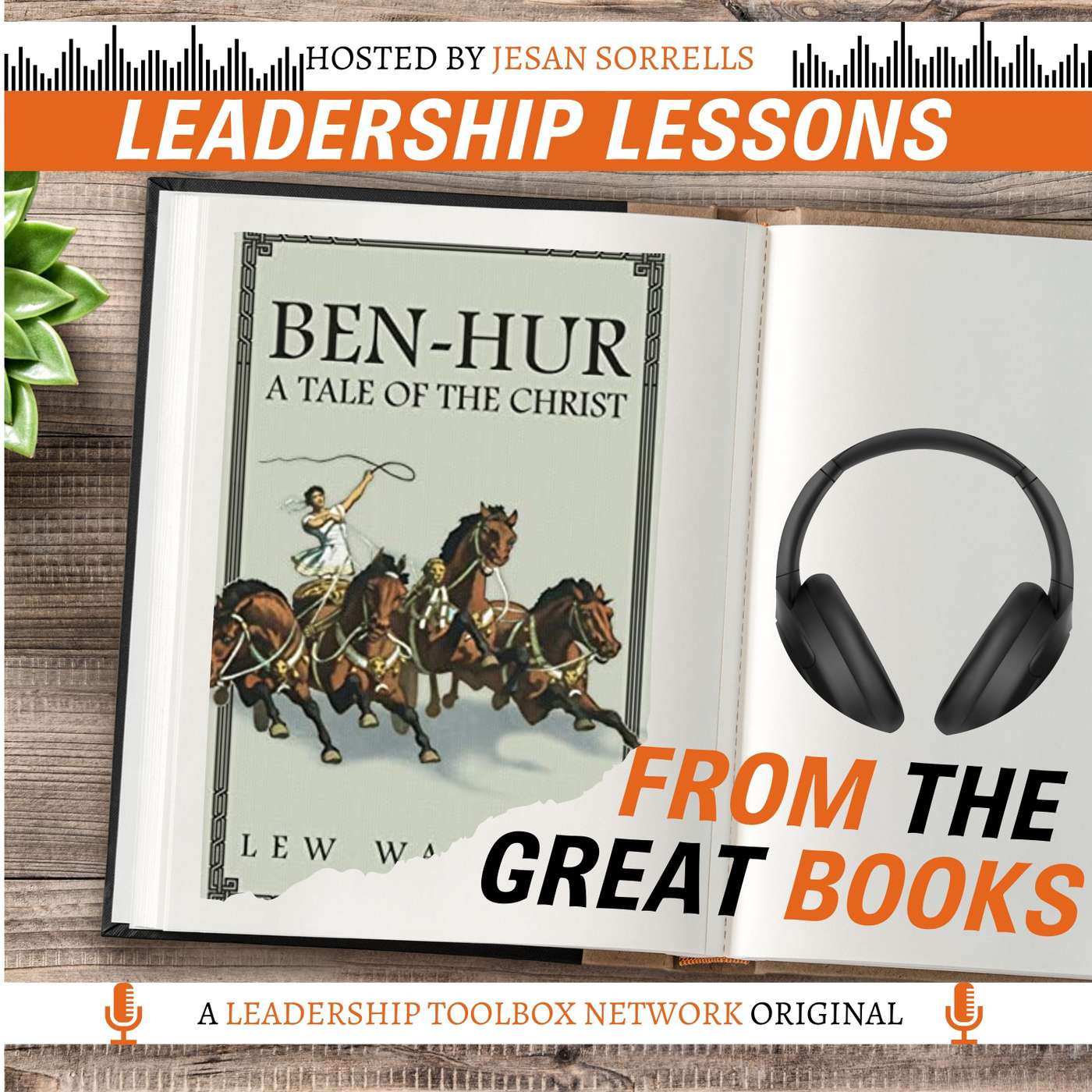
Ben-Hur by Lew Wallace — Vengeance, Redemption, and Leading After Ruin (w/John Hill)
Ben-Hur: A Tale of the Christ by Lew Wallace w/John Hill & Jesan Sorrells
---
In this episode, the hosts dive deep into Ben-Hur by Lew Wallace, exploring the novel’s themes of sacred vs. profane worldviews, the challenges of re-sacralizing modern Western culture, and how historical shifts in meaning affect society today. They examine the influence of religion, technology, and literature on leadership and personal identity, drawing parallels between ancient struggles and contemporary moral dilemmas. The episode also addresses America’s unique cultural experiment in pluralism, the role of skepticism, and the power of books to transmit ideas across generations.
- Book Title: Ben Hur
- Author: Lew Wallace
- Guest: John Hill
- Host: Jesan Sorrells
---
Time-Stamped Overview
---
00:00 Transformation of Western Society
12:23 Introducing Ben-Hur by Lew Wallace
24:03 The struggle of modern times
38:52 Understanding your target audience
52:36 Why I Avoid Politics Here
55:36 Evolution from Ethnos to Race
01:08:21 Hannah Arendt on the Eichmann trial
01:16:01 Discussing morality without religion
01:34:24 Balancing work, productivity, and purpose
01:36:17 Questioning traditional approaches
01:51:21 Discussing cultural criticism and religion
02:02:44 Discussing sales motivation and beliefs
02:10:01 Gen Z's religious beliefs shifting
02:24:01 Embracing change and personal growth
02:30:05 Meaningful conversations at rallies
---
- Opening theme composed by Felipe Sarro - Bach - Silotti - "Air" from Orchestra Suite No. 3, BWV 1068
- Closing theme composed by Brian Sanyshyn of Brian Sanyshyn Music.
---
- Pick up your copy of 12 Rules for Leaders: The Foundation of Intentional Leadership NOW on AMAZON!
- Check out the Leadership Lessons From the Great Books podcast reading list!
---
- Subscribe to the Leadership Lessons From The Great Books Podcast: https://bit.ly/LLFTGBSubscribe
- Check out Leadership ToolBox at: https://leadershiptoolbox.us/
0:00 Hello, my name is Jesan Sorrells, and this is the Leadership Lessons from the Great Books podcast, episode number 193.
0:13 Before I open on the show today, do my standard open on the show today, I want to say something that's a little bit of an addendum. So normally on this show, I don't get into the deep details of my personal life or things that are sort of happening to me. Unlike most people who are on YouTube or doing a podcast or are spreading themselves around social media, my life is not content. I'm a big believer in what Frank Sinatra used to say. The audience gets the performance, and that's all. I really owe you.
0:50 I owe you the performance, but I don't owe you myself. So with that being said, I'm going to sort of break that rule. Not sort of. I'm going to break that rule because for the last couple of weeks, there's been no podcast episode. Sure. We had our June 6th. Our June 6th D Day episode that was a rerun from previous year. And we also had an episode that was released earlier, the Gulag Archipelago and the Life of Ivan Dasinovich by Alexandra Solzhenitsyn. That episode dovetails into some ideas that we're going to cover in this episode and in Les Miserables, which is coming up next week.
1:35 The reason that there has not been an episode for the last couple of weeks is because I had a death in my family. And this individual who passed away very suddenly from a. From a stroke was. Is my younger sister, Cristina Sorrells. Cristina hosted her own podcast focused on the Lord of the Rings. She was a huge Lord of the Rings fan. And if you have the opportunity to go listen to that show, go check that out. I know it's still floating around somewhere on the Internet. She was a creative person.
2:16 She enjoyed dance. She particularly Irish dance. She enjoyed getting together and knitting clothes and putting costumes together. She was very involved with her local community and also involved in politics. Now, she and I may not have agreed on certain political positions, but she was definitely as active as I am, and she was fundamental in her beliefs. Cristina, like I said, was my younger sister. I do have another one who's a little bit younger than. Than. Than Cristina was. And. And my older sister Sonia is also floating around out there, not floating around out there living her life.
2:56 Now, the reason I'm kind of going into this is because people have asked me, are you okay? And how are you dealing with this? And Cristina was 44 when she passed away a couple of weeks ago. And the answer to that question is I don't know. And no, I'm not okay. But I will be okay as we go forward. I don't know if Cristina was a fan of this show or not, but I do know that Cristina was a fan of reading and I do know that she believed that reading was fundamental and is fundamental to understanding our world and understanding how to get along in our work.
3:36 And so she would think, this is weird, and she would probably laugh at me and she would probably have something to say. But I'm going to dedicate this episode, episode number 193, to the memory of my sister, Cristina Sorels. And if you are a Christian person or religious person, I welcome your prayers and your prayers for my family and your prayers for her. If you're not that person, I welcome your thoughts and your condolences as well. And I do ask that you donate in her memory, if you would like, to the SPCA or the Trevor Project.
4:09 Those are two charities that she would. That we as a family are asking that you. That you donate to in her memory. And so like to dedicate this episode, like I said, to my sister Cristina. And now on with the show.
4:29 Opening up today from our book, I'm going to kind of pick up a couple of pieces, a couple of passages that I think will set the tone for where we are going today. And, well, we're going to pick it up here with some, some, some, some men rowing,
4:54 rowing in the ocean. And I quote, at noon that day, the galley was skimming the Sea of Pastum. The wind was yet from the west, filling the sail to the master's content. The watches had been established on the foredeck. The altar had been set and sprinkled with salt and barley. And before the tribune had offered solemn prayers to Jove and to Neptune and to all the Oceanidais. And with vows poured the wine and burned the incense. And now the better to study his men. He was seated in the great cabin, a very martial figure.
5:29 The cabin, it should be stated, was the central compartment of the galley, in extent quite 65 by 30ft and lighted by three broad hatchways. A row of stanchions ran from end to end, supporting the roof, and near the center the mass was visible, all bristling with the axes and spears and javelins. To each hatchway there were double stairs descending right and left with a pivotal arrangement at the top to allow the lower ends to be hitched to the ceiling. And as these were now raised, the compartment had the appearance of a skylighted hall.
5:57 The reader will understand readily that this was the heart of the ship, the home of all aboard. Eating room, sleeping chamber, field of exercise, lounge and place off duty, uses made possible by the laws which reduce life there to minute details and a routine relentless as death. Then they're going to move on and they're going to describe the cabin and describe where this, the master of the watch, is sitting. I'm going to skip through that paragraph and go to this. The spectacle was simple enough of itself.
6:25 Along the sides of the cabin, fixed to the ship's timbers, were what at first appeared to be three rows of benches. A closer view, however, showed them to be a succession of rising banks, in each of which the second bench was behind and above the first one, and the third above and behind the second. To accommodate the six rowers on a side. The space devoted to them permitted 19 banks separated by intervals of one yard, with the 20th bank divided so that what would have been its upper seat or bench was directly above the lower seat of the first bank.
6:51 The arrangement gave each rower, when at work, ample room if he timed his movements with those of his associates. The principle being that of soldiers marching with cadence step in close order. The arrangement also allowed multiplication of banks, limited only by the length of the galley. As to the rowers, those upon the first and second benches sat, while those upon the third, having longer orders to work, were suffered to stand. The oars were loaded with lead in the handles and near the point of balance hung to pliable thongs, making possible the delicate touch called feathering, but at the same time increasing the need of skill, since an eccentric wave might at any moment catch a heedless fellow and hurl him from his seat.
7:31 Each oath hole, each ore hole was a vent through which the laborer opposite it had his plenty of sweet air. Light streamed down upon him from the grating which formed the floor of the passage between the deck and the bulwark over his head. In some respects, therefore, the condition of the men might have been much worse. Still, it must not be imagined that there was any pleasantness in their lives. Communication between them was not allowed. Day after day they filled their places without speech. In hours of labor they could not see each other's faces.
8:01 Their short respites were given to sleep and the snatching of food. They never laughed. No one ever heard one of them sing. What is the use of tongues? When a sigh or a groan will tell all will tell all. Men feel, while perforce they think in silence. Existence with the poor wretches was like a stream underground, sweeping slowly, laboriously onto its outlet, wherever that might chance to be. Then I'm going to skip a paragraph here and go to this one. In the labor of the rowers, there was not enough art to give occupation to their minds, rude and simple as they were.
8:39 The reach forward, the pole, the feathering, the blade, the dip were all there was of it. Motions most perfect when most automatic, even the care forced upon them by the sea outside grew in time to be a thing instinctive rather than a thought. So, as the result of long service, the poor wretches became imbruted, patient, spiritless, obedient creatures of vast muscle and exhausted intellects who lived upon recollections generally few but dear, and at last lowered into the semi conscious alchemic state wherein misery turns to habit and the soul takes on incredible endurance.
9:25 In the last few generations, the people of the west have experienced a profound transformation. The material and social world that used to be held as a sacred place descended in the space of 100 years, inogably or ignobly, depending upon your pronunciation of the word, into a place of the merely profane. The long story of the long 20th century, from the killing fields of World War I to the tragedy of 9 11, is a story of the seemingly random occurrence of numerous traumatic social, economic, political, and cultural events.
9:59 The other dynamic is that the meaning behind those events was never fully explained, not by politicians, policymakers, philosophers, religious scholars, or even the materialist scientists. Not to the people involved in them, and really not to those people observing those traumatic events. This lack of a definitive structure of place, meaning, and significance, or even an attempt to explain the events themselves, has moved Western humans from a location of centered spiritual surety out to the edges of spiritual uncertainty and psychological chaos.
10:33 This transition was documented in literary fiction of the 20th century, from Ernest Hemingway and William Butler Yeats to Joan Didion and Edward Albee. This was reflected in the movies and television shows that inundated Western man during the 20th century. It even redounded down to the songs we danced to and the advertising and marketing we consumed. This lack of meaning, however, has led to a wandering and here's a big word that we're going to focus on today. Desacralization. Desacralization project in the west during the 20th century led to a direct led directly to an increase in the moral conundrums we find ourselves currently mired in.
11:13 I've said this on the show before. I believe that history future historians will wonder why we fail to arrest such a descent into the abyss. They will Wonder that we had all of the technology, we had all of the stuff, we had all of the artists screaming for meaning and significance and yet we couldn't wrap our arms around it. After all, we are the most published ordinary people in the history of the world. And they will use all of our words and images and videos to judge us. And I suspect they will find us wanting.
11:56 However, however, not is all lost or all is not lost. And not all is lost. Right. We in our time, I think in the year of, dare I say, our Lord 2026, we in our time right now have the opportunity, the vague outlines of which are buried in this book that we are covering today. We have an opportunity to arrest some of this desacralization. Of course we're not going to do it by going backward, we're only going to do it by going forward. Now this book that we're going to cover was once described as quote, the most influential Christian book of the 19th century.
12:36 And in our time it stands, and I think my guests will agree with this today as an anachronistic throwback to an infinitely more romantic and I think an infinitely more sacred time. However, even though it's a throwback and even though it's anachronistic, there is a line of a lesson, there's a thread that we can pull from this and use it to weave into what we want to build into the future. And it does offer us a map to explore a potential path towards how to recycle the western world. Today on our show we are going to be reading, we're going to be covering Ben Hur by the great Lou Wallace
13:28 leaders. It will take time, probably a long, long time to re sacralize the western world, at least I think the remainder of this century. The current one we're in right now, it's a hundred year long project. So let's get after it and back to discuss our book. By the way, this book has never been out of print since it was originally published. Never been out of print, although you can find open source versions of it everywhere. And the version that I have is in basically an open source version of, of the book.
14:03 The person that we're going to have discussed this with us today is our good friend who usually comes along with us on the science fiction episodes of this show. So I was frankly surprised that he decided he wanted to read this one with us. John Hill, AKA Small Mountain. How you doing John? Man, I'm good.
14:23 I was also surprised at this book once I realized what it was because I Just. I was just thinking of chariots and cool things. I didn't realize it was gonna have all this depth and. Yeah, man. And as an aside, condolences to you and your family. Yeah. I mean, that's a lot. So thanks for sharing and. Yeah, we'll just keep pushing. So thank you. Yeah. Now, okay. Because we're talking about this before. Before we hit the record, and I just need to get one thing, one thing out of the thing here. Like, I thought I read the wrong book, but the one that you just held up is the same one that I have.
15:01 Okay. Now, what's interesting about this is, like, whenever I started to get into this book, right? It's. It. It's written in a way
15:11 you have to enjoy reading. You have to really just enjoy the words on the page, I would say, in the different ways that people can have to tell a story. Right. Because, you know, if reading a thing like Shakespeare or the Odyssey gives you tired head, this is probably also going to give you tired head, right. Because of how it's written. And so that took a little bit of, like, kind of getting used to it. And so I was worried about the time. And so I was like, okay, I might. I might hop over to the audio version of this just to make sure that I can finish it.
15:40 And I tried to go and find an. And find an audio version of it, and I couldn't find it. So then I'm looking around on Spotify and I'm trying to find the chapter that I was in, and it was, like, skipping around a little bit. It was such a weird thing. And so then I was like, am I on the wrong one? And then I just chalked it up as like, okay, maybe Spotify doesn't have their. Their stuff locked down the way that they should if they're going to do audiobooks. And so then I was like, okay, we're just going to double down and make sure that we finish the thing.
16:04 But then I was looking over the notes and. And the open source one, it's bucketed differently as far as, like, books and chapters and these things. And so I was nervous that I'd read like a. Like a shorter version of it compared to what you had read, but our covers are exactly the same. So now I'm not sure what to think. Yeah. So this is a book that. And I want to talk about Lou Wallace. I really do. I'm. I'm actually. So, a couple of things. One, I'm actually fascinated by Lew Wallace, the author, as a person.
16:39 His life Was he was the classic, like, 19th century romantic guy, romantic figure. And, and one of the things that kind of gets me to this idea of desacralization versus. Versus a sacred world. And I've developed. I've developed some ideas by another book I was reading at the exact same time, which I'll talk about a little bit here too, that has influenced how I think about her. But he was a writer that was so. No, no, no, let me frame it this way. We are so marinated deeply in a post Darwinian worldview that we don't actually.
17:19 We actually don't understand those romantic writers anymore. And, and so, and, and by the way, I'm not just reading Lou Wallace and Ben Hur. I'm also in the process of reading Les Miserables, which will be coming in the next episode. Victor Hugo, a deeply socialist atheist writer, like all the way over there on the other end of like Lew Wallace. Two totally, completely opposite guys, right? But both romantics in the 19th century in a way that we don't. You have to. You have to take their. You have to take their product at its word.
17:58 And it resists deconstruction because at a certain point, and this is what romanticism is, at a certain point, you have to go past the deconstruction to something else that can't be deconstructed. And over the course of the 20th century, this is why I opened up with this. We've done such a good job, at least in our public institutions. And by public institutions, I mean higher education, the media, most of Hollywood, popular entertainment, even now in business and corporations. We've done such a good job of saying that brute materialism is the thing that matters.
18:32 And this is a post Darwinian worldview. Brute materialism is the thing that matters. Things, even in our language, our common language that we use, we evolve, right? We are not sanctified. We. We adapt. We don't grow. Right? Even the way the sentences are written in Ben Hur would be. They even sound like an anachronism coming out of my mouth. And that's because they're coming out of a romantic sort of ideal that I think is really tough for us to wrap our arms around. We think those people were naive or stupid, and they weren't.
19:06 They just. They weren't Darwinians. Well, there's a. There's an interesting point there because, like, when I started to read the book, I was. I. Because I did a little bit of research first, because just trying to get the copy of the book is when I realized, like, oh, okay. This is going to have a fair amount of religion inside of it. Okay, Interesting. And it's. It's interesting because I did have a moment of, like, reading it, and it was kind of like I was expecting it to be written in that easy, approachable version, and it wasn't.
19:36 And so I had a moment of. I needed to decouple the. The romantic side of writing and making art for these things, because I was like, oh, this is going to be hard to read because it's religious. No, that's not. That's not the actual thing. Right. It was just written at a different time when most people that were making it were making art for, I think. I think a certain level of people. Right. And so it did take me a little bit of time to decouple those two things. And then I was like, oh, this is just Gladiator.
20:10 Okay, cool. Right. Like. And. And then it kind of fell into more kind of like a. A theme that I'm very familiar with and have seen a thousand times and stuff like that. So. But, yeah, personally. And that's where we're gonna talk about this a little bit later. But the film that was a Charlton Houston, the Charlton Heston film from, like, the 1930s, the remake of it in 2016, are two. It's. As I said before, we hit record. It is a. It is a. It is. I can think of no greater example of. Of cultural change that you could see where the.
20:47 Where the core content, as we say now, is the same quote, unquote. Everybody's reading the same words off the book, off the same page,
20:57 but the meaning, the significance behind them has shifted because worldviews have shifted. And I'm not saying the worldview shift is good or bad. I'm merely saying it is. We can argue about whether it's good or bad, and we do a lot. That's what we do in this country. We argue whether that meaning is good or bad. But we don't. We sometimes fail to acknowledge. I think we fail to acknowledge that the shift has actually occurred because, again, I don't think we know what to do with that. We don't know what to do with the meaning of that.
21:27 And it feels as if we should do something with it. And maybe we should. I don't know. But I think it's important to acknowledge that the shift has actually occurred. So I have a. I'm curious about this. Yeah. So you said that we're going to talk about this one word a lot. Desacralization. Yes. Okay. And I'M I'm working my way to the point because like. Sure. I'm just curious. Yeah. What does that mean? Like what? Like, because I'm, I'm assuming, right? And this goes back to like the good old days, right?
22:03 People are always thinking about the good old days, but if they weren't glorious for you, you're just, you're just positive about the change, right? So it's, it's funny because like, I noticed a big difference, right? Just in like this book wouldn't do very well today if it was released today, right. Especially not the way that it was written here and everything. And so I'm curious,
22:28 why do you think it's important that we, I guess, remain a sacred society? Is, is that the, is that the thing? Is that, is that your. That's one idea. I actually don't, I actually think, I think we are going to always lean towards being a sacred society because of the nature of you human beings are. That's one assertion that I make. But then I also, and I think that we've gotten to. We were just talking about elon Musk and SpaceX. Not to go into that, you know, before we hit the record button. Not to go into that again.
23:09 But I think that there are, I think we've hit the ceiling of what the brute Darwinian materialist, scientific perspective can, can get us. I think we've sort of hit a ceiling and I'll use a perfect example of this, or not a perfect example, but a example of this.
23:34 Many, many commentators, not just me, have wondered why things, and I don't mean cultural circumstances, but I mean like technology hasn't gotten any quote, unquote better. I actually just saw one of these articles flooded to me in my Facebook feed the other day. Hasn't gotten any better in the last 30 years.
23:58 I see these articles all the time. Technology has not gotten better in 30 years, right? Why have things not gotten better now? The things usually they, they, they start with technology in those articles and, and then they eventually descended to culture because that's really what they want to talk about. And the reason I think ties into this idea of the sacred verse is the profane. But I also think, or, and I also think that this struggle is the struggle of the 20th century, right? And it's been a long 20th century.
24:29 I, I honestly think the 20th century started probably in 1860, no, 1865, and has dragged on to now. It's kind of like the long 19th, the long 19th, the long, the long 19th century, you know, which started in like 1776. Right. With the Declaration of Independence, and then kept right on going all the way through World War I. Right. Long period of a lot of change where people fundamentally didn't understand what was happening. They just knew the shift was moving. I think we're in that same period, but I think we're.
25:03 We're getting ready to exit it. And I think the thing that will allow us to exit that is an idea of the sacred. Now, where I get this idea from. Let me bring up this book, because I was reading this book at the exact same time, this book called the Sacred and the Profane by a religious scholar named Mira Shea Elieida. He was. Oh, gosh. He was. Well, and I'll talk a little bit about him in a minute here, but he was writing in the 1950s about this phenomenon, and he asserts that.
25:42 And by the way, he's a. He's a secular religious scholar. Let me be very clear about this. The man was not a Christian. Let me be very clear about this. Nor was he a Muslim, nor was he any of that. He was. He was consumed by trying to figure out why all of these religious traditions, all of them, even the paganistic religions, religious traditions, all tended to create a human being that was focused more on things that were sacred and outside of the materialism that he was seeing in the 1950s. Because he's writing post World War II, right?
26:10 Post the atomic bomb, which at that point was like, the biggest materialistic example of, like, boom, we can put science to this problem and stop this human behavior ever that anybody had ever seen up to that point. And so he's writing, and he was. He. He was. He escaped from. Oh, gosh, I believe he escaped from Romania during World War II. So he was running away from the Nazis. He had a whole lot of axes to grind in a whole lot of different areas. He also wrote in, like, four different languages.
26:42 It was kind of amazing. Guy was like. He was. He was a. He was what we would call a public intellectual. Back before they had the idea of a public intellectual. He. He was just an intellectual. And so he wrote a lot of books on the nature of religion, the nature of what myth means, how myth ties into a sacred worldview. And one of the points that he makes is that.
27:04 And it's right here in the introduction, and I want to read this, he says this book basically will show the ways in which religious man attempts to remain as long as possible in a sacred universe. Hence what his total experience of life proves to be in comparison with the experience of the man without religious feeling, of the man who lives or wishes to live in a desacralized world. It should be said at once that the completely profane world, the holy desacralized cosmos, is a recent discovery in the history of the human spirit.
27:36 Close quote. So he's writing that in 1557. I think he was exactly right. But I also think that we always do chase that. And you're starting to see signs of re sacralization popping up in varying places, most notably in the environmentalist movement. That's been happening since at least the mid-90s all the way over to what we're getting ready to see with AI. Like you're already seeing AI churches popping up. That's already starting to happen. Human beings want to live in a sacred world. We just don't have the language to go back to it.
28:22 And I think Ben Hur to a certain degree offers us a map for how to do that. And I think a sacred world is better than a profane one
28:34 because I think it grounds us more. It also allows us to deal with things that like psychology and behavioral science can't explain. It also allows us to deal with things that are happening to us that we can't explain. And I think we can do that. No, I think we can do that. I think we will do that with or without an appeal to Jesus. And I know the subtitle of Ben Hur is A tale of the Corporation Christ. Hyper aware of that, but without an appeal to Jesus. I think we're good. I think we've always made that appeal.
29:03 And by the way, Elada thought we may always made that appeal as well. He believed it started way back in pagan societies. He goes all the way back to Mesopotamia and talks about how we've basically been building up our, our. The. The understanding of what is sacred as human societies and as human civilizations. And he ties in the pyramids, he ties in the worship of Greek gods, he ties in math, all of it.
29:28 I think he's got a compelling argument.
29:36 Here's where I get stuck with this idea. Yeah,
29:42 because like I. And this is such a weird thing to kind of be talking about here. I was not expecting to talk about this idea. I think that, I think that people exist in one of two states. Right. You were either
29:55 younger, me loved very black or white scenarios and realized that most of the time there was a lot of gray in the middle in this situation. I don't think there's a lot of gray. I think that this is pretty, pretty, pretty spot on. You either think it's important or you don't.
30:13 Right. And so, you know, one of the things that I have to talk about endlessly with people is like, don't try to sell PCs to people that want Macs and vice versa. Right. Because you can spend your time trying to change someone's heart and mind about what's important. Right? Right. But we're not ever changing core philosophies about what's important in other people. And so it's, it's in this thing of like. Okay, so let me ask this question. Is, is a focus on the environment and it being sacred read a bad thing in your, in your perspective?
30:44 No, I think it's a, I think it's a misordered thing, but I think so I think that we are doing a repeat in, in. Well, let's, let's start with even just the thinking of the environment is sacred, right? Because it's not a thought. Actually, the thought comes afterward. We know this from behavioral science. This is where the science actually helps us. We know that the emotion appears, then the, then the, the rationalization comes. We know this from sales. I have an emotional feeling and then less than 10 milliseconds later, I'm rationalizing that emotional feeling.
31:27 And by the way, I'm doing this all day about everything. Right? Yeah, we're doing this in the conversation that we're having right now. Right. And so when you say thinking of the environment is important, I don't really think it's that. I think we're trying to just like previous pre, pre Christian, pre Judeo, pre Greek cultures did. I think we're trying to reach back and find something sacred in there we can connect with at an emotional level in the environment. We're also trying to scale it up to a global feeling, which is really hard, by the way.
32:05 It's really hard to scale that up to a global kind of thing. Right? So there is some, there are some, there's some data that kind of supports what I'm saying here. So we know that. Sorry, I have a question. Yeah, so, yeah, go ahead.
32:22 This might be overshooting the point, but like, where does just simple self preservation come into play, right? Because like, you know, there is the thing of, like, okay, let's keep the planet here, right? And there's some people that just want to work on the planet in the environment because they feel bad because they want to leave something great. Then there are other, some, Then there are some other people who were like, hey, like, you know, maybe we shouldn't be having this impact at all. But there's just like, a lot of people that they can also be like, wow, we need a place to live.
32:49 Right.
32:52 Where does. Because I also think that there's a lot of people that are uncomfortable with the topic of death. Oh, for sure. Massively uncomfortable with the topic of death. Right. And it becomes easier to think about parts of this whole thing because you get to avoid the discomfort of death. Right. So self preservation as the motivating focus for these sacred things. Right. Whether it's the environment or whether it's for the family. Right. Family's got to be man, wife, 2.5 kids, three dogs. Right.
33:27 And all this other, like, sure. It's the thing that I hear. And please correct me if I'm wrong. You're saying, okay, people are focusing on this bubble, this bubble, this bubble, this bubble, this bubble. None of that matters because these bubbles are all connected to the big bubble. So just care about the big bubble. I'm not saying that none of those smaller bubbles matter. I think all of those smaller bubbles are in search of the bigger bubble. That's what I think. I think they're chasing the larger bubble, but they don't have the.
33:58 And. And Eliade was very much consumed with language and. And meaning and forms and as am I, right? I mean, for God's sakes, we're hosting a literature podcast. So I think correct language then orders things correctly. So if we're talking about things correctly, not even to each other. Let's forget to forget to each other for just a minute. Just for talking about things correctly to ourselves. Right? Yeah. Which gets back to an idea that I've often had. I've said on this show, maybe not with you, but I've said on this show with other guests.
34:32 One of the key questions that I've been asking people for like 15 years now, whenever I get into them with training and development stuff is. Or topics. Training and development topics is how clearly do you think. And you would be stunned. The number of people who raise the hand to say they think clearly and the number of people in the room who are confused by the question.
35:02 And so from there I go, okay, maybe my sample size is too small, but let's use this. Let's use this sample size.
35:15 If. If I ask 15 people in a room, how clearly do you think. And two thirds of them don't understand the question,
35:26 John, would you think that there is something going on there? Would you think there's a challenge there? Because I would. Because then now in my brain, I Leapfrog from lily pad to lily pad. I leapfrog from. Wait a minute. I asked you in a training at 9 o' clock in the morning, how clearly do you think, okay, maybe you didn't have enough caffeine. I'll, I'll grant you grace. Maybe you didn't have enough caffeine. You didn't know you were going to run into the buzz saw known as Haysan Sorels. Maybe you weren't prepared for that.
35:53 It's fine. I'll, I'll be nice. I'll back away. I'll, I'll grant grace, right? Maybe I'll get you better later on in the day. Maybe at 5:30 you'll be clean, thinking clearer. Okay, my question becomes, how muddy is your thinking on the environment or family or the material world or the news? How muddy is your thinking on things that I've spent a lot of time thinking about and tried to put in correct order with correct language, but you don't understand the question.
36:33 And so I look at the little bubbles as being, for lack of a better term, ceilings that people have to break through. But I don't know how to do that. I don't know what the tools are to break people through. And by the way, I don't think it's my responsibility to do that. I'm not taking all that on. I think that books do that. That's why we're doing a book podcast and I encourage people to read these books because books, as I said to another guest a couple episodes ago, books smuggle ideas across time.
37:03 Oh, that's a great line. I couldn't believe it just came off the top of my head. I just, literally just like. And the guy was like, that's genius. I'm gonna write that down. Like, yes, write it down. I'm a genius. That's the thing you wrote down, I'm a genius.
37:22 Yeah, exactly. Yeah, that's right. And as soon as you're done, you're like, man, couldn't, didn't want to forget that.
37:31 And I'm gonna mic drop and I'm out. You all have a good day.
37:36 So. So I think, I think books are the tool that allow us to break through those ceilings. I think more people in the 19th century, which was a book dominated century because there was no tv, radio was, was nascent, newspapers were everywhere, but everybody wasn't literate. We didn't have the literacy levels that we have now. They were greater than they had been at any other time previous to the 19th century, but they still were not at the level that we have now. The technology of distraction was not there.
38:08 Although people would tell you if you go back to the 19th century and you read what people actually wrote, they would say that the public readings of Charles, that Charles Dickens was doing say the exact same things about those public readings that people say about people doing TikTok videos now. Literally the exact same language. So there's always a technology that's destroying something somewhere. And to that point, right, Like God, what, what was it that I was reading they were talking about how.
38:35 Because one of my favorite things is like the generation before always likes to crap on the generation after from a gatekeeping perspective and everything. Yeah. And, and it's funny because like they used to. What, what was it? I think it was books or maybe it was chess. But they were trying to villainize that. Oh yeah. They were trying to say like, you don't want your kids reading because that, because that means they're not going to be out in the field or something like this. Like, and like just think about that person.
39:00 Like they think that they're doing the God's work, right? Of like keeping kids dumb and in the fields and unable to do anything else like this. Right. But this is, this is one of my favorite topics. Cause like, because the thing that I have to help people do is develop discernment around their own products, ideas, services and to have that in awareness while they're having sales conversations, right? So my favorite thing was whenever I'm talking to a founder or a salesperson, it's like, who's this not for?
39:31 Right? Because if you tell me that it's for everybody, I know you're not on the level. Like, and I know you just need time, right? You're like the CrossFitter just started CrossFit and you think that everyone should be doing CrossFit. Like, you know, you're not thinking about like, you know, Kip style pull ups have really, really crazy tensions on like ligaments and tendons and soft tissues. And people can get really, really hurt flopping around on a bar because they're not conditioned for it. But everyone should go to CrossFit.
39:57 You don't know enough, right? It's the Dunning Kruger, right. Stuff and everything. And so half the time, right, there's going to be people, status quo thinkers. I don't want any change at all, right? And they're, and they're, they're, they're spouting consistency because the fear or status quo. And then there's, okay, let's Go try something new. Let's go try something different. Like
40:20 how do we parse these two things? Like, I don't know. That's the God's honest answer. Do you? I don't know. I know that. What I do know, though. I do. What I do know is that we tried to use. We took, we took the theories of Darwin and we, we spread them through folks like writers, right? Like the Huxleys, that entire family, you know, spread them around, right. H.G. wells spread them around through his science fiction. Those are two, two big names that I could just name right there. Then you had folks that spread them around or, or at least took the conclusions of Darwin to what they thought was a logical conclusion.
41:09 So Kinsey, who did all the sex behavior studies, he was one. Freud. Well, not Freud, sorry. Carl Jung was another one that took some of this to its quote, unquote, logical conclusion. I will also quote from another book.
41:27 Ideas have consequences, right? So the idea that. That evolution has occurred over a long period of time and that human beings. Now, let me be very clear here. The idea that human beings are not created in the image of a divine, transcendent God, but instead the idea that human beings evolved over the long course of millions of years from, depending upon where you want to start, a fish in the ocean that decided to get out and come to land or from a, a simian ape, right, that broke off and evolved over the course of however many thousands of years.
42:11 I think up to 12,000 years now, 14,000 years. Now, whatever it is, that idea, I'm not talking about the truth or the factual nature of the idea. I'm not talking, I'm not debating any of that. I don't care. Well, I won't say I don't care, but that's beyond the pale of this, this podcast and beyond the pale of this conversation. I merely talk about the idea itself having a consequence. Oh, well, I did have this. And that idea, by the way, that idea. Just, just let me close up here. That idea then closes the door to guys like Lou Wallace to writing Ben Hur.
42:47 Well, it closes the door gradually, and I don't know that that door closing is a good thing. Now that's an idea. That's a debate I would like to have. That's a conversation I'd like. Well, who gets to be in charge of that, though, right? Because, like, because, because you and I, we're also having this conversation. There's an audience for everything. Right? Right. So. Right. You know, you can be, you can be the Lou Wallace who's like, oh man, publishers don't want to write my book. And. Or you can be the Lou Wallace who goes out and starts a publishing company because you're not going to let anybody stand in your way.
43:15 Right. There's always that shout to out shadow banned on social media. Like, maybe your content just is garbage. Maybe you're not connected to the right audience and different things like this. Right. There's always this, this idea that like, we're being constrained, right. Like, well, Dostoyevsky self published. Let me be very clear. Dostoyevsky self published his books, I think all but the Brothers Karamazov, if I remember correctly. Oh, interesting. I didn't know that. Yeah. So Dostoyevsky couldn't get a publisher.
43:42 I mean, like, and that's my kind of big thing is that like, the big stuff isn't going to be seen in the main threads and you have to go seek it out. Right? Like, sure, the old, old, like martial arts thing, Right. The student who won't spend a year in a horse dance is not a student. Right, right. You have to want to go find your thing. Now, I did have this very surreal moment in the book, Right. Because the thing that I did appreciate a lot, that I never really had much perspective on was just how much like Jewish culture, yes.
44:15 Was like, looked down upon, just like, as lesser just for people who want to go do their thing and have their faith and everything else like this, you know? And it was interesting because I think he does a really good job of just talking about how the Romans just don't get it. Right. Like, like he does. He, he does a good job of talking about that, like, lack of faith makes it so hard to even understand. Right. But there was this part where he was talking about how the Romans have all these gods and they just have the one.
44:47 And how the sheer idea of that causes a lot of like, friction and pejorative, like instant. Well, I'm just going to put this here. You're a snowflake, right? No, you're a snowflake and everything else like this, right. This idea. And I was struck by that at first of just like how, how long this culture of people have just been like, shoved down. Right. And also. Because I could then appreciate that. I could also then appreciate this idea that like, the king of the Jews is coming and stuff like this and what a rallying idea that had to have been for all of these people who felt underrepresented, walked on and different things like this, you know, but just the sheer idea of like imagine having 15 gods and then going and talking to someone and having to do business and having to build a relationship with someone who only has one, right?
45:39 Like, it's because the ideas have been planted through books and literature and everything. It's so much easier for us to wrap our arms around, right? Versus, if you've only ever seen it the other way, it goes back to this other thing. It only seems like magic because you're not smart enough to get it. So this is I'm doing. I'm writing, currently writing the script for our shorts episode, which will come out tomorrow kind of a little bit because of current events. I'm kind of a little bit blocked up right now in my writing.
46:09 But I'll get it out and it'll get out there. Folks, I've got an idea. It's the idea that John actually just said here. I think that I'm glad you pointed this out about Judaism, because this was one of the things that I already kind of knew was going to happen coming into the book because of my understanding of theology and da, da, da, da. All these kinds of things, right? But it's really hard for a person who. And it's interesting that this book has never been out of print. It's even in print today.
46:41 And so we talk about it being hard to read and talk about it being difficult to sort of wrap your arms around
46:51 the. The assumptions that average human beings, because ideas have consequences. The assumptions that average human beings in the west and even globally. But let's stick to the West. The assumptions people have about how reality, quote, unquote, should or ought to work. For instance, the idea that women should and ought to have rights. Now, what those rights mean, how far that goes, we're still negotiating all that. The point is no one in the west is disputing that women should or ought to have rights.
47:33 No one. Why is that? Well, the reason that is is because. Hold your, hold your phone here. The Christians who came out of a Judaic understanding of women, of what a woman's quote unquote place was, which, by the way, descended from the root of one God, rather than 1500 gods determining what a woman's place was, which, by the way, weirdly enough, all those gods determined that a woman's place was to be, as is often slammed about Christians these days, barefoot and pregnant. Actually, that was more like the pagans.
48:10 They actually thought that. But okay, let's just leave that aside. These kinds of ideas over the course of 2000 years have marinated to the point now, where we have legitimate arguments, not about should women have rights or should they not have rights. We have legitimate arguments about what kinds of rights women should have. And we don't even blink twice about it because ideas have consequences. I'm not talking about do we believe that Jesus was the Messiah or not. I'm not talking about any of that.
48:50 We don't even have to go there. We just have to go to the idea that a guy named Jesus walked around, said it would be nice to be. Is it would be a really good idea. And I hate to do this, but to reduce everything down, to be reductionist for a minute, said it would be really nice idea to be really good to the widow, the foreigner and the weak. And people took him seriously for 2000 years, people took him seriously. What was said in pagan, in the pagan reality. And by the way, the early Christians in the first like 500 years of the church, this is what Augustine was yelling about in City of God, which we've read on the podcast before.
49:31 This is his whole argument against the pagans in like 300 or whatever. When he wrote that book, the pagans believed that women didn't have rights. Not, not that they, not that they like should. What kind of right should women. No, no, no, there's none of that. You're just. And you see this by the way, in Ben Hur, the way that, the way that Ben Hur's sister and mother are treated. We, we're shocked by that. Why? We don't ever ask why are we shocked? Well, we're shocked because of 2000 years of Christianity.
50:05 That's why we're shocked. And for us to. An interesting idea. Yeah. For us to not acknowledge that. And again, you don't have to believe in divinity. You don't have to believe in resurrection. I'm not asking you to buy any of that. There are certain fruits that ideas produce. And those fruits come from a tree which has a seed and a root in the ground. A root coming from a seed in the ground. The seeds matter. Ideas have consequences. So if we want to re sacralize the world, we have to look at the seeds of where people's not only individual beliefs are, but where society's individual beliefs are.
50:45 And by the way, we have to question those. And I think the Internet to stand up for modern technology for just a minute here. I think the area does an excellent job and I talked about it in terms of a cul de sac. I'm going to go back to this idea. It does an excellent job of Bringing people who have had these thoughts before, coming from different roads into the same cul de sac and then meeting in that spot which increasingly is happening online and going, oh, wait, you thought that too? Oh, I thought.
51:12 I just thought that by myself. Yeah. Oh, now we can make common cause. And as I keep going back to, I think, re sacralize the world, this is where the postmodern environmentalist movement, this is why it's doing well, because all these people are getting together in the same cul de sac. Yeah, Like, I don't inherently see that as a bad thing, though. No, and, and I'm not arguing that it's a bad thing either. I'm merely saying the, the. The seating of it doesn't. You're not. We're not going in deep enough.
51:44 We gotta go in deeper. We got to go in deeper. And I don't know that people have the horsepower sometimes to go deeper. And I think that's fine, by the way. Like,
51:59 let me, Let me be religious here for just a moment. I think God gave different gifts to different people, and I think that gave different strengths and abilities to different people, because we need all kinds, you know, every. I'm not, I'm not demanding that everybody have the intellectual horsepower of Hasan. No, I'm not making that demand. I'm merely saying we've got to figure, we've got to acknowledge what the seeds are so that we can have a common conversation moving forward rather than a fractural one, a fractured one around things that don't matter.
52:33 Like, things that don't matter at all. Like politics. This is why I don't have political conversations on this show, because politics are misordered. It's all misordered in the hierarchy. Like, we want to talk about politics. Politics is downstream from culture, which is downstream from religion, smaller religion, which is the sacred of the profane idea, which is downstream from how you actually, actually think about being and meaning and significance. We got to go all the way up to the headwaters.
53:03 How do you think about who you are? How do you think about your level of significance? How do you think about your being? And if you've never thought about this before because you didn't want to take a philosophy class in college because it seemed like it was really boring, or maybe you didn't have a history of like, talking about these ideas in your parents house, or maybe you just never. You just didn't think you had horsepower because no one told you, or you looked at that book and you were like, I don't want to deal with that, because Kierkegaard seems really complicated.
53:30 Why can't I read this as fast as my graphic novels? Oh, because you need space to sit and think on these ideas like that. That's what I did for a while. Right? Yeah, I would, I would, I would look over this fence as I was training martial arts, right. And I'm like, oh, watts and stuff. And. And then like, occasionally I'd pick up a book and I would try to like, speed read through it. Like, I read, like, for entertainment. And then I'm like, who's getting depth out of this thing? Right. Wasn't even walking into the deep end, you know, kind of situation, so.
53:58 Right. That's an interesting thing. Right. Like, I, I believe that people have different strengths. And then one inch past the strength is a, is a challenge. Right. It becomes limiting and a constraint. And, you know, as long as you're really aware of what, what you're great at and whatnot and, and not great at and also knowledgeable about and experienced about and not knowledgeable about and not experienced about, I think life gets a lot easier. But if you're just running around thinking that because you did it, it was perfect, you know, and all this other stuff that people get, I think, trapped into.
54:31 Right. None of this is a topic worth getting into, right? No, no. Well, and you talk about. And I want to, I really want to focus on. I didn't really want to focus on the Christian. Christian. The, the Jesus sort of aspects have been her. I didn't really want to focus on that in this conversation. Not because that's limiting, but because now this is my own weakness. I go with the assumption that people have heard about Jesus and either to your point, they either believe or they don't. I, I go with that assumption.
55:00 Right. Okay. And again, that's a limiting factor on me, Right? Because maybe not everybody. Everybody has or maybe everybody hasn't or they've heard the wrong thing. I don't know. Hey, I don't know.
55:12 I think what's far more interesting is, to your point, the, the. The. And it's really the ethnic. This is what Paul the apostle talks about in, in all the post Pentecost New Testament books in the Bible, when he's using the word ethnos, which we substitute in modern translations, we substitute race for that. But that's not what he meant. He didn't mean the modern conception of, like, how we think about race. Not at all. He was much more consumed. And people back in the day, 2,000 years ago, were Much more consumed with the ethnic groups that people came from and how the ethnos of those groups, which is different than race by the way, influenced how people thought about the sacred, how they thought about the world, how they thought, thought about reality.
55:59 The idea of ethnos continued up until the beginning of the Enlightenment, probably in the 16th or 17th century. That's when that started to break down a little bit. And then as the age of discovery opened up in the 17th, 18th and then into the 19th century, that really started to break down. Voltaire was one of the first ones. Actually, we just read Candide on this show. Voltaire was one of the first sort of skeptical, they called him back in the day, skeptical writers who sort of breaking down ethnos and really trying to do the, the conversion to racial groups.
56:35 Right. Because now you're, you're taking Europeans and that's a gigantic monolith word and it doesn't mean anything, but you're taking Europeans from one place, putting them in the quote, unquote, new world, interacting with all these people they've never met before. And now. And they're also importing Africans, again, a monolith term that doesn't mean anything model, importing those folks to the New world in an effort to find a passage to go meet again, a monolith term, Asians, which included, by the way, China, India, Japan, Korea, all of that.
57:13 Right? Yeah. So Voltaire and the thinkers of the Enlightenment were trying to break these, the visible differences that they could see because they weren't blind, nor were they dumb. They were trying to make that term ethnos fit with what they were seeing here and make those two things click together because they were confused. This has been a long project, by the way. Well, and like, to me, and this is a really cool thing because, like, we get to go back to another book that we, we did together.
57:44 Right. A Stranger in a Strange Land has that one chapter about like Islam. Right. And how, yes, the language around Islam colors how you perceive Islam, if that is your mother tongue. And that's like. And I think about that, like a lot. And I was thinking about that as I was reading through this like, book because, like, in that moment of like, you know. Well, well, well, yeah, like, you know, some people have many gods, some people only have one. And like, I us appreciate that that's going to be a little bit weird.
58:12 Well, I can only appreciate that because of the environment that I live in, you know, and so I, like, I was, I was just kind of struck by that, like the Language has a lot of impact on our perception of whatever it is. Right, so exactly. The other thing they're talking about was just like. And I had no idea, just, like, during this time, like, how far, you know, Judaism had, like, spread, you know, because they're talking about these different kinds of Jews and everything else like this, you know, and, like, I. I just think that.
58:43 So that idea was. Was cutting through for me. Right. That it was more about, like, what do you believe? And not, like, where are you from? Kind of thing. Right? Yes, yes, yes. Because in a time where the Greeks were philosophic and Greek philosophy was thought of as. Even Paul kind of degrades this a little bit. And Paul, you know, Paul was a highly educated Jew. Highly educated. He was actually trained in the synagogues by Gamaliel, I believe is the rabbi's name. And so the synagogue system that Paul was educated under before he had his Road to Damascus moment and, you know, became a huge evangelical person for Jesus.
59:29 The system that Paul came out of, a lot of people don't know, this had been built out by the Sanhedrin and by the Pharisees in order to. This is interesting, preserve literacy among the Jewish people. And that was being built in tension against this idea of the Temple, which the Sadducees were building as a physical representation of God on earth. And they wrapped Herod and the Herodians into that. And so that tension was existing in Jewish. He doesn't get into any of this, but that tension was existing in Jewish society at the time.
1:00:08 And so Ben Hur is clearly in this book. He is clearly a product of the Temple system, or not. Temple system, sorry, of the synagogue system. So the synagogue was the folks who were trying to go out and basically give scrolls to people and explain to them, like, these are the first five books of the Bible. This is what. Well, what we think of as the Bible, the Pentateuch, this is what Moses is. And they were writing this down. So I heard this from a Jewish theologian, a podcast I listened to from a Jewish theologian, like, a couple of years ago, did a whole year on that podcast, and he explained a whole bunch of this stuff and a whole bunch of different things that I didn't know.
1:00:42 But in Judaism, that synagogue system is what has maintained Judaism over the course of the last now 2000 years. Because the temple's gone. The temple disappeared in 67 A.D. because the Romans, like Masala, finally decided they were just going to be done with these people and just. They burned the Temple to the ground and scattered the Jews. And that's where the Jewish Diaspora began. That was then. The door was then closed on that in the 1940s, with the creation of 1948, with the creation of the state of Israel.
1:01:18 This is what people don't understand about Judaism. The tension between the synagogue system and the temple system was a main tension when Jesus showed up. And so Jesus was a product of. He was a product of the synagogue system, not the temple system. That's why in all four of the book. Well, except for John, but in four. All four of the books of the. All three of the four books of New Testament, when. When Jesus says, I will tear down the temple and I will rebuild it in three days, the Sadducees got all upset.
1:01:52 This is why. And they were like, who are you? You're gonna. The temple, it's been. Take. It took us like 40 years to build this temple. How are you going to tear it down in three days and rebuild it? Now, the disciples tied that to the crucifixion in their eschatology and in their theology much later on. We just accept that idea as de rigueur now from 2,000 years later. But back in the day, that was a revolutionary idea. That was hugely revolutionary because that goes beyond just the widow and the childless and the poor.
1:02:25 That's saying that. Think about what that's radically saying. It's not just that. And there were a lot of people who were claiming they were the Messiah running around during Jesus's time. There were a lot of folks claiming that, to your point, messianic worldview was very hot among the Jews. Very hot. But. But Jesus said something radical or made it. Made an illusion that people at that time definitely understood. And the illusion was, and you get this in Ben Hur too, the illusion was that the temple system of man that's being built to be this glamorous thing.
1:03:02 And by the way, this is reflected also in the Book of
1:03:10 Kings. Yes, the first part of the Book of Kings, when David dies and David wants to build a temple. And if you go through that first part of that book, God is sort of silent on whether or not David could build the temple. And it's one of those, like, shocking things that like most people don't see in the text. And then his son Solomon goes off and builds the temple after he's gone. But David, David is the one that initiates the building project, not God. So the Sanhedrin and the Pharisees were arguing about this during Jesus's time.
1:03:41 And Jesus was a product of the Pharisee system. And by the way, he was with the Pharisees for three years, and he told them, you have everything except for mercy and grace. You have everything else you need except for mercy and grace. And that's. And by the mercy and grace extended to people that we now think extending their mercy and grace is a natural thing. The widow, the poor, the childless, or the children. Right. The weak. Right. Well, that was radical for his time. That was hugely radical.
1:04:17 Now, the Romans didn't think that was radical. The Romans were like, you're just another weirdo in a backwater running around with no job. Like, aren't you a Carpenter? We have 1500 gods. We're Rome, for Pete's sake. Which is why I opened up with the galley. The galley rowing scene. Because that's Rome. We will press your body into slavery because we can. Force of will. To the previous conversation we were having before we hit record, ultimate force of will. I don't. I mean, with the exception of the benefits of technology over the last 2,000 years, we don't really see states behaving like that.
1:04:57 Or. Or we do, but it's less and less and less tolerated over the course of time. I also think that's a Christian assumption. Like the fact that we question whether or not America should be bombing Iran for 40 days. We think that all comes out of Vietnam. No, Our skepticism around Vietnam. No. I mean, there was skepticism around World War II. There was skepticism around World War I. There was skepticism around the Civil War. There was skepticism around the Revolutionary War. Need I go back any further?
1:05:26 There's been skepticism. And that skepticism comes from ideas having consequences that go all the way back 2,000 years. And so when I. When I talk about making it sacred, I'm just saying just acknowledge that it goes back 2000 years. Let's start with that. Let's just start with that basic acknowledgment, and then we can move forward. Dude, it's so funny because, like, I was. I was in training during, like, 9 11, right? And so, you know that that was my birthday. I think you and I have talked about this.
1:05:56 And so, yeah, I joined as a reservist, and I joined the military for all the wrong reasons. Right? It's funny now because, like, I'll have parents and they'll come talk to me, and they're like, hey, will you talk to my kid about joining the military? I'm like, what do you think I'm going to tell them? First of all, I'm not gonna talk him into it or out of it personally. But I remember going in like the next day, right. And tensions are running hot. Right. I mean, I mean, we're, we're, we're in job training for the military.
1:06:19 Right, Right. And everyone is so excited to go turn it into a parking lot. Like that. That was the exact wordage that was being used. Let's just nuke them all. Turn it into a parking lot. And me, like, me being me, like, I'm like, that doesn't make us any better than them, you know, of course, which wasn't heard. And now I'm the bad guy, you know, in the platoon and everything else like this, you know, because, like, we're not even allowed to have this conversation or talk about it or anything else like this.
1:06:49 It was such like a weird moment, you know, and so it's, it's weird because like, you know, the thing that is like there is, you know, like human life in and of itself is something like worth protecting. Right? Not just right for our side or for our beliefs. Like, like in general, like, I kind of don't care what you believe. If you're not doing harm to another human being, you're allowed to believe whatever you want. Right? Yeah. And so, yeah. And this is,
1:07:24 this didn't come from nowhere. And it, and by the way, it would be an absolute shame. And this is where this is the thing that, like I said this before on the show, and then we'll go back to the book because we've wandered way far afield, but it's. Okay, good. This is a good conversation. The challenge that I had with the Nuremberg trials at the end of World War II. So the challenge of Nuremberg was not. No, was how do you create. In 1946, 47, 48. How do you create a post war order?
1:07:59 And M would, would, would, Would appreciate this. How do you create a post war order based on a. A desacralized world? Because how can there be the sacred in the firebombing of Dresden and the, the two nukes dropped at Hiroshima and Nagasaki, we've now desacralized the whole thing. We are now deeply in a profane world. How does a profane world or people with a profane worldview, even though they may mouth the words of the Bible,
1:08:32 how does, how do those people judge.
1:08:37 Judge German atrocities?
1:08:42 Nuremberg. Yeah. So Hannah Arendt talked about this in her great book Eichmann in Jerusalem about the trial of Adolf Eichmann in 1961, a book we've covered on this show. And I mean, Eichmann was The person who signed off on all the orders that transported the Jews to the concentration camps. And he just made it more efficient. And Hannah Arendt, who barely got out of Germany ahead of the Nazis, was hired by the New York Times, I believe it was, to go and cover the trial, because the Mossad did what the Mossad is going to do, and they went and snatched that guy up in Argentina in, like, the 60s and put him on trial.
1:09:29 And Hannah Aaron made a point that the same problem that the. The Jewish people who were only barely like half a generation away from the Holocaust, so there were people around who still had that in their historical memory. I mean, they'd lived through it. Yeah,
1:09:47 those people had trouble not convicting Eichmann, but figuring out on what basis to convict Eichmann. And so the basis to convict him, Hannah Arendt pointed this out, she thought would have had more power if it appealed to something sacred rather than something profane. And she thought that the basis of convicting Eichmann on the basis of a profane materialistic. And by profane, I don't mean ugly. I just mean materialistic or brutally. Yeah, not godly. Rudely focused in the world. Right. Rudely rooted in the world was a reflection of what had happened, of the failures at Nuremberg.
1:10:33 Because. So let me. Yeah, yeah, yeah, go ahead. I think. I think that what I'm hearing. Right. And this is. This is interesting. Right. So let me work through this. Yeah, yeah. Like, so they. People that had gone through that had. Had had the question of, like, okay, do we really have the right. Right. Or what gives us the right? You know, because of all these other people that have been hurt and everything. And so the. Think.
1:11:05 So. Oh, did it become like a. Like a vanity metric? Right, Because. Because just killing one person, we've. We've all done this thing. So look at the sheer number of people that this person has killed. So. So we're not gonna be outraged by the death anymore. We're just gonna be outraged by the amount of death that this person has caused. That was Stalin's critique of Nuremberg. Oh, interesting. Stalin went there.
1:11:31 That's a. Interesting. It's a hell of a critique. That's what it is. Well, I mean, like, you kill one man, you're a murderer. You kill 30 million. It's a rounding error. It's fine. That was Stalin's critique of everything that he saw. Because if Stalin had gotten to Hitler's bunker, which is a great what if to kind of run in your head, what if Stalin had gotten to Hitler's bunker before the Americans did.
1:12:03 Well, I know what would have happened thinking about it. Oh, Stalin would have pulled Salah, would have pulled Hitler right out of that bunker. He would have, number one, put him in a cage, taken him back directly to Moscow, dried him out from the amphetamines, and then put him on trial because Stalin wanted to yell at Hitler in the dock. Dock. And he wanted to see Hitler in the dock. And then he wanted to hang Hitler in Moscow. That's what the Russians would have done because there were 60 million dead Russians to get that guy.
1:12:37 And Stalin, though, he didn't care about the 60 million dead Russians. What Stalin cared about was Stalin's ego. And he wanted to match his ego because going back to the. The. What was it? The. The ribbentrop, the tree that was signed with ribbentrop that split Poland. He looked at Hitler's actions as a political violation because he was an atheist. He wasn't appealing to a God. There was no God then, no God in Russia other than Stalin. So go get that guy, dry him out, put him in the dock, and let's have a fight.
1:13:14 And that's what would have happened if the Russians had gotten to the bunker and Hitler had been alive.
1:13:22 Now, that's interesting. Counterfactual to run. That's counterfactual history, because it didn't happen that way. And that's not what. That's not what occurred. But, but, but if that had happened, Nuremberg would have looked totally different. So would Eichmann's trial later on. Gosh, almost 20 years. Well, not even 20, 17, 15, 16 years later in Jerusalem would have looked different. Totally different. As it was, the Western leaders tried to. To. To split the. Not split the baby, but they tried to walk a line talking about numbers and morality.
1:13:57 Well, guess what? Eichmann's defense was that he was doing a moral thing. And this is where the idea of just following orders now comes in. I was just following orders. I was trying to advance in the Nazi higher work. And this is how you advance. There is no morality attached to this. Yep. Which I say that out loud, and it even. It irks me to say it out loud. Like, I'm getting like. Like there's little things in my body right now. Like, I'm having a physiological response to this because my spirit, the.
1:14:30 The thing that's inside of me that knows this is wrong is like, this is terrible. This is a terrible thing. Like, I'm having trouble even just saying this out loud, but it is the. It's the Truth of the thing. Well,
1:14:44 and I don't. We, I don't, I am, I don't say normally I'm deathly afraid because I don't like to live in fear. I don't trust. I'll frame it this way. I don't trust the human beings can't wind up back at that cul de sac with better technology and more ability to kill more people. I don't trust that we're better. I don't, I don't trust that we're not evil from the beginning in our hearts. I don't trust that we. I don't trust that we. Yeah. I don't trust that we have to learn how to be good because it's just so much easier to be bad.
1:15:21 Oh yeah, I like I'm with you on these things but we're every person I know who, who, who, who lives in the south, right? And if you're not, if you're not a church going person down here in the south, right? Yeah, every person, right? Because, because we're, we have this little book club. We don't tell all you guys, but all of the, all the, all the atheists and the agnostics, right? When you guys, when you guys are church. We don't go to church, but we do hang out and we, and we share the cancellations.
1:15:47 Right, but we just don't hang signs, right, with, with, with, with recruitment totals on them and stuff that like, like. Yeah, no, it's cool, whatever. Go have the meetings. Everybody should have a meeting. Go ahead, go ahead, get together, sign. Oh, go ahead. Sorry, but every person I know and myself included runs into the thing of like, okay, okay, so like you're not religious, so how could you have morals, right? The presumption that morals are an alien thing because you don't, you know, go to church and have the belief that until you accept Jesus into your heart, you don't, you're going to be damned.
1:16:28 Right. And go to hell. Right, like sure that you know, I don't think it has to go that far. But, but, but that's a very interesting thing of the idea of like, so like was that guilt? Like, like they felt so bad that they had to make it about just like the sheer. Because even from a volume driven perspective, like I would wager those two bombs, I mean you gotta be somewhat, you know, just from a body count perspective, right? So I think that they couldn't, I think they couldn't square the circle in the light.
1:17:02 In light of what? Himmler. Himmler's defense from the doc.
1:17:08 I think that in the case of Eichmann, they couldn't square the circle with Eichmann's defense from the doc. Because while it's not a robust defense, if you're, if you're, if you are disconnected from the sacred in a way where you can't explain why a human being has value and then how 5 to how that scales up. If you can't explain the why and how to enemies, that means you can't explain it to yourself. I agree with that. And so Eliada in the Sacred of The profane in 1957 is noting that the lack of ability to explain is the reason to write the book.
1:17:52 Because he's, he's thinking. It's just an issue of give you the ability to explain. I'll give you the language. I live in 2026, as we've already talked about, with clear thinking. I think the language is long gone. I think the language is long gone. I think it's been forgotten. Like the opening of Lord of the Rings. You know those got a great movie which I just, just watched Fellowship of the Ring with my son. Right. You know, things have been long forgotten because there are none now alive who remember them.
1:18:21 I don't think we have people around who remember that. I think we've, we've gotten carbon copies of carbon carpet copies of carbon copies of carbon copies of that language now. And to re. And this is why I said to re. Sacralize. The west is going to be a hundred year long project because we have to rediscover the language. And again, language away from religion, capital R. Religion. Right. That's why I picked on the environmentalist movement or use the environmentalist movement as an example because it's the easiest sort of one to use.
1:18:55 Right. But I also see where we are beginning to sacralize our technology
1:19:07 and we don't like to use those terms, but we do. So for instance,
1:19:16 how many folks, when they wake up in the morning, the first thing they do is turn on their phone.
1:19:23 Like the very first thing. Like even before you say good morning to your kids or to your, your husband or your wife or whatever your situation is, your dog, the phone goes on, or maybe the phone didn't even go off at night. So the term worship is of course loaded with Christian assumptions. But when you strip away all those, worship just means what you pay attention to
1:19:44 at the bottom of it. So even folks like Elon Musk and others, Jonathan Haidt pointed this out in his book on the Righteous Mind. And then later on in his social media research on, like, what that's doing to teenage girls and sort of how that's how. Well, all that's going. Both of them make the point that we're already cyborgs. We just don't have the thing embedded into ourselves, though. That is the next step. The transhumanists would like to take that next step and go directly to the embedding because we're already doing the worship part.
1:20:21 Well, I hear that as a person who. Yes, okay. Pointing my full cards on the table, yes, his capital are religious, and no, I'm not trying to convert John. I could be friends with people of all different kinds. Okay, it's fine.
1:20:36 But as a person whose capital are religious, that scares the heck out of me. That actually checks me. I'm not looking to check John. John can check himself. I'm not looking to check. Check my lip. Y' all do whatever it is you're going to do, but it checks me. It's like, oh, yeah, how often am I looking at that thing? Rather than doing these other things? How much of this do I need to shift? Where do I need to shift My. My. My worship to my attention to. So instead of. People ask me, how. How do you read all the books you read?
1:21:05 Well, I just don't watch Netflix or I watch less. Yep. Like, I'm in Kung Fu, Right. Because. Yeah, because. Because people will be like, dude, where do you find the time? Well, okay, after work. This is what I do. What do you do after work? Well, I sit on the couch and I watch and I drink beer. Okay. I make. I make other choices. Right, right, right. Not finding a well of time that you don't have access to. I'm just using the. The absolute well of time that we all have a little bit more intentionally than you are.
1:21:37 I often say this, and this is the crack up line. Kim Kardashian and myself, and I'll throw Lewis Hamilton in there. Lewis Hamilton and the guy from Game of Thrones and Kamala Harris and Donald Trump, we all have the same 24 hours. I don't care how you think about any of those people. Not one of them is getting an extra hour in the day. Not one. Nobody that you know, not from the Pope of Rome to the homeless guy on the street is getting one more extra hour in the day. It's 24 hours the same way for every single one of us.
1:22:12 Now, what Kim Kardashian does with her. Her 24 hours and what the homeless guy does with his 24 hours are fundamentally different. I love the framing of that. Right. Because, like, at this. At this stage, right, when you become someone who just does things, right, and you put things out in the world and everything, and they don't always see the time and the effort and all this stuff. Right. Especially if you do things like books and things like that. Yeah, it's. You know, but I love that framing that, like, let's look at all these people.
1:22:38 Not a single one of them is going to find another hour in the day itself. What they spend, like, such a beautiful way of talking about it, right? Because. Because this is like one of the things that I talk about with everyone is there, like. And it's. It's so wild because, like, I was this person, right? They're just stuck in. I call it being stuck in the land of should. Right. Should I have to work this hard? No, no. But don't want more than you're willing to work, right? Like, if you want. If you want an easy job and you want no stress, don't expect great pay.
1:23:12 Just not how it works. Well, and I'm also worried about. Because I'll throw this in as well, because we're way off our script. It's fine. Oh, yeah, we're way off. But this is. This is why I love doing the show, because I get to have organic conversations and it just goes. I worry that the promises of our material technologists of. We will deliver you universal basic income because of all the robots and the AI, and we're going to do that at some unidentified utopia in the future. And you will never have to work.
1:23:43 You will merely. As Dostoevsky wrote about in Notes of the Underground, you will merely hang around and have grapes falling into your mouth and only have to concern yourself with the propagation of the species. Or as Nancy Pelosi's. Because we've been able to. Income. Yeah, because that's gonna work. Or as Nancy Pelosi said, with the passing of the. Of the. The Affordable Health Care act back all those years ago now, she was like, oh, well, people will have extra time to make art and, like, do things.
1:24:17 And now they're saying you don't need. Who was it? There was some there. Oh, the guy who makes the music. The music AI engine thing. He was like, well, it takes a lot of time to learn how to make music. So now you don't have to spend that time. You can go do something else with it. Like, you idiots. But again, if you have a sacred understanding of the world, though, this then translates into a sacred understanding of work. So work no longer is just a thing I do, a rude thing that I do to make money so I can sit on my couch and drink beer and I don't have to go do kung fu because I just made enough money to sit on my.
1:24:54 My couch. Now work becomes elevated to something else. So, like, entrepreneurs call that a calling, or we talk about the drive or all that purpose, passion, drive meaning. Right. Those words are great. And I think they only get you halfway there, because for the 5,000 years, for the vast majority of the 5,000 years of human history, until about two minutes ago, human beings actually worked the land, which is where nature. Nature worship, frankly. Intrinsically motivated. It was easy to be intrinsically motivated.
1:25:27 Plus, it was also easy to see that there were things bigger than you that were in control that you were in control of. Oh, dude. Yeah. So I don't. Right. So I don't. Right, Right. Seasons. And like, I raise chickens. I raise chickens and turkeys. Small anecdote. The other day, I was feeding my chickens. I was throwing out some scraps and whatever. I went and checked on them, and it's a whole thing I got to do because of what we got set up to protect it from predators, okay? So. But I go out and I had three turkey pullets, three young turkeys.
1:26:01 Now, turkeys and turkey chickens are fundamentally different. Turkeys are actually dumber than chickens. Most people don't know this. They're stupid. And it's hard to keep them alive in general. But once they get to a certain level of maturity, then they just take off like a rocket, and they go. And then they don't care about you, so the dumbness stays. But then they have, like, huge survival instincts. They're too big for hawks to take. They fight other animals. It's kind of ridiculous. And then they go perch high up in a tree, and they can get away from things.
1:26:27 It's kind of amazing. But you have to get them there first, right? So we had. We had five turkey babies. Two died at young. Just two died. Matter of fact, my son, one died in his hands. He was like, well, and he's nine. He goes, well, it had to decide whether to live or die.
1:26:48 Only your kid, right? Like this bumping. No. I went, whoa, whoa, dude. Whoa. Your wife is just mad. No, she was out of town. She was out of town. She didn't. She didn't hear any of that. And I was like, oh, dude. Oh. Game over. Go, go. And then he went and watched a cartoon on Netflix. He's Like, I'm just gonna watch. There's that moment of like, okay, did this ruin you? Did this ruin you? No, I want to watch cartoons. Okay. Thank God. Okay, like. Like, go. Go do the thing. He's gonna go watch Scooby Doo.
1:27:19 It'll be fine. Yeah. Oh, my gosh. He's 16 and he hates you when it. What I need you to remember is that it's probably due to this and you didn't give him the right output. I've already told this. I've already told my children, when you get to be 30, I'll pay for your therapy. But it's at 30. I'm not gonna pay for it right now. That's the real measure of. Are you successful as a parent is like, how much therapy does your child need in an adult state to function? Like, I don't want to have a conversation with you about report cards or AB on a roll.
1:27:47 No, like, let's talk at 30, and let's talk at 30. You bring your kids therapy bill. I'll bring my kids therapy bill. That's right. See, we'll see how. We'll share the receipts. We'll see how this all goes. Yes, but I went into a kid willing to go to therapy. Means you're winning. Like, I'm just gonna go out there too, right? No, it's fine. It's like, just holding it away from them and telling them that only. Only sissies, like, talk about, oh, God, no. They never go, no. Oh, God, no, no, no, no, no, no.
1:28:17 Go ahead. But you just gotta wait till you're 30. You gotta save it all up. Otherwise you'll have nothing to talk about. You gotta justify the expense.
1:28:27 Like, you don't have enough at 16. You really don't. Like, you think you do, but you really don't parent. You sound like. You sound like my mom whenever I was a kid. Because, like, sometimes, like, Like, I'd be upset about something and she like, you want something to cry about. Like, that's what you sound like. Right. Know, Right? That's what my mother told me, actually. Oh, yeah. I'll give you something to cry about. And you're like, oh, wait, no, you up the ante. Oh, I don't want any of that.
1:28:48 Yes, yes, yes. So you want someone to talk to. Let me give you enough so you need someone to talk to.
1:28:57 Oh, my gosh. So I went into the. I went into the chicken bin, right? And one of the turkeys. For some reason, I'd been in the chicken pen all night. The night before, my son was like, oh yeah, it's fine. We checked on him. It was fine. Well, I walked into the turkey pan or walked through the chicken pen and the turkey was, was dead.
1:29:17 No visible signs of an attack inside the pen. The pen is predator proof. No predators getting in. And clearly. And it was, you know, it hadn't. Rigor mortis hadn't yet set in, so it had been dead only for a little while, but it was dead long enough to where flies were starting to like, you know, begin to make homes. And so I of course, picked it up and took it out and did the whole thing, disposed of the body and all that. I'm saying all that to say this. I have no idea why that turkey died. And that was three days ago.
1:29:50 That's a small, tiny sliver of what people experienced for the last. For 4,500 years
1:30:00 with the land and nature and crops and animals, just animals randomly dying. And you have no. You don't know why. A storm comes out of the sky, hail takes away a third of your crop, and that's it. You ain't eating for the rest of the year. Or if you are, you're eating at subsistence level. Human beings. And Eliada makes this point in the Sacred and the Profane. And Lou Wallace gets to this in Ben Hur. Because in the middle of the 19th century, they're just beginning to get out of this. This. They're just beginning to start having the kinds of things we consider to be just normal things like the way we live now, light years away from the way people lived over the course of the last 5,000 years.
1:30:41 So it's easier for a human to be close to the sacred because they have to be. And as we've gotten further away from that, and I'm not the first person to say this either, we've become less consumed with that. This is what Eliota was talking about in that one paragraph that I read. We've become more. That's why he says. That's why he says the desacralization process is something that's relatively new in human history. And he's right. So we have all these terms that we use for meaning and significance, but we don't.
1:31:12 They're grounded in different things. They're grounded in industrialization, or they're grounded in Darwinian evolutionary theory, or there are grounded in socialism, or they're grounded in capitalism, or they're grounded in communism, or they're grounded in fascism, or they're grounded in geography. Geography, or they're grounded in race, not ethnos, race. Or they're grounded in economic condition or class structure or Marxist theory or critical theory or whatever they're grounded in. And those things, I look at all those groundings and I go, you push on those just a little bit.
1:31:46 All of them, right, left, center, whatever. You push on them just a little bit and they crack. And we can't figure out why. We can't figure out why those things crack. And I assert they crack because the thing that, that grounds them is not grounded to even at a very bare minimum, the land. Just a bare minimum, the land. Right. So I have a. I have a thing that. I do not think that I do, but we, we have a homestead. Right. And so I've been able to meet a whole bunch of people who are doing homesteading all across this country.
1:32:17 And homesteading people, I don't know what their politics are. It doesn't matter. Most of them, I think, are libertarians, probably anarcho libertarians, probably way over there. But we don't even get to that point because we're too busy talking about, hey, how do you make sure your turkeys don't die? How do you make sure you don't lose three of your five turkeys because you like to eat at the end of the year? That's a real, like, that's a real, in real life, grounding, consideration. And so, yeah, I'm not ashamed to admit, Yeah, I pray over my animals.
1:32:51 Absolutely. Are you kidding me? Because I can't. There's so many things around my control. Yeah. I can feed them, I can optimize their conditions. I can do all the sciency stuff and we do all the sciency stuff, but at a certain point, the turkey's just going to die in a chicken coop. And I have no idea how it happened.
1:33:11 And I have no way to solve that or predict for that. And this is, again, this is something that people dealt with for 5,000 years. And how did they deal with that uncertainty? Well, they dealt with that uncertainty by, by working inside of the concept of a sacred world. Starting with pagan worship. Right. Starting with worship of the elements, starting with worship of weather, starting with worship of, of nature and of circumstances, and then gradually moving up the hierarchy to worship of divine beings and all these other kinds of things.
1:33:43 Now we're in a space where we sort of said, to the higher that hierarchy. That's interesting. But we could control for all these things now. And to me, that feels a little arrogant. Well, okay, man. Such a cool topic. Oh, my gosh. Because I've shifted on this a lot. I used to be the guy. I mean, after the military, I was, it was so weird because like, before the military, like I, I thought I was too good to weigh tables. After the military, I'm not too good to do anything, right? But then I start to figure some things out and I'm like, you know what?
1:34:21 I really hate mowing the yard. God, I really hate mowing the yard. Like, how much does it cost for me to hire someone to like, mow the yard? I could find some kid in the neighborhood, pay them 20 bucks, and then lo and behold, I have an extra two hours, right, that I, that I get to use for whatever I want, right? And so the thing I go back to is that turkey dies, okay? Which is crazy, right? And a couple of years ago, you and I did an episode where I was in the, in the mysterious Southwest, right?
1:34:46 I was, I was in a situation to where like, I mean, I'm driving around through New Mexico and it's so big and open and you see this cloud and like it's the only cloud in the sky. It's creating this like, shadow and everything is so big and it's, it's, it's easy to be in awe of the majestic of the land and every. I mean it's called the land of enchantment for, for God's sakes, right? But here's, here's where like it hits the road for me because I do think that there's something around being busy and being productive.
1:35:12 Now don't, don't ask me to go toil and don't expect other people to go toil and think that you're doing something good because just because it's your idea of a passion and purpose, if you're doing it badly and looping people into it, I think you're still on the wrong plane, okay? But by that same token, if every moment is spent under duress of like, are we going to have turkeys? Is the crop going to come in the right way? Like, does my kid have measles and everything? Like, if all of our bandwidth, right, I go back to Maslow's hierarchy of needs.
1:35:44 It's really hard to think about, huh? Am I really self actualized if all my effort has to be extended to keep the lights on, right? And food on the table, right? So
1:35:55 I'm a believer in work. Like, like, I think, I think I'm a big believer that work worth doing is worth sweating about. Like thinking about toiling under. I think that that's meaningful, you know, but if every moment is allocated towards struggle, community, just trying to make it through, to try, trying to make it through. Maybe a doctor comes, right? Or a vet comes by and says, like, oh, what happened to your turkey? Oh, I have no idea. Well, do you want me to take a look at it? We might be able to keep it from happening.
1:36:24 Don't have time, man. Don't have time. It's God's will. It's just gonna happen again, right? And maybe, maybe the doctor can cut up in this turkey and realize like, oh, maybe they, maybe there's this element in your chicken feed that is just really, really bad for turkey. I'm not saying that this is a thing here, but if we don't ever have the, even the space to ask the question because it's sacred, then everybody has a lot more turkeys dying because no one is, no one is doing the research on these turkeys because you know what, like, why would you waste your time doing these things?
1:36:57 It's in God's hands. Like, just let God handle it. And then we're not asking these questions. We're not seeing that germs have a, a much bigger impact on morbidity rates than like the reputation of the doctor and stuff like that. Because we have decided to stay at such a low level of manual effort, there is no room to ask any higher questions, right? So there is no room for innovation. There is no room for anything, right? How do you, how do you balance these two ideas? Or do you so
1:37:33 these two ideas. I think the I. Well, so I think that we have become overbalanced in one direction over another. So you're right. I could call the vet, which. Why would I do that? It's a 25 cent turkey. Like it's not worth it for me to go get a 500 an hour vet. But to your point, I could, I could absolutely go call a vet. That'll cut up the turkey. That'll do a whole bunch of different things on it, figure something out. Although that turkey is probably half eaten by now. Some scavenger got it. So it fed somebody.
1:38:03 There fit something already, so it's fine. But like it. You're right. The vet would figure that out. And you're correct. We've created systems and this is the prom. This was the promise of industrialization that actually worked out. So the promise of industrialization was you will have more
1:38:22 psychic time. This is the Henry Ford, Frederick Winslow Taylor promise, right? We will optimize your productivity and your work inside of a Factory box and you will have more time to be.
1:38:35 And actually, the way they framed it was in very materialistic terms. So you'll have, you'll have, you know, a white picket fence and a little yellow house. And to your point earlier, 2.5 children. That was the promise of industrialization. And the promise really started in the 1920s in America and really started in like right after World war. World War I. Well, just before World War I. And then World War I kind of ground a little bit that out of Europe. But they got, they got right back on board, particularly in England.
1:39:04 Got back on board. And by the 1950s, when Eliada is writing the Sacred of the Profane, we were so far away from the Ben Hurlou Wallace sort of concept of what good could be, because good had exploded in comparison to what it had been. So the people that lived in the mid 20th century remembered not just one turkey dying and it being kind of, okay, it's 25 cents, it's not going to cost me anything. They remembered whole swaths of turkey dying. Yeah. And having to deal with that, that was in their historical memory in 2020, 26.
1:39:40 I talk about a turkey dying or the 16 some odd chickens that I've got, and everybody goes, oh, well, you're clearly rich because you're raising chickens.
1:39:52 Weird, right? Like, this is, this is the weird. That is kind of a unique perspective, right? Yeah, right. That's interesting. And so, like, I don't have to go to the store for eggs because, like, I'm making them at my house. Oh, well, that means you're wealthy.
1:40:10 Okay, sure. Yeah, right. I, I sigh and I just gotta go. Okay, sure, sure. Because you know what? The Industrial revolution promises that you won't have to raise eggs. Instead, eggs will be raised in some farm factory somewhere with a bunch of chickens that never get to whose feet, never get to touch the ground. And all they do is make eggs all day. Then we'll bleach them, will ship them, they'll sit in a warehouse for however many days, and then they'll sit on the, on the shelf underneath lighting for however many more days.
1:40:38 And then you'll get an egg and it'll be, and I use this in air quotes. Good enough. And by the way, we'll put a thing on the box that says this is nutritious or organic. Right, right, right, right. And it's not just the eggs. It's everything in our food system. Right. Which is where you get folks that then turn to homesteading because they're like, what the Hell, but the fact that they're able to turn to homesteading is seen as a sign of a slough off, an after effect of this great wealth that was produced through industrial revolution.
1:41:08 And the technologists who are promising us all kinds of wild promises with AI are looking at industrial revolution and saying, oh well, the same thing will work out with the technology from AI and robotics. Maybe they're right, maybe they're wrong, wrong. But right now the only working out they have is not. You're going to have a, you're going to have a house and 2.5 kids, for God's sakes. Fertility rates are down everywhere. People aren't having kids. We have more prosperity than ever before in the west and people are not having kids.
1:41:43 You would think that's another inverted sort of logic thing. You would think that you have more free time, you have more available income, you have more wealth because of the promises of the industrial revolution. You would have more children because you don't have to worry about your turkeys and your chickens and your eggs. Somebody else is worrying about that. But that's not what's happening. What's happening is people are having fewer kids and things are inverting. Now, whether or not that's a temporary thing we have yet to see, but things are inverting where people are having fewer kids, fertility rates are down, and what are people doing with their extra money and their extra time?
1:42:15 And this is where I get back to, is man's heart evil or good? Which one is it? Are we. And by the way, as entrepreneurs, we always say this in business, we always say, oh, well, people are. We say this in sales. People are inherently selfish. They only do what's. And we just sort of saw that off. Right? Yeah, well, people aren't just inherently selfish when you're trying to sell them a widget. They're inherently selfish about a whole lot of things. Oh yeah, for sure. Like a whole lot of things. And so I don't know, this is a long way around to saying the answer to your question.
1:42:50 I don't know what the mechanism is to move people back to less selfishness, but I know the mechanism isn't having a love in with everybody. Like the boomers tried that. That didn't work because the boomers all went off and became capitalists. I also know that the answer isn't, yeah, I also know that the answer isn't let's just bomb them all and have God sort them out. We tried that for 20 years, that didn't work. I also know that the answer isn't, let's just allow people to come in in an unfettered manner or an unvetted manner, and maybe, hopefully they'll all become Americans.
1:43:30 I know that's not an answer either. That hasn't worked either. Maybe if we just leave them to their own devices and we let them, quote, unquote, rule themselves, they'll magically discover how to be good to each other. But murder rates in Chicago, Miami, New York City, Louisiana, San Francisco, well, New Orleans. Need I go on prove that that's not true either? The facts, the data, if we're going to be scientific and materialistic on the ground, prove that, that those outcomes don't come from just giving people the utopia that we think they want.
1:44:02 By the way, this was hopefully, I hope that people would have learned this lesson from the French Revolution because it didn't work out there either. They were going to create a utopia on Earth. They wind up with Napoleon.
1:44:17 So these, all these things all come together and if we want to, if we want to, if we want to move away from Christ and God, okay, cool, let's move away from Christ and God. The core question becomes can, how can we be materialistic? Can we have more of our material needs provided for while being disconnected from the source of those material needs being provided for and yet still stay sacred?
1:44:44 That's the core question of the 21st century. And I don't know what the answer to that is, but if I look at history over the last 200 years, I don't think the answer is a good one. Well, I mean, so I cut this a little bit differently. Like, I'm with you for the mo or for the majority of this. But like, my big question is, because in, in the, in the way that you're talking about, if we go back in this direction, things get better. Is your, is your kind of a. Is. Is the thing that I'm hearing from you?
1:45:17 Okay, but sure, we can. Okay, yeah, yeah, right. I think if we look at, I think if we look at
1:45:25 attempts where religious rhetoric was used positively or negatively, there's just as much negative output of, well, hey, our religion is the right religion and everyone else is bad and wrong stuff like this, right? So like, for me, now we're past the tipping point, right? Like, like, you know, because, like, I think, I think moderation is probably like the answer. Like, we're too far connect. We're too far removed from like, core work. Most people don't have a job that they have any passion or purpose about.
1:45:58 They just Took a job because they just went to school and just did this thing because that was the thing that they were sold on. And so if you don't have any work that you care about at all. Okay, great. I can, I understand why clock punchers just want more money. I get it, I do. Right?
1:46:17 But man, I just think about how many, how many, I mean, how many other religions are we not talking about because of the big R religion that's just like steamrolled and said, we're right, you're wrong, therefore. So I'm fine with having all of the other big R religions battling in the public square. I'm fine with all of that. Matter of fact, I believe that America fundamentally, this is why I don't worry about things like, well, I don't worry about Mayor mom dummy in New York City, you know, having the Muslim call to prayer go out from the top of the Empire State Building, although the World Trade center would be too rich for words, but going out from the World Trade center in the next, you know, however many years of his administration.
1:47:09 I'm not actually worried about that. Although a lot of my fellow Christians are. I'm not worried about that. I'm actually not worried about the Hindus building ma, building temples and, and, and building temple communities and, and doing things with other Hindus in Dallas. I'm not worried about that. I'm not worried about the potential for a Hindu mayor being elected in Los Angeles, which may indeed happen. I'm not worried about that. I'm not worried about a Hindu governor of California. Not California, sorry, Ohio, Vivek Ramaswamy.
1:47:46 I'm not worried about him being a Hindu. I, I, that doesn't, that doesn't bother me because, and the reason it doesn't bother me is not because of the idea of the state shall make no church. That's embedded into our Constitution, which, by the way, that's what it says, the state shall make no church. I'm not worried about that. I'm not worried about all these other temples and churches and synagogue. I'm not worried about any of that. Have the Muslim called prayer go out in Dallas. Sure, go ahead, go ahead.
1:48:14 Because what I know is I know something that the Muslims don't know, and I also know something that the Hindus don't know. And it's something very specific about America. I wouldn't say this if I was in the uk. I wouldn't say this if I were in Germany, and I wouldn't be confident saying it if I were in Spain, because those countries have A different historical background with a different historicity, historiosity attached to each one of those. Those religions that I named. But America,
1:48:53 I don't worry about it. And I don't worry about it because of people, quite frankly, like you, John. People like you are going to give the Muslims fits.
1:49:06 And the reason why you're going to give them fits is because of. Is because of people. I think of the people who were in the new atheist movement in the early 2000s, the Christopher Hitchens of the world and the Richard Dawkins and those kinds of things. Folks. Folks who very loudly, because of our freedom of speech, basically proclaimed all religions to be dead and useless.
1:49:28 They specifically went off on a dragon against Christianity. But now Dawkins, even, because Hitchens is passed and Sam Harris is even on this thing about Islam now, they're now turning their sights to Islam. And Islam has no answer for that level of atheistic skepticism. The only answer Islam has is shut up or we kill you. By the way, they do that in Europe a lot. If you make fun, if you do this, if you do that, you're gone, you're done. This is something that does actually happen. Salman Rushdie can actually testify to this.
1:50:04 Someone tried to kill him two years ago because he wrote some new books that basically slams Islam.
1:50:13 Didn't work, and he lost an eye. But, I mean, why is he doing this? Well, he's doing it because he is in America. This is the thing. America is the last, I think, pardon my use of language here, the last, best hope for freedom of speech that actually exposes the big R religions to skepticism, to analysis, to having their. Having their. What do you call it? Their. Their superstructure pulled apart. And the reason that I know America works this way is because in America, we did this with Christianity.
1:50:55 We are way less of a Christian culture than we were even in my mother's lifetime. And my mother's going to be 80 pretty soon here. We are way less Christian than we were 80 years ago. Way less. And I'm not just talking about. In our public pronouncements. I mean, privately, you give us 80 years against. Is against Islam, Hinduism. It'll take us two generations to pull that stuff apart. So does that. Because of our skepticism and our agnosticism, does that mean that,
1:51:25 like the thing, the thing that I'm thinking about as you're talking about this, it's a fascinating concept. Like, I think about, like, bloatware, right? Like, I think about, like. Like back in the day when I sold phones, right? And Android was just coming Out. And Samsung would always put their stupid version of Touch Whiz, right, Which is their, their, their bettering version of, of Android on their phones. And everybody hated it, right? And computers now come with bloatware. All this stuff that like you don't even know that's on there, it's running up, it's taking up systems space and everything else like that.
1:51:57 So in your opinion, if, if, if a thing like, like Islam is going to get picked apart by our culture, does that mean that the, that the faiths have too much bloat or that our, that our culture is too, too cynical? It could be both. Could be both and it could be both. And, and honestly, I think it probably is both and. But the, the Pepsi challenge. Islam's never really faced the Pepsi challenge from, from America. I mean, now, now, now there will be people who will listen. Let me be very clear about this.
1:52:34 There are people who will listen and they will say, well, we've been bombing them for blah, blah, blah, blah, blah, okay? Military engagement against people of a particular religious belief or ideology is not the same as cultural engagement with no bombs. And it is fallacious for us to believe that those two things can even be, can even be compared or be analyzed. So does that, the, the thing that you said there, I'm trying to parse and make sure that I understand. So does that mean that we shouldn't have just been making every bad guy in an Arab and a red and a red like bandana for the past, like 25 years of, you know, action movies?
1:53:15 Is that, is that the core kind of thing that you're trying to talk about here? Yeah, yeah, sure. That, that's, yes, that's a, that's a very, it's reductious, but yes, it works. Yeah, exactly. But the fact that we did that is not a bomb. A movie's not a bomb. A movies can bomb. Don't get me wrong. Like Ben Hur 2016 bombed. Yeah, movies can bomb. But a movie in and of itself is not a bomb. Not a bomb that destroys physical things. It is. And this is where the ideas have consequences idea comes back.
1:53:48 Yeah, the ideas underneath that movie are the bomb. So we argue about those ideas in an American context from, again, Christian assumptions about the sacredness of human beings. We don't reference those because we've, we've dechristianized America or actually, I hate to even use dechristanized, desacralized America. So now we can have these conversations in a space that's, that's more Profane. Right. More materialistic, but in Islam. And we saw this with the Charlie Hebdo killing. So I don't know if you remember this, but this was, gosh, back in the mid-2000s, there was a cartoonist named Charlie Hebdo who basically drew a bunch of cartoons that were published, I believe it was in England or might have been France, and that were anti Islamic.
1:54:38 And this was during the height of the Iraq war. And it was some satirical thing and basically the guy got his head cut off in the street.
1:54:50 I think that, not. I think the, the ways in which America works. I'm not going to say they don't allow for that sort of response from the fundamental radicals in Islam, which, by the way, it is the fundamental radicals in Islam that engage in that behavior. I'm not going to say that it doesn't allow for that. What I'm going to say is the American sense of that's not how you respond to this is going to kick in and those people aren't ready for that response. And this is where you're going to see, I think you're going to see the good old boy Christians that meet on Sunday and the good old boy atheists and agnostics that, that meet on Sunday but don't put out any signs.
1:55:34 Somehow they're going to find each other and go, no, no, that, that can't happen. The culdesac again, that culdesac thing. That can't happen here. One bad guy. One bad guy. That can't happen here. You got to calm down. And by the way, you got to calm down. We're gonna get your kids. Well, yeah, right, because like, because like, the crazy is, the crazy thing is, is like, it's like, oh, yeah, you hate them too. Yeah, yeah. We're not fans of this either. Okay, great. You know, let's, let's, let's all come together.
1:56:02 Come to the meeting at the church, right? Yeah. And bring your kids. We're gonna have a, we're gonna have a special little thing over here for the kids at the church. So, so make sure that you bring them because we're all united in this faith in, in this one drive against these, like, heathens, right. You know that, you know that's how it's going to go because they've already got the gathering places,
1:56:24 right. And, and, and, and those people are going to be like, inviting people like me, right? While. While at the same time, like loathing trans people, gay people, right? Like, like anyone who, anyone who's too far from Their version of what is right. They're. They're probably, like, demonizing and hating and probably even trying to fund politicians that will push legislation that aligns with these ideas, right? But since we're all united in this one fight,
1:56:54 and this is the thing that. So that uniting piece. Once I figured out doing this podcast, I figured out a lot of things, and I read. I read a lot of books, talk to a lot of people on the show, have a lot of insights from it. And this is. This is the secret. And I don't mind saying it out loud, because people listen to the show all over the world. They're not going to figure it out. This is the secret. This is the secret for America. Now, what they have figured out is, okay, if we just fragment these people through cyber nonsense and the very online people, we could create fake bot accounts and do spamming and trolling and all this other kind of stuff.
1:57:34 We could separate these people because the 20% of people who are online, they think represents all 330 million people in the country. Oh, yeah, that's a. That's a mistake. And I don't care if your bot farm is in the Philippines or your bot farm is in India, or your bot farm is in Tehran, or your bot farm is in Hamburg, Germany, or your bot farm is in Nairobi, Kenya. By the way, I've named places where there are bot farms, farms where people are. Various organizations are funneling money in to create bots to gin up crap in the United States because they think the fragmentation is the way.
1:58:11 What they don't get is the minority of people who are very. Online are the ones who are fragmented. And all those people have to do is just turn off the social media, just turn off the machine. Then there's all of the people who are not on those platforms and have no idea what's happening there. And by the way, when their Muslim neighbor moves in, go get the dolly and help their Muslim neighbor move in
1:58:40 and go help their Hindu neighbor move in and go help their atheist neighbor move in and go help their Christian neighbor move in. Like the good. The good people. Yeah, the people driven by fear. No, right, like in the. In. This is wild, man. Because, like, this is. This is a. I mean, I'm a white guy living in Texas, you're a black guy living in Texas, right? So, like, you know, there. There is that situation to where, right, the community comes together. But, man, there's always going to be those people that don't come together, right?
1:59:11 Like, oh, yeah, there's always going to Be your Patrick Henry. Go away and leave me alone. I'm going to go in the Appalachians. I don't want to be bothered. People. People, yeah, absolutely. There's always going to be those people. And by the way, I am guilty. I thought during COVID that all those people. Up until Covid, I thought all those people had wiped out. I did. I really thought that all of that had been oppressed and repressed and that we were all sort of monoculture going along. And what Covid really made me realize, I, you know, I made a couple of bad assumptions in my life.
1:59:41 Right. Was the range apparently is still there. And on the one hand, the range is a weakness. On the other hand, the range is a strength. And which side of the knife, which angle of the blade you get hit by. To your point earlier about gathering at the church, because they have all the buildings, depending upon which angle of the blade you get hit on, it can either cut you or it can cut somebody else. We're the best country in the world to date because no other country is replicating this model.
2:00:08 They don't want to run. Nobody else wants to run this test. Not even the Canadians want to run this test. And they could, but they don't want to run it. And the. The Chinese and the Russians don't want to run this test. Oh, hell no. We're running this test here. We're running this. We're running this simulation like. Like Multiple faiths, under 1. Can. Multiple faiths, multiple ethnicities, multiple classes. Can they. Meaning all those folks I just named, can they actually live together in a republic smaller or larger, depending upon where you believe we are, can they live in a Republic Relatively.
2:00:57 Not 100%, because there's no absolute, but relatively peacefully. Can that happen? Can it? Yes or no? Well, that's been. That's been one of the grand sort of questions of running this thing for the last 250 years. And so far. Look, I said this the other day to a different group of people and they all laughed at me, but I was like, no, I'm serious. Only one civil war. And I said, only, Only one. We should have had multiple civil wars. Are you kidding me? We should have had multiple fragmentations and civil wars, and we should have.
2:01:28 Have that. And the question no one asks is why? Why is it that we have not had that? Why have we had enough people who bought into the idea that this could work? Why? I'm fascinated by the why of that. Why did we decide that this is the thing? Why do people get up every Day and do work. And to your point, I go to work with people who are all over the map politically and ideologically. Forget the other classes, just politically ideologies, allegic, all over the map. I'm not. I don't. I have zero interest in yelling at any of those people.
2:02:01 Oh, same. Yeah, not any of it, but because why. You made it your mission, though, right? And so, so, so, you know, a. A good client of mine, I've known them for a very. I mean, I've known this. I've known this woman for 12 years, right? And she's. She's. She's capital R, right? And for the, Like, I. I have much respect for anyone who's capital R, but that capital R is for them. They'll talk about it, right? There's. There's an open invitation. But. And this is weird because it's coming from the sales guy.
2:02:33 Don't try to sell me on your capital R. Right? Just don't. Yeah, like. Like, let it be known, right? But this idea of your. Your. Your goal. Goal is to go off and convert other people. Like, Like, I always have this, like, this, this concern, right? Because I work in sales and I think about belief and where do people get motivation from and everything else like this. Like, do you need to convert me so you feel better about your decisions? Because that's not a me thing, right? And so my. My whole big thing is, is like, I am in sales, right?
2:03:09 I have a job to do, right? And I do believe in planting the first flag and raising. Raising your hand and saying what needs to be said, expressing yourself. But when it's a no, it's a no. I also firmly believe that, right? So, you know, just the other day, she's like, hey, just got to put it out there again. Do you know that Christ is the way and all things go through? I'm like. I'm like, I. I know you believe that. Like, and I. And I respect that for you. I really do, but I just don't think it's for me, you know?
2:03:35 And she's like, well, I just. I just really want to see you there. There. And I'm like, okay, okay. Like, that's not. Yeah, right. And so it's. It's that, like, that push, you know? And this is. This is really, really interesting. My. My daughter goes to a charter school, right? Not one of the big isds. Sure. And so they're always underfunded. They're always in kind of like, makeshift buildings and stuff like this. And so for a choir Concert, right? Her choir director goes to a church, and so he reaches out to the church like, hey, could we do this thing at.
2:04:08 At your space? Because it's really great big acoustics, blah, blah, blah. And the church is like, yeah, of course. So we go in and it was so funny because, like, I'm there for this performance of a high school choir. And in the background, they've got these, you know, like, when you go to like. Like a. Like an event or a trade show, and everyone's got their little flags right now. And now they make it really easy, right? You can stand on one side it and it. And it puts up and you just like, kick the leg in.
2:04:33 It's like. It's like the easiest version of a really bad tent, you know? Yes. They have these things up there, and it's their recruitment goals, right? Talking about. Our goal is to. Is to guide X. And I don't remember the numbers. I took a picture of it because I was so, like, astounded of like. Of like. Our goal is to bring X number of godless families to God, right? And there was a number on it, like. And you and I both know the power of goals and the power of a quality goal and everything else like this.
2:05:04 And so, like, of all the things you could be thinking about, this is the thing you want to put top of mind in the back of your. Of your sanctuary that everybody comes forward into. Not go help, not give back. Not. Not even like, hey, fund this program so we can send more people out and abroad, bring people here so we can work our magic on them, dude. I was like. Like, I had to take the picture and send it to everybody else in this club that I'm in because I was like, oh, my God, can you believe this?
2:05:32 And now every one of my friends is just like, oh, man, that's a little rough. That's a little rough now because I'm me and I've got a broad network. I also sent it to some people who were capital R. Like, what are your thoughts on this? Right? They were all just fine. They were all just like, well, that's what they should be doing. That's what they should. Like, I don't think that that's what you should be doing. I think you should be going out and, like, doing your works in line with your morals, values, philosophies, and thinking.
2:05:59 But the minute your agenda becomes about, you need to, like, sway other people to the like. Like, I had a guy come knock on my door, right? And I was like, hey, did you not see the sign? There's a no soliciting sign. And he was like, he's like, it's like, I'm not selling anything. And I was like, I didn't ask for this man. Right. Didn't ask for you to come knock on my door. Didn't ask for any of this thing at all. You were taking positive action to come knock on the door of a stranger because you feel like this is important.
2:06:27 Where does that come from? Right, right. And that's where I think it goes too far when you have a recruitment goal. So I will say that. Well, I will say that the, the other big Rs haven't faced that kind of dynamic yet that you're talking about what was like so that me, who doesn't have a problem asking hard questions. No, no, no, no. Well, yes, that's part of it. Absolutely. That's the American part. No, no, absolutely that. But the dynamic of we will chase this number. So Islam doesn't say we will chase a number.
2:07:06 They say we will get everybody eventually. Oh, yeah, that's. That's bad as well. Like, I'm not. That's bad as well. Right, right, right, right. What I'm saying. But what I'm saying is when you go from when you hit when, when, when, when true Islam hits America, the, the, the barrier they're going to run up against. Again, this is why I don't worry about it. The barrier they're going to run up against is folks like you that will be skeptical of the goal. No. Yeah. Huh, huh. But then also they will run into the consumerist culture where that goal comes out of.
2:07:42 And I don't know anything about this, this, this, this church that you're talking about. I don't want to presume anything on them. Sure. However, a banner like that is a signal to me of consumerism as a position versus something else is a position. Yeah. And this is a war, an interesting war that's been going on in the, in the American capital Sea Church for at least the last 30 years. This is an interesting war that's been going on for the last 30 years. And so you have dynamics and, and it's. I saw it most ball baldly when I moved to the south because it's also, you have to divide it up by region.
2:08:25 So in the north, you wouldn't see that at all. Oh yeah, I agree. Like, at all. But in the north, Islam makes easier inroads because weirdly enough, this is the dichotomy. You don't see things like that. So it looks at it as an open field. Islam looks at folks like you as an open field. I'm gonna go to your house, gonna knock on your door, I'm gonna start. You haven't really been solicited until you've been solicited by an imam. Like that's, I've actually had that happen to me before. That's, it's kind of interesting anyway, so, yeah, so you get, you get that, you get that experience, right?
2:09:06 Yeah. The Hindus haven't really faced that either because there's cultural, and by the way, this is in Hinduism and in Islam, there's cultural presuppositions that go along with those religions that Christianity has long since abandoned because Christianity, to your point, is a global evangelizing religion to everybody. But it's been that way from the root. Whereas Hinduism and Islam have had to sort of, for lack of a better term, weld those pieces onto the, onto the machine. And the welds aren't that strong to begin with.
2:09:42 So, so there are those dynamics. And at the root of them, also to your point earlier, is at the root of the, the thing that will dilute those is the cynicism and the skepticism that exists in people who just don't want any part of that. Now, when people don't want any part of that. Well, one other point. When people don't want any part of that, my concern is like the GK Chesterton concern. Do people go and just believe in, we know people don't go and believe in nothing. They, they put their attention, their worship to something else.
2:10:14 And are all those things going to be strong enough to resist other blandishments from other areas, other pitches from other areas. And if we look at the young folks, the gen zers, the 18 to 34 year olds, there's a growing, you know, growing atheism among all of them in that, in that particular space. But among those who are, who do identify as religious, interestingly enough, they're moving more and more towards, and I say this to my, to my very,
2:10:48 my very well meaning Baptist brothers and sisters, they are moving more and more towards more orthodox forms of Christianity, which by the way, you tell that to a Baptist and they get all itchy because it's got to be hard. It's got to be like ascetic. Correct? Am I saying that right? AE yeah, yeah, you're right. Ascetic or. It's the difference between, I'll put it in martial arts terms, it's the difference between the karate dojo that's handing out black belts to nine year olds and the karate dojo that's handing out black belts to 35 year olds.
2:11:20 Well, I mean, and this is where we're at, by the way. This is part of that interseed warfare piece. That's where we're at 100. So. Okay, I have a question for you, right? And this might be a weird way to think about it because you said something about like how Islam is more about like would when we take over the world, when everyone believes as we believe. Right. Do you think, because you also said this line that that's mostly about the fundamentalists, the over the top people. Okay. Do you think when we look at the bucket of Christianity versus the bucket of Islam, do you think that there are more fanatics that hold that idea in Islam than in Christianity?
2:12:00 Do you think that the percentage of fanatical. No, you must believe whether they're aware of it or not because there are some people out here who are just so awash with the idea that this is godly and good. And so therefore, like, like it's absurd to think that you wouldn't want to do these things. Like, like that's a. Sure, that's, you know, another level of this. Right. Do you think that that percentage not count because obviously Islam is, you know, significantly huge. Do you think that that percentage is more or less the same?
2:12:35 I think 20 years ago I would have said yes, it's more or less the same. Now I don't think so. And I don't think so because of things I see inside of the capital C church. So what are you. So, so you're not saying that they're the same, but you're not really saying what you are saying. What are you saying? Right, so what I'm saying is without
2:12:58 knowing the deep interior of Islam, right? I know some of the interior, but not the deep interior. I can't say how many fanatics, percentage wise there might be as a sample size. However, I can say that the ones who get the most coverage are the fanatics. Well, that goes for everybody, right? And that goes for everybody. TV time, right? TV time, media time, whatever. Now I can compare media time there versus media time for capital C, Christians. And those two things don't even match up.
2:13:35 Okay, hold on a second, hold on a second. Okay, so you're saying that. Okay, okay, hold on a second. Because what I want you to pay attention to for just one second. Guys like Kenneth Copeland have their own broadcast networks. Yes, I was waiting for you to bring him up I was waiting for you to bring up Kenneth Copeland. Go ahead. Are we, Are we really holding that in a like, for, like, situation? Or are we saying, well, we see a lot more about bad things on the news from. Is like, like, is it. Are we holding that with some, some discerning thoughts and opinions?
2:14:10 So I will say this. There is a show on HBO I was just told about that satirizes Kenneth Copeland.
2:14:21 And I was told about it from a person who goes to church every Sunday and is a Christian. Oh, interesting. And he thought it was hilarious. Okay, there's no such show that satirizes an imam in London because just like Salman Rushdie, you would have a problem one.
2:14:45 But does absent or, or does. Does proof of absence mean, like, like absence of proof. Right. Because, like, just. Because we can't, like, I mean, because, like, look at Borat, dude. I know. And right. And look at Sasha and Sasha Bar Cohen can't even go back to that country. They've already said they're going to, like, whack him if we find him. Okay. I mean, I mean, fair, but, like, he also doesn't have to go back to that country. Right? Sure. Yeah. You know, so it's like. Well, so. So I will say this.
2:15:13 I will say this. Hollywood. If we're going to use Hollywood, as are not even Hollywood, the media, let's use the media broadly, not Hollywood in particular. The media will always,
2:15:27 For lack of a better idea, they'll always hit low. They'll. They'll. They'll hit below the belt. They always will. Yeah, here's a. They'll hit all pile on. Yeah, right. And they'll hit below the belt. Where there's, where there's the least pushback of resistance. Oh, yeah. 100. The smaller. The smaller the sample, the more of a demon we can make them because. Because they're not going to stand up to it. Correct. So
2:15:55 you're not. So let me tie this to fanaticism, then. The fanaticism that you see that gains the media attention, particularly in a European context, not an American context. Because again, I want to separate these two contexts. Right. So earlier I was talking about the west broadly. Now I want to talk about specifically America and specifically Europe. Okay. Okay. So in Europe, you see a lot of media reports about the results of fundamentalism, because right now the European continent is struggling with Islamic integration, for integration, immigration from Islamic states.
2:16:35 And how do we turn these people, for lack of a better term, into, you know, Englishmen, Frenchmen, Germans, Spanish, how do we do that? And if there's no history of how to do that, how to. How to integrate the immigrant. Well, the less of a history there is, the more of a struggle you're going to have. Agree. Yeah, that makes sense. Which is why you'll see, like a buddy of mine, he. He traveled to London, he used to work in Dubai, worked in Dubai for years, went to London all the time. He no longer does that live in America, whatever.
2:17:08 Went to. Went to London a few years ago. And he was talking with me about it, this is probably about late last year. And he said, dude, the number of like, it's like exploded. It's like London is like little. It's like little Dubai now. Like, he's like the number of like Alfred Romeos and Mercedes and like the number of Muslims you see running around. He's like, it's ridiculous. And he didn't mean ridiculous in like a bad way. He made it in like, this is a good thing. That significant, because London's significant shift.
2:17:35 Right? And that's been. It's been like 15 years since he went back. So in the course of 15 years, less than a generation, there's been a shift in London. Okay.
2:17:45 The English are going to have a real problem with this because England has not fully gotten its arms around what it means to be English since World War II. This is one of those long trailing sort of results from that last apocalyptic world war. And the reason why they haven't gotten their arms around what it means to be English is because of colonial, because of the war, because of Margaret Thatcher, because of all these kinds of things that have happened. And they've had to integrate all this. And they don't.
2:18:19 They don't know how to then take that story and give that to new immigrants coming in in a way that's effective and makes them feel as though they are. And they've even said this out loud. They don't know how to do this. What the challenge for England, and I'm just using them as an example, the challenge for England is what makes England English, what makes you English. They can't even figure that out. I mean, they've been struggling to figure that out on their own continent for years, but even more sharply after World War II.
2:18:43 Okay.
2:18:47 In America, it's fundamentally different. Why is it fundamentally different in America? We never asked that question. Well, the reason it's fundamentally different from in America is because everyone here is from someplace else with the exception of the native peoples who were here for 10,000 years before anybody showed up. Yeah, most people don't Admit their home coordinates. Right. Exactly. Like my. If you trace back my genealogy, there's a slave ship somewhere in it. Yeah. If you say. If you chase back your genealogy, I'm sure there's somebody getting on a boat somewhere coming.
2:19:23 Yep. This is the dynamic of America that America has always struggled with. What does it mean to be American? Who gets to be an American? How do we define what an American is? We've been struggling with this all the time. So is the recipe, let's just go in and smush down indigenous peoples to the point to where like, like when, when they're like a minor footnote and everyone is here on bar borrowed things like, like then no one has a home term or like, like a home team advantage because we just removed all those people.
2:19:55 Is that the, Is that the recipe? No,
2:19:59 I have no idea. This is what we're running. I don't know. But these are the, these are the dynamics on the ground. And so the reason we struggle, not struggle with immigration from south of the border is not because the immigration is coming from south of the border. It's who gets to be an American. It's who gets to be an American. And so if you go and you look at the ethnicity of a lot of the ICE agents currently working to deport people, and we're not going to get into the policies, all that, but they're just the act of actually happening.
2:20:37 Most of those guys have Hispanic and Latin American and, and Mexican last names.
2:20:46 Now you could talk about the social injustice of all of that and internalized racism and all these kinds of terms that we use to kind of color all this at the bottom. The seed that I was talking about like an hour ago now, or maybe an hour and a half, the seed of that is at the end of the day, there is no one way because we're all. Yeah, that's right. That's interesting. And then you import, import. Then people come over from countries where the theocracy is the thing. And it's been theocratic, not to put the two fine a point on this, but it's been theocratic since Moses was in short pants.
2:21:29 And they come here and they run up into all of this.
2:21:36 And so on the one hand, this can be looked at as weakness, which is how a lot of it is looked at from other places, because it's just seen as division, division, division, division, division. But again, on side of every, on the other side of every weakness is a strength. Y. This is where the idea that diversity is our greatest strength, while mocked by people on the political right and while embraced by people on the political left is actually a truth of reality of this thing we're running I think now to get bring halls way back because we've wandered away so far from Ben Hur.
2:22:14 Let me say this for the book. Read the book Ben Hur. You will get into all of this. This will, if you're a thinking person, this will, this will, this will activate you. Yes, there's a great chariot race in there. There's. There's a great galley slave ship crash, which is kind of amazing. There's also the dynamic of the relationship between, which we didn't talk about all today between Ben Hur and Masala, which is huge. I mean, that's the whole driver of the book is the relationship between these two guys and the manipulations that other people want to do on them to serve their own ends and also.
2:22:50 Yeah, to serve. To serve. To serve them, to serve themselves. And so everybody's manipulating everybody. It's actually really quite postmodern book. Everybody's manipulating everybody else for their own internal reasons. And then through all of this and it only happens what, like four times, Jesus shows up four times. Yeah. And it's, it's one of, it's what's called a. Oh, a theophany. That's the, that's the religious term where, where God or a divine being basically peeks through reality and puts his thumb out and says, hey, I'm here, and then pulls back that the term is called theophany.
2:23:22 I believe that Carl Jung didn't coin it. He actually picked that up from. I believe it was Augustine or Aquinas, some of you will correct me, it was one of those Catholic writers back in the early church that coined that term. But it's this idea of a theophany where like God appears, goes hey, I'm God, how about that? And then just disappears from history again. So there's also that in Ben Hur. That's just my quick pitch for Ben Hur. Go read the book. Even if you don't believe anything, it's a great book.
2:23:52 And you're hearing this sort of person who just admitted to being atheistic and kind of having non meeting meetings on Sundays. So like even he said it's a great book. So I mean, there you go. The, the thing that I think is important for everyone to kind of think about is like one of the things that I do try to put a lot of thought and effort into is just our ability to change. Right? Because I think, I think it's super easy to like be against change because of fear more than rhetoric or religion or anything else like this, right?
2:24:21 And so what I think that, what, what I think is very interesting is in that, is in that first back and forth between Ben Hur and Masala is like just the appreciation that he's a different human, right? Because like as a human that has gone through things that is fundamentally changed me, right? Like, you know, big or small, like if you go to college even for a semester and people around you don't, you're going to come back different. If you go join the military, you're going to come back different.
2:24:49 If you decide to spend 15 years training in a martial art, you're going to be different if you decide to read. And so what I, what I really enjoyed about that book before he starts making terrible decisions around his status and his agendas and the limitations of other people was just like, ah, they spent time away and doing their own paths. And that time away is going to kind of forge you a little bit. It's going to make certain things. You know, the concept of trade offs is like one of my least favorite, one of my favorite philosophies to talk about with people, but it's the one that gets misunderstood, misconstrued the most, right?
2:25:22 But if you can't see that there's another, another way for the market marble to roll, you're probably a little too idealistic, right? You're probably a little too excited about your own thing. And whether that's religion or whether that's your business idea, like you got to be discerning, right? Because if you're not discerning, we're not going to be able to change anybody who is discerning, right? And this goes for religion or business or anything else like that. And so you gotta, you gotta know enough so that way you don't.
2:25:51 And I think a of lot like this, one of the things that I used to call this is like, you can't come across as the feverish Alcoholite. You can't, right? Because you're just going to get written off as, as just another one of these dudes trying to, trying to be the Messiah, right? Like, you know, and everything else like that. You got to be able to speak with distinction, you know. And so that part of it I was like, I was like, oh, what a cool way to just kind of talk about how people grow apart and their experiences have a profound impact on them and everything.
2:26:16 And then it starts doing like really bad, stupid, questionable stuff for his status and his, and his wealth and everything. And, and I mean, that's where I can't go with anybody, right? But you know, I was with my daughter a couple of this might have been last summer. We were walking around downtown Fort Worth, right. And there was an event going on which always has protesters of various types. And there were some people there with some very, very, very vivid messages messaging around like abortion and stuff like this.
2:26:46 Right. And they were religious, right? And, and so my, my daughter read it and it was, it was pure, very hateful speech, right? And she, and she says this thing and she's like, she's like, I can't believe that they're saying that. Right. And it was super weird because like, I have to come out of my thing of like, yeah, you know, I can't believe it either. But it's like, hey, I don't believe that. But like, I think it's important that they have the space to be to. Able, able to say that because I want the space to be able to say the things that are important to me, you know.
2:27:15 Yeah. And trying to impress that upon, you know, a 13 year old that, you know, we need to give people space for their beliefs and their thoughts, even if they're not like ours, because you don't want anyone coming around trying to like limit your space. And that also that idea right there is, is key to this whole experiment in America that we're running. But we've gotten there over 250 years of hard arguments. We didn't wind up here because it was easy. We wound up here because it was hard.
2:27:57 And we wound up here because the passionate people pro ancon and the people in the middle and the people who don't understand the question and the people who aren't paying attention and the people for whom
2:28:15 the whole entire issue, whatever the, the issue capital I issue might be of the moment, is just not interesting to them because these other things over here are interesting. I think of the term this. We live in this wildly shambolic country. Wildly shambolic. What does shambolic mean? Sort of rambling and put together and cobbled together. Think the image you should have is like Frankenstein controlled by like Pinocchio screen. Pinocchio string. Correct A diy. We're the BASF of company of countries.
2:28:52 We didn't make it. We didn't make getting together a country. We just made getting it together as a country better.
2:29:03 This is.
2:29:10 To John's point.
2:29:14 I am so glad I can live in this country
2:29:20 not because of the Eagles or The flag or any of that trash. Not because of. Exclusively because of the Constitution or even the Declaration of Independence. I'm glad, because we. We. I'm living in a country where. And John's living in a country where we're free to run the experiment. We're free to run the experiment. And we've sort of put all of our.
2:29:51 You'll appreciate this as a poker player. We put all of our chips on that thing. We're gonna run it all on that thing. And the thing is going to be. There's wildly inappropriate signs at a. At a. At a rally around an issue that creates a lot of emotional upheaval. And a man and his daughter are going to be able to walk past those signs. And instead of the man and his daughter being assaulted or being sucked in, they could walk past that thing and go, okay, let's have a meaningful conversation about this and figure this out.
2:30:32 I'm not saying you can't do that other places. I'm saying that for right now, for my money, this is the best place to do that, period. Full stop. And I'll take the Pepsi Challenge. I will. I will absolutely take the Pepsi Challenge against any other place. I think this is the best. That's why I'm. That's why I'm. That's why I'm not proud. Glad to have been born in this country. Because pride goes before a fall. Careful. Glad to have been born in this country. And. Yeah, look, hey, people with. With my skin tone did a lot of work for free to be able to get us to here, but so, quite frankly, did a lot of people with John's skin tone, they did a lot of work to get us here.
2:31:16 They did. Whether that work was easy or hard, that's a different thing altogether. Whether that work was paid for or unpaid, that's a different thing altogether. We did the work. And the work is not just in the fields. The work is in the conversations, and the work is in the relationships, and the work is in the communities and the work is in the neighborhoods. And. And that is the kind of work that's going to take us if we are so blessed, for the next 25 years or maybe even for the next 50 years.
2:31:44 And I'm 47 this year. It'd be really interesting to be alive in the year 2076. I don't even want to contemplate that
2:31:57 for the 300th anniversary. What? You'd be 98. I'll be 97. 96. Going on 97. Maybe I'll still be doing the podcast at that point. Because, like, why not episode 1763? We're with John Hill yet again. Yet again.
2:32:23 I hope, I hope, I hope in that thing we're like in like the Futurama and we're just like. Like our heads in the. On the shelf. Right. Like that. Just want to get Tank. If, if, if Future can be like Futurama in any one way. I want, I want. I want disembodied heads that can still talk. I'm gonna get Nixon on the show because I gotta talk to that guy.
2:32:48 Think of the guest you could get. Oh, my gosh. It'll be insane. All right, well, we're. We gotta wrap up. We gotta close. This is a wildly shambolic episode. We. We kind of went all around, but pick up a copy of Ben Hur by Lou Wallace, by the way. Didn't even get to talk about Lou Wallace. He was born 1827 and died in 1905. And he was a lot of things. He was. He was a governor of New Mexico. Of New Mexico, yeah. He was. He was involved in the American Civil War. He was an ambassador to the Ottoman Empire under Chester A. Arthur.
2:33:23 The man lived a romantic life. And all of that shows up. He did writing as a way to relieve his stress and his anxiety. Yep. By the way, that's a. That's a. That's a pitch for writers, too. Writing can help you when you're just wildly all over the place. And he was. I mean, but going all the way back because you said that one of your first episodes was. Was Marcus Aurelius. He wasn't ever intended to publish any of that stuff. They were his journals. Yep. That he wrote in for his own own solace for writers, in my opinion.
2:34:01 If you're going through anything, grab a journal and start getting the ideas out of your head. Amen. Absolutely. I recommend writing for Every leader as a pleasure house for your soul. It's a gem. All right. With that, well, once again, thank you, John. And with that, well, we're out.


 Apple Podcasts
 Castbox
 Castro
 Goodpods
 Moon FM
 Overcast
 Pocket Casts
 Podbean
 Podcast Addict
 Podcast Republic
 Spotify