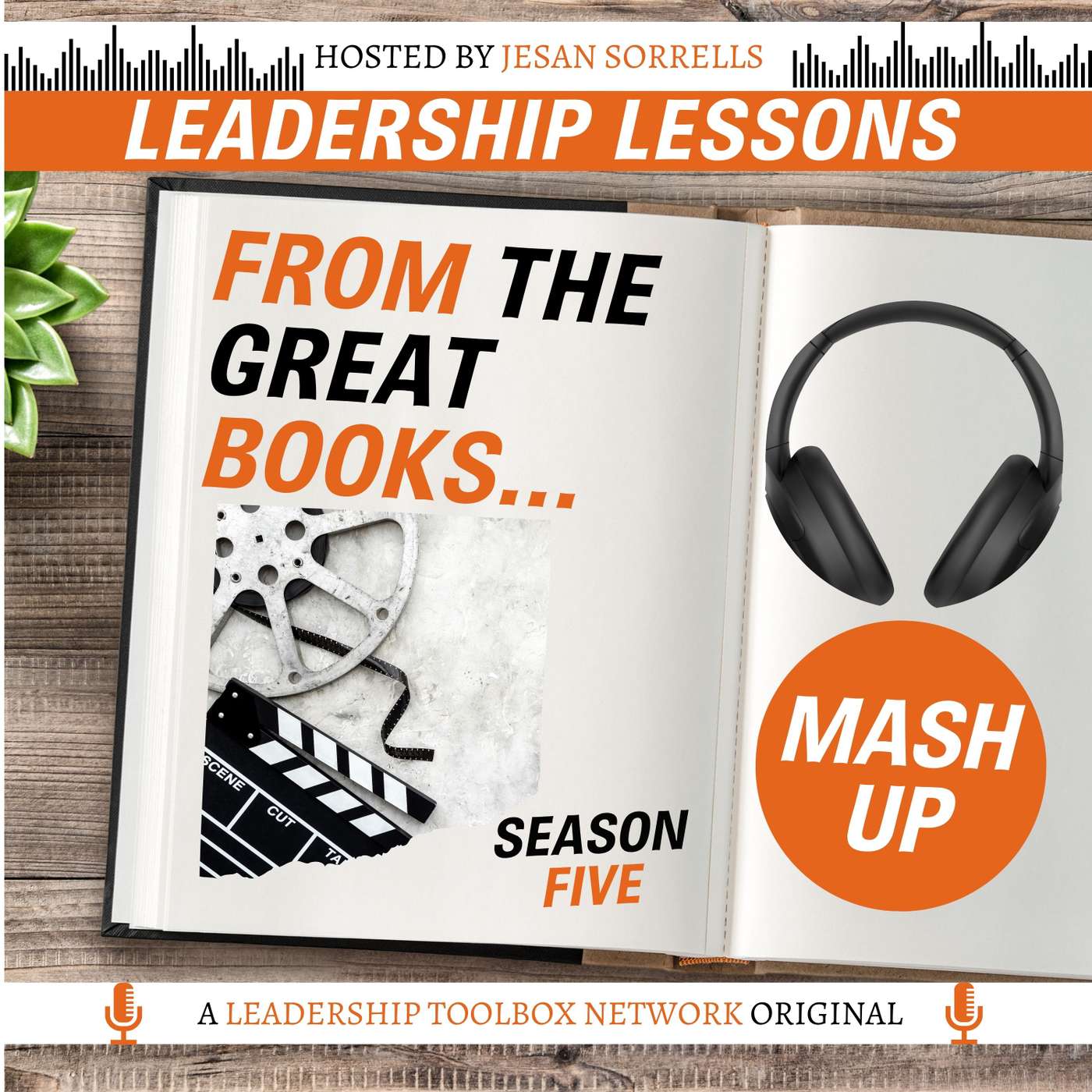
TRAILER - Season Five - Literate Leaders Restore The Chaotic World
Season Five Trailer - Literate Leaders Restore The Chaotic World
---
Kicking off Season Five, host Jesan Sorrells explores how deep literacy from great books equips leaders to separate signal from noise, solve problems, and prepare for generational change. The episode previews upcoming literary analysis, including The Great Instauration by Francis Bacon, East of Eden by John Steinbeck, and The Book of Common Prayer by Joan Didion, focusing on restoration, collective thinking, and solution-oriented leadership in chaotic times. Jesan Sorrells also teases collaborations with past guests and an upcoming leadership education platform, all aimed at providing practical, narrative-driven models for literate leaders.
Featured Books & Authors:
- The Great Instauration by Francis Bacon
- East of Eden by John Steinbeck
- A Book of Common Prayer by Joan Didion
Guest: Jesan Sorrells (Host)
---
Time Stamped Overview
---
00:00 Literacy Fuels Peace and Progress.
04:22 From the Current Chaos to a Future Golden Age.
10:06 What Questions Over Why Questions.
12:55 Patience, Persistence, and Leadership.
17:26 Subscribe to Leadership Lessons from the Great Books Podcast.
---
Opening and closing themes composed by Brian Sanyshyn of Brian Sanyshyn Music.
---
- Pick up your copy of 12 Rules for Leaders: The Foundation of Intentional Leadership NOW on AMAZON!
- Check out the Leadership Lessons From the Great Books podcast reading list!
---
★ Support this podcast on Patreon ★
- Subscribe to the Leadership Lessons From The Great Books Podcast: https://bit.ly/LLFTGBSubscribe
- Check out HSCT Publishing at: https://www.hsctpublishing.com/.
- Check out LeadingKeys at: https://www.leadingkeys.com/
- Check out Leadership ToolBox at: https://leadershiptoolbox.us/
- Contact HSCT for more information at 1-833-216-8296 to schedule a full DEMO of LeadingKeys with one of our team members.
---
- Leadership ToolBox website: https://leadershiptoolbox.us/.
- Leadership ToolBox LinkedIn: https://www.linkedin.com/company/ldrshptlbx/.
- Leadership ToolBox YouTube: https://www.youtube.com/@leadershiptoolbox/videos
- Leadership ToolBox Twitter: https://twitter.com/ldrshptlbx.
- Leadership ToolBox IG: https://www.instagram.com/leadershiptoolboxus/.
- Leadership ToolBox FB: https://www.facebook.com/LdrshpTl
Because understanding great literature is better than trying to read and understand yet another business book on the Leadership Lessons from the Great Books Podcast, we commit to reading, dissecting, and analyzing the great books of the Western canon. You know, those books from Jane Austen to Shakespeare and everything else in between that you might have fallen asleep trying to read in high school. We do this for our listeners, the owner, the entrepreneur, the manager, or the civic leader who doesn't have the time to read, dissect, analyze, and leverage insights from literature to execute leadership best practices in the confusing and chaotic postmodern world we all now inhabit.
Welcome to the rescuing of Western Civilization at the intersection of literature and leadership. Welcome to the Leadership Lessons from the Great Books Podcast. Welcome to the Beginning of the Next Historical High.
But before I get into why this is the beginning of the next historical high, let me hit you listeners with some statistics to start off this new year. According to the National Literacy Institute, 21% of adults in the United States were illiterate in 2024 54% of adults have a literacy rate below a sixth grade reading level. 20% of adults are below a fifth grade reading level. Now. Literary statistics matter a lot to me as I host a literary and leadership podcast because they are a bellwether, usually for other more substantive and systemic problems, from voting for someone for the local city council to avoiding being fooled by the products of an online bot farm.
Being able to read the words on the page or on the phone is important. But even more important than being able to read the words on the page is the ability to understand those words and to be able to make meaning from the words and make decisions from the meaning behind the words we understand, and even the ones we don't understand. Nothing begins without people understanding the words they're reading and being able to argue and discuss and contemplate the meaning of those words. But there's one other area where we need to have deep literacy, and I'm not talking about critical thinking here.
Critical thinking comes after literacy and even after comprehension. We need the ability to make plans for the future based on the meaning of the words we read, the words we comprehend, the meaning that we seek to understand.
Why is this important? Why am I talking about this right now? Well, during times of chaos, during times of disruption, during times of a shifting consensus in a dynamic country like the United States of America, where I live, making meaning of words matters quite a bit in the pursuit of defining, developing, and determining the the nature, depth, and breadth of problems, the meaning of words and the ability to Understand the meaning of words becomes even more critical to track and determine in the transition from a time of chaos into a time of historical prosperity and peace.
There's an idea in business around signal and noise, and words can be both the signal and the noise. But literacy, comprehension, and critical thinking, these three are the tools that we use to separate the signal from the noise.
Now, I'm going to use a word here or a term here, and I want you to. I want you to hook onto this one. The transition from a historical low of chaos and collapse to a historical high of prosperity and construction could be defined by the term, by the words golden age. But how you comprehend that term, what meaning you make from it, well, you might need some help with that part.
A couple of years ago, I expressed the frustration that I have with our constant mastication over problems without moving people towards solutions to problems. Over the last couple of years on this podcast, I have taken time to, at the end of each of our episodes to discuss with our guests the solutions or the potential solutions to leadership problems that are present in our society and culture. Here at the close of the fourth turning, which I suspected the fourth turning was beginning to close back in 2023, this ongoing frustration over the constant chewing over of problems led me to cover books with guests like Shop Class as Soulcraft by Matthew Crawford, the Omni Americans by Albert Murray, as well as Tender Is the Night by F. Scott Fitzgerald and 1984 by George Orwell.
These books, along with many others, opens the door to allow me to talk with my fellow guests and to talk with you as listeners about the problem of respecting the followers you have as a leader, the problem of a return to collectivist thinking, and not in the way that Lenin or Marx would define it, and resurrecting such collectivist or collective or communal thinking from the rubble of the idolatry of individualistic thinking. These books opened the door to me being able to talk about putting aside personal trauma in order to develop other people.
And these books opened the door to me being able to talk with guests about how to develop serious speech that would demonstrate the depth of serious thinking that a leader and quite frankly, everybody should have.
We talked about these problems and we proposed solutions. And in each one of these areas, along with many others, we propose solutions that we covered on the show last season. We actually talked about solutions, some radical, some more pedestrian, but all solution based. The guests that we had actively explored all those potential solutions and engaged with these ideas in the realm of I ideas, which of course is what a podcast I believe fundamentally is for and now, in 2026, starting the fifth season of the Leadership Lessons from the Great Books podcast, we are going to level up yet again and we're going to begin to explore ideas.
Not only those ideas that lead to solutions, but also ideas of restoration in preparation for a future that I believe we are not quite yet prepared for. Whether that is spiritually, morally, ethically, much less materially, scientifically or even biologically. We will be doing this. We will be holding this conversation around restoration and preparation for the future through exploring essays like the Great Instauration by Francis Bacon. And we will go through there all the Way to east of Eden by John Steinbeck.
We will wind our way through A Book of Common Prayer by Joan Didion, and we'll talk about the Great book Ben Hur A Tale of the Christ by Lew Wallace. And towards the end of this year, we will end up in the space of the U.S. army and Marine Corps Counterinsurgency Field Manual edited by General David Petraeus, Sarah Sewell and John Nagel. And finally, we will close out the year by exploring Tolkien and the children of Huron. We will use these books to connect with literate leaders with high comprehension, deep compassion, and literate leaders who have impatience, who are experiencing impatience with the speed of the coming historical high, and of course who are looking for ideas, looking for solutions to what restoration would potentially look like.
So here's a few questions to sort of set yourself up for the upcoming podcasting season. Why do smart leaders read Voltaire instead of the Harvard Business Review? What are the implications of addressing diversity challenges as a conflict of visions rather than as a world ending existential crisis? What is a Tim show? And why does knowing what it is matter to building for the good rather than just maintaining a position in stasis? And what is the importance of decentralized decision making? I am fascinated by the difference between what questions and why questions.
Why questions tend to be problem oriented and the endless pressing of the algorithm in our lives has flooded us with why questions, why this, why that, and why the other. But what questions are solution focused? What is the problem? What can we do about it? What are the options? These types of questions, questions that begin with the word what are more interesting than asking endless why? Questions that merely serve to drive or feed the algorithm. These are the questions that drive thinking about solutions and implementing those solutions rather than continuing to drive a problem based narrative.
The lessons we can learn from reading the great Books have been the primary focus of this show for the last five years and great books Ask and Answer what Questions this year we are moving with several partners and current and former guests into two areas of great impact and of great interest in 2026 that will further allow us to explore the answers to what questions. We are starting to bring together ideas we've explored on this show since season one into writing a book series with contributions from current and former guests, focusing on our discussion of the potential leadership models that arise when you read books written by Jane Austen, plays written by William Shakespeare, books written by John Steinbeck and Ernest Hemingway, or even solutions to life proposed by Booker T. Washington and many, many others.
It turns out that a lot of these books have the answers to the why embedded in the what deeply in narrative structures.
We're also exploring a project, and I'm not going to give the name of it right now, but we're exploring a project, developing it with other partners to leverage the insights, the commentary and the conclusions from the podcast episodes we've done over the last few years, moving those into a working leadership education platform. This idea is still in its genesis, it's still in the planning stages, it's still in the paper and pencil sort of mode. And so stay tuned for more details as we move this project forward.
I once heard years ago as an entrepreneur, and I've taken this throughout my entire life, that and my career actually, that it takes 10 years to become a quote unquote, overnight success, whether you're an entrepreneur or a business owner. Over the course of my life, over the course of my adulthood, I've. I've taken on a lot of other hard things. And you know what I found out? I found out that it takes 10 to 12 years to get your black belt in the martial art of jiu jitsu. It takes 10,000 hours or 10 years to move from being a novice to beginning to starting to be a master at any pursuit worth taking up.
Anything worth doing takes about 10 years to begin to get even remotely good at
the same thing. It turns out with podcasting, I'm heading into the fifth year of hosting this show. Hosting a podcast like this, with a lot of moving parts involves learning, developing and executing the skills of writing, speaking, recording, editing, marketing, and finally distributing. I think at this point I'm about halfway through a 10 year long process to get better, to move from novice to beginning to be a master. And underneath it all, underneath all of this journey, underneath all this process, underneath all of this writing and speaking and recording and editing and marketing and distributing, the most valuable skill.
Well, not even valuable skill, the most valuable thing I'm earning consistently by showing up week in and week out every week is is is permission. The permission to speak into your ears and the permission to have your retention to build a future. To sincerely build a future. I think we want to actually leave for the people coming after us. I look forward to continuing to earn the ears and attention of some of the most literate leaders, visionaries, builders and executors who listen to this show in 2026.
And I thank you for what you have given me so far. Happy New Year and welcome to the next historical high.
And well, that's it for me. Thank you for listening to the Leadership Lessons from the Great Books Podcast today. And now that you've made it this far, you should subscribe to the audio version of this show on all the major podcast players, including Apple, iTunes, Spotify, YouTube, music and everywhere else where podcasts are available. There's also a video version of our. Podcast on our YouTube channel like and subscribe to the video version of this podcast on the Leadership toolbox channel on YouTube.
Just, just search for Leadership Toolbox and hit the subscribe button there on YouTube. And while you're doing that, leave a five star review. If you like what we're doing here on Apple, Spotify and YouTube, just go below the player and hit five stars. We need those reviews to grow and it's the easiest way to help grow this show and tell all your friends, of course, in Leadership. By the way, if you don't like what we're doing here, well, you can always listen to another leadership show. There are several other good ones out there.
At least that's what I've heard. All right, well, that's it for me.
 Apple Podcasts
 Castbox
 Castro
 Goodpods
 Moon FM
 Overcast
 Pocket Casts
 Podbean
 Podcast Addict
 Podcast Republic
 Spotify