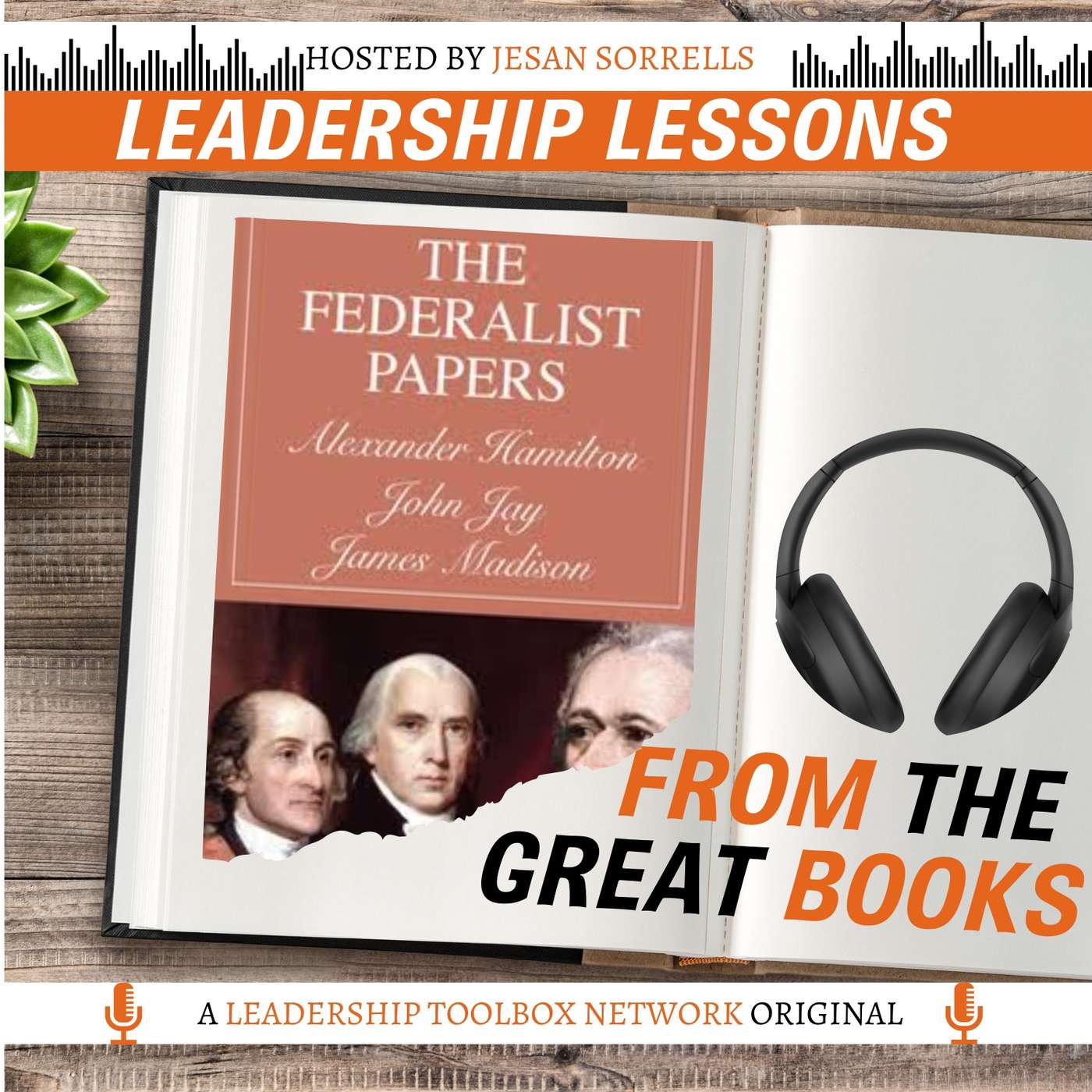
The Federalist and Anti-Federalist Papers - What Lies at the Bottom of Our Constitutional Order w/Dorollo Nixon
The Federalist and Anti-Federalist Papers - What Lies at the Bottom of Our Constitutional Order w/Dorollo Nixon
---
Jesan Sorrells and Dorollo Nixon, Jr. examine the foundational debates framing citizenship, rights, and law in the United States through readings from The Federalist Papers and recent (2026) Supreme Court case analysis. They discuss the evolving meanings of “a more perfect union,” birthright citizenship under the 14th Amendment, Fourth Amendment protections in the digital age, and the challenges of culture and authority facing contemporary American leadership. Supreme Court rulings on mass migration, surveillance, and biological reality take center stage as turning points shaping the future of the republic and the prospects for building strong, resilient communities.
- Book Title: The Federalist Papers
- Author: Alexander Hamilton (and others)
- Guest Names: Jesan Sorrells, Dorollo Nixon, Jr.
---
Time-Stamped Overview
---
00:00 Federal government's defense authority - Federalist No.23
05:31 Founders' views on human nature
11:34 Birthright citizenship and legal debates
20:44 Discussing elite influence on legislation
26:21 Justice Jackson's modern writing style
30:38 Discussing Virginia Convention Amendments
35:27 Discussion on privacy rights
43:59 Justice Frankfurter's memoirs discussion
49:47 Discussing crime and lack of protests
52:08 Artificial intelligence and tech giants
01:01:16 Judicial tenure and good behavior
01:03:43 Discussing Supreme Court cases and biological reality
01:08:41 Worldviews and legislative influence
01:16:14 Christian communities and leadership dynamics
01:22:57 Social media spectacle and republic concerns
01:29:37 Building Community and Support Systems
01:30:40 Discussing what America is not
---
- Opening theme composed by Felipe Sarro - Bach - Silotti - "Air" from Orchestra Suite No. 3, BWV 1068
- Closing theme composed by Brian Sanyshyn of Brian Sanyshyn Music.
---
- Pick up your copy of 12 Rules for Leaders: The Foundation of Intentional Leadership NOW on AMAZON!
- Check out the Leadership Lessons From the Great Books podcast reading list!
---
- Subscribe to the Leadership Lessons From The Great Books Podcast: https://bit.ly/LLFTGBSubscribe
- Check out Leadership ToolBox at: https://leadershiptoolbox.us/
0:03 Leadership Lessons from the Great Books Podcast, episode number 196, with Dorollo Nixon. In 3, 2, 1.
0:17 Hello, my name is Jesan Sorrells, and this is the Leadership Lessons from the Great Books Podcast, episode number 196, And 96. We are wandering delicately through a very, very hot summer where I am living towards our big 200th episode. Here we still are in the month of July, though. And, before we get to that big 200th episode, and, well, we're going to pick up kind of right where we left off with a reading today from the Federalist Papers. Number 23, written by Alexander Hamilton. And I quote, the necessity of a Constitution, at least equally energetic with the one proposed, to the preservation of the Union, is the point at the examination of which we are now arrived.
1:15 This inquiry will naturally divide itself into 3 branches: the objects to be provided for by a federal government, the quantity of power necessary to the accomplishment of those objects, the persons upon whom that power ought to operate. Its distribution and organization will be, will more properly claim our attention under the succeeding head. The principal proposes to be answered by union are these. The principal purposes to be answered by union are these: the common defense of the members, the preservation of the public peace, as well as against internal, uh, convulsions as external attacks, The regulation of commerce with other nations and between the states.
1:57 The superintendence of our intercourse, political and commercial, with foreign countries. The authorities essential to the common defense are these: to raise armies, to build and equip fleets, to prescribe rules for the government for both, to direct their operations, to provide for their support. These powers ought to exist without limitation because it is impossible to foresee to define the extent and variety of national exigencies and the correspondent extent and variety of the means which may be necessary to satisfy them.
2:29 The circumstances that endanger the safety of nations are infinite, and for this reason, no constitutional shackles can wisely be imposed on the power to which the care of it is committed. This power ought to be coextensive with all possible combinations of such circumstances. and ought to be under the direction of the same councils which are appointed to preside over the common defense.
2:52 This is one of those truths which, to a correct and unprejudiced mind, carries its own evidence along with it and may be obscured but cannot be made plainer by argument or reasoning. It rests upon axioms as simple as they are universal. The means ought to be proportioned to the end, The persons from whose agency the attainment of any end is expected ought to possess the means by which it is to be attained.
3:20 Whether there ought to be a federal government entrusted with the care of the common defense is a question in the first instance open to discussion, but the moment it is decided in the affirmative, it will follow that the government ought to be clothed with all the powers requisite to complete execution of its trust. And unless it can be shown that the circumstances which may affect the public safety are reducible within certain determined limits, unless the contrary of this position can be fairly and rationally disputed, it must be admitted as a necessary consequence that there could be no limitation of that authority, which is to provide for the defense and protection of the community in any manner essential to its efficacy.
3:59 That is, in any manner essential to the formation, direction or support of the national forces.
4:14 But of course, as Hamilton himself even pointed out, we're going to disagree even about that. In the course of the last 250 years as a nation, We the people of the United States have argued, fought, disagreed, and clashed over what exactly the opening lines of the US Constitution, which Hamilton was seeking to defend there in the Federalist Papers, and which the Anti-Federalists, who we're also gonna talk about today, were seeking to knock down. These terms, right, the opening lines of the US Constitution, we've been arguing over what these actually mean.
4:57 And just so that you have a reminder, here are those opening lines. We the people of the United States, in order to form a more perfect union. The sweep of such a statement is breathtaking in its assumption that perfection can be formed, achieved, and at the furthest end assured for posterity. But the founders who put together the Constitution, some of whom also put together the Declaration of Independence, believed exactly that. Hmm. As Hamilton talked about in that example that I read from the Federalist Papers about national defense, to get to perfection, we need to tacitly agree on some foundational precepts, not only about reality, but also about the nature of agency, autonomy, coercion, freedom, and in the last order, responsibility and accountability.
5:51 Those areas don't determine where rights come from. They emanate from an Almighty God. But those areas do determine just how far fallen human beings can advance who are tragically flawed, deeply sinful, and fundamentally in rebellion against all manner of circumstances and realities. The reason the US Constitution and the arguments around its meaning matter is because the founders understood the fundamental psychology that theology and orientation of other humans in a way that other revolutionaries who have followed in their significant wake, from Rousseau to Marx to Lenin to Pol Pot to even Saddam Hussein, have missed and will always miss.
6:35 I quote from the second generation of founders, the great Henry Clay, this piece. To keep in mind as we have our conversation today.
6:49 Nothing human is perfect. Do not reject the practicable in the idle pursuit after the unattainable. Let us imitate the illustrious example of the framers of the Constitution and always remember that whatever springs from man partakes of his imperfections. Close quote.
7:11 Leaders, today we are going to talk about how to create a more perfect union, not only through partaking of imperfections, but also through clashes and compromise.
7:28 And we are going to do this today through the lens of, as we usually do during this time in July, like we did last year, we're going to do this through the lens of looking at some Supreme Court decisions that recently came down. And we're going to talk about how these interact with ideas that were explored in the Federalist Papers and in the Anti-Federalist Papers with our usual guest in the month of July. Uh, previous guest, by the way, on this show, Libby Unger, said, and I quote, I don't wanna be on in July.
7:59 That's DiRollo's month. So we give it to, and we open with And we welcome back to the show, after talking about the Declaration of Independence, a good friend of the show, our co-host today, DeRollo Nixon Jr., Esquire. How you doing today, DeRollo?
8:21 Oh, no audio.
8:39 Excellent, excellent, excellent. Yes, doing great. Happy to be here. Happy to be here. So let's talk a little bit about the 14th Amendment and birthright citizenship. Let's open up with that one. The Supreme Court came down in Trump v. Barbara that children born in the United States to parents unlawfully or temporarily present are, quote unquote, subject to the jurisdiction of the United States and are citizens of birth under the 14th Amendment's Citizenship Clause. This one created a lot of consternation, Darrell, because it is, it is about the franchise and how the franchise spreads and opens in ways that even Jefferson could not have predicted, nor Hamilton, nor John Jay, nor any of those guys.
9:26 Right. And so, The Civil War, which of course instigated the creation of the 14th Amendment, because after you win a civil war, what to do with the loser's property, which is now no longer a property, but is actually now going to be, going to be looked at as human beings, really does begin to sort of shift around your conception of what the franchise actually really means, not only at a psychological and at a cultural level, but also at a political and social level. And so The 14th Amendment did little at a cultural level, but at a political level, it created this whole new band of people called citizens that, again, had previously been property.
10:09 However, citizenship is not merely a political act. It's also a cultural one. And some people in our country, some parties in our country get that. Other parties in our country seem to not understand the question. So talk a little bit about birthright citizenship. Talk a little bit about anchor babies for those of us who don't know what that means. And what exactly will the Supreme Court's— where exactly, in your opinion, as a barrister of the court, where will the Supreme Court's decision ultimately lead?
10:42 Because I have some thoughts on this myself, but this was a big one from the Supreme Court this session.
10:51 Oh, let's try one more time. Can you hear me now? Yes, go. Y-M-C-A. Yeah, that one I figured out. That was because I turned my head, because my laptop, uh, included non-directionally sensitive mic likes to do funny things, and DeRollo likes to talk with his hands. And be loud. So, yes, Trump v. Barbara. It's an interesting decision. Interesting in the Chinese sense, right? May you live in interesting times. It's an interesting decision. Yeah. It did have a clear majority, barely, that basically said birthright citizenship, that that rule was ancient.
11:43 That it was still in vigor in the United States, and that it encompassed people, including the children of illegal immigrants, regardless of duration. My understanding is also regardless of duration of the illegality. And so 40 years here, for whatever reason, came as babies, then they meet, have a kid. That child is a citizen, meaning the child who's DNA has been here for almost half a century, as well as
12:17 tourists, right? Birth tourists, mothers, as I know Justice Alito addressed in his dissent, who show up lawfully, right? But in his view, not subject to the jurisdiction of the United States, and then have, you know, a child and then turn around and go back to pick a country. He picked one. I'm not going to, you pick that country, uh, because it could be any country. It's irrelevant. It's that the mother was lawfully admitted into the United States as a tourist, and so it's a temporary stay. Um, there's zero intention, at least without subterfuge, there is zero intention of remaining permanently, right?
12:56 Mm-hmm. Or the tourist visa would not have been granted. And so there you are, and then she shows up. Hi, by the way, I'm 9 months pregnant. Bada bing, there you go. Let's go back home because now you've got your citizenship and we can go. You know, we have our birth certificate, we're outie, you know, and it's just like, no, no. What surprised me the most in terms of arguments that I did not expect was Justice Kavanaugh's, right? Mm-hmm. Who agreed with the result because he thought that the executive order went too far based on what Congress had passed in 1940 and then in 1952, and that apparently the executive branch always cites when it's doing enforcement, or related immigration activities.
13:39 Okay. Section 1401, I believe, of 8 USC. So the U.S. Code, Title 8. And so he believes that all Congress needs to do is change the law. And changing the law is obviously much easier than changing the Constitution. It was designed to be difficult to change the U.S. Constitution. So I find it interesting that for him, And of course, you know, with the way the votes came down, you know, one more justice on the side of, yeah, birthright citizenship, for whatever rationale, should not expand to include people who are not here lawfully or who came here under different auspices, you know.
14:28 Mm-hmm. I think he would be in favor of that. And so, you know, that's, that's kind of exciting. It's kind of exciting. One of the things that I thought is,
14:42 that is pregnant in the circumstances, right, is that we're in an era of mass immigration. Mm-hmm. It's a 21st century phenomenon. And Europe, of course, has been swamped with mass immigration for decades. And the United States had a moment when we were, and thankfully under President Trump, lots of that has diminished, right? Mm-hmm. But there was mass— what do they call it? Mass migration. Excuse me, that's the word, mass migration. Because migration just means movement of peoples, right? It's the movement of some set of people.
15:19 And
15:22 they're not necessarily coming over through the lawful points of entry. And so that's why I like migration better, because, you know, very many people do and very many people don't. Great. And so, um, the use of mass migration as a cultural force to basically drown a host culture, Mm-hmm. I just think is, is not just true, but you can find historic examples that show that. And so, you know, I don't, I don't know what he's saying. Certainly on this show, nobody is saying, hey, you oppose this, you're racist.
16:01 No, no. Yet, you know,
16:05 race doesn't play into it in the sense that it doesn't matter where the origin of the mass migration was and thus what the people look like. It's if you look at the host culture, the host nation, And then you watch what happens when all of a sudden there's all of these people coming over the border. It's just like, this is how you can lose
16:29 your identity. It's how you can lose your, the integrity of your culture, right? And so I think those of us who love America and love our culture recognize that we've been welcoming of immigrants from the beginning. And of course there's an asterisk and then there's a footnote there. Right. And I know some of the justices dealt well with both of those points. Okay. The asterisk refers to, well, if you look at the First Immigration Act from 1790, it literally was limited to freeborn white persons.
17:03 Mm-hmm. Right. So we've always welcomed immigrants. We have not always welcomed immigrants from everywhere. We have always welcomed transatlantic immigrants coming over the North Atlantic only. Got it. Okay. At the same time, there's a footnote because that was not occurring. And I know Justice Alito dealt with this. That was prior to the age of mass migration. And not just that, prior to the age of modern or contemporaneous— no, not contemporaneous, modern global tourism on the cheap, you know, something that didn't really start until the 1970s, right?
17:39 Deregulation, certainly in the United States, deregulation of Air transport is what produced the environment we have now, where if I want to go to Paris from Phoenix, Arizona, and I want 2 stopovers, it's not even going to cost me $500 one way. Wonderful. Yeah, that didn't exist, you know, prior to the 1970s. It cost a lot of money. And certainly prior to air travel, ship, shipborne travel costs a lot of money. There weren't that many tourists. There weren't that many de Tocquevilles, right? Right.
18:08 Yeah. And the Crèvecoeurs, there weren't that many of them. You know, there were many more Thomas Paines. Okay, he was going one way and that was it. And he was intending to remain and get enfranchised and do his thing. And that's a, that's a beautiful thing. And I think our country is better because of it. But anyway, that's what the footnote is about. You know, this is prior to modern global tourism, let alone, you know, this era of mass migration where whole populaces are trying to move like Les Helvètes did.
18:40 Yeah. in the Gaul that Julius Caesar was about to conquer. And he put a stop to their migration. Right. So, so every country in the history of the world has determined who gets to be in their borders and who doesn't, who gets to be, to your point about Rome, who gets to be Roman, to your point about Germany, who gets to be German. Every country in the history of the world has gotten, has had the opportunity to decide who gets to be a member of that nation state. And that was back when we had a more robust, particularly at the elite levels, a more robust appreciation for nation states and for, quite frankly, nationalism.
19:23 Ever since World War II, there has been a declining interest among the elites who make our laws and who determine our policies. You talk about the US Code. The elites who put together that code, maybe not in the 1940s, maybe not in the 1910s, maybe not even the 1920s. The elites 100 years later in 2026, they don't view nationalism in the same way that you and I do who actually live on the ground in nation states with specific cultures, with a specific mindset, with a specific set of variables that we can identify as being Italian or German or, or, or English or Canadian or, or, you know, United States of America.
20:13 Right. And America gets hoisted by its own petard because in the early part of the 20th century, we decided, thank you, Emma Goldman, that we were going to be a nation of immigrants because of that damn, the damn wording on the frickin Statue of Liberty that, by the way, is not in the Constitution and is not in the Declaration of Independence. It's not in the founding documents. It's not part of the founding documents. It's part of the— it's a freaking thing etched. I've seen it on the Statue of Liberty.
20:40 I've been there. It's at freaking Ellis Island. It was one moment in time. And yet we are hoisted by our own petard consistently because of that language by elites who
20:52 look at one mass of people in one country as the same as another mass of people in another country. That's the problem we've got to fix, is the elite thinking and the capture of the institutions, right, that these people are engaged in. Because just, just one Supreme Court ruling— and this is where you get to Brett Kavanaugh now— Brett Kavanaugh knows that changing the law is easier than changing the Constitution because the elite capture all the way up and down the block, even in the United States.
21:26 Is too hard to overcome to change the Constitution.
21:31 He believes it would be easier to change the law. Me personally, and this is where I, I, I will now reveal what I'm thinking about this. When I heard about this, this decision, I, I immediately thought, well, the Supreme Court continues its path that it has been on for the last, I would say, 5 to 10 years of kicking things back to the legislature. And literally saying to the second branch of government, stop being social media influencers and fundraising honeypots and do your— pardon my word, pardon my use of the term— do your friggin job.
22:07 Stay in Washington, D.C. where it's 110 degrees and legislate. Stop sending us up this garbage to deal with. The Supreme Court has been consistently saying this in ruling after ruling, except for cultural ones. And we'll get into that later on here today. But it's been saying that pretty much in ruling after ruling. You see this in, in West Virginia versus Chevron last year that we talked about with the EPA. You're seeing this now with the 14th Amendment, with the 14th Amendment, Trump v. Barbara.
22:37 You're seeing that with this. They are yelling at the legislative body to do its job. And yet we're all on Mitch McConnell death watch. Like, that's our greatest thing to do. Or like, what is— I know Marjorie Taylor Greene isn't in the Congress anymore, but like, what's— who's doing what on Instagram? Ooh, who did Nancy Mace burn on Instagram? Ooh, Thomas Massie really got a good one on blah, blah, blah, blah, blah. This is what we're— or Graham Plantner with his Nazi tattoo, like, on— in friggin', you know, Maine.
23:09 This is the garbage that the legislature is consumed with. So I guess the question becomes really for for us, not at a cultural level, although there's a lot of cultural stuff in there. At a legal level, how do we change the law? How do we get the legislature to pay attention enough, get its head out of Instagram and start being an actual legislative body? How do we return to that?
23:35 As a person, as a person who's ran for a legislative body, DiRollo, I put that to you. How do we return to that? Because that's the only way we're going to solve this. birthright citizenship problem. I think Kavanaugh's right. It may not be the only way to solve the citizenship issue, but, you know, it would certainly be easier getting the institutions out of the hands of— they're not out-of-touch elitists, right? They know what they're doing. It's disingenuous to represent them that way. They're not out of touch.
24:13 They believe they have the right to tell us how to— how we're going to live. They're in touch with the wrong things. Yes. And they, and they don't, they don't have a problem making the decisions that show that they could care less about our liberties and our rights. And so I don't believe that changes until, one, we found new institutions on Older principles that have, you know, stood the test of time. 2, we then begin to be selective in whom we elect, right, to choose non-elitists. I'll give a little microcosm of how it could look that would be really strange when you think about it and kind of scary.
24:54 But I mean, I think liberty is worth it. If you look at statistics on where Supreme Court justices went to college, right? And/or to law school. There's an enormous amount of them who went to Harvard, Yale, and almost nowhere else. And so can you imagine if you had a president, and let's make it not so contentious, in 15 to 20 years, and his or her job was, you know, included nominating, say, 5 justices. Okay. Because at that point, it's possible that several of them could, could have died or could die.
25:34 So imagine if that president said, I'm going to intentionally select people who did not go to Harvard or Yale, who never taught at either of those. Here we go. And then we'd have someone from UC Davis, someone from Emory, somebody from University of Michigan or wherever, and all the— or from Rutgers, you know, my law school. So then it's like, okay, Now, I had to put that plug in. Now it's like, okay, you know, how would our jurisprudence depart from its current, you know,
26:11 sclerotic trenches, you know, where even the mud is frozen? How could it get out of there into living channels again? Right. Where there's a relatability, a vibrance, a relatability by the average citizen and a vibrancy to the decisions that makes sense. Okay.
26:31 My worry about reading somebody like Justice Jackson's opinions, okay, somebody like her whose politics I disagree with, whose cultural and social framing of the American experiment I disagree with, right, is when I read her writing, the way she writes and the types of works she cites, that it's very contemporaneous. Okay, so in other words, It seems more living versus somebody where I understand what he's writing, and I won't name the justice. I understand what he's writing about because this is what I do for a living, right?
27:10 I'm a federal trial lawyer. I deal with this stuff. You know, in fact, I have a motion I have to defend against where it's going to turn on, you know, what Congress decided, you know, in 1945 and then later on in 1989. And it's just like, this is— 1988, excuse me. This is, this is what I do for a living. So I understand this. But the problem is, if I leave my office and walk down the hall, and the woman who's working there in the HR company, right, if she doesn't understand it, now we have a problem.
27:41 Okay? Because then if she does not understand justice where I agree with the views, but does understand justice where I think that her whole point of view is off, then only one of them she's going to be listening to because she can't understand the first person, you know. And so I think about that. But, you know, it's part and parcel of the same type of thinking which says, oh, entrenched elites, how do we get rid of them? They're in our institutions. So found new institutions.
28:14 And then actively make choices to deselect the elitists and then to select the people who aren't elitists. And of course, it's going to take some flexibility. It's going to take some tolerance, right? But, um, I don't see another way other than a mass revival. I don't see another way to— which I can't procure. Um, so other than that, I don't see a way to have the elites owning and running our country, right? Begin to say every single one of these citizens has the same rights and liberties, and my job is to defend them.
28:56 Okay, great. So how do we do that? There's certain things to do that could help the process, or they could just, you know, carry out that mandate. And I just don't— I don't see that happening. Without, you know, reseeding, replanting, and growing healthy trees, right? Because a good tree, as you know, is known by its fruit, because a good tree can only produce good fruit, and an evil tree can only produce evil fruit. So now we have an evil tree producing evil fruit. Okay, cut it down and burn it and found some new trees, and then we're gonna have a nice forest where things function the way they do.
29:37 Yeah. You know, for the— Well, let me, let me— okay, so that's a good, that's a good segue into this next piece. So there was another, uh, decision that came down this summer from the Supreme Court, um, Shachry versus the United States 609, right, where the court held something. And I'm going to go to this because this, this relates directly to to something else that did not exist in the, in the 18th century. It goes directly to, well, something else that didn't exist in the 18th century that we're dealing with now.
30:17 So it's not just mass migration. It's also, it's also our technological wizardry that is killing us. So there were several proposed amendments, right, by the Anti-Federalists, additions proposed to the US Constitution by the Virginia Convention. And it was a proposed Bill of Rights on June 27th, 1788. And there were a few of these that I think would jump out at you. For instance, the Virginia Convention proposed that there should be an amendment that stated the following, that there are certain natural rights of which men, when they form a social compact, cannot deprive or divest their posterity, among which are the enjoyment of life and liberty, with the means of acquiring, possessing, and protecting property, and pursuing and obtaining happiness and safety.
31:06 They were not Marxists, by the way, folks. Second Amendment that was proposed, that all power is naturally invested in and consequently derived from the people, that magistrates therefore are their trustees and agents, and at all times amenable to them. Speaking of DiRollo's last point there. And then this other amendment, which relates directly to what we're about to talk about, that every free man— this is from the Virginia folks— that every free man has a right to be secure from all unreasonable searches and seizures of his person, his papers, and property.
31:45 All warrants, therefore, to search suspected places or seize any free man, his papers, or property without information on oath or affirmation of a person religiously scrupulous of taking an oath of legal and sufficient cause are grievous and oppressive, and all general warrants to search suspected places or to apprehend any suspected person without specially naming or describing the place or person are dangerous and ought not to be granted. Close quote. That's from the Virginia Convention, which of course this wound up The language pared down quite a bit, but this wound up being the 4th Amendment of the U.S. Constitution.
32:31 We have moved in the last 250 years to more and more of a surveillance and data, data gathering, data tracking panopticon, an environment that Thomas Jefferson and Hamilton and Madison and Jay at all would not have recognized. Matter of fact, they'd be shocked. at how much we allow surveillance in our lives. And this development, of course, metastasized and accelerated with great haste between the twin monoliths of 9/11 and, of course, your friend and mine, that pandemic called COVID. From license plate cameras to stoplights to apps in your phone needing access to your camera and your microphone, for some odd reason to work, we have surrendered more and more freedom of movement in favor of the freedom to be quote unquote safe.
33:24 Artificial intelligence applications, of course, push this fact to the next logical level and guarantee, or virtually guarantee, without robust protection, that the citizens of the United States will wind up losing all of their Fourth Amendment protections, or at least only keeping them if they behave quote unquote correctly. as defined by elites who are, to DeRolo's point, I'll grant him this, who are focused on other things and fighting other battles, not the ones we're fighting and not the things we're focused on.
33:58 So the recent Supreme Court decision, Chatterjee versus the United States, the court held that, quote, an individual has a reasonable expectation of privacy in records about his cell phone's location. And the police intrude on that constitutionally protected interest when they demand the information, even though for only a limited time. And by the way, those are the 2 most important words, even though, and, and from a third-party tech company. Now, by the way, close quote. By the way, I was not a lawyer.
34:29 I never went to law school, but I do have a shockingly high level of reading comprehension. And I do understand that, as I said, even though and, and both separated by a comma, interestingly enough, as DiRollo once told me, commas do make a difference, does have incredible meaning and impact, this Supreme Court decision. Matter of fact, I believe this decision is a fundamental miracle in our time that is going to go undiscussed and unrecognized. I was shocked. when this came down. Like, I thought, holy heck.
35:09 And I'll give a little background of the, of the story. So apparently, or the case. So apparently an individual was not pulled over, but there was some sort of legal incident with an individual. And the individual's cell phone data was, was desirous to be scraped by the local police. And they, of course, went to Google and told Google, hey, unlock this person's phone and scrape their information. And the person sued them. And this went all the way up to, to the Supreme Court, resulting in, resulting in this, this conclusion, this case.
35:43 Like I said, monumental, because in my adult time, in the time that I've been adult, I turned 21 2 weeks after September 11th. In the years since I have been an adult, there has been more and more encroachment by And again, this is where the comma and the and is important in this decision. Third-party tech companies just working for the government and pretending that there's some penumbra of protection of Fourth Amendment rights of the individual, when in reality that, that veil has long since been shredded.
36:19 There is no Fourth Amendment protection if the local cops I read a story the other day about how local cops, not in the area I live in, but somewhere in Texas, were, were, were using license plate cameras to like go stalk and harass people. This is happening. This is a fundamental Fourth Amendment violation. And that's why this decision is so tremendous. So, DiRollo, how could people build on the miracle of this decision from the Supreme Court and put more of the state back in the box on the Fourth Amendment?
36:55 And also put those private organizations back in the box, too, because they like them and their 400 lawyers in a basement somewhere in Menlo Park are parsing through this, trying to find ways to just continue giving information to the government because the government is actually— the federal government is actually their biggest, in some cases, their biggest customer for data on you and I. Go ahead, Dorollo.
37:22 Yeah, no, it's a great decision.
37:26 There have been inroads made against the Fourth Amendment for way, way, way, way, way too long on one side, on one side. And then it was taken and people just ran with it. I mean, that's how you got Roe, was abuses of the Fourth Amendment. And it's tough in a sense when you recognize here's a principle, or it must be tough because I've never been a— well, have I been a judge? No, I've only had one quasi-judicial job. where I was on a zoning board of appeals. But it's tough where
37:58 you can see the principle and you can see what you want to hold, but the law is telling you otherwise. And so your job then is to scream about it and then uphold the law. And so it's tough. And so that was the position that Mr. William O. Douglass— Mr. Justice William O. Douglass found himself in, in Griswold v. Connecticut. I believe in 1965, when— and Griswold Douglas, excuse me, he was a— he was a— Mr. Justice Douglas was a real liberal. Okay. A guy living however he wanted, like Walt Whitman.
38:31 Okay. And that was that. I mean, brilliant. Columbia Law School. That's probably school number 3, right, for Supreme Court justices. But anyway,
38:43 Connecticut passed a law that prohibited even married couples from using contraception or something like that. And on constitutional grounds, though the document does not mention sex or sexual relations, on constitutional grounds, using the Fourth Amendment, the Supreme Court overturned that. And Mr. Justice Douglas wrote that opinion, and that was the road to Roe. And Roe would follow in less than 10 years based on the same notion of privacy that can't be touched. What bothered me on the other end, which is where we started, is that they were actual tangible aspects of privacy that the amendment protects, and they were just being ignored.
39:23 Right. And for me, the big— the real edema started with the drug war. Right. Because that was the justification for all of this increase in policing. And that was also, you know, what the need was for. That's what created— I mean, you've heard of the expression hot pursuit. It's coming out of the jurisprudence where there's no warrant, but you're chasing somebody. Oh, okay. So how far can we go? Right? And it's just like, let's back up. Why are you chasing somebody? Oh, it's because it's about drugs.
39:56 Oh, okay. So this is, this is what we owe our weakened— in the contemporary context, what we owed our weakened Fourth Amendment protections to was the drug war. Okay. But anyway, How do you build on this? Well, here's why.
40:18 Here's why. Because the drug war is now defunct. Like, right or left, I don't care who you are. The drug war is now defunct. It's done. And there's no— there's nobody who's reasonably— there's nobody who's reasonably saying this is— no, I'll back up. I'll back up a step even further. When the states are legalizing weed, The drug war is over. But that's just weed, you know, like— Doesn't matter. Drug war's over. What's gonna be next? Is it gonna be heroin? I don't care. I do not care. It's over. It's done.
40:49 Let's all just declare that we lost and let's all just go home. Sorry, Richard Nixon. It was an interesting idea. And maybe when you— if you spent more time protecting cultural morality around Christianity rather than worrying about the federal government coming in And failing to recognize that there would be secular people following you, maybe you would have had a better shot. But you didn't. You just assumed that Christianity would just keep going and Christian moral compass would just keep going.
41:16 And that— have you looked at the population of Colorado lately? That is not a correct assumption. That is fundamentally incorrect. So the drug war is over and the Christians lost. The Christian worldview lost. It lost on drugs. I don't know. You know, there's ways to fix it, but it's not going to be in the law. It's going to be in the culture. So let's declare the drug war officially done. Let's put Fourth Amendment violations, search and seizure, people's papers. What is it when they, when they auction off, you know, the drug dealers' stuff that they find?
41:54 Asset seizures, asset forfeiture. I hate asset forfeiture. And yes, I'm using the word hate. I very rarely use that on this show. I have extremely strong opinions about asset forfeiture. I think it is fundamentally a black eye on the republic
42:10 because you're in essence penalizing a person twice. First, you're penalizing them criminally, which I'm all for. Fine, you want to give somebody— and we could talk about maximum minimums and drug laws and that kind of stuff, whatever— but you've already penalized them criminally. And now you're going to penalize them civilly. And they can't even defend themselves in that, in an asset forfeiture situation. And by the way, this has nothing to do with whether or not I'm pro-drug, anti-drug, any of that.
42:38 This is just a violation of Fourth. I look at this again as under the, under the entire tearing of the veil of the Fourth Amendment. We have now wound up in this space with asset forfeiture that now leads into a place where if I don't take the COVID jab because some state doesn't like it, they can seize my children and my property, or even worse, we'll get to this in a minute. If I don't agree that men can be women, they could take my children away from me. As I'm looking at you, California. That law passed.
43:13 But we'll get to that in a second. How do we put— how do we use this ruling? I keep going back to this. How do we— because I think this is the beginning. This is like the Chevron doctrine that got overturned. This is the beginning of something, I think. Unfortunately, we have a legislature that doesn't legislate. So how can we build on this?
43:38 Willing to— you can hear me, right? Yes. Excellent. You have to find a state that is willing to recognize that people, even potential criminals, have the right to
43:51 be secure in their persons, in their phones, in their non-digital papers. Mm-hmm. And that you just get probable cause, get a warrant. Great. That if you back up, you will accomplish more and you will accomplish— you can have significant achievements that are defensible in detail rather than just defensible in terms of numbers. Oh, I took 1,000 perps off the streets, that, that's not really meaningful without understanding how you trampled on everybody else's rights in order to do that, right? That there's some percentage of them that may not even be guilty at all, right?
44:32 And yet here they are because of what you guys were doing. Or is that just tech manipulation? I don't know.
44:39 But I have a quote, and that's why I got up before. I haven't— being an attorney, I have the memoirs of former Justice Felix Frankfurter in my office. And so towards the end of chapter 5, it's called Reminiscences.
45:00 Reminiscences. Felix Frankfurter Reminiscences. What's tripping me up about the word is that there's a related word that former General Douglas MacArthur used, right? I think his is Reminiscences or something. Yeah, exactly. So this is what he says towards the end of— at the end of chapter 5. He's talking about his former boss who was the U.S. Attorney for the Southern District of New York. And so that's the chief federal prosecutor for Manhattan and the Bronx. That's what it means. Okay.
45:31 And it's interesting because he talked in this chapter, talked about immigration, talked about habeas corpus. Okay. Talked about things that are still relevant today. Just like they were relevant 400 years ago in England, you know, they're still relevant today. Can the government arbitrarily keep you in behind bars? Okay, but for how long? Like, that's literally what they were dealing with then, what we're still dealing with more than 100 years later, right, from Frankfurter State. But this is what he said about Henry L. Stimson.
45:58 Okay, and I underlined it because it stuck out because of my views on the Fourth Amendment. Okay. He was rather austere is a little too strong. I'm sure he must have had a good deal of influence on the exactions I make of my young men, what my standards are. This was an incredibly effective and wholly scrupulous man. When he went out to raid a place with a search warrant, not only wouldn't he do it without a search warrant, But he'd send youngsters like me or Tom Thatcher, with whom I shared a room, later Judge Thatcher, to see to it that the raiding officers kept within the limits of the search warrant.
46:43 Hmm. Quote, I'm quoting, but now I'm going to emphasize, okay, no wiretapping was allowed during his whole regime, period.
46:58 There you go. And so, yeah, and I just, I wrote at the bottom of that page integrity, right? This was a federal prosecutor who did his job, who did his job, you know, with great integrity and who knew here's a line and you don't cross that line. More importantly, He knew as a government official, here's a line beyond which we don't have authority, we just have power. And that distinction has been lost, right? So they have the power. So the tech companies have the power to get this information. They have the ability— they being the government— have the ability to ask, hey, can we have this data?
47:42 And because the tech companies aren't necessarily run by patriots, I'll just leave that there. They have zero problem turning over this data in whatever form and on whatever volume. Right? Oh, it wasn't just one guy's data. It was a million people's data. Yeah, but they were able to search and find this one particular guy. Right. So it doesn't matter then. Okay. Mm-hmm. And you knew that they would be able to do that anyway. But that, you know, that there were scruples and that they recognized, you know, U.S. Attorney Simpson did that.
48:15 Look, here's what we can't do. We can do our jobs, we can get our wins, we'll have some losses, but we can still get our wins. And do what we need to do by keeping within our constitutional authority. Moreover, our country's mission, okay, as this arc of freedom, as this place where men can be free, meaning they can exercise their liberties and own property, and to do that under the law is enabled and encouraged and strengthened when we do this. And then when we don't, I mean, are you really safe?
48:53 I mean, were you going to be mugged in East Germany? Were you going to be mugged in East Germany in 1970 when every other person was, was informing to the Stasi? Right. Were you going to be mugged? Probably less than Chicago. I don't want to live in Chicago. I'd rather live in Chicago 7 days out of 7 than East Germany. Period. Okay. Free and safe. Safe and safety. But what does safety mean? You know, what does safety mean? How safe are you when the government has all the cards, when they have all the power, when they can cancel you and take your property and take your kids and keep you in jail on whatever pretext?
49:36 It frustrates me that people will go— they will go to the mats to show up and disrupt ICE. But they won't go to the mats and show up and protest New York City just releasing criminals left and right like it's normal. Like, oh, this is your second murder this month, great, here you go on bail, whatever. And it's just like, why aren't you showing up for that? Where are the protests for that? And what will it take to get you there? Will it take that it's somebody you love who's murdered, and then will you all of a sudden— will the light bulb go on?
50:11 That would be tragic. In several senses, if that were the case. Um, but what would be more tragic is if it never goes on, if the light bulb never goes on and you just stay in the dark, totally comfortable doing your thing and not understanding, hey, you're living in a matrix and the reality is something else. And, uh, you had a moment when you were exposed to the reality and you just called it a glitch and you just kept going. Hmm. And it's like, no, no. I mean, what's that movie? I'm gonna find— I'll find it while you're talking.
50:47 Um, but it's about— it's about somebody who got canceled, but this is like 15 years before it was a thing. I think it's a late '90s movie about, uh, cancel US movie.
51:05 Where actress canceled internet?
51:14 Nope, that's not even close. Oh yeah, come on, Netflix must own that algorithm search. Speaking of the tech company, well, okay, so that's, that's the other piece of this. So the tech companies, right? Netflix, Amazon, um, Facebook, Google, um,
51:40 the combined worth of which is well over that of a small nation-state. Um, they are worth trillions of dollars in the open market. Their executives— go ahead. Got it. Okay, what is it? The Net, 1995, y'all. 1995. It's 31 years old this year. Starring the lovely Sandra Bullock. Sandra Bullock with that girl from the bus, the movie about the computer with the girl from the bus as what's his name said on— Frank Costanza said on Seinfeld when he was going to open up a tech company in his garage and get George to work for him.
52:22 That's right, he's gonna sell computers. And George was like, you're gonna compete with Apple and IBM and these big companies? Yeah, yeah, yeah, yeah, yeah, yeah, yeah. Well, I mean, look, I, I, I, I hate to say this, none of this is new. It's just the technology has gotten better. And my concern with these big trillion-dollar companies is they are now all developing artificial intelligence. And the thing that is being offered to us, the thing that is on offer from these toys, is that we will all be able to sit around and be, to your point earlier, we will all sit around and be able to be safe.
53:11 There will be universal basic income that will come to us just magically out of the sky. And all we have to do is interact with the magical dictionary machine, the magical predictive dictionary machine that will give us everything. And there are enough— pardon my use of the term, folks, not anybody who listens to this show, not anybody who's on this show, talk about other people— there are enough fools in the world who will believe this. There's never been a shortage of fools who believe that nonsense.
53:45 I think Fourth Amendment violations get to be more— I think one or two things will happen. I think they will be harder to identify. And I also think that they will be tougher to stop when, when, when, because right now artificial intelligence is in its early adopter era. Most average people aren't interacting with AI in any kind of meaningful way. And it's being imposed as a top-down fiat from these organizations rather than as a bottom-up organic thing the way the internet was. And top-down fiats and innovation never actually work.
54:19 They get abandoned unless, of course, there's a, there's a pandemic or a war or some other kind of thing that forces people to give up their rights. Um,
54:35 I'll just ask you this follow-up question. Thoughts on AI? How does AI interact with this? Do you— am I seeing this correctly, or am I totally out the wazoo on this one?
54:47 Oh, oh, start again. Can you hear me? Yeah, go ahead. Excellent. YMCA, We Will Rock You. I'm just, you know, songs from the '70s. Any of them? Yeah. You're gonna start off with Bobby Blue Bland in a minute, and we're gonna all be in trouble.
55:10 Yes, AI can take it to a different level. And then what happens when, you know, municipalities start adopting it to do other things? Like, what about when it's just profiling people with data that municipalities collect? And it's like, I know they made a movie about this. I think it starred Tom Cruise, but where we're going to figure out in advance who's going to commit crimes. Minority Report. Yep. And then it's like, all right, so here we go. Boom. Um, pre-crime. Pre-crime. Yep. Right. Because AI is that smart, right?
55:40 Um, now there's one really cool thing about it, and, um, I'm trying to find a good reference, so I apologize for not having it, but any Christian What am I saying? It's 2026. Christians believe that God is a Trinity— Father, Son, and Holy Spirit. I was going to refer to the arguments people used to have, and it's like, stop, Derulo, it's 2026. Less than 1% of people even know what you're talking about in that regard. So just say it, say it. All right, so Father, Son, Holy Spirit. There's a, there's a tech anti-Trinity, and all I can remember is something like tech will save you as the false savior, and I can't remember the other parts.
56:24 But what I like, in quotation marks, meaning I don't really like it, I think it's horrible. It's just that it's going— our giving ourselves this tech as if it's our savior is going to bring humanity to a place where humanity is then actually ready to recognize, wait a minute, that was all a lie. And now we're worse slaves than we were before. We need an actual savior who can come in and liberate us from this. Yeah. And then it's like, there you go. So I can see it coming, you know, where it's like, oh, but the tech is going to save us, you know, save us from environmental disaster, from this, from whatever, you know.
57:00 And it's just like, stop, you know, read the Bible, stop. Um, so on the environmental aspect, I stopped my research right when I would find passages. And the one that's of course coming in my spirit is from I think it's from the Epistle to the Hebrews, but it talks about how the Son of God is upholding the entire universe with his word. And it's like, okay, I don't have to worry about the earth if the entirety of creation is being upheld by a word. A word. That's power and that's authority. A word.
57:34 Got it. Okay, so you're over here trying to do your crusade to do whatever, and of course Let me back up. I like recycling. I love conservation because I love, I love the earth. I love hunting. Okay. So it's just like, I understand that there are processes to follow to better take care of the earth. And not just that, when you're abusing the earth, you're actually sinning against the earth's creator, period. Okay. These are Christian ideas. They're not new. Right. Go ask a farmer, hey, what happens if we put all this crap in the water?
58:04 Oh, that's horrible. So what do you— right. They get it. They get it. Hunters get it. Hikers get it. Campers get— we get it. Okay, I don't want to go camping in the woods and here's your trash because you couldn't figure out how to use a receptacle and recycle. I get it. Okay. But, um, as you delve more deeply into the enviro— and then sometimes literally enviroterrorism, right? Just the way things go. Um, there's something that is theological at its base. Oh yeah. They're mislaying. Okay. Oh yeah, where, uh, their theology is wrong.
58:40 That's the problem, right? Or even more accurately, their theology is satanic, and therefore they are saying these things and doing these things that are negatively impacting Imago Dei, but also the earth. That's some of the irony of it, you know. It's just like the earth is fascinating, like the human liver. Um, which of course you don't hear U.S. doctors saying this, right? The, the human liver has this tremendous capacity to heal itself. Oh yeah. It's kind of scary. Uh, and the Earth has an even greater one.
59:09 Just leave her alone, as it were, for like 50 years and watch what happens. And so it's just like, oh, how do we fix this? Leave it alone. No, just don't touch it. Just leave the Earth alone and watch what hap— oh, look, renewal. Uh-huh. Because there's something operating there. a principle and things that are actually doing the principle that will teach you if you're humble enough to listen. And if you're not, then you're, you're going to be doing your crusade. Yay! You know, and it's just like, no, you're doing your crusade, canceling investments, um, creating state mandates to do things, you know, doing an energy moratorium in a state that has tremendous problems with energy infrastructure.
59:51 That's you, New York. Right. And it's just like, no, no, no, no, no.
59:58 When we look at all of these things, there's, there's one other case I'd like to talk about today, but I want to open up before we want to sort of introduce that with some ideas that Hamilton has in the Federalist Paper number 78 about the judiciary department and specifically about the character, I believe it is. of the judiciary. And I quote, we proceed now to an examination of the judiciary department of the proposed government. In unfolding the defects of the existing Confederation, meaning the Articles of Confederation, the utility and necessity of a federal judicature have been clearly pointed out.
1:00:41 Is the less necessary to recapitulate the considerations there urged as The propriety of the institutions in the abstract is not disputed. The only questions which have been raised being relative to the manner of constituting it and to its extent. To these points, therefore, our observations shall be confined. First, as to the mode of appointing the judges, this is the same as that, as with that, uh, as of appointing the officers of the Union in general, and has been so fully discussed in the 2 last numbers that there is nothing that can be said here which would not be useless repetition.
1:01:16 Second, as to the tenure by which the judges are to hold their places, this chiefly concerns their duration in office, the provisions for their support, and the precautions for their responsibility.
1:01:28 According to the plan of the convention, all judges who may be appointed to the United States are to hold their offices during good behavior, which is conformable to the most approved of the state constitutions. and among the rest, that of this state. Its propriety, having been drawn into question by the adversaries of that plan, is no light symptom of the rage for objection which disorders their imaginations and judgments. The standard of good behavior for the continuance in office of the judicial magistracy is certainly one of the most valuable of the modern improvements in the practice of government.
1:02:03 In a monarchy, it is an excellent barrier to the despotism of the prince. In a republic, it is a no less excellent barrier to the encroachments and oppressions of the representative body, and it is the best expedient which can be devised in any government to secure a steady, upright, and impartial administration of the laws. Whoever attentively considers the different departments of power must perceive that in a government in which they are separated from each other, the judiciary, from the nature of its functions will always be the least dangerous to the political rights of the Constitution, because it will be the least in a capacity to annoy or injure them.
1:02:41 The executive not only dispenses the honors, but holds the sword of the community. The legislature not only commands the purse, but prescribes the rules by which the duties and rights of each, every citizen are to be regulated. The judiciary, on the contrary, has no influence over either the sword or the purse, no direction either of the strength or the wealth of society. And can take no active resolution whatever. It may truly be said to have neither force nor will, but merely judgment, and must ultimately depend upon the aid of the executive arm, even for the efficacy of its judgments.
1:03:19 I would agree with Hamilton, but
1:03:26 In our time, over the— actually, over the last 100 years, and specifically with all rapidity up through the last 50 years or so. And DiRollo mentioned Griswold versus Connecticut. That was the first Supreme Court decision. Then following on to that with Roe v. Wade in 1973, and then Obergefell in 2015. Then now the most recent case that we're going to talk about, West Virginia versus BPJ. The Supreme Court, the judiciary, has been asked with increasing fervor to take up cases about the nature of biological reality itself, which are cases that the Supreme Court have nothing and should have nothing to say about.
1:04:16 Such cases would perplex and mystify the founders, from John Jay to Patrick Henry, because while they may have disagreed about the nature of rights and the distribution of state power, they didn't disagree about the nature of biological reality itself. Both John Jay and Patrick Henry and Thomas Jefferson at all would have been stunned to hear us arguing about whether or not a man can be a woman, a woman can be a man, or whether men and women are interchangeable people, interchangeable entities. They would find such an argument, such discussion, to be the sign of pagan perversion.
1:05:05 And that's not me being too harsh in my language.
1:05:11 But because we live in pagan times and because Christianity is
1:05:17 the long, drawn-out retreat from culture is what Christianity is in right now. The moves that cultural progressives, not political, but cultural progressives, have made utilizing the judicial and legal arm of the Supreme Court has turned the court into an arbiter of reality itself, a role that it was never meant to take on. By the way, this is a place even Jesus was hesitant to tread. If you don't believe me, just look at Luke 12:14.
1:05:54 So if we're going to have arbiters of reality itself, whether that's biological reality, Well, let's keep it to biological reality. We're going to have arbiters of biological reality who are going to be fundamentally pagan or progressive in their mindsets and rarely Christian.
1:06:15 How do we— well, first off, what do you think of this case? And then second, am I correct in, in, in seeing the the path from Griswold v. Connecticut to, to this case, West Virginia versus BPG. Am I correct in, in, in my analysis here of the Supreme Court being asked to step in and determine things that it was not meant to determine? And then finally, I guess the third question is, just like with the Fourth Amendment, how do we put this genie back in the box? How do we prevent cultural progressives— prevent, Yeah.
1:06:53 How do we dissuade cultural progressives, whether on the political right or the political left? How do we dissuade them from bringing nonsense like this to the court? I don't think we can dissuade them. So I— Because this is nonsense. Like, it's nonsense. But what is nonsense? The idea that a man could be a woman, or the idea that somebody thinks that he's a woman and he's really a man, or— but what part is the nonsense? The nonsense is that whether or not they are a man or a woman, whether or not they have a problem negotiating reality, whether or not they have a mental illness, whether or not they have gender dysphoria, none of that should be arbitrated by the law.
1:07:45 The law has nothing to say about— should have nothing to say about any of this. This is a cultural issue at best. The law as an arbiter of reality at that level should have— should always stand mute and should say, let the culture figure it out. I don't know. You people figure it out. We have nothing to say on this. Right. But once the legislature steps in and then takes a position, then there can be lawsuits arguing that the position is illegal. legitimate or— Oh, I would go even to the legislature.
1:08:19 Yeah, I would go to the legislature. I would take the legislature out of it too. But I, but, you know, I get it. Like, there's steps in the process. Yes. I would even start with the legislature. But that's where I was going. I wouldn't start with the legislature. Well, so we went down that route and got them to change. I'm okay with that. But here, here's, here's why I think the legislature is necessary. Okay. Because I used to think they weren't in the sense that This is a cultural issue, so just let— leave the culture alone, let the culture figure it out, right?
1:08:49 And then what I noticed is basically every other worldview, every other religious position eventually tries to co-opt power to then enforce on a populace its own worldview. It is axiomatic that that's what worldviews do. To put it in more relatable terms in a contemporary, in a contemporary context, Okay, if I'm going to form a running club to run on roads and not run in the woods, right, I'm going to select people who want to run on roads and not in the woods, and I'm going to deselect people who say, no, you should really be running in the woods.
1:09:29 No, we're a road runners club. If you don't like road running, then don't join our club, right? So to be a little more blunt, Every other worldview is trying to use government to force their views on everybody else. That's why the legislature matters. That's why you need people in the legislature who share your worldview so that they can say, you're not doing that. We're not passing a law that does this. We're— or we're passing a law that says this because this is nonsense and it needs to stop. Okay.
1:10:01 Well, Ms. Ketanji Brown Jackson was asked in her Senate Subcommittee confirmation hearing. Uh-huh. Can you identify— can you define what a woman is? And Justice Ketanji Brown Jackson said, and I quote, I can't do that. I don't know what a woman is. Okay. So we've got a— we've got a Supreme Court justice. And by the way, I don't think she's the end of the argument. I don't think she's the period at the end of the statement. I think she's the beginning of an ellipsis that's going to extend out over the next couple of generations.
1:10:42 Because the character of the Supreme Court justice is now in question. You were talking about education earlier. You're talking about Harvard, Yale, Columbia, maybe on the outside, Princeton. I don't care about your fancy schools. I care about your character. And Ms. Ketanji Brown Jackson may have graduated from a fancy school, God bless her, just like Brett Kavanaugh did, just like Justice Alito did. But your character, your character actually influences you quite deeply on these questions that are coming before the court about biological reality.
1:11:26 By the way, the feminists all didn't like Brett Kavanaugh because they thought he was a rapist and they protested against him. Is that really why they did it? Well, that's what they said. And I can only go on what people say. I don't know what's in people's hearts. I'm not— who made me the arbiter between you and reality, right? To paraphrase from Jesus, I'm not that arbiter. I have no idea. I only know what you came out with, what fell out your mouth. So we are in character arguments around these people, but we don't even have a definition.
1:12:02 Talk about worldview. We don't even share a worldview about what appropriate character is. Mm-hmm. Mm-hmm. Mm-hmm. Mm-hmm. Real problem when we're asking them to arbitrate whether or not a man could go into a woman's restroom or whether or not boys can play women's girls sports or whether girls can play boys sports. But only because of their view of jurisprudence, right? What does the law say?
1:12:27 The law right now doesn't say anything. The law is— the law is in some cases, in some municipalities, the law is mute. In other municipalities, the law is yelling about all kinds of things. Remember I mentioned California previously? If I get a divorce, if I were— if I were to get a divorce in California,
1:12:47 Okay. And my wife decided that my son— my ex-wife decided that my son had a desire to transition from being a son to being a daughter. And I objected to that and attempted to take my child under a shared custody agreement out of the state. There is a law on the books in California. This is the screaming example of the legislature. Where if I take that child out of state, I could be tracked down
1:13:17 by the state and prosecuted and dragged back to California along with my child, who will then continue to be transitioned.
1:13:28 What the hell?
1:13:35 Which is why my problem starts with the legislative body. But at the end of it winds up with— you wind up in the judiciary and the character of the judiciary used to be a bulwark against stuff like this. And by the way, I agree with West Virginia versus BP. Right. I agree with the Supreme Court ruling, but that doesn't mean that next year there won't be a similar ruling on a— or not similar ruling, but an opposite ruling that will show a remarkable lack of consistency, as is usually present in the common law.
1:14:06 Because there's nothing in the Constitution about, about, about biology. There's nothing in the Constitution about gender. They wouldn't have understood the question.
1:14:19 Oh, can't hear you.
1:14:24 No. Yeah, go, go. There you go.
1:14:29 YMCA. We will rock you.
1:14:33 So there are several reasons, in my opinion, why the founders would not understand the case. Okay. The transformations within the American Republic to get a form of government that we now have would be something that I think that would stop most of them in their tracks. They would not— maybe Hamilton excepted— wouldn't be able to comprehend the massive scope, right? And the depth to which government monitoring and analysis, data collection and response occurs every second of 2026. Now, the narrower reason why U.S. government policy— or sorry, the narrow reason why federal courts were revoked, right, was Title IX.
1:15:18 Mm-hmm. And so that's what I meant with Congress taking that step and then producing this. Um, the statute, right, which is now then going to achieve certain things for one part of the population only. Okay, fine. Um, and it's just, um, I don't, I don't know.
1:15:40 Um, so the fundamental problem I have is that I just can't, I can't see it operating otherwise unless we Christ followers just abandon government, meaning we're just gonna let you do whatever you want. We recognize from Romans 13 we have a duty to submit to what you're saying, and so we will, but we're just gonna let you do what you want and pray for you all, and we will go on with the actual work of advancing the gospel and focus on that. And you guys, you're gonna do whatever, and God will deal with you, and we're just gonna do what we're doing, and he's gonna deal with us, and that he's with us and not with y'all.
1:16:13 Boom, you know. And so then I would expect persecution with the gospel actually going out, and then there's much more real fruit. Okay, but it doesn't end there. Okay, because eventually we get, in my opinion, we get right back to where Britain, not England, but Britain was in the 5th and 6th centuries. Okay, where Christian communities ended up having either creating Christian polity. So now we have a leader who shares with the, um, with the body of people over whom he's responsible a worldview, right?
1:16:51 Or that's not shared, but the leader says, I will protect you guys and your right to live the way you want. And so they say, this contract we can deal with, right? That's where Britain was in the 5th and 6th centuries. And so it's just like, um, I think that abandoning politics moving forward eventually would get around to that point where it's like, hey, Christian communities are going to start to then recreate or, or re-erect, right, leadership that shares the worldview. Okay. And so, but again, it's, it's, to me, it's axiomatic that individuals and communities, all of whom have the particular worldview they have, that they want to see leadership who share that worldview.
1:17:39 And that they will use, you know, political authority and governmental power to enforce their worldview. I mean,
1:17:49 no one is here arguing for the liberty of child marriage. Nobody. Right. Because it's offensive to our worldview. That's why. Yeah, well, but you know what? That's why we want the legislature saying you're not doing that. That— but that's why. That's why. It's because that's our worldview. Now, somebody shows up from a different culture with a different worldview where that's okay and survives being chucked into jail once we figure out what he's actually doing, right? Because it, you know, ain't no woman advocating this.
1:18:17 We know that. So this dude, right, if he survives not getting chucked into prison— and he wouldn't survive prison, we know that— if he survives getting chucked into prison because of his current status quo of how he's living, right? Right. if he's honest and courageous, would advocate for a change in the law to allow for his worldview. It's totally normal. Okay. We used to have a system where they recognized, just like Frankfurter's old— Justice Frankfurter's, you know, old boss, right? Here's where our authority ends, and then all we have is power.
1:18:49 Okay. The notion that you have authority without power, okay, or that you can have power without authority, I would argue that those are Judeo-Christian notions, and that the other worldviews do not make that distinction. Therefore, the pagan doesn't see that, and therefore there are no limits to how far they will go. There are none.
1:19:15 There's no horizon. They'll just keep going because there's no distinction between power and authority.
1:19:23 None. You know, I don't, I don't expect them to stop. Yeah. You know, I mean, we're gonna have a court case that's, that's arguing about whether or not there's an actual court case, you know, and it's just like, and not like jurisdiction, but literally in terms of like ontology and, and where it's crazy, right? But to them, it, it makes sense. I mean, we will have lawsuits run by dogs soon. Run by dog, by canines, by actual dogs. Okay. in an animal rights suit. That's what we will find. And we will see humans who will say, I've got to confer with my client.
1:19:58 And literally, they'll turn to the dog. Literally, I'm not even making this up. This is going to happen. Watch. It will happen in 10 years. Watch. You will see a suit where it's a dog plaintiff and there's a human who purports to represent the dog and purports to take direction from a freaking canine.
1:20:15 Because Imago Dei has been so Um, uh, dishonored, has been so, um, not brutalized but just trampled upon. Yeah, um, that, that's what we should expect, you know. We should expect that and not just protests and SPCA and their enforcement actions, not just that, but literally there's gonna be a lawsuit run by a freaking dog, not a lawsuit run by a trust
1:20:44 to which you know, that actually owns the property, right? Yeah. So, or the dog is the beneficiary of the trust. And so the trust is, you know, in— the trustee is therefore filing suit on behalf of the beneficiary. Like, okay, fine. That I could understand. But that's not what we're going to be dealing with. Watch, you'll see. We will be dealing with—
1:21:06 what the heck is this? We will be dealing with— pardon me. We will be dealing with that. And but that's why— that's where I see In its root, that's how I see that those set of behaviors happening. Okay. That because there's no distinction between power and authority, I have power. So here's how I'm going to use it.
1:21:27 Hey, I can still use it. So I'm going to keep going. I can still use it. I'm going to keep going. They're actually listening because that's one of the secondary causes, right? The fact that the legislature has been asleep for 20-something years is a secondary cause. It's not a primary cause. Primary cause is this worldview thing. Secondary cause is legislature won't do its job. I mean, you know, they can write laws that aren't general. They can write laws that are highly specific. Here are the only circumstances when you can actually file suit, and this is the court you have to file it in.
1:21:54 And this is like, they could be that, but they don't. I don't know why. Like, remember, um, Dodd-Frank? Mm-hmm. What is it, like 2,800 pages or something? What is in there? Right. No one knows. No one knows. This is the Affordable Health Care Act. Like Nancy Pelosi's famous phraseology, we have to pass the bill before we know what's in it.
1:22:20 She said the quiet part out loud, Ms. Pelosi. She must have started going crazy back then. Like, or crazy. Sorry, the Alzheimer's started kicking in then. Like, you know, so like,
1:22:34 It is things like this that, that have thinking people
1:22:44 worried or concerned that even on the 250th anniversary of the United States of America, that we might not get another 250 years, that we might crack apart. It's things like what Dorollo has just said. Right. And it's not just— it's not just the spectacle. The ridiculous spectacle of the dog and the lawyer.
1:23:06 It's the number of people who would support that spectacle on in Instagram comments and in Reddit posts and all over in the very online places, TikTok reels, right? Who would come out of the woodwork and say, "I love that little doggy," or "How could you hate that little animal?" Or Dogs, human rights are dog rights. I'm looking at you, Peter Singer. The full-throated end of that is the dissolution of the republic. It's chaos, right? It's a Hobbesian Leviathan moment. And this is what people are afraid of.
1:23:52 One of the reasons I do this show, one of the many reasons I do this show, other than to talk to interesting people like, other than to talk to interesting people like, like DeRolo, is I do this show because
1:24:07 I believe fundamentally that the republic can be saved. As long as we are having these kinds of conversations and talking in these kinds of ways, the republic can be saved.
1:24:19 And I believe that something has shifted in the republic. I believe it shifted a couple of years ago when Donald Trump almost got shot in Butler, Pennsylvania. We've decided that we weren't going to go down the road of civil war and cultural dissolution, as many of our enemies, both foreign and domestic, would like.
1:24:39 Instead, we have decided to ride the lightning with the system that we have, flaws and all. And remain in the posture of working towards, though by no means attaining, a more quote unquote perfect union. And by the way, I don't think this is anything new. I actually got a magazine at this antique store, came upon this the other day called Forward Magazine. Dorollo will like this. From— he knows nothing about this— from July of 1925. I paid $2 for it. It. Volume 3, number 12. This was a magazine that was established for the benefit of the employees of Montgomery Ward and Company.
1:25:18 And it's one of those magazines that, um, the periodicals, as they used to call it back in the day, that was internal to the company's workings at Montgomery Ward. And it has all kinds of interesting things in it. It has pictures, it has, uh, it has dog world in it, it has, uh, It has verse. It has inspirational, inspirational little pithy quotes, and of course, updates about all the employees of Montgomery Ward in 1925. Oh, by the way, it also has reports of how much money Montgomery Ward was making back in the day.
1:25:53 By the way, in 1 month they made $9 million. They weren't a small organization. By the way, hired men and women, black and white. On the back of this particular magazine, there is this quote. Well, not this quote. There's this piece from a sermon given by the Reverend G. Ashton Oldham. And I don't know if it was given in 1925. I don't know. But it was reprinted on the back of this employee magazine. Imagine, if you will, the employees of Google seeing something like what Mr. What Reverend G. Ashton said here.
1:26:32 And it ties up everything that we've said together today. And I quote, America first, not merely in matters spirit material, but in things of the spirit, not merely in science, innovation, motors, skyscrapers, but also in ideals, principles, and character. Not merely in the calm assertion of rights, but in the glad assumption of duties. Not flaunting her strength as a giant, but bending in helpfulness over the sick and wounded world like a Good Samaritan. Not in splendid isolation, but in Christlike cooperation.
1:27:12 Not in pride, arrogance, and disdain of other races and peoples, but in sympathy, love, and understanding. Not in treading again the old, worn, bloody pathway, which ends inevitably in chaos and disaster, but in blazing a new trail along which, please God, other nations will follow into the New Jerusalem, where wars shall be no more.
1:27:36 Someday, some nation must take that path unless we are to lapse once again into utter barbarism. And that honor I covet for my beloved America.
1:27:49 And so in that spirit and with these hopes, I say with all my heart and soul, America first.
1:28:06 DeRolo, any other thoughts as we close out today?
1:28:14 Can't hear you.
1:28:22 Oh, there you go. Got it now. It's worth the fight.
1:28:31 This republic is worth the fight.
1:28:35 There are probably other
1:28:39 nations who are involved in a republican, small r, project. where it would be also worth fighting, you know, for them too. But certainly America's worth the fight. And I think it will take a fight. I think it will be a fight to make it another 250 years, but it's possible. It's not, you know, not impossible. I don't think we've either crossed a Rubicon or entered or crossed the Schwarzschild radius, and now we can't get out of the black hole. I don't think we're there yet. I don't think we're there yet.
1:29:09 So But we'll see, see how much time God gives us. Yeah, it— I found out in research that one of the best quotes of Thomas Jefferson is actually on, in truncated form, on his memorial. So it's like, to me, it's telling that it's in DC on the memorial. Hey, look at what Jefferson said. Oh, okay. So like, it's there. You've been warned. It's there. We've been warned. It's there. It's like, okay, great. Forgive us, Lord, how we do this. What do we do? Love our neighbors, build community, reseed and refound institutions, and try to move forward.
1:29:47 I think it takes more than— the conversations are essential, but we also need to take the, the truths we discern, um, and create a plan and then carry it out, you know, where we will then have 1,000 points of light throughout our, the fabric of this nation where it's like, look, you know, we're refounding liberty, we're rebuilding, you know, not just government of the people, by the people, for the people, but life where what this man was calling for, or woman was calling for, the author, we would see where Americans will know, no, I live in a community where if I have a problem, people will help me.
1:30:26 And they don't have to look like me. And they don't have to believe like me. But because of this thing that we share called America, they're going to help and not harm or not just be indifferent. Oh, you're dying. We don't care. What? No. That, that, that's not America. You know, that's, that's just, that's not America. So there we go. And with that, well, we're out.
1:30:55 Wait.
 Apple Podcasts
 Castbox
 Castro
 Goodpods
 Moon FM
 Overcast
 Pocket Casts
 Podbean
 Podcast Addict
 Podcast Republic
 Spotify