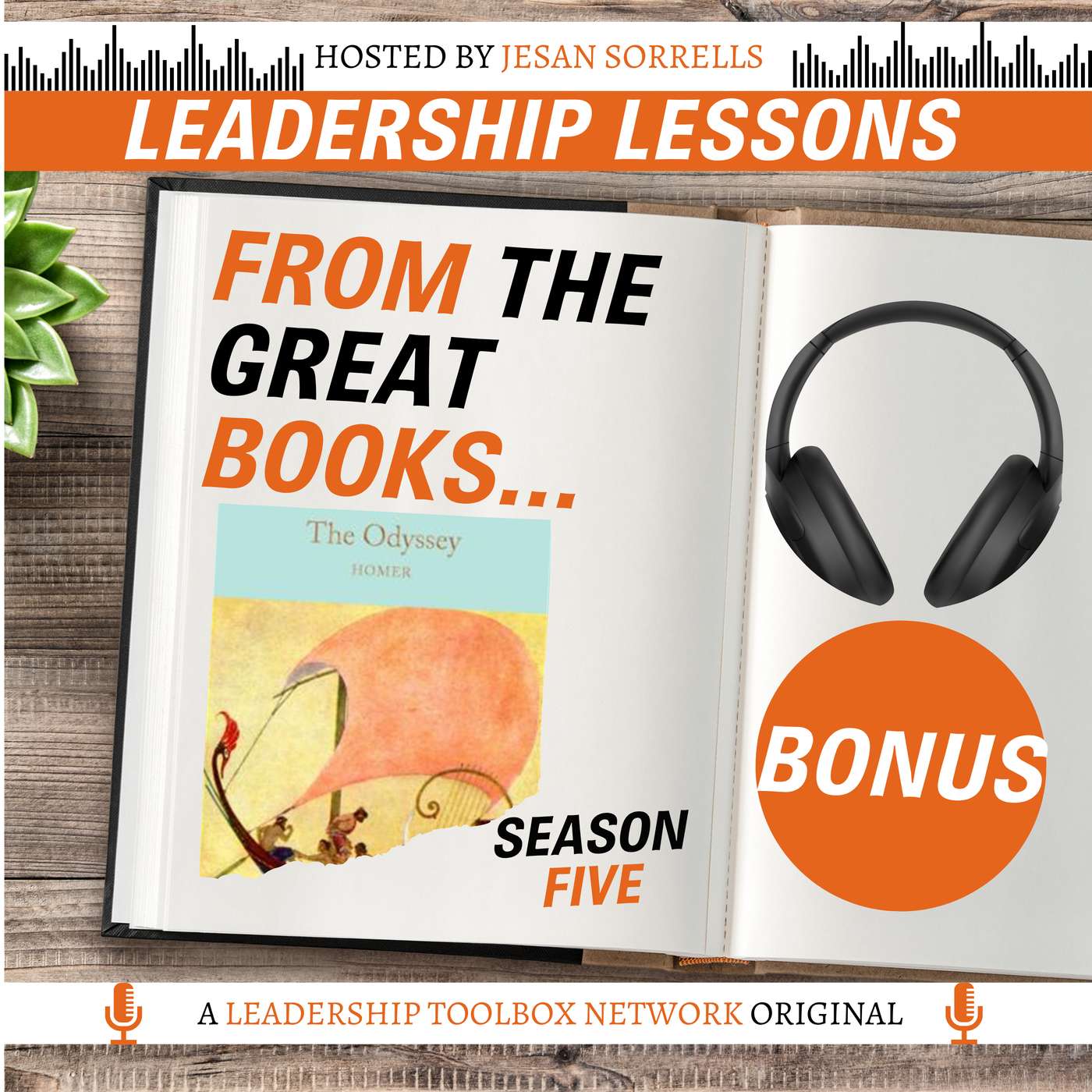
The Odyssey by Homer translation by T.E. Shaw (Lawrence of Arabia) w/Jesan Sorrells
The Odyssey by Homer, translation by T.E. Shaw (Lawrence of Arabia) w/Jesan Sorrells
---
Examining Homer’s epic, The Odyssey, this episode dives into timeless leadership lessons for modern managers and entrepreneurs. The conversation focused on the decline from heroic responsibility to entitlement in Western culture, the enduring value of facing challenges head-on, and the need for leaders to reclaim meaning by embracing tradition and personal accountability. Insights from translator T.E. Lawrence’s life and work sharpen the discussion on navigating today’s cultural shifts with courage and clarity.
- Book Title: The Odyssey
- Author: Homer (T.E. Lawrence translation)
- Guest Names: Jesan Sorrells (Host)
---
Time Stamped Overview
---
00:00 Critique of modern society's values
07:01 Public institutions and heroism decline
15:33 Odysseus receives gifts and journey
22:31 Understanding the author's limitations
24:43 Lawrence of Arabia's wartime role
31:21 Odysseus arrives at the Cyclops' island
40:29 Blinding the Cyclops
42:19 Impact of Nietzschean philosophy
49:27 Odysseus doubts he's home
57:33 Understanding the Odyssey's broader impact
01:01:10 Lessons for leaders from The Odyssey
01:06:50 Conclusion and book promotion
---
- Opening theme composed by Felipe Sarro - Bach - Silotti - "Air" from Orchestra Suite No. 3, BWV 1068
- Closing theme composed by Brian Sanyshyn of Brian Sanyshyn Music.
---
- Pick up your copy of 12 Rules for Leaders: The Foundation of Intentional Leadership NOW on AMAZON!
- Check out the Leadership Lessons From the Great Books podcast reading list!
---
- Subscribe to the Leadership Lessons From The Great Books Podcast: https://bit.ly/LLFTGBSubscribe
- Check out Leadership ToolBox at: https://leadershiptoolbox.us/
0:00 Foreign.
0:04 Hello, my name is Jesan Sorrells and this is the Leadership lessons for the Great Books podcast. Episode number 30 with our book today, which you'll be able to see on the video The Odyssey the T.ELawrence or T. Shaw Trevor Translation of the Odyssey by Homer.
0:36 From the Odyssey by Homer O divine posy goddess, daughter of Zeus, sustained for me this song of the various minded man, who, after he had plundered the innermost citadel of hallow Troy, was made to stray grievously about the coasts of men, the sport of their customs, good or bad, while his heart, through all the seafaring ached in an agony to redeem himself and bring his company safe home. Vain hope for them, for his fellows he strove in vain. Their own witlessness casts them away, the fools, to destroy for meat the oxen of the most exalted sun, wherefore the sun God blotted out the day of their return.
1:28 Make the tale live for us in all its many bearings, O Muse. Book one by now the other warriors, those that had escaped headlong ruin by sea or in battle, were safely home. Only Odysseus, terried shut up by Lady Calypso, a nymph and very goddess. In her hewn out caves she craved for him, she craved him for her bedmate, while he was longing for his house and wife of a truth the rolling seasons had at last brought up the year marked by the gods for his return to Ithaca. But not even there among his loved things, would he escape further conflict.
2:11 Yet had all the gods, with lapse of time, grown compassionate and towards Odysseus all but Poseidon, whose enmity flamed against him till he had reached his home. Poseidon, however, was for the moment far away among the Ethiopians, that last race of men, whose dispersion across the world's end is so broad that some of them can see the sun God rise, while others, while others see him set
2:40 thither, had Poseidon gone in the hope of burnt offerings, bulls and rams by hundreds, and there he sat feasting merrily, while the other gods came together in the halls of Olympian Zeus. To them the father of gods and men began speech, for his breast teemed with though of great Agitheus, whom famous Orestes, the son of Agamemnon had slain.
3:10 It vexes me to see how mean are these creatures of a day towards us gods, when they charge against us the evils far beyond our worst dooming, which their own exceeding wantonness has heaped upon themselves. Just so did Aegisthus exceed when he took to his bed the lawful wife of Atreides and killed her returning husband. He knew the sheer ruin this would entail. Did we not warn him by the mouth of our trusty Hermes, the keen eyed slayer of Argus, neither to murder the man nor lust after the woman's body?
3:41 For therefore the death of the son of Atreus will be required by Orestes even as he grows up in dreams of his native place. These were Hermes very words. But not even such a friendly interposition could restrain Aegisthus, who now pays the final penancee.
4:10 The psychological odyssey in Western Thought from heroic as we just read there in the opening from book one of the Odyssey by Homer, the journey from heroic to not so heroic in western culture and thought has been a long one. We began back in the 7th, or maybe it was the 8th century before the God man Christ showed up by worshiping and appeasing men as gods who insisted on meddling in human affairs, as was mentioned in book one here, for their own amusement and entertainment.
4:51 2500 or well over 2500 years later, in the 21st century, long after the God man Christ has left this world, we in the west have wound up back with the men as gods. Except our scientific inquiry and our relentless ruthless scientism has taken us places that even the ancient Greeks, even Homer himself, would fear to tread. Along the way, Western man has stripped, mined away the COVID of first the natural world and then the meaning, the deep meaning of the transcendental world, to reveal that beneath all that stripping away, beneath all that strip mining, beneath all that ruthless, relentless scientific rational pursuit, only the baser appetites of humanity actually remain.
5:46 And if you don't believe me, or if you're confused by anything I'm saying here, all you have to do is go on social media, just go download TikTok or go watch Fox or MSNBC or you know, just go talk to your neighbor and check out what's happening there between, well, all the genders.
6:10 I observe without any sense of irony whatsoever, that western humanity has also collectively erected barriers, and this is important for leaders to understand, between the personal and the professional, and has assumed wrongly of course, that once the barrier between the sacred and profane was shattered, that somehow, magically the barriers between the personal and professional or would remain irrevocably intact. Of course they did not. And now at the apotheosis of western man, we have children who have amassed audiences of faceless space appetite driven adults.
6:48 We have confused and manipulative adults who are either unaware of the state of the world and the game they are in, or they are too dopamine driven to do anything other than follow along with the masses. And we have public institutions that have abandoned the pursuit of trust, reverting instead to the pursuing of the amassing of raw power and control over the masses for their own sakes. Of course.
7:18 Tragically, it turns out that while we may be a long way from Carl Jung and Joseph Campbell, we are even farther removed from Homer and the Homeric ideal. This is troubling because in epic tales of the past heroes or immature, naive and blind people, of which Telemachus was one in the Odyssey, and of course Menelaus, these folks went on journeys just like Odysseus, to slay dragons, to drive spikes in the eyes of monsters, or to defeat all manner of God driven weather phenomenon.
8:00 They went on those journeys to prove themselves and to prove to the audiences observing them and to their ancestors as well, that they had what it took. They had the right stuff, right. That they could do hard tasks, they could take on large responsibilities and shoulder the massive weight that society, culture, history, and ultimately tradition places on all of us.
8:30 What's troubling is that in the 21st century, with all of our comfort, conformity, complacency and confusion, individuals need to be called back to the journey toward an epic struggle, at least of some kind or another.
8:49 But these heroic acts that men and women need to be called to engage in, in our more abundant age, these heroic acts of defeating the gods and confronting the monsters can't all be psychological. It can't all be psychological heroism. That's just not good enough. Human beings have always needed physical proof of the mere transcendent. They've always needed to be shown, as folks from Missouri will attest to. If you don't believe me, just think back to that other ancient book, the Bible. In particularly the New Testament, where the disciples stared up in slack jawed amazement as the God man Christ ascended to the right hand of God the Father, who bodily,
9:46 or so it is written,
9:51 the esoteric, the small and the mean, the unmentionable, the untruthful, and the outright manipulative, the base, the hollow and the terribly, terribly cowardly.
10:07 No calls to action that are around any of these areas will ever get Western people excited for more than just a few seconds, animated enough to merely swipe left or put in another order for soda on doordash. So here, now, 22 years into the 21st century, we now are beginning to realize that Western man needs an appeal to the heroic to fix what's broken and to journey out on the road of life, to face down the God, men, tyrants all before they affix themselves permanently and irrevocably to the edifice of Western freedom.
11:04 Today on the podcast we are going to talk about the Odyssey, but we're also going to talk about the babbling monster in the sub basement of Western thought that brought us all of this. We're also going to talk about T.E. lawrence and his epic life as Lawrence of Arabia. Actually, that'd be T.E. shaw as Lawrence of Arabia. And I'm going to make an appeal. I'm going to make an assertion. I'm going to throw down a challenge. I'm going to ask a question. Actually, I'm going to ask you one of three questions here today as leaders listening to this podcast.
11:48 So if you thought you were coming here just to hear about Homer today, well, you're going to hear a little bit about Homer, but you're going to hear a lot more about these three questions. And the first one is this whole will carry the logs. Who will answer the call, and who among us will take up the challenge and go on the road?
12:27 Sam.
13:13 Back to the Odyssey by Homer. We're going to read from book five in the T.E. shaw translation of the Odyssey by Homer. Dawn rose from her marriage bed beside high born Tithonus, to bring her daylight to both gods and men. The immortals, with Zeus the high thundering, their mightiest one, sat down in council, and to them Athene spoke thus, designing to remind them of the many misfortunes of Odysseus, whose long sojourn in the nymph's house lay heavy on her heart. Father Zeus, and you happy ever living gods, henceforth let no sceptered king study to be kindly or gentle, or to ensue justice and equity.
13:57 It profits more to be harsh and unseemly in act divine. Odysseus was a clement and fatherly king, but no one of the men his subjects remembers it of him for good, while fate has abandoned him to languish sorely in Lady Calypso's island, kept there by her high hand a prisoner in her house.
14:23 Nor has he power to regain the land of his father, seeing that he lacks galleys and followers to speed him over the broad back of ocean. Moreover, there is now a plot afoot to murder his darling son as he returns from sacred Pylos, or noble Lacedaemon. Whether he went and hoped to hear somewhat of his father Zeus, the cloud marshal answered her, and Said my child, too fierce are the judgments of your mouth. Besides, I think this last move was of your scheming for Odysseus to avenge himself on those men.
14:54 When he comes, you have the knowledge, the power and the skill to convey Telemachus again to his own place wholly unscathed. See that it is so. And the suitors come back too, in their ship. As they went,
15:07 he turned to Hermes, the son he loved, and said, hermes, hear your commission as our particular messenger. Inform this nymph of the love locks of my fixed decision that long suffering Odysseus shall return home as best he can without furtherance from gods or mortal men. Therefore he is to lash together a raft as firm as may be, on which, after 20 days of hazard and disaster he will make rich gleaved Syria, the Phaeton land. The Phoenicians, godlike in race and habit, will take him to their heart with all honor as divine, and send him forward to his native place in a ship laden with gifts of copper and gold and clothing of an abundance such as Odysseus would never have amassed for himself in the sack of Troy, even though he had come away intact and with the full share of booty assigned to him by lot.
15:56 The decree is that so furnished. He shall once again behold his friends and enter his stately house in the country of his fathers.
16:10 Such was the order in the messenger. The Argus slayer made no delay in his obedience. Instantly he laced to his feet the fair sandals of imperishable gold by which she made equal way, swift as a breath of wind over the ocean and over the waste places of the earth. He took the wand with which at will he could lure the eyes of men to slumber or wake them into activity. And with it in hand, the Argus slayer leaped out upon the air and flew straight strongly over Mount Puri as he dived down from the firmament to sea level, and then along the waves he sped like a cormorant which down the dread troughs of the wild sea chases its fish and drenches its close plumage in the salt spume.
16:45 Just so did Hermes skim the recurring wave crests.
16:54 Arriving at the island of Calypso,
17:01 presenting himself to her, he delivers the message, and then Calypso responds
17:16 by saying, as God is to God. You ask me. You order me to tell why I have come, hear the truth of it. Zeus commanded my journey. By no choice of my own did I fare to you across so unspeakable a waste of salt water. Who would willingly come where there is no near city of men to offer sacrifice to the gods and burn his tasty hundreds of oxen. Listen. In no way can another God add or subtract any tittle from the will of Zeus. The aegis bearer, he declares that you have with you the unhappiest man of men, less happy than all those who fought for nine years round the citadel of Priam, and in the 10th year sacked the city and went homeward.
17:53 Yet during their return they sinned against Athene, and she worked up against them an evil wind and tall waves, by which this man's entire splendid company were cast away. As for himself, the wind blew him, and the sea washed him to this spot. Wherefore now the Father commands that you send him hence with speed, for it is decreed that he is not to die far from his friends. On the contrary, he is to behold these friends again, and is to sit under his lofty roof in his own land.
18:25 Calypso, as you can probably expect, didn't take that well. Then with barbed words did she reply, Cruel are you, gods, and immoderately jealous of all others. Especially do you hate it when goddesses elect to lie openly with men, or fall in love and make a match of it with some mere mortal. Just in that same way, you gods are now envying me this man I live with. Yet it was I who saved him. As he clung astride his vessel's keel, alone and adrift in the wine dark ocean, Zeus had launched a white thunderbolt at his ship and shattered her.
18:58 And in her wreck were all the worthy henchmen lost. Only it chanced that he himself drifted to my shore before the wind and waves. And I have loved him and cared for him, and promised myself he should not die, nor grow old all his days. Yet very justly do you say that no lesser God can overpass or make obeying the purpose of Aegeus bearing Zeus. Accordingly, if the impulse and order are from him, I must let my man go hence across the sterile sea. Yet shall descending be in no wise mine here are neither or ships nor cruise to convey him over ocean's broad back.
19:34 Unreservedly, however, I furnish him my very best advice as how he may come safe to his native land.
19:53 The translator of this version of the Odyssey was a gentleman named Colonel Thomas Edward Lawrence, also known as T.E. shaw, also known as T.E Lawrence,
20:11 also known as Lawrence of Arabia. And his book. His. His book, Seven Pillars of Wisdom we will be reading on the podcast at some point here. But I want you to. I want to read directly now from the translator's note
20:32 that he wrote from the Odyssey.
20:38 It's on pages seven through nine. And we're going to. We're going to get his view of the Odyssey, his view of the epic journey of Odysseus from leaving Troy all the way back home to deal with the suitors plumbing or plummeting or plundering, depending upon your perspective. His house. The 28th English rendering of the Odyssey can hardly be a literary event, especially when it aims to be essentially a straightforward translation. By the way, these are the words directly of T.E. shaw. Wherever choice offered between a poor and a rich word, richness had it.
21:19 To raise the color. I have transposed the order of metrical Greek, being unlike plain English. Not that my English is plain enough. Water Street Greek, like the Odysseys, defies honest rendering. Also, I have been free with moods and tenses, allowed myself to interchange adjective and adverb, and dodged our poverty of preposition limitations, of verb and pronominal vagueness by rearrangement. Still, syntax apart, this is a translation.
21:50 Crafty, exquisite, homogenous. Whatever great art may be, these are not its attributes. In this tale, every big situation is burked and the writing is soft. The shattered Iliad yet makes a masterpiece, while the Odyssey, by its ease and interest remains the oldest book worth reading for its story and the first novel of Europe. Gay, fine and vivid, it is never huge or terrible book. 11. The underworld verges towards terrible dia, yet runs instead to the seat of pathos, that feeblest mode of writing.
22:24 The author misses his every chance of greatness, as must all his faithful translators.
22:31 The limitations of this work scope is apparently conscious. Epic belongs to early man, and this Homer lived too long after the heroic age to feel assured and large. He knows exact knowledge of what he could and could not do. Only through such superb self criticism can talent rank beside inspiration.
22:50 In the four years of living with this novel, I've tried to deduce the author from his self betrayal. In the work I found a bookworm, no longer young, living from home, a mainlander city bred and domestic, married, but not exclusively a dog lover, often hungry and thirsty, dark haired, fond of poetry, a great if uncritical reader of the Iliad, with limited sensuous range, but an exact eyesight which gave him all his pictures. A lover of old bric, a brac, though as muddled an antiquary as Walter Scott, in sympathy with which side of him I have conceded tenter hooks, but not always railway trains.
23:35 Few men can be sailors, soldiers and naturalists yet this Homer was neither landlubber nor stay at home, nor ninny. He wrote for audiences to whom adventures were daily life, and the sea their universal neighbor, so he dare not err. That famous doubled line where the Cyclops narrowly misses the ship with his stones only shows how much better a seaman he was than a copyist. Scolais have tried to riddle his technical knowledge, and of course he does make a hodgepodge of periods. It is the penalty of being pre archaeological.
24:05 His pages are steeped in a queer nativity, and at our remove of thought and language we cannot guess if he is smiling or not. Yet there is dignity which compels respect and baffles us, he being neither simple in education nor primitive socially. His generation so rudely admired the Iliad that even to misquote it was a virtue. That is from the translator's introduction of the Odyssey written by Colonel Thomas Edward Lawrence, and according to Wikipedia, Colonel T.E. lawrence was a British archaeologist, army officer, diplomat and writer who became renowned for his role in the Arab Revolt and the Sinai and Palestine campaign against the Ottoman Empire during the First World War.
24:56 The breadth and variety of his activities and associations, and his ability to ascribe them vividly in writing, earned him international fame as Lawrence of Arabia, a title used for the 1962 film based on his wartime activities. He was born out of wedlock in August 1888 to Sarah Junior a governess, and Sir Thomas Chapman, 7th Baronet, an Anglo Irish nobleman. Soon after the outbreak of war in 1914, he volunteered for the British army, and this was after he had worked as an archaeologist for the British Museum from 1910 to 1914 and then briefly.
25:36 Before that he had studied at Oxford at the Jesus College from 1907 to 1910,
25:45 when he volunteered for the British army and was stationed at the Arab Bureau intelligence unit in Egypt. He traveled to Mesopotamia and to Arabia on intelligence missions and became involved with the Arab revolt as a liaison to the Arab forces along with other British officers supporting the Arab kingdom of Hejaz's independence war against its former overlord, the Ottoman Empire. He worked closely with Emir Faisal, a leader of the revolt, and he participated sometimes as a leader in military actions against the Ottoman armed forces, culminating in the capture of Damascus in October of 1918.
26:22 After the first World War, Lawrence joined the British Foreign Office, which basically means he continued being a spy, working with the British government and with Feisal. In 1922 he retreated from public life and spent the years until 1935 serving as an enlisted man, mostly in the Royal Air Force with a brief period in the Army. During this time, he published his best known work, Seven Pillars of An autobiographical account of his participation in the Arab revolt. He also translated books into English and wrote the Mint, which detailed his time in the Royal Air Force working as an ordinary aircraftman.
26:59 Lawrence's public image resulted in part from the sensationalized reporting of the Arab revolt by American journalist Lowell Thomas, as well as from Seven Pillars of Wisdom. Tragically, on May 19, 1935, Lawrence died at the age of 46, six days after being injured in a motorcycle accident in Dorsey.
29:10 Back to the book, Back to the Odyssey by Homer. We're going to move around a little bit, actually. We're going to move around extensively today and we're going to read directly from this idea. Well, not directly from, but we're going to read about this idea that's in the Odyssey, that's embedded within the Odyssey, this idea of sight, this idea of seeing the truth. Right. Because if you can see the truth, whether that's the truth of reality or the truth of responsibility, well, then you can effectively deal with it.
29:51 Or as in the case of Odysseus, you can maybe potentially blind it. So we're gonna go to book nine.
30:01 We're gonna read Odysseus's rendition a little bit here and there of his battle with the arrogant, iniquitous Cyclops.
30:21 We left in low spirits. This is Odysseus speaking. We left in low spirits and later came to the land of the arrogant, iniquitous Cyclops, who so leave all things to the gods that they neither plant nor till yet does plenty spring up, unsown and unplowed of corn and barley, and even vines with heavy clusters which the reigns of Zeus fatten for them. They have no government, nor councils, nor courts of justice, but living caves on mountaintops, each ruling his wives and children and a law unto himself.
30:50 Regardless. Across the blight of Cyclops's country extends a fertile island, a wooded island not very far, yet not close. And in it their harbor, uncounted wild goats. No trace of men scares these, nor do hunters with dogs track them out, fighting their way through the bush to explore the summits of the hills. The herbage is not grazed down by flocks of sheep, nor broken by any plow. Rather, the spot continues in solitude wholly uncultivated, a paradise for the bleeding she goats. By reason that the Cyclops seas have no ruddle cheeked ships nor shipwrights to make them such seaworthy vessels for pleasuring among the cities of mankind, like those ordinary men who tempt the seas to know others and to be known.
31:36 Otherwise they might have made this island theirs, it being not at all bad land. Anything would grow well there in season in the soft moist meadows behind the dykes of the silvery sea, and its vine stalks would bear forever the crop to be harvested at the due time for such smooth plough loam would be heavy, seeing that the undersoil is fat. Its haven is a natural port, requiring no such gear as anchors or warps. Ships can be beached directly to lie there in peace, while the sailors screw up their hearts to venture farther, or until the winds blow kind.
32:07 At the head of this inlet is pure running water from a spring rising in a cave, black poplars shadow. It's
32:23 Odysseus lands and gets off the ship and then sees
32:31 the food and the owner absent in the cave, the flocks of lambs and kids, the milk of the she goats.
32:48 And then. Well,
32:54 so far he had been wholly engaged with his work, but now he rebuilt the fire and looked around and saw us. Why, strangers, said he, who are you and where have you come from? Across the water. Are you traitors or pirates, those venturers who see prowl at hazard, robbing all comers for a livelihood? So? He asked, and our confidence cracked at the giant's dread booming voice and his hugeness. Yet I made shift to speak out firmly, saying, we are waifs of the Achaeans from Troy, intended homeward, but driven off our course haphazardly across the boundless ocean gulfs by adverse winds from heaven.
33:36 It may be the will and decree of Zeus, it may be by the will and decree of Zeus we can vaunt ourselves, companions of Atreides, Agamemnon's men, who is now the widest fame under heaven for having sacked earth's greatest city and brought such multitudes to death here. Therefore we find ourselves suppliant at your knees in hope of the guesting fee or other rich gift, such as is the meat of strangers. Have regard for the gods. Magnificent. We are your suppliants and. And Zeus, who fares with deserving strangers along their road, is the champion of suppliants, their protector and patron God.
34:14 Thus far I got but the reply came from his pitiless heart. Sir, stranger, you are either simple or very outlandish, if you bid me. Fear the gods and avoid crossing them. We the Cyclops. We are the Cyclops. And being so much bigger, we listen not at all to the Aegeus bearing Zeus, or any blessed God. So if I should spare your life and your friends, it would not be to shun the wrath of Zeus, but because my heart counselled me. Mercy. Now tell me where you moored the stout ship you came on. The far shore.
34:46 Was it or the near? I want to know. With these words he laid a crafty snare for me, but to my subtlety, all his deceits were plain. So I spoke back, meeting fraud with fraud. My ship was broken by Poseidon, the earth shaker, who swept her towards the cape at the very end of your land and cast her against the reefs. The drifted us in from the high sea. Only myself with these few escaped. So I said his savagery disdained me. One word in reply. He leapt to his feet, lunged with his hands among my fellows, snatched up two of them like whelps and wrapped their heads against the ground.
35:22 The brains burst out from their skulls and were spattered over the cave's floor while he broke them up limb from limb and sucked off them to the last shred, eating ravenously, like a mountain lion. Everything, bowels and flesh and bones, even to the marrow in the bones. We wept and raised our hands to Zeus in horror at this crime committed before our eyes. Yet there was nothing, nothing we could do. Wherefore the Cyclops, unhindered, filled his great gut with the human flesh and washed it down with raw milk.
35:57 Afterwards he stretched himself out across the cavern among the flocks and slept.
36:11 This obviously cannot stand. And so Odysseus,
36:19 desiring to fix this problem, begins to think, begins to beg the gods for an opportunity to fix this wrong, to correct this heinous act of, well, murder. But even more so than murder, this heinous act of ignorance of good taste and, of course, ignorance of hospitality to guests and to strangers. Of what came to me this seemed best. There lay in the sheep pens a great cudgel belonging to Cyclops, or rather a limb of green olive wood, from which he meant to make himself a staff. When it had seasoned in our estimation, we liken it to the mast of a 20 oared black ship, some broad beam merchantman of the high seas.
37:13 It looks so long and thick. I straddled it and cut off about a fathom's length, which I took to my fellows, bidding them taper it down. They made it quite even, while I lent a hand to sharpen its tip. Then I took it and revolved it in the blazing flame till the point was charred to hardness. Thereafter we hid it under the sheep droppings, which were largely heaped up throughout the cave. Lastly, I made the others draw lots to see who would have the desperate task of helping me lift up our spike and grind it into his eye.
37:40 When heavy sleep had downed him, the luck of the draw gave me just the four men I would have chosen. With my eyes open, I appointed myself the fifth of the party.
37:54 Cyclops leaves the cave,
37:59 and then Cyclops comes back, and Odysseus puts his plan into action.
38:08 Briskly he attacked his household work only after it to snatch up two more of us and dine off them. Then I went up to the giant with an ivy cup of my dark wine in hand and invited him, saying, cyclops, come now, on top of your meal of man's flesh, try this wine to see how tasty a drink was hidden in our ship. I brought it for you, hoping you would have compassion on me and help me homeward. But your unwisdom is far beyond all comprehending, O sinful one. How dare you expect any other man from the great world to visit you after you have behaved towards us so unconscionably?
38:44 I spoke, he took and drank. A savage gladness woke in him at the sweetness of the liquor, and he demanded a second cup, saying, give me another hearty helping, and then quickly tell me your name for me to confer on you a guest gift that will warm your heart. It is true, our rich soil grows good vines for a Cyclops, and the moisture of heaven multiplies your yield. But this vintage is a drop of the real nectar, ambrosia.
39:12 Thus he declared all at once.
39:20 And then at once I poured him a second cup of the glowing wine, and then one more, for in his folly he tossed off three bowls of it. The fumes were going in his cyclopean wits as I began to play with him in honeyed phrase. Cyclops, you asked me for my public name. I will confess it to you aloud. And do you then give me a guest gift, as you have promised? My name is no man, so they have always called me. My mother and father and all my friends.
39:52 Cyclops
39:56 says I will eat no man, finally, after all his friends. The others first. That shall be your benefit. He sprawled full length, belly up on the ground, lolling his fat neck aside in sleep that conquers all men conquered him heavily. He vomited out all his load of drink and gobbets of human flesh swimming in wine spurted gurgling from his throat. Forthwith I thrust our spike into the embers of the fire to get it burning hot, and cheered my fellows with brave words, lest any of them hang back through fear.
40:25 Soon the stake of olive wood, despite its greenness, was almost trembling into flesh flame. With a terrible glowing incandescence I snatched it from the fire. My men, helping some power from on high, breathed into us all manner of mad courage, by whose strength they charged with a great spear and stabbed its sharp point right into his eye. I flung my weight upon it from above, so that it bored home as a shipbuilder's bit drills its timbers steadily twirling by reason of the drag from the hide thong, which is mates underneath to and fro alternately.
40:57 So we held the burning pointed stake in his eye and spun it till the boiling blood bubbled about its pillar of fire. Eyebrows with eyelids shrivelled and stank in the blast of his consuming eyeball. Yea, the very roots of the eye crackled into flame.
41:37 The irony of blindness is not lost on me, and the irony of an unconscionable lack of hospitality to guests is also not lost on me, because, quite frankly, it has been a long, long 20th century.
42:00 Beginning in the 1840s, collectively, through a series of conscious and subconscious decisions and actions, we in the west have blindly and psychologically built and now fully inhabit the world we claimed we always wanted.
42:19 Beginning with the much valuehooed death of God in the early 19th century and continuing through the rise of secular atheist humanism, society, culture, and modes of thinking about our place in the Western world and the transcendental world beyond have catalyzed into an acidic form of nihilistic, existential, blindly paralytical dread.
42:44 And yet I have hope, because there are still some Odysseuses out there. And the Nietzschean ideal fully matured through the existential dread proposed by Sartre and Camus and fully matured by Jacques Derrida and the other deconstructionists, is finally shuffling, I believe, ignominiously, capriciously and ideologically to an end. In the West, I think we are beginning to recover our sight.
43:16 But the tragedy is that the Nietzschean ideal did a lot of damage on the way to the forum of the now. Leaders can see this whether they have one eye, two eyes, or whether they are dead. Blind leaders can see this, and right now they're dealing with entitlement. They're dealing with a lack of grit and resilience, they're dealing with a rise in narcissism, and they are dealing with an end of the ties of shared humility, shared community, and shared reality that used to bind Western culture together.
43:54 Leaders right now are seeing the effects of such conditions in the form of resignations, lower quality work product and an overall decline in productivity and a desire more for the trappings of promotion than a willingness to adopt the responsibilities of promotion itself.
44:13 To navigate our way forward and out, we must go back to the past. We must go into the cave, such as it were, and rescue the knowledge of the rightness of human authority, action and competence from our forgotten, blinded and abandoned father. We must restore our father's sight. But we ourselves can't perform this rescue mission without clear eyes, courageous hearts, and the ability to really speak candidly about what is true. So I'll start. Here's a piece of truth. Every ideal and every idea that the wily German lurking in the sub basement of Western social, cultural, intellectual thought, Friedrich Nietzsche ever had was an absolute cyclopean lie.
45:16 But it was close enough, it hewed close enough anyway, to the perceived truth of some people's mental models of reality. That in the maelstrom of moral destruction wrought by the ideas that were also swirling around at the time of Marx, Darwin and Freud, the lie went mostly unnoticed and became integrated into so many other lies that the tangled web became untangleable.
45:48 That web has developed and turned into a cancerous manner, turned into a cancerous thing that lurks in the sub basement of Western thought that impacts everything we do, and that has made us ill and blind. But it's time. And I believe we are the generation who will begin the long, sordid and messy process of cutting the cancer of the Nietzschean ideal out of the body of Western thought.
46:39 Sam,
47:20 Back to the Odyssey, back to the story of Odysseus. Book 13, where we'll pick up here in book 13. And remember, we we never read the whole book on these podcasts. There's no possible way to do it. These podcasts are built like book reviews or critical critiques, right? Built like folios. Folios? Folios. I can't pronounce words today. Folios of the past. Right? Where you can we give you enough of a sample of the book, we provide you with enough of an idea of the book for you to go out and pick it up.
47:59 And just like we covered the Iliad in episode number three of the Leadership Lessons from the Great Books podcast, this book has plenty to teach us now about all manner of things. Whether that means whether that is about epic journeys, whether that is about recovering from our own blindness or recovering from the blindness of our fathers. But it also has something to teach us about how to be subtle in exacting not necessarily revenge, but how to be subtle in thinking about your powers, your rights and your responsibilities.
48:43 Back to The Odyssey. Book 13. Odysseus speaking with Athena fluently, Odysseus answered, your powers. You assume all forms, goddesses. Your powers let you assume all forms, goddess, and so hardly may the knowingest man identify you. Yet I well know of your partiality towards me from the day that we sons of the Achaeans went to war against Troy, until we plundered Priam's towering city. But after we had embarked thence, and the might of the gods scattered the Achaeans, and since that day I have not set eyes on you, O daughter of Zeus, nor been aware of you within my ship to deliver me from evil.
49:27 So it became my lot to wander brokenheartedly, waiting for the gods to end my pain, until at long last you appeared in the Phaeacians rich capital and threatened and heartened me by your bold words to venture in. Accordingly I now conjure you for your father's sake. Surely I am not in clear shining Ithaca. I think I have lighted on some foreign land, and you are telling me it is Ithaca only in mockery to cheat my soul. If in very deed this is my native land, assure me of it, said Athene or Athena.
49:56 Your mind harps on that, and I cannot leave on tenter hooks one so civil, witty and shrewd. Any other returned wanderer would have dashed home to see his children and his wife. Only you chose to be skeptical and to reject the evidence, till you had further proved the wife who was who, as from the beginning, sits awaiting you in the house, miserable through the long nights and tearful all her days. I was never one of those who despaired for you, because I knew for certain you would return, though not till after losing all your party.
50:26 Wherefore I refrain from open warfare with Poseidon, my uncle, who always wished you ill because of his rage at your blinding his dear son. By the way, that was the Cyclops. But now let me show you the substantial Ithaca to convince you. Then she takes him on a tour.
50:48 The grey eyed goddess then exhorted him further. Be bold and dismiss these concerns from your mind, while we turn to laying up your goods in the hinder end of this cave of marvels, where they will be safe for you. Then must we ponder and advise ourselves the best course of action. Athene spoke and plunged into the gloom of the cavern to search it for hiding holes, while Odysseus carried in the Phoenician gold the tempered Bronze, the goodly raiment, after everything had been carefully laid by Pallas, sealed the passage with a rock.
51:18 Then they sat together by the bowl of the sacred olive to plot the doom of the extravagant wooers. By the way, Odysseus house has been filled with suitors the entire time he's been gone 20 years, consuming through his savings and plundering his goods, his son Telemachus went off to go find him, and was somewhat unsuccessful on his own hero's journey.
51:50 Athene opened. Thus, son of Laertes, next you must settle how to get these shameless suitors into your hands. For it is now three years that they have been lording it in your palace. Okay, three years, not 20 years. Sorry. Plaguing your glorious wife with their suits and proffering marriage settlements, while she, despite heart wrecking anxieties over your return, still keeps them all in play by giving each one hope and separate promises and privy messages. With her mind set constantly elsewhere,
52:20 wily Odysseus replied. My hard fate on reaching home, goddess, would have been such another pitiful death as Agamemnon's, but for your timely acquainting me with the true situation. Wherefore extend your bounty and disclose how I may avenge myself upon these suitors. Stand by me, mistress, fanning my valorous rage. My valorous rage, as on the day we despoil shining Troy of its pride of towers with Your countenance, August1, I would fight 300 men together only buoy me up with your judicious aid, O wise goddess.
52:56 And then Athene or Athena tells him what she will do for him. Surely I shall be by your side always taking thought for you, so soon as we undertake this deed. As for these wooers of your wife and wasters of your substance, I feel that some are about to be spatter the great earth with their blood and brains. But now I must so work on you, that no human being will know you. By parching the fair flesh of your agile limbs and laying waste the yellow locks on your head, I shall even make dim your eyes, which are so lovely, and afterward clothe you in tatters to affront every eye.
53:33 Then your guise will repel the united suitors, as also the wife and son you left in the house. You will begin by joining company with the swineherd who keeps your swine, a man of single heart towards yourself and devoted to your son and judicious Penelope.
53:50 He said to the goddess, why did you not tell him so much? Out of your all knowing heart must he too painfully roam the barren seas, while others devour his living. This is speaking in reference to Telemachus, who was wandering the seas at the time. The gray eyed one replied, taken in not so much to heart, I was his guide. Even I who stirred him up to win favor by this activity. He suffers no hardship, but rests tranquilly in a treaty's palace, lapped in abundance. Admitted the cadets of the suitors lie in ambush with their black ship hot to kill him before he can regain his fatherland.
54:25 Yet I think this will not be. Instead the earth will cover certain suitors who devour your estate. Then Athene touched him with her rod, withering the firm flesh of his active limbs, robbing his head of its fair hair, and making the skin over all his body old like an aged man's. She quenched the sparkle of his handsome eye and flung round him for covering foul and sorry rags, all crusted with a sooty reek. Over these she draped a great deer skin from which the hair was quite worn off. She gave him a stick and a shameful leather pouch of stiff cracked leather slung from a common cord.
55:00 Then, having reached agreement upon their plans, they separated, her intentions being for Lacedaemon to summon home the son of Odysseus.
55:14 That's one way to take responsibility and to set a trap, to be patient and to continue on the road.
55:27 Responsibilities. And this is what Odysseus is really doing here in this passage from the Odyssey. Responsibilities to tradition, to culture, to hierarchy, to the past, and even to the future. Responsibilities matter more than rights
55:44 in the West. We have journeyed away from Homer, and of course we've gone towards the Nietzschean ideal of the pursuit of the overman. And as we have done this, as we've focused more about our rights, what we are owed, we have left behind an older, more robust attention that was once paid to responsibilities. Homer's writing and T.E. shaw's translation, among the undergrowth of many other translations over the last 2500 years or so, was focused on ensuring that our inspiration towards preserving tradition, our responsibility towards preserving tradition, was upheld and maintained, even if it was at the expense of the new, which in our less than heroic, existentially dread filled and narcissistic age, rings hollow to even our jaded ears.
56:44 However, trading the truth of responsibility for the lie of rights has resulted in exactly the type of Western mental modeling of behavior where freedom is held up as the highest ideal. And like all ideals, freedom judges its worshippers. And of course, it always finds the worshippers, well, wanting
57:09 it comes as no surprise that there's never enough freedom, that there's never enough sacrifice to freedom on the altar of individuality.
57:23 This is not epic, and this is not what Western man was meant for. This is not the journey or the hierarchy we should be worshiping. And the Odyssey gives us a glimpse into something that can be higher, something that can be more robust, something that can be more fulfilling, and not in a James Joyce, Ulysses kind of way, more like in a broader world bending, world shaking kind of way. But we can only take up the task, take up the mode of this responsibility, if we actually recognize what it is and put down our appetite, our cyclopean appetite for our rights.
58:12 But a wise letter writer, older than myself, writing to believers, worshiping a different hierarchy with a different ideal at the top of it, during times that seemed just as moribund, unserious, and chaotic as ours, wrote it better than I ever possibly could.
58:33 And I quote, who changed the truth of God into a lie and worshiped and served the creature more than the Creator who is blessed forever. Amen. Romans 1:25.
1:00:14 So this may be a podcast episode that you may want to listen to a couple times, because it's going to take a little bit for you to kind of understand what I'm doing here with the Odyssey. It may seem a little disjointed at first. Listening may seem like I'm jumping all over the place. But I'm making the foundation of a much larger argument that we are going to be exploring this month on the podcast. Our very next episode, we're going to be looking at Heart of Darkness by Joseph Conrad. And then on the back end of that, we'll be looking at Thus Spake Zarathustra.
1:00:50 We're actually going to go into the Cyclops cave, and we're going to see. We can pull out of there with Friedrich Nietzsche. And finally, the end of this month, beginning of next month, we'll be looking at fantasy and memory. We're looking at Alice in Wonderland and what happens when you go through the looking glass, as so many of us have. Whether that looking glass is YouTube, Hulu, Netflix, Facebook, TikTok, or LinkedIn, we're all through the other side of looking glass. And this is part of the place we need to walk out of, for there are caves and monsters on the other side of that looking glass.
1:01:32 So the question I always ask at the end of these podcasts is how do we stay on the path? Right? How do we. How do we make sure that we're actually getting something out of this experience, how do we as leaders integrate this knowledge from these great pieces of literature? And the Odyssey is a great piece of literature, been around for so long and developed an undergrowth of so many different translations. That just proves its greatness. What can leaders learn from Odysseus journey through the wilds of going home?
1:02:05 What can he learn from the speeches of the gods, the laments of Calypso, all the way to the firmness of Athena, the recalcitrant nature of Poseidon, or the angry recalcitrant nature of Poseidon and the hands off leadership of Zeus? How can leaders take all of this and stay on the path in our modern times where we don't believe in the gods and where the transcendent has been stripped away and needs to be restored?
1:02:41 Maybe the first thing that leaders need to do
1:02:45 is not confuse the results of the impact of the power of the triumph of the Nietzschean ideal with the process of the path we walked in the west to that ideal. Yes, that has had impact. Yes, that has had power. Yes. There's a lot of complicated things going on in there and I've used a lot of complicated philosophical terms today. I've used existential and I've used deconstruct and I've used Nietzsche and I've repeated this over and over again, right? Because I want you to know that underneath banal ideals, underneath the clicks and the likes, underneath the hot takes and
1:03:26 underneath the casual commentary lie deeper things that are influencing all of that. And leaders, leaders need to not confuse the results of the impact of the power of that with the path we've trodden. The path we've trodden to that ideal in the west can be retroden and leaders can lead us off of that path or, or if we would like, back onto it. Maybe backwards is better than going forward.
1:04:01 The second thing that leaders need to take from the Odyssey is that the weight of responsibility is something that each individual needs to carry. And this is not just in a psychological sense, but sometimes also in a physical sense. And that when you allow your followers to fail and then put more weight on them, they will rise to the challenge. We talk a lot in our culture, particularly startup culture, about how we're free to fail, right? We, we fail upwards, right? Or, or sometimes we talk about it.
1:04:39 Well, actually failing upwards is usually used as a term of, of, of, of dismissal, right? Or as a term of a person who should have been allowed to fail and then be booted out of, be booted off the scene, right? We have it on the wall of Facebook, fail fast and break things, right? But most of us, most average leaders, most average people don't live in that environment. We instead live in an environment where very often the risk associated with failure, the cost associated with failure is too high to bear.
1:05:13 And so we do everything possible to eliminate failure. Failure. We do everything possible to eliminate mistakes. We do everything possible to eliminate even the possibility that we might screw up.
1:05:28 That's not responsible. That's just avoidance. And at the end of the day, it is responsibility of leaders to make sure that their followers are not avoiding hard things, but that they are instead rising to the challenge of hard things. And that when failure does occur, that people realize, as Zig Ziglar said back in the day, that failure is not final.
1:05:52 It ain't over until the fat lady sings or the fat goddess or the fat whatever.
1:06:03 The last thing we can take from the Odyssey, and I think this is the biggest thing, is that
1:06:11 leaders need to fight for their followers to have the responsibility to experience an epic life. And they need to encourage and support their followers as they travel along the epic path of their own lives. Right? So that we as a society, individually and collectively, but it always starts with the individual first so that we may go into the pit and rescue our dead fathers and our moribund traditions and restore the power of epic, awe inspiring meaning to the West.
1:06:50 Leaders, this is your calling. This is the road that you are out on. This is the answer to the question of who will carry the logs? Who will go out on the road? Who will take the journey? Who will,
1:07:14 Who will go on the path and who will stay on it?
1:07:21 And well,
1:07:26 That's it for me. Well, if you liked that video, you should check out more by subscribing to the Leadership Lessons from the Great Books Podcast playlist here on the HSCP Publishing YouTube channel. You can also get a copy of my third book, 12 Rules for Leaders, the foundation for Intentional Leadership, co written with Bradley Mankin. Check that out on Amazon, Barnes and Noble and everywhere where you get ebooks today. And thanks.
 Apple Podcasts
 Castbox
 Castro
 Goodpods
 Moon FM
 Overcast
 Pocket Casts
 Podbean
 Podcast Addict
 Podcast Republic
 Spotify