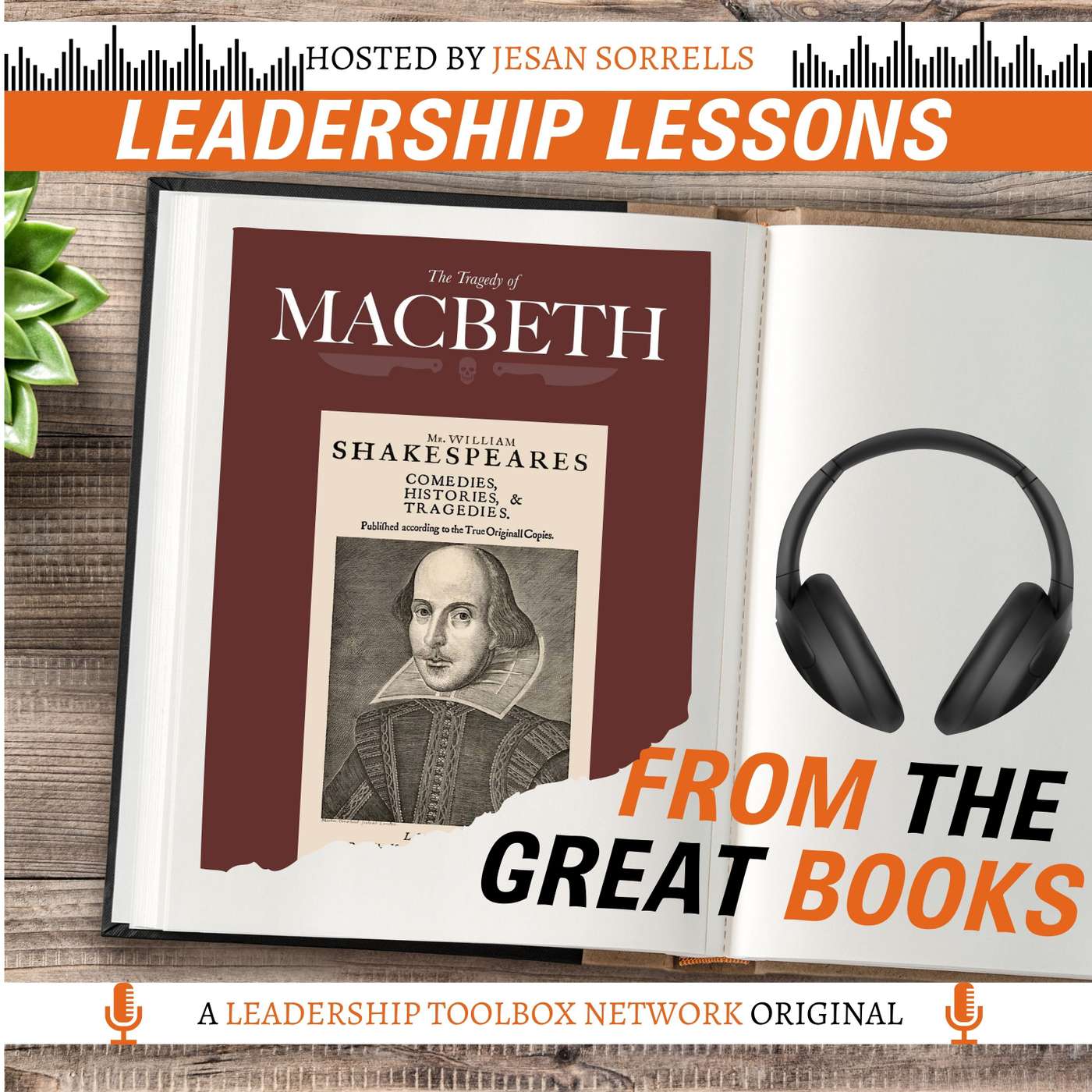
Macbeth by Shakespeare — Ambition, Tyranny, and the Ruin of a Leader (w/Katie Mestres)
The Tragedy of Macbeth by William Shakespeare w/Katie Mestres & Jesan Sorrells
---
Exploring William Shakespeare’s Macbeth, this episode examines the enduring power of tragic storytelling in leadership and culture. The conversation focused on why Macbeth continues to resonate with modern audiences, the complexities of Lady Macbeth’s ambition and gender roles, and how marriage dynamics shape decision-making under pressure. Key themes include the absence of redemption in tragedy, lessons for leaders about ambition and balance, and the timeless human struggle to make meaning from adversity.
- Book: Macbeth
- Author: William Shakespeare
- Guest: Jesan Sorrells (Host) Katie Mestres (Guest)
---
Time-Stamped Overview
---
00:00 Battle update for King Duncan
06:33 Exploring Macbeth's tragedy and relevance today
11:17 Analyzing A.C. Bradley's perspective on Macbeth
17:47 Modern interpretation of Macbeth's design and themes
26:29 Modernizing Shakespeare for Today's Audience
31:43 Shakespeare's Role in Historical Popular Entertainment
37:50 Lady Macbeth learns of the prophecy
43:55 Lady Macbeth and expectations of women leaders
48:04 Lady Macbeth's challenge to gender norms
51:35 Discussing European History and Enlightenment Origins
01:00:10 Lady Macbeth, gender roles, and ambition
01:05:56 Exploring Enlightenment ideas and assumptions
01:10:31 Struggling with narrative amid tragedy
---
Resources
- Featured Book: William Shakespeare: A Brief Life by Paul Menzer.
The best primer for understanding the man behind the plays. 37:01 - Performance Picks:
- Macbeth (dir. Justin Kurzel; Michael Fassbender & Marion Cotillard). Available on Amazon Prime.
- BBC Macbeth (David Tennant)
---
- Opening theme composed by Felipe Sarro - Bach - Silotti - "Air" from Orchestra Suite No. 3, BWV 1068
- Closing theme composed by Brian Sanyshyn of Brian Sanyshyn Music.
---
- Pick up your copy of 12 Rules for Leaders: The Foundation of Intentional Leadership NOW on AMAZON!
- Check out the Leadership Lessons From the Great Books podcast reading list!
---
- Subscribe to the Leadership Lessons From The Great Books Podcast: https://bit.ly/LLFTGBSubscribe
- Check out Leadership ToolBox at: https://leadershiptoolbox.us/
0:02 Hello, my name is Jesan Sorrells, and this is the Leadership Lessons from the Great Books Podcast, episode number 197.
0:16 Quoting directly from our book today, and you'll note on the video that I'm going to be looking down a lot, and that's because I have a digital version of the book, so I'll be reading this off my phone. I'm going to kind of break the fourth wall a little bit, tell you how I'm doing it, but it is the same book that I would have physically today. So we're going to pick up here from our book today, from our play today, actually. Act 1, Scene 1. Thunder and lightning. Enter 3 witches. First witch. When shall we three meet again?
0:54 In thunder, in lightning, or in rain? When the hurly-burly's done, when the battle's lost and won.
1:04 That will be ere the set of the sun. Where the place? Upon the heath. There to meet with Macbeth. I come, Graymalkin. Paddock calls. Anon. Fair is foul, and foul is fair. Hover through the fog and filthy air. They exit. Picking up in Scene 2. Alarum within. Enter King Duncan, Malcolm, Donalbain, Lennox, with attendants, meeting a bleeding captain. What bloody man is that? He can report, as seemeth by his plight, of the revolt, the newest state. This is the sergeant who, like a good and hardy soldier, fought 'gainst my captivity.
1:51 Hail, brave friend! Say to the king the knowledge of the broil as thou didst leave it. Doubtful it stood, as two spent swimmers that do cling together and choke their art. The merciless MacDonald, worthy to be a rebel, for to that the multiplying villainies of nature do swarm upon him, From the western isle of carns and gallows-glasses is supplied, and Fortune, on his damned quarrel smiling, showed like a rebel's whore. But all's too weak for brave Macbeth. Well, he deserves that name, disdaining Fortune with his brandished steel, which smote with bloody execution like valor's minion, carved out his passage till he faced the slave which ne'er shook hands nor bade farewell to him.
2:36 Till he unseamed him from the nave to the chops, and fixed his head upon our battlements. O valiant cousin, worthy gentleman! As whence the sun gins his reflection shipwrecking storms and direful thunders break, so that from that spring whence comfort seemed to come discomfort swells, mark, King of Scotland, mark! No sooner justice had with valor armed, compel these skipping carnes to trust their heels. But the Norwegian lords, surveying vintage— or surveying vantage, with furbished arms and new supplies of men, began a fresh assault.
3:16 Dismayed not this our captains, Macbeth and Banquo?
3:21 Yes, as sparrows eagles, or the hare the lion. If I say sooth, I must report they were as cannons overcharged with double cracks, So they doubly redoubled the strokes upon the foe. Except they meant to bathe in reeking wounds or memorize another Golgotha, I cannot tell. But I am faint. My gash is cry for help.
3:46 So well thy words become thee as thy wounds. They smack of honor both. Go get him surgeons. The captain is led off by attendants.
4:04 That is a bit from our play today.
4:11 And it comes to us in this kind of way. And I want you to think about what we're going to talk about today, because we're opening up a month of Shakespeare here on the show. We're going to start with this play that we are going to be covering today, and we're going to move into Coriolanus and Henry V as well. We do this every year, or at least every other year, on this show. In reading this play, which by the way, the name of it has already been revealed in the name of one of the characters mentioned, something about splitting from the nave to the chops there.
4:45 One of the more interesting facts of our age, The age we live in right now, the age where we have technology like the kind that's bringing you this podcast today. One of the interesting facts of our age is the lack of tragic stories, truly, genuinely tragic stories being told via books and film. Now, don't get me wrong, plenty of tragic circumstances are constantly splashed across our collective social media feeds from people we know, people we don't. People experience tragic circumstances across the globe everywhere.
5:16 Circumstances imposed upon them by fate or identity or chance, both random and purposeful, and of course, nature itself. We observers of this stream of tragedies are, of course, tacitly rewarded by the algorithm for engaging with this stream through clicks and scrolls and eye movements. And while it may initially appear as though there are more tragedies in the world, the actual fact of the matter is that there aren't any more tragedies now than there ever were before in human history. From the burning of a random village in the Amazon in 1500 BC to a person soliciting funds for cancer treatments on a GoFundMe page in the year of our Lord 2026, tragic circumstances are a regrettable and pervasive human constant.
5:57 What is missing in our tragic circumstance social media feeds is fictionalized stories of real people overcoming those tragedies to become heroic. Or maybe remain anti-heroic and succeed in the end.
6:14 Now, it's almost as if we've wound up in a spot like Charlie Kaufman was lamenting in that great movie Adaptation back in 2002, where he stands up and he talks to Bob McKee. You may remember this scene. Charlie Kaufman, played by Nicolas Cage, where he says, you know, what if the writer is attempting to create a story where nothing much happens? Hmm. Where people don't change, they don't have any epiphanies, they struggle and are frustrated, and nothing is resolved. More a reflection of the real world.
6:40 The author today of the play we just read from might come down more on the side of Bob McKee's response to that postmodern lament by Kaufman more than he would with us postmoderns, I think. And the play we are covering today would be part of his answer. Today on the show, We will be discussing the hurly-burly, the nature of tragedy, and the lives of average men, which are more well-documented now than at any other time in human history. Today, let us discuss— let us figure out how to think about in our time Macbeth, specifically the tragedy of Macbeth by William Shakespeare.
7:28 Leaders, the tragic narrative of Macbeth isn't merely, quote, a tale told by an idiot full of sound and fury signifying nothing, not even in our ontologically materialistic era.
7:43 And today on our show, you may have already noted if you're watching the video version of this, we have a new guest. We are We are bringing a new person into the fold. A new guest co-host is joining us. This is her very first time on the show. Welcome to the show, Katie Mestras. Katie Mestras is an artist, actor, educator, human, and clown from Middletown, New Jersey. She has 2 master's degrees, which qualifies her to be here probably even more so than me. One in Shakespeare and performance, one in Shakespeare and one in performance, I'm sorry.
8:16 from Mary Baldwin University located in Staunton, Virginia. She's been working in the theater community on and off stage for over 25 years, finding love in performance design and puppetry. We may talk a little bit about puppetry today too. I want to know if there's ever been Macbeth done in puppetry. She loves script analysis and digging into Shakespeare's poetic and not so poetic texts. And by the way, before we allow her to— well, allow her— before we open the door for her to come in and say her piece.
8:45 She was recommended to us by another guest, Ryan Stout. So this is a case of someone having an excellent experience coming on and then saying, hey, this dude's doing something interesting, you should probably pay attention to this thing over here. So we love it when our guest co-hosts recommend other guests to come on to the show. With all that being said, how are you doing today, Katie? How's it going? Oh, you're muted. I did that to myself. Um, I'm doing pretty well. Um, thank you for having me on the show.
9:21 I just want to clarify, um, the master's degrees thing. So the program itself is called Shakespeare Performance, and I have 2 master's degrees in that specific one. So one is an M.Lit., which is just a fancy European way of just saying a regular master's degree, uh, and the following is an MFA, which is my fine— my Master of Fine Arts. Got it. Okay. All right. Cool. Again, we like to get those things accurate on the show. And again, that qualifies you more to speak probably on this than myself. I'm just a schmuck who reads.
9:55 I like to think I'm a fairly intelligent schmuck, but just a schmuck who's reading. So I want to talk a little bit before we really jump into Macbeth itself and really start pulling apart some of the themes that I think are evident here for leaders in this, in this play, I want to mention that in order to get my arms around Macbeth, number one, well, a couple things. First, I tragically always confuse Macbeth and Hamlet together in my brain. Like, I merge them together in my brain for some reason, which is terrible because we covered Hamlet on this show.
10:25 I should know better by this point, but I still kind of do that. But now, post-reading Macbeth and now talking with you, I don't think I'll be doing that in the future anymore.
10:38 I watched 2 performances of Macbeth in preparation for this episode, and I watched the film version of this play starring Michael Fassbender and Marion Cotillard just to get my arms around that. And that version you can go and check out on Amazon. As you know, folks who listen to the show, I'm also a huge film junkie. So I had to go look up the film. Um, I also read a series of essays on Shakespearean tragedies by A.C. Bradley, which I had no idea who that person was before I sort of stumbled onto all of this.
11:12 Um, I'm sure Katie knows, and she's going to tell me all the problems with Bradley and his analysis. But it, but it, it was written— well, one of the things we do on the show is we tend to look at the writer in the context of the time in which he wrote, and we don't try to apply like our current context to him. We just sort of take him as he or her, as he or she happens to be. Um, because it's usually the best way to do them their best, their best diligence. However, with that being said, I can see where folks would have a challenge with, uh, with Bradley.
11:43 Um, although his analysis on Macbeth was very interesting, we borrowed some of his things here. We'll talk about those today. Um, one of the things that has struck me, Katie, is that we keep revisiting Macbeth as well as Hamlet and King Lear and Othello, um, in film and in TV. And this is what I sort of opened up with on the show today and even on podcasts like this, because it fulfills some deeper longing in us around how to make a narrative sense of tragic circumstances. And I think that that's really what lies at the core of Macbeth.
12:14 But you've clearly got expertise in this space, so I defer to you. What do you think of Macbeth and your background with Shakespeare? And talk a little bit about sort of how you think about this play that seems to seems to never run out of steam or hasn't run out of steam in the last 400 years. Yeah, so my opinion on Macbeth is probably different than a lot of other people's. It's— and it's really just based on personal preference in comparison to his other works. I do enjoy reading the play. It's, it's a quick read.
12:51 It's short. I think it's his shortest tragedy. It's easy to understand. It's well written, has a lot of great monologues and soliloquies. But in terms of theatrical performance, I am sometimes so bored by it. Because it's so— it's one of his more popular ones to do. It's one of his easiest ones to cut and put together. And obviously, you don't have to get any kind of royalties because there's no living heirs to Shakespeare or nothing. Nobody owns his estate. You just do whatever you want with the script.
13:24 And but the fact that you can do whatever you want with the script, but people still tend to do the same things over and over and over again. They don't come at it with a different viewpoint. I mean, it's a very straightforward play anyway, but if it's not— if it's not well directed and if it's not well performed, it has a tendency to drag. And I've seen a performance where they cut nothing from the script, or at least it seems that they kept— like, cut nothing from the script. And there was just some scenes that just went on and on and on.
13:53 It was just exposition of like, yes, we already know this happened. Why are you reliving it? We don't— we don't care. We want to see the action. We want to see it happen. You know, you go to see a play, you go to hear a play, but like— Yeah. I don't know, there's something about Macbeth that doesn't— it also doesn't connect to me. Like, I can't find a lot of salience in it. And I don't know if— I mean, I think modern audiences, they'll like it, but I wonder if they like it because it's like, oh, well, this is Shakespeare, this is Macbeth, I have to like it because everybody likes it because it's popular.
14:22 But, you know, you don't, you don't have to like it. He didn't write bangers all the time, right? Mm-hmm. But there's— for me, it's not a real connection to like a modern audience because we don't have kings. We don't have, you know, people who are succeeding to the throne. We don't have thanes and dukes and things like that. So all of this, all of these people that come in, it's like, who are these people? But for some reason, like the history plays, which I used to think, oh, well, those are probably really boring.
14:53 The history plays to me. Yeah. sometimes are way more exciting than Macbeth because Macbeth is just, oh, it's done over and over and over again. But you, you always see something fresh with like the other history plays like the Henrys or, um, like Richard III. Richard III. Yeah, like those kind of plays. Like people, I think they're a little bit more exciting. I think the beginning of Macbeth is way more exciting than the end, which sounds counterproductive. But I think because, you know, Lady Macbeth is at the beginning most of the time, and then all of a sudden she disappears and goes crazy.
15:30 Mm-hmm. Yeah. And then Macbeth kind of goes nuts. And then all of a sudden it's like, well, we're all against Macbeth, let's go kill him. So it's very straightforward. But there's a lot more— there's a lot more, like, stuff happening, like very specific things, like anxiety-inducing things, like about to murder the king, and are we gonna get caught for it? And you know, by the end it's like, well, obviously we know he's doing bad things, so let's go get him. And at that point it's like, all right, like, let's kind of get it over with.
16:00 There's no, like, yeah, there's nothing compelling to, to bring forward. Also, I think there's such a darkness about this play that kind of sometimes makes me feel physically uncomfortable at the end of it. And, you know, it could, it could truly be like a cursed, a cursed play. Um, So it's interesting that you would bring these points up because I think you're right. I don't think you're incorrect in any of this analysis. Um, I think, I think productions enjoy it, to your point. Like, I— the production I watched was one that came out of, um, it was filmed from the BBC and it had the guy from, um, Doctor Who, um, one of the Doctor Whos in it.
16:44 Yeah. And, uh, one of the more recent Doctor Whos. Oh, uh, David Tennant, probably. He's done a lot of Shakespeare. Might have been him, but I might be wrong. My, my guests will— or my guests, my listeners will correct me on this. Um, if it wasn't Tennant, my— they're reaching out to me all the time. They're telling me, oh no, no, you missed that one. And I could look it up, but I'm not going to do that right now. Um, but, um, but it starred a guy from Doctor Who. It might have been Tennant. Um, and it was, it was done talk about modernizing it, right?
17:13 Mm-hmm. Everybody was dressed in modern costume. Um, it was very, um— and I've done some theatrical production work in my, in my distant past. Um, when I was in community college, I did some community theater stuff because I was a, I was a Bachelor of Fine Arts major. That's what I went to college for. Um, I did not go to college for business or any of that other kind of stuff. Um, and I, I came to that later on. But, um, I made my Bachelor of Fine Arts practice. I figured I needed to know something about theater production, so I did a, I did a little bit on some theater productions and went and saw some theater productions in New York City.
17:46 And so, um, the, the set design of it, which is fascinating to me, um, was very, uh, modernistic, uh, or postmodern actually, which went along of course with the modern costuming. Like Banquo and, uh, and Macbeth when they're dressed as soldiers, They're very much dressed like they came out of the Iraq War, you know, so it's a very contemporary, you know, contemporization of Macbeth. So I think to your point about staging it, it's easy to stage, you know, you don't have too many transitions, it works, you can kind of mold that a little bit.
18:21 I also think you're correct in that
18:26 there's a lack of, and we'll talk a little about this today, but particularly with Bradley's analysis of sort of Macbeth, but there's a lack of, um, there's a lack of psychologizing around why Macbeth does the things that he does. That because we live after the death of not the novel. Well, yeah, we live after the death of the novel because the novel's basically dead. I think anyway, that's one of the things that, one of the ideas that we explore on this show, not the book. That's why this show is called Leadership Lessons from the Great Books, not Leadership Lessons from the Great Novels.
19:01 Um, The book is still alive, but the novel itself has migrated to all these other spaces, right? So it's migrated to film very strongly. It's migrated to theater where you came out of, or where you, and where you make your, you know, made your bones. We think that it's, at least on this show, I think that it's migrated to social media. Like all the things that a novel used to do, that interiority, like a good Jane Austen novel, Now we actually rely on streaming shows and movies to do that for us.
19:32 Um, so the novel's probably on its last legs. And you, and you can disagree with me about that if you want, but Macbeth comes before all of that. And so you're right, we don't get interiority into Macbeth, or we don't get a psychological sort of analysis and a slicing of him. Um, we also don't get a psychological analysis and a slicing of Lady Macbeth. We have no idea what— well, not no idea. Yeah. We have a limited idea of what her motivations are only based on what the words are that Shakespeare put in her mouth.
20:02 And again, we're, we're post-novel, right? We're also post-feminism, which is a whole other kind of set of pieces of analysis around that. And so we're looking at it from different, different lenses, right? And so I agree with you. And then as far as the darkness piece,
20:21 one of the things we really like as people, particularly postmodern people, is we like this idea that, um, anybody can be redeemed at any time.
20:35 And I was watching a, a recent movie that I was watching, Masters of the Universe. I don't know if you've seen that movie. I— is that the He-Man one? Yes, He-Man and the Masters of the Universe. I haven't, I haven't seen that in a really long time, but I used to love, um, when I was a kid, it used to come on like, I don't know, Channel 11 or something every year, and we like We're like already around the TV with our popcorn. We're like, we're gonna watch Masters of the Universe! We were so excited.
20:59 It was, it was like an event in my household. So the movie is, is interesting because it's sort of nostalgic bait for people like you and I who remember this and sort of have these memories. Um, but then it's also updated for like millennials and Gen Zers who have no concept of any of that and didn't get to experience that historically. Um, and so one of the things that is interesting in that movie is Skeletor has a moment played by the Jared Leto crushed it as Skeletor. Oh. Oh my God, it's ridiculous.
21:26 And he says something to He-Man in there that is so totally antithetical to our time, it took me by surprise that he actually said it out loud. Because He-Man's trying to, you know, see if there's any good in him, if he can be turned, whatever. And Skeletor laughs that cackle, and he goes, I just do evil stuff for evil's sake. I'm just evil. Like, there's no, there's no great well of goodness inside of me somewhere. No, I'm evil. I do evil. He didn't say the curse word, but he's like, I do evil stuff.
21:57 That's what I do. I'm an evil guy. There's no other motivation other than that. And it was sort of weirdly refreshing to like hear that because that means that he's not redeemable. You're gonna just, you gotta eliminate him, right? Kind of like the Joker in The Dark Knight, you know, The Dark Knight back in the day. Yeah. with Batman. But we struggle with this idea that people aren't redeemable. And so Macbeth challenges that because there's no— Macbeth is not redeemable. Mm-hmm. Macbeth does not get redeemed at the end.
22:27 He just gets killed and that's just it. Um, so I agree with you, that does create a certain darkness 400 years later in the psyche of a Westerner when they read it. So I agree with all of your points. I'm fascinated by this because I think the lessons in here are really interesting from a tragic perspective. Um, because to your point, and I'm going to push back on this a little bit, I think we do actually have kings, but we call them CEOs now. Oh yeah, yeah, yeah, yeah. And, and we do have emperors, we call them prime ministers now.
23:04 And, and we have these people that are that are playing at global levels in our world, but they don't seem to ever—
23:17 I'm going to be— this is very broad. I'm going to open the door here. They don't ever seem to experience tragic circumstances like the rest of us. They seem to just sort of float above it all. Yeah. And I think that's the thing that actually hooks us into Macbeth. It's sort of schadenfreude for us. Because we see these, like, I'll use a public example that everybody knows. Bill Gates's name was on the list of folks that went to Epstein Island.
23:46 People are still buying Microsoft products. We're recording this on a computer that is powered by Microsoft.
23:57 There seems to have been no penalty for any of that. Yeah. And I think we have to— I think tragic narratives give us the ability, like Macbeth, give us the ability to sort of walk out all of those feelings of like frustration and anger and vengeance and desire for justice to see things happen to people that we think deserve it. And that's why I think Macbeth still works. But I don't know if you— I don't know what you think about that. Oh yeah. I mean, I think obviously Macbeth still works and like, I see your point with CEOs.
24:29 and prime ministers and, uh, being those, you know, what we have now today. Um, I think the thing about Macbeth is, is that it's the succession of title kind of a thing. And like, while there is some like type of nepotism sometimes within companies, it's not like, oh well, this person is going to get this kingship because they're next in line if this person dies. So like, if somebody's like, Well, if I— unless you're like, I'm the son and I'm gonna go kill my dad because I want this CEO title, there's not, there's not like that type of succession in our public sphere that connects the same way as like, oh, if the king dies, then Macbeth is going to be next in line, right?
25:16 Right. So like, oh, if this person dies, I'm going to be next in line. Which, if, you know, if people were smart, uh, directors and people like that, they could make those kinds of connections within that functionality. But I don't know if that's ever been done, or I feel like sometimes with Macbeth, people just tend to get a little bit lazy. Because it's like, it's all just right there laid out for you. Right there. And maybe it's like, maybe people are scared, like, oh, we don't want to screw with Macbeth because like, we don't want to mess with the story because it's so popular and everybody's familiar with it.
25:53 Why change it? Which I get, you know, familiarity, you know, it's, it's something that keeps the masses coming in. And I think sometimes too, like those, you know, it's gotta, gotta put the name on the marquee, right? Like, oh, Macbeth is coming. Like, that's a— I know exactly what to expect when I'm going into Macbeth. I know what happens. I'm already prepared. I don't have to worry that I'm gonna hate this play because I already know that I love it. I want to see what it's done with. And I think sometimes people go to see these Shakespeare shows because they want to see if some— what, what somebody else has done with the same story.
26:28 The same story. So, but sometimes it's just, I'm just gonna keep doing the same thing and over and over and over again. And I, I like that you mentioned Shakespeare in modern clothes. I love when performances do that, and I think it's becoming way more and more common, um, because that kind of connection to the audience where you modernize the characters on stage. It makes the audience feel like they're living in the same timeline as the story that's being told. So it, it makes that kind of visual connection to it.
27:04 And that's, I think, important because if you think about it, the most accurate way to— if you pay homage to Shakespeare's design is to be as simple as possible because he didn't have sets. The costumes that they wore were usually just, you know, hand-me-downs from, uh, people of higher status, or they had specific costumes for, say, like the Roman plays or something. But most of the time they would be wearing just regular Elizabethan garb. which is the same thing as their modern dress. So when we put these plays into our modern dress, you know, we're paying a better, a better homage to Shakespeare in that way.
27:49 Okay, so let me ask you this question. Yeah, one of the push— one of the pieces of pushback that I always get whenever I do Shakespeare, whether it's from our cover Shakespeare, whether it's from guests, and we'll get back to Macbeth in a minute, whether it's from guests, or whether it's from listeners, I always get this pushback. And I'm gonna get this pushback on this episode too. If we can update the dress, which I agree with you, like, I'm reading Coriolanus right now, and I didn't realize that they had turned that into a film with— gosh, a few years ago.
28:22 And so I went and looked at the trailer for that, and they're all in modern, you know, garb. I think Gerard Butler is in that movie, you know, or the movie version of Coriolanus, right? Mm-hmm. And so they're all in, they're all not even in, they're not in Roman garb. They're in, they're in modern warrior garb, right? They're dressed like soldiers from, again, the Iraq War, the Afghanistan War, whatever these modern wars are that we've had. Okay.
28:52 And so that connects to your point, that connects with the audience. But Ralph Fiennes, that's who it is. Ralph Fiennes and Gerard Butler, Fassbender, Maria, um, or Marion Cotillard, um, in Macbeth, the film version of Macbeth, which, by the way, they weren't updated in their clothing. They, they, they kind of did the, the original thing. Okay, cool. But they set it all in Scotland. So it's like in it that this, the, the sets are the environment, which is kind of amazing. Um, but the pushback I get is you could update the clothes, but you can't update the language.
29:25 Why are we saying these and thous? Why are we saying error and or and eeh? Why are we doing this? Like, just make it English. That's always the pushback I get. So go ahead and respond to that. Yeah, and I'll definitely respond to that. So like, it is just— it is, first of all, it is English. It is early modern English. So it's— I know a lot of people say, oh, it's Old English, I can't understand it. It is early modern English, uh, most of the time written in iambic pentameter or other kinds of meter, sometimes in prose.
29:55 I think people approach Shakespeare and they're so afraid of it because they're like, well, I don't understand what any of this means. It's just poetry. Yeah. So it's just poetry. So really, it's just heightened language. It was the language of the time. And I think the fun of it, for me anyway, is analyzing the text and trying to understand exactly what's being said and looking at all the rhetoric and using that towards performance. And it's It's— you have to appreciate the beauty. And that's not to say you can't make a modern English version of Macbeth.
30:32 You can, but then it wouldn't be Shakespeare's Macbeth. It would be somebody else's interpretation of Macbeth, and therefore you'd have to license it from them. So it's just way easier to just use the original Macbeth because it's just— it's free to license. You could just do it, and it's poetry, and it's beautiful, and the language is lovely. And it's interesting looking at a lot of his other plays I remember I was in like a Shakespeare survey class in my undergrad, and we were reading a variety of plays.
31:01 We read A Midsummer Night's Dream, we read Henry IV, we read Hamlet, um, we read The Tempest. Uh, there was one other that we read, but after I read Henry IV, Part 1, and then I immediately read Hamlet after that, and I was like, oh my God. He loved Hamlet. This was his magnum opus. The language in Hamlet is so much more heightened than the language in Henry IV. Henry IV is simpler. It's just kind of like whatever. There's a lot more prose. But in Hamlet, it is, it is art. It is his masterpiece.
31:35 It is, I think, one that he loved writing. So you can tell the difference. Like, even in As You Like It, that play is like 90% prose. He was just kind of like— and I think I've heard people joke like, oh, he wrote As You Like It because And that's why he called it As You Like It, because it's like the audiences wanted more and more and more stuff. He's like, well, here you go, here's some crap that I just put out, you know. So it's like, like modern, like, like modern filmmakers, right? Like, we got like, uh, Steven Spielberg or something.
32:05 In 400 years, people are going to look at Steven Spielberg the same way that we look at Shakespeare today. Shakespeare was just a popular playwright at the time, and that was the common media. So, you know, like our common media today is film and television. Back then it was, it was plays and bear baiting, which was competing with, you know, you could pay the same price to go see a play or you could go down the street or across the street and go see some, a bear being attacked by dogs. So like, it's just, that was their entertainment for the time.
32:36 And our entertainment for the time, Spielberg, not everything that he makes is a masterpiece. Like, you know, sometimes— That's true. Sometimes he makes like stuff that's like, okay, this is for the common people, but then he makes bigger, more important— like Titanic is some like an epic movie that he made. And then I forget, I can't think off the top of my head other things that he's made right now. But you understand, you understand the comparison there. Oh yeah, like Close Encounters of the Third Kind or E.T.
33:09 the Extra-Terrestrial or The— any of the Indiana Jones movies that, that he directed, any of the first 3. I'm not talking about the last few. Those don't exist in this dojo. We don't talk about those. We don't, we don't talk about those, you know, or, or any of his historic epics. So Saving Private Ryan, Schindler's List. Yeah, I thought he did Schindler's List. I just wasn't sure. Yeah. Um, and Titanic was done by James Cameron, but that's okay. Oh, James Cameron, duh. That's okay. That's all right.
33:41 That's all right. That's right. You on that one, you could kind of flip-flop them. They're both doing— I mean, it's fine. Um, my point is, and I get your point, um, those— he's gonna do those kinds of films, but then, you know, he's gonna— oh, for lack of a better term, he's gonna push out something like Disclosure Day, which just came out. And it's like, yeah, maybe you're done, Steven. Maybe, maybe it's time to be done. And maybe that's okay. Like, it's, you know, like Eminem would would maybe say back in the day, like, it's okay to be done.
34:12 Okay. Before we go back to Macbeth, one other point, and I want to find out from you. We don't often talk about who Shakespeare was as a creative on this show because we just make an assumption, and probably an erroneous one, that most people just know who Shakespeare is. But you're the Shakespeare expert. Talk to us about who Shakespeare was. Talk to us about sort of What kind of creative was he? What was he seeking to do with, with his plays? Was he seeking to, as Steve Jobs would say, you know, make a dent in the universe?
34:46 Or was he just seeking to, like, entertain people? So that's the great mystery. So we can't know what his intentions were. He— we can make assumptions, we can make speculations, but we're never going to know how he was as a creative. Um, the only thing that we have a record of really is his plays, and we can't assume that he was trying to say anything with them. We can't assume that the characters that were in the plays represented a part of himself. We can look at the sonnets and make assumptions, but we can never know because none of us were there.
35:26 Um, so that's really the great mystery. I wish I had more information for you. Like, there are, you know, books written, um, Paul Menzer, who was one of the professors at the Shakespeare Performance Program, he was a previous director, and he actually was just recently selected as the inaugural chair in Shakespeare studies at the Folger Library. He wrote a book, and I think it was called Shakespeare: A Life. So it's— let me just look that up real quick. Okay. He wrote that, and I think— I haven't read it yet.
36:00 Um, but that I think is the closest thing we're really going to get as to his intentions. We can look into what was happening in the Elizabethan and Jacobean periods at the time, um, the Elizabethan worldview, um, and kind of try to like put the pieces together as to what he was trying to say, but we're never going to really know it, it in terms of like his creativity and what he was trying to do with it. Mm-hmm. My assumption, he's just trying to make some money. Like, and he was an artist, you know, his father was a glove maker.
36:37 Um, we don't know if his father wanted him to also continue in the line of glove making. Maybe, I don't know. These are all just speculations and assumptions, and you can use your imagination and, and, you know, kind of think. Um, see, let's see. Sorry, I'm just— No, you're fine. A Brief Life. William Shakespeare: A Brief Life. He wrote that in 2023.
37:01 It kind of talks about
37:05 kind of like tracking Shakespeare's life as much as we possibly can. So if you want to understand maybe a little bit more about Shakespeare's life and his creativity and what influenced him, that might be a really good place to start in reading that book. So to repeat, it is William Shakespeare: A Brief Life by Dr. Paul Menzer. Got it. Yeah, we will, we'll put a link to that book in the show notes. Yeah, for this, for this episode. Yeah. All right, let's, let's go ahead and pick up. Let's go back to the play.
37:40 Let's pick up a little bit here from Act 1, Scene 5. And then we're gonna skip and we're gonna go to scene 7. We're gonna talk about a person who I think is probably the most compellingly interesting person in the entire play, but not for the obvious reasons that you may think. So let's pick up with Macbeth. We're still in Act 1, Scene 5. Enter Macbeth's wife alone with a letter. Reading the letter. They met me in the day of success, and I have learned by the perfectest report that they have, they have more in them than mortal knowledge.
38:24 When I burned in desire to question them further, they made themselves air into which they vanished. Whilst I stood rapt in the wonder of it, came missives from the king, who all hailed me Thane of Cawdor, Which— by which title before these weird sisters saluted me and referred me to the coming on of time with, Hail, King that shall be! This I have thought good to deliver thee, my dearest partner of greatness, that thou mightest not lose the dues of rejoicing by being ignorant of what greatness is promised thee.
38:56 Lay it to thy heart, and farewell. Glamis thou art, and Cawdor thou. And caudor, and shalt be what thou art promised. Yet do I fear thy nature. It is too full of the milk of human kindness to catch the nearest way. Thou wouldest be great, art now without ambition, but without the illness should attend it. What thou wast highly, that thou wast thou holily, would thou not play false, and yet wouldest wrongly win. Thou'st have great gladness, that which cries, Thus thou must do, if thou have it, and that which rather thou dost fear to do than wishest should be undone.
39:36 Hie thee hither, that I may pour my spirits in thine ear and chastise with the valor of my tongue all that impedes thee from the golden round which fate and metaphysical aid doth seem to have thee crowned withal. Enter Messenger. What is your tidings? The king comes here tonight. Thou art mad to say it. Is not thy master with him, who, were so, would have informed for preparation? So please you, it is true; our Thane is coming. One of my fellows had the speed of him, who, almost dead for breath, had scarcely more than would make up this message.
40:16 Get him tending; he brings great news. Messenger exits. The raven himself is hoarse that croaks the fatal entrance of Duncan under my battlements. By the way, pause. I love that line, by the way. I love that line. Back to the, back to the play. Come, you spirits that tend on mortal thoughts, unsex me here and fill me from the crown to the toe-top full of direst cruelty. Make thick my blood, stop up the access and passage to remorse, that no compunctions Visitings of nature shake my fell purpose, nor keep peace between the effect and it.
40:53 Come to my woman's breasts, and take my milk for gall, you murdering ministers, wherever in your sightless substances you wait on nature's mischief. Come, thick night, and pall thee in the dunnest smoke of hell, that my keen knife see not the wound it makes, nor heaven peep through the blanket of the dark to cry, hold, Hold! Enter Macbeth. Great Glamis, worthy Cawdor, greater than both by the all-hail hereafter! Thy letters have transported me beyond this ignorant present, and I feel now the future in the instant.
41:29 My dearest love, Duncan comes here tonight. And when goes hence? Tomorrow, as he purposes. O, never shall Son, that morrow see. Your face, my thane, is as a book where men may read strange matters. To beguile the time looks like the time. Pause. I love that word beguile, by the way. Love that word. Uh, back to it. Bear welcome in your eye, your hand, your tongue. Look like the innocent flower, but be the serpent under it. He that's coming must be provided for, and you shall put this night's great business into my dispatch.
42:08 which shall to all our nights and days to come give solely sovereign sway and masterdom. We will, we will speak further. Only look up clear. To alter favor ever is to fear. Leave all the rest to me. They exit. I'm gonna stop there.
42:34 It's a lot to read, and I'm not Shakespearean enough probably for it. Lady Macbeth is probably the most interesting character in this entire tragedy.
42:46 When I first encountered her, I immediately thought of all of the female CEOs I've ever heard of. I immediately thought of Oprah. I immediately thought of Martha Stewart. I immediately thought of the social media exaggeration of the boss babe, in air quotes, right, that floats around social media. Um, and I don't know why those associations came unbidden into my brain, but reading the words of Lady Macbeth and how she was written, uh, particularly when she talks about, you know, dashing a child's, a child's head, you know, against a rock, right, or the milk of human kindness turning to gall in her breast.
43:28 When I, when I read these things, I immediately think of, oh, she's a fully, she's a fully and totally empowered woman. Macbeth isn't telling her what to do. The man is not telling her what to do. She's not— okay, modern feminist theory would say she's operating under a patriarchy and isn't it terrible? Except
43:49 that's not the way Shakespeare wrote her, at least not in the first part of the play, to Katie's point. We'll talk about the second part of the play in a minute. A.C. Bradley, in his famous book of essays on Shakespearean tragedies, asserted— and I agree with this— that Lady Macbeth was driven by courage and force of will, but that such drives came from a lack of imagination and left her unable to repent of her deeds when they visited her again. Now, the fact is that We look at people like this, like Lady Macbeth, and she could stand as an avatar for a lot of other people in our modern era.
44:28 And we wonder—
44:32 we wonder where their imagination is. Like, we already mentioned the rich guys, right? But what about the rich guys' wives? What about Melinda Gates? What about Mackenzie Bezos? What about Hillary Clinton?
44:49 What about Nancy Pelosi?
44:53 Where is the milk of human kindness, or is it turned to gall? Where are these things, right, that we expect from women leaders? The, the canard is always, if women were in charge, everything would be better. Lady Macbeth kind of puts paid to that a little bit. I don't think everything would be better. I just think it would be the same nonsense we just have differently.
45:18 But I want to know what Katie thinks about Lady Macbeth. And I'm going to ask her this question. What can leaders, female or male, we're going to be agnostic on this, we're going to unsex this question, such as it were. What can they learn from her example? Go ahead, Katie. All right, so first, I, I do want to kind of like— I'm gonna like tangent off of this because there's a lot of— Absolutely. There's a lot of historical context associated with who Lady Macbeth represented. So I'm not sure if you're aware of this, but Macbeth was written essentially to flatter King James.
45:58 He had just, uh, ascended to the throne, um, a few years ago, a few years prior to this coming out. Banquo essentially represents, you know, the line of Scottish kings. It's flattering him in that it plays with his obsession and fear of witchcraft and the occult. And then also it was associated with the Gunpowder Plot. Now, the Gunpowder Plot, if you know, that was the Guy Fawkes thing where they, you know, all planned together. But I— so just for background, my master's thesis, I did my master's thesis about— it was a feminine— it was a feminist— sorry, it was a view of Shakespeare's female characters.
46:46 Mm-hmm. But it was a comparison of the ones he wrote when Elizabeth was queen versus the ones he wrote when James was in power. That's a good point. And if you look, and if you look at those women that when James was in power, they were much more villainized. So in going back to the Gunpowder Plot, um, I was in my thesis research, I was reading a chapter in Frances E. Dolan's book, um, Whores of Babylon: Catholicism, Gender, and 17th Century Print Culture, and she theorizes that the conception, the idea of the Gunpowder Plot was heavily connected to the threat of Catholicism, because I believe the people who were planning the Gunpowder Plot were Catholics, which the Protestants at the time, the rulers, did not like the Catholics.
47:36 They were persecuted. They hated anything to do with Catholicism. But with Catholicism held with it the fear of the inversion of the gender hierarchy, and thus the disruption of the social order. So in theory, because Catholics put women on top, meaning, you know, women were more in charge and men were in the subordinate role, the women were supposedly influencing their men to kill James. Does that sound familiar in terms of the plot of Macbeth? Mm-hmm. So Lady Macbeth, in my opinion, represents this subversion from these gender norms and capitalizes on the fear of her emasculating Macbeth and taking— and having him taking a subordinate role to her, as well as James's fear of feminine power deposing his masculine rule, especially with him taking the throne after 44 years of a female monarch.
48:30 Um, so with that being said, I find it very fascinating that you, you know, refer to her as a boss babe, because I usually associate that term with a woman who is kind of taking her life into her own hands and creating something positive despite that patriarchal undertones of society, right? You know, like starting a small business or something, not, not regicide. Um, not to say that, like, you know, not to say Lady Macbeth did not take things into her own hands. She did. And then those hands were then covered in blood for the rest of the play.
49:01 But if you consider that historical context, she is, in my personal opinion, written as the main antagonist of the play. Hmm. It is her decision to kill Duncan that drives the plot forward. So Macbeth would have otherwise accepted his fate regardless of his actions. Um, he didn't have to do anything to earn Thane of Cawdor. Um, he tells— he, he, you know, has a conversation with himself in, in, um, Act 1, Scene 3, where he's like, all right, what should I do? Should I take any actions? And then he decides to himself, if chance will have me king, while chance may crown me without my stir.
49:40 So he has already decided for himself, all right, I'm not going to do anything because obviously I didn't have to do anything to get Thane of Cawdor. I'm just going to excitedly tell my wife, hey, this happened, guess what? And for some reason, upon reading the letter, Lady Macbeth has already decided that the only possible way forward now is obviously we have to kill the king, right? Like, that's a very unreasonable thing, and this is our first impression of her, right? Mm-hmm. So the way it's written in that way.
50:09 Like, she wants to rule and she wants it now. She wants it, you know, she sees her future in the instant and she's ruthless, whether or not that's influenced by the supernatural. So like, you could say, well, maybe like the witches enchanted the letter that went to Lady Macbeth, and that could be some kind of reasoning as to what happens. But we will never know because we can't really do psychological realism on these characters. But she knows that Macbeth is too full of the, the milk of human kindness to get the job done, right?
50:37 She, she also knows, but she also notes that he's not without ambition. The illness, but he's without the illness that should attend it. So she's referencing ambition as, as being sick, and she's passing that sickness on to Macbeth, like in, in her pep talk to him in, in 1.7, you know. Right. Um, she tears them to pieces. She emasculates them. You're like, you're not a man if you can't do this. And the talk about her bashing the child's brain in, she's saying essentially like, if I— if you— what did she say?
51:10 I would have just— I would have sacrificed the life of my child before I backed out on this deal between you and me, because you and me, we are a unit. We are a team. So
51:26 I, so, um, I'm glad you brought all this up because 17th century England and Scotland. Mm-hmm. Um, and remember I said at the beginning, like, I try to look at things within the context of the century that, that they are in, right? That was much more of a warrior ethos kind of culture than even we have now. I mean, at that point in time on the European continent, there had been 1,000 years of war since the end of the Roman Empire. The Carolingians came in, you know, the invasion of— well, not the invasion of Normandy, but the Norman invasion of France had occurred, right?
52:11 Where, you know, the English were trying to get the French to do certain things and the French were like, sacre bleu. And, you know, try to run them off the continent. We hadn't yet made the turn into the, what we, what we tend to think of as the modern world because the Renaissance hadn't quite washed up on the shores of England. We actually read Francis Bacon, The Great Instauration, at the beginning of this year. And I'm fascinated by Francis Bacon because he's the first, for lack of a better term, he's the first shot across the bow of the Age of Enlightenment in England.
52:44 He's where that sort of, that sort of really begins to really sort of click in where, oh, science can be the thing that drives us rather than religion, to your point, religious fervor or, or any of these kinds of, any of these kinds of things. And I, it isn't, I don't remember this, but isn't part of the plot of Shakespeare in Love, like Francis Bacon was really Shakespeare or something like that? I heard that theory somewhere, or maybe I'm confusing 2 things together in my head. I think he was— one of the things is Shakespeare was actually the Earl of Oxford and that like there's like a whole Oxfordian and like the Stratfordian things.
53:18 Yeah. Okay. Right. That's what I'm— okay. Yeah. Again, multiple things sort of flopping around together in my head there. And so when I look at that world,
53:31 on the one hand, you could say, wouldn't it have been great if women were treated equally then? Yeah, it would have been great. I don't know what that would have meant in that culture and at that time, because we look at that through the lens of industrialization and a whole bunch of assumptions that, quite frankly, if we took them back 400 years, would seem weird to those people. Like, they just, they just, they wouldn't, they wouldn't be able to wrap their arms around those assumptions because there's too much water under the bridge.
54:01 I also think that That, to your point about not being able to psychologically examine our characters, I think we read something like this and it seems weird to us because we don't know kind of what their psychology, their psychology was. And of course, psychology didn't exist then. So, you know, I'm not saying they didn't have— they didn't have an understanding of interiority. They did. But they were also, to your point, navigating all of the sort of spiritual and religious elements that were, that were around them.
54:32 Because I think they also lived in a much more, a world that was much more,
54:38 not focused, but a lot more familiar. That's the term I'm going to use. There's a lot more familiar with the sacred in ways that we have sort of abandoned for good or ill. And we talk about that on the show all the time, but that we have abandoned in our, in our time, 400 years later. So I think you kind of got to put some of that context around it. I find it interesting though that, and maybe this is the question, I'll frame what I find interesting as a question.
55:09 So when I saw the 2 performances or watched the 2 performances that I watched of Lady Macbeth, one from Marion Cotillard and then the other one from the David Tennant, the David Tennant version of Macbeth, what struck me was In the stage version, she was much more
55:29 what I would associate boss babe-ish. She came off much more as, I'm gonna run this thing, I'm gonna run this town, to paraphrase from Jay-Z. Mm-hmm. Whereas in the film version, she was much more, while vicious, much more subdued. Now that could just be different actresses just interpreting it differently, which I'll grant that. But I find it interesting that there's enough in her, there's enough meat there, at least in the first part of her appearance in the play. There's enough meat there to kind of get that continuum inside of that character, which is why I find her to be interesting because the
56:16 Well, what are the associations? Let me frame this as a question. I'm finally gonna get to the question. What are the, what are the associations we, we could make with Lady Macbeth, at least in the first part of the play? And we'll get to the second part of the play in just a second here. But what are the associations we could make with her? Should we,
56:37 should we hold her to be a villain, or should we be more Forgiving of her? I think that we can be more— and so I was giving the background of historical context just in reference to the boss babe thing, so, and in reference to like leadership qualities. Um, I think we could definitely like view her in either way. Like, so the same way like you said that these 2 actresses played her differently a director could have a different vision for what he want— what story he wants told there. So he could say, I want to frame Lady Macbeth as the villain in this because I want to, you know, which is essentially what, you know, the original intent could have been, was we're gonna show King James, oh, obviously women and the associations with witchcraft, witchcraft, you know, like they're bad, you know, don't let a woman be in control, obviously.
57:33 because, you know, men are better leaders. So that was kind of like that lesson,
57:40 I guess you could say, that was to be taken from this play for King James. Like, you know, it was still all entertainment. Like I said, this play was written to flatter him. It was obviously also like a good, a good drama for other people to, to watch. Um, but in terms of relating to the time period, like, it— and it really like you know how some plays or some movies play off of current events, you know, kind of? Yeah. So it was the play off of the Gunpowder Plot. So like taking some of those themes, like, oh, this— we don't like Catholics, so don't let your women control you kind of a thing.
58:15 Um, but to go back to Lady Macbeth in our modern era, we obviously don't have to take any of that information and, and use it towards her performance. We can look at her um, as, you know, a lead, like a good, powerful, strong character. She's a great character. She's— I would love to play her one day. She's a coveted role for many a Shakespearean actress because she has all that meat and her language is so rich and she's so powerful. But in terms of leadership qualities, Lady Macbeth in the, in the context of the play, in the context of the time period, as you said, you like look at things within the context of the time period that they're written.
58:58 She's playing the patriarchal game, and she's lusting for power and prominence through Macbeth's promised position of king. So Tina Packer, who was— and she just recently passed away— she was the founding artistic director of the Shakespeare and Company, and she was a prolific director and actress and Shakespeare— in her book Women of Will, which she talks about experience with every single one of Shakespeare's women, that Lady Macbeth, like other women at the time married to men in prominent positions, or even modern times where, you know, maybe we have some women who still feel like they can't, you know, be more— be equal to the men that they're with— she joined with their husband's ambition, empowering their men to get further than they could themselves.
59:47 So she is kind of living vicariously variously through Macbeth in these instances because she can't do it on her own. She's not in a social position to get what she wants. But Packer says the story of Macbeth is a story of what happens when a powerful woman loses herself and plays the patriarchal game. It ends in fascism. Hmm. So the lesson to be learned needs to be kind of treaded a little bit lightly, right? We currently live in a patriarchal society, which has been recently exacerbated by current leadership.
1:00:22 We're essentially— we're going back in time in terms of women's rights in some instances. So if we want to look to Lady Macbeth as an example of leadership and what we can learn from this today, we need to be really careful about how we handle it, considering the historical context of what feels a little anti-feminine. So we could simply say we need to look at not being blinded by our own ambition and losing ourselves in the rabble. But it, you know, it doesn't have to be that simple. Um, like I said, witchcraft was so often connected with women not adhering to their gender roles.
1:00:57 You know, even in the beginning of Macbeth, um, Banquo says, are you women? You know, your beards would make me call you otherwise. So they're kind of like androgynous creatures, like Because, you know, true women, um, in the, in the eyes of, um, Protestant, um, early modern England at the time were supposed to adhere to specific gender roles. They didn't always, obviously, you know, like you have laws and rules today, but people do whatever they want. They just pay fines for it, right? Mm-hmm. Um, but James's obsession with witchcraft may have been incredibly influential to Shakespeare.
1:01:34 and essentially designed the fate of Lady Macbeth as somewhat of a warning to the perils of women in power. We don't want to take that lesson. We— contrarily, it may have also been a lesson for the men as to what happens when your masculine and your feminine powers are not balanced, meaning the hierarchy is swapped, like, which we said was anti-Catholic fear, right? So, but for our modern listeners, The balance of feminine and masculine powers should not be interpreted as external, but internal, right?
1:02:07 So in order to be a great leader, you need to be a balanced leader. You need to balance your ambition with your humanity. You need to be both strong and soft. You need to have a tender listening ear as well as a strong moral judgment. Otherwise, it could devolve into chaos. and anarchy and mutiny. And, you know, obviously, we saw the fate of the Macbeths. So we want to, you know, do we want to take what, you know, face value what Lady Macbeth is doing at the beginning of the play, especially considering what happens to her at the end?
1:02:41 So there's an element here that we also miss in thinking about this that I would like to throw into the pot as well. Yeah, it occurred to me when we were talking, or when you were talking,
1:02:54 We don't talk a lot in our modern times about the nature of marriage between men and women. We actually don't talk a lot about that. We talk a lot about divorce. We talk a lot about divorce. We talk a lot about separation. We talk a lot about single parents. We talk a lot about stepparents. We talk about same-sex parents. We talk a lot about all these other kinds of different arrangements. But it is, it is, it is almost
1:03:30 deafening, the lack of noise around. And I'm married. I've been married for many years. I don't know if you're married or not, but we'll just leave that aside. I am. Yeah. Okay. All right. So being married in a, in a to frame it in modern, postmodern terms, a long-term committed relationship with children and property and all of these other kinds of things going on and been married for a long time and planning on staying married for a long time.
1:04:01 We don't talk about the dynamics of what happened between men and women in marriage. And Macbeth,
1:04:10 Shakespeare touched on this. Shakespeare, He didn't, he didn't specifically put his whole hand on it because that might have been too much for him. And maybe, maybe he didn't need to because everyone in the crowd who was watching the play, even including the king, knew what the deal was. So they had a different set of social assumptions than what we have, right? Yes. Um, and you could talk about the Catholic Church and the Catholics versus the Protestants and the Protestant Reformation, which had started in, you know, 15-whatever with Martin Luther and had spread across the continent, and it's proceeded to rack and ruin, you know, religion along with the printing press, by the way, which allowed all of these kinds of dynamics around Protestantism to spread.
1:04:55 Without the printing press, there would have been no Protestantism. It wouldn't have happened. And so you have a situation where People are knowing what the deal is. The church has already explained to them for 1,000 years what the deal is with marriage, and people just accept it. They're just like, okay, this is, this is fine. So he wouldn't have had to explain it. Yeah. Because we live after all of that, and we do live in an era where
1:05:28 women vote, There is, there is literally no door. And I have daughters too. There's literally no door closed to women. There's literally no door. You can walk through any door you want. Now, what happens after you walk through that door? That's a different thing altogether. But you do have the option to walk through that door. Because of a country that didn't exist during Shakespeare's time called the United States of America, where we just sort of took all of the We did. We took all the Enlightenment promises and we kind of pushed— we have been for the last 250 years of our existence.
1:06:00 We've been pushing them all the way out further and further and further. You can see this in the expansion of the franchise, who gets to vote, who doesn't, all these kinds of things, right? All the kinds of arguments we have here, we wouldn't have had— they didn't have in England. Again, going back to what I said previously, the previous segment, they wouldn't have understood what we were even talking about. It wouldn't have Like natural rights of man. What? I don't know what even that means, right?
1:06:26 So we start from a different set of assumptions looking at Lady Macbeth, but we also start from a different set of assumptions looking at the marriage of the two of them. Mm-hmm. And I think that this is really one of the key things. You asked why Macbeth is still popular. I think this is the thing we can't put our hands on. We don't have a good way, particularly in our movies, because again, remember I said our novels have all gone to our movies now. When was the last good movie you saw about what happens in a person's marriage?
1:06:59 Not their divorce, not the breakup, the actual marriage itself?
1:07:06 Yeah, I don't, I don't know. Because that's not something that's like, you know, right, present in my mind. Right? Right. Because we all, we know what happens in a marriage. It's The thing is, it's not compelling. It's not exciting. Like, it's just like, oh, we're married. It's just no big deal. Like, so that's why it doesn't really show up in a lot of stories. Except it is compelling. Except it is compelling. Like, think about, I think about the way my wife talks to me, not about murdering a king that may come visit my house.
1:07:31 We're not there. Thank you, ladies and gentlemen. But the way she talks to me about picking up the groceries, I'll use something very simple. Picking up the groceries. We had a conversation today on the phone, pardon me, 15 minutes about picking up the groceries. There's all kinds of dynamics going on in that 15-minute conversation that if I were to novelize those or turn those into a play, I'm not saying my wife is Lady Macbeth, not even close, nor am I saying I'm Macbeth, but it touches on dynamics Of how do I persuade and convince my husband to take action?
1:08:11 How do I push back and resist my wife if I don't want to take action? How am I gradually persuaded and convinced to take action? How is she gradually persuaded and convinced to take action? Because by the way, just so you know the full, like, some of the full stack of the dynamics in there, we've also got a home renovation going on. Mm-hmm. We've got like 3 kittens living on our back porch that came out of nowhere. We've got, you know, kids getting ready to go back to school. We've got a vacation coming up.
1:08:38 We— my wife was sick over the weekend. I'm just getting over being sick. Um, I had a death in the family recently, you know, a sibling, you know. Um, we've got birthdays coming up, literally 3 birthdays, bang, bang, bang, bang, bang, in a row while we're out of town. We're traveling. There's a lot of dynamics going on. All of that is To paraphrase from Bob McKee, who I mentioned at the beginning in the open here, that's all human drama. Mm-hmm. And it's all layered underneath there in a 15-minute conversation about groceries.
1:09:13 The fact that we can't find drama in that stuff is a sad commentary on our time, not on Shakespeare, because Shakespeare could find the drama in it. We can't find it. What are we doing? I don't know. We're finding more and more sensationalized things to talk about. I think we're losing the connection with, like, just living because we're not living. We're trying to survive. We're trying to, like, get through this hellscape together. So, like, all the things we, we don't have time to think about, oh, how nice it is to be married and look at all the fun things, you know.
1:09:52 that's happening in the dynamic with my, you know, my marriage. People— I mean, and maybe it, you know, maybe that will like calm people down, but like most of the time people want to be distracted. So they want distraction from real life now because real life is too heavy to bear. So, so like having those like, oh, you know, we're gonna, you know, watch a husband and a wife have a conversation, for, you know, for the people involved, it's very exciting. Because obviously you love this person, you know, but for outside people, it's like, I don't care about groceries right now.
1:10:23 The world is on fire, you know? So that's where we're losing that in our modern time. Well, this is— and this ties back to something that I said at the beginning, right? My, my opening. We are so confronted in our algorithm with tragic circumstances, and yet we struggle to put a narrative to those circumstances. Just like to your point you just made, we are struggling with all of these externalities that it could be argued historically have always been there. But let's just leave it at that. We're struggling with all these externalities, which is the same thing as tragic circumstances.
1:11:02 Let's just put it all in the same box, right? But we don't have a creative narrative structure to make meaning or significance or sense of these things. And I think that this is what Shakespeare does so brilliantly. And this is why Macbeth survives, along with Othello and King Lear and Hamlet, right? Like the, the Iago in Othello. I, I could go on a 3-hour tangent on how much I love Othello because First of all, the story is so compelling. Iago is the perfect villain because Iago is like, he's a guy you'd meet on the street.
1:11:49 Mm-hmm. He's so charming. And I think one of the— and I'll say this now, and I'll try not to go on a tangent because I could talk about Iago forever. I think one of the things that happens in casting of Iago is that they always make him much older than he is canonically. In the play, he's like 27 or 28 years old.
 Apple Podcasts
 Castbox
 Castro
 Goodpods
 Moon FM
 Overcast
 Pocket Casts
 Podbean
 Podcast Addict
 Podcast Republic
 Spotify