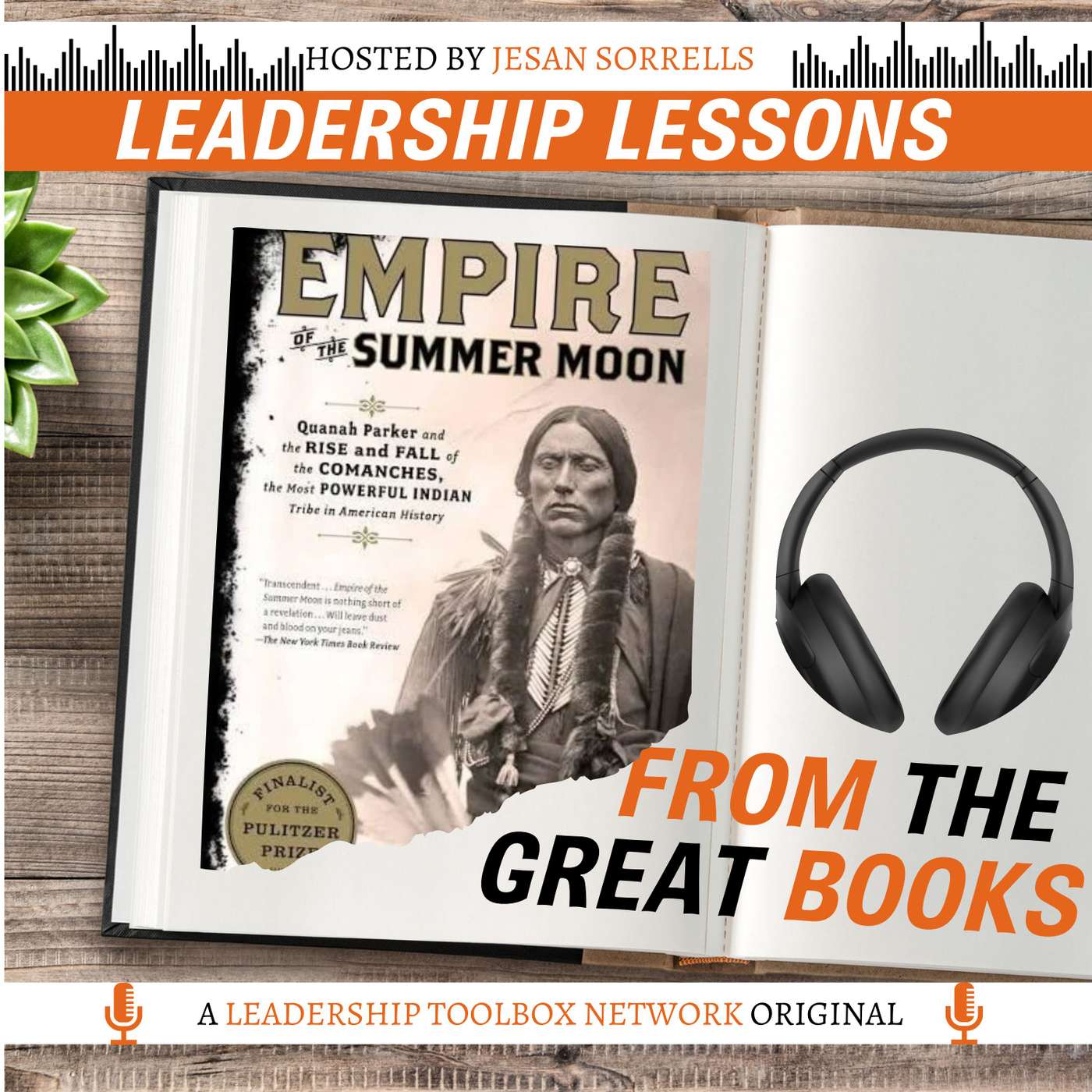
Empire of the Summer Moon: Quanah Parker and the Rise and Fall of the Comanches, the Most Powerful Indian Tribe in American History by S.C. Gwynne w/Tom Libby - Part Two
Empire of the Summer Moon: Quanah Parker and the Rise and Fall of the Comanches, the Most Powerful Indian Tribe in American History by S.C. Gwynne w/Tom Libby - Part Two
---
Delving into S.C. Gwynne’s Empire of the Summer Moon, this episode examines the tragedy of Cynthia Ann Parker’s life, her forced reintegration after years with the Comanche, and the culture clash between indigenous and settler societies. The discussion explores how Quanah Parker’s upbringing exemplifies resilience, leadership, and the importance of multigenerational knowledge transfer. Leaders are challenged to see the value in honoring different histories, adapting in times of change, and guiding others through cultural transformation.
- Book Title: Empire of the Summer Moon
- Author: S.C. Gwynne
- Guests: Tom (recurring podcast guest); Jesan Sorrells (host)
---
Time-Stamped Overview
---
00:00 Cynthia Ann Parker's cultural transition
09:16 Her capture and later life
12:28 Understanding cultural and personal identity
20:12 Cynthia Parker's life's tragic events
24:00 John Wayne's Oscar-worthy performance discussion
32:12 Quanah at the Battle of Pease River
35:13 Surviving in the wild as boys
42:51 Importance of Passing Down Knowledge
47:42 Regionalism and globalization trade-offs
53:23 Quanah and We-ke-yah's elopement plan
59:41 Quanah's tough negotiation choices
01:01:58 Facing overwhelming odds in battle
01:06:24 Comanche leadership and negotiation skills
01:12:52 Courage and cultural confidence
---
- Opening theme composed by Felipe Sarro - Bach - Silotti - "Air" from Orchestra Suite No. 3, BWV 1068
- Closing theme composed by Brian Sanyshyn of Brian Sanyshyn Music.
---
- Pick up your copy of 12 Rules for Leaders: The Foundation of Intentional Leadership NOW on AMAZON!
- Check out the Leadership Lessons From the Great Books podcast reading list!
---
- Subscribe to the Leadership Lessons From The Great Books Podcast: https://bit.ly/LLFTGBSubscribe
- Check out Leadership ToolBox at: https://leadershiptoolbox.us/
0:02 Hello, my name is Jesan Sorrells, and this is the Leadership Lessons from the Great Books podcast, episode number 206, featuring a return to our book that we left off the last time, Empire of the Summer Moon. So we want to I'm gonna pick up our conversation today where we ended. And so we were talking about Cynthia Ann Parker, and we'd ended on discussing the information in chapter 12, which was around the end of Cynthia Ann Parker and how she was captured and eventually, quote unquote, returned, such as it were.
0:52 to, um, to the society of the settlers after the Battle of Pease River.
1:00 And I quote, we will never know how Cynthia Ann Parker felt in the weeks and months after her capture by Sul Ross. There are so few comparable, comparable events in American history, but it was painfully apparent from the earliest days that the real tragedy in her life was not her first captivity, but her White men never quite grasped this. The event that destroyed her life was not the raid at the Parker's Fort in 1836, which we talked about last episode, but her miraculous and much celebrated, quote unquote, rescue at Mule Creek in 1860.
1:34 The latter killed her husband, separated her forever from her beloved sons, and deposited her in a culture where she was more a true captive than she had ever been with the Comanches. In the moments before Ross's raid, she had been quite as primitive as any other Plains Indian, packing thousands of pounds of buffalo meat onto mules, covered from head to toe in blood and grease, literally immersed in this elemental world that never quite left the Stone Age, a world of ceaseless toil, hunger, constant war, and early death, but also of pure magic, of beaver ceremonies and eagle dances, of spirits that inhabited springs, trees, rocks, turtles, and crows.
2:10 A place where people danced all night and sang bear medicine songs, where wolf medicine made a person invulnerable to bullets, dream visions dictated tribal policy, and ghosts were alive in the wind. On grassy plains and timbered river bottoms from Kansas to Texas, Cynthia Ann, not duh, had drifted in the mystical cycles of the seasons, living that random, terrifying, bloody, and intensely alive place where nature and divinity became one. Then suddenly all of it disappeared. Instead of Stone Age camps, a swirl in magic and taboo and scented smoke from mesquite lodge fires, she found herself sitting in taffeta chairs and drawing rooms in the outer margins of the Industrial Revolution, being interrogated by polite, uncomprehending white men who believed in a single God and in a supremely rational universe where everything could be explained.
3:06 This new culture was every bit as alien as the one she confronted after the attack on Parker's Fort. It was as though she had walked yet again through a door into another world, quite as complete as the one she had left, and in all of its mystifying details, completely different.
3:26 Thus we begin on our show today with the end of Cynthia Ann Parker's story and the beginning of her son, Connor Parker's story.
3:39 To wrap up from last episode, we talked about
3:43 all of this. Well, not all of it, but we talked about a lot of this. And I'd asked you, Tom, what your thoughts were on, you know, the violence and the tragedy of Cynthia Ann Parker's
3:58 life. And I kind of forget what conclusion we had come to. It's been a minute now. Several, several other things have happened since then. This is not a, this is not a clean one to the other transition, folks. The numbers say 205 and 206, but it's not a clean transition from one to the other. So just for the purposes of my own edification, I've had quite a lot going on lately. They started pulling siding off my house recently. So that's been fun and exciting. Awesome. Oh, no, not really. So why don't we, why don't we, why don't we revisit some of your commentary on Cynthia Ann Parker just, just very briefly?
4:40 Well, it's funny. It's funny that you say like the, you know, I remember, so this is not the first time for those of you who follow, who have listened to us ramble about these things for the last— I don't know how many years now, Hasan, that I've been doing this with you, but it's been a few. It's been a minute. It's been at least a few. This is not the first time we've had to re-record an episode and/or come back to
5:08 finish a book because we tend to ramble on for a very long time about these things. I don't remember, so like you, I don't remember all of the commentary that we produced in the first episode for this, nor in the subsequent conversations that we've had since. I'll just leave it at that. There you go. But I remember, I do remember talking briefly about, you know, when Cynthia Parker was was adopted into the Comanche when she was young. I mean, she was brought into the community at something like 9 years old, spent the next 20 years living a Comanche lifestyle, or 20-plus.
5:57 I don't remember her exact age when she was brought back into the white society, but I thought it was in her 30s, right? Probably like— In her 30s. Mid-30s or so. So maybe, so it might have even been, let's say 30 years, considering that would put her at 39. So she spent 30— so 3 times as long living as a Comanche than she did as a white child.
6:21 So I can only imagine the, you know, and as children, we do adapt to trauma a little bit differently than we do as adults. I'm not saying better or worse. I'm not a psychologist. I'm just saying that I know it's just different. But I can only imagine the trauma going into, you know, and being forced into an environment where you just no longer understand it. Like, you know, if you think about it, she didn't speak English anymore. She had to be retaught her English language for the most part. And it must have been terrifying for her.
6:56 I mean, again, she had
7:00 come to a point in her Comanche life where she was very well respected. She was considered an elder woman. She was considered as I mean, she was married to one of the higher, one of the more— I wouldn't say powerful, that's the wrong choice of words— but one of the more prominent chiefs at the time. So she was married to a chief, prominent chief, respected elder and respected woman of the tribe. Then she gets tossed into this world that A, is foreign to her, B, she doesn't understand, C, she's nobody at that point.
7:34 Yeah. She's nobody. She's She's nobody to nobody, so to speak. So, um, it, it— I— from, from where I, from where I look and from where I, like I said, I can only imagine the, the, the trauma that she was put through in doing so. Now, all that being said, I mean, you can make the argument that she was traumatized in the first place and she probably shouldn't have been there, etc., etc. Sure. All that may or may not be true. I don't know for certain, but All I, what I do know is if you're out in the middle of no man's land with the next closest person to help you is days away and you're a 9-year-old child, I think I'd rather take my chances with somebody who's going to feed me and at least to the, even, even if it's the bare minimum, than to just kind of wing it in the wilderness at 9 years old.
8:22 So, Yeah. and I'm not suggesting they saved her or anything like that. That was not, I'm not suggesting that was the case. I'm just saying that if I had my druthers, I'd probably go with the people who have food and clothing and shelter versus being stuck out in the middle of the wilderness for, you know, for naught. But then again, on the flip side, as an adult, that's a different thing. You know how to take care of yourself at that point. Right. So now it's just a matter of, do you actually fit in the world that you're being forced to kind of go back to?
8:50 And I can only imagine the challenges that she faced. It would be— I would imagine it would be very, very difficult for her.
8:59 So in looking up, um, I just glanced at the, the Wikipedia article very briefly, um, about Cynthia Ann Parker. And, um, she was, um, she was captured at age 8. Um, so at 8 years old. 8. I thought it was 9, but okay. I was close. You're close. Um, and then, um, she was, uh, recaptured I guess that's probably the correct term to use, um, um, at age 33, um, and died in East Texas, um, and, and her death was a sad one, um, you can read about it in the book, um, 10 years later at age 43 after the, um, after the death of her daughter, um, Prairie Flower.
9:43 Um, during that, during that, and during that 10-year period, One of the things that's really, really interesting in the book, and you can, if you go and look at the Wikipedia article about her, you can see pictures of her. They took tintypes of her. She had massive hands, right? You know, just very, very clearly a very strong woman. Clearly very, very capable and very able, which would make sense. I mean, I've got a 9-year-old myself. If he were, if something were to happen to me and he were to be captured by somebody else, I doubt he would, in his 30s or 40s, have a very strong memory of me.
10:23 It's a unique child that would, that would have that, that would be possessing that.
10:30 She was uncomfortable with the attention that she received because she was paraded around as a, partly as a, as a, as an eccentricity, which is what people did back in the day before television and radio. Right. This is one of the benefits of mass entertainment is now we get all of our eccentricities streamed to us.
10:52 But back in the day, you had to actually show up.
10:57 But she worshipped, right? There's an anecdote in the book talking about how
11:10 the society of her family that was attempting to to reintegrate her, such as it were, never fully kind of wrapped their arms, you know, around that with her. And she didn't, she didn't allow them to, right? She wanted her life back. She wanted the thing, to your point, that she had, that she had known. She was visited by very many people, again, as an oddity and as an eccentricity.
11:43 And she tried to escape several times, was tackled, and was always brought back, always returned. She spoke in, in, you know, the Comanche language, and she would not or could not speak English, although I don't, I don't know that she could not. I just think she would not. And one of her relatives— I'm just going to quote here directly from the book— one of her relatives described her ritual of worship. She went out to a smooth place on the ground, cleaned it off very nicely, and made a circle and a cross.
12:14 On the cross, she built a fire, burned some tobacco, and made— and then cut a place on her breast and let the blood drop onto the fire. She then lit her pipe and blowed smoke toward the sun and assumed an attitude of the most sincere devotion. She afterwards said through an interpreter that this was her prayer to her Great Spirit to enable her to understand and appreciate the that these were her relatives and kindred she was among.
12:45 And of course, she was uncooperative with the neighbors and even her family members who demanded that she give up everything that she had previously known from the age of 8 to 33.
13:00 So there's an idea that we've been exploring for a while on this show, you and I and others. And it's the idea that, and you see it very much in the way that S.C. Gwynne talks about Cynthia Ann Parker.
13:17 And we've covered another book, episode 207, we covered another book, Endurance. We talked about Alfred Lansing's book around Edward Shackleton's voyage, right, in the Antarctic. And there's a certain romance with which Lansing, who was also a journalist, by the way, writes that book, Right, a Journalist and a Minor Historian. S.E. Gwynne is not seeking to make this romantic, like, at all. He's seeking to be matter-of-fact and a little bit damning, honestly, which is why I sort of struggle with the Comanche Nations Resolution a little bit, because S.E.
13:54 Gwynne is not holding up her reintegration. her reassimilation, if we're going to use an old word, into, into white society as a good thing. He's actually damning the society that dared to pull her out of a thing and then refused to understand or acknowledge, to your point, the impact that that experience, that that life had made on her. And There's something very,
14:29 there's a point here, I think, for leaders. And I think the point is that everybody comes from somewhere and everybody has history, and we have to acknowledge that. But we also have to, I think, walk the fine line of not being bound by that, being bound either in judgment and condemnation. or being bound in too much celebration and, you know,
14:56 an over-acknowledgment that almost turns into— I'm going to use a hard old word here, a hard old religious word— that almost turns into idolatry. Because I think that's where we're kind of at now in our culture. We idolize identity almost to the point of holding it up as the only thing possible. Like, if Cynthia Ann Parker were around now, If that kind of situation were happening now,
15:22 there would be a lot of reprobation for the white society that wanted to reassimilate her. It would not, it would not go over well, I don't think. Mm-hmm. Now, we could say that that's because of the path that we've walked through as a culture to get to this place. And it's a path, by the way, that included the running over of Cynthia Ann Parker.
15:46 But I think there's some other things wrapped up in this, and I don't— and I think it's wrapped up in how Gwen talks about this and sort of the, like I said, the de-romanticization of it, the draining of the romance from it. Because this is not framed as a romantic thing. This is framed as a genuine tragedy and not tragic circumstances either, just a genuine tragedy. And I think that that's something that we are not
16:15 I think we need stories about the tragedy. So I would love to see a movie about Cynthia Ann Parker rather than just reportage on the tragic circumstances. Does that make sense? Well, kind of, but I'd like to preface this a little bit more. So, and again, I think you and I in one of our previous conversations, I will, You know, just, I'm not Comanche. I know we've mentioned my Native heritage on this show quite a few times now. Right. But I'm not Comanche, and I don't claim to understand the Comanche tribal government and how they viewed all this.
16:55 But if you look at some of the reasoning behind why they started to kind of distance themselves from the book, Yep. They have their reasons. And as a fellow Native person, I will honor their decision based on this over pretty much any other, right? Like, so I'm gonna give them more credence and leeway into whether they did or didn't think the book was good or whether they should or shouldn't support the book. I'm gonna lean toward them to begin with. That being said, Your commentary specifically about the tragedy part and how S.E.— sorry, S.W.— S.W.
17:35 Gwynne? S.E. Sorry, S.E. I had it right the first time. I apologize. I don't know where the W came from, but S.E. Gwynne— oh, the Gwynne, the W. Anyway, my brain works in odd ways. Anyway, but S.E. Gwynne, one of the things, like, when you talk about how he was just trying to point out the tragedy, I think one of the other things that that we as a Native community start to struggle with a little bit is like some of these, they're like unconscious bias kind of things, right? Where the dominant society, I'll just say dominant, I'm not going to blame white people.
18:14 This is not a white, red, Black, Asian thing, right? Or it's not a color thing. It's when dominant societies read this and they the tragedy to them is what happens to the child and the life thereafter. The tragedy to me is actually on both sides of the coin. So, I see it a bit more equally, right? Whereas— Sure. Yes, absolutely, that was a tragedy that anything like that could happen to a child. And I'm assuming that the— and I don't remember how the book handles this. It's been a very long time since I read this book.
18:54 So, because I realized after we got off the first one that I actually had read this book, I went back and I actually have 3 copies of it sitting in my house. So I was like, because I opened it up, I was like, oh yeah, I do. Oh yeah, I actually read this. Anyway, I actually read this. I don't remember how they handle the transition from that 8-year-old child. I don't remember if they tell you what happens to her at 9, 10, 11, 12. you know, 15, 18. I don't remember the details of that. I only assume that the beginning of this was absolutely horrendous for her.
19:30 Right? Right. And that she didn't feel super confident and comfortable until well past her teens, or maybe it is into her teens. Maybe it's late teens or something like that. 5, 6, 8, maybe 8 years. Then she starts feeling comfortable. Another 4 or 5 years, she starts feeling confident. another 4 or 5 years, she's in the leadership role of the women, right? So it's like, there's process to this. This is not something that you just— and by the way, it wouldn't be dramatically different for a child of the Comanche either.
20:02 They have to prove themselves too. So she just had a late start. So there was a lot more like thrown at her all at once versus at age 5, 6, and 7. You know what I mean? Yeah. Like all the stuff that happened at 5, 6, and 7 didn't happen to her. So they're gonna throw it all at once. So again, to go back to my point here, I'm sorry, I'm rambling, but the idea or concept of the tragedy, you— I don't think you can look at the life of Cynthia Parker as a tragedy and a whole, in the whole. There were a couple of tragic events in her life, sure, but I think there's some unconscious bias that leads us to think that the tragedy as the child is far more dramatic than the rest of her life.
20:44 tragedy as an adult. And I would beg to differ. And I also think that that's some of the pushback from the Comanche tribal government, where this person that you're talking about, you're depicting in this book as she had the— like, these 2 events in her life were the 2 worst things that could have possibly happened to her. But you're, you're not putting any emphasis or stress or anything on the Comanche, uh, um, uh, oral histories of her life, because they may be very different. And if I remember correctly, in the ruling, in the article that they sent out, that was part of it.
21:20 The oral histories weren't taken into consideration by S.E. Gwynne. And when you are writing about another culture, why would you not just go straight to the source and ask them? So, I can understand why they pushed back on this book a little bit. And I understand there's also terminology that they're using, whether that he uses, because he maintains the, the, that barbarian style of living, the savage style of living. They didn't view themselves like that. Right. So if you're going to be true to the journalistic integrity, then you should be reporting on both sides of the coin and making sure that both sides are represented in an equal and sort of fashion.
22:02 So I think that's where he falls. I think that's where he falls short in the Native side of things. Like, he's still using very
22:14 biased-centric terminology. Ethnocentric, I believe, is the term that was used. Yeah, ethnocentric, right. Yeah, in the resolution. Yeah, yeah, yeah. No, no, no.
22:25 Yes, that terminology is used in the book. I would be remiss if I did not. Say that. Yes, it is, it is used in the book.
22:37 And I'm not defending it. I'm merely saying that— not merely saying the terminology is used, the framing is there.
22:46 I, I, I, but I don't think that that framing is— and maybe this is where I separate from the, from the Comanches a little bit on this, actually. Yeah, a little bit on this.
22:58 I understand that no language is neutral. I mean, we're a podcast, for God's sakes.
23:06 We move people based on words. No language is neutral. Okay. And words have meaning. Absolutely. I'll grant you all of that. But to fail to recognize that SC Gwynn is actually damning the society that these words came from, to fail to recognize that that's actually a significant win in comparison to— let me go back to 1956 where the movie The Searchers starring John Wayne, which was based on Alan Lomax's novel called The Searchers, and it was directed by John Ford and starred John Wayne as a frontiersman searching for years for his kidnapped niece based on the source story of the search for Cynthia Ann Parker.
23:49 If you go back and watch The Searchers, yeah, I mean, it's a monster performance by John Wayne as an entertainment piece. It's absolutely amazing. John Wayne should have won an Oscar for that, right? But that story, the way that story's told, the language used there is exactly the kind of triumphant language that you do not see in the— with it also being tragic, but it's tinged with triumph. Right? The, the, the— because it's mythology being resold by John Ford to people who probably had grandparents at the furthest back, great-grandparents that directly experienced these, these battles with, uh, with the Comanche and directly experienced this, uh— I don't want to use— I want to be careful my terminology here— the, um, directly experienced the movement of white settlers into the Old West.
24:48 I'm gonna use neutral language there. The, the gap between 1956 and 2010, when this book is published, and the ways in which society and culture has changed— I'm gonna make a, I'm gonna make a very Bill Maher point here. The idea that nothing's changed since 1956 Is astonishingly blinkered. We have absolutely changed how we refer to these things. We have absolutely become more damning. That's my larger point. We absolutely have. Is there ever going to be enough to replace all of the blood of the, of the native tribes that were spilled?
25:27 And, and is there ever going to be enough to reconcile the damage that has been done? No, probably not. Probably not. But we have to acknowledge that change has been made.
25:42 And the difference between LeMay and SC Gwynn, light years, light years of difference. So I respect the Comanche's resolution. I respect your point here. I agree. In broad— in the broad strokes, I absolutely agree. We have to look at it in whole. I think we need the ability, and I think this is huge, we need the ability to tell the story in whole. I think that's because I think that that's the way we wrap our arms around it and the way that we get a hold of it and the way that we embed it in our emotions so we do get the words right and we do understand— oh my gosh, we do understand what is happening.
26:29 Okay, just to— the reason I said, oh my gosh, is because my phone keeps trying to do a factory reset reboot even though there's nothing wrong with it, and it's been cycling like this for the last 2 days. And so every time it comes with the black screen, the little red things on it, and it flashes at me like it's going to do a factory reboot, that's why I was saying, oh my gosh. The epitome of 21st century first world problems. Oh my God, it's so annoying. Oh my God. As we talk about an era in time that didn't even know what a— I know.
27:01 I know. I know. I know. That makes me— see, that makes me a knucklehead. That makes me a knucklehead. Think of this lovely, broad philosophical point, and then I happen to glance down at my device that has more computing power than what we used to put Apollo 13, whatever moon landing man, on the moon, and it says, would you like to reboot your device? No, I don't want to reboot my device. doing? I don't want a factory reset.
27:28 I was joking with somebody the other day, remembering— I remember a statistic I heard in, I don't know, I think it was like 1992 or '93 or something like that, that in 1985— so again, the statistic was only 5 to 8 years old, right? So in 1985, we had more computer power in the in the '85 Buick Grand National than we had on any space shuttle that flew to the Moon. It was crazy. You reminded me of that. It made me laugh then and it makes me laugh now that we actually— essentially, because we sat people in a capsule sitting on a whole bunch of just rocket fuel and said, let's just do it.
28:17 Let's just go. We weren't worried about math. We weren't worried about what's gonna happen if something goes wrong. What's the worst thing that can happen? We lose a couple of people. We have 150 million more. Whatever. Yeah, yeah, we already blown up a few monkeys getting there. It's fine. Oh, it'll be no problem. Uh, anyway, um, didn't mean to take you out of the, out of the show, folks. Just happened to glance down and my phone's been doing this weird reboot thing once every like 20 minutes. And, and eventually I am gonna have to factory reset it and it's gonna be a pain in the butt.
28:48 And I'll probably have to do that like, I don't know, this weekend because then I'm gonna have to restore everything anyway. It's gonna be, it's gonna be nonsense. I'm just gonna live with it. By the way, all my 2-factor authentication is also on my phone because of course it is because, you know, the internet is a weird, wild place where like Wade from Kim Possible is trying to steal all my data on the dark web. Like I don't, I don't— I know it's a weird, wild place. Why do I have to 2-factor authenticate with my phone?
29:13 And yes, that is a first-world problem. Okay, back to the book. 21st century first-world problem. That's how I classified it. Yeah. Yeah. It's not a Coupe DeVille or whatever the hell car was you mentioned. Oh my God. All right, let's talk about Connor Parker. Let's talk about, let's talk about Cynthia Ann Parker's son. By the way, I'm writing a short story just Just so you know. And I thought the name Quano was so cool that I'm gonna use it for one of the characters. I know it probably has deeper meaning and I'm not— it's, it's actually a story that occurs like on Mars in the future, but it just sounds like a cool, a cool name.
29:50 Anyway, I know it probably has some, some tribal, deep tribal meaning and I'm probably misusing it and I'm, I apologize, but it was the first name I thought of for my short story that is currently unpublished. I haven't even like, I've only written like 500 words cuz it came to me in like a jolt. I was like, oh my gosh, and the character's name is— and it just all came together in my head. Like, I had the vision of everything. Anyway, I'm sorry. I don't know. I'm probably violating about like 10 or 12 different things just by naming that person.
30:17 And I apologize. I apologize to everybody that I'm violating, but like, creativity, what are you gonna do? So, also a fictional book. So it's not— it's not— yeah, it's a short story. It'll be— it's only gonna be like 5 pages. It's It's on Mars. It doesn't matter. It doesn't matter.
30:36 Cynthia Ann Parker's son. Okay, so she had, she had 3, she had 3 children. And one was, one was her, her daughter, Topsannah. And then of course, Cynthia— or Cynthia, I'm sorry, Quanah Parker. And I'm going to look up the son, the other son's name, because I don't have it immediately in my brain. Because it's been a minute.
31:07 Was, let me see. Oh, Peanuts. That's right. That was the, that was the appellation given to, to the other, to the other son.
31:17 They fled after the Battle of Pease River. And the boys were young. They were 12 and 10 years old. And when they fled the village,
31:33 they— their mother, Cynthia Ann Parker, had somehow been with them, but then they lost her at some point in time during, during the escape.
31:43 They may or may not have witnessed the death of their father, the, the tribal leader, Peter Nocona. But they almost certainly understood that their mother had not been killed. But they obviously got the general idea that everybody else was dead, and so they fled. Now, a 12-year-old boy and a 10-year-old boy, specifically a 12-year-old boy and a 10-year-old Comanche boy, were not without resources in the wild. Let me be very clear. As a part of Comancheria culture, they would not have been allowed to participate in battle, but they would have and probably would not have even been allowed on a buffalo or deer hunt, and he would not have been left on, as, as S. Seagood puts it in the book, the immensity of the Southern Plains without food or weapons and with no sense of where his people were.
32:34 And then what he says here is interesting. What happened next has been unnoticed or uncredited by the main chroniclers of Comanche history, largely because Quanah himself later forcefully denied that he was at, that he was even at the Battle of Pease River. Or that his father had been killed there. Both assertions were untrue and had to do with Quanah's interest in cleansing what would have been a terrible stain on Peta Nocona's record. The Comanche saw, um, Pease River as a fiasco and a disgrace.
33:02 And it had happened entirely on his watch. Quanah and Peanuts were at the camp because their mother said they were. She was frantic because of it. We also know that 2, and only 2, riders survived the fight and managed to get away. We know this because Charles Goodnight and 10 scouts under his command tracked them from the confluence of the Pease River and the Mule Creek— and Mule Creek to a large canyon near the foot of the Llano Escotado, somewhere between 75 and 100 miles to the west. He never saw their faces, only the tracks of their horses.
33:35 This is not unusual, by the way, in, in discussing or in addressing or even in documenting how, quite frankly, white trackers had trouble with the Comanche. They never saw evidence of them. They just— beyond their— beyond the tracks of their horses, right? Because they knew the Southern Plains. They knew all of West Texas and what is now Oklahoma and Kansas, and that was their backyard. That was, that was their land.
34:12 And northern Mexico. And northern Mexico. Oh, yeah. Oh, yeah. And raiding into northern Mexico. We'll get into the raiding in a minute. When Quanah was born in 1848, he was born near the Wichita Mountains in what is now southwestern Oklahoma. And 1848 was the time when white men were still very, very far away. Quanah grew up as any other Comanche boy would have grown up. He was— by the time he was— when he was 4, he would have been riding an old pack horse. By 5, he managed a pony of his own. By 6, he was riding young colts bareback, and soon after that, he was enlisted to help herd ponies.
34:52 Like all Comanche boys, he would have become expert at roping and catching horses. From this point onward, he spent an enormous amount of time in the saddle. His horse quickly became, as it was for all of the people, men and women, an extension of his physical being. He was shooting birds. He was hunting by 6, 7, 8, 9, 10 years old. These boys were not without resources being thrown out into the world. They knew how to track, even though— and they knew how to track animals. You know, they may not have known how to bring down a buffalo, but they definitely knew how to feed themselves.
35:27 Out in the wild,
35:32 they they roved about in gangs with other little boys. You know wrestling and swimming and racing horses and shooting hummingbirds and following birds and insects.
35:47 They would have looked for the signs of the animals right in the rocks, and they would have looked to the skies to figure out what weather was happening and what weather patterns were going on. They were not only skilled in hunting, again, not enough to bring down a buffalo, but enough to feed themselves. But they were also skilled in making a fire and in establishing a shelter. So this isn't, this isn't 10 or 12-year-olds. Like we were just talking about my phone. This isn't 10 or 12-year-olds that are stuck on TikTok.
36:21 This isn't that. This is a totally different thing. And so I guess a different question I want to start with,
36:31 and I know you and I have talked about this kind of a little bit offline with what you see happening in the transference of knowledge among and between elders of what you're seeing in your tribal community. and transferring that to younger folks, right? The, what I call the breaking of the great chain of being, which by the way has hit all ethnic groups. All ethnic groups are kind of going through this, but specifically with native tribes in America, the native tribal peoples.
37:10 Quanah was part of that great chain of being. Matter of fact, and we're going to talk about sort of the time in which he was born and the other, the other tribal chiefs that, that came up in other tribes around him. It was sort of the, the beginning of the great time of the great, the great tribal chiefs. Um, but how much of this do you think, how much of Connor's
37:36 life, right? Uh, particularly his younger life. Should be replicated and brought forth. Because when I read this, I was like, why don't we have kids doing this now? Like, my God, I want to— my 9-year-old, my 9-year-old does not know. God bless him. He knows how to take care of the turkeys and chickens. I'm not taking anything away from the man, but if he had to track a deer, I mean, he would be interested in doing that, but he wouldn't know the first thing of how to do that.
38:08 That kind of knowledge, while seemingly useless in a post-industrial, highly technological 21st century first world society, seems to be an anachronism. But there's other things that are underneath that knowledge. And so
38:25 are we missing something? I guess that maybe is the question. Do you think we're missing something? I think I have to say yes. Just because— well, no, kidding aside, because like, so like raising my own kids in the community, right? Like, there were always things that I was showing them or their grandfather was showing me that I now show them or whatever, like some sort of combination of that, or maybe their grandfather was showing them directly, that I still see as valuable, like, right now, right?
39:04 So, like, I'll just give you an example. We were, we were at a, we were at an event, and we were out in the woods. Mm-hmm. And it was a, it was a tribal event. Like, we were out there kind of hanging out, doing some things. We had some visitors that, like, were not tribal people, but we were, you know, we're relatively welcoming as long as they're not disrespectful. we're okay with people being around or whatever, right? But my— we were— it was— it had just rained the day before. So everyone— or no, I shouldn't say everyone, but there was a group of people that were like, oh, we're supposed to have a fire and this is going to be impossible.
39:38 The, you know, can we do this without the fire? Because all— everything around us is wet. It had just rained. And my son, who happens to now be not 9 but 27, says, No, we got this. Like, my dad showed me how to do this with, like, whether it's raining or not, like, you can always build a fire. So, he was able to build a fire even in that environment. And there were people even amongst our own community that were like, oh, wow, I didn't know you knew how to do that. Like, your dad showed you that?
40:08 How'd your dad know how to do that? Like, so to your point, and I'm using one very simple example. Yeah. This is a very simple example because we have also shown them how to skin animals and how to treat hides and, like, There's stuff that we can do that, to be honest with you, a very high percentage of people think is absolutely useless today because I can just go to Tandy Leather and buy a bolt of leather, or I can go like a, you know, there's like, it's accessible to us without having to know how to, the process behind getting it.
40:39 Right. Well, the reality of it is my son is absolutely 100%, 100% 100% unequivocally convinced that there is going to be an apocalypse in his lifetime. He is— I tell you, he's not a tin hat person, like he's not wearing tinfoil, but he just feels very strongly that the human race is going down a pathway that we cannot come back from. And it's a combination of all the things that we know are wrong with the world, whether it's— Sure. People not getting vaccinated properly or the AI data centers or Global— oh, sorry, climate change, not global warming, climate change, all these things that we all know are bad.
41:19 He thinks at some point there's going to be a
41:24 pivot point where we're not going to be able to come back from. And once that happens, it's going to speed up the process of the apocalyptic event, right? Hmm. Okay. He thinks it's going to happen in his lifetime. And again, this is not a tin hat thing. This is not conspiracy theory. He's just looking at things that are actually happening in our lives that he thinks are gonna all come to a head at the same time. Okay. Anyway, all right, the point is that if that apocalypse happens, he wants to be able to live through it.
41:51 And he thinks a lot of the old ways are going to be vital in knowing how to be able to manage and handle your life and your livelihood once you don't have access to electricity, running water out of your faucet, your, you know, your cell phone for You don't have Google at your fingertips anymore, how to do something. You don't have YouTube to show you how to step by step on how to perform something or perform an act or something like that. So you're gonna have to have this inherent knowledge or you're gonna die or be reliant on other people to survive, which in his mind is also a detriment to him.
42:27 Okay. So anyway, but to your question, I think that even small things like that, Like the building of fire in a wet environment. If you can't learn that, like, I don't know how to express why I feel it's so important to know these very small and seemingly innocuous things, right? Right. But there's something inside me that feels like they're important. And whether it's simply, to your point about the whole transfer of knowledge thing, and maybe it's an embedded DNA thing that I just have this need or this unwritten thing in my brain that says I'm supposed to transfer knowledge regardless of what it is.
43:08 Mm-hmm. It's like, it's like a human thing. So I don't know what the driving force is behind it other than for me it is a cultural thing. Like, I do know that that's there and, and there is lots of
43:23 euphemisms and lots of like little, these little idiosyncrasy things and sayings and all these things that kind of are, are kind of pounded into us. And one of which, by the way, is you are each responsible for the next 7 generations, which I don't know if you want to do the math, but I promise you, I'm not going to live that long. So, it's, it's, it makes what the reason that the phrasing is the way it is, is because your knowledge should live past your life, right? Right. So, like, so if I can get my son's sons to know what I know and embed in them the same principle of you now are responsible for the next 7 generations after you, that my job is done because he will now have imprinted at least on the next few generations, right?
44:11 Right. So, like, I'm 3, he's 3, so I'm at least at 6. I can live my life knowing that if I can instill that force thought into that, into that 3rd generation from me, which I hopefully am still alive with, like, you know, but that's the point. The point is like, yeah, you know, you can't be the one teaching that 6th and 7th generation, but if you do your job right, the next generation will teach the next and the next will teach the next and so forth and so on and so forth. But, but I do also feel like, to your point, um, regardless of how much a person or two emphasizes this, because I know it's very, very, very deeply rooted in our family, not necessarily our whole travel community, but at least in our family.
44:58 But if you don't, if you're not able to produce that same kind of influence over the whole travel community, then to your point, it kind of dies off. Right. And we are seeing that, like, even from a Native community perspective, more Native people hold these devices in their hand than than not, right? So like, it is concerning. I will say it that way. It is definitely concerning. And I'm not 100% sure how to fix it outside of my own family unit. I just know that inside my family unit, that is real.
45:31 Like, that is something we actually talk about very regularly, about making sure the next generation learns from the next and so on and so forth. So when we When we think about how we transport or transpose this knowledge, by the way, for your son, you may just want to let him know, I thought the same thing in the 1990s and everything's still here. So, you know, you might want to ask him, what do you do when the apocalypse doesn't come? That's the more penultimate question. What do you do when it doesn't show up?
46:08 Like, you're just waiting around for it. It just never— But he's not waiting around for it. He's doing it. But he's convinced it's gonna happen. He's convinced it's gonna happen. He's convinced it's gonna happen. It's gonna happen. Yeah. So that deep knowledge transfer, right? And this touches on something else that we had talked about, or that another point that I brought up quite a bit ago, and I wanna revisit it because it kind of jogged my memory when you were talking.
46:41 Many of the authors that we talk about on this show are authors that were
46:48 created and got— not were created, produced works of importance during the 20th century. And they produced those works coming out of a tradition that was very American. Zora Neale Hurston, she could not have written her books, she would have had zero interest in writing her books to appeal to a broader global audience. Although later on, after she was, she was passed away, audiences found something in that story that was universal outside of it being about African American people, you know, in Florida, right?
47:23 Or Katherine Anne Porter, Pale Horse, Pale Rider, right? Or Oh gosh, who is it we just covered? Oh, Eudora Welty. That's where this also came up when we were talking about her book that we covered on this show too. Or Charles Portis, who wrote True Grit. He's always the example that I bring up, a book that is very much grounded in American regionalism, this idea of American regionalism. Okay. There's an idea there that actually goes to that knowledge transfer. And the idea that goes to the knowledge transfer, to your point about the devices, is when you're no longer grounded in the regionalism of your area or of your country, then you go out to the globe and you become— not too much to find a point on, but you become watered down, right?
48:17 And you lose what makes you
48:22 African American, or you lose what makes you ethnically Irish or ethnically Italian. You lose what makes you Native, right? You lose those things in the pursuit of something more global, which of course always flattens everything, including flattening knowledge. And of course, the assumption with that flattening, the assumption that comes along with that flattening is that you know, the lights will always be on and there will always be someone to like cook the food and make a fire for us. And we're always going to be able to go down and get the leather to your point.
48:56 And we will always, now becomes an expectation that the world will just work in a particular way. And of course, you know, then an event like COVID comes along and wrecks the entire, wrecks the entire rowboat on that. Which, by the way, an event like COVID then looks like an apocalypse, but only because of the expectations laid upon everything else for it to just work. And by the way, for those of you who went through COVID, I get it. I understand. Tom and I have talked about COVID before on the show.
49:27 We don't need to go back into that. I would just point out that the Spanish flu took off more people during World War I than what was taken off with COVID By a lot, by the way. By a lot. Spanish flu and World War I is an apocalypse. That's an apocalypse together. COVID by itself. Okay. That might be something else. Our expectations have shifted and the expectations of Quana and Peanuts. And I would presume if Cynthia Ann Parker had not been again recaptured, you know, by white culture and brought back in, I'm assuming that Topsannah, her daughter, would have gone through not the same, but would have had a similar sort of standardized Comanche female upbringing, right?
50:22 I mean, there's very little that we get into inside of the book on that. Do understand from the way that S.E. Gwynn writes this, that, you know, the the, the, the, the women in the Comanche tribal culture took care of a lot of stuff. You know, they were doing a lot. There was a lot laid on them. And I presume that Topsannah would have been integrated into all of that as she had come to, as she would have come to, to, to be of age. Right. Unfortunately, she did not. She did not get to experience that.
50:53 So. Um, As we go along in the book, obviously, we learn more about Quanah Parker's life. We learn more about how he was raised, or not how he was raised, but sort of how he developed over the course of time. One of the interesting things is that as he became more of an adult, he wanted to— well, he wanted to get married. He wanted to raise some children, right? And he— but he lacked something that was necessary in order to make this happen in Comanche culture. He lacked wealth. And wealth came in the form of horses, shockingly enough.
51:41 And so he got it in his brain. And I'm going to read you directly from Hermes Seguin as we kind of round the corner here. On sort of the, the most dramatic story around Quanah that sort of sets the, the table for everything else that's going to happen to him afterward.
52:01 He had many wives later in life. This is speaking about Quanah, but none of his unions were ever as dramatic as his marriage to his second wife, whose name was Wekeah. His first wife was apparently a Mescalero Apache about whom little is known. The marriage probably took place in the early 1870s. Uh, Quanah was in love with Wekea. They had grown up together. She was in love with him. She beaded his moccasins and both were— they wanted to marry. There was just one problem. Her father, Old Bear, opposed it.
52:28 This was partly because of Quanah's white blood and partly because as an orphan and thus a pauper, he had no standing in the tribe. Complicating matters was a rival suitor, one Tanap, son of Ekitowacup. Oh, I always screw that up. Who was a, who was a wealthy chief. Wakea did not like Tanap at all. At the heart of Quanah's problem was that, was that the most important unit of Comanche wealth, horse flesh. Tanap's father, who owned 100 horses, offered 10 of them for Wakea's hand in marriage. Quanah could only offer 1 horse.
53:04 Wakea tried to implore him to match Quanah's offer or Tanap's offer. So Quanah went over to his friends, managed to gather up 10 horses. He presented them to Old Bear's— at Old Bear's teepee. And unfortunately, his rival's father had already heard of his plan and had doubled his offer. Undeterred, Quanah came up with a new idea. Now, he told We-ke-yah that their only hope was to elope, which was apparently not uncommon in Comanche culture. An impoverished suitor often had no choice but to abscond with the bride.
53:36 Quote, when a girl learned that a rich suitor whom she did not care to marry was about to propose, she might elope with the man she loved. Couples occasionally eloped when the boy was poor and unable to furnish enough ponies or other articles of value to satisfy the parents of the girl. In such a case, the relatives and friends of the boy might supply the necessary ponies to soothe the dishonor suffered by the wife's parents. Quanah had no such family, which meant that by taking Wekea, he risked death, as did Wekea.
54:04 Comanche families could be quite unforgiving about such things, and it was a simple enough matter for a powerful chief like, um, Eketolkap to recruit an expedition to seek retribution from a young man who had so grossly violated cultural protocols. Well, guess what? He took the young lady anyway,
54:24 along with a party of 21 other young Comanche warriors, because when you're going to run off with your bride, Why take your boys with you? Together they rode south, uh, for 7 hours, not breaking for a trot except when crossing streams. This was as fast as Comanches could travel, and they could only have done with— they could only have been done with a large number of mounts for each warrior. So fearful were they of what might be pursuing them that they traveled for— by night for 2 nights, split up and rejoined a number of times, and split up again into units of 2, coming together at the Double Mountains near the present town of Snyder in West Texas.
54:59 By the way, pause. I know where Snyder is. I've been to Snyder. Back to the book. They finally stopped at the North Concho River near the town of San Angelo, and as Quanah put it, quote unquote, went to stealing horses. They stayed there for more than a year, during which time Quanah built the camp up into his own power base. Their main activity was horse stealing. Quote, we just stole horses all over Texas, according to Quanah. They undoubtedly killed people too. With time, some of his young and daring cohorts returned to their main camp, telling of riches and adventures and Quanah's leadership, returning to the North Concho with their sweethearts or wives, as well as other young men who wanted to ride with Quanah.
55:42 And at the end of the year, Quanah's band numbered several hundred, and they owned a large horse herd. Meanwhile, the dad, uh, Well, Dad didn't take this too well, as you could probably imagine. And, uh, well, he, uh, they rode south. Eketowahcup did, uh, for— with a war party and arrived at the renegade camp on the river. It is not clear what he expected to find, but what he and his warriors found themselves, uh, confronting was Quanah's entire band, armed and painted and drawn up for battle. Shocked by the number of warriors, Eketowahcup became alarmed for his own safety.
56:21 Instead of fighting, he decided to settle. 4 leaders from each side met on neutral ground. After much smoking and haggling, a deal was made. Eketowahcup would receive 19 horses, the pick of Quanah's herd. In exchange, Quanah would be granted the right to return to the tribe. Quanah observed later on, after the deal was concluded, that he knew a ranch where he could steal 19 comparable horses in a few hours. The deal was sealed with a night of feasting and dancing. Because Quanah's band had by this time become too large to be left in peace in that part of West Texas.
56:51 And he followed Ecotoa Cup back home the next day, where he found that he enjoyed new status as a fully fledged war chief. That's a long piece from this book, Empire of the Summer Moon. But I read that because—
57:08 Tom, you and I have both been young men. Now we are old men. We are much closer to Ekatoa Cup, uh, than we are to Connor Parker in this story.
57:22 What was Ekatoa Cup to do? Like, did he, did he do this correctly? Was this the right way to go, to cut a deal with this, with this young, brash, probably good-looking, uh, you know, young man, or Or should he have? And I know second-guessing, you know, we're looking at the— we're second-guessing on the play long after the play's been decided. But is this the correct way to sort of deal with this situation when you're faced with it? Is this the right move? Is it the right move to negotiate?
58:01 Well, I mean, for all intents and purposes, I think
58:06 the father came out exactly the way— like, he came out no different than he would have if she had married the original guy, right? So like— Right. But with one minor, yet vitally important component here. His daughter is now happy. Right? So like, so, and by the way, I don't know know if you caught the subtlety here of the dig. Like, there's a— Connor Parker throws mud in his face without actually throwing— like, I don't know if you caught that, right? But I did. So the original offer was 10 horses.
58:46 He offered 1, came up with 10, and the guy, the other chief said, I'll double it to 20. Yep. And Connor Parker actually gave him 19. 19. That was very, very purposeful. Like, I don't know if a lot of people catch that subtlety, but that was very deliberate. That was very deliberate that it was 19. Yes. That was his way of basically just going, fuck you. Fuck you. Now, that being said, because of the respect and whether it says it or not, there had to have been some form of respect on Connor's part to the dad, right?
59:26 There had to have been, because otherwise he wouldn't have entertained it at all. And he would have just kept doing what he was doing and basically brushed him back off to the tribe, the main tribal village, right? Right. He could have very easily just turned him away and been done with it. Right. He didn't for 2 reasons. Number one, there had to have been some form of respect to him that he had already, like that it was already there, number one. And/or number two, that he wanted to be part of the main— back being part of the main village.
59:58 Those 2 driving forces, I think, put Quan in a position where he felt like he had no choice but to negotiate, and he was going to have to give up something significant, like the 19 horses, because at that point, 19 horses, that was a tremendous amount of wealth, right? Mm-hmm. So I think there was something to do on both sides, and I think I think, again, if you and I, you have a daughter, I have a daughter.
1:00:25 And I think if given that same situation, you know, me and my 4 buddies show up to my daughter's boyfriend's house, and there's 20 of them sitting in there, and they're all strapping young men. And— Right. I mean, I think it's, I think it, there is a point where
1:00:42 wisdom takes over. the ego, right? So like the ego would say, I'm gonna fight this out. Wisdom takes over and says, I know there's no way I'm going to win this fight. So I have to win another way. Right. And I think, I think he was faced with that exact dilemma. It's like, he's riding out with his posse. And I can— I don't think it ever mentions in the book how many he rode with, whether it was 5 or 10 or 20 or whatever, like I don't think he— they say the number, but I can just tell you, more likely than not, it was probably a couple of dozen.
1:01:18 Like, there's— Yeah. He's not doing this by himself, and he's not doing it with 2 or 3 people. And the fact that they specified that 4 leaders from each side came to the table, or not the table, but came to the conversation, also tells me that those 4 leaders are leading other men. They're not— it's not— you're not showing up with those 4 guys. So, right, I'm assuming he shows up with a couple dozen, you know, a couple dozen of his own people and realizing that they are still vastly outnumbered.
1:01:46 And by the way, even if those, let's say, 2 dozen, say, say 24 people were far superior in, in battle or like skills, Mm-hmm. the sheer volume of number, like, is still gonna make you either lose or, or even if you win, it's going to be massive losses on both sides, right? You might walk away with 2 or 3 of your guys left, and he may walk away with 10 or 20 of his guys left, but it's still going to be a— it's still going to be more. So the wisdom takes over. So to your question, I think you and I would handle it the same way.
1:02:20 We would go there with all the vim and vigor we want and all the intent that we think we're gonna just steamroll this young buck. But when we get there and realize we are outnumbered, outmuscled, and it doesn't matter what our skill set is, right? There's still a high probability that we get our butts whooped.
1:02:40 Our mindset begins to change before we even get to that confrontation. Because I'm assuming as soon as he saw the village of 300 sitting there, Mm-hmm. his mind was already starting to change what his approach was going to be. So I think that's where leveler heads prevail when the wisdom kicks in. Because again, like as you read, Quanah and his men show up ready to fight. That's why they're painted the way they are. That's why they are ready to fight. Right. And I think, again, given our situation in that same situation, we're going to defuse that threat as fast as possible.
1:03:21 Oh, yeah. Oh, yeah. And the only way we defuse that threat as fast as possible is to say, I'm here because I miss my daughter. I want her back. And I'm willing to do whatever we have to do to make this work. What do you— what are your expectations here? Well, it's interesting, because I'm personally right now in a moment,
1:03:45 I'll frame it that way, where
1:03:55 This may be a situation that may be more close to my actual life than I might be comfortable with.
1:04:05 And, and, and I was thinking about,
1:04:10 I'm gonna try to be as oblique about this as I can. I, I was thinking about Saying to the young man in question, the Conor Parker young man in this example, hey, you know what? I could just jump you in because I do jiu-jitsu, so I'll just jump you in and it'll be fine. Now, me being an old man, I know that this is not wisdom, but it's funny to me because inside of every old man, there is a young man who still thinks he's a young man. Well, again, there is There is some truth, Payson, to the statement or that old adage, I'm not as good as I once was, but I'm as good once as I ever was.
1:04:50 As I ever was. Right? So if it is just you and him rolling on the mat for one time— One time. You probably could take this and be fine.
1:05:01 But anyway. But I also think that This is the— now I think I know that this is the way in which
1:05:17 the transfer of meaning, the transfer of culture, the transfer of power happens in a culture. And I want to close on this note, looking at Quanah Parker and looking at his life, right? Um, he was part of a, a, hmm, he was part of a cohort of Native peoples whose tribal chiefs were some of the best war chiefs that Native tribes ever, ever produced, right? in the history of the United States. I mean, in fairness, some of the, some of the, some of the best battle strategists to ever live, even to ever live today.
1:06:08 Oh, yeah. Let's talk about that. Yeah, just straight up battle strategists. You're right. I mean, Sitting Bull was his contemporary. Crazy Horse. Crazy Horse was his contemporary. Exactly. Exactly. Yeah. Um, you know, so these were not wilting violets. And he was part of a company of folks that in some alternative universe somewhere, they all got together and had a meeting and were like, hey, if we just put our brains together, we can give the Americans— and they wouldn't have called us that, but we, they can, we can give the Americans something really to write home about.
1:06:52 And that would have been a real Donnybrook. I mean, he was again, the example proven by the way in which he handled this situation becomes the example then becomes the thing that sets him up for the rest of his life. He was a man of enormous ego,
1:07:14 which you have to be to be a leader of of a tribe like the Comanches. He was a man who understood how to negotiate and how to navigate the white settlers. He knew when to hold them and he knew when to fold them, you know. But he also understood something that I think a lot of the war chiefs, like Cochise and others, didn't quite get their arms around. He understood when it was time to just sort of let it go. and figure out how to, how to do the— not assimilation, but how to do the integration in a way that would honor the Comanche, or at least try to honor the Comanche.
1:07:57 Um, and that's a tough, tough, tough, um, needle to thread, um, particularly when you're in a situation and in situations like he was in. Um,
1:08:11 talked a lot about this. Final thoughts. What are the lessons for leaders from, as we wrap up, from Empire of the Summer Moon by S.C. Gwynne? Tom, what are some lessons leaders can take from this book?
1:08:26 I mean, I think there's lots. And I know that you and I have had multiple conversations about this book, some on and some off camera. So I don't remember all of what was said every time. Okay. But I do feel like there's some, you know, I mean, obviously, like, you hear about him kind of, Connors Parker taking off. I think a lot of the leadership lessons are built around him. If you think about it, I think there are probably some resiliency lessons that are built around Cynthia Parker, but Connors Parker in general shows you that charisma, that determination, that, you know, knowing your— knowing that having an inside track on your enemy can all benefit you in the overall scheme of leadership, right?
1:09:21 Knowing he— because that's essential. That's why I think about it when his warriors are coming back to the main tribal and they're talking about you know, all these feats of glory and how Quanah Parker is an awesome leader. He didn't have to say anything to anybody. People wanted to follow him, right? Yeah. And I think that's an impressive thing to do, get people to follow you without you being the one to go and preach it. That's powerful. I think that's a more powerful leader than anybody, any— I don't want to use the word preacher because I don't want to— I mean no disrespect to the to the Christian faith, but like, preachers get people to follow them because they're really good at speaking the word of God, right?
1:10:02 Or they're really good at conveying the message of Jesus or whatever that is. But it's their voice that people are following and hearing. It's more impressive to me when you don't have to be the one to be the preacher and people still come to follow you. And I'm sure there are preachers like that. I'm not taking away from that. Oh yeah. Oh yeah. I'm just saying, like, there's— but I think that's where you can really start learning. Like, so now what the book doesn't go into, and which I would love to hear maybe even from the Comanche themselves, what are those stories?
1:10:35 What was he doing? And what was he saying to those people to make them speak so highly of him outside of his presence? What are people saying in the room when you're not in the room about you? And I think that's like the The ultimate, right? The epitome of like true leadership. When people are talking about you in such a high value sense, when you're not even in the room,
1:11:01 that can't be bought. Like you can't buy that. You can't, like you have to earn that. And I think that's one of the biggest lessons in my opinion of leadership here is that he earned the right to be spoken about without being in the room. Yeah. Yeah, I would agree. I would also say that
1:11:21 one of the things that we can learn from, from Connor Parker's story, and quite frankly, from the story of the Comanche overall, from the ways in which they dealt with, the ways in which they addressed the, the end of— or not really, maybe not the end, the transformation, right, of their society from one thing to another.
1:11:49 There's a lot of anxiety. Talk about your son and the apocalypse and the apocalyptic planning. There's a lot of anxiety we have in our world today. Climate change, to your point, COVID most recently, but, you know, election results, you know, most recently in the news, Chinese honeypots. Okay. By the way, the lesson— by the way, just as an aside from that, this is one of those old men lessons. If you're an old leader above a certain age and you are a male, this is the most sage wisdom I have ever seen on LinkedIn.
1:12:21 You should just assume that if any young woman's interested in you, she's probably a spy. Just assume that automatically because no one's— no one's interested. Spy or gold digger. There's only 2 options. There's only 2 options. If you can live with one of them, then go for it. Have at it. I would just say back away slowly and go back to your house. Just go back to your house. I'm with you. I mean, I am with you. I'm just saying. Garden, something, anything else other than talking to that person.
1:12:52 Anyway, agreed. In a world where these things are happening,
1:12:58 in a world where there is a lot of anxiety,
1:13:03 I think we need to take the posture of Kwame Parker. I think we need to abandon anxiety and we need to stare at the thing and understand what it is and preserve our cultural confidence, or maybe recapture that through the clarity that comes from understanding where we are standing historically and having the courage to stare that in the face. No matter what the results of that and no matter what the consequences of that might be. And true leaders guide people through that clarity and don't allow the people around them to be self-defeated or to be fooled, right, by what they're seeing.
1:13:47 So that's a big lesson that I took from Empire of the Summer Moon. Great book. I look forward to seeing whatever may happen with it in whatever form in the future. I know I mentioned this in the beginning of our first episode. I know Taylor Sheridan, he who owns the Paramount+ network, is poking around it or has done something with it. I have no idea. I think he's already purchased the rights, if I remember reading correctly. I think he's already purchased the rights and he's starting, at least starting the feelers for casting.
1:14:18 Okay. All right. I would hope that He would. And you know what, he's been fairly decent, not great, but fairly decent at getting the correct advisors into projects that he has done. That is one of the things that he is most known for. And so I hope that he's reaching into the Comanche Nation or has reached into the Comanche Nation and has pulled out the appropriate advisors for working on this, for working on this project. But You know what? Hey, I'm not involved in it. I have no idea, and we shall see.
1:14:52 All right. Well, I wanna thank Tom for coming on the show. Always a pleasure. We've talked Empire of the Silver Moon probably to death, so we're— I think we're done with it. On and off camera. On and off camera. So, well, with that, well, uh, we're out.
 Apple Podcasts
 Castbox
 Castro
 Goodpods
 Moon FM
 Overcast
 Pocket Casts
 Podbean
 Podcast Addict
 Podcast Republic
 Spotify