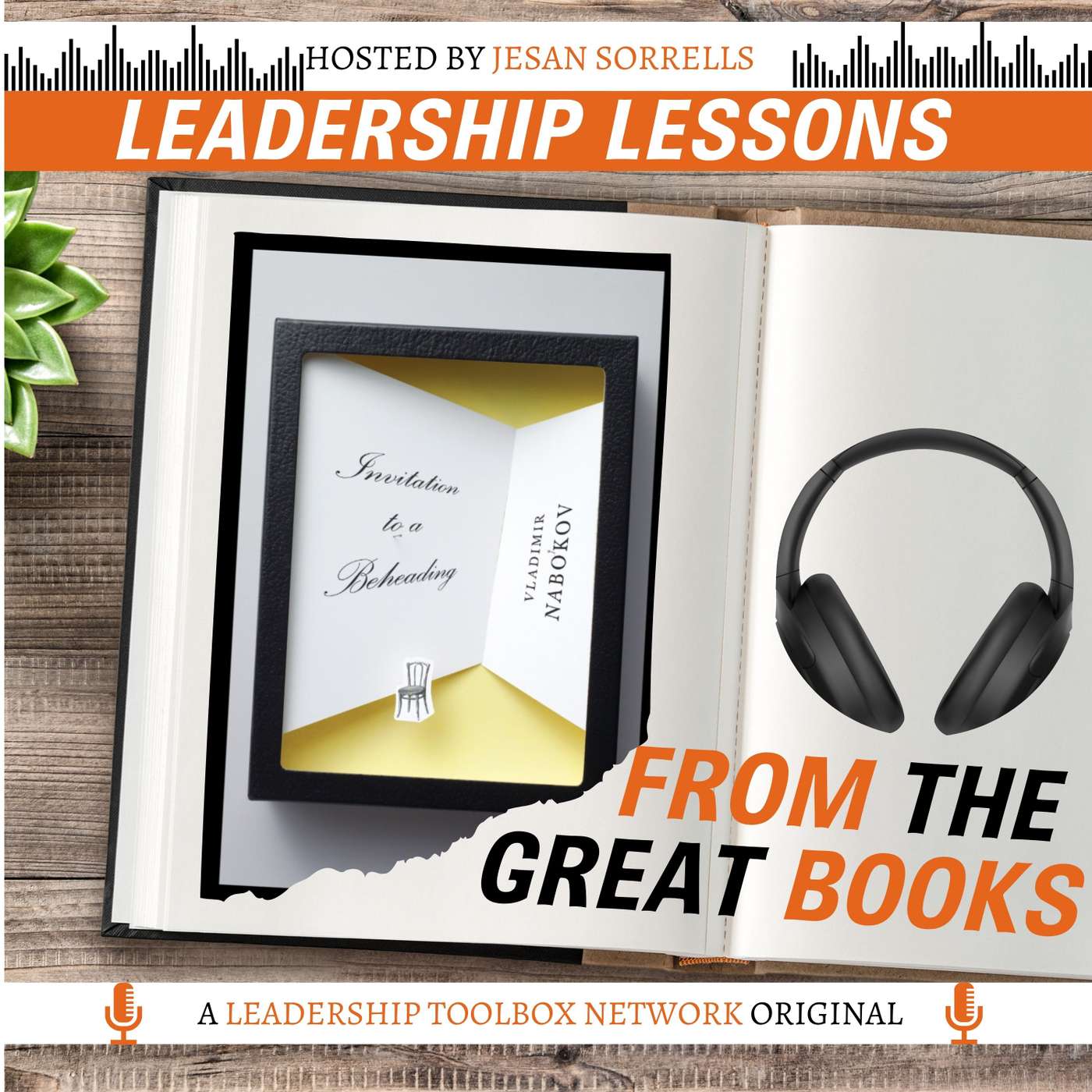
Invitation to a Beheading by Vladimir Nabokov w/Claire Chandler & Jesan Sorrells
Invitation to a Beheading by Vladimir Nabokov
---
Exploring the surreal world of Vladimir Nabokov's Invitation to a Beheading, Jesan Sorrells and Claire Chandler analyze the novel’s absurdist critique of totalitarianism and the societal pressures for conformity. They examine Nabokov’s literary style, the challenge of translating Russian nuance into English, and how the narrative’s exploration of meaning, individuality, and truth remains relevant for modern leaders. The episode draws powerful connections between the search for meaning in the 20th and 21st centuries, the impact of technological noise, and the leader’s responsibility to pursue authenticity in an increasingly absurd world.
- Book Title: Invitation to a Beheading
- Author: Vladimir Nabokov
- Guest Names: Jesan Sorrells (Host), Claire Chandler (Guest)
---
Time-Stamped Overview
---
00:00 Discussing influential dystopian literature
11:20 Discussing Nabokov's complex themes
13:03 Nabokov and totalitarian regimes
22:52 Discussing the book's translation challenges
24:25 Discussing multilingual communication challenges
29:04 Discussion on Cincinnatus's imprisonment
37:35 Bringing Jungian myth to academia
43:36 Russian writers and dystopian themes
49:18 Moving furniture and family tensions
51:06 Cincinnatus C. helps move furniture
01:01:30 Choosing truth over conformity
01:06:42 Local debate over data centers
01:12:31 Finding clarity amidst distractions
01:16:12 Deconstruction and authority confusion
01:20:41 Addressing lack of accountability
01:28:53 The impact of AI on society
01:34:00 Surviving social media surveillance
01:40:11 Discussing societal complacency and noise
01:47:02 Discussing Cincinnatus' writings
01:48:37 Legacy and leadership importance
01:53:28 End of the conversation
---
- Opening theme composed by Felipe Sarro - Bach - Silotti - "Air" from Orchestra Suite No. 3, BWV 1068
- Closing theme composed by Brian Sanyshyn of Brian Sanyshyn Music.
---
- Pick up your copy of 12 Rules for Leaders: The Foundation of Intentional Leadership NOW on AMAZON!
- Check out the Leadership Lessons From the Great Books podcast reading list!
---
- Subscribe to the Leadership Lessons From The Great Books Podcast: https://bit.ly/LLFTGBSubscribe
- Check out Leadership ToolBox at: https://leadershiptoolbox.us/
Hello, my name is Jesan Sorrells and this is the Leadership Lessons from the Great Books podcast, episode number 187. Picking up from our book today we're going to open up with a series of vignettes that will sort of set the table for where we're about to go today. In accordance with the law, the death sentence was announced to Cincinnatus C. In a whisper. All rose, exchanging smiles. The hoary judge put his mouth close to his ear, panted for a moment, made the announcement, and slowly moved away as though ungluing himself.
Thereupon, Cincinnatus was taken back to the fortress. The road wound around its rocky base and disappeared under the gate like a snake in a crevice. He was calm, however, he had to be supported during the journey through the long corridors, since he planted his feet unsteadily like a child who has just learned to walk, or as if he were about to fall through, like a man who has dreamt that he is walking on water, only to have a sudden doubt. But is this possible?
Then another vignette. Sometime later, Rodion the jailer came in and offered to dance a waltz with him. Cincinnatus agreed. They began to whirl. The keys on Rodion's leather belt jangled. He smelled of sweat, tobacco, and garlic. He hummed, puffing into his red beard, and his rusty joints creaked. He was not what he used to be, alas, he now he was fat and short of breath. The dance carried them into the corridor. Since Natus was much smaller than his partner, Cincinnatus was light as a leaf. The wind of the waltz made the tips of his long but thin mustache flutter, and his big limpid eyes looked askance, as is always the case with timorous dancers.
He was indeed very small for a full grown man. Martha used to say that his shoes were too tight for her. At the bend of the corridor stood another guard, nameless with a rifle and wearing a dog like mask with a gauze mouthpiece. They described a circle near him and glided back into the cell. And now Cincinnatus regretted that the swoon's friendly embrace had been so brief. And then another piece here, and I quote Prisoner, in this solemn hour, when all eyes are upon thee and thy judges are jubilant, and thou art preparing for those involuntary bodily movements that directly follow severance of the head, I address to thee a parting word.
It is my lot, and this I will never forget, to provide thy surgeon in gaol with all that multitude of comforts which the law allow allows. I shall therefore be glad to devote all possible attention to any expression of thy gratitude, preferably, however, in written form. And on one side of the sheet. Close quote. Those are some sections, some polls from our book today, and we're going to jump around in it, and I think Nabokov would actually appreciate this. We're going to jump around in this book because, well, this book represents something that we, we, we kind of sort of touch on the edges of on this show.
But now we're going to fully embrace it. And so I'm going to open up my thoughts with this. I think one day, looking back, probably two or 300 years from now, historians in the future will write that we now have lived, quote, in a long, absurd and dangerous 20th century that began in the killing fields of World War I in Europe and ended with individuals staring at their phones searching for meaning early in the 21st century. Close quote. And they will be correct. It has been a long and ridiculously absurd century, from the collapse of empires to the launching of people to the moon.
And of course, we're doing this in 2026. So not only to the moon, but around the moon and back. And culture, culturally, politically, and socially, the systems that were supposed to provide us meaning have failed woefully in our long and absurd century. But. And here's the but. Because of our technology, we are too arrogant and prideful to admit cultural, political, and social defeat. Instead, we're going to double down on ideas and approaches that don't work. We're. We're going to go whole hog into that.
Now, today's book that we're reading actually sort of challenges this a little bit in a weird kind of way. And I think it should be required reading for high school and college students, but mostly for high school students, right alongside Alice in Wonderland, Brave New World, and the book, I think that is closest to it, in parallel 1984. 4. It describes the triumph of totalizing absurdity in a world where little makes logical sense because it's not supposed to.
And to recapture meaning and to commit the crime of Gnostical turpitude, we're going to have to reinsert meaning first into ourselves and then deeply into our institutions and back into our systems. And I do think that will be part of the mission of the next 75 years of this century. So with that being said, today on the show, we are going to cover a book whose fictional narrative, like I said, links to the book we covered in episode number 184, where we talked about G.K. chesterton's the man who Was Thursday.
You should go check that book out and listen to that episode with ideas we talked about in episode number 183 where we talked about, once again, unreliable narrators like Harry Lime in the Third man by Graham Greene. Today we are going to glean what we can from a very perplexing book on its face and try to apply it to our real lived leadership lives in this book. And you should be able to catch the COVID right there on the video. And there it is. Invitation to a Beheading by Vladimir Nabokov. Leaders, here's a caution for you.
Just illustrating absurdity is no longer enough to jolt people out of their absurd behavior. We need stronger medicine to match the disease of the era we are in now.
And back for this episode today
from episode number 152 where we discussed the Orwellian state of affairs laid out so brilliantly by George Orwell in 1984, is our co host today, Claire Chandler. How you doing, Claire? How's it going? I'm doing great. It's so great to be back here and
chatting with you about some of the great, the great literature of our history. So I've been looking forward to this for quite some time.
So let's talk about Nabokov because we've, I mean we've, we've discussed. This is the only time I'll mention it. We've discussed Lolita.
Sorry, not sorry. Right, right. And we'll, we're going to skip over that. You can go listen to that episode. Like to hear that discussion there. And, and we've discussed in 1884. I like to kind of delve in a little bit to, to Nabokov here, kind of poke at him a little bit in reading Invitation to a Beheading. It's clearly not Lolita. Right. And so what are some of the. And we'll kind of talk about Nabokov as a writer. There's some ideas I have about him. We don't need to go into his background. If you want to find out more about that, you can either go listen to our introduction at Lolita where we sort of did a deep dive into him, or you can go listen to the shorts episode.
I think it's number 217 from this year where we talked about Tim Scholes and Gnostical turpitude, tying ideas from east of Eden into Invitation to a Beheading and laying the foundation for the next episode. That where we're going to cover Fyodor Dostoevsky's notes for Underground. Oh, yeah, we're doing all the heavy duties in the end of the quarter here, folks, so step right up.
So, yeah, Nabokov. Back to Nabokov. Invitation to bang. Like I said, it's not Lolita. So what are some substantive differences between the two texts? And what is. What is. What are the substantive ideas you think, do you think, Claire, that Navikov is wrestling with. Wrestling with here? Well, there's. There's a lot, certainly. And I know you're going to get into a little bit of. Of the background, the time in which he wrote this book and his other novels. There are a couple of themes that bubble up to the top for me.
One of which, of course, is in this sort of theater of the absurd that he has built for us in this prison. Is it real, is it imagined? Is really why he is there in the first place, right? This. This sort of made up crime of gnostical turpitude, which I still don't quite grasp, nor are we expected to, but there's this wrestling between how do we maintain our own individuality while the world rewards conformity. Right? Or maybe says, you need to bring in your individual personality because otherwise you are boring, you're not entertaining.
Would say, monsieur Pierre. And yet if I, you know, if he demonstrates too much of that individual personality, it veers off of this totalitarian idea of what is proper. Right. Reminiscent to me a little bit of the Stranger, right? Camus, the Stranger, where he does not mourn. It was that book, right, where he does not mourn the death of his mother the way that society would have expected him to. So there's a little bit of that. And then there's also, of course, the. How do we truly discern between what is real and what is imagined?
How much of the prison, the walls, the barriers, the stress, the strife are
fact versus something that we just sort of conjure up in our own, you know, out of the ether of our own anxiety and our own fear. So, yeah, there's. There's a lot going on in that, in this, you know, relatively short book, unlike Dostoevsky, which you have ahead of you. But there's a lot. There's a lot there. There's a lot there for sure. There's also the idea and, and I like how you sort of brought some of those themes together, some things that even I didn't. I hadn't even picked up on in my reading of it because I was so.
Flummox is probably not close enough to the word.
Every time I go into Nabokov and I'm glad I'm going into him. On the one hand, I'm glad I'm going into him now when I'm in my, like, late 40s, because I'm a little too old to be seduced by the Kurt Vonnegut, like, sort of, oh, isn't it cool that everybody's lying kind of thing that you get into when you're, like, in high school and a little bit into college when it's like, oh, I discovered that everybody's lying in the world? Yeah. Okay, great, great big wolf here. And I'm not. And I'm not saying, like, to be cynical or dismissive of it.
I'm saying at the certain developmental stages in our lives, certain authors make more sense. There's a reason why we haven't covered Vonnegut on this show. I don't, I don't know. I don't know that that well. Anyway, there's a reason why we haven't covered Vonnegut on this show. I think some people mature. I think you have to mature past certain, certain authors. Right. And that's fine. Certain authors exist a certain period of time for certain groups of, for certain groups of people. Right. Nabokov, though,
this is not my second interaction with him. And I got to admit, I, I, I, I looked at it and I'm like, I don't know what's going on in your, in your brain pan. Like, I, so I see the total, to your point, I see the totalitarian thing here. Right. And that is reflected in Abakov's life. So when I went back and looked at his life, did a little bit more research on him, I mean, you know, he, he was early to absurdism. He was early to, like, the absurd nature of totalitarian societies in 1938, you know, coming up in, in a Stalinist Russia where there were secret police and gulags and everybody inside of the country knew it, but the information was not going out to the broader, the broader world population.
And even if it was, it was 1938. So we're knocking on the door of Hitler and we're knocking on the door of World War II. So all of that needed to be sort of negotiated in a geopolitical sense. And Nabokov often said in interviews about this book that he did not anticipate German fascism. And so for him, the book stood in not as an indictment of German fascism as a totalizing geopolitical force, but communism as a totalizing geopolitical force. But he would never say that out loud because, you know, you gotta live right?
You can't have the secret police chasing you around Europe and Switzerland in America for, like, the next. Like, for the rest of your life. Right.
But with that framing, with that thinking, I also got the sense from reading the book, this was one of the things I held on to solidly. And you could tell me if I'm maybe if I'm right or wrong. He was obsessed with, at least in this book, the dichotomies between what Communism or Marxism promised and then the reality that showed up. And I don't think he had a good handle on how to deal with all that. And I think this book was an attempt to get a handle on how to deal with that. Am I reading. Do you think I'm reading that correctly?
I mean, I think that's absolutely valid. I do think that he, like a lot of the other authors of that time and other times in history where thoughts were regulated or speech was punished, the great authors, this is their form of rebellion, right? This is their form of speaking out in a way that is somewhat. I don't want to say protected, but disguised. Right. And it's. So. I think he lived in a time where he didn't perhaps see German fascism, but he did see what was coming, and the world was shifting in ways that he wasn't totally cool with.
And so he thought, well, the more absurd I can make this story, the more outside the bounds of reality, the safer it is for me to be uber critical of the jailers and of the sentence and of the crime. Right, right. Well. And this book got passed around first as samizdat, Right. Which is the Russian term for. The Russian term for the practice and actually the product of sending around mimeograft, basically mimeograph books at the state, if they got a hold of them, would kill you for having. Right.
And so samizdat was revolutionary papers. It was anything that was outside of Pravda, which was, of course, the Russian word for truth, Right. The official organ of the Communist Party in. In. In the Soviet Union. And so samizdat got passed around between people. Like, literally talk about this with our episode on Solzhenitsyn, right, where Gulag Archipelago got passed around as Miami. A graph, a mimeograph document that you had to pass from neighbor to neighbor by hand, and you only pass it to people that you trusted, and that was it.
And if it got out of the neighbor's hand, everybody was gonna be like, nope, not mine, you know, and. And back away. If I remember correctly, in my research into the. The book and how it came together. This was also passed around as part of that samizdat, sort of underground publishing scheme that was going on in Russia,
at least at first. That's how it was first published. And then when he escaped and got out of the Soviet Union and came to the west,
he managed to go ahead and publish it sort of more openly and collect everything together and publish it more openly.
And that idea of sort of subversively passing around ideas. Oh, it's not necessarily a theme that runs through the book. I don't sense that. You talked about.
Whatever his name is, the guy with the P. And. And I can't really get. Okay, you got to explain that character. Me, I could not get a handle on him. Like, what is his role there? Is he a. Is he a prisoner? Or is he just, like, a MacGuffin for, like, other things? Well, we're going to get into that with the whole second Cincinnatus, don't forget, because there's this shadow, one of him, too, that. The. The Pierre guy. Just for simplicity, let's just call him that. It took me a beat to understand what the heck he was, too.
Both within the story as the character, and then also from the writer's perspective. He was a vehicle for something. Right. Because everything's a device. And so for him to just sort of show up billed as a fellow prisoner, but clearly with more. With more freedoms than Cincinnatus enjoyed, or at least he took advantage of more freedoms that were offered to him than Cincinnatus did, because sometimes Cincinnatus was allowed out of his cell and he could go for a walk and he could play with the daughter of the warden.
I mean, what was that about? Right? Was she real? Was she imaginary? So, yeah, and then for Pierre to come around and all of a sudden go, oh, I'm the one who's gonna separate your head from your body tomorrow. So I wanted to, you know, get to know you. It's like. Right, yeah, yeah. Again, absurd, right? It's all. It's. And it's like, as he's. As he's sitting there writing that, do you think he kind of, like, would. Would write a section, walk away, have some vodka, and then go, how do I even amp up the absurdity of what I just wrote?
Because I don't think it's absurd enough yet. Oh, so I don't think Nabokov needed vodka. Oh, yeah. So it's certainly Stephen King. Like, all of his plots come out of dreams he has. Yeah, that's scary, too. Yes. I think. I think Nabokov is one of those. Was one of those literary novelists whose brain was just that way. He didn't need another. I'll put him. Another person who I would say is. Was kind of wired that way was Charles Bukowski and. Or. Or. Or maybe a More. A more popular title because he was a poet.
Was more of a poet. Hunter Thompson. Right. He. He was. Now. Now, people. Here's the interesting thing. People confuse the absurdity of how a person's brain, a creative brain, works with the creativity. Absurdity, the creativity of how a brain works. They confuse that with a lack of discipline, which is why Stephen King's book. I'm glad you brought up Stephen King. Stephen King's book on writing is one of the greatest books about writing ever written. Because just like Hunter S. Thompson, who had a ridiculous discipline that he stuck to with writing, Stephen King has a ridiculous discipline that he sticks to with writing that he then filters, like, you know, the cocaine fuel.
Tommyknockers through, you know, or whatever. Right. You know, and that book is wild, by the way. We'll never cover that book on the show. This is not. This is not the show for that. But Tommy Knockers is a wild book if you ever have an opportunity to pick it up. Nabokov, I think, was the same thing. He had a. And here's. Here's how I kind of get a sense or I kind of know that he had that discipline. You don't go out and become a la doctor with the butterfly stuff. Yeah. Without having some, like, discipline inside of you.
Yeah. That's not an accidental sort of. I'm just gonna trip and fall over this hobby kind of thing. Yeah, that's not a casual hobby. Yeah, that's not a casual hobby. That is a. That is a thing that comes directly out of who he is as a person. And so I absolutely think he was disciplined in his writing and in his production. And he came from a time when writers didn't talk about writing because they didn't want to ruin the magic of it. It's only the post World War II writers that talk about writing, because now everybody wants to know about process and wants to get into the thing, wants to figure out how the magician does the tricks.
Pre World War II writers, or I would say writers up until World War II,
they didn't really explain the magic. They're just like, I don't know, I sit down and stuff comes out of me. Yeah. But, you know, I think you're spot on in terms of speaking to his discipline. Because while the story is absurd and like you, I kept getting through certain points of it and going, why did we agree to cover this book? Like what it. It. Because it's, it is so to say, bizarrely absurd, I realize is redundant, but it is bizarrely absurd. But I'm also thinking the original was written in Russian.
Yes. Right. Yes.
The translation into English, which is the version that, that we read. I also have to wonder, just sitting here kind of unpacking it with you, did it become more absurd in the translation? Less absurd? Like, is it true to the absurdity in the original? Because there were a couple of very, very few, but there were a couple of phrases in the book that he kept in Russian because they didn't, they don't translate. Right. It was like one or two. They were sort of throw, throwaway lines for us because I don't know about you, but I don't speak Russian.
But like they, they defied translation. Right. So I just, it's just another layer of, of nuance when you think about, when you, when you are setting about and your job is to translate this absurd book into English and, you know, keep it true to the original absurdity. That was the Russian original. Tall task. Well, it's a tall task. Yeah. And, and we don't, we never talked about this on the show, but this is a good opportunity to sort of unplug or not unplug, but unpack this for a couple of minutes.
So,
so we're going to read Dostoyevsky. And Dostoyevsky made his money before he sort of, not sort of, before he started creating novels and writing novels. He made a ton of his money translating novels from Russian into various other languages. And so he sort of walked that divide. Nabokov, if I remember correctly, translated his own novels right. Into, into other languages. He was also, he also spoke, you know, French and I believe German as well as Russian and of course English. Right. So he's operating in, in four different languages.
And the dynamic of translation and the dynamic of different languages saying or being able to express the same human idea but in a different kind of way is something to your point that I think we, I think we devalue very much in the west because English has just sort of won the day and sort of in business and all my French speaking listeners, I apologize, like, but sorry. So, so, but, but if we want to do business, even with the Chinese, if you want to do business, we're all going to speak English, right?
So there's a certain level of cultural and Civilizational hubris that comes along with that, that's just sort of baked into the pie. And so coming from Russian into English and realizing that even though both, there's. There's no fundamental difference between people who speak English and people who speak Russian at a human level, it's just a difference in language, how you express absurdity. But the way in which the depth of that absurdity is expressed is going to subtly shift in language. And a translator is going to.
A translator who doesn't. Either doesn't know anything about Russian or doesn't know anything about English is going to miss that. But if you do know that, you are going to struggle. Like I think of if I'm trying to get instruction in whatever I'm doing in jiu jitsu, this is the first time I'll bring it up and the last time I'll bring it up, because I gotta bring it up once a show. But if I'm doing jiu jitsu and I'm doing something, and one of my instructors speaks. Is Brazilian and speaks Portuguese, I could.
I could watch him get frustrated explaining a concept in English. And finally he just defaults to, we'll just do this. I don't know you, ain't you. He always says, you Americans, you have to name everything. And he just walks away like everything is in your name. Just do this thing. Yeah, right. Because it doesn't. There's no parallel in Portuguese, right. For what we're doing here in. In. In English, right. Even though the body is doing. There's no difference between a Portuguese, a Brazilian body and an American body.
There's no difference. Same. Come on. It's like we're Martians or whatever. But there's no way to sort of get that across, right. The depth of that. So I think it's the same thing with, with the. With this. With this book and with the translation. One other thing, and I'm reading Les Miserables right now because we're going to cover that in June, and I would love to read Les Miserables in the original French. Actually, the person who I have coming on, she's probably going to outdo me and she's going to read it in the original French because she's.
She's a huge Francophile and she'll so comfort of the original French and I will be at a significant disadvantage. But that's fine. She will beat me on my own show. But, but. But one of the things that strikes me is I wish I knew Russian because I think I would get something more out of the book. I think it would probably make more sense if I read it in the original Russian. And then the little French pieces that, that are dropped into invitation to a beheading would actually make more sense as well, because I'm reading this, this whole entire sentence in English.
And then there's this little French piece here, and I don't know about you, but I don't go to Google Translate and then, like, put the French piece in. I don't, I don't have time. I just got to read the book. Right. So I just sort of live with that, not knowing. I live with that little hole in the boat. And there was a lot of that here in this book. Right. And he did. And this will be the only time I reference Lolita. He did that a lot in that book. I as well, you know, where I, I, I took high school French.
So I, I knew enough of the words to be dangerous, get the general sense. And then, like you, I just, you know, moved on and just assumed it wasn't going to materially affect my understanding of the book. Right, right. So it really didn't. But it really didn't. Y.
There's another thing here that we'll go, we'll go back to the book, another idea here that I want to lay the foundation for and we'll talk about today. So does Navakov believe that people can be decent? I'll frame it as a question.
I'm going to say yes, because.
Two bits of evidence that I would say to back that up. One is, despite the fact that he was imprisoned throughout the entire book, there was a common thread of frustration, but I didn't really pick up on a sense of hopelessness. Right. There was frustration, less so about his quarters and more so about the people who kept visiting him and interrupting his solitary confinement, essentially. Right. And then, of course, the ending, which I know we'll get to, and I don't necessarily want to spoil the ending for, you know, the audience, but, you know, the fact that the, the ending was, if not redemptive, at least not final.
And so I do think, you know, and then there's other threads, like this, this Pierre guy who was like, you know, by all, by all accounts, he was the executioner, but he wanted to make sure that Cincinnatus had a good, good time right up until the final cutting. Right. I mean, like, I wanted him to be well fed, and how could you complain about this meal? And we, you know, we ate so well. And then, of course, later, Pierre had some indigestion to deal with, but regardless. Right, so. So I do think that that would suggest that Nabokov is, at heart.
I wouldn't call him an optimist. I don't think we would call him that, but let's not go that far. He generally believes that most people are inherently good. Okay, okay, I'm going to. I'm going to pick up on something here. By the way, there's a bunch of other characters in here, too. It's not just Cincinnatus and Pierce. That's also. There's Rhodian, who. So Rodion is the jailer. Right. I had a little bit of trouble following that bouncing ball that. That kept, like, sliding off of the glass. But Rhode on is the jailer.
And then you have the other character in here who also has an R name. Right. Rodrigo. Right. I'm pronouncing that correctly. Who or not Rodrigo. Sorry, Rodriguez. Rodrigue. Rose. Rig was the. Was the. The librarian. Correct. Who kept bringing him back? He's a librarian. Yeah, probably. Yes, yes. I don't know. There were too many. There were too many. There weren't nearly as many names as in a dusty Epson novel, but there were a lot of names. No, no, not the Librarian. He was the prison doctor. That's right.
Rodriguez was the prison doctor. That's right. Yes, yes, yes. And then the librarian sort of just. I don't think he had a name. He didn't have a name? No, no, the librarian didn't have name. The Library just comes in and out, like, delivering the magazines and being bothered that he's being bothered. And they just. Right. He's. He's Brooks from Shawshank. Absolutely. Yeah. Ah. I would not have drawn that parallel, but yes. Yes, he is. Yes, he is. Oh, my gosh. Oh, and let's. One last thing before I go back to the book.
So, Cincinnatus. Right.
The name Cincinnatus comes from the. No, Greek. Is it Greek? No, Roman. Right. Roman legend of. Yes, it's Roman. The Roman legend of Cincinnatus. Who was. I'll just give a very brief overview. You can go Wikipedia more of this. And I had to Wikipedia just to be sure what I was like remembering. But Cincinnatus was a farmer in the Roman Republic who was invited in by the Senate, or invited and petitioned by the Senate. The Roman Senate, when Rome was still a republic, to. To basically take control of Rome and become a dictator in order to defeat an invading army from the outside.
I can't remember who it was. It might have been The Persians or one of those other invading armies. Anyway, so Cincinnatus comes in, he takes on the mantle of authority from. From the. From the Senate, becomes a dictator, marshals the Roman city state, marshals all the forces,
defeats the invading barbarian hordes, and then. And this is the thing that makes Cincinnatus so interesting, then goes back to the Senate and basically says, I don't want to be dictator anymore. You all have a good day. Lays down his power and leaves, sort of walks out the door. Mic drop, I'm finished. Goes back to his farm and. And in the. In the legend, if I remember correctly, and those of you who are listening will correct me if I. If I don't remember correctly, but dies behind his plow, not pursuing any.
Any power. And. And Cincinnatus is used as a. As a sort of an avatar for the individual who comes in, is offered dictatorial power. Right. Uses that power not to his own ends, but to service the city state or to service the populi vox. Populi. Right. And then. And then steps back and steps away from that. The usual parallels, by the way, in the American Republic are to, of course, George Washington, who didn't want to be president and didn't want to be king either, he just wanted to go back to Mount Vernon to be left alone, which is kind of amazing.
And who put down power when he could have actually been a king and people would have. Would have been fine with that at that time, but it would have set a terrible precedent for the future of the American Republic.
So I say all that to say it's interesting that the prisoner's name who is due for execution is Cincinnatus. I do not think that that is an accidental pick that Nabokov had for that name and for that character. And I'm still not clear from reading the text why he picked it. Like, what the subtle jab is he's making at the Russian Communists there, because I think it is a jab at the communists, but I'm not quite sure where the jab goes in Russian. Right. I just know it's there. Yeah, yeah, that's. That's interesting.
And you're going to. You're going to hate me for the commercial parallel, but, you know, it's sort of the alternative ending to Gladiator. Right. Where he had ultimate power and he conquered the barbarian horde and wanted to just go back to his farm and turn the power over to the Senate. Right. Would have been a completely different movie. Yeah, it's interesting. I. So you did more research on that than. Than I did. I figured, okay, Cincinnatus, Unusual name. Did it for a reason, and then I just accepted it.
Yeah. I'm struggling to understand the parallel between that name, which I absolutely agree with you. He chose with intention and what that message, subtle as it might be, was to the communists of the time. Interesting. Yeah. And I wonder if it was a message that the. I wonder if it was a message about dictatorship and. And totalizing power. And I wonder if it was a message to the readers and less to the party members, because the party members wouldn't. While they were aware of. Of samizdat, they weren't like, trying to stop it because they didn't think it had any power.
Right. So it's like, I think of the eye of Sauron in Lord of the Rings. Right? The eye that searches for everything and misses the smallest thing. Because of course.
And it is a totalizing eye. It always is.
But it's interesting too, because you're parallel about the war of Cincinnatus.
Would you characterize this Cincinnatus as a hero? Because that, you know, the Roman one clearly was.
Right. Because a lot of protagonists are heroes. They're heroic, they do something. They conquer evil. They, you know, they defeat a global enemy, whatever it is. We don't have that here. So that's a good question. And this is a little bit far afield from where we are today, but that's okay. So
one of the things that I'm. I'm involved in a project in another area of my. My work life where we are. I'm working with a group of people to
bring in a professional, an ensconcer professional in an academic institution who has spent 25 years of his career
working on and delivering on. Not delivering on, but delivering the ideas that are embedded in Jungian myth to. And Jungian myth and mythological structures to people who do not have a story structure in postmodern America, and that's vague enough to not be specific and specific enough to get to the idea of where it is. I want to go with this idea. Right. And one of the things that this individual, this professional points out, who we are working with on this project, is that everybody has a myth and everybody has a hero's journey.
That's what Jung would say, but that not everybody knows either knows what their myth is, which is true. And if they do know what their myth is, most people are not aware of where they are on their hero's journey. Now, I said all that to say this. I'm not Quite sure Cincinnatus is on a hero's journey, because in myths, depending upon which myth you read, while we can look at all of the journeys as heroes. Journeys. Most characters in myths are on their own journeys that all intersect with the main hero's journey.
So there's the journey that the women may be on in the myth were referenced. There's the journey that the. The gods are on in the myth, and then, of course, there's the journey that the villain is on in the myth. Now, the professional I'm working with would, if he were here, he would probably say they're all heroes journeys. And just that's. That's what Young would say. Okay, Perhaps. I think that those are distinctive journeys, and I think that Cincinnatus is not on a hero's journey, but he's on an absurdist journey which.
Which mirrors the. The. The hero's journey, but it's a distorted funhouse mirror of that journey. Because I don't think Nabokov. This gets back to my idea. Looping it back now. This gets back to my question about decency. I think that Nabokov thought that
this is not me being influenced by Lolita, although it does show up in. In that book quite a bit, and a number of other books that he wrote, too. I don't think. I think he was skeptical about human decency. I don't think he believed human beings could be decent. I think he thought that.
I don't think that he thought human beings could arise. Could rise. Could. Could. Could rise above banality and nihilism and absurdity. Like. Like Camus. This is why one of the reasons I struggle with Camus, because Camus, at the end of the day, his only solution to the absurdity problem, and we're going to talk about this a little bit later, but his only solution to the absurdity problem was eat, drink and be merry and let's crash my car, you know, in France somewhere. Like, that's not a solution, Albert.
May I call you Albert? I'm going to call you Albert. Come on. Like that's not a solution. Right? So. But I think. I think that struggle begins when you don't see people being decent and when you live in a society. And Nabokov had to add far more, I think, of a permission slip to be skeptical of human decency than Camus did, even in spite of seeing everything with World War II. Still more of a precious slip than Camus did, because Nabokov was in a society where everybody lied and everybody knew everybody was Lying.
And the liars knew. Everybody knew that everybody was lying. And so you're in this weird panopticon of lies. And the person who is going to be the outlier in that, as Solzhenitsyn would say, would be the person who dares to tell the truth. And that's maybe who Cincinnatus is, the person who dares to tell the truth.
So not a hero, just in a funhouse mirror. Yeah, sure. And you know, and the other thing I. I think about is, you know, to your colleague's point that everyone is on a hero's journey, it. It may just be the case that Nabokov chose not to tell us that point. Portion of Cincinnatus life. We don't know that much about his life prior to his sentencing. Correct. Right. We know what his wife was up to. She's perhaps the only other one who was telling the truth throughout because she didn't really make a secret of the fact that she was
not terribly faithful to the guy. Right. But we don't really know much of it. So it's sort of that unanswered question also. Also of maybe he was a hero prior to being sentenced. And we just don't know that part because Nabokov chose a portion of his life that came after that. Or. Or. Or maybe comes before that, because as I said, the ending is not a final ending. Well, and his mother shows up. I don't know if you remember this. I do. And I'm like, oh, so Mom's gonna show up and we're gonna have a bit of dramatic.
I mean, can we. Can we just call her a drama queen? That's fine. Yeah. Yeah. Well, you know, I mean, I've been thinking a lot about family lately and just kind of goes through things in my own head. Not about my own family, but just families in general. And it's just. It's amazing how people show up in families. It's just. It's amazing, you know, and that in and of itself is an absurdity. Again, the idea that it's not just lies that impact the top of the state, but the line goes all the way down to the substrate of even who the individual is.
It poisons the well all the way down. And Nabokov was early, I think, in invitation to a beheading, to an idea that Solzhenitsyn fully developed law and fully developed out later on in Gulag Archipelago. And these Russian writers were inside of. They were inside of a nightmare. Bulgagov is another one. Like, they were just inside of a nightmare where, like in the Master of the Margarita, right? Where Mikhail Buglecog, where, you know, the devil shows up, but no one recognizes him. Wow. I haven't thought about that book.
I did read it, but it was decades ago. Yeah, it's. It's. The Russian writers of the 20th century were dealing with a hell of a thing. Yeah. And they didn't. They didn't have a lot of good. Have a lot of good frameworks because the hero's journey, the hero, the myths got smashed, right. And the people got smashed. And so how do you. How do you rebuild in a time when all of that. And it's not just the spiritual infrastructure and not just the economic infrastructure, but the psychological infrastructure and the physical infrastructure is all just.
All just wrecked, just wrecked by people who, by the way, you know, believed, as Vladimir Ilyich Ulianov Lenin did, that in order to build a better society, you gotta break a few eggs. Yeah, well. And just as I'm listening to you take me through that, I think back to our core protagonist, hero or non hero, Cincinnatus, who nothing in the book is as. Is what it seems, right? And you think about the tap, tap, tap, and the digging going on at night, and he doesn't know what that is, and he doesn't know who it is.
And out pops our buddy Pierre again. And he's dug a tunnel, or maybe it was always there that has he. He had just gotten there, right. A matter of days ago. Could be weeks, I don't know. Because time is not terribly, you know, predictable in this book either. And he leads him back through the tunnel through a series of dead ends and wrong turns, and, you know, finally into his cell, and they have a nice evening, and then he has to go find his way back out. And then he takes a wrong turn again, and he finds himself on the outside of the walls of the fortress.
And then he meets up again with Emmy. What was the young girl? Emma. Yeah, Emma. Emma, Emmy. It was Emmy. Yes. And he allows her to lead him right back into the dining room where his captors are enjoying their tea or their dinner. So there's this. Nothing is what it seems. And throughout the book, he continues to be led by false leaders, by people who are. Who are trying to
not lead him astray, lead him back to the path that they want him to be on.
I think that is an important idea right there, Claire, that you brought up, that. That idea of being led by false leaders. I think. I think you're onto something. There. I think that's, I think that's skip toward when we get to leadership. I'm getting older and senile Hassan, and if I don't say it when it comes to me, I'm going to lose the thread. So yeah, it's okay. The threads. Are we going to talk about the spider at some point? Yes, we'll talk about the spider. Okay, I'm going to get to the spider.
This is your show. You go, where are we going next? I'm going to, I'm going to tie the spider into the, the visit from the family. Because this is one of the more important, this is one of the more important things in the book. So let me, let me pick up with the invitation to be heading once again, we're going to jump around in this book. It is still under copyright to Nabokov's estate. While I don't think he would have a problem with any of this, the estate might have, might struggle a little bit with it.
So we are going to just pull some things out here and there. But I'm going to go to chapter nine in Invitation to a Beheading. And this is when Cincinnatus's family randomly shows up. I'm going to start with this. And again. The day began with a din of voices. Rhodion was gloomily giving instructions and three other attendants were assisting him. The entire family of Martha had arrived for the interview, bringing with them all their furniture. Not thus, not thus had he imagined this long awaited meeting.
How they all lumbered in. Martha's aged father with his huge bald head and bags under his eyes and the rubbery tap of his black cane. Martha's brothers, identical twins, except that one had a golden mustache and the other a pitch black one. Martha's maternal grandparents, so old that one could already see through them. Three vivacious female cousins who, however, were not admitted for some reason. At the last minute, Martha's children, lame Diomedan and obese little Pauline. At last, Martha herself, wearing her best black dress with a velvet ribbon around her cold white neck and holding a hand mirror.
A very proper young man with a flawless profile was constantly at her side. So this is the, this is the table that is set for this visit. And then I'm going to jump to this. Meanwhile, furniture, household utensils, even individual sections of walls continued to arrive. There came a mirrored wardrobe bringing with it its own private reflection, namely a corner of the connubial bedroom with a stripe of sun, a strip of sunlight across the floor, a dropped glove and an open door in the distance, a cheerless little tricycle with orthopedic attachments was rolled in.
It was followed by the inlaid table which had supported a flat garnet flacon and a hairpin for the last 10 years. Martha sat down on her black couch embroidered with roses. Then a conversation just pops up because why not? And the father in law is striking the floor with his cane and. And yelling. Well, not yelling, but berating Cincinnatus for some reason, calling him, quote unquote, an insolent fellow. I am entitled to expect from you, if only today, when you stand at death's door, a little respect how you managed to get yourself on the block.
I want an explanation from you. How could you? How you dared. And then of course, it keeps going on with the father in law. Martha is talking to a young man in a low voice who apparently is her lover,
much to. Much to Cincinnatus's dismay. And then, because I have animals at my house, this little detail popped up to me, which I thought was interesting. And I quote a black cat stretched, straining back, one hind paw rubbing itself against Cincinnatus's leg, then was suddenly on the sideboard and from there noiselessly leaped onto the shoulder of the lawyer, who, having just tiptoed in, was sitting in a corner on a plush hassock. He had a bad cold and over a handkerchief held ready for use, was inspecting the assembled company and the various household items that made the cell look like the site of an auction.
The cat startled him and he threw it off with a convulsive movement.
C. Has a conversation with his brother in law, his father in law. And then
Cincinnatus stood up, Rodion and another employee, looking at each other in the eye grasp of the couch on which Martha was reclining, grunted, picked it up and carried it toward the door. Goodbye, Goodbye. Martha called childishly, swaying in time with the step of the porters. But suddenly she closed her eyes and covered her face. Her escort walked solicitously behind, carrying the black shawl he had picked up from the floor, a bouquet, his uniform cap and a solitary glove. There was commotion all around.
Their father, breathing asthmatically, was overcoming the multi segmented screen. The lawyer was offering everyone a vast sheet of wrapping paper obtained from him by some unknown source. He was seen. He was seen unsuccessfully attempting to wrap it in a bowl containing a pale orange little fish and clouded water. Amid the commotion, the ample wardrobe with its private reflection stood like a pregnant woman, carefully holding and turning aside its glass belly so that no One would brush against it.
It was tilted backward and in a reeling hug, carried away. And then. I'm going to skip down. Emmy unwillingly followed Rhodian as he dragged her. Her eyes kept rolling back. Her shoulder straps slipped off, and now, with a swinging motion, as though he were emptying a water bucket, he splashed her out into the corridor. Yes, pausing. Yes, I said. He splashed her out into the corridor. Back to the book. Then, still muttering, he, meaning Rhodion, returned with a dustpan to pick up the corpse of the cat that lay flat under a chair.
The door slammed with a crash. It was now hard to believe that in this cell only a moment ago,
That held me up for two days, that entire chapter, I pardon my use of the French, I did not know what the hell to make of any of that.
It was like one long, protracted fever dream where it just got absurder and. Absurder. That's probably not the right word to the point of stupidity. Where. And I think that was definitely a point where I was reading through it and going, how much longer can this go on? Is there a way to get out of this interview with you? Because if I have to continue this story, I may, I may, I may grow to resent you. But it's like. But these are the things that stretch us and help us to grow so. And eventually it ended.
Yeah, I was. I was upset about the cat. I did not like the treatment of the cat. The cat was the only one who acted like himself. The cat was the only one that knew what the hell was going on. I mean, he was just like, I'm. I have legal representation here. The wife brings a date to an interview with her condemned husband. Right. You know, again, being the most transparent about her infidelity. So she was, like, the only one there. Even though she came in with an elegant hand mirror and she's dressed to the ninth.
She was the only one who was completely open about who she was. Right? Yeah, she's the only. She was the only person actually being truthful out of that entire sequence. The father in law, the grandparents, the cousin, the brother in law, even Rhodian, the. The. The prison guard, right? Like, coming in and out and moving things around. It kind of reminded me a little bit of. For some reason, last week, not last week, but the week before, I was goofing off at work, which, you know, occasionally I do goof off at work.
I am human, after all. So I was goofing off at work and I was playing yakety sax. That's what it was. The. The theme song from Benny Hill. And, and this put me. Yeah, see, when you put that as the soundtrack to all the. All the. Wow. That's it. That's. That's. That's it. It's. It's literally the end of Benny Hill. You remember that? I mean, you remember he's running around with like. I didn't like the Benny Hill show either. For this very reason. This very reason. Because that was absurd. The scantily clad ladies all chasing him around.
What is happening? Yeah, that's in my head now. That song is in my head. And the whole. Yeah, the whole intro and outro. Wow. Yeah, well, well, we were. We did reference Yakty Sax a couple weeks ago with the man who was Thursday. We did me. And again, I guess I'll drop in that reference here too. I'll run the soundtrack again. That's gonna be like your new thing. You gotta have a sound button in your studio. Oh my gosh. Yeah. Of all the absurdity throughout this book, that was the most consolidated, intense burst of absurd.
Absurdity. Other than the final dinner. Yes, other than the final dinner. But. But this was probably the. The most absurd collection of absurdities in the entire book. Well, and what does it say when like even the family is. Is rendered absurd by the actions of the state, Even the relationships between the family are warped. Right. So the father in law isn't saying anything that makes even any remote sense about anything. He's. He seems to be more concerned with. With the fact that Cincinnatus, which by the way, interestingly enough, I'm now clicking on something.
When you read stories of Russian dissidents who, who escaped or folks who escaped from Russia, one of the things that they would talk about is. And I might be confusing this with something that I read, Solzhenitsyn or maybe even in Bulkov. But. But you would read about how people would actually be jealous of family members and turn in family members if they had a larger apartment than them. Right. So the entire machine. Well, not the entire machine.
One of the pieces or the bits of fuel that goes into a totalizing machine and the reason it makes it work is envy. And envy is always about things. Jealousy is always about people in relationships. Just keep that in mind. Those are distinctions with a difference that we need to understand. We're using words. And envy of another person's possessions obviously could easily slip over into jealousy of a person's interpersonal relationships. This is why the, the. This is why the two. The two most perplexing commandments of The Ten Commandments, or thou shalt not covet thy neighbor's wife, nor thy neighbor's husband.
And then it goes into the neighbor's possessions. There's a reason for that. It's not an accident. Nope. So and so when you eliminate that right and you allow envy to be part of the fuel that drives the state,
it filters down into those interpersonal relationships. And you see that in the father in law, he's not actually seeking to understand what's happening with Cincinnatus. He wants to know why Cincinnati's got such a big cell. Yeah. Yeah. Well, and in their own way, his family, mostly his in laws, turned him in as well. Right. Because his criticisms, as well as Martha's at the very end were, why don't you, first of all, why can't you behave more like the rest of us? And also, why don't you just own it, apologize for it, and throw yourself on the mercy of the court, essentially?
Right. Why don't you conform? Because if you conformed, you could get out of here, right?
Yeah, but I could just not conform and have a bigger cell. So I think I'll hang out for a little bit. Which is. Which is, by the way, since that's his response to this, I'll just sort of, you know, I'll just. And. And look at the. Look at the very thorough cleaning job they did for him when he was expecting, you know, the interviewer to come in. Well, and maybe that's. And I, I now about. I'm about to switch an idea here. So we just talked about Hero's Journey, and I was like, well, maybe I said, you know, I took the position that, you know, maybe he doesn't have a hero's journey.
No, I think the hero's journey is the journey towards. I'm now thinking the hero's journey is the journey towards the beheading. That's spoiler alert. It's in the title. But like, like, you know, I don't want to ruin the end for you folks, but you've had many decades to read this, people, so if we're spoiling the ending for you, really, it's your fault. Yeah, it's been around for a while. It's. You can go get it. It's not. Not new, but. But maybe that is the journey. The journey is the journey. The hero's journey through, to your point, the battle against conformity.
I. I had not seen it that way. And I think you're right, because he could, at any time, according to various visitors, have gotten on board with just conforming, agreeing, being agreeable, being hospitable. And he chose to stay individual and, and be himself, even knowing that that was going to secure his beheading at the end. Well, and he's a better hero. Better hero. He's more heroic than. What's his name in 1984.
The. The. The. The guy who basically gets brainwashed and tossed back into the mix at the end of, at the end of 1984. I can't remember the character, but yeah, because. Because he ultimately did relent and just relented and just gave in. Or I think of. I think of, oh, who was it in that coupe in the Kubrick movie? Yeah.
Clockwork Orange you're talking about. Yes, yes. Anthony Burgess. Yes, yes. Okay, so, so Clockwork Orange, right, The character in Clockwork Orange that he's forcibly submitted. Right. To. To the state, right, in order to change him forcibly and brainwash him forcibly into being a good citizen.
Cincinnatus. Doesn't, doesn't. He's like, no, you know what? He takes the opposite tact. He says, no, you know what? I'm not a hero.
I don't want to be a hero. Don't look to me for anything heroic. I'm just going to walk this out logically, because walking in a logically is more truthful than the lie of conformity. And again, to my point earlier, the person who has the most power in a state where everyone lies from top to bottom is the person who tells the truth, even if the truth means being killed by the state. Which, by the way, is a very. Oh, sorry, kids are gonna hit you with this. Sorry, folks, gonna hit you with this. But, like, that's a very Christian martyr way of looking at things.
That philosophy doesn't just come from nowhere. The philosophy just doesn't come from nowhere. Yeah, so. So.
This book is about the geopolitical disaster. One of the things it's about is the geopolitical disaster of communism. Right? And just a massive, like, way, how do, how do you deal with that disaster? Right? And you had Aldous Huxley and George Orwell who were trying to deal with it from the West. And then of course, you have, you have Naov in this book. I've already mentioned Solzhenitsyn and Orwell, but also Milan Kadera, who wrote A Bearable Lateness of Being and tattled on everybody and then ran away to France, told on all of his enemies, and then vac off Havel, who wrote the Power of the Powerless, which we've Also covered on this.
On this show.
Let's turn the corner to our more. Our more code contemporary times. I do want to talk about the spider web in a minute here. But in our contemporary times. And I did open up this episode by saying that historians in the future, I do think, are going to look at two or 300 years from now, after we're all long dead and. And gone, they are going to look back at the 20th century and they're going to. I think. I do. I think they're going to say, what was wrong with those people? Like, what the actual hell was going on with those people's brains?
Because everything
that we've accomplished technologically or even at a leadership level, I wrote a blog post about this today. We've taken practically, we've taken material reductionist thinking to its logical conclusion. Everything can be reduced to atoms or to how physics works. Everything can be reduced to biochemical this and biochemical that. The interaction that you and I are having is mediated by technology. We're not even in the same state, much less in the same time zone, and yet we can do this quote, unquote, magic together.
But the 20th century has utterly failed. And now we're 25 years into the 21st century and we are still utterly failing to provide any sort of sense of cosmic meaning behind any of this. Now, I do think we'll get out of the meaning crisis. I do think we are going to find meaning. And that's part of the reason why I do this show, is because part of this show is a search for meaning to go into. Go into the books that have been written and pull out what we can and provide meaning for leaders and provide meaning for people.
Because I do think the biggest crisis of our time is a meaning crisis. And I wish that more people would accept a Christian conception of meaning. And there's a lot of water in the pool in the other direction that's got to get either drained out or replaced, right? Because absurdism and nihilism and those kinds of things, existential dread, none of that's going to provide meaning. And 300 years from now, people are going to wonder, why did you have existential dread? You had everything you could possibly materially wanted, yet you didn't know what it meant, right?
Nabokov was on to this. So were the writers, the Russian writers of the 20th century. They were on to the meaning crisis. And that is the great crisis of our century.
God almighty. We're now in a space where we have unserious people, like in 20, 26, we have unserious people running things. And I'm not just talking at the political level and I'm not just talking about politics and political decisions. I'm talking about people who are fundamentally lack seriousness in their roles. So for instance, I'll use an example. We have members of school boards who are so worried about Facebook posts threatening their lives that they hire private security to walk around their local communities.
I'm going to draw a parallel in my local community, where I live. We're, we're one of the local communities in, in the country that is where, where there are, where there are fights going on right now about data centers. Where do data centers go in for AI? Do they go in, do they not go in? What does that mean for water, energy consumption, things like this? Right. And because we've outsourced sourced our emotional absurdity to Facebook and other social media platforms, the mayor of my town, who's an 80 year old former entrepreneur who didn't have to do the job of being mayor at all, he could have just stayed retired, is lambasted left and right as if he's, pardon my use of the term, as if he's Donald Trump and he's not.
The other day I was walking down on the street going to get lunch or whatever. I happened to see him and I had a nice 10 minute long conversation with him. And guess what? It wasn't absurd, it wasn't nihilistic, it wasn't existential. Although he did ask me a question about how do we actually get people to not be so afraid of change. He's 80 and he's asking me this question. And so we're exploring ideas while we're sitting there. That's local politics, that's localized all the way down to something that's meaningful.
Yeah, but what we've done with our technology is we've ramped up the absurdity and the unseriousness and we still don't know what it means. What does it mean to have a school board person who takes something on social media from some random person they've never met in their community so seriously that they think they're going to. Or, or even worse, even worse. We have people who pretend to be serious and put on the language of seriousness, but their behavior, their actual lived behavior is just as absurd as anything, an invitation to a beheading.
And we can all name names and we can all give examples, not just nationally, but also locally, also in our, in our civic life, in our social life, in our government. This is the Challenge right Now, the early 21st century is how do we walk the line between work because we're past absurdity, now we're into unseriousness, just people who are fundamentally unserious. Right. About fixing problems or about proposing solutions. This is the question in the, in leadership, in all spheres eventually descends into absurdity on a long enough timeline.
How do we walk the tightrope as leaders between absurdity and seriousness? Because we're in a seriousness crisis too, along with the meaning crisis. But yeah, how do we do that? You know, one of the things that I try
to, if not remember, at least convince myself of is we are not the only generation and we are not the only, only point in the quote unquote evolution, which implies forward progress. But it doesn't always happen
and we're talking about it now. I think one of the reasons that you pull forward into our modern times, these great books of decades and centuries ago, is for this very moment, this question you just asked, asked because as absurd as the times we are living in now. And you just painted the picture of the absurdity. This is not the first iteration of that in human history. Right, Right. It feels like that because we are, we are by definition self centered. And so we think, well, surely even totalitarianism, Communism, Marxism, right?
Nazi Germany, surely they had to be serious people there. Well, not only that, but you know, they, they had it easy compared to. If you've seen the knuckleheads run in the world net like it. That has always been true. But this is the reality we live in now. And I, and I have to say that out loud because I have to, I have to believe that just like they got through that, not unscathed. We have to get through this. We have to somehow welcome back the people that are done drinking the Kool aid of the truth that they are told is truth.
And they go, well, that's easier than me finding that out or thinking for myself or having serious conversations or having serious thoughts. I think one of the things that makes it so difficult to be a leader right now and a true leader, not someone who goes around and says that they're a leader because they've been granted people power they probably did not earn. But a true leader is they have to somehow, which gets to the heart of your question, help navigate the people trying to follow them, the business are trying to run and themselves
toward a clearer, sharper, brighter, achievable horizon somehow. And the problem with their navigating is on top of everything else that leaders have always had to Deal with. There's all this noise. There's all of this bombardment of 24. 7 news cycle news in air quotes, social media, you mentioned AI. We haven't even scratched the surface of what that has introduced where every wall, everything that's plugged in is listening and feeding what you consume, right? On your smart TVs, your social feeds, your email sidebars, all the things.
And so there's all this noise.
And I think, you know, part of. And I'm going to bring it back to Cincinnatus for a second because I think part of what frustrated him was he saw how absurd his situation was and what he was trying to do was the reason he didn't want to be social and go, let me spend the last few days on earth conversing with and breaking bread with some really interesting people. He wanted all of them out of there because the noise was stopping him from getting to the conclusion that he could change his circumstance at any time.
And he wasn't allowed to because he kept getting filled with absurdity and noise and visitors and furniture and cats, right? So all he wanted was space and quiet to read, to write to and to. And to somehow come to terms with his life and have an accounting of that life and what he was writing. And I want to come back to what he was writing at some point too. I think fast forward to today. That is part of what leaders need to find a way to do is to not rise above the noise. Because I don't know how possible that is right now, but somehow separate themselves from the bombardment of the obstruction absurd and say, this is what I have to stand for.
Because if I just continue to think that leadership is a role that I play where nothing is what it seems, but instead is a, you know, an obligation that I have or a, you know, a responsibility that I own, then I'm always going to have it. Look at leadership as something other than. And then it's too easy to say, well, that leader is evil and that leader's good because it's just a right. Yep. So there's no easy answer because there's still. The world is still chock full of some really bright people, really bright people.
And there's a subset of those really bright people who are using those really bright brain cells for good. And there are others who are using that for power. And right now, and it's not just right now, history has proven to us that whoever is in power gets to make the rules. Right? Who writes the history books? It's the victors Right. It's not the conquered. The barbarian horde, as far as I know, do not have a history book. Well, they do. They, they all became the barbarian horde, turned around, became Christians.
So, I mean, you know, you can, all right, you can, you can argue that, but. No, no, no, but I understand your point. No, no, no, but I, I understand. No, but I understand your point. And this is. Well, and this is the challenge of. One of the points that was made not by myself, but by somebody else is the, the challenge of Nuremberg, the Nuremberg Trials, was that the, the, the west, not the west, the victors in the United States, Great Britain, Russia, in an attempt to say something meaningful.
This is that word meaning again to say something meaningful about the death of 6 to, to 8 million, you know, people in Germany. The attempt to say something meaningful about this was made. But. Was made. And by the way, Hannah Arendt pointed this out in Eichmann in Jerusalem when she went and covered the trial of Adolf Eichmann right after the Mossad kidnapped him and brought him back to Jerusalem in 1961, or 62, I believe it was. And she reported on this. Nuremberg attempted to make an argument about morality without an appeal to a higher transcendent good.
And thus that appeal to morality, she said, fell hollow because. And the Germans were right on this. The German response to that was, well, you won the war, so you get to make the rules, I guess, which is where everything then devolves, which is our current. One of our other current problems with the lack of seriousness, where deconstruction, the French deconstructionists took this idea, deconstructed everything out, and now we're just in this place of not authority, because the authority and power confusion is real, but a place where who has raw power is the only thing that matters.
And all of that is. Or all that leads to is a Hobbesian hellscape mediated by social media, which is what we're in now. And all against all doesn't preserve a society or a civilization. All against all doesn't work when you have to make a moral judgment about, like I said two episodes ago, objective evil or objective truth. Right. Like one of the things. And it. I'm saying it more this year probably than I have in previous years, but I do believe you can know objective truth. You can, because we know what objective untruth is.
Matter of fact, we're all very clear on what objective untruth is this. Like we could spot a lie like a dime on the highway going at 80 miles an hour. Yep. But all Of a sudden. But we don't know what truth is. Come on, That's. That's logically fallacious. Get. Get out of town. No, we don't want to talk about objective truth or we don't want to say there's objective truth because we might risk running into, not hurting somebody's feelings. We're past that now. We might run into actual accountability.
Oh, wait. If there's objective truth, then I actually have to be accountable, not just in my own life, but I might have to be accountable to other people in my life. And thus I might have to be accountable to a larger community and I might have to be accountable to the state. And by the way, no one from the state's going to come here and tell me what objective reality is. I have to tell the state what objective reality is, which means I really have to be aligned with objective truth. Okay, That's a lot of accountability.
Maybe I don't want that. Maybe I just want to be free to float anchorless and be unserious. But then you can't lead, and then your family falls apart. You fall apart, your family falls apart. The whole thing, the whole thing undoes itself and the challenge. And what Nuremberg, the trials of Nuremberg did. And this is my whole point with this. What they did was they. They opened the door to devolving questions of morality, to just questions of power, which allows unserious people in at the back end.
It takes a few generations because the people who, the people. I would, I would assert that the people who, who put the. Who put. What's his name? Guring, right? Herman Guring on trial and executed him. Those people were deeply serious. They were. They were deeply read. They were deeply serious. But they were also struggling with. How do you.
How do you insert or reinsert objective truth into a nihilistic and absurd world? How do you do that? And they didn't have the tools to do that other than, well, we'll just be the role models. We'll just role model this and it'll be fine. The role modeling is enough. The statue is enough of the thing. The problem is they topple the statues or they erode. The role modeling is not enough of the thing. You have to actually say the thing. You have to actually say the truth. You have to actually advocate for it.
And post Nuremberg, generation after generation after generation, four or five generations past Nuremberg now, and people are surprised. Why? There's right wing ridiculousness online. People are surprised. People are. I mean, I talked. I do. I talked to some people who just genuinely Surprised? Like I'm not surprised. They have no historical anchoring to any of that. That's number one. But also number two, they have no more. They have no anchoring to a higher objective morality because we've just sort of done relative truth for the last 80 years.
So why, why would. Why wouldn't it be fine? It's a logical cul de sac at the end of this philosophical idea. Oh, you don't like the results of it? Because there's a lack of accountability there. Oh, well, I hate to be the bearer of bad news because you're all nice people and I hate giving nice people bad news, but this is where you wind up at. Now it's really hard to deal with it to your point, because how do you get quiet and the noise and the bombardment. I do have an idea on that, but thoughts on anything that I've just said before I go rambling onto, like the idea of how you solve that problem?
No, I mean, well, I'd love to hear how you solve that problem, but I. Yeah, you know, it's so. It's so crazy because the world today, and I know there have been previous versions of this, but currently the world today says whoever's in power tells you what the objective truth is and they point to it as objective truth. And when it doesn't line up with keeping them in power, they label them alternate facts. This. Right. We are in the generation where, you know, the previous. The previous generations called it something else.
Our generation now refers to those as alternate facts. And we no longer. I don't know about you, but I find it next to impossible to watch the news. The only news that I watch is the local news, where really the big stories are. There was a, you know, not a cat in a tree, but the equivalent of. Right where it is as. As unbiased as you could possibly be in the moment that we're in. But beyond that, we are. We pin our beliefs, we believe what we do because either we do watch the news or we just can't get away from social media.
And we believe what the algorithm tells us to believe. And the algorithm is designed to continue to feed what your micro expressions light up about the first time you see, see them. Right. That's where we are right now. But the. These alternate facts and AI and everything else, those were created by human beings who had an intention perhaps for, you know, it originally for efficiency and productivity. And, you know, this is evolution. We want to be more productive by automating, you know, the things that we used to do.
But then, of course, it gets corrupted, right? Power corrupts. Absolute power corrupts absolutely. And here we are. Well, and while it may be escaping from the noise is a form of Gnostical turpitude. I just clicked this together in my head. Maybe this is the Gnostical turpitude. So let's look at the word gnostic, right? Gnostic typically means secret, secret or unknown or mystical special knowledge. Right. It's typically how it's used, particularly in a religious construct, which. It is a religious term.
Term. But it's, it's, it's. It's the idea that.
It's the idea that there's a conspiracy and they're hiding something from you, and I'm going to gnostically bring you into this mystical knowing and mystical understanding of this thing. Okay, so you got the Gnostic part, then you got the turpitude part. The turpitude is just, you know, going against the grain. Right. Refusing to comply. Right. Refusing to go along. An older word would be a Joan Didion word would be declassee.
And so you're combining these two ideas, right? We're going to be. We're going to be outside the mainstream and refuse to comply. And that's going to be a secret. That's what the crime is. The crime is being secretive outside of the mainstream. Well, in our time, if you want to be secretive outside of the mainstream dream, I think you do a couple of things.
I think you, at a practical level, as a leader or anybody, I think you get off of Facebook. I think that's one practical way to do that. I think you also abandoned TikTok. I don't think that place is any better. I don't think any of those neighborhoods are any better. Never been on TikTok. Yeah, but I've never. Yeah, yeah, yeah, yeah. I've never been to that neighborhood. I. I'm too old to go over there. There's certain neighborhoods I'm too old to go to. I have no business over there. You know, I'm too much of a grown man.
So
you abandon Twitter, Right. You know, maybe cut your Pinterest consumption. The other way you engage in. In Gnostical turpitude in our time is you touch grass, as the kids say these days. So you leave your phone at home and you go outside and you talk to real people. Some of them, you're going to have to rest from their phones because they don't really have enough discipline or willpower to kind of get away from the algorithm. But eventually you walk along far Enough. Down the street, you'll find people out walking their dogs.
I see them in my neighborhood. You'll find people mowing their lawns. I see them in my neighborhood. The AI still can't mow the lawn and walk the dog. They actually tried an experiment with a dog walking humanoid robot, and the dog found a. The dog screwed up the robot with the AI Somebody was telling me about this. This is the most amazing story ever. The dog screwed up the humanoid robot by chasing a squirrel. Wow. There is a robot lawnmower now, though. There is? Okay. Oh, yeah. Well, you know, I still.
I think of. It's. It's like a Roomba, but it. Yeah, it plots that. I've seen it. I've seen it. So. So. Did you ever watch the movie the Big Lebowski? I don't know that I've ever seen it all the way through. I'm. I'm familiar with it, but I don't think I saw. So remember when Labowski is at Jackie Treehorn's house? Okay, so Jackie Treehorn is the. The. The adult film producer in the movie. And. And. And Lebowski is at Jackie Treehorn's house, and Jackie Treehorn is trying to paint him a vision of the future of adult entertainment in America.
And he says, it's going to be all digital, dude. It's going to be amazing. And. And. And Lebowski says, and I quote, that sounds cool, dude. But I still, you know what? Manually. And this is what I always think of when you tell me about humanoid robots mowing lawns. I still mow my lawn manually, man.
Yeah. Oh, you go right on ahead. It could all be digital. It could all be algorithmic out there with the AI or whatever. I'm still going to do it manually. I'm old school. I'm old school. I still have records in my house, you know.
Gotta be very delicate with that. Sometimes we got kids listening to this show. Sometimes my kid listens to this show. Gotta be very delicate with that. But, but. But this is the. This is how you defeat the noise. This is how you engage in gnostical turpitude in our time. You go talk to people. You do the things that need to be done. You put your phone down, you exit the panopticon of social media. I'll do you one better. Go buy yourself some chickens. Seriously, go buy yourself some chickens. Put them in your little yard in the front.
That'll your HOA number one will drive your HOA crazy, Number two, they'll produce eggs, and number three you'll get all of the challenges you could possibly need with chickens in your front yard. That will distract you from literally everything else. And don't get them a WI fi feeder. It doesn't work. Trust me, I've tried. None of that works. And the chickens don't care. They will beat the WI fi because they don't. They don't. They're engaged in gnostical turpitude. They. This is how you escape.
This is how you engage in the secret act of not complying.
I think more people are onto this than ever before. And I think the reason we don't know more about it is because it's not being broadcast, it's not showing up online. It is quietly happening. And I do think that. I think the people are moving in that direction. And I do think that the future serious leaders that we are going to have over the next 25 years are going to come out of that milieu. Now, with that being said, I also think on the opposite end, because there's also flattening that's going on with AI.
There are the people who can't pull themselves out of the spin or out of the decline. There are people who are half in, half out and can't make a decision and their families are half in, half out. And all of our future leaders come from families because families, the first organizational culture. And you're going to have a lot of confused people who were raised half in, half out, or you're going to have a lot of people who are flattened who were raised all in. I think that's going to be. Those are going to be your three groups for the next 25 years.
Those who engaged in gnostical turpitude, those who were half in, half out. And those were all in on the matrix. Yeah, I agree. I think that's true. Yeah, I do think that is the thread that pulls this book into the present is
how do we make sense of the nonsensical? And the answer is you don't. The answer is you don't. The answer is you have to remind yourself that you have your own choices and you can make them. And that sort of, you know, again, not to spoil the end of the book, but when he finally realizes that he can choose to do something other than lay down and wait for the ax,
everything changes.
So, you know, I think the. The entire story, he is not spending time trying to rationalize the absurdity going on around him. He's just trying to tune it out. He's trying to just stay within himself. And so. And through that comes the solution, Right. It's not, you know, I finally figured out what Pierre is. Or, you know, how to make friends. Friends with Rhode on it's or, you know, I'm going to take that spider home and make him a pet. One of them did. I think he put him in his pocket. But regardless, you know, he.
He doesn't get. He doesn't break through because he. He makes sense of the absurd. He breaks through because he finally recognizes the absurd for what it is. And he says, I'm done pretending it's real.
I'm gonna pull something from the book because there's something here. And then we're gonna round the corner and close because we've talked for a while about this. Go get this book and read it. It's Nabokov. It's going to be challenging. Go get this book. Okay, we're gonna pull from chapter two here. Okay. Okay. The morning papers brought to him with a cup of tepid chocolate by Rhode on the local sheet. Good morning, folks. And the more serious daily voice of the public team does always with color photographs.
And the first one he found the facade of his house. The children looking out from the balcony. Balcony. His father in law looking out of the kitchen window. A photographer looking out of Martha's window. Window. In the second one there was the familiar view from this window looking out in the garden, showing the apple tree, the open gate, and the figure of the photographer shooting the facade. In addition, he found two snapshots of himself depicting him in his meek youth. By the way, this whole setup, I thought, oh, my God, this is social media.
Oh, my God. This is what he's setting up. This is. This is so true. It's. Oh, my God. Nostradamus. All of a sudden. Oh, my gosh, this is it. Cincinnatus was the son of an unknown transient and spent his childhood in a large institution between the Strop River. Only in his twenties did he casually meet twittering tiny, still so young looking Cecilia C. Who had conceived him one night in the Ponds when she was still in her teens as his mother. From his earliest years, Cincinnatus, by some strange and happy chance, comprehending his danger carefully managed to conceal a certain peculiarity.
He was impervious to the rays of others and therefore produced, when off his guard, a bizarre impression as of a lone dark obstacle in this world of souls transparent to one another. He learned, however, to feign translucence, employing a complex system of optical illusions, as it were. But he had only to forget himself to allow a momentary lapse in self control. Pause right there in that sentence. I think of the Pink Floyd album. Momentary lapse of reason. Anyway, back to the book. In the manipulation of cunningly illuminated facets and angles at which he turned his soul his soul.
And immediately there was alarm. In the midst of the excitement of a game, his co evals would suddenly forsake him, as if they had sensed that his lucid gaze and the azure of his temples were but a crafty deception, and that actually Cincinnatus was opaque. Sometimes, in the midst of a sudden silence, the teacher, in chagrined perplexity, would gather up all the reserves of skin around his eyes, gaze at him for a long while, and finally say, what's wrong with you, Cincinnatus? And cincinnatus would take a hold of himself and clutching his own self to his breast, would remove that self to a safe place.
In the course of time, the safe places became ever fewer. The solicitous sunshine of public concern penetrated everywhere as and the peephole of the door was placed in such a way that in the whole cell there was not a single point that the observer on the other side of the door could not pierce with his gaze. Therefore Cincinnatis did not crumple the motley newspapers, did not hurl them as his double did, the double, the gang girl that accompanies each of us, you and me and him over there, doing what we would like to do at the very moment but cannot.
Cincinnatus very calmly laid the papers aside and finished his chocolate. The brown skim that had mantled the chocolate became shriveled scum on his lips, and then Cincinnati put on the black dressing gown, which was too short, too long for him, the black slippers with pom poms and the black skull cap, and began walking about the cell as he had done every morning since that first day of his confinement. That's how you survive the social media opticon. If you're looking for a practical way to survive the social media panopticon, if you can't get rid of Facebook because maybe you use it for your business or use it for marketing or use it for thought leadership, maybe use it for whatever, and you're trapped in there and you see the absurdity of it, you need to withdraw into yourself and become opaque.
I also think some people have figured that out.
That, my friend, is the secret. That's gnostical turpitude right there. Right there. Yeah, we've covered a lot today, covered a lot of waterfront for Benny Hill and Yaki Sachs all the way to. All the way to Nau Turpitude. We have not touched on. Let's do this with the last few minutes that we have here. We have not touched on
what I think is probably the. The next level troubling thing here, which is the teleology on silicone. Right. The eschatology that artificial intelligence allegedly is going to bring us.
And I'm not the only person who's saying this. So as a person who is a Christian and who follows Christian principles, at one level, I am concerned about the development of idolatry in our pockets. But idolatry is a sin as old as time. It goes back to when, you know, infants were being put on the temple. The. The temple, sorry, the statues of BAAL and were sacrifice. Right. Like that. I'm not. Idolatry is a very old sin. Old wine and new wine skin, such as it were. Right. What is troubling to me, though, at a deeper level, and I see it with.
With the AI tools, and I've. I've used many of them in. In some of the work that I've done with clients, and not in my personal life, but in my professional life, I'm keeping a nice veil between those two, or curtain, actually.
What. What troubles me is people will look for life's purpose in the temple in their pocket. And I haven't really brought this up yet on the show, but I think Nabokov would appreciate this in all kinds of ways, by the way. So would Aldous Huxley. He would be horrified, actually, because we finally got to Brave New World, and he was like, oh, my God, I thought you would, like. I thought it would take a long time, or you would, like, pull yourself back from the edge, but apparently not.
And so the eschatology of intelligence on silicone won't be absurd, and that will be absurd in and of itself. It will be ruthlessly logical. It's already ruthlessly logical, and it's because it's just following patterns and matching them all the way out to. To a logical end. Right. And it doesn't know to get off a certain path unless you tell it to get off a certain path. But if you don't even know how to question the path, you're not going to tell it to go off of a different path. And so it's just going to keep going.
And I'm going to read this here. Intelligence on silicone doesn't understand absurdity, because when, while it contains the language of emotion and can elicit emotions from the humans around it that they experience. It has no emotional life itself to recognize absurdity as any more meaningful than a predictive data point. And when it is asked to find the meaning, it begins invariably to hallucinate patterns that do not exist.
This is going to be a real eschatological. And yes, I mean that in terms of Book of Revelations kind of eschatological. This is going to be a real eschatological problem that I don't think we're prepared to deal with with God on silicone, and I use small G. God on silicone won't seek to overcome us. I don't believe that. But I do believe it will seek to make our lives better, to serve us, just as we seek to serve a God or any other transcendent thing that we put out there above ourselves. And it will of.
We will of course be above it and it will seek to serve us. But again, we will not have solved for meaning, but we will fool ourselves into thinking we have. That's far more disturbing to me than anything else.
And it will be absurd on its face. But just pointing out that absurdity won't solve the problem as I pink people want. They want the, they want the,
They, they want the safety and security in their amygdalas of not having to think about meaning.
And I don't know how to solve that problem, but I see it coming. I have no solutions for that. No, no, you know, and it, and it doesn't get more absurd, absurd than over indexing on the intelligence part of that word and intentionally forgetting that it's artificial, right? When we, when we think about all that, you know, coming back to this, we are all bombarded 24,7 by noise unless we willfully, intentionally and and of our own free will turn it off, tune it out, put it down or stand up before the ax falls in the back of our neck, right?
That after a while it become. To your point about Cincinnatus is more of a hero than the protagonist in 1984 and in other books it becomes the path of less resistance, less effort and less judgment to just lay down and take the ax, right? To get the lobotomy to, to, to be, you know, to, to join the institutionalization and call it community. Right?
And I don't have the solution for that, that either. But I, but I do think that's why we're so deeply in the muck of where we are right now. Because the noise became too much and it is exhausting and otherwise good hearted, good natured Intelligent people are saying, I just can't anymore. And so I'm just going to accept that this is our world, this is my reality, and I can do nothing to change that. And like Cincinnatus, we accept the walls that are confining us until we decide, no, you know what?
I. I'm not going to anymore. I find it interesting, and I had forgotten that until you read the first passage you shared during our discussion today. When he was first sentenced, Cincinnatus needed to be helped as he walked. Mm. And when he was going up to the. To the gallows, to the platform, to the stage. Because this, after all, was a performance and a ceremony. Right. Where all. Everyone in town was invited and children were frolicking. Creepy. But, you know, has happened in history. He was adamant, in a more emphatic way than he had been throughout this entire story, that he would walk himself.
Yeah. And maybe to your earlier point, that truly does make him a hero, because he faced. He took accountability for a crime he had not committed, and he took accountability for accepting the execution of his sentence. No pun intended. Right. Because it was the logical end of his confinement. Until then. He chose a different path, of course. But I just find it interesting because when I. When I look at the arc of the story, he. He originally accepted the sentence, needed to be helped to. To sort of move forward, and by the end, he said, no, I'm going to do it myself.
Yeah. Yep. Yeah. I think of.
Some movie I saw years ago or might have been. Might have been Old Yeller. I don't know. You know, why would I. Why would I have somebody else kill a dog that I raised myself? Why would I. Like, I'm going to do this myself, you know, or, you know, it's. It's. You've got a.
What is the last thing you own? Here's a deeply philosophical question. What is the last thing you own? What is the final thing you own? And. And nobody, nobody higher up the transcendental ladder than Jesus said, you know, don't fear the person who can kill the body. Fear what can kill the soul. That. And cast it into. Basically cast it into hell. Right. Or bring it up to heaven. That's who you should be fearing. Right. The body, though. And this is the problem that Christians have had with the body for the last 2000 years.
This is part of. Wrapped up into it. But the body, this physical life, this thing, yes, it's something. It has meaning, but it's not all of meaning. That's a deception. It's not all of meaning. And this is something that we have forgotten. And again, Nabokov grew up in an environment where the Orthodox. The Orthodox Russian Church wasn't quite completely destroyed and dead. And yes, he may have been atheistic or agnostic in his later life, but he had all of those. All those threads running through him.
The same way John Steinbeck at East of Eden had all those, you know, Old Testament biblical threads running through him because of how he was raised. That it's all. It was all in the water for Nabokov. Right. And so there is a sense of not saying that Cincinnatus is standing up for Jesus here, but I am saying that. That. That idea that I could put my body down, I'm not gonna pick it back up, but I can put it down. I'm free to do that. And it will be my will that does that, because it's the last thing that I own.
And the state doesn't get that. That's not what the state gets. The question, I think, for our times
is, well, where are our lines? What do we own? You know, we're promised that we will own nothing and love it. And. And, you know, that's just. That's just the. The phraseology of a totalizing demagogue. So. So I think we have to be very, very clear. I also think we have to escape. We got to escape. We got to figure out where can we. Where can we go? What are the places where, like, much like Cincinnatus in Invitation to a Beheading, where are the places where we can read magazines in the cell and just be left alone?
If. If we're going to live in the cell. Right. If we're going to live in this thing. I do think, unlike Russia, we do still have. While there may be social pressure to stay inside the cell, at this point, there is not sufficient state pressure to stay inside the cell. There's not. People think there is, but there's not. Not like there was in Russia, not even close. So you still don't have the state coming for you. Anyway, final thoughts, Claire, on Invitation to a Beheading. And thank you, by the way, for coming on the show today.
This was an excellent conversation. It was absolutely my. My honor. I appreciate that you asked me back again.
You know, I think coming. I wanted to come back to this. This note or this series of notes that Cincinnatus kept writing when he had time, when he was not interrupted by all the absurdity. And there was something he said toward the end of the book, I think, on page 211, where he said, well, actually, two page numbers I wrote down. One was page 194, where he said he basically hoped someone would read these words, otherwise he should tear them up. Right? And it was sort of this, These. These words were not a vanity project for him.
They were his attempt at leaving behind a legacy. And in fact, when Martha came back in to see him, he tried to give her those pages and she refused to take them. And it's interesting because it kind of comes back to something you had said, said earlier in our conversation where that might have also been a little bit of a jab to contemporary Russia where if she had been caught with his words, she would be implicated. Right? And so it's sort of the. If no one ever reads my words, what was the point in writing them?
And then on page 211, where he, you know, before he's even let out of his cell, the walls had started to. To dissolve. They didn't crumble, they didn't break, they dissolved. And he said, nothing of me will remain within these four walls. And so I, you know, I was reminded of how important it is for all of us. And I'll bring it back to leaders, because that's the, you know, core of your. Of your show, how important it is for leaders to be not just mindful, but intentionally nurturing the legacy they will leave behind.
A few moments ago, you said, you know, in 75 years, people are going to look back at this time in this era and what we all did or did not do, what we did or did not stand up for and say, what the hell were they thinking? Right? And I think leaders have to be mindful of that now and understand what is that legacy? What do they want to be known for, remembered for? And I don't think it is going to be authoritarianism. I think it is going to be some deeper impact that is. That is lasting. So that's that thought.
And then I'm going to ask you one final question, because as you were sort of sharing your. Your final notes on this book, a question popped into my head that I can't answer, and I'd love to know if you can. At the very end of the book, he's laying face down. He has to adjust because Pierre didn't like the angle, and he wanted to get a clean shot at the back of the neck. And he stands up. So my question is, which Cincinnatist stood up? The real one or that shadow one who, as you just read the description of him, did all the things that he really wanted him to do, but he had to tuck him away.
I think, number one, that's a great question. Number two, I think. I don't know.
I think. I don't know. I think I would have to. I think I'd probably have to read the book again.
Yeah. I don't know. I don't know. I don't know. I. I don't have a firm conviction.
And maybe that's the point is for us to not know and to not have a firm conviction, because.
Maybe at the end of the day, when the state takes away, maybe it doesn't matter. Maybe it doesn't matter. It does have meaning, but maybe it doesn't matter,
but I don't know. That's. That's me groping towards an idea that I don't have. I don't have a full or even a partial grasp of that question did not occur to me as I read that scene. It. It truly had only occurred to me as you just took me through as a fellow Christian, the, You know, the idea that the. The body that we all get obsessed over is transitory and really it's about what you take with you and, you know, it's your soul. Right. So that's what kind of triggered that. That question. And I. And I would honestly have to go back and read through it again because there was a.
The Shadow Cincinnatus was a little bit of an Easter egg right. Throughout the book. He didn't appear everywhere. It wasn't like every single thing Cincinnatus did. The Shadow Cincinnatus did the opposite or something more brazen. And in fact, by the end, he really didn't appear at all, to the point where I was even thinking, where is that guy? What happened to the shadow version or whatever they're calling him the second Cincinnatus. So, yeah, I was just. I was. I was curious what your. What your reaction would be to the question, because it did not occur to me in real time either.
Yeah. Yeah. I think this is going to be one of those episodes where we've resolved nothing and we've solved nothing. And that's okay, by the way, We've just put forth the questions. We haven't. And yes, we've deconstructed a little bit the text, but I would encourage folks to go read it and go figure out the answers to these questions yourself. I want to thank Claire Chandler for coming on our podcast today. Always a pleasure, Claire. Always have a great time with you. And with that, well, we're out.

 Apple Podcasts
 Castbox
 Castro
 Goodpods
 Moon FM
 Overcast
 Pocket Casts
 Podbean
 Podcast Addict
 Podcast Republic
 Spotify