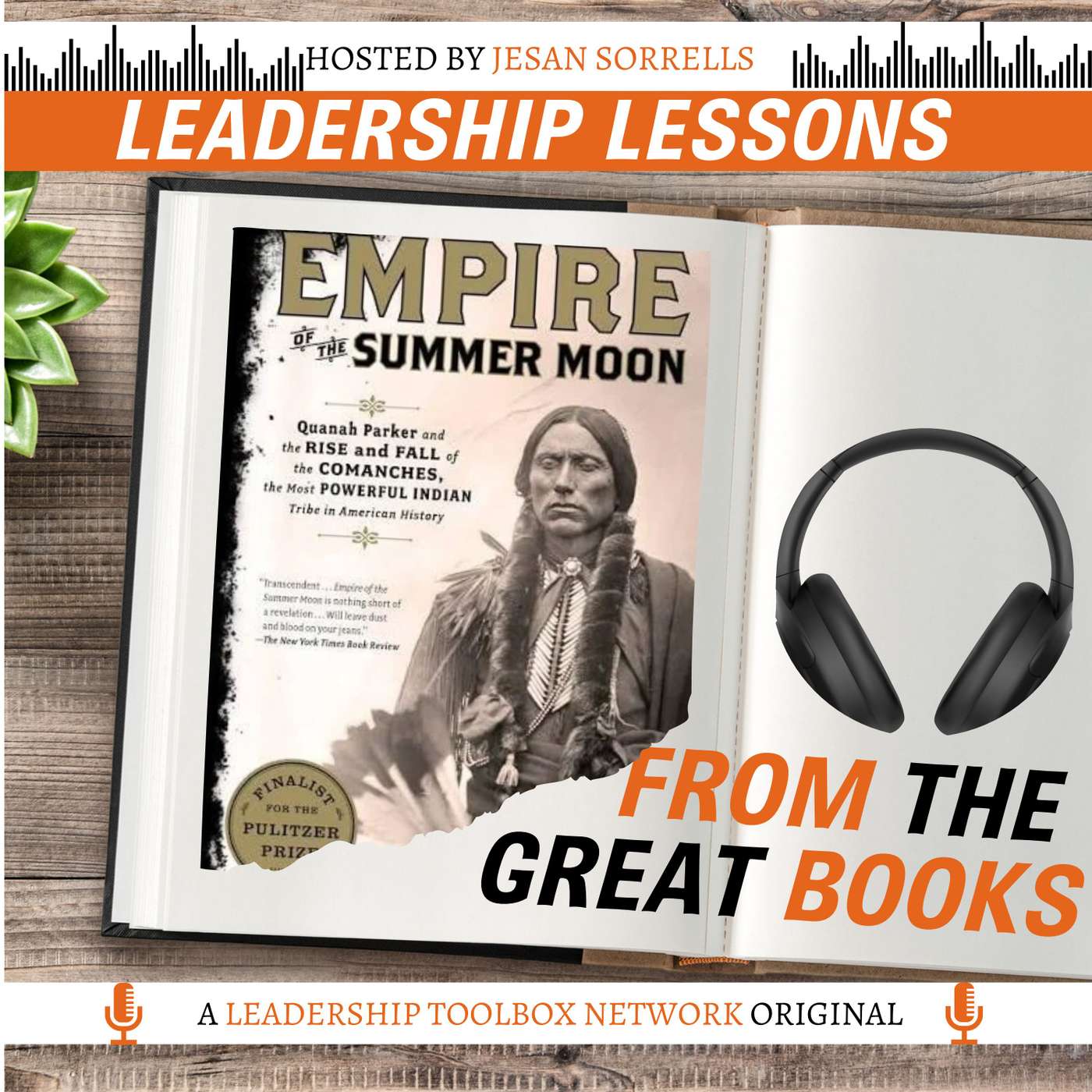
Empire of the Summer Moon: Quanah Parker and the Rise and Fall of the Comanches, the Most Powerful Indian Tribe in American History by S.C. Gwynne w/Tom Libby
Empire of the Summer Moon: Quanah Parker and the Rise and Fall of the Comanches, the Most Powerful Indian Tribe in American History by S.C. Gwynne
---
Exploring the rise and fall of the Comanches, this episode examines S.C. Gwynne’s Empire of the Summer Moon and its unflinching look at Native and settler histories during American westward expansion. The conversation focused on the legendary Comanche horsemanship, controversial narratives surrounding Native history, and the epic life of Cynthia Ann Parker and her son Quanah, the last great Comanche chief. A key theme that emerged was the complexity of cultural clashes, assimilation, and the framing of historical victories and tragedies in the American West.
- Book Title: Empire of the Summer Moon
- Author: S.C. Gwynne
- Guest Names: Tom Libby, Jesan Sorrells
---
Time-Stamped Overview
---
00:00 Settling in Texas and Comanche Stories
09:21 Discussing authorship and perspective
11:16 Discussing historical narrative biases
18:14 Discussing barriers for diverse authors
25:28 Native ancestry and the Trail of Tears
30:16 Discussion on cultural history in America
33:57 Bering Strait theory and early inhabitants
39:55 Cultural differences across language bases
45:12 Discussing resource access disparities
49:40 Spanish colonization challenges
56:29 Depiction of Comanches' dominance
01:05:25 Colonial land acquisition strategies
01:10:27 Settlers' conflicts and government views
01:12:45 Discussing Cynthia Ann Parker's capture
01:20:40 Discussion on Comanche Nation history
---
- Opening theme composed by Felipe Sarro - Bach - Silotti - "Air" from Orchestra Suite No. 3, BWV 1068
- Closing theme composed by Brian Sanyshyn of Brian Sanyshyn Music.
---
- Pick up your copy of 12 Rules for Leaders: The Foundation of Intentional Leadership NOW on AMAZON!
- Check out the Leadership Lessons From the Great Books podcast reading list!
---
- Subscribe to the Leadership Lessons From The Great Books Podcast: https://bit.ly/LLFTGBSubscribe
- Check out Leadership ToolBox at: https://leadershiptoolbox.us/
0:01 Hello, my name is Jesan Sorrells, and this is the Leadership Lessons from the Great Books Podcast, episode number 205. With a summary of our book today. There are 2 astonishing stories in this book that we are going to be covering today. The first story traces the rise and fall of the Comanches, the most powerful tribe, one of the most powerful tribes in American history. The second entails one of the most remarkable narratives ever to come out of the Old West, the epic saga of the pioneer woman Cynthia Ann Parker, who was kidnapped by Comanches as a 9-year-old girl, and her mixed-blood son, Connor, who became the last, and some would say the greatest, chief of the Comanches.
0:56 Although readers may be more familiar with the Apache and the Sioux, and I know for sure I was before I read this book, it was in fact the legendary fighting ability of the Comanches that determined when the American West opened up. Comanche boys became adept bareback riders by the age of 6. Full Comanche braves were considered the best horsemen who ever rode. They were so masterful at war that they stopped the northern drive of colonial Spain from Mexico and halted the French expansion westward from Louisiana.
1:25 White settlers from back east arriving in Texas were surprised to find the frontier being rolled backward by Comanches incensed by the invasion of their tribal lands. The war with the Comanches lasted 4 decades, in effect holding up the development of the new American nation, and our author of the book today, which has been the winner of the Texas Book Award and winner of the Oklahoma Book Award, And was a finalist for the Pulitzer Prize, has documented this as only a journalist first and a historian second could.
2:01 Today, we are going to go into the controversy. We're going to go into the depths, and we're going to go into the book here that eventually is going to be covered by Taylor Sheridan in one of the shows that he is going to start on Paramount because it's. It's the Al Taylor Sheridan Network. Empire of the Summer Moon by S.C. Gwynne.
2:29 Now where I live, I want to open up with this today. Where I live in Texas, I live well within or well past The, the line that separated the furthest expansion of white settlement in the West in the 1840s, 1850s, and 1860s, and the beginning of what was known at that time as Comanche Country. The descendants of the people who moved here settled here and invariably were not scared off by raids, massacres, and constant warfare, warfare still tell stories in their families of their great-grandparents' battles with the Comanche Indians, who at one time held territory that ranged from the edge of the Rocky Mountains in the Colorado West to the edge of the Mississippi in the East.
3:23 Their stories haven't faded out of the historical lexicon of the families who transformed truth into legend. And by the way, I've talked to some of those people. As background for, for this book. And I'll tell at least a couple of those stories today, including one from a gentleman whose grandmother came here from Scotland, was dropped off on the East Coast of the United States, and then got into a Conestoga wagon and came here because of the promise of free land and found a whole bunch of people here that weren't exactly
4:01 Scottish. Not quite. By the way, this lady and her husband, uh, this lady was a big lady. She was like 6'2 and like 180. She was a big lady. And, uh, he told me an incredible story about her directly fighting the Comanches herself, which was apparently not unusual.
4:23 As my co-host today will point out, there are other stories as well. In this historical lexicon, and we want to be clear on what those stories are, and we'll get into all of that today. But however, what we must admit right up front is that the Comanche Indians were the most fearsome, warlike, and courageous bands of natives that the white settlers and their immigrant descendants from back east had ever seen. They mastered the horse, as I just read there. They mastered close-quarter battle tactics.
4:53 And they mastered the buffalo. But as we have brought up on this show before, they didn't understand or fully appreciate the pressure that was going to be put on their way of life from disease, warfare, and finally from the insistent, ruthless spread of a culturally confident American empire that decided right after the Civil War at the end of the 19th century to just stop screwing around. and conquer the continent.
5:23 Today on the show, as I said, we're going to be covering Empire of the Summer Moon. And just as we always do when we cover stories of Native American history, we turn to my co-host, my constant co-host, who has a deep background in this area, Tom Libby. How you doing today, Tom? Doing fantastic, Jesan. I might, I might even allow you to start using my native name when we do things like this to introduce me. However you want to, however you want to roll, man. I would feel proud to be, to be able to do that.
6:01 It might, it might lend to some credibility, I think, because when people find out that I'm not like a history professor or something like that, then they go, wait, why then? Why is this guy talking about this? Trust me, Tom is qualified. He's actually more qualified than I am. I just read the books and then I go a little bit into, a little bit into the history of it because I'm approaching it kind of like S.G. Wynne did a little bit. I'm approaching it from a little bit of a completely, actually not a little bit, a completely different angle.
6:29 We're going into these books looking for, looking for other things. Oh, by the way, one of the points here, early leaders that you will get when you read this book, just to everything up front. Leaders, we have to be intelligent, observant, and courageous enough to hold our current victories loosely in our hands and to prepare for the future strongly, especially if we don't like the future we see coming.
6:58 This is one of several books, Tom, that we've covered on this show that talk about and address Native history from the perspective of white people, quite frankly, white immigrant settlers. I mean, we've covered— looks like Bury My Heart at Wounded Knee. We've talked about— oh gosh, what's the other ones? I mean, we've talked about a bunch of them. Bury My Heart at Wounded Knee, of course, is the big one. But in talking about these books, and we've talked about this before on the show, one of the things that jumps out is just sort of the, the clash of civilizations that was involved in westward expansion and sort of how that was framed up.
7:38 I want to talk about S.C. Gwynne as a journalist, but before I get into that, what do you know about Empire of the Star Moon? I'm assuming you know way more than I do, so go ahead and educate me while they're— by the way, folks, if you happen to hear the sound of drilling, I'm in the middle of a construction project. This is going on around me. So if you happen to hear that on the audio, it's not me. I'm blocking it out as much as I possibly can. I will mute myself as much as I possibly can, and I will let Tom talk way more than me today.
8:06 So that'll be a twist. That'll be a twist. Exactly. Well, you know, I mean, this is— see, there are benefits to construction. There are benefits, mostly to Tom. So Tom, what do you know about SC Gwynne? What do you know about this book? Sort of introduce our listeners and our viewers today to to this journalistic documentation of history. So first things first, what I know about S.E. Gwynne is probably not very much. I didn't know— this is probably the only book I know of him. I don't know if he wrote a multitude of other books or anything like that.
8:44 I really don't know. I know you sent me a couple of links of Wikipedia and stuff like that, so it's limited what I know about him personally. But I think so. There are, there are several— how do I word this? I have lots of thoughts and feelings about some, some of this kind of stuff, right? One of the things that, that I have the biggest challenge with in my own brain is the fact that a very high percentage of these books are written by non-Native people, right? So, it's, it's whether they're fictional or nonfictional or whether they're supposed to be documentary style or not.
9:21 It's, it's just, it's very different when you're coming at it from a perspective of, uh, you know, I— it doesn't really impact me, right? Like, so there's no, there's no, uh, generational trauma. There's no gen— like, there's not— there's no, uh, generational genocide. There's no— like, there's like things that you— that when you view this— now I can tell you that some of the better versions. And, and I love the fact that S.E. Gwynne was a journalist because there have been a handful of books that I've read that are coming from a very journalistic perspective that I like better than when they're just written about like, uh, like just some random— I'll just say it this way, without— with all due respect— some random white dude, right?
10:05 Like, because it's, you know, other cultures don't even write about this for some reason. It's like it's the, it's the dominant white society that's more fascinated about writing about this. content than it is any other race. You don't have a lot of, um, you don't have a lot of African American or Black authors in it. There's not a lot of— your point about, um, well, in that era, in that, that time frame in the mid-1800s, there were a lot of— there was an influx of Chinese, uh, immigrate— immigrants coming over, but none of them talk about it.
10:35 Like, there's never a Chinese author writing about it. It always seems to be the— this white, like, dominant white society. And even if looked at through the lens of a journalist, it becomes very dry and non-nuanced, right? So I do prefer it though, out of like other writers that are not— other non-Native writers that are like just saying, oh, well, my grandfather was there. He told me a bunch of stories. I'm going to put these stories into a book and call it a day. I would rather them not do that, right?
11:07 Because It's, it seems to be, first of all, it's very one-sided. It's very, it's very, uh, um, very egotistically driven. There's very, like, there's lots of death and destruction with no purpose, no meaning. There's a lot, a lot of things like that that happen of it. At least when they look at it through a journalistic lens, they can look at facts and then they can address how the, though, that particular fact impacted one or the other, and if it had more impact on one or the other. And they can clearly identify, um, pathways that it can do that, right?
11:44 So like, just to kind of lay the groundwork here, right? Because when you talk to Native people, you get a very different story than when you hear stories about, you know, the westward expansion. And one of the clearest things that I have, and that really frustrates the heck out of me, Is that every time you talk, every time it's written in a book— if I'll word it this way, I'll ask it as a question, how about that? Maybe you can answer this, Hasan. This will be the question for you, which will be, why is every white— or, or, uh, I'll use it this way— why is every colony, every colonist victory considered a great victory for the, for the, for the people a sound military victory, but when the natives win, it's labeled as a massacre, right?
12:36 It's not looked at from the same perspective ever. And I think that distinction with a difference makes a difference. So I will answer your question by pointing you to— because I was just reading this this week. the, this weekend, a book that summarized the history of the Thirty Years' War that occurred in Europe between Catholic France and Protestant, like Netherlands and Germany and a whole bunch of other, whole bunch of other different places, right? And one of the things that jumped out to me about the history that I was reading there was that apparently in Germany, they still write about the Thirty Years' War as if it just happened yesterday.
13:19 And they write about it from the perspective of, to your point about natives, they write about it from a quote unquote native perspective as a massacre and a slaughter. In the 30 Years' War, something like 20,000 people died, which was the largest number of people to ever die in a European war up to that point, right? So they'd never seen any destruction like that before. And at that point in time, Germany was not unified, right? There were different tribes of folks. It was the Prussians, it was the Austrians, a whole bunch of different folks going around.
13:48 And That war and the results of that war led directly to the ideas of German unification that 300 years later, roughly around 200 to 300 years later, would lead to World War I and World War II. Okay. I don't think it's just unique to colonizers and the colonized, but let's go directly to that question right there. I think that it's done that way because, well,
14:17 Victors always like to pump themselves up. That's like, yeah, this, it's propaganda. It's a sales tactic, right? It's, this is how great we are. I think that the United States is unique, and this is why I brought up Bury My Heart at Wounded Knee. I think the United States is unique in that we have created a cottage industry of critiquing our own selves in a way that other societies and cultures don't, and the degree to which, and we'll get into Empire of the Sun and Moon here in a minute because this also hits Empire of the Sun and Moon because of, but the, there, there was a lot of controversy around this book when it first came out in 2010.
14:57 The Comanche Nation basically repudiated the book. If you can, there's, I think in one of the links I sent you was the list of like their complaints with the, against the book. But I have to say that If you tried to take, up until I would say probably 30 years ago with the rise of the internet, if you tried to take the kind of allowing—
15:24 this is a terrible way to frame this, but let me frame it. I'm going to frame it this way. If you took the idea of allowing, quote unquote, losers to write history or to have their opinion about it, if you took that to any other culture in the world outside of the United States, No other culture in the world would have that because it's about victory and supremacy and we are the best. And I don't think that's necessarily just an American thing. I mean, you can go back in the Bible, Epic of Gilgamesh.
15:51 I mean, all of it's a human thing. We all write from the perspective of we want to be winners and we want to be great. So it's propaganda. Yeah, I get that and I agree with that. But that's part of the problem that I'm talking about, right? Number one. But number two, and I'm not asking for history to be written by the losers per se, but all I'm asking for is equality over terminology. I think, and I think that right there is a uniquely American ask that, again, I don't think has gotten to other places up until about 30 years ago.
16:28 Now, I think, I think that's expanding over the course of time. And just like anything else in culture, which we talk about on this show, just like anything else in culture and in history, It takes a long time for that to come down the mountain, but it's coming down and it's spreading fast with the internet because now with the internet, the losers in the battle, I just, we were just talking about the counterinsurgency manual, the losers in the battle, which we'll be covering in the next episode, folks.
16:55 They now have access to TikTok too. Right, right, right. So everybody now has a voice in history, which of course leads to frustration about who's right, who's wrong, and knock-on effects and all of that. Yeah. I think that also, and I'm going to add this into my comments because I think this is also something that you're hitting on.
17:22 Americans have a lot of guilt coming out of the Civil War, and it starts with the white Anglo-Saxon Protestant guilt first, and then the guilt sort of— you talked about other ethnic groups that don't write about, about natives, even though they were around, a native history, even though they were around during the time when this was happening. Well, let's be clear, African Americans at that time,
17:50 they weren't exactly the most literate folks on the block. There were, there were many of them that were literate, but they weren't exactly literate. Plus they were also driven by an oral culture and those kinds of things. But, but, but in fairness, what I'm talking about is those same writers today, I'm not talking about back then, obviously, I wouldn't expect them to write about it back then. But S.E. Gwynne did not live in 1838 or 1860 either. That's what my point is, it still happens today. It still happens today, right?
18:16 I don't think that an author like, let me pick on an author who I think would do this well, John McWhorter, the linguist, the African American linguist from Columbia University. I think he would write a great history of native,
18:31 not even massacres, but like native, the native history. I think he would, and I think he would do it from a linguistic perspective. I think if you asked John McWhorter to do that though, as an African American, he would be put off of it. Hmm. He wouldn't want to touch that because what he would say is, and I think that this is, I don't think this is a legitimate answer, but I think this would be his answer. Without knowing him, without having any engagement with him, I'm just speculating, right?
19:00 I think he would say it wouldn't be socially just of me to do that because I don't have a lived experience, a lived generational trauma experience there to write from.
19:10 I also think that that's why you don't have a
19:14 person who is a descendant of folks who were here working on the railroads who came over from China writing about any of that. I think the same thing sort of— I think each minority group in America, and this is again another place where America is unusual,
19:31 I'm going to frame this this way, each have their own beefs against the white Anglo-Saxon Protestants and want to work out their own beefs without having to work out anybody else's beefs. So in other words, we all write about our own stuff, but the white people can write about whatever they want.
19:47 And we need the freedom to work out our beefs without worrying about your beef.
19:52 The last thing they would want was for all the minorities to come together and be one voice. Why would they want that? Why would you want that? Nobody. No, no, no, no, no, no, no. Let's not say we did. Then the other factor you have to put in is, and I think this is also a legitimate factor,
20:21 People who come from a white Anglo-Saxon Protestant background, whether their family came here on ships initially or not, or went west or not, right? I think a certain percentage of them are imbued through cultural systems with a sense of guilt. I mean, let's not be, let's not gussy it up. They're imbued with a sense of guilt, either historical guilt, racial guilt, class guilt, status guilt, economic guilt. I mean, this is where you see, you see people who have paler skin, let's say, consistently trying to repudiate the history that that skin existed in.
21:12 And you could see examples of this. I mentioned TikTok already, but you could see examples of this all over social media. I mean, you know, I don't have to pick any. There's so many out there. Just go find one. And so I think that those people have a beef with people that look like them. And so because there's a lot of them, it's fine for them. They can shave off a few percentage points of people that have a beef. And most of those people that have a beef, by the way, become academics or journalists or historians and work out their beef with a lot of notes at the end of their 200 and 300 page and 400 page books.
21:50 Now, why that happens and the psychology behind that beef, I'm not going to get into that, but I think those are the factors on the ground. Yeah. I would love to see a Well, there's one book that we covered here on the, on the show. This is probably about 3 years ago now called— it was the, the, the, the narratives of African Americans who had been, who had either been enslaved by Indians in Oklahoma or who had run off with Native, Native tribes in Oklahoma. Right. And it was written by an African American.
22:26 No, it wasn't. It was written by— it was written by a white Anglo-Saxon Protestant author. That's right. Who who did the anthropological studies and found all of the stuff and like put it into a book. I remember, 'cause I was in a shop in, I was in a shop in like Central Texas somewhere, like, like one of those historical, like, this is a historical background place. Here's the shop, exit through the gift shop. Situations. And when I was exiting through the gift shop, I found the book and I thought, oh my God, I gotta cover this on the show.
22:57 This is amazing. Because you never, to your point, you never hear about any of that. And I'll, and I'll double down even further. You never hear about that from African Americans. So every African American— I've never actually brought this up on the show. I should bring this up. I'm going to bring this up now. Every African American who you've ever met who can trace their ancestry back to a slave ship through ancestry.com or whatever, Alex Haley, whatever, every African American you've ever met claims some native American somewhere in everyone.
23:32 Now, that's not possible. It's just not possible. I'm not surprised by it though. That wouldn't surprise me. But I'm not surprised by it. Right. So like in my family, my grandma on my mother's side
23:51 always claimed that there was some Cherokee blood in our background. Right. As I got older, I found out that, oh, a lot of African Americans are claiming this. And I began to be, shall we say, skeptical of that claim. And skeptical not because I don't believe that there wasn't such a thing as intermixing. And the term they use in Empire of the Silver Moon is miscegenation, which was an old school term that I thought everybody had forgotten about. And N.C. Gwynne actually put it in the book. I was shocked.
24:23 Because it just sounds like, it just sounds like a, it just sounds like a Southern white, unrepentant Confederate word.
24:35 Yeah. It just does. It just, it sounds like that. Miscegenation. Like you just say the word and you can see like, like in my, at least in my head, like you see like old school Southern mansions with like mint juleps and stuff and, you know, all the worst parts of Django Unchained, right? Yeah. Shove in your brain when you say— Oh, that's the whole movie. And no, I'm sorry. Anyway, go ahead. No, you're right. No, you're not wrong. I was shocked that they made that movie, by the way. Shocked. But, um, but, um, but that sort of racial mixing, you You, you, you hear about, to your point, in, in family narratives, you hear about it in family narratives.
25:20 But I had never up until that point of picking up that book ever seen it actually documented by an anthropologist. Well, that's funny. It's funny that you talk about that because I do a lot of speaking for history departments and anthropology departments up here in the Northeast. And I mean, I'm telling you, I have no hesitation to tell people If your family's been here for more than 5 to 6 generations, it's very likely that you have Native blood somewhere along the lines, whether your skin tone looks like yours or mine.
25:53 Because Native people didn't— we never, back in the day, Native people didn't view the color of your skin as a reason to marry or not marry, or a reason to, you know, mate with or not mate with. It was always more about convenience and proper processes. I said that very carefully, but like, you know, but like what you're talking about and why I'm not surprised by the sheer volume or number that for your community that can trace their ancestry back that far will say that. There's specifically one particular event that led to a tremendous volume of that happening right out the gate.
26:39 So, the Trail of Tears in 1830, when they were moving the Cherokee from North Carolina to Oklahoma, first things first, and I think this is where some of the Black and African American community can potentially get it wrong because they almost always latch on to the Cherokee because the Cherokee was the most famous tribe labeled in that move, but they were not the only ones. There were Choctaw, there were Chickasaw, there were lots of Native groups that as they went from North Carolina to Oklahoma, they picked them up along the way and they brought them with them.
27:14 Well, one of the easiest ways to kind of free yourself from those— from slavery back then was to try to connect with that group of people and/or run toward them. You know, who else has a very, very influential, a very, very historically influential process in this is the Seminole. Because the native, all like a lot of the natives and the Black people that would join them on that journey, they would leave and go south and just interact with the Seminole. And all of a sudden, they the Seminole tribe exploded, like their population exploded, and nobody was able to defeat the Seminole in their own territory because who the hell wants to buy marshland in Florida?
28:02 Let's— I mean, I'm joking, people. I know. I'm just— I'm not taking away from the Seminole people or any of the other tribal affiliations down there. That's not my intent. My intent is to say that as the Native and Black communities moved south and connected with those people, Mm-hmm. They were, they were taken in. So to know, or to say you can trace your ancestry back to Native roots before you, or around the time your family either got off the boat or got to the freedom part of it, that makes sense to me because the volume of that happening during that 18— from 1830 to 1838 was incredibly high.
28:37 It was incredibly high. Well, and the other thing is that, and it's interesting that you brought up the Seminole because when we read Their Eyes Were Watching God, by Zora Neale Hurston, right? Hurston, yeah. So Hurston researched all of this to write her book. Now, she wrote her book from obviously African American female perspective, writing about things happening to African Americans. And I don't want to make this podcast all about that because we're talking about Empire of the Summer Moon here, and we'll get back to that in just a second.
29:04 But this is an important segue. She got into the anthropological research, right, that was available in the available to her in the '20s and '30s. Didn't have the genetic research, which, you know, wouldn't come till much, much later, but got into the anthropological research. And she writes in her book, In Their Eyes Are Watching God, about how the African Americans and, to your point, the natives of the Seminole Indians in the Seminole tribes in Florida, how they engaged with each other. And she's writing about it.
29:44 She's writing about that engagement from a— and this is back to that idea of triumphalist versus like not triumphalist. She doesn't write about it from a triumphalist perspective. It's really curious. She writes about it from the perspective of, and I love this about her, we are over here doing our thing. It's kind of exactly what I just said. We're over here doing our thing. Our beef is against the wasps. Our beef is not with you people. And you can see it in the back end of the book when the hurricane comes through that wipes out everything.
30:15 Yeah. And then they all have to like sort of go walking. And the main character in there, whose name I have forgotten, you all will remind me, but the main character in there comments that, or one of the characters comments that You could see where the Seminole Indians had passed through before even the African Americans, because they knew the thing was coming and they had already moved inland. But the African Americans had decided they were going to wait and they were going to party and they were going to drink and they were going to do their thing, their shindig, you know, out in the, out in the whatever.
30:48 And they got, they got taken away with, with everybody else. And so it's very much this sense of, and this is interesting because again, America, and this is the uniqueness of America.
31:03 Most other countries rely on homogenous populations to get things done. So, you know, in government, I always think of how people talk about how great the Finnish countries are, like Norway and Finland and Denmark. And I always have to say to people, Up to about 15 or 20 years ago, they were 90% white. Yeah. Just like Japan. Japan is 99% Japanese. They're not letting people in. They weren't letting people in. They were actively keeping people out. The Japanese were actively keeping out the Koreans and trying as hard as they possibly could to keep out the Chinese actively, like on purpose, like for thousands of years.
31:50 The Finns and the Norwegians and the Scandinavians, no one wanted to go there because it's cold. Yeah. Especially halfway up. Like you don't even have to go all the way to the north part of the country. No, you just, you walk in, you see a fjord and you're done. You're like, you know what? I'm out. I gotta go.
32:10 America is unique in that we sit geographically in a nice climatized, you know, area where everybody can come. The extremes are bad but not horrible, um, you know, and we have 4 seasons. We have a wide swath of a third of the continent. It was almost as if it was made to be a place where anybody from everywhere could come. Just from a geographic perspective and just sort of, not to put too fine a point on it, but just sort of screw around and find out.
32:52 And from crossing the Bering Strait, let's be real, from crossing the Bering Strait, human beings have been coming here
33:01 for a while now. And it's been a multiethnic, even among the native tribes. Like I saw a map one time. that mapped, actually, again, from anthropological data, mapped all the native tribes like pre-Columbus, right? Pre-engagement. And it's something like 400 or 500 different ethnicities,
33:25 all with their own thing going on, all with their own customs, all with their own traditions, all with their own language.
33:34 Not to put too fine a point on it, but that's a lot. That's a lot. The problem with the— well, we don't have— we can move on. We can move on to this. But the statement you just made is always debated. It really depends on who you listen to, right? Yeah. Okay. Number one, the Bering Strait theory— and you notice the difference, I call it a theory and you didn't, right? No, I didn't. Bering Strait theory has been disproven a few times. So like I'm not saying nobody came over the Strait, but if you look at the timelines that people came over the Strait, there were already people here for tens of thousands of years before the Bering Strait happened.
34:15 So, and there's been archaeological proof that what we originally thought was 20,000 years ago, 25,000 years ago, the Bering Strait people walked over, and that may still hold true for that group of people. But there were already people here in, in this, in this, in these continents, number one. Number two, when you're talking about linguistics and, uh, and cultural divides, um, there's— if you, if you, if you— there's, there is a certain sect of people that will tell you that there were only 7 distinctly different languages spoken on the continent prior to European contact.
34:52 Now, of the 7, to your point about the 400, Of the 7, similar to English, there were dialects all over the place. So they could communicate with each other even though they were not speaking identical languages, very similar to the way that we speak to people in England, or England speaks to people in South Africa, South Africa to India, India to Australia. Those are the largest English-speaking groups around the world, but yet we don't think we speak the same language half the time. Right. Yeah.
35:22 Because dialects are so vastly different, but it is, it is all English. That's the similarity, right? So like, think of like, just think of English as, as in general, the United States, England, South Africa, India, Australia, the largest English-speaking countries in the world. And we don't speak the same language most of the time. Now, take that into one of the 7 distinctly, distinctly linguistic languages, and now you could have dozens upon dozens in each one of those 7. that represent the same language base, but not the same language detail.
35:54 Okay. Let me ask you a follow-up question to that then. This is the John McWhorter question. Okay. You got me on the linguistics. This is where I'm fascinated by it because language precedes or parallels, depending upon how you want to look at it, culture, because language is the way that you talk about how you view the world. And if you can't talk about how you view the world, then you can't have a culture. You just, you can't have it. You can't even have the beginning of a conversation. Right?
36:17 Which we're finding out now in America anyway. And we speak, we use the same words and we're not even talking about the same things.
36:28 So let me ask you a linguistics question. So you mentioned the countries that speak English, each one of those countries though, no one, no one's going to confuse South African culture for Australian culture. 100%. So Would each one of those 7 linguistic bases— bases, there we go. Yeah. Would each one of those bases, would it be fair to say that each one of those bases, like out of one of those bases, you could have multiple cultures spring out of that? 100%. Or is it more true to say, okay, or is it more true to say for each one of those bases, like I think of the, the Iroquois, right?
37:05 Yeah. Or the Seneca, the Seneca Nation or the Ojibwe. right, where, where there's very— or the Seminole, where there's very strong commitment to whatever their linguistic base is. Is it more fair to say that there were
37:25 cultural tussles around which linguistic base got to be the top dog? Because I don't want to be— I want to be very clear. Native cultures and native peoples had the exact same dynamics as European cultures and European peoples because we're all humans. Just like in Africa, we were talking about African cultures before the slave trade. They were fighting wars and building empires and oppressing people and genociding and doing all those kinds of things. It was— I don't buy the myth of the— I have never bought the myth of the
38:01 The colonized person who was somehow, or the colonized people, not individual, but the colonized persons who are somehow these pure innocent things and then were corrupted by the colonizers. I think that's quite frankly nonsense because human beings, and this is where my Christianity thing kicks in, human beings are all full of sin. All of us, all of us, we're all doing the same thing. We're all, God made all men equal. Like, like we're just, we just are, that's how we are. So would it be fair, would it be fair to say that there were tussles at that linguistic root?
38:35 Or would it be more fair to say, yes, things just grew kind of, kind of, kind of out the way that they grew? So I, I think, and again, I wasn't alive 10,000 years ago, so I, I don't know. I'm, I'm speculating and/or using the best available data that I can through either archaeological digs and/or anthropological studies. Yeah. Where, so like, take the, like, to your point about the, the, the Haudenosaunee language, right? The Haudenosaunee, or what you would recognize as the Iroquois. Sure. 5 very distinctly different tribes.
39:08 They, they, and they unified themselves, but they were all linguistically, they all spoke the same, essentially the same language, right? Yeah. Just to the east of them were the Algonquin-speaking tribes, which would have been the Mohican, the Abenaki, etc. Do I think that the Abenaki— the Abenaki and the Wampanoag, or Abenaki and the Nipmuc— had major conflicts with each other? Probably not. They all spoke the same language. They could figure it out. They could figure out a way to work it out, some sort of democratized kind of version of what happens.
39:42 However, you throw the Mohawk in there, which was part of the Haudenosaunee, And now you have the Mohawk trying to interact with the Abenaki, complete language barrier. Do I think there could be major conflicts there? 100%. Okay. So I— and, and some of that to your question, or to your alluded question earlier about could each of these 7 distinctly different language bases have different cultural divides? Definitely. Again, think about the— you're talking about a continent 3,000 miles wide that that had these little dribs of these language barriers in between them.
40:18 There's no doubt that somebody from, uh, you know, from northern Maine or southeastern Canada is going to have a little bit different view on life than somebody from the Delaware area, which would have been the Lenape, all spoke— speaking the Algonquin language. They're going to be a bit different. And the Ojibwe, by the way, which also is a foundational Algonquin language was far inland. You don't think that somebody super far inland or somebody from the coast is going to have differences in cultural thought processes?
40:47 They have completely different— they have access to completely different food sources, completely different— yeah, so there's going to be some differences there. Now, as you move westward, it gets a little bit, in my opinion, it gets a little bit more, even more tricky, because now you're talking about expensive, expansive vasts of— vats of land that now you have to overcome in order to even meet to the next tribal affiliation. By the time that you get there, you're irritated, you're exhausted, you just want a pizza and a Coke, right?
41:17 Like, and, and they say, we don't have pizza, we don't have Chicago-style pizza here, we have, uh, you know, Mexican pizza. And it causes— no, I'm just kidding. But, but, but the, but the point is though that you you don't see another human being for 100 miles, and then all of a sudden you see a full-blown tribal, you know, village or something like that. Right. I, I think that there are— there's like, if you're out, if you're alone and you're by yourself and you're scouting, then that is a red flag to get the hell out of there.
41:49 But if you're traveling with a whole family unit looking for another place to stay or another place to, to move to or latch on, Are you start— you're a dad, I'm a dad. Are you thinking, can we, can we assimilate here and marry off one of our kids so that we become right, like, and we're now defended by the bigger group? I— yeah, it's— and then, then you get like giant villages moving into other villages. Yeah, you know what, you step on my toe, I'm gonna step on your toe. We're gonna have a, we're gonna have a battle.
42:18 Yeah. So I, to your point, I think you're right. A lot of that stuff happened. A lot of stuff But I think the abundance, or whether you were, whether you were in an area of abundance or an area of scarcity, also mattered. Yeah. If you look at tribal affiliations in the Northeast, in the Northwest, in the Upper Northwest, there was a lot less fighting in those areas because the food sources were way more abundant. You didn't have to fight for food. Your natural resources were more abundant. You can chop down trees to build homes.
42:50 Like, It wasn't like you weren't fighting for that, to chase that same herd of buffalo. As like, if you're a Comanche, you're chasing the same herd of buffalo that the Apache or the Chiricahua Apache were chasing for food. And that causes way more conflict that you're now fighting for the same food source. Right, right, right. I think even saying that, like, that throughout the continental U.S. there had to be warfare, I think that is an oversimplification of a statement. Okay, okay. And I know, and I know that, uh, S.C.
43:22 Gwynne mentions that, by the way. Oh, he does? He did an interview where he said he would talk specifically about— there's this, there's this, um, uh, what is the term? Um, not glorification, it's like a, um, ah, there's a term. Why am I forgetting the term here? Um, that we're basically— he's, he's talking about trying to elevate the, the Native community beyond reproach, right? Like, they were everyone. Like, there's this glorification of Native communities that was also kumbaya and everybody.
43:55 Oh yeah. White people came in and we became warring. It's exactly what you're talking about, right? Right. And he says that's basically— he's calling, calling BS on the carpet for it, right? Going, yep, everything you read about the Comanche— and by the way, the Comanche were one of the fiercest in the West. So were the Chiricahua Apache. Those 2 groups of people and the Lakota were the same way. They were absolutely— they were because again, you're fighting for resources at that point. There is clear evidence of that kumbaya state that we talk about in the Northeast and in the Upper Northwest.
44:30 Right. Most of it, I, I believe— my belief is that it surrounds the abundance of of natural resources versus scarcity of natural resources. Which would make sense, right? So if you are in a place where, and we see this with anybody, right? If you're in a place where,
44:49 I don't know, let's take any resource. Oh, I'm going to bring this up to modern times. So if you are in,
44:59 if you're living in the ghetto, I'm going to make this broad.
45:05 The fights over resources are significantly different than those of the suburbs. Yeah. Even though you're both speaking English, to Tom's point, you're both speaking English, you both live in America, you both technically speaking have access to the same things at a, at a, at same resources at a technical level. So If I'm living in the ghetto, a ghetto area of a major city, sure, I can get on the bus. If there's a bus line, I can get on a bus and go to Whole Foods in the suburbs, just like someone from the whole— someone from the suburbs can get on the bus and come to the bodega.
45:42 But to paraphrase from Bubs in The Wire, it's a hell of a long way from heaven to here.
45:53 I think we, because we live in a time of plenty and because we live in a time where most of our material needs are met and our material comforts are, shall we say, have been, our material discomfort has been ameliorated through technology and progress. We forget that. And when you read a book like this, by the way, to your point about S.C. Gwynne, he makes a point of laying the foundation for what the actual environment was, not just for the settlers moving into these eastern areas. He starts— he doesn't even start with that.
46:34 In chapter 5, The Wolf's Howl, he begins with— and I appreciate this about him— he opens up with describing exactly who the Comanche were. And exactly how the development of, and let's, we're going to, I want to, I really want to talk about this, the development of horsemanship among the Comanche and how that basically kept down the Spanish because they had no clue what was going on like this, which is shocking to think about. So
47:05 I, not to make this a history podcast, but I think most people forget That the tussles that occurred over the North American continent occurred between 3 major powers, 3 major European powers. The French, everybody forgets about the French. Haiti got sold because Napoleon, A, didn't want to run in it and didn't want to run a colony. He would've kicked it in with the Louisiana Purchase if he could have, but because he needed money to go off and kill Germans and Russians. His war. Yeah, exactly. That's correct.
47:36 Because he cared more about that. The French have always been— I'm going to get in a lot of trouble here, but I don't care. The French have always been piss-poor colonialists. They always have. So if we're going to explore another planet and colonize it, we should not invite the French? Is that what you're saying? Don't invite them. Don't ask them along. Don't tell them we're doing anything. Just— they're terrible. From— and you could look back at the historic— I am not making this up. You can look from being unable to figure out the North American continent all the way to Algeria.
48:11 The French have been piss-poor colonialists. Now, with that being said, the other major power was of course the British. The British have a mixed record on colonies. Yeah. In some places they put down railroads. And they gave them the law and then they like let, just let things happen. That was India. And in other places, well,
48:39 they treat, they took a little bit of a different tact. Let's just say that.
48:45 And so the English, again, from, from, from the time of North American exploration all the way through them just giving up their colonies at the end of World War II because of a lack of, as we talked about in our last episode, an overwhelming lack of cultural confidence at how World War II turned out for them. The English had a mixed bag record around colonialization, and most of the problems that people have with colonialization, quite frankly, come from a British conception of colonialization.
49:16 Weirdly enough, not a French one. Weirdly enough, the French get a pass. That's strange, but not unusual. Strange, but not unusual. Probably the worst colonialist power out of all of them though was the Spanish. And that's hard because the French were pretty bad. The Spanish could not figure out, well, no, so not could not figure out. When you look at the Spanish settlement of North America and quite frankly, they're trying to get into South America too, they seem to not be able to figure out, number one, what the hell they wanted to do.
49:52 Things changed based on who was in the crown and there seemed to be no controlling authority. But the other thing that sort of drove the Spanish over a cliff was Catholicism. They insisted on missionaries going along with their exploratory parties and converting every South American, North American tribe they could possibly get their hands on. Now we could talk about Christianity in a different kind of, in that kind of context. I'm fine with critiquing Christianity on that, but it was, but I want to be very clear.
50:27 It wasn't Protestant Christianity. It wasn't the evangelicals. It wasn't the descendants of the Lutherans. It wasn't them. It was the Catholics. And the Catholics insisted on going out, missionizing, giving the Bible, converting, baptism. They even talk about the— he, Essequin even talks about this in the book with the Comanche. And with the Comanche, Spanish colonial assumptions failed miserably.
50:59 And the Spanish knew it was failing miserably but had no solution for it because the Comanche— Not to put too fine a point on it, this is the big thing you get in Wolf's Howl— the Comanche, once they got ahold of the horse, took everybody completely by surprise. Yeah. They took everybody by surprise. So I don't know how much you know about the Comanche and, and their horsemanship. That part, that part like really opened up and I didn't know, I knew very little. Let's just put it that way. Beyond just like the surface stuff, the things that S.D.
51:28 Quinn talks about in chapter 5 of his book, In the Wolf's Howl, how they conquered the horse and then how the Comanches literally turned that on the Spanish. and then turned it on everybody else afterward is just, from a military standpoint, is just incredible. It's like, it's almost as if you gave them a tank in like 1630 and were like, eh, go ahead, figure it out the rest of it. I mean, they're gonna run outta shells eventually, but they're gonna figure out how to like make shells. So not only, not only did they, they master the horse, I, I, something that I think goes kind of under the radar here, uh, a lot of times on when it, when you're talking about specifically the horsemanship and the history, That when we had muzzle-loaded rifles, right, where you had to pound the musket ball into the powder and fire, right?
52:18 A Comanche on horseback could fire off 6 to 10, depending on how skillful they were, 6 to 10 arrows for one shot coming at them from that musket. Yes. Now that by itself is impressive, However, they didn't fall off when they got their hands on repeating rifles, revolvers. They got so good at being able to shoot and ride at the same time that they were almost unstoppable. What put— what gave them their advantage was also their downfall. Right. Because the, the, the U.S. cavalry, I can't remember his name right now.
52:59 If I look it up, I'll probably tell you. But it was actually— I gotta, I gotta, I gotta, I gotta— And they probably mentioned him in the book. Hold on. It'll kill me. Yeah, they probably mentioned him in the book. It's McKenzie. McKenzie. Colonel McKenzie. Yep. So what Colonel McKenzie figured out is that if you take away their strength, you win this war. Right. He did 2 things that we actually even look at in today's modern warfare. We look at today as what the— how do we defeat an enemy in today's modern warfare?
53:38 Supply chain and take out their strategic advantage, which is what he did. He went after the buffalo and he went after the horses. He killed the horses. Nobody talks about that. No, nobody talks about the strategic advantage that he gained by eliminating their, eliminating their primary source of, of, of, uh, of livelihood, which was the buffalo. Go out, let's kill millions of buffalo. Fine, okay, they could probably overcome that by, you know, whatever, or, or, or even raiding English settlements or, or, or United States, U.S. settlements by you know, they can go take their cows and whatever.
54:17 Yeah. But then he figured out, but if I take away their strength, so let's kill the horses. Don't steal them, which is what tribes were doing to each other. They were stealing. Oh yeah. They just go steal each other's horses all the time. Oh yeah. They were horse thieving all the time. And then they would like sell back the horses to each other, which is insane. So, so there's that. But, but like, okay, so let's not, let's not steal the horses and try. No, because they can steal them back. They can buy them back.
54:40 They can get them combat. We'll just kill them. So they started killing off all the wild mustangs, the Spanish wild mustangs that were in the thing. And then the Comanches, he basically just cut their legs out from underneath them. Yeah. And nobody talks about how detrimental that was. That was the downfall. That was what killed the war for them. Well, and they didn't figure this out until the 1880s. The Comanche had been running things.
55:13 They've been running things in the American Southwest since at least the 1680s. Yeah. And then when the horses showed up in full, in full force from those glorious Spanish colonialists from about the 1710s, the 1720s, the 1730s at the Until the 1880s, to your point, when Mackenzie figured this out, you know, you talk about history being written from the perspective, or you mentioned your first question, right? Why is it written in terms of like this triumphant kind of thing? And I said it's propaganda.
55:51 One of the things that S.E. Gwynne did, has done brilliantly in this book is, and I, and this is why I'm curious what, and we're going to get to the commingination piece here in just a minute. I'm curious why the Comanche Nation would have a problem with this because he's actually not, he does not write this as a triumphalist saga. This is not what this is. Mm-hmm. He writes it as a tragedy on the part of the Comanche and a series of foolhardy, stupid, dangerous, and ultimately deadly mistakes that were made repeatedly by various colonialist powers.
56:25 who could not see the forest for the trees. Yeah. This is very much a post-Vietnam, post-Bury My Heart at Wounded Knee crack in the mouth to American history. It is not triumphalist in any sense of the imagination. The way I see now, does S.E. Gwynne pick the right words all of the time? No, he doesn't pick the right words all the time. He's not using the right phraseology. There are some conclusions, and I do agree with the commiseration and the repudiation of some of this in this piece. There are some ideas he has that don't follow through from other ideas, but if you read the entire book, it all kind of clicks together.
57:12 But I will say that, or not say, but in spite of that, he is writing this from the perspective of, or Outright from the perspective of he is seeking to show just how dominant the Comanches were and how much of a force to be reckoned with they really were, and how much how much angina they gave to basically everybody around them. And I think we we covered this. I asked you this question, you know, probably like last year last time we. We, we did something around this. We did a book around this. He doesn't postulate the question, but I, I wonder what would've happened if the Lakota and what was left of the Apache and the Comanches, and to a certain degree the Navajo, although the Pueblo peoples were, again, talk about linguistically, they were linguistically wired to do something totally different culturally.
58:08 Yeah. And they wanted to have absolutely nothing to do with the Comanche. part and parcel. I wouldn't say absolutely nothing to do. They would, they would trade with them and then that was it. Yeah. But I often wonder, to your point about the Algonquin peoples and coming together in the Iroquois Confederacy, there was none of that in the West. There was none of this coming together. And so everybody got picked off. And so he writes it from the perspective of the Comanche being the Comancheria, actually, as he puts it, being having this vast empire, and that's the word he uses, this vast empire that the colonialists could not see and could not understand and could not comprehend.
58:48 And basically stepping into something, stepping into a negotiation they didn't understand how to get out of. And the only way that, the only thing they could settle on was brutality. That's the only thing they could settle on because they couldn't figure out any other way. Which, by the way, I also have to point out, the brutality only starts— when I say only,
59:12 the brutality really kicks in. That's a better way of framing it. Like, really committed, intentional brutality really kicks in, not from the settlers, not even from the settlers pressuring the United States government, because he also talks very clearly about how— and as a person who lives in Texas, I appreciated this. about how
59:33 most Texans didn't want the federal government's help until they wanted the federal government's help,
59:38 and then they wanted the federal government to go away, which by the way is a continuing strain. I was going to say, so what's so different today? Yeah, yeah, yeah. I loved it that he wrote it down. I loved it that he wrote it down. There's something about the people that settled this spot where they have the hate-hate relationship with the federal government. But they didn't have enough
1:00:05 intelligence resources, wherewithal to actually pull off the thing they wanted to pull off, which was clear the country of Comanche so we can put settlers here so we can have cows. They didn't have enough wherewithal to be able to do that. So he writes from those 3 perspectives, in particular with Cynthia Ann Parker and the raid that occurs there. where she gets kidnapped, he has nothing but reprobation for the white culture that attempted to bring her back in and reintegrate her and basically killed her.
1:00:35 That's what he does. He lays that at the feet of white culture. So I want to be very clear, this is not a triumphalist narrative in any stretch of the imagination. And I did specify that early when we first started talking that I think journalists do do this a bit better. Yeah. So I made— there's another book out there. I don't know if you've ever read it or if you ever want to read it. It's fascinating to me. It's called Indian Givers. And it's a book that was written that basically tells you about all the things that the rest of the world would not have if it wasn't for— it's what the natives gave back to the rest of the world, if you think about it from that perspective.
1:01:12 Things like chocolate and peppers and— Peppers. Coffee, not coffee, sorry, cocoa beans, but things like that. Like he goes through a whole list of things that the world would never have access to if it wasn't for the Western Hemisphere. Yeah. And so when I say the Indian Givers book covers the entire North and South American continents, it's about the Western Hemisphere. But again, written by a journalist. This is not something that's, so to your point, he doesn't even even— he doesn't even venture into the, the realms of right, wrong, or who, you know, murders and whatever, because there were definitely some stuff that was happening for, um, for some of these things.
1:01:57 He goes into— he talks about how it right now currently— well, when, as of his— as of him writing that book, there were, there were 630 U.S. patents based on Native American medicine. medicine. Hmm. Like, so things that we— like, things that we were using as medicinal things that the world would have never even thought of without this. But, but I— to my point, I'm sorry, I'm not preaching about the book here, but I'm saying that, that the style of writing from a journalistic perspective just lends to—
1:02:32 it's, it's not— to your point, it's, it's just very matter-of-fact. It's not like— it's not who's right, who won, who lost. It's not about that in these— in their brains. It's a matter of disseminating information that people can then interpret on their own. Like, it's up to the reader to decide, was that a massacre or a battle? Was it a military victory or was it a massacre of innocent people? Yeah. And again, from a Native perspective, there's not a single innocent person in that story, right?
1:03:03 Like, You're coming and building a house on my land. Just because I'm not there today doesn't mean I'm not going to circle back around to check my land. Think about somebody who has 200 acres of land. If, if you're not walking that property every day and somebody builds a house over there on the corner, you're going to have a problem with this. Oh yeah, they're going to go. It doesn't matter. It doesn't matter that you didn't plant crops on that field that, that year, or that you didn't graze your cattle in that section of the, the ranch that, that that month or whatever.
1:03:31 People forget that because the land was already occupied, you are literally stealing from them. And they— and so they go in, they burn down your house, or they kill the people, whoever's there. I don't care. It— well, it's not that I don't care, it's irrelevant if it's women or children. Their thought process is, you built a house on my land, you need to go, right? But, but, but that's a massacre, right? But that's a massacre. Natives massacred these, these people that build, all they were doing was building a house.
1:03:58 They were just trying to make a life for themselves. And it was unclaimed land. No, that's not the way it works on our side of the coin here. It's no different than somebody having a 500-acre ranch and having somebody build a friggin house on the end of it. Well, and this is where we get into Cynthia Ann Parker, right? And she gave birth to Quanah Parker who ended up being— yeah, I know who she was. Exactly. So in 1836, Texas existed as a republic, and as part of existing as a republic,
1:04:38 Texas offered land, to your point, to the Parker family and several Parker family heads. I'm going to read directly from the book on this. were each given grants of 4,600 acres of land in Central Texas near the present town of Mexica, which is actually kind of close to where I live.
1:05:01 Let's see, in perpetuity, by the way, they were given this. No taxes or custom duties for 10 years. Pooling their resources, they had aggregated adjacent lands totaling 16,100 acres, which is 25.2 square miles, a veritable kingdom by the standards of their native Virginia. They supplemented their grants with another 2,300 acres they bought themselves for $2,000. The land itself was magnificent, located at the edge of Texas's prodigiously fertile Blackland Prairie, tempered with forests of post oak, ash, walnut, and sweetgum, and crosses broad rolling meadowlands.
1:05:36 So one of the interesting things that we don't talk about in America is, and you talked about this in terms of, of from the native perspective. Let's talk about this just very briefly from the, not just the federal government's perspective, but from government perspective, period. Whether you were the Mexican government, whether you were the US federal government, whether you were the Spanish colonialists, whether you were the French with the Louisiana Purchase, or whether you were the Puritans landing on either Plymouth Rock or, you know, down at— well, there weren't any Puritans.
1:06:10 Oh, that's right. There were very few Puritans at Jamestown. One of the things that was amazing to governments, colonialist and otherwise, was the amount of land you could get here on this continent.
1:06:28 And why is that? Why was land, why was the acquisition of land, the presence of land that, yes, had people on it, But we're going to ignore that for just a second. Oh, sure. Just a moment. Just a moment. Why would that be amazing to people coming from or coming out of a European background? Why would that be amazing? Because you didn't have the opportunity to have land in Europe. Every piece of land was already spoken for. By the way, you see this other places. So One of the reasons why colonization failed at a broad level up until, gosh,
1:07:13 the back half of the 19th century in Africa, on the continent of Africa, is because it was hard to go into the interior. It was hard. Why was it hard? Because the land was unyielding. Yeah. South America. Why is it that you still have places in South America where people are still living the way that they have lived for, to your point, 10,000 years? Centuries. Yeah. Why? Because it's hard to go inland. This is why Cortés burned the boats in Central America. It wasn't because he was like trying to be funny or trying to be an entrepreneur, although entrepreneurs use that story all the time about burning the boats.
1:07:57 It wasn't because of that. It was because he knew that his soldiers were going to go into the interior. They were going to see some wild and crazy stuff, and the first thing they were going to do was they were going to run back to the boats. Yeah. And it wasn't going to— whatever they were going to do wasn't going to work. And I don't think that Cortés had much of a— much more of an idea other than we got to find gold. He didn't really have much more of an idea than that.
1:08:25 The presence of land that was not understood and the amount of it boggled the colonial mind. And we don't appreciate that because from our perspective in the 21st century, all the land has been conquered. All the land's been conquered. There's no more lands left to conquer. Well, with the exception of maybe Antarctica, which is why like climate change is going to be really interesting. I don't think Donald Trump yelling about Greenland is an accidental thing, actually. I really don't. I don't think that's an accidental thing because we get excited about land.
1:09:00 Why do we get excited about land? Well, because like my father said, they ain't making any more of it. Like, what you got is what you got. There's no more coming. That's not entirely true, but what, what land is being made is not hospitable yet. So like volcanoes are still creating islands in the middle of the ocean, but we just can't live there yet. Yeah, you can't live. Who wants to go live there? So getting back to the book. So in 1836, land was offered to the Parker family. They bought the land.
1:09:30 They went out and settled the land without knowing, to your point about squatters coming in, without knowing exactly who the heck's land they were squatting on because they didn't ask. They didn't ask the Spanish. The Spanish might have told them, but they had just wrapped up a war against the Spanish and the Mexicans. The Texans weren't asking anybody, any of those people anything. The federal government. And it's interesting, by the way, here in this book, one of the other things that's pointed out is that the federal government had a— how can I put this— had an ambivalent to almost dismissive relationship with settlers out west.
1:10:09 And I don't— this is one of the things that struck me in reading the book because I didn't Coming from a minority group, I think the majority is, is one mass. Very often I could fall into the thinking that they're just one mass and they just wander off and do one mass thing. Hive mentality. Hive mentality. They follow the hive. They follow the hive. But that wasn't true. Apparently up until, for about 1836, up until 1867, The vast majority of folks back east, particularly in the United States government, looked at the settlements and looked at settlers as being troublemakers who were just making stuff up about native tribes.
1:10:54 And their position was, if the native tribes were just left alone, you all would be fine. At the same time, holding a different thought in their head in tension, of we have to expand to the Pacific Ocean. So you have these 2 thoughts being held in tension without any resolution between the 2 of them in the heads of many back East. And of course, Jesse Gwynne being a journalist, he reports on what journalists were saying about this. And the vast majority of what journalists were reporting was either minimizing what was going on in the West or was dismissing the settlers' claims as being basically troublemakers who were out there causing problems where there didn't need to be any problems because the Native tribes were just peaceful people.
1:11:39 I'm not saying just, I should be clear, not just peaceful people, but the journalists framed them as these peaceful people whose land was being moved on to and the settlers just needed to get along. Well, the Parker Raid, in which Cynthia Ann Parker was taken and her occurred in 1836.
1:12:03 There were very few survivors of this raid.
1:12:11 And Benjamin Parker didn't make it. Silas Parker didn't make it.
1:12:19 James Parker almost didn't make it, if I'm reading— if I'm remembering correctly. And And what wound up occurring was a—
1:12:33 how can I frame this? It was a 30-year search for Cynthia Ann Parker.
1:12:40 And I know we got to get— we got to close here in about a few minutes. So we're going to come back to this next week. We haven't even begun this. But The 30-year search for Cynthia Ann Parker is at the core of the first part of this book. And she is presented as a— Gwynne presents her as a person with her own narrative and a person with her own story. But he also presents the Comanche as people who, after the killing and the raiding and the to your point about squatters, the moving of the squatters off their land was completed,
1:13:23 basically went back home and hung out. Now, it wasn't framed as— he didn't frame
1:13:32 her move from the raid portion to the being integrated into the tribal culture as being easy. Actually, he framed it as being quite difficult, particularly because of things that happened after the raid and trauma that occurred after the raid. She probably witnessed her female relatives being— I'm going to use a hard word here, but being raped and killed. She probably witnessed that. She also probably witnessed the death of relatives around her and as a very young child.
1:14:12 Right? And then of course there was the integration into the tribe, which was, well, it wasn't done by 21st century standards. Let me frame it that way. You know, this was not, this was not, hey, come in, we're really sorry that like this thing happened to you, come join our tribe. It wasn't that.
1:14:33 It was a little bit rougher than that. Let's just frame it that way. And Gwynne presents this— once again, I want to be very clear— he presents this with no sense of right or wrong. It just is. This is the thing that just happened. And so Cynthia Ann Parker's story is told. It opens up the book. And then we travel. We basically travel. We fast forward through 30 years. And we meet Cynthia Ann Parker after another raid that occurs in 1860 where a woman named Martha Sherman is killed. Again, another settler.
1:15:04 And in the chapter entitled, in chapter 12, called The White Queen of the Comanches, we get into the story of what happened to Cynthia Ann Parker.
1:15:22 We already mentioned, and we'll close with this question because I know we got to, you got to go. But I'll close with— I'll ask you this question just to close, and then we'll wrap. They'll come back next week and we'll wrap this up.
1:15:33 But you already mentioned that when the Trail of Tears occurred, there were folks of all races and various, I would assume, socioeconomic levels who joined the Trail of Tears. That was significantly less different than joining a tribe based on a raid, Right? Yeah, yeah, I would imagine so. Okay. I mean, think about it, like, they, they moved tens of thousands of natives. If you decided to— I don't know why I find this funny to think about, but hey, sonny, you're a slave, like, back in 1830, and you decide to run away, and you see this caravan of people, you kind of slide right in.
1:16:15 Slide right in. Nobody's gonna notice. Nobody's gonna notice. And, and, and nobody who's in that caravan is going to give a rat's patoot about another person being there or not being there. It's basically— it really comes down to the end result. Like, when they finally get to their end destination, how do you, how do you divvy up the, the land plots to the tribal affiliations and the leadership and all that stuff, right? Like, yeah, then they go, oh, who's this Hassan fella and why is he with us?
1:16:42 Uh, he's another male body. Let's just throw him over here with, with the Choctaw, Let's show them. Don't mind me. I'll join the Choctaw over here. Don't mind me. But like those that, those that went straight past it and went down further south into the Seminole, it, it was still, it's, it's, I mean, it's not like, I don't want to mislead people into thinking that every tribal affiliation across the continental US, if they stumbled across a person, they would be like, oh, let's just take them in and call them our own.
1:17:10 Like, no, there were still processes involved. You had to prove yourself. You had to be part of the, you know, part of the community. You had to earn your keep. You had to earn your way. There's all kinds of things like that, which is what you're talking about when you talk about Cynthia Parker being brought back to the, the, the tribal village of the Comanche. She was, if you think about, she's 9 years old when she gets there. Yeah. She has basically 9 years of proving herself before she's even thought of as being a peer to the other 9-year-olds in the, in the, in the village, right?
1:17:43 So yes, she is treated differently. She's treated poorly. She's, she's basically going to have challenges in front of her that she's gonna have to overcome day and night in order to earn her keep and earn her place in the societal, you know, uh, hierarchy, right? Mm-hmm. But once she does, and she's at some point taken in, basically said, you're now one of us, you are now one of us. We are treating you as the same we would treat somebody in your level, your peer, etc. Yep. Because when she gets back to the white— and again, I know we don't have time to go too deep into this, but she feels like she's been kidnapped all over again.
1:18:22 Yep. She does not assimilate into white society at all. Nope. No, she does not. Like, there is zero assimilation on her effect. That's not because they beat it into her. That's not because they tricked her into thinking— no, it's because she's finally earned her place and now she's viewed as one of us. And now you're viewed as a respected elder or a respected mother or grandmother or wherever you are in that hierarchy thing. But she matters to them at that point. Right. Yeah. So, and now you found a place where you matter.
1:18:57 And think about this as a 9 or 10-year-old girl thinking that everybody, all the white people just gave up on her, right? Like, they're not even looking for her. I'm sure they did, but she doesn't know that, right? Yeah. Oh, and I'm going to talk about her uncle in a minute because her uncle spent thousands of dollars and years of a search. As a matter of fact, I'll say this last piece before we go. The search for Cynthia Ann Parker becomes the basis for the John Wayne movie The Searchers. Yeah.
1:19:23 Um, and— or becomes one of the base stories. He also attempted to buy her back, by the way. Yep. Yeah, that didn't work. And that didn't work either. And so I'm not saying that, but she may not have known all of that is my point. Right? Yeah. All that stuff going on in the background. She just feels at some point she feels like, all right, this is actually where I belong because these people actually give a crap about me and I should just do what I gotta do. Right? Do what I gotta do. Yeah. She stopped fighting and she started— there was a period of time where she kind of fought the system, so to speak.
1:19:57 At some point she was just like, you know what, why am I fighting for people that aren't even looking for me? They don't care. She just decides to kind of fall, go ahead into the Native side. Once she did that and became part of the community, it was very different for her. I have a 9-year-old currently living in my house eating my food. I've raised 3 other 9-year-olds. And the, the level of fight inside of that 9-year-old is going to be, it's going to be, it's going to vary from person to person, obviously.
1:20:34 But it is going to, it is going to be there. But at a certain point, to your point, the fight's going to fall off. Yeah, it goes away. And then they're going to, then they're going to, here's the dirty word, just like miscegenate, they're going to assimilate. And we can talk about that when we come back. Thanks, Tom, for joining us on the show today. We'll be back next week with this exact same thing. We'll push back the other thing another week. But we'll pick up, we'll pick up next week with, with Connor Parker.
1:20:59 We're gonna talk about Cynthia Ann Parker's son. And the last— I hate to say the last ride, but the final ride, maybe I should say, of the Comanche Nation or the Comancheria. Thanks for your help today, Tom. I appreciate it. Always, always my pleasure. Talk to you later.
 Apple Podcasts
 Castbox
 Castro
 Goodpods
 Moon FM
 Overcast
 Pocket Casts
 Podbean
 Podcast Addict
 Podcast Republic
 Spotify