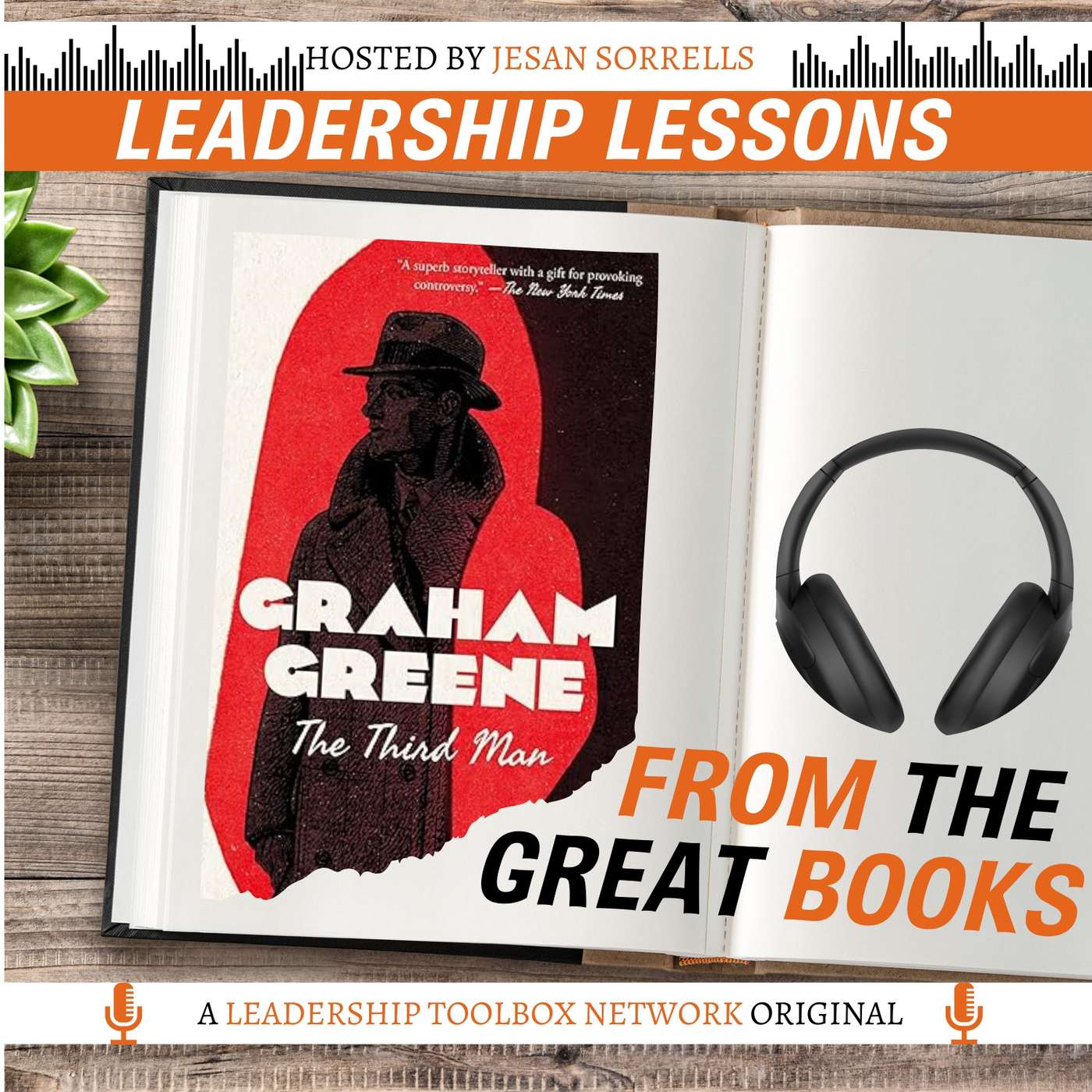
The Third Man by Graham Greene w/Jesan Sorrells & Ryan J. Stout
The Third Man by Graham Greene
---
Exploring Graham Greene’s postwar classic, The Third Man, Jesan Sorrells and Ryan J. Stout unravel the psychology of unreliable narrators, leadership in times of nihilism, and the timeless challenge of ethical decision-making amid a world of grifters and cons. They dive into Greene’s cinematic writing style, his nuanced character portrayals, and how postwar Vienna mirrors our own era of skepticism and manipulation. The conversation draws out practical leadership lessons—particularly the need for sincerity and humility—in a landscape shaped by both history and human nature.
- Book Title: The Third Man
- Author: Graham Greene
- Guests: Jesan Sorrells (host), Ryan J. Stout (guest).
---
Time-Stamped Overview
---
00:00 "The Myth of Modern Nihilism."
07:55 Graham Greene's Mastery of Characterization.
12:38 "Relatable Characters and the Appeal of Dark Humor."
20:30 "Graham Greene's Cinematic Legacy."
24:03 "Post-War Struggles and Black Markets."
31:58 Post-War Deals, Distrust, and Vienna.
34:01 "Vienna's Loss and Legacy in The Third Man."
39:21 "Friendship, Loneliness, and Keen Observation."
48:00 "Observations, Language, and Hidden Motives."
54:59 "AI Scams: Bots and Deception."
59:01 "Children, Leadership, Ethics, and Modern Challenges."
01:04:17 "Making Others Feel Heard & Valued."
01:06:28 "Critiquing the 'Citizen of the World' Ideal."
01:12:01 "Finding Meaningful and Spiritual Connections."
01:18:18 "Harry Lime’s Iconic Ferris Wheel Scene."
01:26:27 "Recognizing Transformation Through Self-Love."
01:29:33 "The Importance of Open-Minded Humility."
01:37:47 "Moral Choices, Lost Knowledge, and Invention."
01:42:29 Defending Free Speech and Objective Truth.
01:45:51 "Film Versions and Orson Welles Radio."
---
Opening theme composed by Brian Sanyshyn of Brian Sanyshyn Music.
---
- Pick up your copy of 12 Rules for Leaders: The Foundation of Intentional Leadership NOW on AMAZON!
- Check out the Leadership Lessons From the Great Books podcast reading list!
---
★ Support this podcast on Patreon ★Hello, my name is Jesan Sorrells, and this is the Leadership Lessons from the Great Books podcast, episode number 183.
From our book today, I'd like to pick up and, and maybe make a little bit of a, maybe make a little bit of a character introduction. Now, when I talk about this character, when I introduce this character, you're going to see him in your mind, hopefully, cinematically. And I quote, one never knows when the blow may fall. When I saw Rollo Martins first, I made this note on him for my security police files. Quote, "In normal circumstances, a cheerful fool drinks too much and may cause a little trouble.
Whenever a woman passes, raises his eyes and makes some comment, but I get the impression that really he'd rather not be bothered. He has never really grown up, and perhaps that accounts for the way he worshiped Lime," close quote. I wrote there that phrase, quote, "in normal circumstances," unquote, because I met him first at Harry Lime's funeral. It was February, and the gravediggers had been forced to use electric drills to open the frozen ground in Vienna's Central Cemetery. It was as if even nature were doing its best to reject Lime, but we got him in at last and laid the earth back on him like bricks.
He was vaulted in, and Rollo Martins walked quickly away as though his long gangly legs wanted to break into a run, and the tears of a boy ran down his 35-year-old face. Rollo Martins believed in friendship, and that was why what happened later was a worse shock to him than it would have been to you or me. You, because you would have put it down to an illusion, and me, because at once a rational explanation, however wrongly, would have come to my mind. If only he had come to tell me then, what a lot of trouble would have been saved.
We postmodern people, we believe that we invented everything from sexual behaviors to ironic detachment, from sincerity interpreted as cringe to anger interpreted as social reforming passion. We believe in our own time, in our own era, that we invented nihilism. We believe we invented existential dread and that we believe that we are the only folks in history or in the history of the world to notice, to recognize, right, that there are patent absurdities that exist in the realm of human experience.
The problem with such a belief system, the problem with such a worldview, the problem with our us convincing ourselves of this so deeply in our own time is not that it is so fallible and naive, but that it is so incorrect. It's partly incorrect because we are not students of history in the same way that people of the past were. We don't believe in the cyclical nature of human experience because our technologies, like the one bringing you this podcast here, and our propaganda factories from the schools to the media, act perpetually and breathlessly surprised every time some human being does something somewhere, usually in the form or usually in the context of the 24-hour news cycle.
It's also incorrect because we tend to ignore the evidence presented to our very own eyes of the cyclical nature of life, from the seasons that we live in to the ways in which the homeless man behaves like clockwork on the street corner when he's panhandling. Either way, we are constantly fooled by history, constantly mugged by reality, perplexed by change, and rendered unable to address the deception and manipulation of, like, some of the people we're going to talk about today, like a particular person we're going to talk about today, unreliable narrators, or even the behaviors of characters that may show up unreliably in unreliable narratives.
Speaking of which, today on the show we are going to cover a book whose fictional narrative links the books— links the book we covered in episode number 121, Lolita by Vladimir Nabokov, with ideas we talked about in episode 166, where we discussed the book by the British historian B.H. Liddell Hart, Why don't we learn from history? Today we are going to glean what we can and apply it to our real lived lives from a great little book, The Third Man by Graham Greene. Leaders,
the fact is that when we postmoderns don't learn from history, unreliable narrators and unreliable narratives can have their way with us in all manner of human endeavors. And back for this episode from his most recent jog with us in episode number 180, where we discuss Thomas Sowell's thesis about the tension, the Hegelian dialectic between the constrained and the unconstrained vision deeply embedded in the human heart, which, by the way, a little of that shows up here. Actually, a lot of that shows up here in The Third
Man. Is our friend Ryan J. Stout. How are you doing today, Ryan? How's it going? I'm doing well. The sun is shining and, you know, I woke up, got most of my teeth and feeling pretty good. Thank you for having me. It's a pleasure as always. Honor to be here. Absolutely. To talking about this to this book and the human condition, such as it were. Yes. So we talked a little bit about Graham Greene, and we talked about the literary life of Graham Greene. You should go check out the most recent Shorts episode that we released, Shorts number 215, on leadership in absurd times.
We talked in there about the background of Graham Greene, who he was as a writer, a journalist, and his stature or the way that he was perceived by other writers of his time, including William Golding, author of Lord of the Flies, as a Catholic writer,
right? Graham Greene in that space is going to act as a precursor to another very Catholic writer we're going to talk about,, later on this month, uh, when we cover the book The Man Who Was Thursday by G.K. Chesterton, uh, with our good friend Neil Kalachovsky, uh, former physics genius inventor and current venture capitalist and SBIR advocate. Uh, so we'll have him on the show, um, another couple of episodes. You're going to want to listen to that. But Graham Greene, And I made this point in the shorts episode, and this sort of leads into my first question to Ryan.
As an author, Graham Greene was able to observe human behavior, um, not only in the character of Rollo Martin as the mark, you know, in The Third Man, which is sort of how he's set up there by the narrator just in that first little piece that we read from the first chapter, but also the behavior of the British police officer narrator, um, a gentleman named Calloway. And even in the behavior of— and we'll talk about this guy quite a bit— the grifter, Harry Lime, the hustler, the matchstick man, such as it were.
And the way Graham Greene sort of sets up all these characters, he sets them up in
a way from that open where you get everything right away. And this was Graham Greene's mastery, right? So So we have a funeral that's happened. We know it's in Vienna. We know it's post-war. We know that Rollo's 35, so too old to be a child, but not old enough to be a font of wisdom. And we can sense from the narrator Calloway that he's a little bit of a, for lack of a better term, a stiff upper lip British police man, right, um, in, uh, in this part of, uh, in this part of Vienna. And the thing is that unlike Nabokov, who I already mentioned, or even Liddell Hart, Graham Greene was a writer and a thinker and a creator who— and I definitely got this from reading The Third Man— um, who saw through the veneer of decency that surrounds most human behavior, but he wasn't dismissive of that decency in and of itself.
He wanted people, and he pushes his character Rollo Martin to behave decently, if fallibly, but indeed decently throughout the entire narrative, right? He believed, as most of our modernist grandfathers and great-grandfathers did, that a human being could rise above banality and absurdity and even nihilism and overcome. And so that sort of opens up, I guess, our first question for Ryan, who, by the way, is a big fan of absurdity, big fan of absurdist. We've had a whole— we've had discussions about this.
We've sparred back and forth about this over the course of our friendship and our time together. I am less of a fan of the absurdist only because I think— and I made this point in the shorts episode— I think pointing out absurdity doesn't get you anywhere. I think it's a childish sort of response to absurdity. Like, give me the solution for this. And please don't tell me that the solution is just to eat, drink, and be merry, or tomorrow we may die, or just to like have fun, or even just to like smoke in a French ironic existential way.
I need something more than irony or cynical detachment. And Graham Greene, to his credit, I was not going into The Third Man looking for this. Graham Greene does give you an alternative to the, to the Camus, Sartre sort of deal with absurdity. But it's an alternative that takes a level of sincerity to pull off that I think us postmoderns don't have because we interpret sincerity as cringe these days. So I guess maybe the question to open is, Ryan, what did you think of the book? What did you think of The Third Man?
And then I'll ask maybe a couple of follow-up questions as I, as I sort of round the corner here towards a point. So what did you think of The Third Man? Let's start with that. Thank you kindly. Great intro. Um, I, I like, I like the book. I like the language. I like the details
that at
times, uh, I mean, could be seen as unnecessary because it does not necessarily add to the depth of the story. It almost seems, um, it will— it adds to the depth of the characters, and it also gives you more insight into who Calloway
is. Much like John Denver would, you know, would say, you know, when asked why he's so popular, or, you know, he said, I write about the human condition. So the human condition is, it will never be out of style. It's something relatable. At some point, I can relate to every single character in the story because there's just enough good and just
enough— what's the word I'm looking
for— just enough temptation kind of throughout where you can understand where the character is coming from, often pushing up to that line very much so with the specks of dots and down there. And so, and so where
is It's fun to entertain, and that's probably why we find things humorous that are kind of dark at times, because, you know, we get to see played out in movies and in literature what we're thinking but we would never
behave. And so I think Green does a tremendous job of doing that with all the characters. You get to see the motivation of— I mean, the Schmidt
character And even I was listening to something earlier, and this is in reference to the movie and how almost in a Fellini-esque way, I
believe the person said that in the movie that, you know, everyone is kind of grotesque looking, you know, even like the little boy. And, and, but Anna's not. And then, and then, of course, Harry Lyman. And so there's, there's these, these these figures that kind of like, uh, transcend, that add to the— this kind of like the sinister nature of, of, um, of the, like, the behavioral aspect of, you know, you could, uh, like, don't trust the book, judge a book by its cover. Yeah. Um, yeah, I just think, um, and, and the language that's used throughout I think is, is really wonderful as well.
I just like, you know, in Stephen King's On Writing. He talks about the one when he talks to other writers when they do readings and what's a question that they wish they were asked more. And, you know, so many writers say, we wish people would ask us about the language. And I just think that's an excellent use of language. There's not a wasted word. It's a really short, compact, delivers on all fronts. And I think contributing to that is, you know, we see Rolo like right out of the gate, like he's already— all we know him is in the act
of— he's already in despair and confusion out of the gate. We have no pre— there's no— there's no— he's not talking about spaghetti westerns and he's not talking about like his failed writing career or anything. You're just going right to the conflict, and so you open with that. And so, right, and even though it opens like that, Green does a fantastic idea with filling in all those gaps pretty quickly. The bar scene with Calloway, the caviar sandwiches, the expense account, you know. And so, yeah, he drinks a little too much, the blow, you know.
And yeah, his perception of of how Roland Martin perceives women. So you're talking about the underlying— so it's like, you're getting like the response of a response, right? Perception of a perception, a perception of reception. Yeah. Well, and he also, I mean, in the, in the edition that I have, there's an introduction that was written by, by Graham Greene. And he talks about how he co-wrote this, co-wrote The Third Man, um, with Carol Reed, who directed the film, the 1949 film The Third Man, which of course starred Joseph Cotten, um, as Holly Martin.
They changed the name to Holly Martin. Um, Trevor Howard was Major Calloway, and of
course the great humbug actor of the 20th century, Orson Welles, And I'm not saying that as a negative either. I think he understood something about Hollywood that, and being an actor and being a producer and being a writer and being a thespian, that a lot of actors have missed. They miss the entire joke on Orson Welles. Like, they miss the entire thing on him. But, um, but he was in, uh, he was in, obviously he was in The Third Man as, uh, as Harry Lime, right? And so in the introduction, Graham Greene talks about or writes about co-writing this with Carol Reed, talks about the writing process.
And one of the interesting things that he says is this, I'll just read directly
from my book. He says this, and I quote, on these treatments, Carol Reed and I worked closely together, covering so many feet of carpet a day, acting scenes at each other. No third ever joined our conferences. So much value lies in the clear cut and thrust of argument between two people. To the novelist, of course, his novel is the best he could do with a particular subject. He cannot help resenting many of the changes necessary for turning it into a film or a play. But The Third Man was never intended to be more than the raw material for a picture.
The reader will notice many differences between the story and the film, and he should not imagine these changes were forced on an unwilling author. As likely as not, they were suggested by the author. The film, in fact, is better than the story because it is, in this case, the finished state of the story. Close quote. So to your
point, um, in looking up The Third Man, and this is one of my knocks with like modern movies, particularly in our post-Marvel, post-CGI, post-Marvel world, Um, you know, The Third Man was an hour and 33 minutes. It was a 93-minute film. They told an entire story in an hour and a half. We can't even get out of the gate in the first act under an hour anymore in a movie. And it has nothing to do with the script because it isn't the script's fault. The script actually The writing is actually terrible.
Writing now is actually worse than it was in the 1940s, even where writing is adapted from a novel. So we just, we just talked about our previous episode, episode number 182. We talked about Oil by, um, by Upton Sinclair. The first 100 pages of that 575-page novel, which was written in the 1920s or 1930s or whatever, um, the first 100 pages of Oil were the basis for the 2007 film There Will Be Blood. The first 100 pages, that's all they could adapt. Couldn't adapt the rest. It's like a 2.5-hour-long movie or 2-hour-long movie.
It's a 2.5-hour-long
movie. And Paul Thomas Anderson just won an Oscar for Best Director for One Battle After Another, a film starring Leonardo DiCaprio that I— and I like Paul Thomas Anderson as a director, I watched one trailer for that sucker. I lasted 10 seconds in and I was out. I was done. I was like, I can't, I don't need to see this. I already know the joke. So what are you doing to me for 2 and a half hours? Graham Greene and Carol Reed knew how to structure a story. To your point, short sentences, really well-developed characters, start with the conflict, They understood something about writing that I think a lot of modern film writers— but let's put that aside for just a second.
It's not a film show, though we do talk a lot about film on this show, and we will talk about the Third Man film because we have to talk about Orson Welles. I mean, we just have to. We don't have a choice. But, um, but putting that aside for just a second, the novel is definitely written in a cinematic form. I agree with
that. So In thinking about Graham Greene as a writer, I don't know if you did, if you looked into his background or kind of dug around on him a little bit. Um, had you ever interacted with any of Graham Greene's work before this? Did you have any idea of who he was? He wrote something like 65 novels, um, during the course of the 20th century. He was shortlisted for the, uh, Pulitzer— no, not the Pulitzer, the Nobel Prize for Literature a couple of times, never won it. He was considered to be one of the most prolific writers of the 20th century actually.
Just quoting from his Wikipedia— oh, no, he didn't write 65 books, hold on a second. Through 67 years of writing, which included over 25 novels, he explored the conflicting moral and political issues of the modern world. His one novel, The Power and the Glory, won the 1941 Hawthornden Prize. And The Heart of the Matter won the 1948 James Tate Black Memorial Prize and was shortlisted for the best of the James Tate Black. Greene was awarded the 1968 Shakespeare Prize and the 1981 Jerusalem
Prize. Unfamiliar with his work. Like I said, the, the most I knew about the movie was that last scene that I saw 20-some years ago sitting in my grandmother's living room. And I just happened upon it, WHYY Channel 13. And I just remember Anna Schmidt walking and then Holly leaning on the car and then just
that, and that row of trees on both sides, and how there was like an R-esque feel to it. And picking up a TV
Guide and going, what day is this? What date? And they're going, oh wow, The Third Man. Well, I
never, uh, I, this looks like an incredible movie. And I like, that was kind of the extent of my, uh, my Graham Greene knowledge. Yeah. And I have the, uh, so this is The Third Man and the Fallen Idol. And so Uh, I went through the book twice, um, and I'll probably, you know, just pick up and, and read The Fallen Idol as well. Yeah, I believe that was turned into a film as well, if I remember correctly, um, in 1948, um, also directed, I believe, by Carol Reed. So, um, okay, so Graham Greene. So you're, you're, you've got a little bit of a window into him.
You're a writer, you're a poet. Um, you talked about his writing style, his language. What were you able to glean maybe about his psychology a little bit as a writer, just from, just from the little glimpse you've had with the third man? I would
say, um, the importance of— well, You could say the importance of
research. Okay. Um, because right out of the gate, so you have a war-torn, post-war-torn, you know, the four quadrants being occupied— what, Russia, Great Britain, uh, Vienna, or it's post-war of Vienna. Um, yeah, so the insight that goes in to kind of like grasping the psyche of who would be living and what their, uh, what their sort of attitudes would be. And it goes into the racketeering, and everyone was into racketeering. So clearly it was not a wonderful place to live. Uh, it was not economically this booming thing.
There was a lot of people doing a lot of kind of like black market activities in order to survive. So it wasn't behaving in a sinister way for evil's sake, if I could say that, which makes the lime thing
even more sinister. Because at one point, I believe he's asking the neighbor, or if it's the doctor, and he said, well, everyone was into trading cigarettes for buffs. And or I'm trying to think of what other kind of nefarious activity, but it would be the equivalent of, I don't know, like I used to sell chai, like black market chai, you know what I mean? Or I roast my own coffee and I'm selling coffee out of my house rather than selling it to the store. And then so whereas it was stamps, you know, I think they mentioned stamps.
And so whereas it may not be like legal, those behaviors, but it just seemed like a fairly destitute economy and a destitute society where they were able to live and function because it was governed under these, these four powers. Um, but also that the Governing Bodies understood kind of the, the plight of the area and understood that everyone was kind of into these things. It reminds me of, in a modern, postmodern context, that show from the early 2000s on HBO, The Wire, where, you know, yeah, it's, it's drugged out Baltimore, right?
It's, it's, it's, you know, drug violence, all that. But The Wire never dealt with the situation that the drug dealers and the kids and the, and the, and the mothers and the fathers and the cops and the command structure, and the command structure of the drug user— the drug users, yes, but also the command structure of the drug runners. They never dealt with David Simon on that show never— and by the way, he was a journalist. Graham Greene also came from a background in journalism, so there's a comparison there.
And David Simon never— was he a former officer also? Yep, he was a former police officer too. Yep. So Simon never dealt with the characters in The Wire as caricatures, right? He didn't draw them as caricatures. He drew them as real people. You see the same thing, I think, from Graham Greene in terms of the racketeering, the scammers, the hustlers, because everybody in The Third Man, everybody in this book is on the con. Everybody, everybody's on the con, from the, from the, the woman who allegedly was Harry Lime's love lover, all the way to even, even the mark Who is Rollo Martin?
Rollo's the mark throughout the entire book. He's the mark, but even he's on the make. He's trying to hustle something. He's trying to scam something. So Graham Greene, just like David Simon, and I think it's that journalistic eye that you're talking about, gets to something about human nature that I think a pure novelist might miss. Like, Like, you, you maybe get, maybe you get close with like someone like David Copperfield, or not David Copperfield, I'm sorry, Charles Dickens, um, who wrote David Copperfield.
By the way, there's a great episode of, um, of, uh, The Wire. I think it's in the third season, the Dickensian aspect. Yeah, yeah. And sort of that deep double inside joke that you're only gonna get if you're a literate person. Um, but the Dickensian aspect of Vienna is writ large in this, um, in this book. And I don't think we have as moderns, particularly not in America. I mean, we didn't experience any, any structural damage from World War II. I would argue that we, we experienced a lot of psychological and emotional and, and spiritual damage from World War II.
We sure as hell did that. But the physical damage, the actual burned out buildings, the actual husks of whatever, people walking around, ex-soldiers with nothing to do, we didn't experience any of that. Um, one of the miracles that never gets commented on, or one of the, one of the things of a post-World War America that never, America never gets any credit for this, but, um, the American military command structure was really worried that they were going to bring back 16 million men that had served.
And that these men just weren't going to disband. They just weren't going to disband. They're going to take over the government because that's just what they had seen in Europe and in, and in Asia, in Japan. They were going to take over and they were just going to come back and they were going to run the government. And they were really, Ike was worried about that. Eisenhower was worried about that. The entire command structure, um, that ran the war was worried about that. And it didn't happen. Everybody, all of those guys got off the boat and all they wanted to do was go back home and get jobs.
And that is, that is so uncommented on that it's unbelievable. And to me, that's an aspect of leadership. But anyway, um, I mean, that also, I think, goes to
show, um, the psyche of and the paranoia of power that is associated with power. Sure. Because, and there's, there's, I mean, to bring the psychological term narcissism in, to think that 16 million people are going to think like the people who were pulling the strings of the American government is, I think, a bit of a reflection or a bit of a, some insight onto what these people really thought or how powerful You know, people think they, uh, well, and you could— I, I sort of give them a little bit of grace because again, they had just seen that with— I mean, Nuremberg, the Nuremberg Trials had just wrapped up by the time they shipped over every, every guy who was serving.
Um, they still had— the United States still had forces in, to your point, Vienna. They also had forces— I mean, this is 1949, the Iron Curtain was down across Europe, so we were already We'd already divided up Berlin. Berlin was already being contested between us and the Russians. Stalin was— Stalin was still alive, you know, still yelling and screaming, you know, still locking up people in gulags and sending them off to concentration camps like it was a bodily function. So all of these things were still happening.
And by the way, Stalin hadn't yet tested the bomb. I think that happened in 1950, if I remember correctly. And so The Americans, because, you know, what we did was we got all the Nazi scientists, and then, you know, the Russians, well, they got all of Eastern Europe. I mean, that was the, that was the trade, such as it were. Maybe not, maybe not an on-purpose trade after the Potsdam Conference, but it was the trade. Um, and so, um, and, and thus we got to, you know, do the space stuff and do the nuclear stuff, and the Russians got the
land. Um, my point is that in that sort of post-war environment, the level of distrust— and I think Vienna stands in for Germany, it stands in for Berlin, I think, because Graham Greene couldn't write that book. It would have been too hot. That had been too close to the bone for his audience because they had historical memory of this, right? But Vienna Vienna was the pre-World War II Vienna in that weird post-World War I, you know, pre-World War II time period. Vienna, obviously part of Austria.
Vienna was the height of like classical culture in Europe. It was the place where the arts were, were huge. Germany, um, was, uh, was trying to envelop Austria into its, um, into its security umbrella., or, or was trying to maintain that in a post-World War I world. Uh, Hitler loved the Austrians, loved Vienna. Um, most of the physicists that helped the Americans build the bomb were educated in mathematics and physics out of the University of Vienna. Like, there was— it was a group of— that was a place where highly educated, urbane artistic, culturally sophisticated people lived.
I feel like Nietzsche and, and even Einstein, right? There's— yeah, yeah, it was kind of like the— and they had a long history of, of intellectual, you know, and then, you know, you bomb the hell out of it and that's the end of that and everybody leaves. That's what you find a point on it. But I mean, like, that's, that's what happened. And so the Vienna that we get to see in The
Third Man would have been a Vienna that it would have been psychically traumatic to be in that Vienna because the people who were of like Rollo Martin's 35, that's old enough to have heard rumors, not even rumors, but to have been like, not only heard rumors, but to have been educated by people who came over to America or came over to Britain from Vienna and told stories about how much of a jewel
Vienna was. And then what do you do with that? And I think Graham Greene ties into that the same way that David Simon— just to sort of close this loop— the way David Simon does in The Wire when he talks about, particularly in season 2, talks about what Baltimore used to be. And David Simon's always said that The Wire was a love letter to Baltimore. I think of The Third Man as a love letter to Vienna from Graham Greene. Is— I really have to use the restroom. We'll pause. Let's pause. I'll be
back momentarily. All right, we're back. You good now? You good? Great. Never better. No, never, never better. All right, good. Um, so let me take a little bit of a— let me take a little bit of a turn here. So we've been talking a lot about postwar Vienna and how Graham Greene sort of, you know, looked at, um, looked at the environment he was in. And he did do a lot of travel, by the way. That's another thing that you get from his, uh, his profile that I was able to find. Um, he did go around to various places around the world.
Matter of fact, he, he globetrotted so much that there is a belief that Graham Greene, um, worked for an— worked for intelligence agencies. Um, uh, MI6. Like, one of his best friends Actually, he did work for MI6, if I remember correctly. And so one of his best friends who was his commanding officer in MI6 actually later on was discovered to be, or to have gathered intelligence for the Russians through the British intelligence service and sent it back to the Russians. So Graham Greene was involved in intelligence.
He was a globetrotter. He saw a lot of places. And every single one of those places influenced how he wrote and what he
wrote about. I want to talk about Rollo Martin a little bit because he's the mark, you know, want to talk a little bit
about him. Rollo takes the position in The
Third Man, you know, against
Calloway. That, um, that he is going to find out
things that, um, that Calloway can't. Let's— let me frame it that way. He's going to go places that
Calloway can't, um, and because he received— as a British subject, he received money that he basically couldn't spend in Vienna, in post-war Vienna. That's the other thing that would be weird to people, the idea that you couldn't spend money in certain countries because of currency exchanges or to Ryan's point, instability in government. That was the other reason why there was so much racketeering because if you're a French citizen living in the French zone, You can't spend French francs, right, to get anything that you need.
So you got to figure out how to get what you need. And I'm not talking about like luxury items. I'm talking about things like bread and milk and gas. You know, you have to figure it out. You got to be hustling. And so Martin's is set up as a, as an author of spaghetti westerns. He's also set up as a person who has his own sort of
belief that, well, as I already said, that he's going to figure out what the cops can't. He sort of has this arrogance, a sort of chip on his shoulder, right? The thing about amateur detectives is you don't have to work 9 to 5. That's right. Something along those lines, you know. That's right. Yes. And you don't have to have— I think about every procedural cop show I've ever seen in my life You know, if you're an amateur detective, you don't have to follow rules of evidence. You can do whatever the heck you want to do that was on Law Order, whatever the, the latest spinoff of Law Order is that you saw like 10 minutes ago.
Like you can do all of that, right? Um, what did you think of Rolo Martin's like, and, and I sort of put myself in this kind of situation. Like if I had been dropped in a situation like that, how would I have responded or how would I have reacted? And I can't say that I would've reacted any
differently than Rolo did. The friendship— I understand the friendship aspect and holding people who've influenced you in
to such high
regard, but there's also,
uh, there's a desperation And you could— it just seems that even as he's talking about Lyme and then Calloway is talking about Lyme, that, uh, like, the insight I get into Rolo is that he,
he doesn't have much going on in ways of things to look forward to, or people, or lots of loved ones in his life, say family, uh, friends. I mean, if his best friend is in Vienna and he
came from the States and, and he's 35, and when's the last time he saw him? And so there's a
lot
of vagueness Um, whereas there's this dichotomy between the— I love when Green talks about— these are, these are the little details that I really, I really enjoy. So he talks about the toupee, and yes, he adjusted toupee with one hand and with the other hand seemed to wipe the smile off his face as if it didn't exist. Yes, and then he talks about the horn-rimmed glasses that are too thicker than he'd ever seen. So little details like that. So you get into Calloway that Calloway must be a good detective because look at all these small details that he's adding to the situation.
So he has a keen eye for the, the nuance,
whereas Rollo is, is swayed by the romanticization of, say, uh, the lifestyle of a writer, uh, falling in love with the woman immediately. She's an actress or an aspiring actress, so he doesn't know her. She could be acting, so everyone is acting, right? He's like falling for every single infomercial, right? And with the dichotomy that I mentioned a few moments ago, it was like the maître d' or the person— maybe it was Cribbins, I'm not sure— at the hotel. Oh, yeah. Says he's one of your— my favorite novelist, right?
Yes. Cribbins. Cribbins. Yes. Cribbins. And so Cribbins says, you're one of my favorite novelists. And then And then he says something about cheap westerns, and he's like, well, I write cheap westerns. And then he's also— Lime set him up to speak at an engagement. Yep. As an author. And I would think as an author, I would be over the moon. Oh yeah. And he has no time for it. And he says, Well, he'll do anything for a drink, and it's just an
opportunity to really— to, to, to, to, uh, to get as much dopamine as possible with minimal effort. It's kind of like, you know, um, it's kind of the feeling I got,
you know, just it's He's— it's like Charles
Bukowski without the talent, you know. I'm in it for, for this. I'm in it. It's like the, the path of least resistance to get what he wants, which is really just, you know, uh, like I said, hunting dopamine. Hunting dopamine. Well, and, and this is Green's— this is Green's brilliance, because you get the sense that like like there's some authors like Charles Portis. So we read True Grit, right? We covered True Grit. Can't remember what episode it was, but we've covered True Grit, Charles Portis, right?
We also covered— I already mentioned Nabokov, right? We covered Lolita. We're about to cover later on this season, we're going to cover Invitation to a Beheading. We're gonna go back into Nabokov yet again, and see one more shot at one more crack at that. Milan Kundera, Unbearable Lightness of Being. Greene,
Kundera, Nabokov,
these European authors, right? They seem to understand something about human nature. And they put it in their characters that I think American authors— I already mentioned Dickens— I think American authors miss, right?
They have a certain And this is also why I liked Green. So they have a certain cynicism to them, obviously, about human nature. Where Green separates from Kundera and Nabokov and those kinds of guys is he doesn't allow that cynicism to be the primary driver of— again, we're going to talk about Harry Lyman in a minute. But Harry Lime's comeuppance. He doesn't allow that to be, because he allows Rolo to actually, in his character arc, get a— not get redemption for himself, but to be the vehicle that redeems Harry Lime, the only way Harry Lime could be redeemed.
And that's unique to Greene. Nabokov doesn't do that in Lolita. There is no redemption for Humberg, like there's no redemption for that guy. There's no redemption in that arc. There's just punishment and then an unreliable narrator. In The Unbearable Lightness of Being, please. I like Milan Kundera, but he didn't believe there was redemption. That's why he sold out all of his friends to communists, to the communists, and then ran to France for the remainder of his career. And wrote from there. Um, so, but Greene, Greene took that cynicism that you see in characters like Rollo Martin, or let's talk about Anna Schmidt for a minute.
He, I think, and I think this comes from his Catholicism, which I brought up earlier. I think Christian, his, his Catholicism, his belief in a God. Well, he called himself an agnostic Catholic at the end of his life, but I can tell you as a— and I always say this this way, you'll appreciate this as someone who has the background that you have— I am a recovering Catholic. You're always recovering. You're never, you're never fully
recovered. You're always recovering. Um, I can tell you that once you get the Catholic on you, you, you never, you never get it off. And Green tried to get it off, like he did. He tried during his career, he tried in his writing, but it's always there, sort of like Peter Pan's shadow, you know? Like, oh, I'm gonna take my shadow and I'm gonna nail it to the floor and it'll never go anywhere. No, you're gonna take that shadow, it's gonna nail to you, it's gonna follow you around. And that's the thing I think that you see in characters like Rollo Martin, um, Anna Schmidt.
I want to talk about her. I mean, she was in love with Harry Lyne. And she's the only female character that really
shows
up in here. Yeah, and, and, uh, I mean, and, and to backtrack just for a second, and she changes her name. Yes, yes, she does. Right, so that just adds to the facade of, of the, you know, persona needs mask. So just the personas of these characters. Yep. I mean, even, uh, Rolo has a Dexter. This is his pet. So no one is who they say
they are. They are. Um, and even when you go to the doctor's office, and this, like, back to the sort of the language— I know I'm kind of like jumping around a little bit, but when he says, uh, cleaner than any doctor he's ever met, and he talks about his shirt almost crinkling as if it were made of celluloid. Yes, it's just like these little details that are kind of like thrown in, and the use of language. And so you
get a sense that, um, that Calloway is observing all these things, and he's observing Rollo fall for all of
these things as well. Um, but there is no— there, there is, you know, to your point, like, there's no— there's no resolution or solution. And interestingly enough, like, if Rolo Martin's is the mark What is being extracted from him? Is he there to, to, to, to be the, to be the solidifier of the murder? Is— I think that's an excellent question. So, because that's a long game. That is a long game. Well, well,
well, this is why So here's everything I know about cons from my book reading and from my movie watching and from, um, and from, um, well, just from everything I've been able to observe from people running cons in my own life. Um, so I put those things in that order because that's, that's the layer cake right there. Um, So there's a, there's a short con, right? Short-term cons are always immediacy. They're always about immediacy. They're all about, talk about the dopamine hit, right? They're always about the dopamine hit.
Three-card monty. Three-card monty. Or, um, I don't know, get your red tops, get your red tops, red tops right here. Short con, right? I'll give you something for nothing inside of 3 seconds. It'll cost you nothing, but then I got you hooked, right? Okay. Medium-range cons are basically what all marketing is. All marketing is a medium-range con. All of it. All of it. From Facebook ads all the way to the billboard that you see on the street. By the way, medium-range has nothing to do with time. It has to do with the impact of the con, right?
So there's a great marketing story. I don't know that I've ever told you this. I mentioned it on the podcast before with another guest, but I'll tell you this story. Um, there's a great story of a luxury car company executive. I think it was Mercedes or might have been BMW. I think it was BMW. And he was interviewed at a conference years ago and somebody asked him, some naive person asked him, why do you spend at that time, $30,000 a month on billboards in Times Square? And why do you do that continuously?
And he looks at the person who asks him this question as if they are stupid. And he says, because the reason I spend $30,000 a month on Mercedes is because I have to convince a person when they're 3 years old that by the time they're 35, they want a Mercedes. It's worth it to me.
That's a medium-range con. And you're laughing because you know exactly what that means. You know exactly the psychology of what is that. So the money is irrelevant. And people who don't pull cons think the money is the thing that's relevant. Money's— and you, I'm getting to, to answer your question about what he's extracting, right? And then to your point, then
there's the long con. The long con always extracts from the mark everything. Everything. It extracts their belief. It extracts their psychic energy. It extracts their emotional energy. It's about manipulation. It's about deceit. It's about the amusement of the grifter or the hustler or the scammer doing the thing. So it's for their entertainment because they're, they're deeply— talk about narcissistic. Not only narcissistic, in many cases, they're sociopathic. Sociopathic. Yeah. Yeah. And so they're getting actual pleasure from watching the mark squirm, um, because they lack empathy, right?
It's about extracting the material good from the mark repeatedly over and over again until the mark is dried up. And then it's about depersonalizing or taking away the humanity in a long con from the mark. In my experience with cons, and again, those of you who are going to be listening, you will have— your mileage will vary, as someone once said to me a long time ago. You will have different thoughts on this, and that's fine. But in my opinion, the long con is— the point of the con is to extract everything.
And that's what Harry Lime is seeking to get from, uh, from Rollo Martin's. And this is why, by the way, he doesn't show up until the beginning of the third— oh, the middle of the third act. Like, that's— and that's a huge play because, like, you've built him up, you built him up, you built him up, you built him up, you built him up, and he better pay off. And he does. And to, to show and prove to him that he is no different than one of the specs, right, on
the ground, right? Yeah. Um, I think the challenge of our time as individuals— we haven't talked about leadership yet. We've sort of done a book report on the book so far. We've admired the book. We've loved the book. The book is great, by the way, folks. Go and get it. If you're a leader, I absolutely think you need to read this book. I think you need to put it on your shelf next to Lolita, next to Unbearable Lightness of Being. I think it stands alongside those works as well for leaders because it does reveal something about human nature.
Um, and I think it reveals something that we've forgotten in a world that's been flattened by the internet and by social media, right? Where cons and scams are still being run on us. Um, grifters and hustlers still want to take our money. Marketers still try to separate us from our hard-earned dollars. Propagandists and conspiracy theorists on either end of the spectrum still are trying to convince us to believe things that may not necessarily be reliable. We live in a world where the number of scammers and hustlers and grifters and con men has exploded exponentially.
And some of them are bots out of foreign countries. Matter of fact, most of them are bots out of foreign countries, and they're designed to take advantage of the stupid Americans. And I think real leadership these days is teaching the people who we are leading particularly if we're in a family, the people that we love, how to not get fooled by the people or by the bots online. And this becomes a real challenge with the rise of AI, being able to make images that aren't a thing. I mean, I'm now starting to see ads in my Facebook Reels feed of AI girlfriends.
I don't know if you've seen those in your Reels feed, but you will see it. It's coming to a Reels feed near you. Click on the link here, I can be your AI
girlfriend. And I'm like, who's clicking on this? Oh, well, well, the same people that thought a Nigerian prince was going to give them a letter from some bank with a billion dollars. Happy. It's tapping into the depravity
in a way that's exploiting the heck out of people's loneliness as we grow more and more disconnected from interpersonal connectivity
and having tangible experiences. Um, you know, it— I see those ads and I, I still think like, like, God, it looks like it's such a hassle. Like, that's still too much. It's— you want too much. You still want too much. Remember, remember the line that, that, um, oh, Lebowski gave to Jackie Treehorn when Jackie Treehorn was talking about how everything was going to be digital in the future? He's like, yeah, I
still do it manually. Yeah, that's what I always think of every time I see one of those ads and I crack up. I do, I crack up. But this is
the thing that's coming. Careful there. Hey, son, to, uh, to, uh, to a household near you, to a room near you. And we worry a lot about like kids being online and we absolutely should be worried about kids online. And, you know, I just had a practical level. Um, we have a rule in our house where my children don't get a cell phone until they're 17, 18 years old. And if that sounds like restricting and whatever, well, we're parents. That's what we signed up for. We signed up for our lives to be restricted and be like managed and like, I don't know, we have to lead people.
So I don't know, maybe, maybe not having your kid do every after-school activity is an okay thing. I don't know, maybe, maybe not having your kid not get picked up, maybe actually, maybe actually negotiating with your boss in a way or negotiating with your wife in a way or your husband in a way where somebody picks up the kid is actually a better negotiation than having them the dopamine, handing them the dopamine-filled machine with the scammers inside of it. Maybe, maybe, but that's just me. That's just me.
Again, your mileage may vary.
With that being said, you talk about interpersonal relationships. This is an ethics question. So I'm going to ask you the ethics question. How can leaders bring their followers to ethics? In the light of the collapse of ethics that we have had in American culture? Because I think, I think Greene was on to something. I think the collapse started in his time. I think he would be shocked beyond belief. I think all the guys that I've mentioned, all the authors that I've mentioned who wrote about the collapse of narrative in the 20th century, would be surprised at how far it went.
How do we retain ethics in a place where particularly online, or just even in our own families when we're trying to deal with people. Like, I know you don't have kids, but you deal with people who do have children. You've been a child. This is why, like, I don't know, the people who don't have children, you do have something to say because you've been a child. It's not like it's an unfamiliar, like, you know, kind of thing to you that there might be, you know, these small people in the world that might want to do things, right?
So, and they might be the future because they're going to grow up to be adults that will work in your future coffee shop., right? So how do we as leaders bring our followers to ethics if what they see as examples everywhere around them is just pache totalitarianism, but are many hairy limes everywhere? Not many Eichmanns, we have those too, but many, many,
many hairy limes just everywhere. Right. And everywhere is Vienna. Everywhere is post-war Vienna now, just in an online space. Yeah. I think the
great scam of technology is— this is gonna sound— this may not make sense, but I will make it
make sense. Okay. Is technology think leans toward convincing the consumer
that only everyone is watching. Say it again. Only everyone is watching. So I was working in a restaurant one time, and, well, many times, but And this guy Steve I worked with, he was incredibly loud, tall, uh, really well-built,
lifted weights,
blowhard, loud. And the restaurant during high volume is sounds like a cocktail party of geese at the reservoir. It's loud,
there's things going on. And, uh, the din, as they would say in the '50s and '40s. And so how to disappear in the din is to raise your
volume as well. And so Steve and I would have conversations that would last 10, 15 minutes long. We're yelling throughout the restaurant. He's waiting tables, I'm behind the bar. There's 100 people, 120 people in this building. We are quite literally yelling the conversation through the restaurant, talking to each other, and not once did anyone
say anything about the volume. Hmm. We disappeared by matching
what the environment was. Okay. Hmm. And so if only everyone is always watching then in
a way no one's watching. If that's the case, then your behaviors can
get— and I think that's, that's, that's why I think music and, uh, I mean, music has always been sexualized. However, yeah. There, there's gradients and stepping stones. And I mean, we're, you know, we're 6 months away from watching live sex at the Super Bowl halftime show. Yeah.
Or 12 months away. Not— and I think that's also why, uh, so although I'm not a parent, I, you know, as you said a moment ago, you know, How many people I've met, and people even that I've spent a lot of time with, who have been raised by the television or the computer. And so in this
way, people have
become depersonalized. And so If that's the case and only everyone is watching, then no one is watching, then you, you become not— I would say not even a cog. You're less than a cog. You're, you're like a, like a miasmic vapor that's just kind of like floating
through the air. And so It has to happen, at least in my experience, on a very— and this is like being in customer service
for such a long time and having people come back to me and even reading
reviews online of people saying They're like, the reason they are over the moon about the experience is because I treated this person who came to get something. I made them feel special and like a human being. They were valued. They were like, like they felt listened to. They
felt acknowledged and their existence was somehow validated. Whereas
in all the noise and how time, popularity, exposure has become a currency, it devalues and depersonalizes. And so it becomes about, you know, a like or a hit or, you know, chasing the dopamine. And when you're engaged in conversation with someone in a way that they feel heard, valued, validated as a,
a, a, a human being,
then I think only then can those things move past that, because otherwise everything is just more propaganda. Although we are not— often we are not aware that we're floating in a sea of grifters. And so, you know, I, I, you know, the— what's it say— the, the global and local Mm-hmm. Yeah, yeah, yeah, yeah. The, uh, think global, act local, right? Yeah. So how are you going to— you said it doesn't exist. Well, I, I question in practice how do you do that, because there is no citizen of the world, right?
Like, I've never met one. I, I see a lot of people who talk about being citizens of the world. I see a lot of protesting, very idealistic, 18 to like 34-year-old. Yeah, 34 is right these days. 18 to 34-year-old young people who are, who are going to buy fair trade coffee and then go put on a kaifa and scream about Queers for Palestine, or go and post something on some Substack somewhere about how the Israelis are really running all of our foreign policy. And, you know, um, the Holocaust didn't happen, right?
Or I'm going to see— who, by the way, then are going to go out and, you know, go look smacks, whatever the hell that means, that people are doing now, and weightlifting. I don't know what the kids are doing, but they're doing things, right? All these very idealistic kids
are doing these things, and There's no meaning to any of it. It's just a thing we're doing, to your point, to get the likes or to get the attention. But we're not doing it to engage in stickiness. Like, like this show, this show is designed for people. And I've had a couple people, you know, ask me about this show recently, um, who, who wanted to, uh, who wanted to subscribe to the show, right? And I love having subscribers. I love all my new subscribers. Please hit the subscribe button. Subscribe to the show, YouTube, Spotify, Apple.
I don't care how you do it. Just subscribe to the show. Tell all your friends. But this show is not for people who are looking for quick dopamine hits. It isn't for that. I have a relationship with all my guests. I have a relationship with Ryan. I have a relationship with other guests that I have on. I value their opinions. I want to hear what it is they have to say. We're talking about these books. I believe that the value of what they're bringing, like the value of that insight about being over the din, that's worth its weight in gold when you think about the ethical implications of how we live in this world.
But this thing is not designed to— to your point, this thing is not designed to echo over the din. This thing is designed to
kind of be like the kind of be like the quiet conversation happening while you and while you're yelling at the waiter, you know, from the, you know, we're having a quiet conversation in the corner. And if the people around us want to participate in the quiet conversation, great. If they don't, well, that's great too. And it's not a chip on the shoulder kind of thing. It's an actual making a decision to go against the den kind of thing, which I think is, I think in an attention-driven, dopamine-driven economy, I think that the best way a leader can lead, one of the better ways that a leader can lead or one of the other options that a leader has if they don't want to shout over the den, which I think is a great option, shout over the den, but just realize you're making certain decisions with that, like certain consequences that come along with that.
You could lose your voice. The, the volume of the room could go up to match you, or, um, the, the party could move to a total another restaurant down the block, which it does all the time online. And then you're left just shouting to people shouting inside of a
room where no one's there. Um, I like what you said about the quiet conversation because how many times have people
been in those
situations where, uh, you know, this is— it's funny, this is, uh, D— I was gonna say this is a Jimmy Eat World song called In the Middle. Yes. And the video— so the video is these kids are going to a party. They're probably 18, 19 years old, probably college kids. To go to this house party and everyone is taking their clothes off. And so it's just because everyone's taking their clothes off, everyone's taking their clothes off. And there's this one boy and this one girl who are looking around, they're like, I don't want to, like, yeah.
And so like, they're like, we don't want— this is making— this makes me wildly uncomfortable. I'm not going to do it. So they're walking around kind of like making the decision whether to stay or to leave. And everywhere they look, everyone is getting down to the underwear or taking all their clothes off. And a guy and a girl, their eyes meet and they're both fully clothed and they like get out of there. It's for the— it's, it's to— it's to have the moment of like, oh, well, there's someone who— there's a— not all hope is lost.
There is there's promise of relatability. There's promise of something outside of what
is happening in the macro. There's— there, there, there— we just have to look a lot harder these days. Whereas I used to have— in my drinking and partying days, I used to I mean, that's probably why I went out, was to have to run into that one person who I could have a conversation with. Yeah. And, um, as things have become more disjointed, louder, uh, and,
and more specifically, uh, attention-driven than capturing someone's ear or eye in a room full of facsimile of a facsimile of facsimile, it becomes increasingly more difficult. And so when you have the moment or the opportunity to see someone who's kind of like— and I don't even know I'm sure there's a, there's a Japanese word that means it, but it's like, you know, when you see someone and like your eyes meet and it's kind of like, oh, this kind of like this kismet, this like kindred spirit. Yeah.
And so there becomes this sort of relatability, and whether you're— it's for an
afternoon, 2 weeks, a season, uh or a lifetime, those
individuals do exist. And so, um, and it's another way of capturing attention, but I think in a very different way, in a, in a, in a more meaningful way. And dare I say, always come back to kind of like some spiritual
connectivity. Yep. Where there is You know, and I, I, I like the— I like the— I don't know who said this, but, you know, we are spiritual beings having a physical existence, or physical— yeah, we're spiritual beings having a physical, physical existence. Yeah, physical, uh, experience. Yep. And so more along those lines where, you
know, it has to be, uh— I mean, music does a great— I mean, Nick Drake, I say, would be, would be a musical artist who embodied that really well, where, uh, or Edgar Allan Poe died completely broke, uh, and it wasn't until many years after he died that people, oh wow, this guy actually had something to say, this is brilliant writing, you know. And, and there's lots of music, there's lots of literature. I might be one of those people one day, you know. That was kind of always the goal, to be honest with you, just because that always seem to be the meatier, uh, uh, uh, uh, more in tuned with how I want to experience.
And, and, and, and, you know, and right now, I mean, we're, we're talking about the similarities of, of the podcast. Yeah, this isn't for— this isn't for you know, the, you know, the, the Metallica ticket buyer who— so at the Sphere in Las Vegas where they're selling Metallica tickets for like 10 grand apiece. Yeah. And you're like, wait, what has happened here? What's happening here? And so, and so I, I think just on a very, you know, because you never know who's going to affect your life and in what ways.
And so I and how the ethics
of it, it's, you know, you have no idea how, who you're going to affect or how you're going to be affected by any subtlety in verbal exchange or behavioral observation. And so I'm not saying you always have to be on, Yeah, but you know, a lot of this has to do with taking the high road and, and kind of being as, you know. So do you know the show One Piece? No, I don't know. It's a manga, right? There's over a thousand, there's over a thousand episodes. And okay, I've been seeing someone and they're huge, they're, they're a cosplayer.
This And so anyway, the live action, they're like, do you have any interest in watching this live action of One Piece? And it's like, live action of anything is usually like so bad. Yeah, usually it's not good. And she's like, no, no, no, no, Oda. So it's, uh, Oda is the, the last name of the creator of this. It's like, no, he's had his hand in every thing. Like, it's, it's— and so we're watching it and I'm going, what is the— who is supporting the budget for this? This is crazy. It's— they're doing things in the live action that you can't do in cartoon, where it's usually the other way around, right?
Yeah, yeah, yeah, yeah. Unbelievable. Yeah. Um, and, uh, and I, I mean, I don't know why I brought
up One Piece, but But, well, I think it ties into this idea of, to your point about having those quiet moments around something that matters to a very small number of people, which on the positive end is what the internet has done for us. It's this idea of the long tail, right? We can all connect quietly in a room together around something that may not be popular or rise above the din of the masses. Right now.
The challenge is, of course, scammers are like termites, right? Like they're always looking for wood to eat and they'll eat the wood of a tree. But if a house is there, they'll move right on to that house. They don't care. They'll move right along to a shack. They don't care. And that, of course, brings us around. This is my transition. This brings us around to finally talking about— well, finally talking about the gentleman that Orson Welles made such a famous character, Harry Lime. Harry Lime doesn't show up in The Third Man until chapter 14, okay, which is in the back end of the book.
And he shows up because Martin basically goes to Kurtz, the the doctor's house, or not the doctor's house, but the gentleman with the toupee's house, and basically says, hey, you know what, make sure Harry meets me in a popular spot in Vienna. And, and at the time, the popular spot at Vienna was a, well, it was a, a Well, there was a canal and then went to a— oh, was it a great— the Great Wheel, which was a— what do you call it— a Ferris wheel. That's the term I'm looking for, a great Ferris wheel, right?
And even in the movie, this film is— the scene is filmed in a Ferris wheel. And it says here, for an hour, he, meaning Rollo, waited, walking up and down to keep warm inside the enclosure of the Great Wheel. The smashed freighter with its bones sticking crudely through the snow was nearly empty. One stall sold thin flat cakes like cartwheels, and the children queued up with their coupons. A few courting couples would be packed together in a single car of the wheel and revolve slowly above the city, surrounded by empty cars.
As the car reached the highest point of the wheel, the revolutions would stop for a couple of minutes, and far overhead, the tiny faces would press against the glass. Martins wondered who would come for him. Was there enough friendship left in Harry for him to come alone, or would a squad of police arrive? And then he starts, of course, asking him questions. And then, of course, Harry walks up behind him and he says this: Don't picture Harry Lime as a smooth scoundrel. He wasn't that. The picture I have of him on my files— this is Calloway writing— is an excellent one.
He is caught by a street photographer with his stocky legs apart, his big shoulders a little hunched, a belly that has known too much good food for too long on his face, a look of cheerful rascality, a geniality, a recognition that his happiness will make the world's day. Now, he didn't make the mistake of putting out a hand that might have been rejected, but instead just patted Martins on the elbow and said, "How are things?" They get the Ferris wheel, they go to the top of the Ferris wheel, they have a conversation.
And Graham Greene writes about this part of the book as it translates over to the Third Man film. He says this in the introduction. Another minor point. In deference to American opinion, a Romanian was substituted for Kuler. Since Mr. Orson Welles's engagement had already supplied us with one American villain. Incidentally, the popular line of dialogue concerning Swiss cuckoo clocks was written into the
script by Mr. Welles himself. By the way, Mr. Welles was notorious for adding things when he thought— adding a little English, as I've been telling my child who I've been teaching to drive, my 15-year-old daughter, put a little English on it. Orson Welles was notorious for doing that. And by the way, the cuckoo clock line is the famous line in The Third Man. Which usually comes along with whistling a tune and a gunshot that comes along behind it. If you've ever heard the show, the radio show The Adventures of Harry Lime, of which I'm a big fan of, it's an old show from 1951 to 1952 that was released after the movie The Third Man, which of course opens up with zither music and, and and a
great voiceover by Orson Welles, which then of course sets up the line from the third man that he says to Holly Martins in the movie, Rolo Martin in the book. And of course, this line is not in the book, but it is in the movie. I love this quote. He says, and I quote, don't be so gloomy. After all, it's not that awful. Like the fella says, In Italy for 30 years under the Borgias, they had warfare, terror, murder, and bloodshed, but they produced Michelangelo, Leonardo da Vinci, and the Renaissance.
In Switzerland, they had brotherly love. They had 500 years of democracy and peace, and what did they produce?
The cuckoo clock. So long. Presenting Orson
Welles as The Third Man. The Lives of Harry Lyon, the fabulous stories of the immortal character originally created in the motion picture The Third Man, with
zither music by Anton Karas. That was the shot that killed Harry Lime. He died in a sewer beneath Vienna, as those of you know who saw the movie The Third Man. Yes, that was the end of Harry Lime, but it was not the beginning. Harry Lime had many lives, and I can recount all of them. How do I know? Very simple. Because
my name is Harry Lime. And I would assert that Harry Lime is the stand-in in our era, even in our era, for all the matchstick men, the professional swindlers, all those people who are just too cool to be touched emotionally by anything. And you definitely got that sense in the book. He's— he didn't care about Anna. He didn't really care about the kids that he sold the, uh, the fake penicillin to. Um, he didn't care about even the scams he was running in Vienna or the people he was running scams with.
Uh, Harry Lime was the original, the original scoundrel, and he's so tied as a character to the visage of Orson Welles. They've literally become that person. Like when I was reading the book, all I saw was Orson Welles running around in my
head. That's all I saw. Um, and so the mindset of Harry Lyme and the mindset of guys like Harry Lyme, of course, has existed through history. But of course, we've taken it to our logical conclusion. We already mentioned human scanners. We already mentioned
AI. That's the logical conclusion. Um, I think maybe the question for us as we round the corner, as we whistle a little tune, maybe some zither music by Anton Karas, um, I think maybe
the question for us is, uh, Ryan, how do we, how do we recognize the sharks and not get taken in by them? How do
we
recognize the Henry Limes? So
very much the same way,
um, that people, you know,
uh, get
sober or change. I'll expound. Everyone tried to get my mother, girlfriends, blah, blah, blah, blah, blah. Nothing.
I mean, it took a fairly drastic act of
God to
kind of like wise. Yeah, and, and, uh, some luck,
as the doctor said, to, uh, to, to initiate some— a
desire to change. And
so it's kind of a You don't know yourself, then you're in really no position to almost place judgment on anyone else. And if you can't place judgment on anyone else, then you
lack the discernment to do, um, to lose— like, so critical thinking is, is enormous in this, um, And kind of understanding what makes oneself tick, understanding the foibles, and dare I say,
most importantly is, you know, kind of
learning how to love yourself. Um, because otherwise I think people are always going to be searching for that solution, for that pill, for that panacea, uh, for the unconstrained, uh, uh, vision.
Yeah, yeah, the savior. Yeah. Um, whereas, uh, you know, the only one You know, this is— it's, it's great. I mean, the only one who can do it
is myself, the individual oneself. Um, I mean, it's, you know, I love the— I love the line, uh, you know, God will move mountains, but bring a shovel. So you got to be willing to do the work. But, you know, I mean, even before that, you have to recognize that there's work to be done. Um, and I, I say this all the time, several times on this podcast, is an old sponsor, and he was a district attorney in New Jersey, and he would say, you know, no matter what court case I go into,
I give every one 2%. It's because I don't ever— so 98%, he said, I don't ever want to be in a situation where I think I know everything. And I think once you start to think you know everything, then you're starting to talk about infallibility. And once you think you're infallible, I mean, you open the doors to any maelstrom that could
come through. And so it's, you know, remain open-minded to the fact that you may not know everything, and that there's always something to learn, and that there's always going to be a blind spot. And I mean, a lot of this has to do with—
it's like rigorous self-honesty and staying true to oneself. And sort of defining what matters. Because otherwise, like I said, it's kind of reaching for external solutions to internal problems. And yeah, based on— yeah, so that we were talking about before we hit record. Yeah, yeah, yeah, no, that— yeah. Well, and we on this show, I mean, we talk a lot from a position of certainty, right? So I've— we've, we've had— I've had— we've had, uh, AI examine the transcripts from this show, right? And one of the things that AI kicks back at us is that, um, we tend to take a position on this show and then we tend to find the evidence that we are looking
for to support that position. Um, and this is what everybody does. To wit, to the AI, I say, this is life. I mean, like, what do we What are we actually— I mean, is this a critique? What are we doing? But the— well, no. And what else we do
on this show is we set the space, I think, for self-awareness to grow. And we use these books as an entry door into that. To your point, self-awareness will show up. You have to bring the shovel. The book is the shovel, but you have to want it
before you can start shoveling. When we think about someone like Harry Lime or anybody else who is cynically detached from the work or ironically distanced— and by the way, you and I are from the generation that sharpened irony place with sharp and ironic detachment to like, we're really good with that weapon. Like it's, it's the tip end of the spear and we will, we know how to swing it. We've been swinging it for a while now. We've been swinging it. We, as a generation, we swung it on the boomers.
It didn't work, but we tried our best. Um, we swung it on our little brothers and sisters who turned out to be the millennials. Didn't work there either. And now we're swinging it on Gen Z. Some of us are raising Gen Zers. And they're actually turning out to be a little bit more willing to, to pick up the sharp end of that spear and kind of swing it right back at us, which is kind of interesting. It only took like 2 generations to sort of like get there. And I've— we've come to the conclusion, I've come to the conclusion on this show that after 3,
4 years of doing this now, The ironic detachment of Harry Lime doesn't allow you to pick up the shovel, and we need a mountain to move. We, we need a mountain to move, and in order for a mountain to move, I have— we have to care. And Harry Lime is fine if the mountain is not eroding, if the mountain doesn't need to be restored. If the sediment doesn't need to be rebuilt, if we're not eating through the seed corn of civilization, if we still have a thick basement to go through, fine, be cynically detached, be ironic, have ironic emotional distance.
Cool, fine. When this book was written in 1948, '49, that's fine. I mean, you just went through a major war, as we already said. You went through the trauma of of, um, of World War II, and, you know, you had done the thing that needed to be done. And by the way, none of the folks in the Greatest Generation would— I don't say none. I think the level of ironic detachment was probably way lower then, probably way lower, just looking at the culture, looking at the product that came out of those folks.
Pre-World War II and then
post-World War II, right? Okay. But then you get into the boomers, you get into a whole bunch of things we talk about on the show all the time. I don't want to get into all that. And now we're at a space where the seed corn has been eaten through, to paraphrase from
Jeremiah, I think it's 23:16. What is it? Something— what does he say? What's the line? It's, um, the, um, the fall is ended— or no, the summer has ended and the fall is over, or the harvest has ended and the fall is over, and we are not saved. Like, there's nothing— I'll find the— I'll find the Jeremiah quote here in a minute— but like, there's nothing there. There— we've eaten through the seed corn and irony isn't going to get us to pick up the shovel or plant the seeds or do the thing. We need sincerity for that.
And our books of the modernist era, books that were written before the 1970s, I would say in that modernist era between like the '30s and the '70s, I think that's where we can go back. And I want to close on this idea. I think that's where we can go back and pull the
sincerity forward that we need in order to start the process of rebuilding, rebuilding the mountain, because it's going to be a long process. It's going to take a long time, um, and there's going to be a lot of resistance and irony and ironic detachment. And my generation, us, we, we are going to have to lead. You're part of it. We're going to have to lead. We're the ones. We don't have any choice. There's nobody else. The boomers are out of the game. The millennials will come along once they actually see proof of life, because that's what they're looking for.
There aren't just, there just aren't enough, the numbers of us as Gen Xers, but the numbers of us that there are, are going to have to pick up. We're going to have to pick up the mantle and lead, and we're going to have to do it sincerely. Does that make us cringeworthy? Sure. Okay, fine. We're cringeworthy. I don't know what the kids are calling it when you mean like sincere, but like, sure, we really mean it. We really do mean that. Like, like one of the things that Graham Greene really comes across in The Third Man, and I think it's his rebuff to Harry Lime, he believes that you can know objective truth.
There are things, people that are objectively bad and they are committing objective evil and they should be punished. If that's cringeworthy, Well, okay, fine, call me cringe. That's fine. You call me cringe, I'll lock up the
criminal that steals your radio, and I'll do it sincerely. And when you come to me and say, well, that person just hasn't been hugged enough, I'm like, no, they got hugged enough. They hugged themselves right into jail. I remember what I was going to say about the one piece, and it has to do exactly what you just said. So the Admiral of the Marines, this, the head figure of the Marines, gives an order, and this one person comes back and thinks they're going to get punished because they didn't follow the order.
And he said,
you know, there's a time, uh, where you have to make your own decision, and you have to live with that decision. And if that decision is in line with your, your moral fortitude then that's the right decision, and you're not going to be punished for that because you're insightful enough and saw all the throughways that that was the right decision to do. Um, and I was watching a podcast the other day, Danny Jones, where a NASA scientist was on, and he said, you know, we can't go back to the moon because we don't know how to, because that generation, all those scientists from, uh, that led up to the late '60s going to the moon, the moon landing, it's like that information
has gotten lost. And so quite literally do not know how to get back. And we would think where we think, and back to the So,
and one of my favorite, uh, uh, Picasso quotes— he goes into the caves of Lascaux in France and sees the cave drawings, and he looks at them
and says, we've invented nothing. But there has to be, like you said, someone to carry the torch and keep it
going. We, we have to— yeah, there it is. I found the quote I was looking for from Jeremiah. Sorry. By the way,
a prophet who was also— yeah. Yes. But also was one who was ignored and led with sincerity. And by the way, got him dropped in the bottom of a prison cistern, and then he got to stay behind while everybody else went into exile. The quote is from Jeremiah 8:20. The harvest is past. That's what it is. The harvest is past, the summer is ended,
and we are not saved. This is the situation we're in. And to your point about the Moon, It's not that we don't know technically how to get to the moon. We absolutely know the science. We don't know the meaning of why to go to the moon anymore, because we don't sincerely believe that we deserve the why of going to the moon. I think
real leaders in our time? Well, like I said, I think it begins with understanding that there is objective truth, period, full stop. Your subjective feelings about that objective truth might be interesting at some level, and there's objective truth. What are you going to do, banish gravity? How about air? You gonna fight air? Because if you're gonna fight air, I
wanna watch you fight air. You'll be no better than Odysseus, you know, trying to fight the gods in, you know, Greek in, uh, in the, um, in the, uh, in the Odyssey. Go ahead, fight, fight the air. Go ahead, fight gravity. There is objective reality. We can know it. We can know objective truth. Capital T objective truth. We can, and we can absolutely be sincere in our defense of it. And again, if that makes us cringe, if that makes me cringeworthy, whatever the hell that means, if that makes me a cultural embarrassment as a leader, that's okay.
That's a minor price to pay to go to the moon or to rebuild the mount. That's a minor price to pay. That's nothing. That's nothing. I mean, we already had— we've already come through the 2010s where people were getting canceled left and right for talking about objective truth. We've come through the free speech wars of who can say what where, and where I don't think we're fully even done with that yet. I mean, talk about European writers, they're locking up
people in Europe for tweets. What are we doing? You know, so we can know objective truth and we can have objective free speech about that truth, and that is worth defending. That's worth rebuilding on. That's part of the American— that's part of the American project that we're on here. We're on here on this show. That's what we're part of. And the Harry Limes of the world, well, quite frankly. Uh, at the end of the day, Harry Lime always knew that he was going to get— spoiler alert— shot. He always knew.
He just didn't know that was going to happen in the sewer underneath Vienna. He just knew that it was going to happen because he knew that there would be a punishment that was going to come, a day of judgment that was going to fall
on him. He knew this. And again, that's Graham Greene's Catholicism coming through. There is a day of judgment. Judgment will get meted out. You do— my father always used to tell me, you're going to pay the piper. You're either going to pay now or you're going to pay later, but you are going to pay. Nobody gets away free. Nobody. And I think our literature is a
small microcosm of that fact. Last word. What are some leadership lessons we can take from the third man, Ryan, as
we close out here today? Temptation will come in all shape and size. We can't always identify it as so And as you know, if it feels too good too soon, it's
probably not
a good idea.
Yeah, wait. Find people that— find at
least one person you trust. Mm-hmm. Uh, if
you have an idea that it's a little suspicious, or, or you're, you're questioning its, its, uh, I
don't know, validity or truth, uh, you know, it's good to have sounding board. And remember, no one knows everything. If I just say that most people,
myself included, don't know anything. Well, that's it. I think that's a good spot for us to end on. So with that, I want to thank Ryan Stout for coming on our show today. Go pick up your own. Yeah, you're welcome. Go pick up your copy of The Third Man by Graham Greene. You will not regret buying and reading this short book, and then go ahead and check out the, uh, the movie. The Third Man, 1949, directed by Carol Reed. The British version is 104 minutes, the American version is 93, so they cut about 10 minutes between the two versions, but either way it's worth your time.
And if you have an opportunity, go and check out the publicly available—it's public domain—the Adventures of
Harry Lyme starring Orson Welles. It was produced in 1950 51 and 52, I believe. And you can go check that out on Spotify, Apple, or everywhere where you get publicly available podcasts. I don't think anybody owns it. And you'll, you'll get to hear the amazing Anton Harris zither music that was made popular by Orson Welles in that, in that old-time radio show. All right, well, with that, well, uh, we're out. Let's beat.
 Apple Podcasts
 Castbox
 Castro
 Goodpods
 Moon FM
 Overcast
 Pocket Casts
 Podbean
 Podcast Addict
 Podcast Republic
 Spotify