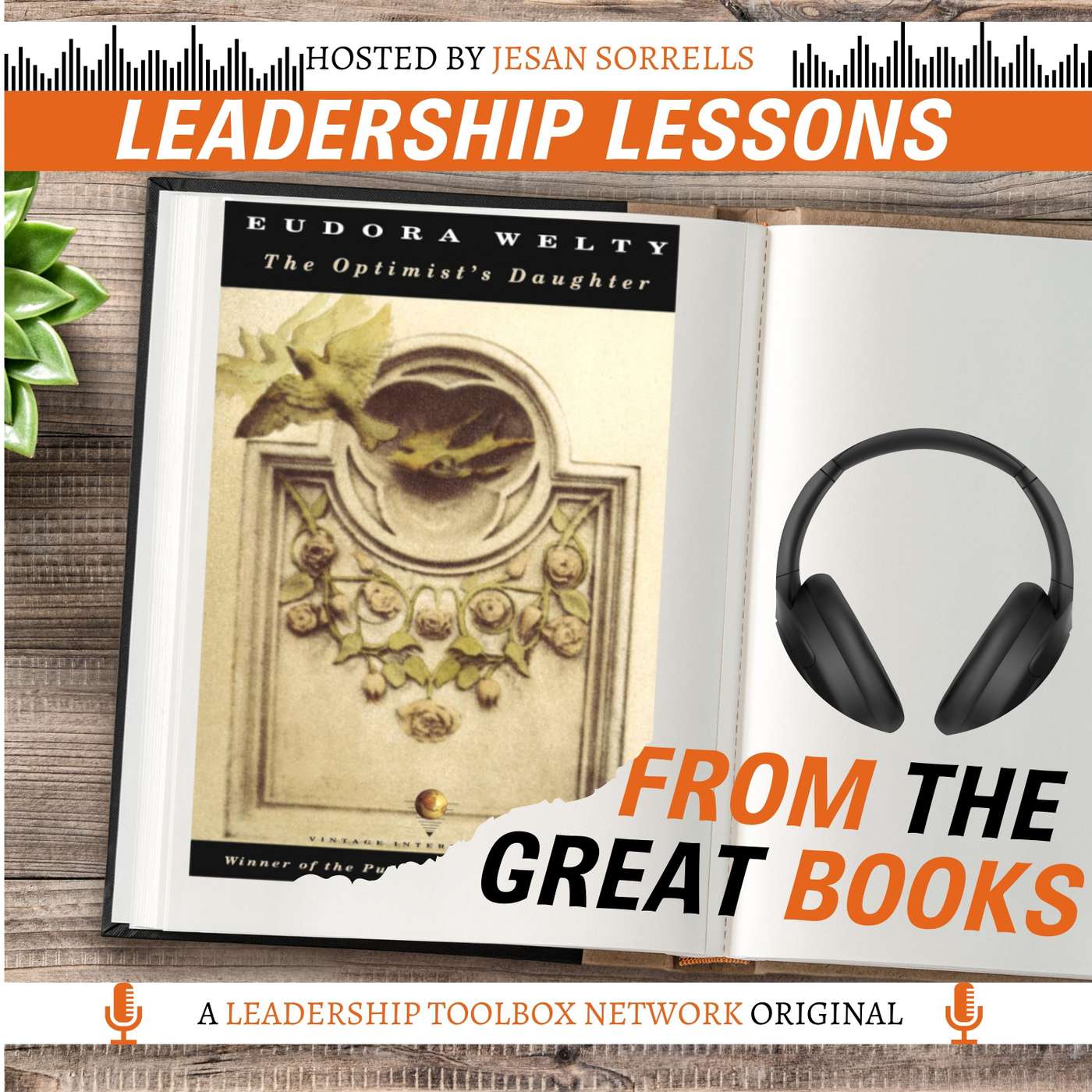
The Optimist's Daughter by Eudora Welty w/Tom Libby & Jesan Sorrells
The Optimist's Daughter by Eudora Welty w/Tom Libby & Jesan Sorrells
---
Explore how Eudora Welty’s The Optimist’s Daughter delves into themes of grief, regional identity, and the challenge of preserving cultural memory in a rapidly globalizing world. Jesan Sorrells and Tom Libby discuss the impact of community traditions, the evolving role of observation in literature, and the struggle to find objective meaning amid today’s digital noise. They highlight the contrast between sincere storytelling and modern content creation, drawing leadership lessons from Welty’s keen insight into relationships and local culture.
- Book Title: The Optimist’s Daughter
- Author: Eudora Welty
- Guests: Jesan Sorrells (Host), Tom Libby(Co-Host)
---
Time Stamped Overview
---
00:00 Exploring existential themes in media
10:46 Discussing a lesser-known author
14:13 Discussing influential female authors
21:13 Discussing African American Identity
24:16 Global access to regional language
28:08 Taylor Sheridan and rural storytelling
36:00 Future writers' digital observations
41:56 Funeral and community support
46:31 Laurel's perspective and social commentary
53:22 Discussing early misconceptions of truth
58:02 Muddied information and confusion
01:04:35 Boxer confronts online critic
01:09:58 Handling past failures in marketing
01:11:41 Lessons in leadership and kindness
01:15:56 Losing traditional learning methods
01:22:08 Star Wars fandom and cultural shifts
01:30:00 Generational conflicts and technology gaps
01:35:42 Observing before taking action
01:38:14 Concluding a discussion without resolution
---
- Opening theme composed by Felipe Sarro - Bach - Silotti - "Air" from Orchestra Suite No. 3, BWV 1068
- Closing theme composed by Brian Sanyshyn of Brian Sanyshyn Music.
---
- Pick up your copy of 12 Rules for Leaders: The Foundation of Intentional Leadership NOW on AMAZON!
- Check out the Leadership Lessons From the Great Books podcast reading list!
---
- Subscribe to the Leadership Lessons From The Great Books Podcast: https://bit.ly/LLFTGBSubscribe
- Check out Leadership ToolBox at: https://leadershiptoolbox.us/
Hello, my name is Jesan Sorrells and this is the Leadership Lessons from the Great Books podcast, episode number 189. Opening up with a summary of our book today because the book that we are covering is still under copyright, strict copyright through Vintage International. And so we don't want to read too much from here, but we're going to open up with a summary of an idea. Our book today opens up with a judge, a judge named McKelva who is in a hospital and he is dying. The judge is joined at his deathbed by his wife Faye, his second wife, Faye, and the daughter from his first marriage, Laurel.
Laurel McKelva hand was a slender, quiet faced woman in her middle 40s, her hair still dark. This is a woman who as we go through the first few chapters of our book today, we find out a little bit about. We find out that she is a woman who has escaped her region. She moved away and now she has been called back. She is a woman who has a fraught or dare I say non existent relationship with her stepmother, Faye. And her stepmother Fay, who is significantly younger than her own mother was, is trying to rally the judge to come back to life.
By the way, the judge died suddenly, not because of anything having to do with with disease, but just having given up.
Laurel stays, of course, with the judge during the course of this opening to this book today. And she spent her time and read Nicholas Nickleby and that seemed like it was endless. Matter of fact, she read to him while he was in a coma, understanding, of course, that coma patients can hear everything. Once, of course, Fay enters into the picture more. Faye attempts her own methods to bring Judge McElva back to life. She attempts to appeal to his masculinity, to his Southern manhood, and of course, to his ability to defeat disease.
This does not work and the judge passes away anyway. This opens the door to our action and to our movement because this book is not about a funeral or not about a judge's death. It is instead about everything that happens afterward and the way in which Laurel and Faye and all of the other characters in this book react to and respond to in a very regional and very specifically Southern American way to death and to what it brings to their lives. And so we are going to be summarizing and talking about probably one of the better books by any female author of the late 20th century.
Today on the show we're going to cover a book I think you should pick up, the Optimist's Daughter by Eudora Welty, Foreign.
Now during the most recent golden era of our time on streaming and cable television entertainment, several popular shows played with the trope of the witness who documents without fully understanding. The best shows that did this included the Wire, the Arrested Development and Breaking Bad. At least I think they were the best shows. Now these comedies and dramas were part of a 20 year long mid century effort on television and in novels, as we are going to see in our novel today, to leverage the tension evident when a person observes another person's empirical actions and is unable to determine any deep meaning from from those actions.
In essence a witness witnessing but not understanding what they're seeing. The challenge of determining meaning by witnessing another person's actions is one that was visited upon the west sharply because of the West's inability to collectively psychologically process the existential evil of the horrors of World War II. From the rape of Nan King to the trials at Nuremberg, the moral challenge that faced the west in a post war context was how to call observable evil what it was, and without an appeal to the existence of a spiritual transcendent authority whose existence all parties involved in the prosecution of the war may or may not have agreed upon.
This friction, of course, led to an increase in existential dread, the toleration of higher levels of cultural and social absurdity as a coping mechanism, or as cope, as the kids would say these days, and finally at the close of the 20th century, appeals to deconstructionism, to the power of, well, raw power.
However, the person or the society who witnesses evil and yet is shocked into incoherence has a problem. They do have a genuine problem, and we're going to see this in the Optimist's Daughter today. But their problem is not a lack of belief in a transcendent good. The problem is one of a lack of language to ask the right questions, interpret assertions that may be bogus, and a lack of ability to discern and then critically think through the challenge of interpersonal horror.
The writer, essayist and journalist Joan Didion, who we're going to cover a little bit later on this month, keyed into this exactly when she opened her 1961 collection of essays, which we've covered on this show before, Slouching Towards Bethlehem and we will cover again this month about the baby boomers who are beginning to make their own contribution to the long thread of cultural incoherence. Post war cultural incoherence, it was going to be in America. When she quoted in the opening of her collection of essays from William Butner Yeats, the Second coming, published in 1920, and I quote, turning and turning in the widening gyre.
The falcon cannot hear the falconer. Things fall apart, the center cannot hold. Mere anarchy is loosed upon the world. The blood tim tide is loosed and everywhere the ceremony of innocence is drowned. The best lack all conviction, while the worst are full of passionate intensity.
And that is something that we are going to see here today. We're going to see the attempts by Eudora Weltley and the characters that she creates to make sense of the horror that she is seeing. But personal horror. The horror of the death of her father and at a much larger level, the death of a way of life that she had known since she was born.
Leaders. Today on the show, I'm going to start off with a fundamental belief. I think we can describe what we're witnessing. Matter of fact, I think we have a moral duty to do so. There is objective reality and documenting those moral challenges does require us to make moral judgments. But we must lead with the idea that we can do so first.
And of course, as usual along my journey, here to explore some of these ideas and to discuss the challenges of the witness who documents is our regular co host, Tom Libby. You doing Tom? I mean, if I was doing any better, hy, I would think I was off in la la land. I'm doing so good. It's, it's, it's crazy.
I'm doing just fine, thank you for asking. You're doing so good. It's a level of insanity. I. You just can't describe it. You, you know, it's. What's that line from? From, oh, gosh, those old ESPN this is Sports center promos. What was it? No, not. This is Sports Center. Stuart Scott used to say this. You cannot hold him. You can only hope to contain him. He is, dare I say, in fuego. And actually, that might not have been Stuart Scott. That might have been Dan Patrick. Who's one of those guys? What?
I'm pretty sure it's Patrick, but that's okay. Might have been Dan Patrick. Yeah, might have been Dan Patrick.
So we open up today with the summary of the first few chapters of the Optimist's Daughter by Eudora Weltley. I sent you a bunch of paperwork and a bunch of information on. On. On wealthy. And I'm going to keep probably mispronouncing her name. It's W E, L, T, Y. But I, I tend to reverse the L and the T and the Y. So forgive me, folks, but it is T Y. That's, that's. That's her last name, the author's last name here that we're covering today. So, Tom, we've, I kind of sent you a bunch of information about her.
You're coming in fresh to this. In looking at the information that I sent you and looking at sort of her life, what do you think of this? What do you think of this author? I actually, I found it interesting at the very least. And by the way, like, I found it even more interesting that I had never heard of her, even though she's, you know, she won the Pulitzer in 71 with this book. Not that I know every Pulitzer Prize winning author. I'm not suggesting that I know all of them. But as you've seen on this in our past episodes, even if I hadn't read the actual book we're talking about, most times I've heard of the author, like, you know, so I found it interesting that I actually had never heard of her.
And I think before we hit the record button, and I'm sure you're gonna get to this a little bit more in depth in a little, a little bit later. But I think your point about, as we were talking before you, we started the recording, I think your point about her being a regional author kind of matters in this ca. In, in my case, because of like, not really being from that area of the country. She was never really brought up in our schools or, you know, we don't really talk about her, so to speak. Even more so I think it's interesting that, that she was in a relatively dominated environment, dominated by black culture, but yet she was white.
So I think that's another reason why we didn't really talk about her up here. I think she would have gotten more attention had she been a black author in a black dominated, you know, region of the country. So I, again, I'm not saying she wasn't worth it or worthy. I'm just saying that I had never heard of her before. And I'm trying to figure out, I was trying to figure out my brain why, because what little I like, when I started reading her, her bio and stuff like that seemed very interesting at the very least, like, you know, talking about, you know, she didn't, it wasn't one of those things where she like, grew up so dirt poor that she had to write her way out of, out of her world.
She kind of grew up middle class and kind of did her thing and went around very well educated. And similarly, I went, I, I, I found some similarities between this book and her life. If you then they're not exact, but like some of the similarities about her dad getting sick in real life and her going back and looking at the book and the daughter going back to her dad getting sick, like certain things. I was wondering if this was like her interpretation of her life at a, at a. She just kind of changed it enough that people wouldn't recognize it.
Like her friends and family reading it, so to speak. Right. So anyway. But yeah, I, I thought it was, I thought she was my, in my, my. Like my initial reaction to her was I would, I probably would go back and read her at this point. Like, I think, I think it would be interesting to see what she has to say, especially considering she wrote for, you know, the radio station and stuff. Like some of the jobs she held. Like, it was interesting. And then to your point, she took a very similar career path as others and felt obligated to go into teaching, where today you probably wouldn't do that.
Right. Like a writer just wants to be a writer and they're going to go write and they'll figure it out along the way. They may do odds and ends jobs like, you know, but, but a writer, as a writer. As a writer, so to speak. And, but I don't think they had that opportunity in her era, like back in that time frame. So she seemed like a very normal, there was, there was a lot of normalcy to her pathways, I think is what I was getting at like, like the. When I started reading the bio. Yeah. She was born in, she was born in 1909 and she died in 2001, so.
Only died 25 years ago, as a matter of fact, as of July 23rd, it'll be exactly 25 years since, since she passed. She mostly wrote short stories to kind of kick off her career and then she gradually moved into, into larger and larger or more, more challenging, more challenging work. She was a photographer as well. Kind of close to my heart there a little bit. And one of the things that, that Tom is mentioning here, and it's a good point to mention for our, for our listeners, is she wrote at a time and she came of age during a time when the author William Faulkner, who was sort of the, the powerhouse of the cultural standard of what a regional author could be, specifically a regional Southern, you know, American author could actually, you know, be and do and succeed at.
He was the gold standard. His writing was the gold standard that everybody was, that everybody was judged by.
Her peers included folks like Catherine Ann Porter, who actually wrote, I believe, an introduction to one of her books, Harper Lee, who we covered in episode number 109, who wrote to Kill a Mockingbird, Zora Neale Hurston, who, to Tom's point, African American author. We've covered a couple of her books on this show. In episode number 100, she, along with those other female authors, she wrote in that space that Faulkner pioneered. And it is a space of, as I was saying before we. We hit the record button to Tom, it is a space, interestingly enough, of regionalism.
And I want to talk a little bit about that for just a minute, because I think that that's part of the setup for this book, that if you're going to read it, you've got to really understand that and really sort of imbibe that. So if you are a reader or a leader who has been reading and consuming what we now call content, books, movies, television shows, I'm sure you've noticed over the course of the last 25 years that things have become more homogenized, more globalized. Now, part of that is because of the ubiquitousness of cell phones attached to the Internet and social media.
Part of that is due to what the algorithm pushes versus what it does not inside of those platforms and where people's eyes and ears are. But also part of it is that
you're going to get more homogenization when things are flattened, when content is flattened, when ideas are flattened, and everybody seems like they're saying the same thing. And that's one of my troubles with, with books written in the last 25, 30 years. And that's why I tend to not cover newer books on this show, because most of them aren't saying anything that's dramatically interesting or dramatically different than any other book you could get. Whereas if you go back to the Optimist's Daughter, or you go back to any books by Zora Neil Thurston, or you go back to books written by Katherine Ann Porter.
They are not part of a global culture. They're part of very much part of a regional perspective on. On writing. And this is not just in the American South. You have writers that were specific to the American Northeast. You had writers that were specific to the American West. One writer that jumps out to me in particular is Charles Portis, right, who wrote the book True Grit that we covered on this show and that the movie was made out of. And even when a book was turned into a movie, it still rang very specifically of being of a specific region.
And other folks, other readers who lived in other regions of the United States, recognized that author or that movie as Being part of. Part and parcel of that region. And even to Tom's point, like, we didn't get this up here, quote, unquote, right, because it didn't match our region. That's all gone. All that, all that, all that, all that differentiation has passed and now everybody sounds like everybody else. And you don't get that with. You don't get that with. With Welty. She said that. That her interest was in the relationships between individuals and their communities, and that stemmed from her natural abilities as an observer.
And she observed people in her community. She observed people in her own place. She observed people in her own customs and traditions, and she even referred to folks who lived in the south as her people. Nobody talks like that anymore, Tom. Like that's. That's all gone. It's even a struggle for. I mean, you. You know this as a. A proponent of the native peoples and the native people's perspective and NATO people's voice. I mean, how hard a fight is it to. To avoid the globalization there? Oh, it's.
It's very hard. It's very hard. I will tell you though, one thing that surprised me. One day I met a. I was with a person from Russia. He was. He was here visiting for business. And when he had said that, like, some of the. There are descendants over there of our native. Of our native people, and I. It. It took a second for me to understand how in the hell that could happen. But then I remembered like, some of the. Some of the slave trade went the other way. Right? Like, so as the. As the black and African slaves were coming over here, native people were being taken over to Europe as slaves.
So yeah, like, we have descendants like this. This connection over there. So I guess to your point, when those people start wanting to learn about the culture that they left behind hundreds of years ago, this is, you know, similar to maybe somebody like yourself trying to look up roots from your ancestors, et cetera, et cetera, really is difficult for them. It's difficult to hear, I guess, kind of circum back circling back to what your. Your question being. It's very difficult for them to find something so regionally located or, you know, or it's it for us.
Maybe it's tribal affiliation. So you say, like, I know I'm this tribe, so I can go research that particular tribe. That's fine. That's not easy. But it's at least a. A pointed direction to what you're talking about with regional writing. But if you're looking for like an overarching commentary about like Say the Southwest, whether it be Navajo or Hopi or something like that. And you want to have like a general. There's no generalization like, or, or not. I, I shouldn't say there's zero. But it's very difficult to find where you can have a single author that's going to write about several tribal affiliations in a, in a way that makes them all make sense and makes them all true to form and true to identity.
Right. If they're using, if they're generally using overarching terminologies and stuff like that, somebody's going to be irritated that they wrote it that way. So it's, you're right. It is very difficult in that sense to, to find something that's generalized like that. Well, and I'm seeing something, and I pointed this out this year on the show during Black History Month when we covered African American authors. And I pointed it out last year and I pointed it out the year before that because I've been seeing, I haven't, not even seen.
I have a suspicion, not even a suspicion. I'm sensing the cultural wind blowing in a particular direction. And a lot of, a lot of African Americans aren't ready for the cultural wind to blow in this direction, but it's going to blow this way anyway at a certain point. And I know from a Native perspective, we're all foreigners here. We're all visiting. Got it, Got it. We're all, we're all invaders in your house. I get it. I understand among the invaders, though, there are distinctions with a difference.
And, and, and as time has gone on over the last 25 years, because of the flattening of globalization, because of the ubiquitousness of Internet communication, and because of the nature of the ways in which voice, tradition, custom, community are being scaled up, I am convinced that African Americans, at a certain point, and it won't be in the next 25 years because there's still too many of us who grow up with that designation with the dash in the middle. Yeah, but that's going to go away. It's going to go away in 50 years.
It, it'll be probably closer to the end of my lifetime before that goes away, but definitely in my kids lifetime that'll go away. It's, it's going to be all flattened out and we will just be, much to African Americans dismay in this country, we will just be Americans. That's it. And I don't think folks are ready for that kind of revolution. And it's, but it's going to happen gradually. It's going to happen soon, so gradually that no one's even going to pay attention to it. And, and I think the seeds for that flattening are the same seeds that don't allow.
This is my last point, that don't allow a writer like Welty, and I do think there are still writers like her floating around. I just don't think they could get any traction and get anywhere even with self publishing, which was a point that you were making, you know, because I wonder. I don't think the audience is there anymore. I think the audience was probably barely there in the late part of the 20th century. Probably was there more in the early 20th century when Faulkner was writing in the late 19th century.
But in the early part of the 21st century, getting into the middle part of the century, I think that audience is going to go away. To your point about being with somebody from Russia, you were with somebody from Russia at a, at a networking event. That's, that's, that's globalism. That's the triumph of globalism. Now, what you talk about in the language you use to do business, of course, will be English, but you're gonna have to find some way to relate to that person. And I'm not saying that if a regional author is writing, they can't find a way to relate to somebody from Russia.
But I'm saying that the level of internal creative strength that they will have to have just to commit to that region is going to have to be so high that they're not gonna. They're not gonna get that far. Well, I think, I think it. I. It's interesting that you say that because I think there's some language things too, that matter. Meaning. Like. Like to your point, right? The globalization of even, like, lingo, right? For example, like up here in New England, for some strange reason, people use the word wicked for everything, right?
Wicked cool, wicked bad, wicked ugly, wicked beautiful, whatever. It doesn't matter. It's like an adjective that goes with everything. So if you're a writer from New England and you're writing things like that and somebody from Russia picks it up to your point about global flattening, it's not lost on them anymore. They could just look it up. Like, what does New England mean when they say wicked? Like, and then they. Now they start understanding our lingo to the point where it's not a regional writer anymore.
Like, I, I'm agreeing with you, but I'm using, like, a very specific example of how so people can understand what you mean by this is like, like when you. When I remember as a kid when I read certain things, there was no Internet for me to look up what it meant. I just had to move on and say, oh, that must be a regional thing down there or up there, over there, or whatever it is. And I, I went and tried to interpret it myself and moved on, but I didn't feel like I was a part of that culture, a part of that region.
Whereas today people would do that. I, I can tell you, I know people, I know people personally that would just look something up and then all of a sudden adopt it and be like, oh, and wait, no, this is something they only say in Texas. Like, why would you say that? You know what I mean? But you read it in the book somewhere that you like the book, so now you're going to use it. Or they say things in England. There are certain words that they use in England that are very frowned upon here. And I'm not gonna say them, but there's one particular one that pops into my head very frequently that when they say it over in England, I'm just like, oh, my God.
And. But again, I go back to. If you read that from. We might take it as offensive where they don't like. And that's that global, that flattening globalization that you're talking about, where now people can just absorb whatever that culture is in that book, in that writing, and it's no longer a regional writing. Right? Like the definition of regional writing is, to your point about the dash. And it's going to go away. I think it's gone already. There might be, there might be some proud. There might be a little proudness.
Like if you go back to. I thought for sure we're going to avoid it on this episode, but we're not. If you go back to the film industry and like the, like the, the filming of episodic television, whether it's streaming or network, there is a certain sense of pride with visualization of it. Meaning, like when I see the cityscape of Boston in a show that's kind of cool, and I like that. And I can, I can start associating my. Like, I can feel the world like it's my world, right? Like, but, but that's a visualization because as soon as they start talking and they butcher the Boston accent, and I think it's so overplayed and I'm like, nobody from Boston speaks.
Speaks like that. What are you doing? Like, like, there's like, like they over accentuate the Boston access. Boston accent for for effect. Right. So, but, but. So there's. I still think there's some pridefulness in that regionality of certain things when it comes to, like film and, and, and in, in recording television. But I think in the writing it's different because you don't have that visual aspect of. I think that I would agree with you if you're talking about. And maybe this is the next major sort of division, right?
So we, we've, we talked about in our. In our most recent episode where we covered. What was the last one we did. I can't remember. We do so many episodes, but the, the last episode that we did, a couple. Never mind. I just lost it. I just had it. Because we recorded it twice. We did. We recorded it twice exactly. Because we forgot to press the record button. But we. I made a point in there that I think needs to be revisited. And the point is that. Or not a point, but I made an observation, right.
I think that the division between. Oh, yeah, because you were talking about Taylor Sheridan's myth of not being able to, you know, sell a story that occurs in a rural area to, to television and movie executives, Right? Because they've committed, according to him, since the 1970s, to only showing stories that come from an urban area or based in urban environments. Right? Now, whether that's psychological manipulation, a psyop, as the kids say these days, or not, that's a whole other thing all together.
We're not talking about it in that context. I'm bringing that up to say that I wonder or to mention or to wonder if the next great divide is not at a regional level in the United States. Maybe the next great divide is because you brought up Boston, right? So Boston is fundamentally different as a city than where I live in north central Texas. I live in a very rural. What would be considered by folks who are in Boston, it would be considered to be a very rural area. Now, it's not that rural to me, but it seems that way to people.
The stories that are in rural areas and the stories that are in urban areas, I think that's the next great dividend. And, and, and I wonder, just as I did in that episode where we're talking about this point a little bit further, I wonder if the next great sort of creative strength is going to come from. From a writer or an author in a rural area who's going to say, no, I'm committed to this rural area east of Eden. That's what we're talking about it. I'm committed to this rural area and I Don't care what you all are doing in the city.
That's interesting, but the next time you film my stuff, you're not going to see a skyscraper in Boston. Like, that's not what I write for. I don't write for the skyscrapers in Boston. I think that's already happening and I don't think you're realizing that it's happening. It's not the style or the, it's genre driven. If you think about this for a second, most like a tremendous amount of horror movies start in urban America. Like they start in those urban environments. Most crime dramas end up in cities.
Like so. Yeah. If you think about Last Cabin on the Left and like all these other like, horror, like horror movies, they're all in these like little rural suburban neighborhoods. You don't see a horror movie in downtown New York City, like, like in Manhattan or. Right. Like, or in downtown Boston. Those are, those are crime. Those are crime movies or gang movies. Like, I think it's already happening. I think it's just happening by the genre instead of the authors, that's all. Okay, Okay. I mean, and you may, and you know what?
You might have something there. Maybe, maybe this does descend into genre because I don't, I, I. Human creativity is too powerful to be bound up for too long. Right. It's just, it's, it's like, it's like you're trying to. It's like you're trying to dam up a raging river. Right. You know, the Chinese tried to damn the Yangi, the Yellow river, and it didn't work because it's, it's a river. Like, it's, it's a force of nature. It just is. And that's what human creativity is. It's a force of nature. And so if you dam it up in tamping down regionalism, right, for the last 25 years, it's going to pop up in.
Maybe to your point, all those people who would have gone regional are going now into genres, right? Because they can, they could play a little bit more. They could play a little bit more or in there. Well, they could play to an audience that understands. Right. Like that's instead of a regional understanding. It's a, it's a, like, instead of like southeastern United States regional, it's now it's either inner city or suburban or rural. And anybody who lives in those environments will get it. Like they'll, they'll understand those, that, that, that the writing.
Well, I wonder if it's also because one of the things that Welty did And we'll get back to the book here in just a moment, folks. But one of the things that Welty did really well is she observed, right? She said that all of her writing was based on observation, observation of people in her communities, observation of place. Place was hugely important to her, right? This place, this geographical designation has meaning, right? It's not, it's not value neutral. It has meaning here. And of course, being a Southern American, it's interesting that I'm reading this book or that I read this book now and that we're talking about this on the podcast, because one of my older daughters is my older daughter.
My oldest daughter not older. My oldest daughter is. She's writing a paper for college right now for her American history class around the Civil War. So we've been talking a lot about the Civil War in my household, right? And been sort of laying out to her, laying out for her with Proximate and the, the first order, second order, third order causes were for the war. Da da da da da. And one of the points that I make to her, and it is a point that I think Welty would appreciate along with Faulkner and Zora Neale Hurston and Katherine Ann Porter, all the Harper Lee, I mean, To Kill a Mockingbird.
Come on. Like, one of my favorite books of all time. Exactly. The reason why those books are so powerful is because they tap directly into the plot place of the south in its own psychological conception of itself, which is, of course, all the things that we know about the American, the American South.
I wonder if there is a. I wonder if one of the other factors that we're. That we're, that we're, we're seeing in creatives is that lack of observation. Like, I wonder how sharply people observe things anymore, right? So, like, if I was going to write a book about Carl Hiason, I'll use him as an example. Carl Hiaasen, he was a mystery writer back in the day, and he wrote mystery novels that were based in Miami, Florida, or in Florida just in general, right. He knew Florida. When I would read Carl Hiaasen mysteries and I read a whole bunch of them when I was like late teens, early 20s.
I like banged through a whole bunch of them and then I like jumped off of that train and went to something else. I've heard a Carl. I haven't thought about Carl hiason in like 25 years. Good Lord.
But, but he was a specifically Floridian writer. You could tell that he understood Florida. He knew Florida. He observed Florida. He also attained national prominence from selling books about Florida. So selling literally. And Weldy Welty would appreciate this. The myth of Florida to people in like South Dakota, the myth of Florida to people in like Idaho who are never going to go to Florida or the myth of Florida to people in New York City who when they would retire would like to go and experience the reality of Florida in the middle of that state.
So Carl Hiason in the mystery genre, the detective genre, the crime genre, was an author who captured all that regional flavor from his observations. Just like Welting captured regional observations and was able to turn that into, into dramas and short stories. I think that's a strength that modern authors are missing. I don't, I wonder how many of them are on their phones too much. Oh yeah, yeah, yeah, you got it. You got it. You got to put the phone down and look around, right? Like this is what we tell leaders.
Like, you got to put the phone down and look around. Like, does that, does that lead into the observations? I wonder if our next generation of writers are going to do what you're asking them to do, but it's going to be through the lens of their phone, right? So like all of their observations are gonna come from tick tock or Instagram or Facebook, whatever, like whichever the, whichever the flavor is. But. And, and you're gonna start seeing books written in that instead of, I guess goes back to your point about.
Instead of like the flattening of the, this global globalization. Flattening globalization thing is because now they're going to be seeing everything they see on their tick tock talk is from all over the place. So there's not one universal like you're just talking about the gentleman writing from Florida or in Welties, you know, writing from the, the South. It's, it's going to be maybe, maybe, maybe that's what it is, right? They're observing. They're still observing. Listen, if you, you're gonna, you're observing whether you think you are or not, whether you're registering it in your brain is observing, observing or whether you're like whether you understand that that's what's happening or not is not the is is you.
It is happening. You're. You are definitely. Now if you're always observing this right then people are going to start writing about what's in the little box instead of the regions of the world. Well, one of the ironies of our time, both of, both of us are film guys and we'll go back to the book after I make this point. One of the ironies of our time is as the phone has become more ubiquitous as a physical object in our lives, the integration of the communication and the physical object of the phone into movies and television, which basically have overtaken the novel and have killed it, I think.
Not the book, by the way, just the novel. Right. Those tools, the phone, that phone is an object, but also the phone is a communication tool. The struggle that, the struggle that film people have had to integrate that into stories has been kind of amazing to me. Kind of funny. Yeah, it's kind of amazing because it's like
the analogy that I can make is how often do you see someone in a horror movie? You talked about horror movies. Okay, how often do you see someone in a horror movie go to the bathroom? Not because something horrible is about to happen, but just like, because people have to go to the bathroom. Or, or. My favorite part is when this thing does come into play in a horror movie, it's all of a sudden out of Service. Like, we have 99. We have 99.9 of this coverage around our country, folks. But yet inevitably, you are in a dead zone when you're in a horror movie.
It's my favorite part of the horror movie. That's true. That's true. And you could, and you could time it almost to like the beginning of the second act. Like the, the second act kicks in and then all of a sudden we're in a dead zone. You're like, really? Like, Sprint has 100% coverage. What are you talking about? There's no dead zones. Just call somebody. There's no dead zones in the United States anymore. I mean, come on. I mean, I mean, maybe there are. I'm not, you know, whatever, but they're, they're very few and far between.
You know, there's a, there's, there's a 15. Not even a 15. There is a 10 minute dead zone between where I live in Dallas, Fort Worth and it. And it doesn't even, it's not even dead. It goes from, it goes from. What do you call it? It goes from a 5 bar 5G down to like 1 bar 1G. So I can still like stream an audiobook. And I've done that before. I just can't have a phone call. Hey, son. I can drive. I can drive from New York City. From New York City, which is four and a half hours south of my home.
Yep. I can drive from. I can drive from New York City past my home, drive all the way up to Portland, Maine, which is another two hours north of My home and never hit a dead zone, not once. See, that's. Yeah, I mean, but that's inevitably. I think they're getting clever to it now though, because every once in a while you'll watch a horror movie where the phone doesn't work and they'll be like, oh, there's some interference. Like something's happening to the. Yeah, okay, so. So it's not a dead zone anymore, but some, you know, the cell tower's down because the electrical storm or some jack wagon stuff.
By the way, h. By the way, we will actually, at the end of our episode today, we're gonna have a little bit of an extra bonus because Tom and I are going to talk about Project Hail Mary because I have some, we have some thoughts on that. I have some thoughts on movies. So if we have some time at the end of our episode, we'll do that today. Okay. So going to book two. So Optimus Daughter is divided up into, into four books, right? Sort of an old classic, sort of novelist's approach. And so we're going to go into, we're going to head into and summarize a little bit of book two.
So book two opens up with, with a funeral. Right? Now I am a big fan of funerals. Pause in literary works. Because a funeral is a place where we can not only play with an understanding as an author or as a, as a, as an audience member or as a reader, as a witness. Right? We can play with perceptions of reality, but we also get to play with things that are existential. Themes that are existential, like life and death, themes of renewal and redemption, themes of forgiveness and reconciliation. And of course, when a funeral occurs in real life, as it does in a novel, as when it does in a novel, everybody who is at the funeral, well, everybody doesn't need to be there.
So in book two, we open up with Laurel McKelva returning to her father's home. And all six of her bridesmaids from her wedding that she had had years ago show up. And these six bridesmaids begin to help her navigate the funeral process. The community shows up to help her bury her father, the judge. Now the interesting thing about these six women is that they are the ones who hold the memories of the community. And it's interesting, so wealthy Welty sits on, on an observation here that women, and by the way, Welty was born in 1909.
So she, she saw and grew up in a pre feminist world in the south and then matured and had her career in a post feminism world in the south feminism doesn't enter into this book. That's a warning, by the way, for some of you who are looking for it. So if you're, if you're reading this book and you're looking for that, that doesn't, it doesn't enter in here. Except. Not even. Except it enters in, in one. I shouldn't say it. Interest in it. It glides across the top in one fashion. And how Laurel, the character Laurel talks about leaving the south and going to Chicago where she got married at, at the beginning of the beginning of World War II.
But, but Laurel is comforted by these six bridesmaids and by the way, they swoop in and they do everything they can to help her. Now with that it there of course, is gossiping, backbiting, conversations that we would consider to be more feminine coded and more female coded that do occur in this part of the book. But there's also the giving of food and the preparation of meals. There's the turning down of the bed. And the. The African American maid returns who used to work with the judge and who helped raise Laurel, returns to, of course, help her during her time of need.
This is the coming together of community in the second part of the Optimist's Daughter. Now, a couple of other things happen in here too. So there's, there's Fay, the judge's second wife, Laurel's stepmother, such as it were. And Faye's family comes in to the narrative in part two. And Faye's family is from Texas. They are not from Alabama. No, not from Mississippi. And they're not from Georgia. They are from Texas. And there is a distinct regional flavor given to them, as I often say, about conflicts that happen across the world.
We in the United States don't know the difference between XYZ ethnic group and ABC ethnic group, but they know the difference. Same thing here, people in the American South. They know the difference between folks from Georgia, Alabama, Mississippi, Louisiana, Arkansas and Texas. And yes, I can tell you, living in Texas, they all talk dirty about each other. Absolutely. Still these days, states do still matter. And in this narrative it matters as well, because the family of Fay rushes in and behaves as one of my old ex girlfriends.
Back in the day, their mother would have said to me, they behave like a bunch of wood ticks.
Some old school terminology there. Finally, there are the men who help bury the judge, the judge's male friends and the judge's male friends. The men in part two of the Optimist's Daughter behave in a fashion that is old School, Southern patriarchy. They run around, they do the things they're supposed to do, they listen to the women when they need to. And then when they can scatter off and not take any responsibility, they scatter off and not take any responsibility. There's a whole, there's a whole sequence in there of one of the judge's friends.
I don't want to ruin it for you. Go, go read the book. But one of the judge's friends going and getting some lemonade for his wife, who literally berates him into going and getting the lemonade and, and then coming back and he delivers the lemonade and then he runs outside to go smoke cigars. And Laurel observes this as a, as a witness, both of those, both as a witness of the new generation, the next generation that's beginning to come in and is, is observing and judging this old school behavior, but also as someone who grew up in that behavior and finds comfort in it during her time of need, when she's mourning her, her father.
Welty hits on something in here, in the second part of the book that Joan Didion also hit on another point that her and Didion, you know, sort of, sort of share where she's writing part two of this novel. And at one level it operates as a regional documentary of behaviors of people in the south during that time around funerals, but it also writes, she also engages with it at a social documentary level. She's making some social commentary on what she's seeing and what she's, what she's thinking about.
And I think this is where Welty's genius is. I think this is what won her the Pulitzer Prize because she's doing the social documentary without being heavy handed. She's not being judgmental. She's merely saying, this is what we saw. This is, this is the way that it was. And you make a judgment about it now in our time, everyone documents everything. We talked about that extensively in the first part of the show with the phones and everything else, from every small aspect of their personal lives to the larger social moments of our culture.
But no one ever stops to ask what documenting and making and sharing all of this quote unquote content actually means matter of fact. I think that historians of the future 300 years from now are going to wonder at the flood of irrelevancy that we have created. And I think they're going to be, they're going to be choked. They're not going to know what to do. They're not going to know how to sift out meaning. And I think they will come to the conclusion that we, we didn't know how to do it either.
And I don't think that that'll be, I don't think that'll be a check mark plus for us. I don't, don't think that's going to be a good thing. So Tom and I were talking about something that I want to bring up here in a little bit of a different context. Previously we were talking about this book and getting ready to prepare for the show. A couple days ago we were talking about this, the issue of disinterested journalists. And Tom was going on a little bit of a rant about journalism. I don't know if he's going to revisit this here, but Welty sort of behaves like an anthropologist and a journalist and a social commentator without
she mastered journalistic. Just like Joan Didion early in her career, not later. Later Didion got wackadoo a little bit on this. But, but early in her career they both mastered, and they were both of the same generation, mastered the idea of that disinterested journalist where you couldn't sense what their biases were. And now we live in a world where everybody's a marketer all the time. We're all marketing all the time. Whether we want to be marketing or not, we're marketing all the time. Even I am marketing right now.
I cannot help it. We are all marketers now,
but no one seems to know what meaning we can grasp from this. So I'm going to use optimist daughter and the funeral and all that that I just set up. There is a setup for this question. Question, Tom, if.
What does all of this mean? I'm going to ask you the existential question. What does all of this mean? Give, give us some meaning for all of this. That way at least we'll have something on the Internet that Maybe will survive 300 years from now that can be found. Because I'm, I'm, I'm not yelling nearly as loudly with my voice as I could be. That maybe in some quiet corner of the Internet some historian 300 years from now will find and they'll go, Tom Libby. Got it.
Good luck to them. I mean, I'm not sure. I mean, you know, all I got right now are some opinions and as you know, they're pretty strong this case because I, you know, kind of like you're leading, leading to here. There is a major difference in what you just described as wealthy's writing style, which is observational, no bias. I'M just going to tell you what I'm seeing. And that just doesn't seem to exist anymore. And because journalism has turned into marketing. And one of my frustrations, as we were talking, as you alluded to as we were talking the other day, I cannot find anywhere anymore where I can just get factual data.
Right. Just give me what. Folks, listen, we all know what's going on around the world right now. We have wars in Iran, we have Israel doing this, Ukraine and Russia having this fight, et cetera, et cetera. We know that there's, there's turbulence in the world. But I want to know what the turbulence is stemming from without somebody giving me their, to your point, their bias. Whether you, and again, whether you are, whether you are, whether you stand behind our current, current administration blind faithfully, or you are on the other side and you hate him, you hate the administration with the passion of a thousand sons.
I don't care which side of the coin you are, you're on, but give me factual reasons why you stand on that side of the coin. And nobody does it. Nobody is giving us factual information. Why are bombs being dropped here or there? Well, this happened, then that happened, then this happened, then that happened. The bombs dropped. Okay, now it's up to me to determine what side of the coin I, I fall on because of the, the factual data. If you have a hundred. This, this goes to me, this goes directly to the heart of a problem that I was told when I was very, very young.
When I was very, very young. Somebody asked me, one of my elders at the time asked me, me if I understood the difference between right and wrong. What's the difference between not right and wrong, True, true or false? Sorry, what is the difference between true or false? And I said, well, one is right and one is wrong. And they said, no, it's the majority. If the majority of people think something is true, then you are going to start believing it's true. Whether it is or not, it's the, the, the true or false, it lies with the majority.
And, and that, that's kind of what I'm seeing with journalism. If enough journalists say this is happening this way, then we all just follow that leader. It's very rare that you find somebody trying to buck the system not because you have alternate views, just because you want to hear factual information. It's very strange to me that, that you know, and again, I'm not saying I believe that, by the way, that the truth, the difference between the difference between true and false or the difference between between right and wrong is the majority.
I, I understand that is not, that is not how you should be living your life. I get that. But that was said to me when I was a young kid that had no other, I had no other point of reference to understand the dynamics that they were talking about. So it's like it was the easiest version of that explanation to me as I grew older and I started understanding what they meant by that. That was the shock, that was the shocking awe for me. Like that's what I was like, oh, they're right. But it's not, it's not truly the definition of right and wrong or the definition of true or false.
It is just people tend to lead or follow like sheep to that, that majority. The like. It's very rare that you find somebody that says, we're not gonna anyway to go back now circle this back. Because in my opinion, journalists are marketers in a sense. They just need the clip clicks. Right? Like so they will say and do wherever the majority leads them because they want all the clicks, because that's their job survival at this point. They're not being, they're not being hired by CNN or Fox News or ABC or whomever.
They're not getting hired by any of those people to just dragnet it. Right. Like dragnet just the facts, man. No, they want clicks, which means you have to do something or say something to drive those clicks. You are marketing your opinions or your biases. The. That's the only way for they, for them to survive. The problem is that is now leaking and seeping into everyday life because of these things. Yep. So now, now whether you speak loud or not, you're going to basically be judged by the number of clicks you get on this web, on this podcast.
Podcast, or a number of downloads you have on this podcast. So your success or failure is going to be based on the number of downloads, not on the quality of the content. Because you could have the best podcast in the market right now. And if you don't have enough downloads to justify that statement, you're not making it. So, so I will say this. I. I do have the best. I do have the best podcast in the market right now. You are part of the best podcast in the market right now. And then you're right, I don't have enough downloads to justify that.
You're exactly correct.
And this is why
on the other side of the idea that we are all marketers is also the idea that, or, or not the idea, but the, the fact that for lack of a better idea,
the Idea that marketing ruins everything, right? And it's not that the Internet was this like, you know, pristine sort of virginal territory with no bad actors. That's never been the Internet. Tom. Tom and I both been. We've both been here since. Since the dark magic. The rails for the dark magic were originally laid. We've been around here for a while. It was never. Oh, I just saw today that that ask.com finally just shut down, right? I was like, oh, really? I didn't even know. Yeah, I didn't know that was still rolling.
Good Lord.
But my point is that human beings are going to be bad. Human beings are going to be good. This is. This is. This is just sort of the human nature kind of thing, right? The. The challenge we have is. And. And Tom, you named it correctly, the challenge we have is if the vast majority is pursuing clicks and behaving in a way where they are only pursuing marketing outcomes, then of course they're going to be biased. Now, with that being said, my oldest son is in journalism, and I will tell you that the way he writes is not a way that.
That, that pursues clicks. He's actually trying to get to maybe not capital T truth, but just the facts. Right now there are people who believe that his pursuit, because they have been so warped. And this is the thing on. This is the other side effect. They have been so warped by people who are pursuing clicks, they're running after him going, well, you had to be pursuing clicks to say this thing about me, even though it was factual. You had to be pursuing clicks because that's the only way that someone would bring up this factual.
Right. That even remotely bring up this factual thing. Thing. Right? Which. Which of course leads to an inability of the audience who is observing this and reading this and trying to discuss out what is not true. Again, I'm not using that word on purpose. What is factual from what is opinion to be confused. And so you have the people who don't like what's happening muddying the waters. You have the people who are manipulating the system muddying the water. And then you have people who are seeking to navigate the waters, like myself or my son, in a way that neither muddies them nor.
Nor further causes problems, who can't get traction no matter how loudly we yell. Which, by the way, I'm of the opinion that. And I'll just sort of preface this a little bit. This is sort of how I'm going to end today. I'm of the. I'm of the ability. I'm of the thought process now that actually speaking quieter is probably better rather than yelling louder. But, but that's, that's, that's for a little bit later on. So I know I saw you sort of have that. You sort of had that, had that, had that response.
Because this is, this is what, this is what is happening. And it's still at the end of the day. And, and, you know, people want to know what all this means. We want to know what it means. Not necessarily. Like, you picked. You pick something big, right? You pick like Ukraine and Iran, and these are big things. Yeah. Okay. Because there are things everybody knows. I'm less interested in what those things mean, and I'm more interested in. In what.
I'm more interested in what the tax abatement
promises mean for my community around data centers. Which has nothing to do with anything that you're doing in Boston. Right. It has everything to do with what's happening in my local community. I want to know what that means. And Facebook, even Facebook muddies the waters of that meaning. I can't get meaning on that because you know what the people. And again, it's, it's, it's a smaller microcosm of a much larger thing at scale that you're seeing with larger international events. So we've scaled down that sort of marketing behavior to the average person, and that's been deleterious, that's been damaging to our culture.
That's why we can't communicate about the same things. Yeah, no, and you're right, I, again, I, I use something because, you know, people listening to this podcast are listening from all over the place. So I was trying to find something universal. Right? Like that everybody on the planet could put their fingertip on if they wanted to. Yeah. Fact still remains the same, though, because I agree with you too. Like, if I'm looking at, like, you know, we have a, A thing up here. You know, we have a special prop, what's called Prop 2 and a half, right?
Like, there's a, there's a. There's this automatic trigger that your town could pull. It's called a. A property tax of 2 1/2 percent. So it's an automatic prop 2 1/2 increase. If they need revenue for something now, they can only pull the trigger, like X so many number of years. Like it's like once every five years or something like that. But. And I don't remember all the details to that, but the point is, to your point, when they pull that trigger and you want to know why, like, okay, what's going on that you need the revenue, like for the city.
Like, you're like, you're abatement problem. I'm like, we can't find like, oh, there was, you know, a school blew up or not blew up, but you know what I mean? Like, they needed to expand a school or they needed to pay for whatever, whatever it was. And you want to be able to justify it. And you can almost never find. But to your point, Facebook forums and all this stuff are just people throwing mud at each other. Like, well, you know, and then of course, every once in a while you get the, you try to get the voice of reason in those groups that say, hey guys, stop.
You guys are neighbors. Stop throwing mud at each other. When you realize that the government can do this whether you want them to or not. That's why they call it a prop two and a half override. Like, they, they, they can just do it and you're just asking them for why out of. And they're going to tell you out of the nicety, not out of the requirement. Like, there's no requirement that says they have to tell us what the money is for. For. But every government official does just because they know we can vote them out.
Right? Like, if you don't tell us what it's for, we're going to vote you out next. The next election, you're gone. So they tell us. But they're finding that information is literally like finding a needle in a pile of needles. Never mind the haystack, it's like a needle in a pile of needles and you just don't, don't know which one you're grabbing onto to try to figure out what the hell's going on. So again, I agree with you that it's like the muddying of the water is not. And by the way, we're not picking on journalists here because to, to your point, with this, this, you know, Facebook forum situation or Facebook group posts, whatever you're talking about, it's not just journalists, it's everybody.
Like, people will say something in those forums just to get reactions from people. Correct? They're not saying it because they're trying to add to the conversation or they're trying to clarify something. People will throw comments in there just to see how people react. And that's not helpful. Stop that, guys. Like, it's not helpful. And that's even before we've gotten to the trolls and the bad actors and the bot farms that are offshore that are, that are mucking around in our internal infrastructure.
And by the way, where we're mucking around with our trolls and our bot farms in our country, in other countries, infrastructure. Because everybody's doing it to everybody else, right? This isn't just something the Iranians happen to be doing or the Russians happen to be doing, where the Chinese and the North Koreans happen to be doing. The United States is doing it, the British are doing it, you know, the French are doing it. The first world, the first world, whatever that may mean. The first world nations are doing it to the third world nations.
Everybody's doing it to everybody. This, this is, this is the problem. And there's no meaning behind it. To your point, Tom, it's just trolling. It's getting a reaction to get a reaction. It's. I'm not saying, I'm just saying. And then go ahead and saying the thing and then, you know, they just walk away, like I, I, something some. Was it today? Might have been today, maybe it was a couple days ago, in preparation for this podcast, but apparently somebody ran their mouth in England online about some boxer or something.
And the boxer, like, actually showed up to their house, like, found out where this person lived, because of course, you know, everybody could be doxed on the Internet and like showed up to this person's house and was like, you're gonna say that to my face? And the guy's like, oh. You know. And apparently there was like a whole like commercial ad campaign about this. Like, don't say the things on the Internet that you. And of course they use it because there's no free speech laws in the UK and it's libel and blah, blah, blah, blah, blah.
So there was a larger sort of of state cultural apparatus behind this thing. And those kinds of things work other places. The reason they don't work here is because we have this thing called the First Amendment. And as Dave Chappelle infamously said, the reason the Second Amendment follows on the First Amendment is because you're free to say whatever it is you want to say in this country. Government can't stop you. But here's the but. You're gonna need a gun.
If you run your mouth that hard.
I still don't think we've underst. We know what it means. We haven't really figured that out. I think maybe we got close to something with your idea of perception, and maybe that's the thing for leaders here, is, you know, we can talk about perception equaling truth and what other people observe, but if you're observing something as a leader, that makes no sense. I Think it is incumbent upon you to go and figure out what that thing is and why it makes no sense. I also think it's incumbent on us to.
And this is why I started with the funeral. I think it's incumbent on us to revisit and re rebuild traditions and structures and customs because we've talked a lot about the Internet and social media. One of the other knock on effects of those tools is that it's convinced us that we can just sort of float along above things and just not be impacted by them. And that's a lie. That, that's a lie. And Welty, you know, doesn't believe that the culture that she came out of didn't believe that. Tradition was the thing that grounded you.
Community was the thing that grounded you. Family and, and even, even, I mean, nature. Like in part three of this book, it opens up with Laurel and her six bridesmaids who have come back to her house after they've cleaned out the Texas clan and everybody's gone home and the funeral's over. And yes, I did use the word clan. Clean them all out. Right. And. And the six bridesmaids come over and they're all helping her garden and they're gossiping and talking in the garden. Right? And it's just six ladies talking in the garden to Laurel.
And there's such, there's. There's. One of the things that's interesting about parts two and three of this book is there's such a sense of community. Like at first I was like, oh, I'm reading this. It is a man. You know, men perceive community differently than women do. And how that grows is different than how it grows among women. But you could definitely see that like Eudora had sat down with. Not even sat down, had seen women behave like this. Older women behave like this and pass along these traditions and engage with the nature, such as it were, you know, in the garden bed and use that engagement as a way to grow relationships between people.
And by the way, they're still gossiping the way the people gossip on Facebook. That's not gone away. But it was only the six of them. It wasn't at scale. And everybody in the neighborhood wasn't trolling in. That's the fundamental difference.
Yeah, the anchoring to small dramas and small things.
So let me talk about these women for just a second. The characters of Faye, Laurel and the four. The four. Four of the six bridesmaids who stuck around. Mrs. Pease, Ms. Adele, Ms. Tennyson and Tish, they all hold memories of the Past, and that's in part three. Is, is, is. It's all about the past memories of the judge, the past memories of Laurel when she was a child. It's kind of this attempt by these bridesmaids, these friends of hers, to build Laurel back up after the funeral had happened. And that's what great tight knit communities do for people.
And that's the thing that we're missing by thinking that we could float above it.
You're a person, Tom, who, not only out of your cultural tradition, but I think just how you're wired, the way you've talked, and we've never actually directly talked about this, but I do think the cultural memory is very important for you, just how you're naturally wired. Unfortunately, it's not. It's not. I think that that's again, one of those things that's either dying or maybe needs to be renewed.
But I do think it's important for leaders to hold cultural memory. So how do we, how do leaders do that? Not just in an organizational structure, but how do leaders do that in general? How do they, how do they hold memories? Like, how do they connect with people and do that? What is, maybe some ways that they can do that? Because that's, that's something that definitely jumps out at you from the optimist's daughter.
I think there's, I think there's an awful lot to actually unpack there because I think it, it matters from which angle you're looking at the business itself. Meaning like so for example, when you're talking about sales and marketing, you have to have a pretty short memory and not allow the, not allow the mistakes of the past to hold you in fear of trying to advance the future. Meaning like so just to give you an example, like I, I, you know, you encounter somebody who is, got a new product on online or whatever, and you're suggesting they do maybe a social media campaign or something like that, and they go, no, no, time out.
I tried social media. It didn't work. We're not doing social media. And that, that, that memory of them failing at social media is not allowing to them to realize that social media today is not the same as it was 15 years ago. Right. Like, so there are ways and mechanisms and levers to pull there that didn't exist 15 years ago and that you should revisit this. But the holding on to those memories stop them from doing so. So it stops them from progressing into thinking that. Now on the flip side, there's.
I was again, I was told, I remember working for as very young, I was probably in my early 20s and I was working for this senior VP level person and this guy was just super nice, like super nice all the time, even when he had to discipline like, like enforce a disciplinary action, whether it's putting somebody on a pip or whatever, right. But he was always just genuinely nice about it. He genuinely cared about you, you as a person, not you as an employee. Well, he did still carries you as an important.
But he went be. It went beyond caring about you as an employee and it went into the, the realm of caring about you as a person. And I asked him one day because again, as you know me, I'm trying to learn everywhere I can for I asked him, I was like why, why is it important for you to do that? And it had nothing to do with like it was just being inquisitive, right? And he said, well, you've got to be really nice to people on the way up because you're going to see them again on the way to down. So I may be a regional VP of sales and mar, like you know, sales now it's like but 10, 20 years from now when I'm obsolete, I might have to go get a job from that person that I just put on a pip that now they're the VP of sales and marketing and now I would need a job from them and they're going to remember that I was a human being to them first.
So that theory of like remember, remember things on the way up because you're going to see them again on the way down. That was very impactful to me when I was a young guy, like when I was learning some of the about when I was learning about leadership, that, that put a peg in a place where I don't think a lot of people actually took from like that wasn't everybody's instinct to do that is, you know, to be nice to somebody on the way up because you're going to see them on the way down. So I think again, depending on which facet of business you're looking at, I think all, all of these things have.
They hold water, right? Like there's something to be said about letting memories go versus hanging on to the like all of it matters. Like, and it's not a simple box to put everything in that says you should learn this from memories and then move on, right? Like it's not that simple. And I think that we as people sometimes want something wrapped nice and neat in a little package and we say, okay, this is how we do something we learn that we move on to learn something else in this particular case, and holding on to memories.
Memories are so impactful to us that. That there are lessons to learn and there are lessons to unlearn because of them. And you need to be able to kind of go back to the well multiple times in order to kind of indicate what you're supposed to do next. Like, the past will teach us for sure. You and I have talked about this so many times about, like, the past repeating itself. The more things change, the more things stay the same. If you have those memories rooted in that, in that past, then you can go back to that well over and over to try to teach yourself how to anticipate things, how to have predict.
We have predictive analytics built into us based on our past. Based on our past, we can predict how we're going to react to a future event. Like that's. We have a built in, you know, predictive. So memories allow us to use that. Memories are what allow us to use that predictive analytics on the inside. Now, real quick, from a cultural perspective, though, I think there are things getting lost that once they are gone, are going to be so missed that we're not going to understand why we even miss them.
I'll give you an example of. And this is going to be. This will be a little behind the curtain here. So for any of you who are listening, who happen to be native, I really. I apologize for giving away some of our secrets. But this one, I think is important because it directly goes to what you're talking about here. My daughter and I were at a powwow yesterday and we were observing. Her and I were just observing a few things and we were observing some of the younger dancers and how there used to be.
And my daughter has. My daughter is only 24, and she has memories of this. When you wanted to be a particular style of dancer, there was a particular way that you would go and ask somebody to teach you. And today nobody's really doing that because they're all online now. And they just can watch the steps and learn the steps, and they can, but they're not learning the meaning behind the dance. They're not learning. They're not learning that value that there's this intrinsic value to understanding how to ask somebody for help.
That from our culture is literally vital. It's like the root. It is the root of the culture of being able to look at an elder or look at somebody old, like, ask. There's a mechanism there that you're supposed to leverage. So that that elder knows that you're sincere in wanting to learn. And the sincerity of the want is going by the wayside because we have just such easy access to the footwork or to the steps or the styles or the regalia styles that match the footwork. And we can just look it up on YouTube and watch a few steps and learn how to dance and just go.
And I think that's heart wrenching to me that the memories of how to ask, how to be asked, the honor, the honor it has for somebody to come to you and ask you to that, that, that being missing from the cultural perspective is terrifying to me. And my daughter still has memories of being taught those things and she's watching younger dancers that are just not being taught that. And it hurts her heart at 24. So again, what leaders can take from some of these memories, especially if you're talking from the cultural perspective.
Stop. Stop allowing them to do this. Stop allowing them to use that as a cultural reference point. You have this deep rooted ancestral culture that is going to be gone if you don't hold on to it. Now that being said, there's this small, like this little woodpecker thing inside me that bangs my brain every once in a while that says, just remember your culture is a living, breathing thing and it will adapt and move forward. That that's the way it's supposed to happen. But there are just certain things that just cannot be forgotten.
That. To your point about holding on to the memories, I absolutely refuse to let those memories go. Refuse. And, and I'm starting to be viewed as an elder in our culture. And I'm not. I don't, I do not think of myself as an elder. I am certainly not old enough. Although my kids think I am. I'm not. I am not. I find there are elders that are, that I still go to for a lot of guidance. I still ask a lot of questions to. I still ask and I ask in very particular ways the way that I'm talking about and they appreciate the fact that I still do that.
So when I have grandkids, you bet your damn bottom dollar my grandkids are gonna learn that. And I don't care what cell phone they have in front of them. If they don't do it the right way, they're gonna have to. Gonna. They're. They're going to contend with me. So it's. Anyway, I, I can go on and on. Like I said, I think there is a lot to unpack with this one because I think this one is really really important. This is huge because.
The solution. Let me go to a solution. Maybe I don't know. Or trade off, I don't know. I, I think, I think the trade off is to your point and I think you hit on it correctly. The trade off is,
it's a trade off between the advancement of culture
and the gatekeeping of tradition. Yes. And by the way, thank you for sharing that. I appreciate that, that, that was a little bit behind the curtain. I, I didn't ask for that. But it's a great example of, of what we're, what we're talking about here. I think, I think that trade off has been made in the direction of advancing culture for benefit and gain. And we could talk about what those benefits are, what those gains are. But I think too often in the last 25 years, particularly sharply. And by the way, that trade off has always been made.
That's always been sort of the tension. I think what's happened in the last 25 years is that trade off has been made more and more often in the direction of
progress, whatever the hell that may mean, versus gatekeeping tradition. And I'm going to use a popular culture example of this. So we're recording this today. The date of this recording, not the date of the release of this episode. The day of the recording of this episode is May 4, 2026.
Star Wars Day. May the fourth be with you. Yeah. Okay. Now I'm not going to go on, on and on about Star Wars. Not going to do that. I could, I could do an entire series of shows on Star Wars. I'm a Star wars guy.
George Lucas did not gatekeep that franchise correctly. And when he made the trade off between progressing a vision of story in order to maybe get paid or maybe he was tired, whatever the entity he sold it to, Disney then proceeded to make all the wrong trade offs, removed the boundaries and the borders. And to your point, I love how you've mentioned this about permission. This is genius. Disney believe they didn't have to ask the permission of the elders of strangers. Star Wars. And the elders of Star wars weren't George Lucas.
The ones who held the cultural memory of Star wars were the fans. Yeah, the original geek fans that watched those movies. And, and, and were a subculture of culture. And yeah. Was it majority males? Were they majority white? Were they majority dopey dudes who couldn't get dates? Yeah, absolutely. That's, that's who the Star wars fans are. They're dirty, smelly, video game gaming, tabletop gaming dudes who can't get dates. Yes. Okay, so what, they're the elders, though, to make the, to make the parallel here.
They're the ones that hold the memory of what Star wars was and Disney was like, nope, we don't care because we got to go get this new audience over here. We have to progress the culture. This has happened consistently in popular cultural properties over the last 25 years. And then when the people who hold the cultural value, who were never asked what their opinion was, when they riot online, then somehow they're the problem. They're toxic. They're the issue. Now, I want to be very clear. I am not minimizing what Tom is saying at all.
What he gave is a very high example.
I think the exact same thing that Tom is talking about is what's happened is what's happening everywhere else in our culture too. I don't think that this is, this is an outlier thing. And that's a real problem for me. It's a problem for me too. And to your point, when, but when you say something about it, you're, you're like, you're old fashioned and you're not, you know, you get labeled all kinds of weird things and I don't even care if, if, if troublemaker or, you know, dissident. I don't, I wouldn't care about those.
But I don't like when it comes back to you as being too stiff and too, too, too, too wrapped up in the old ways. You don't like, you don't, you don't like, you can't see the future. Like, stop. You're opposed to progress. Yeah. Like, especially, again, especially in my culture, I laugh when I say that. I'm like, I use AI more than anybody. Like, like, trust me when I tell you it's not because I don't want to see the futuristic part of the world. That's not what it is. But there, to your point, there, there needs to be some, I think there needs to be guardrails in place where this stuff doesn't happen on a regular basis.
I just think it's, it's unfair. It's unfair to the people that matter. And to your point, it's the elder generation. That elder generation is, is the ones that, that matter in those cases. It's also the use of, and this is where technology as a tool, tool is now neutral because it's not the technology's problem. Yeah. So the technology of the phone and YouTube disconnected. To your point that the mechanics of being able to do the traditional dances correctly from the meaning of the traditional dances that was held by the elders at.
At a. At a. If I may use the term, a pow wow. Right. Okay. That separation was facilitated by technology. And if it hadn't been YouTube plus the phone, it had been something else that would have made. That would have separated those things. Right. Okay. Now, with that being said, I think of the line from Jurassic park, the original Jurassic park, the. The great Ian Malcolm line. You were. Your scientists were so worried about whether or not they could, they didn't stop to think about whether or not they should.
Yeah, our technologists were so worried about whether or not they could. Our marketers were so worried about whether or not they could. The people who were tearing down cultural guardrails like Disney, I'm looking at you, were so worried about whether or not they could, they didn't stop to think about whether or not they should. And every time someone causes, calls, pause and says, should we be doing this? They're getting the dirty end of the stick. And that's that. That's my opposition. That's my opposition.
You know, the, the should we do this? People, they're not enemies of progress. They understand that when you separate the mechanics of a thing from the meaning of the thing, the meaning always goes away and the mechanics stay. But now they're hollow.
Now, question for you as follow up to this said your daughter's 24. My oldest daughter's 21. My second oldest daughter is 15. Get ready to be 16 in about a spin of a minute, about a month and a half. That girl's going to be 16 years old, by the way. I just signed up to, like, be her parent instructor, which. You can do that in Texas. Be her parent instructor for driving lessons. Yeah. Good. This is going to be good times.
In the under 25s.
I think we can take heart.
I think they're sick of the. The technical
disconnects. I think they're sick of the surgery. They don't like what they've been left with. They don't like the technique without meaning.
I think you can take heart, Tom. I think that that will be the generation that will bring you the grandchildren, and that generation will tell you those grandchildren will tell their kids. You shut your mouth and you listen to Tom. Yeah. Put that crap down and you shut up and listen to him. Well, I don't want to. This is old and boring. You don't get a vote. Be quiet.
That's not. That's not a. That's not. I don't know how she'll approach it. But I sense that if she's anything like my daughter, there's a lot of folks in that, as they call them, the zoomers. There's a lot of folks in Generation Z that want that, that they want those two things clicked back together because they've been through the, the disintermediation with technology. They've been through the trade off. They understand what's at the other end of the trade off. Like I talk about myself as an African American who was born on the other side of the civil rights movement.
I saw what happened on the other side of the civil rights movement. I would. Jim Crow wasn't great. Let me be very clear. Okay. And the legal function as a technology of the Civil Rights act disconnected the techniques from meaning in black community, which is why black community has particularly underclass. Black community has floated anklelessly in worse and worse ways for the last 50, 60 years. My generation didn't have enough power, nor were there enough of us to click those two things back together.
And then the cultural flattening started. And I say these things and people don't even understand what I'm talking about. Right, right. It's, it's already gone. It's, it's too far gone. We, we have to go to, in my case, we have to go to the future because the past is just too far gone. We, we can't get back to the way Thomas Soul was raised and educated. We, we can't get to a, we can't get back to a pre civil rights conception of African American existence in this country. We can't get there. The way the bridge is, the bridge is burned.
It's gone. And so you're correct in defending that. And I think your daughter on the other side of that and other folks in her generation are going to be the ones that are going to do the yeoman's work of, of making sure that, that, that, that gets, that it gets maintained. At least I get that sense. I hope so. I, I hope you're right. And to your point, I mean, I, I get that, I get that feeling from, from, you know, kids, her age group as well, because again, they're the ones that are going to start having kids in the near future.
But some of the teenagers that are a little younger than her like that, 14 to 6, 14 to 17, I don't get that sense from them. Yeah, well, well, there's always so, so millennials. Millennials. And the millennials and the Gen Z are going to have an out andout street war socially that's already starting because, and this is, this is how it always goes, right? And then whoever's coming up behind Gen Z, Gen Alpha, they're going to have an out andout social street war. Like it's just going to, it's just going to happen because of the nature of how technology has speeded up the, the progression between generations.
And the technological, which we brought up last time we talked in east of Eden, the technological separations now that matter more than generational or even historical. Right? So the 14 year old doesn't understand why they can't go to YouTube. They, they, they, they literally do not understand the question. Like it doesn't. You could bring it to them. They would be shocked at even having to consider that. That would open up new parallels of, of stuff in their brain. Whereas, you know, the 24 year old, only 10 years older goes, oh, I know what we've lost, or I recognize what we've lost.
You know, so gatekeeping, gatekeeping is huge. And I think, I think we've got a. I think everybody in the United States has. I think every cultural and subcultural group in the United States, and not just in the United States, but also I think other places around the world kind of get this a little bit better even than we do. But you have to culturally gatekeep, otherwise you can't, you can't protect, to your point, what's valuable.
Okay. Rounding the corner. Don't want to talk about Project Hail Mary. I want to wrap up this book. This book is great. Go pick up the Optimist's daughter in book four of the Optimist's Daughter. Book four is actually one long chapter, so don't be surprised it's not divided up into different chapter pieces. And book four is about the confrontation between Laurel, the, the judge's daughter, and Faye, the stepmother, the young stepmother. And they get into, they get into a fight over a breadboard.
A breadboard that was Laurel's mother's breadboard. A breadboard that has specific meaning because it's part of the estate. Right. That's going directly to Laurel. And one of the things that's interesting in this is that Laurel wins the fight. And actually this was in the review that I sent to you from the New York Times. I don't know if you had a chance to read that, Tom, but Laurel wins this fight because Faye doesn't actually understand what she's fighting over. Faye only understands that to my point that I was just making earlier.
She only understands that she doesn't understand and she doesn't even know the right questions to ask. And so Laurel wins by not fighting. Laurel wins by in essence abandoning her, not her roots, but abandoning the thing in order to pursue something higher. And then she gets on a train and goes back to Chicago.
One of the points that I like to make at our close here today is that.
Eudora Welty and, and, and what she was writing about in the Optimist Daughter her entire career. And I think Tom and I have kind of covered this really, really well today. So go pick up Optimus. His daughter. Eudora Welty really was sincere in what she was trying to do. She was trying to make a sincere representation of people that she observed mythologies that she believed in or maybe that she did not, maybe not that she believed in. I don't know if she believed in them or not. And that's a great thing.
I don't know if she believed in them or not. She presented them though, as if she did, which is genius. That's how that's where her real talent was, was she presented tradition and custom as things that anchor people to reality into meaning. And that those things, when you lose them, when you are disintermediated from them, as Tom has brought up, you really do lose something. It's not just about breadboards or in Tom's case, footwork, or in my case education in a pre civil rights black America. It's not just about those things.
It's about the things that they mean and the way they anchor to us, to the world and us to meaning. And Welty got all that, but she could only write about it in a sincere kind of way. You and I have talked about this on the show before, Tom. I think that for Gen X, sincerity is one of those things we're going to have to pick up. You and I are both firmly in that generation. We're the generation of cynics and ironic detachment. I've said that before on this show and I don't think that works like I see the passion which you're talking about, what you were observing, that's sincere.
When I talk about the things I talk about on the show, this is sincere. I couldn't do this show without sincerity. Wealthy couldn't write her book without sincerity. And sincerity is not cringe. It's not even cringe worthy. It's the thing we actually need, need to get where we need to go. I know we didn't talk specifically about specific pieces in the book, but final thoughts on the Optimist Daughter. What can leaders learn from this. Tom, what. What should we all take from. From our conversation today, even?
Well, I've used this phrase on the show before, and I think it was something that we kind of joked around a little bit here and there, but I think it applies here as well. Again, when I. Some of the leadership training that I've had in the past, one of my favorite parts of it was, you have heard a hundred times in your life, don't just stand there, do something right? So they. People want action when things are happening, when in reality. And I think this leads back to what she was doing is don't just do something, stand there right?
Like so observe. Make sure you completely understand what's going on before you just jump in to answer questions or jump in to answer or give solutions or anything like that. I think into your point with her observation skills, I think leaders can learn from those observation skills. Being able to objectively view something without bias, without predetermined, without allowing certain things to influence your thought processes, I think it's. I think it's a talent that you need to hone. It's not inherent.
Like, you don't just get this automatically. I think it's something that she probably learned over the years. And when we were talking about her bio earlier, if you thought about, think about what she did for work, how her education was, it taught her to be that observant. And I think even if you are not, if you don't have access to those teachings directly, then you should just go look for them. You should be observant as to what's going on. Make sure you know and understand the. All of the details and happenings around you before you start making those decisions.
I think that lesson is all over this. Like, anyway, that's my take out of it, anyway. Yeah, yeah, yeah, yeah. Well. And you know what? Like, the challenging of determining meaning, as we brought up at the begin, I brought up at the beginning of this episode, from what you're watching other people do, is a challenge that dogged us through the 20th century. It dogged us at a social level, dogged us at a cultural level. And we're going to explore more of this in A Book of Common Prayer by Joan Didion and Sting towards Bethlehem.
We're going to cover both of her books. We're also going to visit a 17th century novel and talk about that as well. Because the challenge of observation, the challenge of being able to determine meaning, the challenge of being able to sift that as an observer is huge, I think for all of us. Because we do spend a lot of time observing the world now
in those rectangular devices that we have in our hands. Yeah. All right. Well, Tom and I didn't resolve anything today, and I'm actually glad about that, actually. Normally, I was like, well, we should have resolved something. Now we didn't resolve anything. We brought up a bunch of different points, and you know what? I'm fine with that. So I want to thank Tom for coming. Oh, go ahead. In the. In the. In the words of CNC Music Factory, we gave you things to make you go, hm, CNC Music Factory. With that, well, we're out.
 Apple Podcasts
 Castbox
 Castro
 Goodpods
 Moon FM
 Overcast
 Pocket Casts
 Podbean
 Podcast Addict
 Podcast Republic
 Spotify