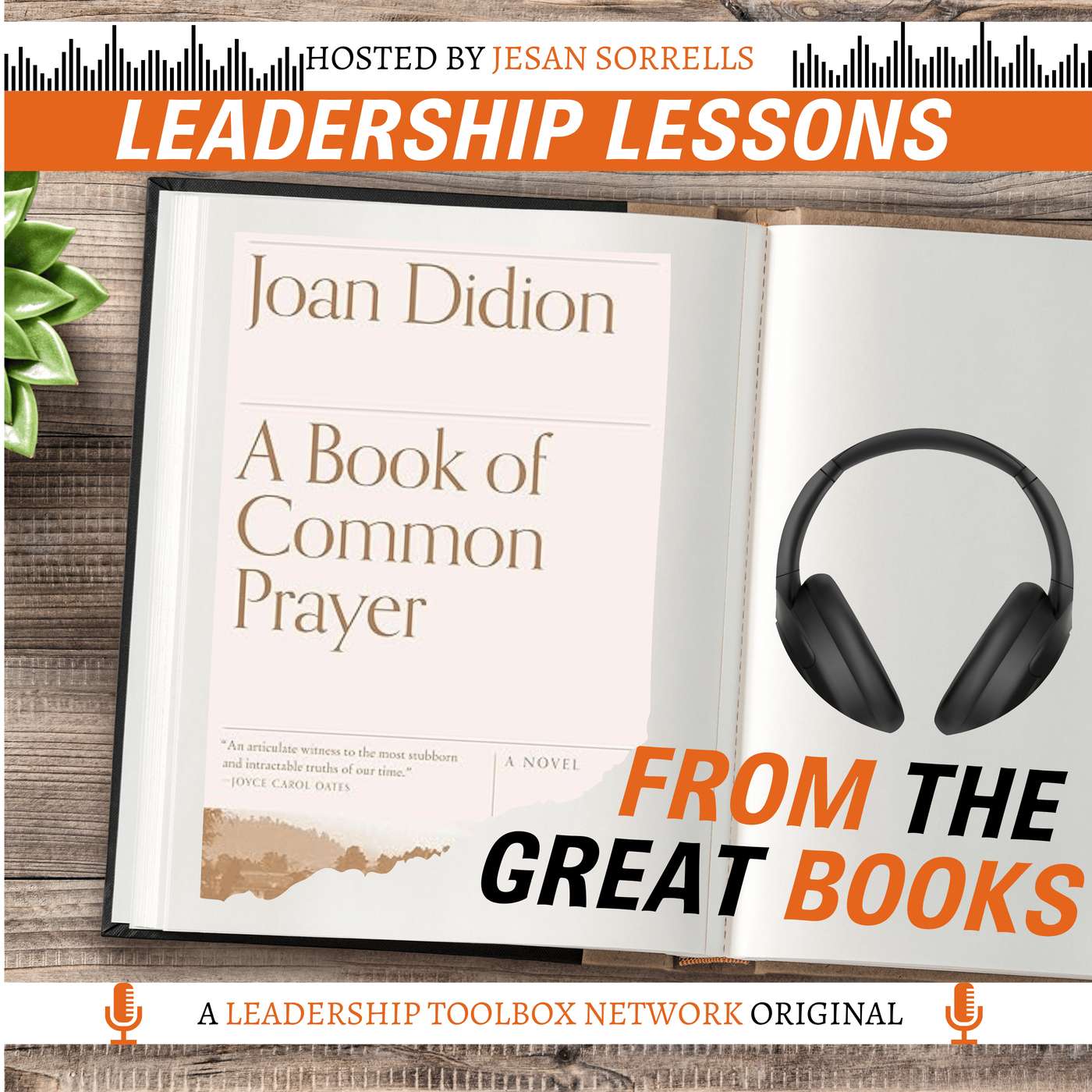
A Book of Common Prayer by Joan Didion w/Tom Libby & Jesan Sorrells
A Book of Common Prayer by Joan Didion w/Tom Libby & Jesan Sorrells
---
Delving into Joan Didion’s A Book of Common Prayer, Jesan Sorrells and guest Tom Libby analyze the intersections of perception, privilege, and empathy within leadership. They discuss the pitfalls of solipsism, the evolving role of journalistic language, and how understanding regional and cultural context is essential for authentic engagement. The conversation expands to address practical empathy in business, the impact of technology on communication, and the necessity of fostering grounded values at home and in organizations.
- Book Title: A Book of Common Prayer
- Author: Joan Didion
- Guest: Jesan Sorrells (Host), Tom Libby (Co-Host)
---
Time-Stamped Overview
---
00:00 Introducing A Book of Common Prayer
07:44 A challenging day so far
12:28 Winning a Vogue essay contest
19:28 Discussing an underrated author
26:48 Discussing editors and literary history
30:45 Discussing LLMs and word precision
36:26 Charlotte at Boca Grande airport
39:28 Joan Didion and Central American conflicts
44:03 Objective reporting in conflict zones
53:59 WNBA pay and revenue discussion
58:28 Nature versus nurture discussion
01:01:57 Self-improvement and career inspiration
01:05:51 Money's Impact on Boca Grande
01:14:35 Discussing sympathy versus empathy
01:21:43 Discussion on failed assassination attempt
01:25:31 Business lessons from the book
01:27:57 Ending the conversation
---
- Opening theme composed by Felipe Sarro - Bach - Silotti - "Air" from Orchestra Suite No. 3, BWV 1068
- Closing theme composed by Brian Sanyshyn of Brian Sanyshyn Music.
---
- Pick up your copy of 12 Rules for Leaders: The Foundation of Intentional Leadership NOW on AMAZON!
- Check out the Leadership Lessons From the Great Books podcast reading list!
---
- Subscribe to the Leadership Lessons From The Great Books Podcast: https://bit.ly/LLFTGBSubscribe
- Check out Leadership ToolBox at: https://leadershiptoolbox.us/
Hello, my name is Jesan Sorrells and this is the Leadership Lessons from the Great Books podcast, episode number 190. What this means, by the way, if you're accounting at home, is we are 10 books, 10 episodes away from our big 200th episode of this show. That means we've really done something. That's all that means. Just means that we've really done something here. So we'll have more updates on that 200th episode and of course you will be joined by our guest co host on that 200th episode and a few other guests if I can wrangle some people together.
So stay tuned to this spot for them. I'd like to open today with a not really a selection, but maybe the first opening lines, the first openings stanzas of our of our book today. And I quote, I will be her witness.
That would translate S Testigio and we will not appear in your and will not appear in your traveler's phrase book because it is not a useful phrase for the prudent traveler. Here is what happened. She left one man. She left a second man. She traveled again with the first. She let him die alone. She lost one child, to quote unquote history and another to quote unquote complications. I offer in each instance the evaluation of others. She imagined herself capable of shedding that baggage and came to Boca Grande a tourist.
Una tourista, so she said. In fact, she came here less a tourist than a sojourner. But she did not make that distinction. She dreamed her life. She made not enough distinctions. She died hopeful. In summary, so you know the story. Of course, the story had extenuating circumstances. Weather, crack sidewalks and paragornia. But only for the living.
When you open up the book here, when you open up the book today, you are introduced to a woman named Grace Strasser Mindana, nee Tabor. She has been for 50 of her 60 years a student of delusion, a prudent traveler from Denver, Colorado. Her mother died of influenza one morning when she was eight. Her father died of gunshot wounds, not self inflicted, one afternoon when she was 10. From that afternoon until her 16th birthday, she lived alone in their in her parents suite at the Brown Palace Hotel.
She has lived in equatorial America since 1935 and only twice have had equatorial fever. She is an anthropologist. Grace is who lost faith in her own method, who stopped believing that observable activity defined anthropos. She studied under Kroeber at California and worked with Levi Strauss at Sao Paulo, classified several societies, catalog their rights and attitudes on occasions of Birth, population, initiation and death, did extensive and well regarded studies on the rearing of female children in the Mato Grosso and along certain tributaries of the Rio Jingu.
And still she did not know why any of these female children did or do not do anything at all. She wound up in a land called Boca Grande and wound up there, well, by plane. Boca Grande is not a land of contrasts. On the contrary, Boca Grande is relentlessly, quote, unquote, the same. The cathedral is not Spanish colonial, but corrugated aluminum. There are no waterfalls of note, no ruins of interest, no chic boutiques. The politics of the country, of course, at first appear to offer contrast, involving, as they do, the quote, unquote, colorful Latin juxtaposition of guerrillos and colonels.
But when the tanks are put away and the airport reopens, nothing actually changes in Boca Grande. Boca Grande is the name of the country as well as the name of the city, as if the place defeated the imagination of even its first settler. And of course, there's this quote in the book and I quote. Boca Grande has no history, the librarian said, and he seemed gratified that I had asked, as if we had together hit upon a catechistic point of national pride.
The book we are going to cover today is a fiction book that reads like non fiction. It reads like reportage. It's the story of a woman who is looking for surety, narrating the life of another woman who is so. And you're going to want to follow the bouncing ball here with me today. So solipsistic, not narcissistic, but so solipsistic that she is perpetually surprised by how other people's minds work, which is particularly relevant for our era where we follow the bouncing ball on social media and through social media posts and even into our own personal lives.
But we really are lacking a deep understanding of how other people's minds work,
exploring themes that we opened the door to in our last conversation in the Optimist's Daughter. And we'll continue on through another book by this authority later on in the month. Today we're going to cover a book of Common Prayer by Joan Didian.
Leaders. One of the things that we're going to pull out of this book is one of the things that we always say. So I'm just going to front load it here. The more things change, the more they regrettably stay the same. And the problem of eyewitness testimony, the problems that we have.
The problems that we have, I thought were problems of a lack of language in order to engage in discernment, to interpret assertions that may be bogus. Bogus, and then to discern and critically think through the challenge of what we observe interpersonally. But I'm beginning to think maybe that the problem
is that we only think that our own minds are sure to exist and we're not quite sure about everybody else's.
My compatriot along this journey today back to discuss the timeless nature of Central American republics, guerrilla republics, particularly like Boca Grande. The 1970s, when a lot of those Central American republics were. Well, they were America's backyard for the battles between the Yankees and the communists, is our good friend of the show and a person who's not struggling with. With understanding other people's minds, but a person with other. Chuckling, Understanding other people's behaviors, just as I am.
Tom Libby. How are you doing today, Tom? Well, based on that intro, I would have to be completely honest with everybody listening right now and saying, I've had better days. You know, like, today is. Has been a very challenging day. I will, however, say by the end of the day, I will have had a good day regardless, because that's just kind of in my personality. So regardless of how the day starts and whatever challenges I face, typically when I say my day is done from, you know, from professional life into personal life, that gets left behind, and it's fine by the time I'm done with it, and then I move on.
So I will be fine. But as of right now, it's been a challenging day so far, if I'm just being completely honest. Absolutely. This is. This is what we love. We love the honesty and the transparency on the show, by the way. I got a. I got a text message from someone who is a listener, and I want to give a. I want to give a shout out to this person early in the show, fellow named Nicholas Jackson. He's been listening to our show and he sent me a text message, actually, which, no, listeners, you don't have the ability to send me a text message on the regular.
No. So sorry. Uh, Nick gets special treatment because, well, he's a personal friend of ours. Well, personal friend of mine, anyway. I don't believe Tom has never met him, but. But Nick sent me this. This text message last week when I was dead sick in the middle of, like, sweating and fever, and I was laying on my couch and my phone happened to buzz and. And Nick almost never texts me unless there's like, an emergency or something pops up or something like that. And he sent me a Picture of the screen in his car listening to our episode from last week, the Optimist's Daughter.
And he said, and I quote, I've really been enjoying your podcast. Your perspective, education, intelligence really shines through in your work here. I think we really have a ton in common when it comes to our thoughts about cultural, religion and the impact of Western culture.
So, Tom, I can't take all the credit for that. That also goes to you. So there you go. A little something else to brighten your day. Look at the day's getting better already.
We're not, we're not just doing unexamined, unrewarded, unrequited humans work here. We're actually, we're actually doing something meaningful. And speaking of doing something meaningful, let's, let's do the transition here. We talk a little bit about Joan Didian. So we've covered two of her books on our show previously in solo episodes. One in the second season of the show, we did Slouching Towards Bethlehem, which was her initial collection of essays that she wrote in the 1960s. And we're going to recover that in an upcoming episode with, with another guest co host coming up here fairly soon.
So stay tuned for that. And then we also covered her first novel that she wrote, Play it as it Lays, a interesting novel about a, about a woman struggling, right. To navigate her life in Southern California while the, while the specter or the idea of the freeway in LA runs through everything. And now. So this will be, this will be Didian's third book that we've covered of hers on this show. So that's, that makes her like, I mean, I don't think we've covered any male author three times here on this show so far.
So that makes her a grand champion. But I don't think I've ever covered her with another guest. Actually, I haven't covered her with another guest until now. So most people, when I introduce them to Joan Didiana, have one of two responses. They'll either say, that's really interesting. And then they sort of like eat the hors d' oeuvre and wander away. Or they will say, oh, I read her and, but, and then there's a whole like thing of string of things after that. Right. Didion was a woman who, a writer who started writing.
She started her career when she, when her mother gave her a notebook, I love this, gave her a notebook as a little girl and told her to write down her thoughts because her mother couldn't be bothered to hear them. I thought was really interesting Didion was influenced by Ernest Hemingway. And I have a quote in here from her about how she did her writing process. But she won an essay in high school. There was an essay contest back when they used to have essay contests. Vogue magazine did an essay contest.
And I think she won it when she was like 17 years old and then graduated high school and went to work for Vogue magazine in, in New York City. So she flew from, from California, where she was born and raised, flew out to. Flew out to New York, lived in New York for a time, became a journalist, learned the discipline of journalistic presentation and, you know, was coming around and was writing essays and writing column pieces and being edited during a time when that was probably the best way for a young writer to actually become honed.
She's totally the opposite of a John Steinbeck, right, who we covered on this show. She was not a working class. She didn't come up from working class back. Well, she came from working class background, but she was not, she was not part of a working class milieu. She never thought of herself that way. But she also never thought of herself as an intellectual or a scholar or, or even particularly a writer. She thought of herself as a journalist. And the many things that I've, I've watched on her, I watched her autobiography that was produced on Netflix about her.
I'm fascinated by this woman because she represents sort of that mid century writing moment, that brief moment between the end of the 50s and the beginning of the 80s when you could kind of get away with anything if you were a male or female writer. Like you really could. Like everything had become really super egalitarian. Magazines like Vogue were publishing really interesting writing, but so was like Reader's Digest and Life magazine. You know, you could open up, you could open up Harper's Weekly and you could see a writing from Hunter.
Well, you could see writing from Hunter Thompson just using him as an example. I'm not saying Hunter Thompson never wrote for Harper's Weekly, but you could. Charles Portis is a better example who wrote True Grit. You could see writing from Charles Portis right next to reporting from Walter Cronkite. Just to use another example of a name that folks would know. It was that weird mid century American moment when high culture and low culture began to merge together and began to overlap and began to influence each other.
And Didion was at the center of all this. Her first collection of essays, Slouching Towards Bethlehem, was written basically because she was asked to go back to California after she quit Vogue. She was asked to go Back to California by the New York Times, who had picked up on her to report on what was going on at Haight Ashbury, because the summer of love was about to kick off. And of course, she was right around the age where you could go and observe the summer of love and not be a part of it. And she did.
And to her horror. And this is where it's interesting. The thing, the other thing that fascinates me about Didion is interesting. Didion was probably the last gasp of California Republican leanings that eventually would become left wing over the course of the 80s and 90s. She was sort of that last gasp of California propriety that was, that was holding back. The Haight Ashberry types who are, in our own era would have, would be the great grandfathers of the folks who are high on methadone and pooping themselves on fentanyl right now in the streets of San Francisco.
That's what Haight Ashbury gets you. You wind up at that spot, at least I think you do. So that's a lot there. I just document dumped on you tomorrow about Didion. And that's really like stuff just for the Wikipedia article and other things that I've been able to gather about her going around. Like I said, most people have not heard of her because she's considered to be a literary writer, not a popular writer. And she was also considered to be a very waspish writer. She was a classic sort of. I write for the New Yorker.
Oh, the New Yorker. And then your voice goes up at the end and you know, you stick out your pinky like you're drinking tea or some crap. So, but, but I think she was a woman who wanted to be read by more people, but was just fine not being read by more people. And I think that's what really turns people off about Didion. She doesn't really care if you don't like her writing or her sentence structure or not. She's doing work and if you want to come along, that's cool, but if not, well, there's plenty of other writers for you to read.
She was also nervous. She was a small woman, so she wasn't that tall and she was little. She was like frail boned and tiny. She was a tiny woman. Although the, the COVID of Sagittari towards Bethlehem that I have, we took a close up of her and she has these big Jackie Onassis sunglasses that like cover half of her head.
And she's so California Waspy specific that she like presents a door even before you've Opened it and most people. We were talking about Eudora Weltley last week. Right. Welty, who, who wrote from a Southern American perspective. Didian definitely wrote from a Californian perspective. Even though she spent a lot of her career and a lot of her life in New York and then went back to California. But Didion didn't care about what was going on in Kansas. She had no there there, and she wasn't going to go have a there there.
And she was fine not having a there there. And so she wrote for a very specific, very specific voice, for very specific audience, and she observed human behavior in a very specific way. And so these are things that fascinate me about Diddy. So again, I just document dumped on you. So just want to give you some time to marinate and think because I know we didn't have a whole lot of time to like give you some research time, but what do you know about Joan Didion, if anything, beyond just what I've told you?
Right. Right now? Yeah. No, so there's very few, I would say there's very few things I know about Didion. But, and I'll give you the one thing, because it pertains to my world a little bit, by the way, so I won't, I won't be able to quote her. But there's a, there's a, there's a, there's a position that she takes that kind of does influence marketing a little bit. Like, I'll explain in a second. So, but to your point, I don't, I never really read her. I never really like, I, I, I've known about her, put it that way.
I know about her, I've known her, I've heard her name several times, but I've never gone out of my way to read her writing for no other reason than the fact that she's always seemed a little obscure to me. Right. Like, she's always seemed to be a little bit outside of the, the huge, the hugeness. Like, so when you think of the Hemingways and the Faulkner's and the Steinbecks, she's never usually in that conversation. So for me, she's always been on like an outsider looking in from that perspective.
I'm not suggesting that she's not a quality writer. The, the reason that she resonates with me and the reason I said what I said a second ago is she had a particular opinion, and I'm going to paraphrase because I don't remember the exact quote, but she had a, she had a particular opinion about the way that sentences are written that makes essentially what she's saying is words matter, right? The way that you place words on a page matters. The order in which you place them on that page matters. And if you use the exact same words and rearrange the order, it's a different sentence that means a completely different thing.
So, and what I mean by and why I say that, that some, Some people in the marketing world know her because of that quote. And again, I'm not quoting it exactly as, you know, like, but there. But if you go back and look at the quote, you'll understand what I mean. Because in marketing, words matter. Like, you have to be. Sometimes when you're trying to be clever, you can be disingenuous. When you're. Sometimes when you're trying to be transparent, you're giving away the farm. Like, there's words matter and how you phrase things matter.
And so she comes up sometimes in those conversations with. Which is why I at least have heard her name before, but never really went out and read her. Now, to your point, about once, I, Once you sent me some of the. The course material for this podcast, and I started looking at it and I, I did find the quote, by the way. I was like, oh, I recognize this quote. I was like, that. That it's the same Diddy and like, it's the same person. I was like, okay, so now I started looking at her writings and stuff, and I was like, oh, interesting.
And to your point about the whole, I found it. I found it interesting, too, that she wrote from behavioral perspective, like an observational behavioral perspective than. Than an experiential perspective. Right? Like, so I think you've kind of alluded to that, but to me, that's a very clear distinction. Right? I'm an observer. I'm going to write what I see. I'm embedded in this. I'm going to write what I'm feeling based on what I'm. Based on what I'm experiencing. So she was a different kind of writer from what I can see based on some of the stuff that you sent to me.
But again, where she fits into my world is that quote. And again, I'm not going to quote it, but just paraphrasing the importance of how you structure sentences and the way that these sentences impact what you're trying to interpret or mean. That all matters to me. Now, one other thing I wanted to throw in here, by the way, because as you know me, I live my life around quotes from famous people and stuff. I, I happen to have Written a book about these quotes. I'm not going to mention the book, but whatever.
But the, but one of the things that I found interesting about your initial commentary in, about eyewitnesses, eyewitness behavior and things like that, it. It reminds me of a quote that is attributed to Albert Einstein most times, but has never been able to be proven that it was exactly him that said it. But the quote is that. And the reason that. And I feel very strongly as to why eyewitness testimony in legal cases is. Is not really reliable. It's is because of this particular quote that constantly pummels my brain every time I hear something like this.
It's. Perception is greater than reality. And again, it's attributed to Albert Einstein most times, but there's no written proof. Like, there's no book or essay he wrote or anything like that that they can extrapolate it from, but it's very commonly given to him. And what I mean, the reason I think that that's relevant to what you were saying is think about this. If perception is greater than reality, and I give people the simplest version of this I can think of, Hasan and I are sitting in a room for 1 hour, 60 minutes.
Both of us leave that room and look at each other. And one of us says, I can't believe that was only 60 Minutes. And the other one says, 60 Minutes. That felt like three days. Well, here's the reality, folks. It was 60 Minutes. No matter how you time it, no matter how you measure it, no matter how you. It's still 60 minutes. Regardless. The both of us experienced 60 minutes, but our perception of that 60 minutes was way more impactful to us as a person. Which means, which I'm getting. I'm circling around to my point here, which means that all of this eyewitness testimony, observation of human behavior, all that stuff is influenced by your own perceptions.
It's not the reality. You're not observing real. You're observing it through the lens of your own, Your own eyes. So it's, it's. It's your perception of that, whatever that reality is, which is. And again, you and I have had several conversations about my frustration with today's version of journalism, which is not.
It's not a perception of behavior, it's an opinion. It's my opinion of that behavior. And it's not reporting just the facts or like giving, you know, the, the exact reality versus injecting my own opinion into what that reality should or shouldn't be or can or can't be. That's journalism. Today, journalism today is not observing human behavior and. Right. And telling us what it is. It's injecting their own opinions. So, again, circling back here. Wrapping up. Wrapping up, I should say. No, no, no, you're.
You're right. Yeah. No. So the. The quote you were talking about from Didion, I'll just give it to the folks here, because I have it here in my. In my course materials for today,
for our conversations. This is actually from her essay published in. I believe it was 1976, if I remember correctly, called why I Write that. She wrote for. For the New York Times. And I quote, to shift the structure of a sentence alters the meaning of that sentence as definitely and inflexibly as the position of a camera alters the meaning of the object photographed. The arrangement of the words matters, and the arrangement you want can be found in the picture in your mind. The picture tells you how to arrange the words, and the arrangement of the words tells you.
Or tells me what. What's going on in the picture. Close quote. Yeah. So now you get what I'm saying. Yep. Yep. Well, and that's very. I mean, she. So she started writing for Vogue, Right? And so, like, back in the day, Vogue wasn't just like this. I remember vogue in the 1990s. It was this magazine that, you know, was the size of, like, a tree trunk. Like, how many trees had to be killed to go into that magazine? Right. Um. All glossy, all filled with emaciated models that look like they needed a meal.
Male and female. I'm not being gendered here. They all look. They all looked hungry and. And. And. And weirdly enough, Vogue always smelled like perfume. And I never, like. You touch the magazine, you're, like, smelling all day. Like, the hell was that? Oh, I just touched a magazine and, like, the newsstand. Like, give me a break. For me, this. For me, that's Vogue magazine. That's not what Vogue magazine always was. Vogue magazine was actually a legit, like, literary magazine back in the day when Didian was writing for it and the editors at Vogue.
So it's interesting talk about this now, because The Devil Wears Prada 2 just came out, and the Meryl Streep character in there is supposed to be based off of whoever the woman was, that Anne Wintour, I believe it was, who was the editor in chief at Vogue. Now, I don't know what an editor in chief does for a glossy fashion magazine these days, but I know what an editor in chief used to do back in the day and an editor in chief back in the day was the person who, to go back to the Didian quote here,
would look at and question your arrangement of words.
This question is not in the course materials, but it occurs to me to ask this. So there's two other authors we've covered on this show. George Orwell, who wrote his great essay on the English language, which we talked about, about the arrangement of words. And then David Ogilvie, we talked about his book
Confessions of an Advertising man, which actually, you and I should talk about that book. It's another one we should go back and revisit, as I talked about it with John Hill and Chris Widener. But we should, we should go back and talk about that book. One thing that, that unites. There's a thread that unites George Orwell to David Ogilvy to Joan Didion. There's a, there's a thread here, and the thread is the idea that words matter, that language matters. Here's the question that's not in the script, but it just occurs to me to ask.
We started off this month with the idea from Seth Godin that everyone's a marketer now, and yet language seems to matter less and less, which is weird because we now have the, like, language prompting machines. Yeah. That we're dumping words in and we're expecting the language prompting machines to suddenly become conscious and kill us all. And I'm not the first person to point out this disconnect like, like there's something we're missing in our current era. And so I guess the question is,
How do we get back to the kind of language discipline? Or is there a way to get back to the kind of language discipline that Didian and Orwell and Ogilvy had in the space of the discourse that we engage in on a regular basis, Is there a way to get back to that discipline?
Because I don't think people believe words make pictures anymore anymore, even though, weirdly enough, again, we have the words machines that make pictures. Right.
That's a, that's a really good question, actually.
I, I think it's less about. And to your point, to your point about the, the, you know, we have machines now that can take our words and turn them into pictures. Right. So you, you can tell, I don't know, Gemini or Chat GPT or whatever it says I want a picture of a person, male or female, you know, whatever, and I want them positioned this way. And, and it will do it, right? For the most part, it'll do it. If your prompt is good enough, it'll give you A picture that you'll go, oh, that's what I was thinking.
So I think we're already seeing what you're talking about in. And you. We've had several conversations on here about the. It's a, it's a, it's a, a better, better example. It's, it's a, it's a clear, it's a clear example of garbage in, garbage out. Right? Like meaning. So therefore you have to be better with your words in that prompt to get out of that LLM what you want out of it. So to your point, I think we are circling it. I think we're just coming at it from a different perspective than we're used to.
Again, you and I grew up in a time where somebody could paint a beautiful picture with a good essay, right? Or if somebody wrote a really well written paragraph or something like that, you can envision in your brain exactly what they were talking about. And more importantly, if two or three people were discussing it, that is Book clubs, if two or three or four people were discussing it, they had the same impression, right? Because writers were writing in such a descriptive way that we could envision it.
Now we're just taking that description and putting it into an LLM so that we can actually see the picture. Instead of talking about the picture, we're actually, we're seeing the picture visually. Now, that being said, I don't know where the impact is going to start and stop with actual writers and having them protect their content to the point where you, you or I couldn't take that content, throw into an LLM and say, give me a picture based on this author's description. Like, so I think that we're in some wild, wild west kind of stuff here with that.
But. And I think there are occasions already where today's version of authors are being a little bit more obscure, being a little bit more vague, so that you can't take their stuff and put it directly into the LLM. But if somebody comes to them and wants to interpret the, their book into a movie, they now get paid as the adviser to that movie and they can interpret what they meant. Well. And I wonder if this. And then we'll circle back to the book, because we got to get back to the book. But I wonder if this answers the question that we, we broached in the Optimist Daughter episode, episode number 189 before this one, where we were talking about regionalism and the regional voice.
And I was saying, you know,
the death of the regional voice in America because of the flattening and the homogenization of Internet culture where everyone has to sound the same as if they came from everywhere. And the, the pressure on a writer to sound unique is incredible right now. Yeah. To push through the noise that's been created by, quite frankly, language and by, quite frankly, a loose, undisciplined, and unserious language that's everywhere. And so the. Maybe what you're talking about, it occurs to me, maybe it resets.
Maybe we do find a Eudora Welty, but it's. She's regional and obscure until she gets plucked by some screenwriter somewhere. Maybe that's the solution to the problem. I don't know. Or the trade off. I don't know. So I. I wonder. I wonder if we're going to get to a point where the writers are going to start doing it themselves, right? So, like, so in the book that they publish, there'll be a little vague and obscure. Then they take their own book and throw it into an LLM and say, create a movie, but add this and that and this and that.
Like, add these components where I left out here and here. And then all of a sudden we have AI generated movie based on the writer themselves injecting their thoughts into their own book.
That's Wild west to do. Okay. I don't know what to make of that. That's definitely Wild West. That's a definitely Wild west idea. I don't know what to make of that. I don't know what Didion would have made of that. But I do know we got to go back to the book,
back to A Book of Common Prayer. By the way, the title of the book, A Book of Common Prayer, does reference A Book of Common Prayer, which I believe, if I remember correctly, is the title of the. It's not West. Yes. Westminster Catechism. I believe, if I remember correctly, and I'm doing that from my brain. And so if I've gotten that wrong and you're listening, email me or text me if you have my phone number and correct me, but I believe it's the Westminster Catechism. So this is. It's a call back to religion.
Right. Which is kind of ironic because of what we're dealing. Not ironic, but it's kind of another. Another layer of meaning from language that Didion is, Is socially signaling by selecting this title for. For the book. Okay, so the book is divided up into five different sections. Six different sections. Sorry. And in each section. Well, not in each section, but the way it's divided up, the. The woman that I introduced at the beginning Grace Strasser Mendana, who is an anthropologist, is narrating the life of.
Of Charlotte Douglas. By the way, Charlotte is a. Is a very special name for me. I'll just leave it at that. So Charlotte Douglas has. Has a lot of problems,
to say the least. Charlotte Douglas is trapped in Boca Grande. Charlotte Douglas might have gone to Boca Grande because she wanted to go to Boca Grande, but Grande is in the middle of. When Charlotte Douglas arrives, it's in the middle of a, well, civil strife, civil unrest. It's in the middle of a civil war, a guerrilla war, actually. And it turns out that the people who are running the guerrilla war happen to be in the family of Charlotte Douglas's husband, making it extra complicated for. For Charlotte.
Now, Charlotte Douglas doesn't really understand what's going on. Charlotte Douglas spends a lot of time at the airport in Boca Grande, which seems to be the place where. And Didion is sort of interesting when she sort of puts this in perspective. It's a place where all the action happens. It's a place where a lot of the negotiations happen, particularly the restaurant at the airport is where a lot of the negotiations around the civil War is where the negotiations around how the war will be, how the government will be reset up.
A lot of these things happen here at the. At the airport. Remember, Grace is reporting on all of this. So we are reading what Grace is reporting on Charlotte doing. So it's a. It's an inversion, right? It's. We're looking at the actions of a person observing the actions of a person through a microscope that's being held by somebody else who's also looking through the microscope.
As you go through the narrative, you also find out that the. Charlotte has had some problems not just with the person she's currently married to, but problems with the people that she. The man she was formerly married to. Charlotte had a daughter and. And Charlotte's daughter. Charlotte's daughter was. Was named Marin. And Marin gets involved with a group of. Well, a group of revolutionaries and revolutionaries in America. And the FBI comes and visits Charlotte because they suspect that Marin, her daughter, is going to contact her.
This is a throwback to things that were happening in the 1970s. Patty Hearst was kidnapped. The heiress. Patty Hearst was kidnapped and. And then was later revealed to be working with the Symbionese Liberation Army. Those of you who are history files can go look that up. But that's what Didion is referring to. And there was a spate of this happening right, where rich young socialites would go off with these revolutionary armies, shave their heads and then start blowing up buildings inside of America.
The FBI clearly took.
How can I put this? They clearly took a problem or they had a problem with this offense to this. They did take offense to this. It's a deep offense to this. And people forget the 1970s was a time of great. Just like in the early 20th century, a time of great anarchy in America. There were a lot of internal civil bombings. There were a lot of these revolutionary groups, not just symbionese, who I've never heard of liberation, but also groups that were in favor of black liberation, women's liberation, gay liberation.
And all of these liberation fronts or liberation groups all had violence and anarchy at the bottom of them. They weren't necessarily about.
Well, Malcolm X had a great, a great phrase. He said, we're either going to solve this with a bullet or we're going to solve it at the ballot box. Right? And a lot of these folks wanted to solve things with the bullet because they thought the ballot box had failed. Didion was in the middle of all this. The other dynamic that's in this is the late 1970s were the beginnings of genuine revolts, like between the Sandinistas and everybody else in San Salvador that eventually of course, would be funded by the Ronald Reagan administration in the United States.
But in the 1970s, all this stuff was getting planted, all these seeds were getting planted. And as a matter of fact, Didion had been sent down to Central America to report on some of these civil wars and guerrilla wars that were going on and these experiences that were written about in her non fiction book, I believe it's called Salvador Influenced Very much A Book of Common Prayer and her perceptions of society and how it breaks down.
Joan Didion did something very interesting that I haven't really talked about since Joseph Conrad's Heart of Darkness, which we covered on the show with Professor Dr. Momin. Quasi. Oh, gosh. Way back in the second season of our show, Didion was the classic, and this is why I mentioned that she was a wasp, white Anglo Saxon, Protestant. She was the classic WASP colonialist going down to Central America, reporting on what people were doing and then being emotionally impacted by it while all the people standing around down there looked at her and said, well, you could always go home Yankee.
Which is the typical response.
Didion took a hard. She took a journey into the heart of darkness of human behavior. And so he wrote a book of common prayer and Salvador, one. One non fiction and one fiction in order to sort of deal with what she saw in the context of her of a life in the United States that was also being written by riven by civil strife. Turns out the Boca Grande isn't just a place in Central America, it's also a place in your backyard in America.
War is a particularly brutal dissector of middle class assumptions about human behavior. And civil war in a foreign country. Is this dissector just taken to another level?
Tom, watching human behavior is a spectator sport. If the New York Times asks you to go to Central America, let's frame it that way. Or some other place like you were talking about in our last episode, talking to somebody from Russia. If you were suddenly asked to go to Ukraine to report on what's happening in the Ukraine and to put what you were seeing in accurate sentences and languages for the folks back home, not for me, I don't live in your local community. But just say folks in your local community, your friend circle.
Or maybe you go to the Ukraine, maybe you're not asked to report. Maybe you go to Ukraine, you hang out, you come back. I know, bed. During early. During the Ukraine war, there were all kinds of like Special Forces guys that were like going off and running off to go fight the Russians in the Ukraine. And I met several of those guys, not who went to go fight the Russians in the Ukraine, but I met several forces, Special Forces guys. And so I understand that mentality. Not understand, but I recognize that mentality.
They wouldn't want to go off and get involved in some Contra Trump like that. But folks who have that are of that mentality don't necessarily always have the words to describe what it is they've seen or what it is they've dealt with. That's why they suffer from ptsd. You, on the other hand, do have the language to describe that. So I'm going to ask you this question. What if it. A little bit, now that I've pre preempted it and built it up. Yeah, I'm going to. I'm going to. What if it.
What if you had to go someplace and see something like the Ukraine or San Salvador in the late 70s that you had absolutely no context for and could not understand? How would you describe it to people coming back?
I would hope that I would be. I would hope that I would be of my own, that I would take my own advice. Right. Meaning if I knew nothing about what the purpose of this war was or what the catalyst of this war was or what the. And I was just going over there to, to observe and report back. Right. Like, I would hope that I would be very
careful on how I worded factual information. Like, because that, to me, that's, at that point, that's the only, that's the only thing that I should be interested in or willing to do is to go over there and basically just report back what I see, what I, not what I feel. I mean, if I'm in the middle of a bunker and I feel the whole bunker shaking because some bomb landed above us, I'm going to be petrified. Right? So now I'm, now I'm writing from a perspective of whoever dropped that bomb is the enemy or the evil one, and we're the good ones.
And that's not for me to say at that point. Who am I? I'm an, I'm an outsider looking in. I have no right to say which one is right or wrong and which one is good or evil. So, and, and whether or not that even exists in this particular battle, so to speak. Right. So I would hope that I would take my own advice and be able to take down factual information, what exactly is happening and be able to report that as fact and not put in any of emotional stature to it. Because that's not what I was there to do, number one, or not.
Even if that is the purpose of sending me there, I don't have any context for it. So I shouldn't have an opinion about it, essentially, is what I'm. My point is. So hopefully I would take my own advice and do just that. Okay, now let's go live in the reality, the real Tom Libby. We've set up the idealized Tom Libby. Okay? Now what about the real Tom Libby? What is the real Tom Libby going to actually do, though? As I can tell you right now, the question is reversed on me and I got to go to the Ukraine and I got to.
I am absolutely going to be emotionally driven. There's just no way around it. Like, it's going to. If a Ukrainian drone strike comes in and I'm in, like, I don't know, or a Russian drone strike comes in and I'm in Kiev, absolutely. I'm going to be cursing Russians. I, I just, I, I'm going to fall into that, that trap of human behavior, right? I'm going to be yelling about sneaky, blankety blank Russians the entire time, right? That's going to absolutely color how I write about a thing, how I text back to my friends about a thing.
That's abs for me anyway. That's absolutely. I'm going to fall into that Pit. I also think time, time of exposure matters, right? If I, if I go there, observe, see a bomb or two, come back, fine, that, that might be one thing, but embedding there, being there for weeks, months, etc. Experiencing this shoulder to shoulder with whomever you're experiencing it with. To your point, if I'm, if I'm in Kiev, I might experience this completely different, as if I was sitting in Johannesburg or St. Petersburg.
Like, so, again, I think, I think that context matters, right? Like, and I think the longer you're exposed to that single side, I think, okay, like, for example, so let's say I. And again, I think the perception here is greater than reality. Again, because take it, let's take two people. You send one to the Russian, like to Russia, one to Ukraine for one month, and then swap them for one month and then have the two of them write their perspective. It's going to be influenced by what hits them first versus what hits them.
Like, all that's going to matter. So to your point about, you know, and you can put yourself into these hypotheticals all you want, but unless you actually experience it, you have no idea how you're going to respond to this. So this is, this is the point I was making about middle class assumptions. This is the point I was making about middle class assumptions. So we like to do these thought experiments and we like to say, well, if I were this or if I were that or if I did this or if I did that, people rip on Didion.
This is one of the main critiques of her that. Matter of fact, a friend of mine, actually, who's from New York City and is very well read, very literary, knows quite a bit about her and he just totally dismisses her. He's like, no, she's a New York Times, she's a New Yorker writer, she's irrelevant. She's blah, blah, blah. She's all these things. She, she in his brain. She check marks all of the boxes for white supremacy. Okay, all right, fine. That's one man's opinion. That's fine. You're allowed to have an opinion.
I think that
the fact that she was able to go to places where. No, let me wind this back. There's a lot of talk about privilege, right? And privilege is tied to colonialization. And this is an argument that I, I know is probably close to your heart, Tom, because of just the things you do and all of that. I think privilege is the wrong term to use. I've long thought privilege is the wrong term, term to use. I think it's, it's the wrong language to use to describe a frustration that we feel. And the frustration that we feel is a person who looks or is a certain you of a certain economic status gets to, when I use that term in air quotes, go to someplace else, observe I use that term in air quotes again and then report back.
And the people who that person is in air quotes observing, those people don't get a voice. They don't get to talk. And we somehow think that that is unfair. We somehow think that that is an unbalanced reporting or an unbalanced observation or an unbalanced witness.
Except the thing is,
and I got to be very careful how I frame this because it's the truth, but this is going to be a truth that hurts like a lot.
Throughout the entire history of the world, there have been billions, damn near trillions I would assert, of people who never got a voice regardless of their circumstances. So if there is a argument from. And again, I don't like the word. If there's an argument from advantage, I'm not going to use privilege. If there's an argument from advantage to be made, it's not an argument that argues with the particular, certain current cultural, historical or even past cultural historical circumstances that allowed that advantage to happen.
I believe fundamentally the argument should be why haven't those circumstances happened other places and why can't they?
But that's considered to be, weirdly enough, when you make that argument, Tom, that's considered to be a right wing argument. Yeah. And that, and this is not about wings, this is about human flourishing. And I don't know that human flourishing is benefited by someone showing up, watching me suffer through a civil war, not lift a finger to help me and then go back and report. I'm more irritated about that.
And I'm just going to kind of leave that argument there because that is the, that is the crux that people have a problem that people have on the left. If we're going to make it about politics on the political left in America. That's the crux of the problem they have with reporting. They think reporting isn't activist enough, isn't picking up the, the gun and shooting the, the Yankee funded rebels who you know are Yankee funded enough. Right. Or picking up a gun and supporting the Marxist rebels who are just trying to bring in the glorious revolution, fight the power.
And then you layer in individual things like what's going on in your own country, in your own backyard, from the siby, the Symbanese Liberation army and Patty Hearst all the way up to.
Well, all the way up to people who we have currently running for political offices all over the country. I'll just leave it at that. And this is a real problem in our time that we've politicized and we can't get clarity on it. And I think Didian was caught in the middle of that as a writer. She was caught in the middle of that transition that occurred starting in Vietnam. That's when all this carping really started and has continued on through our time, through the war on terror and through now the Russian Ukraine war.
I mean, it came to a really sharp point with the Israeli Palestinian war that is now currently died down but eventually will flare back up at a certain point in time in the future or whatever it is we're doing in Iran. It always shows up with geopolitical events. It always does. And it's always the same, it's the same argument. We don't have the same argument since Vietnam.
Interesting. So I, I don't have. I don't know, I guess I, I'll try to use an example of that, like to your, to your point, the problem that, you know, advantage, etc, I'll, I'll try to use an example that I feel is like, really shouldn't be politicized. And it's, it's kind of pretty matter of fact in my brain anyway, but yet it constantly gets bombarded with these kinds of political and left and right kind of things. Right. So sports, right. When you look at. I'll just take the, the easiest example I can think of, which is the NBA versus the wnba.
And there's a lot of people out there that think that women should be paid equal and equivalent to men in every aspect of life. But when you look at the NBA versus the WNBA and you say, all right, the highest paid player in the NBA should be the same as the highest paid player in the wnba. The reality of it is the wnba, the whole league, doesn't make enough money to pay that one player. So it's, it's a very, to me, it's a very practical matter that the WNBA needs to be better at raising their revenue in order to pay their players.
It's, it's that simple. You need revenue to pay your players. And the idea that somebody should just give you the money to do it, that is asinine to me. So because there's been some, some chatter about the NBA essentially subsidizing the WNBA for some of this financial, some of the financial pieces, and I just don't Understand the logic there. Like, so my what I, to your point about why can't it happen elsewhere? Like, I don't remember exactly the phrasing of it, but in my brain I'm sitting there thinking about it going, so why aren't women who are super successful, there's plenty of women that are super successful.
Billionaires, billionaire women. Why aren't they looking at the WNBA as something they can go help and they can inject advertising dollars, et cetera, whatever, into the league to make it better? Why do successful women not want to participate in the, in the wnba? Because successful men dump money into the NBA. Like, oh, I can tell you what the, I can tell you what the answer would be. The answer would be that those successful women have internalized to the patriarchy.
That's, that's the answer that's always given. Oh, no, but hold on, hold on. So you're. Yes, yes and no. I'll agree, I'll agree to it if you just rephrase it in a sense that, that, that the, the women, those ultra successful women have bought into the late stage capitalism and they see that their money serves them better if they put it into the NBA too.
That's, that's what I think the problem is. They're, they're not looking beyond like, okay, my money can earn more money, my money can earn more money if I give it to the NBA. The NBA. And as ass advertiser, I'll take a discount and put it into the WNBA if it helps women. Right. Like, and I think that's a microcosm of what I think you're talking about here. Right? Like, why can't people just help each other? Meaning like if, if I grew up in the ghetto and I make it rich, why am I not going back to that ghetto and developing programs for accelerating brilliant students or accelerating super athletes or whatever.
But like, but we don't think like that. We feel like once we cross a certain threshold, we now no longer belong in that group that's being suppressed and we're part of the advantage. So we're just going to go run with the advantage. Right, Right, right, right. And so again, the people who would say, well, the problem is they just internalized name your patriarchy or they've internalized racism or they've internalized misogyny or whatever. Right. And I find the internalization counter to that to be thin on the ground.
Yeah. Matter of fact, I find it to be so thin it's almost non existent. What is far thicker is, and I don't think we're at late stage capitalism. I think there's way more capitalism to be had in the bucket. But let's go. I understand, but. I understand what you're. But. But I'm going to use that framing. I'm going to use that framing because that framing, actually, I think if we're going to talk about language more accurately and narrowly describes exactly what is occurring without reference to external factors that have been out of people's control for
time. Out of mind since. Since, in my opinion, yours. Yours will vary. I'm saying it's my opinion since God created the earth. Been. Been. Been out. Out of our hands. Out of our hands. I can't do.
Race may be a social construct, but melanin content is a reality. It's greater than reality.
You know, my, my genes,
you know, my chromosomes have determined certain things.
You may have an opinion about what those certain things are. I may have an opinion about what those certain things are, but it doesn't change the reality of the chromosomes. And if you're paying attention, you know what I'm talking about. That's why I'm kind of dancing around that one. Okay. Because I don't feel like getting any more trouble than we're wandering into getting into right now. As far as money and status and things that are changeable, the United States of America, pound for pound, is still the best system in the world for changing your status if you actually want to put in the work.
And if you put in the work and your status doesn't change. Individualism. Right. If you put in work and your status does not change.
I don't know what to tell you. I really don't. But how many times have you seen that happen in your lifetime, though, Hasan? Oh, a lot. I see people who put in the work. Well, I won't say a lot. No, no. In my opinion, it's not often. Usually you're finding people that are quote, unquote, putting in the work, but they're not really. Right. They're saying they're putting in the work. But are they really? And that's the problem that I think that most people, because running on a hamster wheel at 100 miles an hour is not putting in the work.
No, no, it's not stopping. Stepping out, understanding your strategy, reinventing yourself. Re like, that's like, that's putting in the work. Like you're not, you can't just. You can't wake up and say, I want to be a millionaire, and then tomorrow you're a millionaire. Like but well, to your point about the America being the best, it's still the best system on the, on the planet. Well, that is 100 true. Because if you think about it, per Capa, we still have the highest number of billionaires, the highest number of millionaires and the highest number of people.
Now, that being said, we probably, we also have the highest number of people living per capita in poverty. Correct. But that's just because we're also, population wise, in the top five of the world of population. We are a very large country. We're not. That's like saying India should have less poverty. Even more so than that. Even more so than that. There is a biblical principle that sits behind this. Matthew 25, you know, if you put in more, you're going to get more. Jesus said this, if you put in more, you're going to get more.
And if you put in less or nothing, guess what? Even that that you had at the beginning will be taken away from you. It's called the Matthew principle. Economists have tested this because it seems brutal, it seems vicious, and it seems. I'm going to say the word unfair, except, and I think I mentioned this before on the show, but it's been a long while.
In my house, we abandoned the word fair by the age of like 12. My 9 year old boy has another 3 years to use the word fair. And then we don't talk about fairness anymore. We just talk about reality. You put in the work, you're going to get an outcome. You may not be the outcome that you like and it may not be the outcome that you wanted in comparison to somebody else, but it is an. Is it an outcome that you got that is better than the outcome you could have gotten yesterday? That's the only measurement.
Are you better today than you were yesterday? If the answer is yes, great. If the answer is no, well, you got some things you want to work on. That's, that's. Now that people hear that and they go, well, that sounds brutal. No, that's the reality that we are all facing out here. And so Didion, if I wanted just to bring it back to our book for just a minute, if I wanted the career that Didian had, I have to do the things that Didian did. Yeah. I have to make the decisions Didion made all the way from
when she took her mother seriously about writing down her thoughts that her mother didn't want her to bother with her when she was like nine or ten and gave her a notebook. Nine or ten, that's when it started. It didn't start when she got to go to San Salvador and write about rebels. She was just dropped into that. It was a step by step by step progression. You can argue privilege from that, but a, a notebook in California in the 1950s was probably 5 cents. Now, did the mom have to scrape to get to the 5 cents?
Sure. Because like the value of a dollar was more. It was pegged to the gold standard, blah, blah, blah. You can make all of these whatevers, but I mean, she would have given her two sheets of paper. Two sheets of paper. Now how many. Now the question of course you can ask is, well, how many other little girls at nine got notebooks from their mom? They didn't become Joan Didion,
play it as it lays to pray to give another book title. But like, those little girls didn't make the correct decisions. And this is the brutal like reality of late stage capitalism. And I think, and this is my concern, I think it's going to become more and more brutal as we go along. Not less and less in a lot of different places. Like we already mentioned the LLMs, but like the moat. We said this last episode on the Optimist's Daughter. The moat between people who would understand how to operate the language machine and those who treat it like a Magic 8 ball is just growing by.
It's just growing like this. And all the people who, who treat the moat, who treat the thing like a Magic 8 ball, they're all going to be mad that somehow the people who didn't treat it like a Magic 8 ball, that somehow those people did something wrong or they're going to start having the vantage point that, oh, well, they're probably, they're just, they got better training than I did. They're smarter than I am. They get, they're always, there's always going to be an excuse as to why somebody advances and you don't.
Right. They had privilege
or, or they are. They bought into the, the LLM driven patriarchy. The llmicry or whatever it'll be called in the future. Is the LLM part of the patriarchy. I need to not understand this before I get. Go much further down this pathway. You be careful, Tom. We're already down the path. We're already in trouble.
That. Back to the book.
Back to the book. All right.
Want to sum up this book?
Towards the end of the book, we get to the. The beginnings of. And I'm glad, I'm glad Tom brought up capitalism. The beginnings of capitalism begin to invade Boca Grande with the discovery of oil. Interestingly, Enough. So Didion hit all the marks. Right.
Book five opens up with. I love this line. It says, oil wells about to come in have a sound that the attentive ear can detect, as do earthquakes. The only person who would know about this is someone who lived in California, where there are both oil wells and earthquakes. That's the only way she could write that. Written that line. That's brilliant. Like, I underlined that line twice. I was like, that's genius. And she inserted in here to open up the door to the idea that, you know, el Presidente is now being seduced by oil companies and has to get kidnap insurance, as do regular people, because now there's so much money that is beginning to flood into Boca Grande that it's beginning to change the tenor of how the Civil War actually occurs, or whether there will be a civil war in the first.
In the. In the. In the first place at all, or whether we're just going to all try to get rich together.
Money warps everything, by the way. With the money, of course, comes boutiques and the idea of film festivals that Charlotte is involved in writing the names of actors and directors and agents. And as you sort of flip through this book, there's a sense of solipsism from. From Charlotte that Grace, as she's documenting Charlotte's life, really begins to pick up on. And solipsism. I had to kind of look up this term, right? It's this idea of philosophical solipsism, and it's this idea that I'm reading directly from the Wikipedia.
Solipsism is a philosophical idea that only one's mind is sure to exist. There is no shared reality as an epistemological position. Solipsism holds that knowledge of anything outside one's own mind is unsure the external world and other minds cannot be known and might not exist outside the mind. Close quote. Now, this is something that infants tend to have as babies, but then they. They tend to mature and they tend to grow into what's called a theory of mind. And a theory of mind is the idea that we all have running around.
It's the idea that's driving this. This podcast right now. I believe that Tom has a mind with his own experiences and his own values and his own context, but that I can tap into that mind. And while I may not be able to 100% understand it, I can at least make an effort towards that. And Tom believes the same thing about me. That's theory of mind. And by the way, I believe it about you all you listeners out there, even though I cannot see you, and even though you may be listening to this at some other.
Some other place in time from when it was originally recorded. So theory of mind is supposed to defeat solipsism, because what theory of mind does is it brings along empathy. Yeah. One of the challenges of our time is that we are not the witnesses we want to be. Because just like Grace with Charlotte and just like all of us looking at things happening on our phones, this is one of the great insights I had today that sort of turned my mind away from what I originally submitted as the course material for today to a different direction.
You like that phrase? You like that phrase? I do. Like that phrasing. I like that phrasing. I think we're going to adopt that. I think we're going to keep that
we. I was drawn into the idea that. I think the challenge or the thing that Didian was hitting on in A Book of Common Prayer and in a lot of her other books up to. I think, particularly when she wrote in the 80s and 90s. And then I think that sort of stops with the Year of Magical Thinking, which was the. The book that she wrote about the death of her son, or not her son, her husband and daughter. And daughter. Yeah. Gregory Dunn. Yep. And Quintana, which is a great book. I listened to that. I listened to that on audiobook, by the way, your Magical Thinking, it's one of the better memoirs I've ever read about death and dying and about how like, you actually deal with that in a way that wasn't grief streaking or weep or weepy, but you could tell she was grieving like it was.
It was kind of amazing, actually, to sort of see that kind of happen.
I think the problem is a lack of empathy. I think that's our core problem. I think we pretend we have empathy these days. And that's where the phraseology like, well, that person has privilege or that person doesn't have privilege. And so we're going to stand up for the underprivileged or we're going to stand up for the disadvantaged. I think that's where that's coming from. But then the practical action behind that doesn't actually show empathy, even when the practical action is protesting or standing in front of the cars of ICE agents or whatever.
Right. I don't think that's a practical exhibition of empathy, matter of fact. I think it's actually more of a exhibition of more solipsism. Not narcissism, by the way. Narcissism is a. Is a psychological diagnosis, right? It's a. It's a medical diagnosis. And so we use the word narcissistic because we don't, you know, the word solipsistic. And they're. They're words of describing two different. Not. No, they're. They're two different words that are describing the same psychological thing or philosophical thing that's happening.
But one I think is within our ability to actually solve. The other one, I think is not in our ability to actually solve and actually hardens. So I think narcissism hardens, but I think solipsism, you can actually solve if. If, if.
Well, I wrote it down here. If you're faced with resistance, challenges, and disagreements from other people consistently over the course of time, I think that that is what cures solipsism more. So many of us are, like, walled off into our little gardens on our phones and our little whatever that we don't have, and we're surprised by the way when someone comes in from the outside and challenges us, and then we just wall it off a little bit more and a little bit more and a little bit more. And the algorithm likes that because, like, that just means they could sell us more ads inside of that little.
Inside of that little garden. But the other downside of that is that we're no longer shocked into incoherence when we do actually see genuinely tragic things. Things. And I think back to the example that popped in my brain is the assassination of Charlie Kirk. Like, we weren't but five minutes away from that before the meme started. It was disgusting. We should have all been shocked into incoherence. And I think many of us were, but not nearly enough and not for long enough. And that's what solipsism gets you, is a lack of practical empathy.
I think this is a real problem for leaders, Tom. I think it's the problem that's the poison that never gets talked about, because it's really complicated and it's really hard to spot. I also think that we don't want to acknowledge that it might be inside of us. We may not be all that empathetic. And if we admit to that out loud, then that means we're not nice. And that's the big sin of our time, is that we just are not nice. Oh, God forbid you don't be nice. You know, I guess you're into a lot of trouble.
So kind of stumbling on this and thinking about this. Science can tell us, like, the what of human behavior, but it cannot tell Us the why. And I think philosophy could tell us the why. And philosophy is where solipsism comes from or that idea.
And the story that you told us in the last episode about, about the n. The native dances like that has really stuck with me because I really do think that that's emblematic of what I'm talking about here. I think all those things click together. The, the lack of understanding from the 14 year old that can just watch it on YouTube, links into the solipsism that we're all experiencing online. And they're just a second generation of that. Which also links into the inability to be shocked into incoherence by genuine.
I mean a murder that occurred in public that would have, in any, any other time in our culture would have rocked us into incoherence for at least a couple of years. Like I think about after Kennedy got shot, like the country didn't come back from that for 10 years. Right. And that wasn't even, I mean it was in public, but it was recorded on the Zapruder film. But like it wasn't an immediate like trauma. It was a gradual trauma that rolled out over time if people were still sensitive enough to be shocked into incoherence by even just hearing about it.
So that's a big hairy. I've linked a lot of big hairy ideas together and that's what we do on this show. You can't see him on the video right now if you're listening to this on audio. But Tom is looking at me like, where are you going to land this plane? Well, no, no, no, not at all, not at all. Because I'm thinking like again, as you're, as you're walking down this, this, there's, to your point, there's so many things that are popping into my head, like just to give you snippets of it, like, I think sometimes we confuse sympathy and empathy.
Like I think, I think being sympathetic to somebody's plight is different than being empathetic and understand. Like being able to understand and put yourself in somebody else's shoes and like all that stuff that's, those are two different things. But yet I think society as a whole sometimes confuses the two. And I think sometimes that confusion not being explained to, to people at a younger age is a problem. So to your point about the phones and all that other stuff, like, I, I agree with that.
I agree with the, I, I think the difference, some of the differences between the Charlie Kirk thing and the in the JFK thing, I think there's several, several layers of issues as to why it, it impacted us differently. One of which, as you said, the rollout right today, everybody knew about Charlie Kirk literally within minutes. The entire country knew about it within minutes. So you get that incoherent. Ex, that incoherent, Sorry, how do you phrase that? The, the shock to do a coherence like that.
The shock of incoherence happened basically all at once and then diminished all at once versus Kennedy kind of. It happened and then it happened and then it happened and then you were talking to people. Did you hear? Did you hear? Did you hear? And you were experiencing it over and over and over. You yourself were experiencing it over and over. Now, I wasn't alive when Kennedy was shot, but I'm just, I know it wasn't the same thing, but for me, like, when Reagan got shot, I was still in school. Same idea.
We didn't have this, this social media stuff that when Reagan got shot. So I heard it in school, then I heard it at home, and then I heard it like it was all this thing like, and I was young enough to, to not really give a crap who the president was. Right. Like at that age, but it was still the president. So to me, it didn't matter whether it was a Democrat or Republican or it was. To me, that position of power was all that mattered. Like, somebody in that sense, seat could get shot than anybody in the world could get shot.
Right? Like, it was, like it was impact, to your point, it was impactful. It was hugely impactful. So I think that there's, that, that speed of information is something that impacted that dramatically. And again, whether, whether I think that the Charlie Kirk assassination was impactful or not impactful is not relevant to my statement because I, I don't. Quite honestly, I, I am a little surprised it didn't impact us a little longer. I, I, you know, again, whether you're right or left, it doesn't matter.
This is a human being we're talking about that just got killed for no, no good reason. It's not like, it's not like he was in the process of doing, committing a crime. It wasn't like somebody literally just didn't agree with him politically and shot him. That to me, is the most asinine thing I've ever heard of in my life. So again, I did have some shock and a, like in. Right, right, whatever. But to your point, I think there's also. And you, you and I talk a lot on these podcasts about film and tv, and I think there's been a huge Desensitization based on what we see on our phones and in the movies.
And like, we glorify certain things that we see in real life and go, well, yeah, like, because we just saw, we just saw Jason Statham do it or we just saw. Yeah. You know what I'm saying? Like, yeah, we glad. Glorify these things in video so that. Why are we now surprised when something happens in real life and people are desensitized to it? So, yeah, again, I'm not suggesting it's a good thing either. I, I think this is absolutely horrendous. I think it's dreadful that people blur the line between reality and, and fantasy.
And I think that line is getting more and more blurry the more and more we look into these things and we, you know, and the more and more that, the more and more we. We don't teach our kids. You, you and I have had this conversation I don't even know how many times at this point. All of the stems at home. I hate to tell you this, people, but all. If you are relying on the, on, on general media or the general population or the government, or if you're relying on somebody else to, to fortify your children with morals and ethics, ethical.
Or ethics and a moral compass, you're going to fail as a parent. All of this stuff starts at home. So again, stupid, small little things. When we sit down as a family at the dinner table, nobody has their cell phone. It's not allowed. Cell phones are not allowed at the table. And by the way, my children are now all adults and they still don't bring their cell phones to the dinner table. Like, it's stuff like that, that, like, even if it seems small, it's impactful. Like, so again, I, I have five children.
They're all over the place when it comes to political views. I did not raise five Democrats or five Republicans. They're all over the place. But yet every one of the five of them were a little shocked that Charlie Kirk got shot. All five of them. That's, that's, that's the success. That's it. And I can't talk about. But that doesn't happen if you're allowing public schools to tell your kids what morals and ethics are. And that's not what happens here, people. This starts at home. You should be starting this stuff at home now, by the way, I'm not suggesting that if you're a Republican, that you should raise a group of Republican children or if you're a Democrat, you should raise a group of Democrats.
No, you should empower them to be able to go and make their own decisions, look at differences. But they have a foundation of right and wrong. They have a foundation of what's ethical, and they have a moral compass. And that moral compass again. In our family, whether you're left or right, you view each other as a human being first. You view each other as family first. No matter what happens in that political arena, you are family. And you can agree to disagree anytime you want and walk away. But we're losing touch with that type of stuff with strangers.
We just are. And that's how you combat solipsism. That's how you combat it hardening into narcissism. That's how you. There's a commentator, years ago, I, I can't remember his name, but he talked about how, how people were divided. People were divided. People are divided by the narcissism of small differences. And that's exactly correct. This is what. Is what, Tom? This is what you're talking about, right? Like, I don't know of any other laboratory in the world that's better for fixing this problem than the family.
Because guess what? That's where it all starts, too. To Tom's point, I'm going to back him up. When you outsource your children to the government,
some of those teachers are really, really good. Don't get me wrong, there's many teachers in the public school system. They're really, really good. And they're doing humans work. There's also some who are not good and are not doing the yeoman's work. Yeah, Case in point, the guy who just tried to assassinate Donald Trump at the White House correspondence dinner. Not a lot of conversation going on about the fact that that guy was like a middle school teacher up until the day before he decided that it would be a really good idea to storm the Secret Service and shoot everybody at the dinner.
What do you think he was standing next to your kids saying when you weren't there? Because this stuff doesn't stay contained inside of a container. And this is what a Book of Common Prayer is about. This is. This is what Joan Didion was even talking about back in the 70s. People knew that it doesn't stay inside of the container. Technology is just another facilitator of getting it out. But it's the problem. Horatio doesn't lie in the phones. It lies in ourselves. That's the thing we have to fix.
That's the thing we got to work on. That's the thing. If we want to have Real empathy. If we want to start having really awesome conversations around the dinner table, then, yeah, we'll be contentious and, yeah, there will be disagreement and yes, we will. May have to agree to disagree. And by the way, agreeing to disagree, agree, that's okay. That means that I may not like them for a minute, but this isn't going to rise to the level of, like,
whatever level it is that we think it should rise to, like, the. The amount of. Of caterwauling that I see online, particularly around, you know, major public holidays like Thanksgiving or July 4th, you know. Oh, oh, should I go spend time with my family because, like, they're all Republicans and I'm a Democrat, or should I go spend time with my family because I'm a Republican and they're all Democrats? What are we talking about? You. Are you telling you have no other relationship out with your family outside of politics?
Yeah, like that. That, like, hurts inside. That hurts deep. Like, really, if I just couldn't imagine. I could not imagine one of my kids not coming home for. For visiting, like, because I had a little bit too far of a right or a little bit too far of a left opinion about something. Right. It should happen. It shouldn't matter.
I'll close with this, by the way. Go pick up a book of common prayer. It's going to open up all these kinds of doors in your head. Didian doesn't resolve anything at the end with Charlotte, nor with Grace. Grace determines that she has not been the witness that she wanted to be, because Grace is looking for something that's definitive. She's looking for.
She's looking for a very specific solution to human problems that are messy. She's bought into the scientific idea that, by the way, the technologists bring us as well, that if we just put everything inside of these nice, clean boxes with clean lines, everything will just cleanly work out. And it isn't the boxes of the lines. It work because human beings, as we pointed out in Notes from Underground by Fyodor Dostoevsky, go listen to that episode. Human beings will break those boxes out of spite.
They'll break those boxes because they want to prove themselves to be human. We don't like to be in boxes, and we like the fight. Pointed that out in east of Eden, too. And that's okay. We were wired to do that by God or evolution or whoever. We were wired for that. Which means if you want innovation and creativity, if you want to move things forward, you've got to accept the good with the bad. That's also part of reality. And Didian gets to that in a Book of Common Prayer.
We kind of wandered all over the place. Tom. This was a heck of an episode. Final thoughts what should leaders take from this book? I think there's a lot leaders can take from the book, but I think, I think that if you go and you think about the, the, like, what we just went through on, on, like what, what we just talked through throughout all this, I think, I think there's a couple of things that pop out to me. You talked about regionality, so I do think from a business perspective, understanding local context matters.
I think if you, you're. And again, especially from my world, if you're marketing and you're putting up geofences for your SEO or you're putting up. I think that you really have to understand, if you are a nationwide company, how to market and speak to the people of particular regions. And I think that, like, we've talked a little bit about that, so I think that's a lesson they can learn based on what our conversation in this book about making sure you understand the locality and the localness of certain conversation pieces.
I think there's other things, like the fact that the book has a narrator. It often, oftentimes reminds me of things like don't fall in love with your own narrative and make sure you're making business decisions on what actual data is telling you to do. And don't fall in love with the, the, the experience of your own, you know, theories. And, and, you know, don't revolutionize the circle. It's. Circle's still a circle. So if somebody's looking for circles, circle, sell them a circle, don't sell them a square.
You know what I mean? Like, don't, don't fall in love with it. You have to be on. So there are certain things like that, that if you are reading this book and you're listening to this podcast and you're thinking about it from a leadership perspective, I think there's several layers of things like that that you can kind of pull out from here. But overall, I just think, you know, we, it's, it's, you know, you just gotta stay true to yourself and stay true to your. Your stay true to your customers.
Don't worry about what your thoughts and your narrative is and what your story is and all that stuff. It's. You gotta, you gotta know what you're selling, who you're selling it to and why they buy it. If you know those three things, you'll be fine. Well, and that's and that's real empathy with your customers, by the way. Yeah, that's real empathy. That's real, practical empathy that will allow you, when your customer is wrong, to actually treat your customer like a human being when they're wrong, rather than like a data point or a number.
All right, I'd like to thank Tom Libby for coming on the show today. We gotta wrap up. I got a hard stop at the top of the hour. Thank you for coming by, my friend. I will see you in a couple weeks. Always my pleasure. All right, take care. Thank you. And we're out.
 Apple Podcasts
 Castbox
 Castro
 Goodpods
 Moon FM
 Overcast
 Pocket Casts
 Podbean
 Podcast Addict
 Podcast Republic
 Spotify