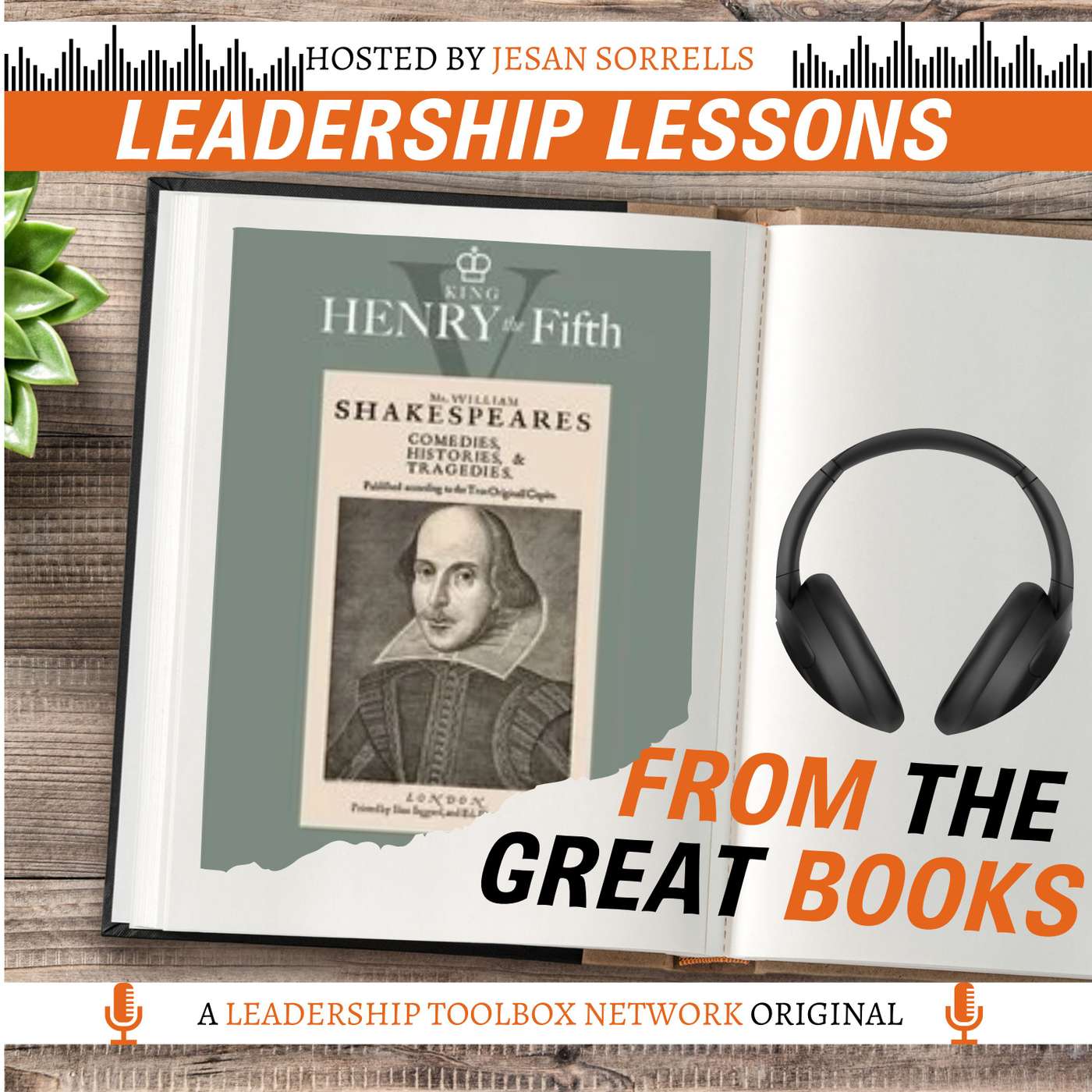
Henry V by Shakespeare — Legitimate Authority and the Leader Who Rebuilds (w/Zac Stucki)
The Life of Henry V by William Shakespeare w/Jesan Sorrells and Zac Stucki
---
Delving into William Shakespeare’s The Life of Henry V, Jesan Sorrells and Zac Stucki analyze the cultural foundation of leadership, the decline of cultural confidence in Western societies, and the complex responsibilities leaders face when making consequential decisions. They connect Shakespeare’s lessons on accountability and mentorship to today’s leadership crises—highlighting generational gaps, the impact of cultural narratives, and how leaders can prepare to uphold a standard in turbulent times.
- Play: The Life of Henry V
- Author: William Shakespeare
- Guest: Zac Stucki
- Host: Jesan Sorrells
---
Time-Stamped Outline:
---
00:00 Debating France's royal succession
21:07 Discussing OK Boomer Cultural Dynamics
24:34 Emergence of New Political Powers
42:06 Discussing future Shakespeare episodes
43:58 Portraying the French as complex characters
01:00:11 The thin red line of America
01:05:25 Shakespeare's historical context and audience
01:23:28 Defining true intelligence beyond academics
01:31:32 Child's simple requests for water
01:46:11 Current insurgency tactics and alliances
01:55:04 Post-War Nuremberg Trials Discussion
02:00:40 Discussing moral standards and politics
02:15:59 Discussing King Harry's Agincourt dilemma
02:28:08 Learning from older generations
02:35:29 Wrapping up the podcast episode
---
- Opening theme composed by Felipe Sarro - Bach - Silotti - "Air" from Orchestra Suite No. 3, BWV 1068
- Closing theme composed by Brian Sanyshyn of Brian Sanyshyn Music.
---
- Pick up your copy of 12 Rules for Leaders: The Foundation of Intentional Leadership NOW on AMAZON!
- Check out the Leadership Lessons From the Great Books podcast reading list!
---
- Subscribe to the Leadership Lessons From The Great Books Podcast: https://bit.ly/LLFTGBSubscribe
- Check out Leadership ToolBox at: https://leadershiptoolbox.us/.
0:34 1. Hello, my name is Jesan Sorrells, and this is the Leadership Lessons from the Great Books Podcast, episode number 199.
0:52 Yes, I've done 199 of these. I know, right? Who does 199 of anything? And following this episode will be our big 200th episode. And there's going to be a lot of folks that are going to be on that show. You're going to want to tune in and watch it. It's going to be, it's going to be a little bit of a, it's going to be a little bit of a Donniebrook. Or if it's not going to be a Donniebrook, it'll be one until a Donniebrook shows up.
1:23 I'm going to go open, as I usually do, from our play today because we are closing out our month of Shakespeare with some lines from one of his more titular plays. And I quote from The Bishop of Canterbury, Act 1, Scene 2. God and his angels guard your sacred throne and make you long become it. King Henry. Sure, we thank you. My learned lord, we pray you to proceed and justly and religiously unfold by the law. Wait, wait, wait. I'm going to cut you off here just a second, Jesan. Do you want me to be Canterbury and you can be Henry, or do you want to do vice versa?
1:59 This is Shakespeare. We got to act it, dude. Sure, we can go ahead and do that. Let's go ahead. Yeah. All right. Sure. You go ahead. You're Bishop of Canterbury. I'll be Henry. Go ahead. All right. God, God and his angels guard your sacred throne and make you long become it. Sure, we thank you, my learned lord. We pray you to proceed and justly and religiously unfold why the law Salic that they have in France, or should or should not, bar us in our claim. And God forbid, my dear and faithful lord, that you should fashion, wrest, or bow your reading, or nicely charge your understanding soul with opening titles miscreate, whose right suits not in native colors with the truth.
2:40 For God doth know how many now in health shall drop their blood in approbation of what your reverence shall incite us to. Therefore, take heed how you impawn our person, how you awake our sleeping sword of war. We charge you in the name of God, take heed, for never two such kingdoms did contend without much fall of blood, whose guiltless drops are every one a woe, a sore complaint against him whose wrongs gives edge unto the swords that make such a waste in brief mortality. Under this conjuration, speak, my lord, for we will hear, note, and believe in heart that which you speak is in your conscience washed as pure as sin with baptism.
3:27 Then hear me, gracious sovereign, and you peers that owe yourselves, your lives, and services to this imperial throne. There is no bar to make against Your Highness's claim to France but this which they produce from Pharamond: interum salicum mulieres ne succedent. No woman shall succeed in Salic land, which Salic land the French unjustly glose to be the realm of France and Pharamond, the founder of this law and female bar. Yet their own authors faithfully affirm that the Salic land is in Germany between the floods of Sala and Elbe, where Charles the Great, having subdued the Saxons, there left behind and settled certain French who holding in disdain the German women for some dishonest manners of their life, established then this law, to wit, no female should be inheritrix in Salic land, which Salic, as I said, twixt Elbe and Saale, is at this day in Germany called Meissen.
4:34 Then doth it well appear the Salic Law was not devised for the realm of France, nor did the French possess the Salic land until 401 and 20 years after defunct King Pharamond, idly supposed the founder of this law, who died within the year of our redemption 426. And Charles the Great subdued the Saxons, and did seat the French beyond the River Sala in the year 805. Besides, their writers say King Pepin, which deposed Childeric, did, as heir general, being descended of Blithild, which was daughter to King Chlothar, Make claim and title to the crown of France.
5:16 Hugh Capet also, who usurped the crown of Charles, the Duke of Lorraine, sole heir male of the true line and stock of Charles the Great, to find his title with some shows of truth, though in pure truth it was corrupt and naught, conveyed himself as there to the Lady Lingère, daughter to Charlemagne, who was the son to Louis the Emperor and Louis of Charles the Great. Also King Louis X, who was sole heir to the usurper Capet, could not keep quiet in his conscience, wearing the crown of France, till satisfied that fair Queen Isabel his grandmother was lineal of the Lady Ermengarde, daughter to Charles the foresaid Duke of Lorraine, by the which marriage the line of Charles the Great was reunited to the crown of France, so that as clear as is the summer's sun, King Pepin's title and Hugh Capet's claim, King Louis has satisfaction, all appear to hold in right and title of the female.
6:21 So do the kings of France unto this day. Howbeit they would hold up this Salic law to bar your highness claiming from the female, and rather choose to hide them in a net That amply to embar their crooked titles usurped from you and your progenitors. May I, with right and conscience, make this claim? The sin upon my head, dread sovereign, for in the Book of Numbers it is writ, when the man dies, let the inheritance descend unto the daughter. Gracious Lord, stand for your own. Unwind your bloody flag.
7:02 Look back into your mighty ancestors. Go, dread lord, to your great-grandsire's tomb, from whom you claim. Invoke his warlike spirit, and your great-uncle's, Edward the Black Prince, who on the French ground played tragedy, making defeat on the full power of France, while his most mighty father on a hill stood smiling to behold his lion's whelp forage in blood of French nobility. O noble English, that could entertain with their half— with half their forces the pride of France, and let another half stand laughing by, all out of work and cold for action.
7:42 We'll pause right there. Our guest today is right. You got to read Shakespeare. You got to, you got to play the play. The play is the thing.
7:59 In our country today, however, We have leaders and politicians who, much like the Bishop of Canterbury there, and even King Henry himself, sound very convincing when they make the case for engaging in warfare and conflict. The problem, however, with their, with many of their remonstrations to battle is twofold. One, less than 0.5% of the available male population in the United States of America Has even placed themselves into a situation through voluntary military service where a bullet would fly past their head in the last 40 years.
8:37 And 2, the number of people who have experienced life outside the school to elite job in politics pipeline has become very, very thin.
8:49 For older leaders, like the Bishop of Canterbury and Bishop of Eli and on the French side, Exeter, in this play. This is a real problem from the mentorship and succession perspectives. This is, this is a real challenge, this lack of life experience. But for younger leaders, it is the same problem, but from a different, and dare I say, an even younger angle. It is a problem most notably defined by the King of Israel, who came after the great King Solomon and then proceeded to listen to the advice of his younger advisors rather than the older men who had Faithfully advised his father.
9:25 King Rehoboam is who I'm talking about, and King Rehoboam's problem is the same problem that the king in our play has today: how to lead when you don't know enough to know what questions to ask, or really, in some cases, what to do in the first place. Our play today, as you've already heard and seen if you're watching the video, features some of the most famous speeches in the Western literary canon and tradition.
9:54 Yet the flowery nature of the language employed by our author elides a deeper truth. Leading people in real meaningful ways through real meaningful sacrifice requires men— and yes, I am saying men here— men to be grave and not double-tongued, not given too much to wine, and not greedy of filthy lucre, as well as being found blameless and being the husbands of one wife, ruling their children and their own houses well. And the fact of the matter is, we've actually forgotten that at this stage in the Republic, much to our dismay.
10:36 But I believe it can be recovered if we actually read and understand plays like the play we are reading and trying to understand today. So today on the show, We are going to be covering the Folger Shakespeare Library's edition of The Life of Henry V by William Shakespeare.
11:00 Leaders, at the end of the day, you as a leader are responsible for every action that happens under your purview and under your leadership. And you are accountable for addressing every outcome Even for the decisions you didn't make. And by the way, that's a good thing.
11:24 And back to discuss probably the most famous play in all the Western literary tradition, person who jumped in and helped us out here, who is going to stand in the role of the Bishop of Canterbury and probably a couple of other roles as we read through this play, our sections here today, is our co-host back from episode number 150, where we discussed Sun Tzu's The Art of War. Hello. Zach Stuckey. How you doing, Zach? You know, I'm doing great. I got to listen to Henry V like 3 or 4 times. I got to watch Tom Hiddleston play it.
11:59 It was awesome.
12:03 So I'm going to start off with that, the Tom Hiddleston version. So
12:10 one of the things that you can tell, we've talked a lot about this in our covering of our Shakespeare plays this This year on the podcast, right? So we've covered Macbeth. Those of you who haven't listened to that episode should go check that out in episode number 197. And then we covered the tragedy of Coriolanus with, with John Hill, my good friend John Hill. You should go check that out. That's episode 198. And now we're covering the life, the life, not the tragedy, the life of Henry V, which I find interesting here in episode number 199.
12:43 One of the things that we've noted in all of those is that
12:48 those plays have all been updated film-wise, right, within the last few years. So I watched a version of Macbeth that had— that co-starred— well, what's his name? Oh, I'm gonna pull it up here. Hold on. I always forget his name.
13:10 Here we go.
13:17 It wasn't Patrick Stewart, was it? It was not Patrick Stewart. It was another English actor. He was in— oh gosh, it'll come to me in a minute. I always forget his name. But Marion Cotillard was Mrs. Macbeth, Queen Macbeth in that version. Oh, Michael Fassbender. I always forget. So Michael Fassbender played Macbeth. And then Marion Cotillard played Mrs. Macbeth, played Queen Macbeth. And then in The Tragedy of Coriolanus, I watched the version that was directed by Ralph Fiennes and co-starred Vanessa Redgrave, who just chewed up scenery, and an actor who never mails it in.
13:59 I always have to say that, Brian Cox. Oh, yeah. Brian Cox always brings it. He never He never halfway does anything. He, he was great. But the, one of the things I noted with reading Henry V and then going and looking for a film version of Henry V was that, and I did note the Tom Hiddleston version, but I noticed that, that, but that's a, that has been not, that wasn't a movie. That was a BBC play that was filmed. It, it was a 2-parter in a TV series that— It was a 2-parter on TV. That's even, see, to me, that's even worse because The last genuine film of Henry V that I could find, and maybe you can correct me if I'm wrong, was the one that was directed by Kenneth Branagh in 1989.
14:43 Yes. So, so there, Henry V is very interesting to me because it comes up culturally at different periods in English history, and it seems like they bring it back. Like, I don't know if you ever read Red Storm Rising by Tom Clancy, but he talks about how they bring up Alexander Novaleski or something like that, and his Russian defeat of the Poles. And whenever they're getting ready to do something patriotic, the Soviets— like some expansionist thing— the Soviets would show that on their TV.
15:19 It feels very similar to me with Henry V, where you've got the heart of World War II, you've got Laurence Olivier in 1944 doing Henry V. '44. Yep. And then you've got BBC doing a full televised play in the late '60s, early '70s, right? This is right in the heat of the Cold War. And then you've got 1989, which is right around the Falklands War. And then you've got they're doing it today. And each one has its own unique mood. Each one has its own unique things that they decide to cut out. The only one that, that is the full text is the 1960s BBC one, which is interesting to me.
16:02 But, but the Olivier one, the Kenneth Branagh one, and the Tom Hiddleston one all have different things that they've chosen to cut and different things that they've chosen to feature. And it's very interesting, the messages that that sends about what the culture feels like it's facing in that moment. So one of the challenges that I think is available to us right now, and we'll, we'll get into sort of the more— not esoteric, but the more practical areas of this. of this play in a minute. But one of the more interesting factors to me is the current— currently British culture is
16:46 struggling to define what it means to be British. Yes. And in doing this in the midst of If not the dissolution, the defense, the defenestration of NATO in the face of, in the face of Russian aggression, if we're going to frame it that way. So you have the defenestration of NATO. You have the French, interestingly enough, doing French things. French people, the French government doing French things, you know, being sneaky and conniving and going around and doing the things that the French typically do, um, because they've determined that they're the only near-peer power they have.
17:32 They've already determined internally that they're the only near-peer power that's going to run the continent in the next 100 years. They're the ones. And then you have the Germans who've basically been defanged and are done. Yeah. And so the British are having an external identity crisis in the face of old enemies, uh, enemies that Shakespeare would have recognized. Yes. While at the same time having an internal identity crisis because of immigration and because, uh, yeah, mass migration, not immigration, but mass migration into their culture while also trying to figure out how to keep the lid on, for lack of a better term, nativist English folks in the countryside who actually do know what it means to be British and actually do believe in Britain as a nation state and as a culture.
18:24 And so it doesn't surprise me that there would be things cut out. What surprises me is that no one— and this is why I, I sort of pin— I put a pin in the Kenneth Branagh version. That was probably the most full-throated version of Henry V, and I don't know that you could do a full-throated version of Henry V today. Am I incorrect in my thinking on this? I think that I would say yes, but with a caveat. And that is, is that you see Henry V as a placeholder for England in these productions. And so at that time where you've got the Falklands War, you've got— shoot,
19:16 why am I blanking on her name? Iron Lady. Oh, Margaret Thatcher. Yes, you have Margaret Thatcher who's in, in Downing Street. People know what it means to be British. Like, they're, they're not afraid of that. And so, like, you're in the midst of this war. And I don't know that Kenneth Branagh would like that we're saying this, but you know what? He can deal with it. I'm still a huge fan, but he can deal with it. The fact of the matter is that
19:46 because the English knew what it meant to be English and the British knew what it meant to be British, they could be that full-throated. Henry could be that full-throated. But what you see in the Tom Hiddleston version that's very interesting is he's very much looking elsewhere for guidance. Mm-hmm. And the way that he plays the performance is I need to learn how to become a king. That's how he's playing the performance. I, I, but, but, you know, listening to some of this
20:25 lecture and analysis of the text, it's very interesting because there, a lot of the scholars are saying, no, Henry comes into this play knowing what it means to be a king. Yeah. And so it's, it's interesting to see, to your point, that I don't think that given the current political climate, they could make a Henry who knows exactly who he is and who is, who is coming in as a king doing king things. And that's why I think it's particularly salient to the conversation now, because a lot of young adults, a lot of young leaders are learning what it means to be a leader because frankly, the older generation just hasn't done a very good job of teaching us.
21:07 Yeah, and we're going to get to, we're going to get to the dynamics between, which I haven't really sort of done a full-throated addressing of that, of that, those dynamics on this show, but the dynamics of the sort of OK boomer, the very online OK boomer sort of, and I've been watching this coming around for like the last 10, 5 to 10 years, like just growing and growing and growing and growing. And now it's starting to spill over into, I was talking with somebody on another project that I'm involved in.
21:33 Now it's starting to spill over into researched books, which means it's about to next spill over into public policy, which means after that it will spill over into law. And that is the progression of things, of moods out of culture that then wind up creating laws that bind us in ways that we would not have asked for and are unpredictable to us and to our nature because The thing is, and I, as a Gen Xer, I say this with all love to my brethren generation, a couple generations below me. I hate to be the bearer of bad news.
22:14 You're all going to get old.
22:19 I hate to be the bearer of bad news. Like, I hate to, I hate to be that. And eventually you too will be part of a generation who will be crapped on by people who come after you. So maybe a little humility on your part might be a good idea, but we'll get into that in a second. We're gonna, we're gonna, we're gonna get to that in a second. I want to just add to what you're saying. I would argue that we're already seeing it enacted into laws now, but okay. Yeah, we'll have that discussion later. Yeah, we'll dive into that because I think, I think the life of Henry V Particularly in the, in the first setup that we read here, you know, Bishop of Canterbury, the bishops that he had surrounded himself by, these advisors, these were older men.
23:01 And these were older men advising him on the, as I said before, the casus belli, the reason to go to war. That's why I picked that section to read. And the Bishop of Canterbury later on, of course, reveals, you know, he wants to really sort of figure out how to get money and how to, you know, sort of, in essence, manipulate tithes and keep money flowing into coffers. And he's leveraging war in order to do that.
23:29 There's another dynamic in here that I find interesting. So one of the interesting things about The Life of Henry V as a play is that it is a play that covers warfare and politics and the civil authority and how they all interact. And of course Shakespeare is writing this in the 17th century, or, well, the late 16th, early 17th century, during a time when the printing press had only been around for about 200 years. The religious wars of Europe were grinding on. England and France were mortal enemies locked in mutual embrace, and also the North American continent had begun to open up.
24:17 So Queen Elizabeth had sent out folks, you know, the first colony was going to be established at either Jamestown or Roanoke was going to happen well within— well, not within, but just a little bit outside of Shakespeare's lifetime, but they were really amping and ramping up for this. Yeah. And so a new world was opening up, new vistas, new horizons. There was going to be wars over who was going to who's going to have a right to own these new lands, right? Who was going to— who's going to be able to engage with that?
24:47 And at the same time, you have the conception of the king versus the— well, no, not really versus, but you have a concept of a king who operates not as a theocrat, But operates with theocratic tendencies because the king is a representative of the church. He's also the representative of the government. He's representative of a lot of things on earth. Now, England was the first place where this started to break in really interesting ways in the 16th and 17th century. But the fact is that when we read this as Americans, and this is where I'm going to come to this now, as Americans, I think Americans have always struggled after you get past the rousing speeches.
25:32 that are in Act 4 and Act 5 that Henry gives to his troops. After you get past the rousing speeches, I think most Americans step off the boat with Henry V because there's so much, it's so English and we're on the other side of a lot of those arguments. Yes. And so the appeal to us as Americans is, yes, we're having rousing speeches, rousing leadership speeches, you know, band of brothers and, you know, forward into the breaches once again, dear friends. You know, we have these, well, we had anyway, Up until about 30 or 40 years ago, we had these phrases that were in the common lexicon because I remember my grandmother, you know, having me memorize one of the speeches in Henry V because it was just a good diction thing and Laurence Olivier did it.
26:19 And so I could be able to, I should be able to do it. And there were a lot of guys in my generation, my grandmothers who sort of, you know, forced them to do this. Right. Um, but there's no emotional connection to it. Um, like I'll be, I will be honest. Yes. I, I don't think I've ever admitted this on the show so, so forthrightly, but I will say this. I don't care much for royalty. I find royalty to be a, to be kind of an anachronism, not kind of, an absolute anachronism, particularly in light of what America has proven.
26:50 Now, if it were, if it were 1775, if this were 1775, we're doing this podcast in 1775. Number one, it would be a miracle. But number two, if we were doing this podcast in 1775, I would have a different opinion for sure, because the cultural things on the ground would just be different. And I can understand royalists and I can understand, you know, Americans who are, who would be considered to be rebels, who we would call patriots now in our time. I can see the distinction, right? And I would probably have been a royalist.
27:24 I probably would have been. In the year of our Lord 2026, though, I gotta be blunt. I don't have much use for King Charles. I think he's a shoddy, shabby old man. And I think the royal— I think, I think all of the royals should go away. They're just rich twit people that don't produce anything. Meghan Markle being like one of the big examples of marrying a rich twit, marrying into other rich twits. Why do I care about these people? It drives me absolutely crazy that we spend any amount of time talking about them.
27:52 And this is not just— the English are the biggest ones to like target to hit. But like, I don't even care what like Like, I know, I think Sweden or Denmark or one of those Northern European countries still has a queen, a king, something. I don't care about any of you. You produce— both of them do. Okay. You produce nothing. You have no use. And I know I've heard the arguments from Jordan Peterson about like the embodiment of God on earth can't be in the president because it's too much to hold into one body and we need to have all— I love you, Jordan, but I don't buy any of that.
28:24 I don't buy any of that. I don't buy any of that. You agree. But I will say this. Now, I said my— I've been blunt in my critique, and I have deep reasons that are logical as well. It's not just an emotional reason, but I do have a visceral opposition to them because I don't see them producing anything. I don't see them making the world a better place in real material ways for real material people. Now, with that being said, I will give this caveat. Yes, Princess Diana walked around and held the heads of babies in Africa that had flies in their eyes and made a better world for those babies.
28:58 And I think she was an outlier in that family. Queen Elizabeth. Oh yeah. For all of her awesomeness at being a little old lady who just like held up standards. And she was, she was a little old lady who held up a standard. She really did. I admire her for that. But quite frankly, and I even think she probably suspected this, she had outlived her usefulness. I think she probably suspected this. And this is why she held on for so long because she looked at the sons she had. not just Charles, his brother Andrew too, who's on the Epstein Island list, and went and looked at all that and went, oh crap, I can never die.
29:37 I have to hold a standard. And unfortunately, from the Pope in Rome all the way down to the homeless man in the street, death comes for us all. And death came for the Queen. I think she is the passing of— she was the— her passing was the passing of a standard. And now we're into a different— we're into a post-standard era. And that's a whole different kind of— that's a whole different kind of conversation. But my larger beef with them is just the idea of a king, just the idea of a king, the idea of a queen, the idea of these people that, again, you're not going out in the front of a military.
30:12 King Charles isn't going to jump off a boat and go like, go get like a drug dealer. He's going to hire people to do that. He's not going to go to Africa and hold babies' heads. He's not going to do any of these things. So what, what value do you actually have? What, what do you, why do you, why does your position exist anymore? And this is, this, no, this is, I think this is interesting and this ties into what we're talking about in terms of leadership and what we're talking about in terms of Henry V, right?
30:40 Because Henry V is the embodiment of what it means to be English. And I guarantee that we'll see probably in the next 10 years, another production of Henry V that will talk about, you know, the current problems that England is facing then, or it will be that we've triumphantly overcome these problems, and it will be either a complete repudiation of Henry as a weak leader, or it will be a full-throated, you know, I'm Henry and I'm awesome. But I think that the royal family, bringing it back to what you're talking about, the royal family's purpose in an industrialized world.
31:19 And I think that Queen Victoria really struggled with this because, to be quite honest, the monarchy probably could have ended under Queen Victoria and, and the world would not demonstrably change. Right? Right. You still have World War I, you still have World War II. Like, the world doesn't demonstrably change. What Queen Victoria established is the role of the monarchy now is to uphold what it means to be a British person. And now the Queen held that standard to what you were talking about. Queen Elizabeth II held that standard.
31:55 But then when she died, King Charles is repudiating all of that now because the monarch is supposed to be the defender of the faith and the head of the Anglican Church. But I was in London last March and, you know, I went to Westminster Abbey, loved it, toured a couple of cathedrals. But the thing that was interesting to me was that this was after King Charles came to the throne, that there was a complete lack of, this is Christ's church on the earth. Even the, even the clergy were like, yeah, it's all just kind of relative.
32:34 And like, I get it, when you have a church that's established by King Henry VIII for the exclusive right to be able to divorce and behead your wife because she won't give you a male heir, then yeah, you're gonna have some relativistic tendencies. That's a good observation. You're gonna have some problems. You're gonna have some challenges.
32:52 But, but my point is that, that, that lack of King Charles upholding this is what it means to be British bleeds into the rest of society, and it creates all of these cultural problems that are now being discussed. And now you have parties like, what is it,
33:14 Reform UK. I can't remember, but there's another party. It's like Reform and Restore UK that are going back and forth against each other. One's Rupert Murdoch, the other one's Nigel Farage, and they're at odds. And they're both sort of this conservative wing of the party that's like trying to define what it means to be British in the face of what a lot of English people feel is an invasion and a repudiation of their English identity. And I think that for leaders, this is an important lesson because we have a responsibility to set the standards for the people that we lead.
33:58 And that gets back to my point about Queen Elizabeth II. You know, I admired her because she held— she figured out, to your point about Queen Victoria, and I hadn't really sort of clicked it together that way. So that's useful for me. Thank you for that framing. And to your point, she saw what Queen Victoria had done because she was a student of history. And of course, she was educated in the old ways. She, she came to the throne as a young woman. Young leaders, this is something to pay attention to.
34:30 She came to the throne as a young woman who understood what the one or two things were that she actually had to do.
34:42 And then everything else was sort of negotiable, right? And one of those things, and it is a heavy thing, is to, to your point, uphold a standard. Because for, for a lot, and this is another, another challenge I have with parliamentary systems just in general. In parliamentary systems, the prime minister basically can't tell you, no, not basically, can't tell you. And I'm looking at you, Keir Starmer, can't tell you what it means to be culturally nationalistic. They can't, they can't define a national culture in a particular way because that power or that ability has been taken away from them and has been imbued into the monarch.
35:28 Okay. And this is back to Jordan Peterson's idea of the monarch being you know, the, the figurehead for, to your point about the church, yes, the church, but also all this national identity stuff. That way it doesn't land in a prime minister. The reason I think Henry V doesn't land for many Americans or lands for us as an anachronism is because we think we've already solved that problem because the Constitution And we did our month on the Constitution, so y'all can go back and listen to those episodes and hear what I'm thinking about the Constitution now.
36:07 But, you know, we're in our 250th year right now, this year. And in 250 years, we've basically laid everything. We've laid the weight of what it means to be an American, what it means to be a member of the United States of America, a citizen of this country. We've laid that weight on documents. And the documents outlast the human being, which is why George Washington, even though he was offered the opportunity to rule for life, very wisely, and probably for selfish reasons that were just due to him, because he was just like, I just, I just want to go back to Virginia.
36:48 Just, I just want to be left alone. Like, really? Yeah. You know, you'll just leave. I got to get out of here. Don't ask me to do anything more. You've asked me to do enough. Um, but like Cincinnatus, right? Like the Greek Cincinnatus, you know, he put down the rulership. If he hadn't done that, we would be in the same, we would be in the same problem where the man is now higher than the documents. And now you got to re— you got to rejigger out the man. You got to recycle the man every single time.
37:18 Whereas in America, we flipped that and we don't even think about, think about the implications of flipping that or the implications for leadership in flipping that. And don't get me wrong.
37:28 We're running into problems now, particularly with the legislature, with the Congress and the Senate and how all that works. Or sorry, not the Congress, sorry, the House of Representatives and the Senate and how all that works and where power is actually imbued. We're running into major problems with that. And I've mentioned that on this show before, on major issues with, you know, the, not just the Senate, but also increasing, well, increasingly the Senate, but already the House of Representatives being, you know, basically a platform for 585— well, no, 415 or 485 people, however many it is, um, now to basically just dunk on each other on Instagram.
38:04 Like, come on, you're supposed to be ruling, you're supposed to be making law, you're supposed to— or if you're not doing that, get the hell out of town and go home, right? Like, what are you doing? Like, we don't need more of you dunking on Instagram. Like, I'm looking at you, Marjorie Taylor Greene. I'm looking at you, Jasmine Crockett. I'm looking at both of you. You're both a part of the problem. Yes. But so we've gotten into problems with that, where you rest the power of the nation or the identity of the nation state on the documents, not on the human beings.
38:34 So I'm not saying there's a perfect solution. I'm just saying America has pursued a different route. And that route comes with certain assumptions that then when we come to the life of Henry V as a play, We bring those assumptions with us and they're just unstated. And we go, why am I reading this? Like, who's this English guy? Why do I care? And I think we should care. Don't worry. I mean, I absolutely think we do. We should care because I'm bringing it to us. I think we should care. I think there are things in here we need to pay attention to, but I think the lessons are a little bit different for Americans.
39:06 Go. I'm sorry. Well, and I think that, that for older generations, that is the case. But I will tell you that for my generation, we have a complete wasteland in terms of civics education.
39:20 Like, but I will tell you that in high school, we were required to take a US civics course. Do you want to know what that consisted of? It consisted of a presidential factoid of the day and watching Mr. Smith Goes to Washington. That was all I remember about that civics course. And so I had to teach myself how the Constitution functions, right? So for like being an American for a millennial and younger, has no meaning, right? Mm-hmm. And so now the younger generations are doing exactly what you're talking about.
39:57 We're looking for paternalistic figures and maternalistic figures to take on that role. The king traditionally took on that role for people, particularly at the time of the Revolution, because if you look at the arguments against and for the breaking of ties. It was, you know, we're going to be left without someone to come and get our back if the, if the French come and decide to do that. Yeah. It was all this sort of paternalistic fear stuff, like we need a big brother, we need a daddy to come and take care of us.
40:31 And the founders were functionally saying, no, that's not the case. So while I agree with your argument that, that being an American really means almost like joining the Church of America with your, your scripture is The Declaration of Independence, the Constitution, and the Bill of Rights. Like, and if we agree on, on those fundamental principles as enshrined in those documents, then yes, you're an American. I think that my generation hasn't been taught that, my generation and younger. And so we don't know what it means.
41:03 And so I think that what you would find is that for a younger generation listening to and watching and interacting with this play would resonate differently than, you know, your generation and older who has a more robust understanding of civics.
41:23 Back to the book or back to the play. Back to The Life of Henry V by William Shakespeare. By the way, part of the Henriad of, of plays. that Shakespeare wrote. So he wrote plays about Henry V, which of course we're reading today, Henry IV. I believe he wrote like 3 plays about Henry IV, if I remember correctly, and then a play about Henry VI. And so there's, there's a lot of different, different, different ways in which leadership can sort of be pulled apart as we look at these plays and as we look at these, as you look at these writings.
42:04 Of course, we're focusing on Henry V today. In future episodes, in future years, we will get into Henry IV, and we will get into, like I said, Henry VI, and of course Richard III, which is another famous Shakespeare play that ties into interesting elements about tyranny and what that actually looks like when the person that you've picked The man you've picked turns out to have feet of clay, as men always turn out to have feet of clay. All right, so let's go to— let's see, let's go to Act 3. So Scene 1.
42:50 So when we— as the play goes through, and I'll kind of do a brief sort of summary here for folks— As the play progresses, We actually wind up going back and forth and looking at sort of what the French think about what's about to happen to them. And of course, the English setting up their, their casus belli for invading France and for, for taking over and for having a battle, for removing folks from the throne and for, for Henry V advancing his cause, right? We see the conversations that the Bishop of Canterbury and the Bishop Eli are having in the English court.
43:26 But then we also see the conversations that the French are having, uh, the Dauphin and Exeter, right? And they're sort of— Well, and we're going to talk about the French here in a little bit because Shakespeare doesn't create straw men. He doesn't create fake characters here. He does something that a lot of a lot of modern or postmodern analysis sort of elides or goes past. He sets up the French as fully fleshed-out human beings. And yeah, they may not be taking the, the threat from the English that seriously, but they are also not just flippant caricatures, right?
44:14 They're not, they're not straw men or cardboard stand-ins. These are people who who are thinking, who are feeling, who have certain opinions about what is happening to them and about the blood that's going to be shed in this battle that they're— with these battles that they're about to fight, and also have their own motives that are mixed just like the English. And so in this play, if you're going to read it, what you're going to see is real human beings engaged in real— engaged in real human ways, trying to figure out what happens When the battles begin.
44:50 Speaking of the battle beginning, so again, we're gonna go to, uh, we're gonna go to Scene 1, okay, of, uh, of Act 3. We're going to start off with, well, as I said, one of those, one of those famous, uh, those famous speeches. All right, The Life of Henry V, Act 3, Scene 1. Enter King of England, Exeter, Bedford, and Gloucester. Alarum. Enter soldiers with scaling ladders at harfleur.
45:25 Once more unto the breach, dear friends, once more, or close the wall up with our English dead. In peace there's nothing so becomes a man as modest stillness and humility, but when the blast of war blows in our ears, then imitate the action of the tiger. Stiffen the sinews, summon up the blood, disguise fair nature with hard-favored rage, then lend the eye a terrible aspect. Let it pry through the portage of the head like the brass cannon. Let the brow overwhelm it as fearfully as doth a galled rock o'erhang and jutty his confounded base, swilled with the wild and wasteful ocean.
46:03 Now set the teeth and stretch the nostril wide. Hold hard the breath and bend up every spirit to his full height. On, on, you noblest English, whose blood is fet from fathers of war-proof, fathers that, like so many Alexanders have in these parts, from morn till even fought and sheathed their swords for lack of argument. Dishonor not your mothers. Now attest that those whom you called fathers did beget you. Be copy now to men of grosser blood and teach them how to war. And you, good yeomen, Whose limbs were made in England, show us here the mettle of your pasture.
46:41 Let us swear that you are worth your breeding, which I doubt not, for there is none of you so mean and base that hath not noble lustre in your eyes. I see you stand like greyhounds in the slips, straining upon the start. The game's afoot. Follow your spirit, and upon this charge cry, God for Harry! England and St. George. Alarm in the chambers go off and they exit.
47:13 That is one of the most famous speeches in all of Western literature delivered by a king who,
47:27 if we were probably to actually look at his age, Probably wasn't much older than 22, maybe, maybe 23, might even only been 18.
47:41 And Henry in this play, let's talk a little about him as a, as a, just as a character, just as a person. Henry is young and impetuous and ego-driven and status-conscious. He's also aware, and you could tell by this speech, that war has a cost and that other people will pay, not necessarily him and not necessarily him directly, but other people will pay this cost. And so he has to, he understands that he has an obligation, he has a responsibility, has an accountability to these folks, and not just an accountability to get them to move forward into cannon's breach, as it were.
48:21 But, uh, he has a responsibility to give them a reason to even get up in the morning, to even engage. Now, Henry's advisors, uh, from the Bishop of Canterbury on down, are scheming and conniving, and they are looking for easy answers to hard problems. And of course, they discover, as do all such people, when the shells start flying, that the shortcut is usually the long way around.
48:51 To Zach's point about not understanding or not, not, not under— it's not not understanding, not being given the appropriate education around civics until he independently pursued it later on.
49:04 To his point about that, only those who have never sacrificed can mock or dismiss or look for motives that aren't there in the strength that they don't understand and can't identify with. That Henry begins to show the first glimmers of in this speech. In the life of Henry V. So here's a question for us to really think about. Once more into the breach, dear friends. That used to be the rallying cry to courage. And now, actually, I would say now, I wrote, when I wrote this question, Zach, I said, now it's a marketing message.
49:44 But in thinking about it, I don't think I've heard this even as a marketing message in the last 30 years. I think probably the last time I heard it as a marketing message was when I was in high school, which was all, which was 30 years ago. Yeah. Like, yeah, as of this year, it would have been 30 years ago. Oh, wow. Okay. Um, and so how do we bring this back? This is the challenge of our time, I guess, that we're talking about here today. And not just for Americans, I guess, for globally, but let's specifically keep it to just our own backyard.
50:23 How do we bring this back? How do we,
50:27 how do we reinstall courage? the kind of manly grit, right? And no, I'm not saying that manly grit can only be identified, can only be identified with men. I'm not saying that. But manly grit, not but, and manly grit. How do we restore that to people who don't, who haven't been given it in the first place? How do we, how do we put that grit in the, how do we put that grit in the gears? How do we do that? I, you know, I think this is a really intriguing question to me.
51:00 Because I think this is actually a question that Shakespeare himself is asking with this play, right? There is a great BBC sitcom called Upstart Crow that is— you know the guys who did the Are We the Baddies sketch where it's like these 2 SS officers and they're like, are we the baddies? We see skulls everywhere. Yes. Okay. Yeah, yeah, yeah, yeah, yeah. Yes. I've seen memes of that, but yeah, I'm aware of what it is. Yeah. So, so the guy who's asking, are we the baddies? He plays William Shakespeare in this, in this show.
51:38 And it's well-researched, but it's a sitcom. So, you know, you take it with a grain of salt. But one of the things that society is dealing with at this time that they do a really great job of bringing out in this Upstart Crow sitcom is the Puritans, and they jokingly call them the Purititties. You know, pardon my language, but that's what they call them. Yeah. And the Puritans are sort of this, you know, anti-iconoclastic group that is focused primarily on, we just want to read the scriptures and worship God.
52:14 We don't want any distractions. And it gets taken way too far. Enter the English Civil War that's going to happen, you know, about 80 years after Shakespeare's dead. But the thing that— the reason I bring that up is I was listening to a lecture about this play, actually. And one of the things that the lecturer brought up was— and I glossed over it at first because the author, the lecturer
52:46 Um, I could tell that the guy wasn't Christian just based on what he was saying, and he was lecturing about these Christian morals. And it was like, well, you know, for a Christian, the ultimate sin is this sin of pride. And I think that, that there is some truth to that. I think that he's, he's kind of wrong, but I, I think it's because he does not know how to define pride because he's not Christian. Okay. And I think that, that what we are doing now is kind of the same problem. Just getting back to my point, it's that we live in a society where pride is the ultimate sin unless it's the right kind of pride.
53:32 Okay. So, so, and I'm going to potentially get, get canceled for this. But the, the kind of pride that is okay is pride based off of your sexuality or your gender identity. Oh, yeah. The kind of pride that is not okay is based off of your race. It's based off of your ethnicity, and it's based off of your nationality, unless you're specific types of, of races, ethnicities, and nationalities. And so the only way, directly answering your question, The only way that we're going to be able to return once more into the breach, dear friends, into a rallying cry, is if we understand what it means to be proud of where we come from without that being a sin of pride.
54:25 And that's, that's where the problem is.
54:33 Cultural confidence. I've been saying this for a while now. The biggest challenge I think that America in general, and we talked, we started with, with England on this. I'm sorry, Britain on this. Hey, we're the cultural inheritors of Shakespeare. Go for it, man. Yeah. Yeah. Well, let me, let me go back to the root. Let me start with the British. From, from Britain to France, who I also mentioned, to Canada, uh, the United States of America. And even I would argue Japan, although Japan gets the tail end, Japan and South Korea get the tail end of this.
55:16 They get the, they get the backwash. Yes. The biggest challenge the current inheritors of the Western tradition have, of which Shakespeare is a part, Citizen Kane is a part. The Bible is a part. The Greek myths are a part. Plato is a part. And yes, if we're going to go all negative, sure, slavery is a part. Ecological destruction is a part. Nuclear weapons are a part. And yes, not treating other people nicely is a part. Colonialization. Sure, it's all a part. It's all in there. That's all part of the Western tradition.
55:54 And all of the inheritors of the Western tradition inherit parts of that. And in some cases, like I would argue in the case of the United States of America, all of it. The biggest challenge we have
56:06 is cultural, is a lack, an alarming lack of cultural confidence. And I will bring up 2 counterexamples. Number one, or I'll bring up examples that prove my point. Number one, Zach, you've been to China as a missionary, so you're going to resonate with what I'm about to say. The Chinese do not— and I've never been to China, by the way. I've interacted with people from China, but I've never actually been to China. I don't know what's going on in Beijing. I have no idea. I know what I see. I know what I hear from other people I've talked to.
56:38 But you know what I can sense from what I see? A sense of cultural confidence.
56:49 Interesting. I've interacted with folks from India. Some, some good friends of mine, this is always the phrase you say, good friends of mine are from— yes, well, they actually are. Good friends of mine are from India. Yeah. Second generation raising their kids here. Immigrated here back in the, back in the '80s, landed in LA. They have a whole story, great people. When they talk,
57:14 They have cultural confidence. I'll bring up one more example.
57:23 When I see Vladimir Putin talk to Tucker Carlson, the most alarming thing isn't that Vladimir Putin has been a dictator, demagogue, whatever you want to phrase him as. in the appropriate, correct way, whatever that may mean, for the last, like, you know, let's say nigh on 40 years in Russia, because he's been running things for a while there. That's not the biggest problem I've got with the man. Russians culturally can deal with that. The biggest problem I have with the man is not that he can't somehow figure out how to convince Russian women to have more babies, although that is a problem, but he can't figure that out.
58:02 He can't crack that. He can't crack that egg. By the way, nobody across the world can crack that egg. There's legitimate reasons why, which we don't have to get into on this podcast. That's way too far afield for us, but it's one of the big problems. Yeah. Yeah. But even in spite of that problem, when I see and hear Vladimir Putin talk, do you know what I hear from him? Cultural confidence. He believes in Russia. The Chinese believe in China. Indians believe in India.
58:37 Now, someone's going to cancel me for this, and it's fine. I don't think Make America Great Again would be necessary if we already had cultural confidence. And it especially wouldn't be necessary if our elites who we imbue with power on the global stage had cultural confidence, but they don't. They don't have cultural confidence. They don't believe in America. Case in point, the current, not the current administration, the last 3 administrations before the current administration, not including the first Trump administration, the last 3 administrations before the Trump administration all were filled with people.
59:25 Bush, Obama. Bush, Obama, Biden. Were filled to the brim with people who consistently lectured Americans about how much we suck.
59:36 And then would give the little caveat at the end that, yeah, but we're still the greatest country in the world. God bless America. But you could tell they didn't believe it because for the first 45 minutes they've been yelling at us about how terrible we are. This is now filtered down into the mayors of our major cities. Yes, I'm looking at you, Mom Dami. And I'm looking at you in Chicago and I'm looking at you, Karen Bass in LA. Yeah. So we have mayors in major cities that don't believe in America.
1:00:01 If you believed in America, you would clean up the homeless. If you believed in America, you wouldn't be yelling about affordability. Instead, you'd be— and rent control. You wouldn't be doing those things. You would be caring for your fellow man. You'd be caring for your— you have cultural confidence, but you don't even believe in the culture because you have no confidence in it. This is the thing. And by the way, the only thing, the thin red line, and I do use the word red on purpose, the thin red line in America today is the people who are, like in the place where I live in Texas, the farmers, the truck drivers, the electricians, the plumbers, the carpenters, the veterans, the nurses, the teachers.
1:00:41 And I'm not talking about the teachers in the big districts. I'm talking about, not even administrators. I'm talking about the teachers in the schools, the charter schools that you've never heard of. The moms and dads in the homes, particularly the ones who are homeschooling their kids, the Boy Scout leaders, the church folks, that's the thin red line of cultural confidence in America. And that line is consistently pressured by the media, by politicians, by academics who have zero cultural confidence in America and yet wouldn't bust a grape in a food fight to challenge the Chinese on their cultural confidence.
1:01:22 I don't think China should be culturally confident. And do you know why? You're communists. Yep. You just are. You killed 60 million people. You killed 60 million. Mao killed 60 million people. Until you could come to grips with that, you don't have— you don't deserve to be culturally confident. Russia, you're being led by a guy who said, and I quote, The greatest geopolitical disaster of the 20th century was the collapse of the Soviet Union. Close quote. Every single time he shows up to talk to somebody in the West, they should just confront him with that quote.
1:01:59 He should be explaining that for the rest of his life. But no, that's not what we confront him with. Instead, we confront him with, well, aren't you really— isn't it really terrible that you invaded the Ukraine?
1:02:13 Yeah. Cultural confidence is the thing that we are lacking in as inheritors to the great things of the West. Hell, we have prime ministers in Canada, Justin Trudeau, who say that countries aren't even countries anymore. They have no national identity. They're just places where, like, migrants come across. This is why mass migration is a thing across the West now. Because if you don't have cultural confidence, then you have nothing to defend. But the people who have cultural confidence are the ones you're going to lock up.
1:02:46 And yes, I did name them the truckers, the farmers, the farmers. Tommy Robinson in England. Tommy Robinson in England, from Tommy Robinson in England to the protesting farmers in France. Yeah, those are the people with cultural confidence and the elites do not have it. who we have chosen to allow to lead us. And this is where I— this is where I have a challenge. Well, I agree with you. I would push it even further and say it's not just that they do not have it. It is that they are actively prosecuting it as a sin.
1:03:21 There you go. It is the sin of pride in their mind. It is the sin of pride. They are our generation's version of the Puritans. Well, I don't want to hear— I don't want to hear about sin from people who haven't— who the last time they opened a Bible was when they were like 4. Well, but, but here's the thing is that their worldview, right, is not a fundamentally Christian worldview. No, it's their worldview. So, so what the Bible defines as sin is irrelevant. Right, right. Their worldview is defined by I'm the god now.
1:03:57 I get to make the rules, and anything that would lessen my power or make me feel bad about myself is the sin. And if it's a sin for me, then it sure as hell has to be a sin for you. And so they're prosecuting this stuff because their worldview, particularly on the left, is fundamentally a worldview of oppressor and oppressed. And if you look at the world in this dichotomy of oppressor and oppressed, then yeah, you know, the West, because of our— what we have done, we've, we've been an oppressor sometimes.
1:04:32 We have to own that, right? We've been an oppressor sometimes. Chattel slavery, not great. Imperialism, not great. I don't care if you have imperialist apologists out there now. Still not great. Not, not a good look. But the point is, back to your cultural confidence, You cannot do what Harry is doing in this speech unless you have that cultural confidence. He's saying, look at this, look at this, whose blood is fed from fathers of war proof. Your dads were proven by war. Now it's your turn. Let's see you have some confidence.
1:05:11 If we were doing this, we would be running ads of, of the storming of the beaches on D-Day. The Marines putting up the flag on Mount Suribachi, like, we would be doing all of that stuff. So this, this, this, there's 2 things that sort of come around to me on this. And I think it's important for leaders to think about because we have to, we have to place this in the correct context. Yes, of the history of the play itself, which I've said before on this show when we're looking at Shakespeare. And we can't help it but bring it forward to our own.
1:05:43 Our own time.
1:05:50 The cultural confidence that Shakespeare is rallying people to, rallying his viewers of this play to, as the actors strut about the stage of the Globe Theatre, the thing that he's rallying them to is the cultural confidence to go off and face the French, to continue to face the French in 100 Years' War, in 100 Years' Religious War, right? And look, this was, this was written in a space where, and I've heard some analysis on this, and I don't necessarily agree with it, but this is some analysis, this is a perspective, that Shakespeare was writing to an audience that was for their time more secular than the religious folks that were, that maybe were surrounding or were in more of the general public.
1:06:46 So that there's always been this, and I won't tell you who the person was that I read this analysis from. It doesn't really matter. That was the kind of the thing that stuck out to me because I don't think of Shakespeare as a secular writer. Now, that could be, you know, that could be an ill understanding on my part. I will own that. So perhaps maybe that person had something correct there in their analysis. But I would say, or I would assert that 2026,
1:07:15 400, 300, 400 years later, we've gone so far beyond what Shakespeare thought of as secularism that we are now as far away from that as Jupiter is from Alpha Centauri. Like, you just, you can't get there from here, right? And so to my question of how do we put the grit back in the gears? How do we regain cultural confidence? You mentioned we show the, the, the storming of Mount Suribachi, the putting up of the flag at Iwo Jima, you know, Mount Suribachi at Iwo Jima. We show the storming of Normandy.
1:07:50 And this is what clicked over in my brain. Most of our references to that kind of courage come from 80 years ago. Yeah.
1:08:03 No one is going to show pictures
1:08:07 of the
1:08:11 Battle of Fallujah
1:08:15 or the holding of a hill, a no-name hill in Afghanistan. So one of the books that we read was the book War by Sebastian Junger. Read that book last year on the show. And it is the story of an army battalion that held a pass in Afghanistan for 2, 3 years that basically the British, the Russians, and even Afghanis, native Afghanis, wouldn't go into and hold. And we held it for 2 years. Yeah. And then, you know what we did? Because Americans are fickle now with war, the American public anyway is, we just left.
1:08:53 We didn't lose. We were killing Taliban fighters by the boxful every day. We had superior firepower. We had superior training with 18 and 19-year-old guys being led by 22-year-old guys. We had that thing in Afghanistan in 2007 or whatever it was, 2004, 2007. We held that pass for 3 years. No one's showing videos of that. No one's showing videos of the retaking of Fallujah. No one's. Instead, what we would see, what we would see is the glorious
1:09:34 retreat from Afghanistan under the Biden administration, which, of course, references back to the fall of Saigon in the Vietnam War, which is why it would be shown.
1:09:47 The people who are in control of the narrative around cultural confidence don't believe in the cultural confidence of the country themselves. And I'm not talking even now about the elites. I'm talking about folks all the way down in the pile. So when the people who run your advertising agencies, and this is not even a political statement, lean more progressively,
1:10:11 They don't even understand Once More Into the Breach, dear friends.
1:10:16 I agree with that. And I think that you can see that spill over into pop culture. Like, compare— this is very interesting— compare the prequel trilogy of Star Wars with the original trilogy of Star Wars with the sequel trilogy of Star Wars. Oh my, yes. Okay, so you've got the original trilogy, and you have to do it in not in story order, but chronological order. when they were released, release order. Because you have the, the good guys going up against this evil empire, right? And it's this thematic of the rebellion is on the rise.
1:10:49 And that coincides with what? Morning in America, right? It's morning in America again. And then you have the prequel trilogy that comes out '97 to 2005-ish. Hmm. And you see this Republic in its waning days. You know, no one is— everyone's corrupt. No one has faith in the institution anymore. And the institution is overtaken by an evil empire. And then what do we have is the sequel trilogy, which comes out, you know, 20— what, '16 to 2020-ish? Mm-hmm. And you have essentially
1:11:28 a non- functioning state in the New Republic that is overtaken by what is essentially, you know, Space Nazis 2.0. And it's this same sort of thing that you're talking about, like this lack of cultural confidence, this lack of functioning governance. And it's imbued in our cultural mythos. Star Wars was our cultural mythos for a while. It's, it's, it's— Disney has so screwed it up that it's no longer the case anymore. And you'll find more, more fans of Star Wars reading what's called the EU, which is the, the books that were written from like 1993 until about 2016 when Disney bought Star Wars, than you will find people actually watching the sequel trilogy and all the content that they put together.
1:12:22 Because we fundamentally long for a cultural confidence. I think we really do fundamentally want that. And it's going to have to require people from the ground up saying, no, I know that America did bad things. I'm well aware of, you know, the Trail of Tears and, you know, how awful we treated the Native Americans. My brother-in-law is Navajo. Like, I know how bad we treated the, the indigenous peoples of the United States.
1:12:59 I'm a student of history. I understand how awful that stuff is. But also, we did good things. You know, allowing women and girls in Afghanistan to actually go to school, to learn to read, to learn music. That was not a sin. And that's okay. And I think that part of this is that we've We've become the cultural inheritors, or we're experiencing what, what Europe experienced after World War I, which was there's no such thing as valor anymore. You know, World War I, people went into it expecting, oh, we'll have these glorious cavalry charges across the field and we'll take the trenches and blah, blah, blah.
1:13:43 We had learned from the Civil War and trench warfare that doesn't work. And so we weren't doing that, but they were learning that. And so you have literally millions of men slaughtered in the mud for no reason to gain an inch, maybe a mile of land. And so this loss of a belief in valor, in honor, in glory, in— it goes away. And so we, we have even stripped this idea of a just war out of our mythos as well. And so now there is no way for us to sort of recoup that. And I think that that's why we go to these examples from 80 years ago, because you have these stories of, of the Korean War.
1:14:29 That's the forgotten war. It was kind of useless in the end, because the lines stabilized around exactly where they were before. Then you have the Vietnam War, which was a travesty. You have, uh, you know, Grenada. You have PG-1, which was, you know, that didn't really end up doing anything. We have PG-2. We have, uh, Afghanistan, right? And now we have the Iran War. And it all culminates in sort of this idea of the futility of war. And unless you believe that at some point fundamentally war is justified, that you are able to take up arms in protection of your liberties, in protection of, of, of what you believe to be morally just, then you will never get to a place where this sort of speech feels rousing and brings a tear to your eye because you, you functionally cannot relate to it.
1:15:29 So I was having a conversation with somebody the other day.
1:15:35 Um, I'm not going to go into specifics about who the person was because that actually really doesn't matter. But the point that the person was making is that, or was that, they were morally outraged by what they were consuming and the messages they were consuming via social media. around what Israel was either doing or not doing in the response to October 7th and in the Palestine, in the Palestine war or in their war against Palestine. And this person was expressing to me anti-Israeli sentiments.
1:16:25 And accusing the Israelis of war crimes, right? In the course of that war, again, based on what they were seeing in their social media feeds, and then claiming very robustly in the conversation with me that they had already done their research, and that anybody who opposed or had an opposite view of of Israel's actions was just a quote unquote, and I'm going to use the term they used, was just a quote unquote Trumpist who was just believing quote unquote propaganda. Okay. Mm-hmm. This is the dynamic you've got.
1:17:05 And so I, what I did was I went to just war theory. I went exactly to that. And by the way, I absolutely confused the person by referring to that. I said, well, I understand that you are morally outraged by what you see. I think one of the challenges that we have in our society, I said to this person, is that we have confused morals and ethics. We actually don't know how to separate those 2 anymore. And because we don't know how to separate those 2, we actually don't know what just war looks like.
1:17:38 We don't know what box to put warfare in. So all warfare becomes this unethical, immoral act all of the time. Even when it is an act done in self-defense or to clean up a problem or to solve a— to do anything. Like, we, we, but we don't have the correct categories. We're making category errors all over the place in our thinking. And when we make those category errors, then we can become more susceptible to the messages that we are receiving in our social media feeds. And when I said this to this person,
1:18:17 and this is a very highly educated, wealthy person, they're not, you would not call this person dumb in their field of, in their field of work. They are not stupid. It was, it was as if I had said nothing at all.
1:18:34 And they just went right back to the, the, the, the The two sort of pillars they were bouncing back and forth between in their brains of propaganda and/or Trumpist. And then Israel is a bunch of genociders and we should stop supporting them. At which point in the conversation I had to say, well, we're not going to solve this today. Let's move on to something else.
1:19:04 I think the other factor and that, that story, the reason I'm telling you that story is because I think the other factor The other reason why this speech doesn't play is because social media and what is in our feeds has convinced us, as Jonathan Haidt would say, has convinced us that our minds are righteous and that we don't need any external inputs that may push on that. And when those external inputs do push on or counteract Whatever it is we already believe. And by the way, that has been reconfirmed for us in our social media feeds.
1:19:43 The problem lies not in us or in our social media feeds. The problem lies in those folks over there.
1:19:53 That right there, that division.
1:20:01 Encourages the growth of a lack of cultural confidence. It also encourages a decline in the body politic and in the republic. And this is why, as I said, you know, 15 minutes ago, the line that's thin is the line of people who, quite frankly, are too busy to be on Instagram. Yeah. Because they're busy building the infrastructure and maintaining it that lets Instagram run. Yeah. And allows all the people who don't understand that there's a bunch of people who are holding up that infrastructure. It allows those people the— we talk a lot about privilege in our culture now— the privilege of complaining and finding moral outrage in things where they begin from a category error and then move forward.
1:20:58 I don't think this is an issue of education, at least not the common way we think of education. I think that this is an issue of spiritual development and growth. I think this is an issue the church, capital C church, needs to step in and deal with because the church, capital C, is the one that actually is equipped, even though they don't think that they are. And those kinds of errors have entered the church too. So let's not go there for just a second. Yeah. They're the ones, they're the ones That are equipped to be able to deal with this.
1:21:27 And but the church has, to my point earlier about the king embodying the, the, the, the being the embodiment of the Spirit of God on earth, the church has abdicated its role in the body politic. When faith becomes a personal matter, then it can never scale to solve these larger problems. And by the way, if you don't believe me, just go read Thomas Aquinas on just war theory.
1:21:57 Thomas Aquinas comes up with just war theory, not because he has his own personal Jesus. He comes up with just war theory because he recognizes the church's impact and God's impact on the earth and through the earth. Yeah. Through, yes, quite frankly, a Catholic and Christian lens in the 15th century. And in the 14th century, yes, that is correct.
1:22:22 I, you know, this is not, this is not, this is not, this is these, the answers to these questions aren't hard. The answers are easy. The implications of them, though, are hard to deal with. And we'll talk about consequences here with Henry in a minute. But the implications and the consequences of these are, are what is, are what we struggle around. Because we, we are uncomfortable with where those implications go. Am I advocating for a theocratic state and Christian nationalism? No, I'm not advocating for that in this conversation.
1:22:51 I'm not advocating for any of that at all. I am merely saying that the church has a role here, whether you believe in a transcendent God or not. And I really like that because one of the things that, that I, I want to add to that is this idea of category errors. I really think there's something to that. I wrote a LinkedIn post about this a couple of days ago. I was listening to a podcast and the hosts were talking about the— I think his name's Jason Arday, the Cambridge professor who was exposed for a bunch of these lies.
1:23:26 Yep. And one of the things that I noticed was that they kept saying, now, obviously, this is a very intelligent person, obviously, and academics are very intelligent. And it struck me that it's like, I don't know that these guys are actually using intelligence properly. And so it led me down this rabbit hole of like, what is intelligence? And I think that, that this goes hand in hand with this sort of category error, because in our culture today, we believe that intelligence is just the accumulation of knowledge.
1:24:04 Um, I believe that knowledge is the— or that intelligence is the application of knowledge to solve a problem. So in a certain context, a man who only has a high school diploma could be more intelligent than someone who is, you know, Cambridge educated. And I think that what happens is, because we, we are so locked in on that idea of knowledge accumulation, we are unable to hear what other people are saying to actually solve the problem. And we think, well, I'm smarter than you because I have more knowledge accumulated than you do.
1:24:43 And it's like, yeah, but your knowledge is about 15th century French poetry by supposed lesbians. Right. And we're talking about how to fix a car. Right, right. Or, or you are, you are engaged in a conversation. And, you know, I worked in academia for many years. I still do work with folks in academia. I'm academia adjacent now, which is actually a lot better. But
1:25:18 the confusion of, to your point, the confusion of the acquisition of knowledge with intelligence. really began to kick off with Google and Google Search. And of course, it's going to go on steroids with LLMs and AI applications. We're already seeing this. This is why— Yes. This is why Anthropic, the Apple computer, by the way, of AI companies, is watermarking everything now. So that's not going to help them. But okay, you go ahead. You get after it. Um, uh, but the, the, the, the ability to, to your point, the ability to apply that knowledge correctly is the true sign of intelligence.
1:26:02 And to this Jason Arday issue, um, I sort of have tangentially been following that. It's kind of like a fly buzzing around my head because of people I'm connected to. Yeah. And I get things shared to me. And just like everybody else, I will scroll and, and not pay attention to something and move on, right? I have zero opinion on Jason Arday. I have zero opinion on what happened with Cambridge. I have zero thoughts on his unfortunate suicide. It's always unfortunate when a person kills themselves.
1:26:34 And no, I'm not gonna use any euphemisms. It's suicide. That's the word we should be using. If we're— if you're triggered by that term, I, okay, I don't know how to help you. You need to see, you need to seek professional help. You need to seek professional help. I've counseled people who were suicidal. I've counseled people who have had suicidal tendencies. Suicide is not about the person saying the word suicide. Suicide is about the person who has the idea in their head, which is again, responsibility, accountability, something that we have failed to do along with the infantilization of our culture, which which ties very directly into the lack of cultural confidence.
1:27:13 And on this Arday piece, I think that, or to sort of summarize my thoughts here, I have no opinion on any of this. And Cambridge, we should probably be looking really closely at what they were doing with this gentleman. Yeah, I think that's a wise stance to take. very close to my stance, right? Cambridge probably should have done a better job of actually vetting this guy and his credentials and, you know, whether or not his stuff was, was plagiarized and all of that. And you know what? I personally feel bad for the man that he was allowed to get as far as he did because the guardrails were not up for him.
1:28:00 Well, sometimes guardrails, sometimes no is necessary. Okay. So to your point about pride, right? And I'll close with this. We'll close up this section with this and we'll move on to, move on to other pieces of this. I want to talk about the French and I want to talk about how do we get to where it is we need to go here. You said that, you know, from a non-Christian, the non-Christian perspective of the gentleman that you were bringing up earlier, his analysis of Henry V, talking about how pride was the thing.
1:28:23 And that led us down to this conversation about cultural confidence. I don't think pride is the sin of our time. I think the primary sin of our time, at least from a secularist's perspective, the primary sin of our time is not pride. The primary sin of our time is to just not— is not being nice. And I use that word nice, N-I-C-E, nice. If you are somehow not nice, you have committed a sin. So if you have offended someone, that means that you're on the opposite side of being nice. If you don't use the correct tone, I wrote a whole blog post today.
1:28:55 You can go check it out about tone policing. Because of an email that I got the other day. Again, deep. I'm being very vague. I'm going to be very vague on this. Very vague. Because a lot of people who could get in trouble. Very vague. Let's just say I got an email and I was— my first thought was, who are you to police my tone? You don't even know me. You don't know me and you don't know my name. How dare you? And then after I got past that initial sort of, how dare you, then I went to, wait a minute, this is just them walking out behavior via email in a business context.
1:29:35 Now, this is where it spilled over into that we have seen on social media. Yes. This is yet again another spillover from social media now into a business context where you're policing my tone.
1:29:50 So the problem actually isn't with me and my tone. The problem is with you and the avatar of me that you have in your head because you don't know me and you don't know my pain. Even folks who are looking at the video, watching the video, listening to the audio of this, you don't really know me. I mean, I've talked about things, whatever, but you don't know me. We're not friends. It's okay, by the way. We're not required to be because that's not what the point of this is. However, we believe that we should be able to know.
1:30:19 We do believe that we should be able to authenticate and be transparent. But we've replaced it, not replaced, we've substituted that in for intelligence and mixed it in. Again, category errors, right? Being, not being nice is the primary sin of our time. And sometimes saying no, 90% of the time saying no. I'll use, I'll use a perfect at-home example. I've talked about my kids a lot on this show. When I say no to my child, to my 9-year-old, like the other day we were out for ice cream or whatever, and he hoovered through his one scoop of ice cream.
1:30:53 And then he, you know, because it's hot and he's hoovering through the ice cream or whatever. And I didn't get ice cream. I got a bottle of water because I didn't want ice cream. And we're sitting outside. He's hoovering through the ice cream. I'm drinking my bottle of water. We're all having a good time. My wife's talking to somebody that she saw on the street who she knows, whatever. And, and he looks at me and he says, hey, can I have a— can I— and by the way, I did offer him a drink of water with— unbidden, you know, after he finished eating his ice cream.
1:31:18 And then I told him to wipe off his mouth because he had ice cream all over his face. It was kind of a mess. Okay. That's the context, right, of what I'm about to say. Then a little later on, he's getting bored. And you know the signs if you've ever had a child, you know, around you, anybody under the age of 10, you know what the signs are of them getting bored. Yeah. Adults are doing things that they don't care about anymore. Like they've lost interest. They ate the ice cream and now they're done.
1:31:37 And so he's doing all the things that the child does when they're bored, right? And he lands on— his eyes land on my bottle of water and he says to me, he asks me, hey, can I have a drink of that water? And you know what I said to him? I said the kindest thing I could possibly say to him in that context. I said no. And you know what he said? Okay. Waited like 5 more minutes. Hey, can I have a drink of that water? I said, no,
1:32:04 no, you're fine. You already had water. You're already hydrated. You had ice cream. You're good. You're just impatient.
1:32:13 Category errors, right? Yes. The role of society. Now let's scale this up. The role of society is to look at a person or the role of Cambridge. Let's put this on Cambridge for a minute. Not even society, Cambridge. The role of Cambridge is to look at an individual. And I'm not going to pick specifically on Jason R. Day. I'll just say all of the Jason R. Days that could potentially come to Cambridge and knock on the door. And to say to some of them, no, no,
1:32:44 that goes back to Queen Elizabeth II upholding a standard. That goes back to what it means to be Cambridge in the context of what it means to be— Yeah. you know, in New England or in England or wherever, like whatever that's, that's standard, right? We're holding a standard. We're holding a line. The kindest thing sometimes you can say as a leader to somebody is no. No, I, I love this. And I just want to add one, one layer to this because I think you're spot on. I think the kindest thing you can do as a leader is say no.
1:33:19 But building on this idea of Niceness, niceness, I think that we interpret niceness as any conflict is bad. And because we interpret any conflict as bad, we create a category error that all
1:33:39 conflict— or participate in a category error, I think would be the more accurate way to say that. We participate in this error that all conflict is contention. But that's not the case. Conflict is healthy and it has to exist. Contention, I believe, is destructive because egos get involved and you care more about being right than doing what is right. Mm-hmm. And I think that, that, you know, just, just building on what you're saying, that's what we're experiencing right now is this because we cannot be Because we are stuck in this sin of niceness, we cannot and cannot differentiate between conflict and contention.
1:34:23 We cannot solve the great issues of our day. And so we're Balkanizing. And the people who are saying, I'm just going to— I'm just going to have the conversation, are labeled as bad by one side and a breath of fresh air by the other. Yeah.
1:34:45 Yeah. Back to the play. Back to Henry V. So we're going to pick up with Act 3,
1:34:54 Scene 7. This is a long scene. I'm not going to read all of it. Read part of it and read down to
1:35:07 Oh gosh, there's— and there's French in here, by the way, folks. I'm terrible at French. I don't know the language. I do understand the people, but I don't know the language, which I will butcher some French here. Let's see, let's read down to where it says the messenger enters. You got the Orleans, you got the constable talking. So we'll read a few pages in this. We'll try to pick up on— I'm gonna try to— brush up on my French here in this. So, uh, who do you want me to be? Well, let's see here.
1:35:37 Got the constable, but the Lord Rambures, Orleans, Dauphin, with others. I think we'll just go back and forth. We'll just alternate. All right, cool. Yeah, we can do that. So let's pick up Act 3, Scene 7, this long-ish episode of The Life of Henry The 5th. Don't worry, folks, we're going around the corner. Just stay with us.
1:36:03 All right, enter the Constable of France, the Lord Rambures, Orleans, Dauphin, with others. Constable, I have the best armor of the world. Would it were day. Orléans, you have an excellent armor, but let my horse have his due. It is the best horse of Europe. Will it never be morning? My Lord Orléans and my Lord High Constable, you talk of horse and armor.
1:36:36 You are as well provided of both as any prince in the world. What a long night is this! I will not change my horse with any that treads but on four-paste Ha! He bounds from the earth as if his entrails were hairs. Le cheval volant, the Pegasus, cuit à la narine des fieux. When I bestride him, I soar. I am a hawk. He trots in the air. The earth sings when he touches it. The basest horn of his hoof is more musical than the pipe of Hermes. He, uh, he's of the color of nutmeg. And the heat of the ginger.
1:37:16 It is a beast for Perseus. He is pure air and fire, and the dull elements of earth and water never appear in him, but only in patient stillness while his rider mounts him. He is indeed a horse, and all other jades you may call beasts. Indeed, my lord, it is a most absolute and excellent horse. It is the prince of palfreys. His neigh is like the the bidding of a monarch, in his countenance enforce his homage. No more, cousin. The man hath no wit that cannot, from the rising of the lark to the lodging of the lamb, vary deserved praise on my palfrey.
1:37:56 It is a theme as fluent as the sea, turn the sands into eloquent tongues, and my horse is argument for them all. 'Tis a subject for a sovereign to reason on, and for a sovereign's sovereign to ride on. and for the world familiar to us and unknown to lay apart their particular functions and wonder at him. I once writ a sonnet in his praise and begun thus: Wonder of nature— Orléans, I have heard a sonnet begin so to one's mistress. O fond, then they did imitate that which I composed to my courser, for my horse is my mistress.
1:38:30 Orléans, and your mistress bears well. Dauphin, me well, which is the prescript praise and perfection of a good and particular mistress. Nay, for methought yesterday your mistress shrewdly shook your back. Dauphin, so perhaps did yours. Mine was not bridled. O, then belike she was old and gentle, and you rode like a kern of Ireland, your French hose off, and in your strait strausses.
1:39:02 You have good judgment in horsemanship. Be warned by me then. They that ride so, and ride not warily, fall into foul bogs. I had rather have my horse to my mistress.
1:39:15 I had, as Lafe have, my mistress a jade. I tell thee, constable, my mistress wears this own hair. I could make as true a boast, As that if I had had a sow to my mistress. Dorbon, la chienne est retournée à son propre évanouissement, et la truie l'avait appropriée. Thou makest use of anything. Constable, yet do I not use my horse for my mistress, or any such proverb so akin to the purpose. Rambures, my lord constable, the armour that I saw in your tent tonight, are those stars or Stars, my lord. Some of them will fall tomorrow, I hope.
1:39:59 And yet my sky shall not want. That may be, for you bear many superfluously, and 'twere more honour some were away. Even as your horse bears your praises, who would trot as well were some of your brags dismounted. Were I able to load him with his desert! Will it never be day? I will trot tomorrow a mile, and my way shall be paved with English faces. I will not say so, for fear I should be faced out of my way; but I would it were morning, for I would fain be about the ears of the English.
1:40:41 Who will go to hazard with me for 20 prisoners? Constable, you must first go yourself to hazard ere you have them.
1:40:50 Dauphin, 'tis midnight; I'll go arm myself. He exits. Orléans. Orléans. The Dauphin longs for morning. Rambures. He longs to eat the English. Constable, I think he will eat all he kills. Orléans. By the white hand of my lady, he's a gallant prince. Constable. Swear by her foot, that she may tread out the oath. He is simply the most active gentleman of France. Doing is his activity, and he will still be doing. He never did harm, that I heard of. Nor will do none tomorrow. He will keep the good name still.
1:41:29 I know him to be valiant. I was told that by one that knows him better than you. O Leon, what's he? Constable, merry. He told me so himself, and he said he cared not who knew it. O Leon, he needs not. It is no hidden virtue in him. Constable, by my faith, sir, but it is. Never anybody saw't but his lackey. 'Tis a hooded valour, and when it appears, it will be bait. O Leon, ill will never sit well. Constable, I will cap that proverb with There is flattery in friendship. And I will take that up with, give the devil his due.
1:42:11 Well placed! There stands your friend for the devil. Have at the very eye of that proverb with, a pox of the devil. You are better at proverbs. By how much? A fool's bolt is soon shot. You have shot over. O Leon, 'tis not the first time you were overshot.
1:42:38 That right there, it's just a sampling
1:42:43 of the wordplay and the humor here in Henry V. It's not all dour war soliloquies or or phraseology by King Henry V. It is when it comes to the French. Shakespeare uses them, yes, as foils, but also he uses them, as I said before, as fully fleshed-out people with humor, with tact, with ill manners, and of course with mistresses. As I said before, the French are not cardboard cutouts and they're not straw men. We don't— and they have motivations, they have desires, they have fears, they clearly have humor, and they are driven to pursue mixed outcomes from unclear premises from a war that they did not initiate.
1:43:38 We've already talked about this topic, wars being just and unjust. And I wanna make a point here. The French, they are fully formed enemies. They are fully human in their humanity. And the fact is that all war without fail is a crime. All war is a crime all of the time. It is also a tragedy once it begins. The French opponents in the play, in Henry V, are less interested in stopping the war because it's a crime or because it's immoral. They're interested in stopping the war because war presents them with a reduction in status.
1:44:19 And we can see this in the going back and forth with the Dauphin and the Constable. They are quite jocular when matters of life and death are at their doorstep.
1:44:36 Um, we, I talked about cultural confidence. I want to talk about the French for just a minute.
1:44:43 Our enemies, right, Zach? So we talked about the Iran War, right? I'm going to kind of— Yeah. Kind of put this up a little bit. So World War II, you had the Germans and the Japanese. In the Korean War, you had the Chinese. And ostensibly, I mean, they were called Koreans then, not North Koreans, but let's say North Koreans. In Vietnam, you had the man in the black pajamas, South Vietnamese. Um, and, uh, and then, you know, in Grenada, we had an enemy. I'm not quite sure who that was, but that's okay.
1:45:24 In the Persian Gulf War, you had, um, the Iraqis, specifically Saddam Hussein's Republican Guard. In Sarajevo, you had the Croats and the Serbs, and then 51 flavors of people coming out of the woodwork. In the Second Iraq War, you had the cleanup of Saddam Hussein's folks. And then of course, everybody that sort of flooded into that space, by the way, sponsored quite a bit by the Iranians right next door. So everyone from al-Qaeda to the Taliban. And of course, in Afghanistan, you had the Taliban who were also funded by your friends and mine, the Iranians.
1:46:07 And now the Chinese. And the Chinese. Yep. And in the bombing of Iran, which we don't have boots on the ground currently as of this recording, but we may in the future when you listen to this again. But currently in Iran, we have the Iranian regime, such as it were, who apparently is holding on quite solidly
1:46:32 without a whole lot of other extra actors coming in. Now, one of the books that we are reading for our coverage of warfare in December is the United States Marine Corps Counterinsurgency Manual that was written and published in 2007. And It asserts that insurgency is now the new way of warfare. And I don't see anything in the last 20 years that convinces me otherwise. You can even see this happening in the Ukraine, where North Korean troops are coming over to help the Russians in the Ukraine. And the Ukraine, of course, is welcoming any warm bodies it can welcome from anywhere with any motives.
1:47:11 Gone are the days of Henry V, where the English
1:47:19 got all the English together and went and fought the French, and the French got all the French together at Harfleur and defended the town or surrendered the town, depending upon, you know, what you're looking at there.
1:47:32 Gone are those days. Gone are the days of, I think, solid nation states and solid populations in nation states. fighting each other, which is why,
1:47:44 and which is why when I hear talk online from the persistent, very online folks about the potential for an American civil war, a second civil war, I shudder to think of that.
1:48:00 Yes. Because if you think that the Middle East is a mess,
1:48:09 Oh man, just wait until you see what LA looks like. Forget LA, like Houston, right down where, down near where I live. Like, yeah, Houston is, Houston is just about the size of LA and has how many different ethnic groups in it?
1:48:29 Funded by who? From where? Doing what? No, it isn't going to be a simple progressives versus conservatives war. If we had a civil war here, it would be a Baskin-Robbins affair on steroids. Yes. And you would not be able to stay in your little town and have the internet and have running water and have electricity. electricity. It would be an insurgency war of terrifying proportions. And that's even before you get to the fact that the native, quote unquote,
1:49:16 Americans— let me put it this way. You know how the reason I don't worry about America having a tiny military in relative size to the rest of the world is because I've met the kid in Arkansas that can program Iranian drones and send them to Walmart. I've met that kid. Wow. There's a lot of that kid in America, and you don't want that kid Programming Iranian drones not to do DoorDash, but programming Ukrainian drones to go kill his neighbors. You don't want that kind of innovation. You don't want that kind of thing on the ground.
1:50:02 And that's what you would have even before you get to the multiple divisions and everything else not working. Because that kid's going to find a way, even if the internet is spotty and even if the electricity's out. And even if there ain't that much food, that kid's going to find a way because this is what we do in America. We find a way. And we've been finding a way for 250 years. So let's stop all this Civil War talk and let's figure out how to keep the republic together because it would be a mess here of epic proportions.
1:50:34 So that's my little side jog on that. Back to the French. When we look at the French,
1:50:47 How could we—
1:50:54 okay, here's the question. How can we have empathy for our enemies and see them as human and still understand that they're committing evil? This is, this is an interesting question, and I was listening to Hardcore History,
1:51:11 amazing podcast. The guy who does Hardcore History, he reads a bunch of books. I don't— he may or may not have a script, but he'll just go for like 3 hours. What's his name? Dan Carlin, I think. Dan Carlin. Yep. And, and I've been listening to Supernova in the East, and I'm on part 5 of 6 or 7. And one of the things that he talks about is there was this Marine Corps sniper who killed a man, says, you know, shot a man in the dark. Hopefully he was Japanese. Comes to find out, yes, the guy was Japanese.
1:51:47 Takes the dog tags, has the name translated, and then is going to Japan on business 20 years later, puts an advertisement in the newspaper and says, if anyone wants to know about such and such soldier from such and such campaign, in World War II during this time frame, come and talk to me, basically. Never clear whether or not someone comes and talks to him, but I bring up this story because that Marine Corps sniper never dehumanized that person, never dehumanized the Japanese as a group. And we talk about this a lot, like The Nazi Party was evil, right?
1:52:33 It was absolutely a heinous stain on the history of mankind. However, the Germans were not. The Germans were led astray. They were deceived by a man who, you know, some people believe had supernatural abilities or was imbued by the devil to do terrible things. Now, I don't know if that's true or not, but I can empathize with them being put into a position economically that was so horrible that you are desperate and reaching for any life preserver that you can. And here's this man who's coming with, to your point, cultural confidence, which is why I think a lot of people think that those people who are sharing cultural confidence are fascist and misunderstanding the definition.
1:53:22 But they come back to this, and you're— you find someone who comes in with cultural confidence and says, no, we can be great again. Like, I can have empathy for that. I can have empathy for the individual German who made that decision, while at the same time saying, and as a result, they did terrible things that should be stopped because they are morally repugnant. Those 2 things aren't orthogonal. So one of the things we've talked about on this show is the challenge of— talked about it in— oh gosh, talked about deeply in— I think it was our episode, we covered Notes from the Underground, where— by Fyodor Dostoevsky, where we discussed this idea of the Nuremberg Trials.
1:54:19 And the massive failure, in my opinion, of the Nuremberg Trials is— it was, was the big massive failure was Nuremberg did not ground the atrocities the Nazi Party committed in Germany. Mm-hmm. It did not ground the judgment against those atrocities in biblical terms. Yes. Instead, it ground the condemnation and the judgment against those atrocities in the much weaker framework of international law.
1:55:03 Yes. And the lack of ability of folks from the State Department in '45, '46, and '47,
1:55:17 many of whom were Bible-believing Baptists in good standing,
1:55:25 who then employed judges and prosecutors who were also Bible-believing Baptists in good standing.
1:55:34 The lack of those folks, church folks, the lack of internal strength and courage, and maybe they were just exhausted. It had been a hard war with a lot of moral problems inside, not ethical ones, moral problems inside of that war. The lack of their being able to push at the Nuremberg Trial, not even able, the, the The, the, the not even inability. The
1:56:09 yeah, I guess inability is the correct word. The inability of those folks to push for a judgment at Nuremberg based on a biblical standard, regardless of whether or not the world shared the biblical standard, regardless of whether or not the German High Command believed in the biblical. Standard, and regardless of whether or not the rest of the world was going to accept that standard, to push in the face of that and instead to default to international law
1:56:40 allowed for
1:56:44 the beginning. That's the pebble, the beginning of that erosion of cultural confidence. I think, I think that that is one of the big problems with the Nuremberg trials, that lack of grounding in a biblical standard. Because if the only thing transcendentally you're appealing to is the law,
1:57:08 and this goes back to my idea about papers and the Declaration of Independence and the Constitution that we mentioned earlier, these 2 ideas do go together. If all you're appealing to is the law and there's no embodiment a royal embodiment of a human being, and we're not going to appeal to a transcendence of any kind that sits at the top of the hierarchy. Well, as Adolf Eichmann pointed out at his trial when he was kidnapped by the Mossad in 1962, and Hannah Arendt noted this in her book that we've covered on this show, Eichmann in Jerusalem, if all you're going to appeal to is the law,
1:57:49 Then Eichmann repeats the same thing that Hermann Göring repeated, that Hermann Göring said 20 years earlier or 15 years earlier. Who says? By whose authority? Yes. Who says? Who says I have to bend the knee? Who says that I'm committing atrocities? Who says that I have to put down my cultural? Who says? Oh, you say, because you're the victor. Okay, well, that's just power. And I'll have power tomorrow. I may die, but my descendants will have power tomorrow. And then somebody else's descendants after them will have power, and somebody else's descendants after them will have power.
1:58:28 And this is where the progressives, even with all their nonsense about social justice, are absolutely correct. This is where Foucault actually, which is where they got the idea from, is correct or was correct.
1:58:43 Power, stripped from the transcendent, is the ultimate authority, which is why you need the transcendent on top of that power. The transcendent is the one that holds the power. Yeah. It's not the human beings. It can't be. And it also can't be the thing that human beings create, which is the law, the civil authority. Human beings create the civil authority in the world. to police other human beings. But without there being a transcendent behind that, who says? Oh, this piece of paper says? All these guys say?
1:59:14 Who cares? And this is why Donald Trump is so frightening to the people on the left, I think. Uh, because this is fundamentally what Donald Trump does at every single turn. And we know that it works because Pierre Polyev did the same thing with that That Apple interview. Do you know the one I'm talking about? Yep. Mm-hmm. Yeah, he did the same thing. And it's very simple. You're going to come in and you're going to make a claim, right? And I'm just going to question the claim. Who says? And then you're going to say, well, this thing says, okay, well, why should I trust that thing?
1:59:53 What inherently gives that thing any sort of moral authority over me? Right? And then you're going to say, oh, well, how dare you think that that thing doesn't have any sort of moral authority? You're bad now. And then I'm going to say, see, you're just biased because you're, you're, you're criticizing me because I don't believe in the same authority that you do. Right. And essentially, it's, it's what Nietzsche talked about when he said, you know, God is dead. Right? You have to be careful because unless something universal replaces the God that you killed, then you will do the same thing and you'll see even worse devils that come up.
2:00:38 And that's what we've done. Right. To your point, right? Because we didn't have this sort of universally established moral standard because we've chased God out of the public square now. Well, then I can question your standard just the same way you questioned mine. You know, I have this running theory that woke was sort of this turning's version of a revolution, and that Trump is the Thermidorian reaction to that revolution. So if you— for those listeners who don't know, Thermidorian reaction is a term for what it was that essentially the counterrevolution evolution to the French Revolution that led up to Napoleon Bonaparte being able to take action, take power in France.
2:01:24 And so I kind of see Donald Trump as, as almost this Thermidorian reaction to woke as the revolution. And I think that he's following the same playbook that is followed during these Thermidorian reactions, which is we used to have this mutually agreed-upon standard that you no longer So now I can follow the same playbook and question any standard that you bring along. And that's exactly what you're talking about here, is that, that we've chased a mutually agreed-upon standard out of the public square.
2:01:58 So why is your standard any superior? Why is your standard superior to mine? And the only way we are going to have leaders that are actually moral and ethical is if we bring back the agreed— not even bring back— inside of those leaders, not only at an individual level, but at scale. But let's start with the individual level first. They must be imbued, to your point about the sniper that didn't dehumanize the enemy, they must be imbued with that transcendent standard. Again, I want to be very clear on this.
2:02:31 Even if you don't believe every jot and tittle, I am not talking about faith here. I am talking at the very base level, and I would love for everyone to have Christian faith. I would absolutely love it. And at the very base level, here's what I'm talking about.
2:02:50 Have you actually read the book?
2:02:54 Do you know what it says? Yes. Have you not only read the book, but are you surrounded by people in your life who are advising you, who have read the book. Maybe they didn't understand it. Maybe it was hard to get through. Maybe they were intimidated by 16 different translations. Maybe they don't know the difference between the King James Version and the ESV. It doesn't matter. The book that even Nietzsche himself could not overcome as much as he tried— that's what drove him crazy. He tried to overcome the book and he couldn't do it.
2:03:29 The book that defeated Nietzsche himself. The book that lies at the bottom of the Western inheritance. The book that Shakespeare knew, even though Shakespeare may not have even believed in it. The book that lies at the bottom. The book that allows you to humanize your enemies. And to Zach's point, see the humanity in the German people and be able to not make the category error of confusing the German people with the German government,
2:04:01 the book that allows you to do that, and also the book that allows you to correctly condemn the actions of the German government and place the responsibility and accountability for those actions in the correct spot, and that neutralizes all appeals to power, the book that does that, the only book I've ever seen, and the book that we cover sometimes on this podcast, we'll be covering it more next year,
2:04:26 Kids, you'll be surprised when I say this. Listeners, it's the Bible. It's the only one. It ain't the Quran. That— I mean, the Muslims have some interesting things to say, but it ain't the Quran. It ain't, it ain't the Torah. Torah is very interesting, but the Torah slapped together with all the rest of it, right? It ain't the Buddhists. It ain't the Tao Te Ching. And all those books are wonderful. I've read them all. And the book that beats them all,
2:04:57 that's the one that's going to help you humanize your enemies. That's the one that's going to allow you to see that flicker of humanity and yet also call the villain a villain. And I think we're sort of wandering around back to this. So I don't know if you saw the movie Masters of the Universe recently that was released. Yes. Yes. Okay. So one of the— and you'll appreciate what I'm about to say— one of the more stunning aspects of that movie is Skeletor's character, played by the great Jared Leto, the great and probably corrupt, morally corrupt Jared Leto.
2:05:29 I don't know anything about the man, but what I've heard, probably morally corrupt. But again, allegedly, I should say allegedly, I shouldn't cast aspersions on the man, allegedly morally corrupt. One of the more amazing moments in that movie is when He-Man
2:05:49 tries to do the pop culture version of finding the humanity in the villain and turning him back to, to good. And what does Skeletor say? Skeletor says, I'm evil. There's no more depth to me than that. I do evil things. He doesn't even— he doesn't even say like, because I like it or because it makes me feel good. Or I have power. Didn't say anything. He's like, I do. I'm— there's no humanizing of me. I'm evil. Like, one of the greatest, the greatest apotheosis of trying to humanize the villain occurred in— and I like Christopher Nolan.
2:06:25 I really do. I like him as a director and I love Batman. Batman's my boy. But one of the greatest humanizings of a villain that probably should never have been done was Heath Ledger's, um, the Joker in The Dark Knight. Yeah. Yeah, that was the pop culture apotheosis of this humanizing a villain and trying to see the humanity in him and trying to give him a— to your point about orthogonal, trying to make him orthogonal, trying to make him this— no, he's just evil. He just— I think Elphaba, I think Elphaba and the Wicked Witch of the West could give him a run for his money.
2:06:53 Oh yeah, I think so. Well, yeah, I mean, maybe for, maybe for women, maybe, maybe it divides up by gender, you know, for women and men, right? Um, but That inability of the culture to call evil evil, and yet at the same time, see people for what they are and not make a category error or confuse those 2 things.
2:07:18 That is what we're missing. And the book at the bottom of the culture is the one that gives us the ability to cleave those, cleave those things. So I want to add something to this from my own unique faith tradition, because I think that you are Spot on. I am a member of the Church of Jesus Christ of Latter-day Saints, a.k.a. Mormon. You already knew this. Your listeners may not. One of the things that we have is it's where we get our name Mormon. It's called the Book of Mormon. Yeah. Now, we believe that the Book of Mormon is an ancient record of people sent to the Americas by God at the time that, that the ancient Babylonians destroyed Jerusalem about 600 BC.
2:07:58 Now, right around 70 AD, there's this really cool guy named Captain Moroni, and he's defending his people from their enemy, the Lamanites. And the Lamanites have a guy named Zerahemnah who's come up to war against the Nephites, and they're fighting. And Captain Moroni has managed to surround his enemy And they are trapped in a river valley, and he is slaughtering them. And he calls for a stop of the shedding of blood because he says, listen, we don't want to kill you. We would rather that you depart with an oath not to come up to war against us again and let you go than continue to kill you.
2:08:48 Why? Because we see you as people who are being misled by a leader who is consumed with a desire for power.
2:08:57 And the leader says, no, we're not going to do that. We won't take the oath. And so Moroni says, okay, we will finish the contest. Um, great line. Um, and then there's a random soldier who comes up with a sword, scalps Zerahemnah, the leader of the enemy, and says, even as this scalp falls to the ground, so shall all of you fall to the ground. unless you depart and make an oath not to come up against us today. And that's what we're talking about, right? Yeah. Is I can recognize that you are a human being, that I don't want to have to kill you.
2:09:36 But if you're going to come and try and take away my liberty, try and, and impress me into slavery, try and do those things that, that, you know, you shouldn't do, enforce your power by right of force alone, then yeah, I have a right to paraphrase the Constitution, not only a right or the Declaration, not only a right, but a duty to stand against you violently if necessary. Hmm. And that's what we're talking about when we bring this back to just war theory and all of that. It's like, I can be a nonviolent person who occasionally has to engage in violence to defend what matters most.
2:10:26 Martial artists understand this. Folks who are in the tradition of the martial arts. One of the things that always seems sort of counterintuitive to people who don't practice the martial arts Is that someone would spend years and years and years in a particular tradition, whether that be, you know, kung fu or karate or my current, current tradition that I'm involved in, jiu-jitsu, any of them, right? Would spend any, even wrestling or boxing, right? The American, the more American traditions. One of the things that's interesting to a person who's standing outside of that is, and you see this in comment threads all across the internet all the time, um, is the idea that someone would spend years and years and years inside of this tradition, develop these skills that the vast majority of the population, particularly the vast majority of the male population, just don't possess.
2:11:21 And they would want to and want to desire to never use them. Yes. I saw an interview with, uh, Jocko Willink. guy who wrote Extreme Ownership, Navy SEAL. Folks who listen to my podcast probably listen to Jocko's podcast as well. We're sort of in the same sort of line. And if you've ever seen a picture of Jocko Willink, he looks like a silverback gorilla. Basically, like if a silverback gorilla were a human being, that's Jocko. Yeah. Like, you know, he's exactly what you think he looks like, you know.
2:11:55 And if you want to pull up a picture of him, you can take a look at him in that other browser while you're listening to this episode.
2:12:02 Jocko does jiu-jitsu. Jocko's been doing jiu-jitsu for 30 years. Jocko's a black belt in jiu-jitsu. Jocko's, along with all the other stuff that he does, that did as a SEAL, right? This guy killed people and ordered people to kill people. Like, please. And yet in this interview that I saw with him, and it's, and it's, it was a clip from a longer interview that I actually seen before. But he says the number one, I think it was when he was on Joe Rogan, actually, he said the number one thing that he wants to do is self-defense.
2:12:28 If he's on the street with some random dude that he doesn't know, and that random dude walks up to him and starts pushing him or starts, you know, getting in his face, whatever, he's like, I'm going to run away. This is a Navy SEAL who looks like a silverback gorilla. Now, I don't know why you would walk up and start a problem with this person, but we have crazy people in the world. We do. We have crazy people. We have mentally unhinged people. It's nuts, right? This man is at the pinnacle of what the U.S. government can train a person to be.
2:12:57 And then he put jiu-jitsu on top of that on his own time because he was doing jiu-jitsu back when it wasn't popular and it wasn't hot. Okay. Before UFC 1, before the Gracies, before all of that. That's what he started as a young SEAL back in the mid-'90s. Right. Okay. Runaway is still his Number one thing.
2:13:21 There is an idea in the Bible that the meek will inherit the earth, but we misinterpret that idea. The word meek doesn't mean weak. It also doesn't mean fighting or taking on things because of disrespect consistently and proving yourself. That's not what it means in the In the original term, the original Aramaic/Greek term, meek means those who have swords. And to your point, to your story that you just told from the Book of Mormon, those who have swords but have to basically be pushed to the wall in order to unsheathe them.
2:14:01 Yes. This is what we're getting to with our discussion here of the French. The English pushed the French to the wall. And the French unsheathed their sword. But the French were not weak. They were not feckless. They were not stupid. They were not, again, as I've said before, straw men or straw people.
2:14:23 They were just human beings like you and I, pushed to the wall. Martial human beings, for sure, in a martial, a more martial society than ours. But still, folks who understood that Sometimes getting away from conflict and running away is okay. But when there's no more options to run away, then we're going to turn and fight. And the turning and fighting doesn't make you a villain. It makes you a human. And yet inside of that humanity, you may indeed wind up doing villainous things. And this is the, this is the line that we have to walk.
2:15:02 Not only in warfare, but also, also in our own lives.
2:15:12 Yes. I want to— I wanted to read Act 4, Scene 3
2:15:17 here in, in the play,
2:15:22 particularly the speech where King Henry talks about his cousin Westmoreland. And talks about, talks to Salisbury and Westmoreland and Tucker and Monjoy.
2:15:40 But we've, we've talked a lot on this episode, and I want to actually visit something that, because Zach did a post on, on LinkedIn a little bit ahead of our conversation here, and I reposted it. You can go look at that. You can go look at that conversation. So I want to kind of close talking a little bit about that, or go look at that post. I want to kind of bring that into our conversation here. So, one of the things you pointed out in your, in your post, and I think that this is, this is hugely relevant for kind of our wrap-up here today.
2:16:08 And I'm gonna go here and pull this up. And you can, again, you could go look at the repost today or tomorrow or anytime on LinkedIn. If you just follow me on LinkedIn, just type in Hey, Sansarails, and it'll popped right up.
2:16:23 You talked a lot about the scene in the play where the night before the Battle of Agincourt— I always mispronounce that, but Agincourt— the French are rested and they outnumber the English, and they're asking, you know, will this night ever end? And Harry decides to go, you know, pretender decides to go in disguise, right, to speak with his men to kind of see how they really feel. And you make this point, and I'm going to quote your words back to you from this post. You said this: it's an interesting scene because up until this point, Harry is able to deftly justify the consequences of his actions and shift the blame on others.
2:17:02 But in the face of his soldiers who believe they will be slaughtered because of the king's ego after the sun rises, the justifications seem feeble and sound hollow. And that makes Harry mad.
2:17:16 I see that in myself sometimes, and that's what in my mind sets justification and maturity against each other. Justification focuses on defending the decision because owning its consequences might be too heavy. Responsibility requires someone to own the concrete costs of their own decisions. I see that as a feature of maturity, not a bug. That's what to me makes this scene so interesting. Harry keeps saying, there are reasons for this that you may not understand. We should trust the king. And the soldiers answer, sure, but regardless of those reasons, if we die tomorrow, we're still super dead.
2:17:52 And that's why Harry gets so angry, because these soldiers refuse to let his reasoning absolve him. Now Harry's justification is no longer enough to sustain him. He has nowhere left to shift the responsibility except Onto himself.
2:18:13 I don't think Henry V gets to do this without some help from older friends.
2:18:21 And I want to close out our conversation today, our wide-ranging conversation. We've been all over the map with this. This has been great, Zach. Yeah.
2:18:30 And I want to get down to practicalities and brass tacks because quite frankly, we've got a mentorship and succession problem, but we also have an accountability and ownership problem. And it's on 2 ends of the spectrum. So on the one end, you have Gen Z and millennials who have an ownership and accountability problem. And then on the other end, you have baby boomers and yes, even my generation, Gen Xers, who have a mentorship and succession problem.
2:19:06 Now, to a certain degree, Gen Xers could be forgiven for some of this because the cohort just at a numbers level is just smaller than the other 3 cohorts that I've mentioned. And so there actually weren't enough of us because the twin scourges of abortion and and the birth control pill fell directly on our generation from the baby boomers. If those 2 scourges had not existed, or even just one of them only, there might have been at least 25 to 30 million more Gen Xers, and some of the pressure would be off of the millennials right now.
2:19:38 But yeah, you play the game as it is laid, right?
2:19:43 And baby boomers take a lot of
2:19:48 They take a lot of crap online. A lot. I see a lot of this, not only in Substack and other places, but in social media. And the chorus is growing of this cultural— and I'm going to use a word that I don't think is too harsh— cultural hatred for the boomers. I see a lot of the day of the pillow is coming posts, particularly posted by Gen Zers and younger millennials. I see a lot of these. That's terrible. Oh yeah. If you go to the darker corners of the internet, it's bubbling up from the bottoms of Reddit and stuff that bottoms up from the bottles of the bottoms of Reddit eventually shows up in, in, in, in books with better language written by individuals with PhDs who justify the stuff at the bottom of the barrel.
2:20:37 That's what I'm worried about. That's, that's why I said at the beginning of this episode, the stuff that starts on Reddit eventually winds up as public policy and then law.
2:20:49 The problem is
2:20:53 the younger cohorts seem to forget that, as I said at the beginning, you too will get old
2:21:03 and there will be Generations behind you.
2:21:08 By the way, I've raised 4 generations of people in my house. I'm currently raising a Gen Alpha who's under the age of 10. They're coming. And if you don't get your crap together, Gen Z, someone's going to be doing to you or posting about doing to you what you're posting and thinking about doing in very online spaces among very online people to the people who came ahead of you because you're resentful and entitled rather than picking up the mantle that has been laid down for you and advancing it.
2:21:48 But I don't want to come in for condemnation. I want to come in for hope, right? This is a restoration piece on this show. But that is the warning. That's the thing that I'm seeing. And this is the thing that— that's one of the things that disturbs me. That's why I opened up with King Rehoboam, because I think this is a King Rehoboam problem. This is, this is that problem. I will increase the, the weight on you, and then the country splits, the kingdom splits, and then that's it. It's over. And it wouldn't take much.
2:22:19 The choice, I think, is simple for younger generations. Either build a better world or don't. But know that the responsibility and accountability for that world will be thrust upon you when you are an elder. You will have to answer for either building a better world or not, the same way that you're asking the elders now to answer for the world they built or didn't, in your estimation. You'll be asked to answer as well.
2:22:47 I think there are very simple ways to sort of crack this nut. I think, I do think it takes time. I mean, it's hard when you're 20 to sit still and listen to the rambling 40-year-old, which is why the vast majority of the audience of the show is over the age of 40. And that's good, actually. That's fine. It's hard to listen to the stories. It's hard to be patient with the ramblings. It's hard to not ask the generations before you, or to demand, That they conform to a future that they may have had no part in building.
2:23:20 It's hard to do that, but it's not impossible. So I guess, Zach, for you, the question becomes, based on your, your past work and your current work and things you've seen, and even your own experiences in your own cohort, in your own time, what are the practical ways that young leaders reading Henry V can prepare to be old leaders? years. Because as I said before, everybody's going to get old. On a long enough timeline, everybody turns gray. Yes. And the Gen Zers of today who are, who are voting for rent control and candidates that are going to promise them the moon are going to wind up being 30 and 40 and 50 and 60 and 70 and 80.
2:24:09 And if the science is to be believed, 90 and 100. And that's a long time to live as a human being with the outcomes of decisions made in haste or advocated for in haste in your 20s and 30s. 70 years is a long time.
2:24:33 And countries are— exist longer than human beings.
2:24:39 How do, how do young leaders become, how do they prepare to be old leaders? How do they do that? And I'd rather, I'd rather you talk about this because I talk about this a lot on the show, but I'm an old man. I'm a rambling old man. You know, it's okay. I'm, I'm 3 years away from being 50. Soon I'll be a rambling old man whose opinions will be irrelevant. Will you yell at the clouds too? Oh, I will absolutely Grandpa Simpson it up. It's going to be amazing. Absolutely. And I will, I will yell at the clouds every single opportunity and twice on Sundays.
2:25:11 Yes. Um, I think I want to revisit that Rehoboam story there for a minute because I love, I love that story because what happens is you have this King Solomon who, um, you know, has lots of wives. He starts off as a really good dude but is corrupted by the influence of women in his life. And then he has Rehoboam. And Rehoboam, to your point, does not listen to the senior advisors. No. He listens to his young friends and he says, my father taxed you a thumb's worth. I will tax you a thigh. And I love that language because it's so visual, right?
2:25:58 It's But, but essentially, you know, when you boil it down, what, what Rehoboam is doing is making a category error. He is assuming that age precludes someone from having value. Mm-hmm. You mentioned this, right? Listen to old people's stories, ask them questions. You know, there is a great movie— not— it's an okay movie, but the principle is good. It's called The Intern, and it's got Robert De Niro and Anne Hathaway. And Robert De Niro plays this retired CEO. He's a widower. He has nothing to do.
2:26:39 And so he gets an internship with this— it's an e-commerce women's fashion company in the same building that he used to work in. And it's about the wisdom that he brings to, to this woman CEO that she's bringing, that she needs as she's building this company, dealing with her husband having an affair, all of this sort of, of stuff. And just because someone does not know how to use their iPhone does not mean that they don't know how to structure a corporate takeover. Mm-hmm. That's the part that young people are often missing.
2:27:20 Mm-hmm. They, they forget about the fact that there is value in the underlying principles that these people have understood and learned. And so they throw the baby out with the bathwater. And I am guilty of this. In my 20s, I was the biggest dick about stuff like this.
2:27:44 I was, I was honestly, I was really awful. And I've, I've since realized that. And I've, I've actually tried to do a mini 12-step program, as it were, with regards to this, where I've reached out to some people who I genuinely was a dick to and said, listen, I'm really sorry. I didn't see what you were trying to do for me, or if I did, I didn't value it. it. And for that reason, I've, I've, I've missed out on a lot of benefit in my life, and I'm sorry. And so, you know, number one is, is, you know, stop disrespecting those old people.
2:28:27 Stop making that category error of just because someone is tech Inept does not mean that they don't have the knowledge that you're looking for if you ask it in the right combination. Right? That's the big thing. And you can think, sure, I could learn how to structure something from ChatGPT, but it's like, how often does ChatGPT or Claude hallucinate? And how certain can you be that it's not confirming your bias? Right? When you talk to someone who's older than you and ask them these questions, they are not going to confirm your bias.
2:29:04 They're just not. And if you talk to the right ones, then they might be a dick about it sometimes, but you will get the right information. Right. The second one, I think, is stop worshiping youth. We started doing this in the 1960s because you had all of these parents who came back from World War II. They had kids and they Mourned the childhood that they were not allowed to have because of the Great Depression and the Second World War. And then they, they sort of tried to live vicariously through their kids.
2:29:40 And, and that generation was sort of the last generation where it was okay to grow old. Hmm. And now we've got like 65-year-old women who are still rocking bikinis and and they're like trying to pick out their grandma name, but it can't be Grandma. It's got to be something really cool and chic like Gam Gam or Grammy. And like, you have to try it on and see if you really like it. Like, nah, get rid of all of that. Like, stop worshiping youth. Asian cultures actually do a really good job of this. It's rude in Chinese culture to sit down before the oldest person in the room.
2:30:20 Mm-hmm. The oldest person in the room determines when you sit down and they'll make a game of it. They'll like start to sit down and then they'll try and catch you and like, just as a test to see, for me, a white person, to see how well I knew their culture. But they couldn't catch me on that. But, but
2:30:40 the fact is that age does bring a greater accumulation of knowledge, going back to this idea of knowledge versus intelligence, and the ability to apply it. Mm-hmm. And so you want to plumb the depths of that intelligence. You want to give them the exact parameters of the situation that you're facing and allow them to help you reconstruct a mental model, because just that action alone will be valuable. to you, because someday you will be the senior manager making the decision, and you won't be able to turn to that person because they'll be gone.
2:31:20 But you will have been taught how to think about the problem and how to solve it. And that's what we need. We need you to be able to think through problems and solve them by doing what's called destructive deduction and creative induction, where we're pulling apart, um, base— how do I say this— we're pulling apart our mental models to, to find their core components, and then we're reconstituting them to match the problems that we're facing today. That's true intelligence. That's what we need more of.
2:31:58 But it's like a muscle. Unless you've worked it out, then you're never going to— to get that. And then I think that, that, um,
2:32:10 you know, one other thing that really helped me was I finally got to a point where I just said to God, whatever you want me to do, I'll do it. Whatever you want me to do, I will do it. Just put me in a position to build the kingdom. And I think that that's the third thing is that when you're young, you come out and you have these dreams, and you believe in those dreams, and you believe that the world owes you your dreams. And this is going to sound harsh. The world doesn't owe you your dreams. The world doesn't owe you anything.
2:32:49 And, and frankly, your dreams are often smaller than what God would give you. Hmm. It's like Joseph in Egypt. Joseph thought that he was just going to be the next person to inherit the birthright and that he would be probably a seer in his local community. But God saw him as the second in command to the most powerful nation on earth. Hmm.
2:33:17 God can make your life a masterpiece, but you have to let go of this vision of of what it needs to be so that the people who are in your life can mold and shape you and push you in the direction that God wants you to go if you're willing to listen. Um, and that's the, the last thing that I would say. Now, Joseph had to go through a lot of crap to get to where he was. He was, um, almost murdered by his brothers. This is not the, the Andrew Lloyd Webber version. No. He was almost murdered until finally someone said, there's too much mess.
2:33:55 Let's, let's just sell him as a slave. Then he worked as a slave for a couple of years, was almost raped by the wife of the owner, then falsely imprisoned for a couple of years before he interpreted the dreams. And then he was still in prison for a few years after that until the cupholder was finally like, oh yeah, there's this guy. I promised that I'd help him get out. Yeah. You know, like, there's a lot of stuff that he has to go through. And I think that at some point he was finally able to say, okay, God, if I'm going to serve as a slave the rest of my days, then I'm going to be the best slave I can be.
2:34:35 If I'm going to be in prison the rest of my days, then I'm going to be the best inmate that I can be. And that set him up to say, okay, God, if I'm going to be the second in command of Egypt for the rest of my days, I'm going to do that the best that I can.
2:34:58 Powerful ideas here to close out our month of Shakespeare. I want to thank Zach for coming on today. This was a great conversation, wide-ranging. We covered a lot of the waterfront. There's a lot of things here for us to talk about, not only in future episodes, but also for us to continue to build on as we move forward in the podcast. Zach will be back to join us for our 200th episode. So get ready to welcome him back for that. Looking forward to it. Yeah, it's going to be, it's going to be, like I said, it's going to be a humdinger.
2:35:32 Or at least it'll do until a Humdinger shows up. So I'm personally excited about it, and I can't wait to get that episode out to folks. Once again, I encourage you to pick up The Life of Henry V, the Folger Shakespeare Library edition, or any edition that you can get a hold of. Pick up an edition, pick up a copy of this great play by William Shakespeare, and read it and absorb it. And think about what we have talked about here today, what Zach has brought to you today, if you are a young leader.
2:36:05 Once again, I want to thank Zach for coming on the podcast, on the Leadership Lessons from the Great Books podcast. And with that, well,
2:36:14 we're out. We're out.

 Apple Podcasts
 Castbox
 Castro
 Goodpods
 Moon FM
 Overcast
 Pocket Casts
 Podbean
 Podcast Addict
 Podcast Republic
 Spotify