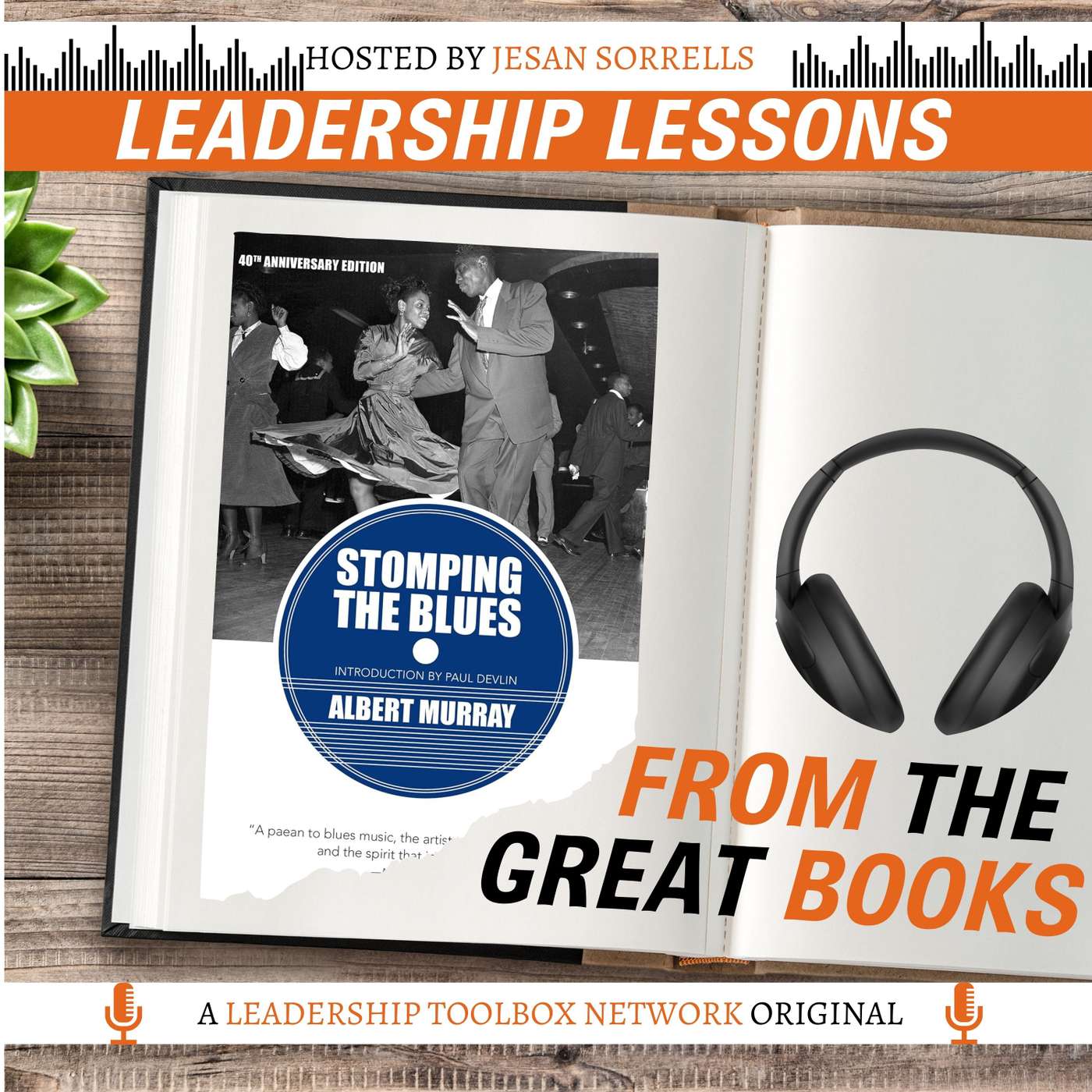
Stomping the Blues by Albert L. Murray w/Tom Libby & Jesan Sorrells
Stomping the Blues by Albert L. Murray
---
Exploring Albert Murray’s landmark book, Stomping the Blues, Jesan Sorrells and Tom Libby unpack the true roots of jazz and blues as uniquely American art forms. The hosts break down how Murray distinguishes the blues idiom from jazz, the importance of improvisation in both music and leadership, and why understanding America’s cultural “soundtrack” is vital for restoring meaning and moral direction in turbulent times.
- Book Title: Stomping the Blues
- Author: Albert Murray
- Guest Names: Jesan Sorrells (Host), Tom Libby (Guest Host)
---
Time Stamped Overview
---
00:00 "Elements of Blues Composition."
07:35 "Albert Murray's Nuanced Legacy."
15:54 "Blues: An Expression of Duality."
19:37 "Blues: Music’s Deep Cultural Impact."
23:24 Unexpected Pathways to Country Music.
29:43 "Discovering Quality Writing."
34:40 "Beatles, Rebellion, and Influence."
40:10 "Blues: An American Synthesis."
46:39 "Hearing vs. Listening to Music."
49:32 "Globalization, Rugby, and Hockey."
54:28 "Data Overload and Decision-Making."
01:02:47 "Blues, Dance, and Sacred Tensions."
01:05:20 "Blues, Church, and Cultural Tensions."
01:10:31 "Temptations Shaped by the Internet."
01:19:05 "Stop Fighting, Start Riffing."
01:21:37 "Experience Over Technology in Life."
---
Opening theme composed by Brian Sanyshyn of Brian Sanyshyn Music.
---
- Pick up your copy of 12 Rules for Leaders: The Foundation of Intentional Leadership NOW on AMAZON!
- Check out the Leadership Lessons From the Great Books podcast reading list!
Hello. My name is Jesan Sorrells, and this is the Leadership Lessons from the Great Books podcast, episode number 181. 181. We're on the countdown to 200. Only 19 more of these episodes and we're going to get to the 200th. It's going to be— going to be a humdinger and a shindig. Actually, I need to start emailing people. To figure out who's going to, who's going to come on the show for that recording.
This is a little behind the scenes there for those of you who are listening. As I said, I'm going to open up, uh, from our book today, which is a, a non-coffee table book, which has coffee table level photos and images and even coffee table level ideas. Inside of it. It's a book that is about a great American art form, and I don't think that Mr. Murray would have a problem with me using this quote right here. And I quote, sometimes it all begins with the piano player vamping till ready, a vamp being an improvised introduction consisting of anything from the repetition of a chordal progression as a warm-up exercise to an improvised overture.
Sometimes the vamp has already begun even before the name of the next number is given. Some singers, for instance, especially those who provide their own accompaniment on piano or guitar, use it much— use it as much as background for a running line of chatter, commentary, or mock didactism as to set the mood and tempo for the next selection. Also, sometimes it is used to maintain the ambiance of the occasion and sometimes to change it. Then the composition as such, which is made of verses, optional choruses, refrains, riffs, and breaks, begins.
Some blues compositions, such as Handy's Yellow Dog Blues, have an introductory or verse section which establishes the basis for the choral refrain. Many, like Bessie Smith's Long Old Road and Big Joe Turner's Piney Brown Blues, do not. And in practice, perhaps more often than not, the verse is omitted by singers as well as instrumentalists. But whether there is a vamp and/or a verse section, the main body of a blues composition consists of a series of choruses derived from the traditional 3-line stanza form.
There may be as many choruses as a musician is inspired to play, unless there are such predetermined restrictions as recording space, broadcast time, or duration of a standard popular dance tune. That is a direct quote from the book we are going to cover today, a book from an author we've talked about on this show before, and it is one of the best authors we've covered. We're actually revisiting him a second time because here's the thing. America as a nation state has very few things that are specifically unique to our people.
Regardless of our ethnos and our racial background. We have apple pie, of course. We have baseball. I think my guest host would agree with me about that. And of course, we have the highest pursuit of material freedom and liberty in the world possible. Now, that doesn't mean we reach it all the time. It just means we have the pursuit. That's all we're promised, by the way. We're not promised the attainment. But we also, and I think the author today would make this point, he would want to throw this in, we also have the blues.
The blues, or jazz as it is more commonly known, exists as a mixture, a mashup, such as it were, of the influences of European, Native American, and African music traditions. But it also represents the soul of a people. We talk almost incessantly about race in this country. We actually can't shut up about it. And I believe fundamentally we have stopped saying really anything meaningful over the last 50 years. There's really been no new ideas. It's just been a consistent rehash of the same old stuff.
But jazz, jazz has nothing to do with race. It has to do with ethnic pride, musical accomplishment, and the willingness, as I opened up there, the willingness to swing and improvise if necessary. Our book today is the single best book I've ever read on the history and the background of a type of music that I started a festival in my local town to celebrate. By the way, as of the release of this recording, um, by the time you hear this, the 5th annual jazz festival will have come and gone, on our way to our 6th annual Jazz Festival, which is kind of amazing, actually.
It started from improvisation with 6 people around a table. Oh, and by the way, no money.
And has wound up being— well, it's wound up being quite a thing.
Sure, other musical genres in America matter. I don't want to give other people short shrift or other genres short shrift, uh, from rock and roll to country and from rap to salsa. And from classical to heavy metal, but jazz music, jazz music itself is America. I fundamentally believe that. And in a time of restoration, uh, particularly a time of upcoming restoration, a golden age, I believe we are indeed entering in fits and starts and, and somewhat against our will, as is usual. I think we need to tap out our work of rebuilding what we have lost to the soundtrack of the music that made us, to paraphrase from VH1 back in the day.
Anybody remember that channel? I know I do. So today on the show, we're going to take a tour, a jazz tour, a blues tour through the great book by Albert Murray, Stomping the Blues. And I have a 40th anniversary edition. I would encourage you to pick that one up. Leaders, all our efforts at restoration won't mean a thing if it ain't got that swing.
And today on the show, we're going to improvise, we're going to jazz, we're going to rift or riff, we're going to vamp a little with my usual accompaniment, my usual accompanier, the guy who's on the trumpet. Actually, if he were in a jazz band, he would be on the trumpet, I'd be on the sax, because Well, that's just how I roll. We're none of us, neither of us are in the rhythm section. Uh, Tom Libby, how you doing today, Tom? How's it going? Um, I'm, I'm doing really well, doing really good. I was, I was kind of excited to get this invite because of The Omni Americans, and I think I remember very, very clearly when I, when I started doing the research on, um, on Murray, on Albert Murray, in the first, when we were doing The Omni Americans, I just remember myself thinking, like, I just want to go to lunch with this guy.
Like, I really just want to go out for a beer or like, like, or maybe sit in the, like, in the, as a fly on the wall as he's maybe playing something or teaching somebody or whatever. Like, I just thought, I remember very clearly thinking this would have been a guy I would have loved to have been around. So I was very excited when I saw the invite that it was back about Arthur, uh, Albert Murray. Albert Murray is— he, he was, he was in that. So the, the jazz critic, um, Stanley Crouch, uh, we did a, did an episode last year on, uh, Considering Genius and, um, about his writings on jazz.
And, and Crouch was influenced as a jazz player, um, obviously by jazz music, but then as a jazz critic and a cultural writer, he was very much influenced by Albert Murray, um, and He even said, and I have a quote from here, in here, in here about him, which I'm going to, I'm going to bring up. Um, but Crouch was noted for basically saying that, you know, Albert Murray was one of those unsung geniuses of the late 20th century, um, writing, such as it were, in a moment where culturally African Americans weren't interested in hearing from a guy like that.
Because he wasn't captured by
the sort of blunt instrument in the post-civil rights movement moment of how are we going to address inequities and what is affirmative action going to do? All those sort of blunt instrument arguments that we just keep circling around, as I said in my open there, over and over and over again. He was much more interested in nuance. He was much more interested in these are the things that fundamentally, yes, make African Americans African Americans, and yes, give the African American experience in America interest.
But he was also interested in— and this is his primary thing— how does all of this mix together? Like, what are we getting? And that was the point of the Omni-Americans, right? Um, you know, they're all just multicolored Americans. And you know what is interesting? I made this point a couple episodes ago when we talked about, uh, The End of Race Politics: Arguments for a Colorblind America by Coleman Hughes, which we've covered with Rollo Nixon, and then made it also in Conflict of Visions, where we covered the Thomas Sowell book with my good friend Ryan Stout.
We as a country, but we also as African American racial group, have reached that strange spot that Murray thought we were going to reach. And I'm not the first person to say this. But we've reached a point where we will perceive among ourselves, I think over the next 25 to 30 years that we're just Americans. And that's going to be a real hard, that's going to be a real hard, it's been a real hard, what do you call it? Clearing at the end of the path to get to. We're recording this probably about a week after Jesse Jackson died at the age of 84.
And I think as more and more of those guys who were involved in, and were that generation that was deeply involved in the civil rights movement and just sort of kept that going, as they passed from this mortal coil, they're going to be replaced by folks like myself, Coleman Hughes, who have a different vision. And it's just a vision of just, we're just Americans. Like, yeah, sure, there was racial strife, but you know, I went to a multicultural school. I live in a multicultural society. No one's ever had a problem with me, at least on that level.
And if they have, it's been quickly culturally shut down as well as legally shut down. So what do we do next? And the author Glenn Lowry and the linguist John McWhorter talk a lot about this on Glenn Lowry's show, quite a bit on his podcast. And one of the points he makes is, what are you going to do when you have to compete in a global environment? What's going to be the tools that you have to compete? You have to use when you compete globally. And of course, AI is going to push this and a bunch of other things, but it's already starting to happen.
The rails are being laid. And Murray called it all the way back in the '70s and '80s. He said eventually we were going to wind up here. And so he comes off like a prophet very much, in my mind anyway, and uses blues, the blues idiom, as he would say, the blues idiom or the jazz idiom. And he didn't like that word jazz. He liked the word blues more so than anything else. But he saw music as a way to sort of get us there. Essentially the equalizer, right? Like, yeah, that could be true about that.
That could be true. Or it could be said about several different genres of music. Like, and I do— so one thing, back up a half second, because sure, one of the things that I found interesting in your opening line to today's podcast episode, when you, when you said that, you know, the blues— and I'm quoting Hasan here from earlier in this episode— the blues, comma, or jazz as it's more commonly known, that actually surprised me a little bit. I got to tell you, I got to be honest with you, because I have always viewed them as two separate things.
Now, now, why? I, I don't know. I can, I can tell you in my mind's eye what the definition or differences are, but I never realized that those two genres of music were one. In the same. So to me, and again, just from a very basic standpoint, again, I'm not a musician, but I love music. I love listening to music, and I will listen to just about anything. The only thing I really don't listen to on a regular basis, quite honestly, is country music. And that's— I just— there's something about that, that, that twang that just bothers my ears.
And the twang in the voice, not the music, not the actual instruments, because I have no problem with the banjo, the fiddle. Like, I have no problem with the musical instruments that play country music.. But for some reason in the vocals, I can't, I just can't get past the vocal of it, which you don't get like in jazz. And so back to my point where jazz and blues are the same thing. If I were to simplify it in my brain, the most simple definition, or to me, the most simple definition or the most simple difference between the definitions is, and you're going to probably laugh at me here because you know me really well.
Blues is internal and jazz is external. Meaning like jazz is the expression of external emotion, right? Jazz is about just laying it on the line. You ain't got that thing unless you put the swing, right? Like it's about the swing. It's about movement. It's about— blues to me was more about an internal reflection. It's like a deeper soulful kind of point to it. To say that those are the same kind, like literally those two things are the same music, blew my mind when I read that before we got on. I was like, wait, no, that can't possibly be.
That's not right. And of course I research and then you're right. But, but like, but to me, to me, I do think there's, even if the, even if the difference is subtle in my brain, it's a little different. That it's like, like I said, jazz is external, blues is internal to me. Right. I feel like that's, and again, you could say the same thing about, uh, about metal or about rap or about whatever, like the difference between what a regular rap versus gangster rap, right? Like, well, they're both rap.
So they're both rap. Yeah. They, but, but the, but the, the inter, the inflections and the meaning behind them are different. So I guess to me, the, the difference between blues and jazz, there is a difference, although subtle, although subtle. Well, and this is why I love talking to Tom about these kinds of topics and these kinds of areas. And I love sort of bringing him on is, and this is why I invited him on a few years ago. I was like, listen, you gotta come on. You gotta be like the everyman because otherwise I'm just gonna sound like this wandering intellect and everybody's gonna be bored.
Right? You can't have that. You gotta have the everyman. And this is what, Tom, what you're bringing up, this is exactly how most people perceive quote unquote blues and quote unquote jazz. As a matter of fact, Murray talks about it in his book and he lays out an argument that, to your point, blues is the external, he would say, the external manifestation of those internal emotions, right? And the point that he would make is this, he would go a step further. He would say all those emotions are not negative.
Those emotions are, are the, are the, it's the, it's the emotive ability of, no, not even that. It's the musical accompaniment. There we go. That's what it would be. The musical accompaniment to emotive ability with disciplines, with discipline around it. Right. And he would say, and he writes several essays in this book, which is a collection of about, well, it's a collection of essays. I'll go into the structure of the book in a minute, but it's a collection of essays. And in each one of his essays, he always makes the initial point somewhere or makes the point somewhere in the essay
that blues as an idiom is an expression. That's why I said as an idiom, it's an expression. And it's an expression that works both on Saturday night rocking at the Savoy, but it also can come as an expression on Sunday morning rocking in the church. And that's a huge link, right, that he makes, a huge conceptual link. And he points out very obvious things, which is what most really good cultural critics do. One of the most notorious being that those who are swinging on Saturday or swinging on Friday and are looking for places to swing, they're going to be the first people up in the pew on Sunday talking about how they love the Lord.
And they will see no difference between the two, those two
things. Now, what he would say about jazz, and the reason he rejected the word jazz, is because he would frame jazz as— and I would agree with him— he would frame jazz as a great marketing word for a blues idiom. Okay, it's a marketing term. It's because you can't— how are you going to market Jelly Roll Morton, a genre that includes everybody from Jelly Roll Morton and Count Basie all the way to Duke Ellington and Miles Davis, who he thought went off the table there at the end. And so did Stanley Crouch, by the way.
But like, how are you gonna include all of those artists in one box? He's like, you can't, you can't do it. But you have to be able to market it. I would assert as an entrepreneur and a marketing guy, you have to be able to market it. And so jazz is the way to market it to an external audience. And so you wind up seeing in subsequent years, like over the last 50 years, the explosion of like world-based world music coming in in the jazz genre, right? Because all of these other folks around the world are now beginning to pick up on that idiom and they're beginning to put their own mark on that idiom.
Um, but yeah, it's, it's a distinction with a difference and it took me a long time to sort of buy it, but once I saw it, I was like, oh no, he's right. He, it does make sense. It does make sense though, if you, because again, when we talk about You know, when, when you and I are off this podcast and we're talking about sales and marketing and marketing more specifically about, you know, ideal client profiles and how you niche down the niches, this is a good way to do it, right? So you make— right, you basically take blues and you give it this word that attracts a certain kind of people and a certain type of listener.
And that's the whole— that's what marketing is all about, to really identify who's going to listen to this and go get them, right? Right? Go, go, go. So, so it does make sense. I'm not suggesting it doesn't make sense. All I'm saying is when I first read it, I went, no, oh, come on. And then I read, and then I went and looked at it, and I was like, yeah, you're right. Damn
it, he read the book. I always read the book. It's fine. Um, so yeah, speaking of Albert Murray, so we did his, we did his whole intro and his whole background, um, for episode 140 of The Omni Americans. I would encourage you to go listen to the first part of that if you want to find out more about the guy, or you could just, you know, go Google search him. Tons of stuff on Albert Murray. Speaking of Stanley Crouch, just this great quote about him. He had this to say, he said, and I quote, "When Murray wrote in quick succession South to a Varial Place, The Hero and the Blues, Train Whistle Guitar, and Stomping the Blues, he might not have stepped out of Ralph Ellison's shadow but he had created the most original body of work other than Ellison's that I knew of, and that remains true even now.
That's from Stanley Crouch's book Considering Genius. That's in the prologue, Jazz Me the Blues, a term, by the way, that even he used, but he knew, he knew the distinction with the difference as well. Um, Albert Murray understood blues music at a deep level. He also understood the ways in which blues impacted not only the ears of the listening public in the mid-20th century But also he understood at a deep level, and this is why I'm a big fan of his, he understood at a deep level the way that it might point forward to clarifying and distilling larger cultural problems in America.
He understood that music, regardless of what we may think about it, is the thing that binds us together. No human being on— there's no group of human beings on the planet, heck, no group of individuals on the planet, but let's say group of individuals, there's no individuals but there's no group of folks on the planet that doesn't have some sort of musical thing that happens in some sort of rhythmic kind of way. There's
something— it touches us at a deeper emotive level than words can. There's something communal about it. Yeah, yeah, exactly. Something you have to do together. You cannot do it by yourself. Oh, well, you don't want to say you cannot. You can, but then How do you get other people to buy in? And that's the great thing about any kind of musical idiom. You have to get other people to buy
in. By the way, one note about country music, I too had a problem with the twang. And then I started— well, no, I did. And in a lot of modern— like anything from the '80s and '90s, I'm probably not going to listen to. But I got into Johnny Cash. And that was the door that sort of dropped me into the hole. Right? And so what I always say to my kids, who by the way, don't— only one of my kids is kind of okay with country music, the others are like, please. What do I say to my kids is there's country music for sure, just like you were saying.
And then there's Johnny Cash, and that's a totally different thing over there. I don't know what he was doing. He's one of those sort
of cultural iconoclastic folks that sort of stepped over the genre itself. Which you very rarely get. Duke Ellington in blues or jazz music was another one where he was just— he just stepped over the entire genre and did whatever the heck he wanted. And music allows people to do that. So when it comes to country artists, there are a couple that I can tolerate more than others, I will tell you. Like, and by the way, so I'm with you with the '80s and '90s. I go a little further back. So the '70s with the Johnny Cash was in the '70s.
Kenny Rogers was in the '70s. Dolly Parton was in the '70s. Those three artists, I actually don't have a problem listening to even with a little bit of a twang from them. But for some reason, they're— it almost sounds to me like country music meant something more to them than it does to the artists today. Yeah, right. So like when I listen to artists today, it sounds just like everybody else. There's no, there's no, there's no emotion behind the, the, the— it's, I mean, let's face it, it's all about money at this point.
Like, they're, they're trying to figure out how do I make money, and if I can make money with the— they'll just go do it. With Kenny Rogers, and by the way, Dolly Parton, um, probably one of the best songwriters of our entire generation. She's written songs for just about every genre of music there is. Like, she's made money off of other artists either. And there was times where she didn't sell the song, she just thought somebody else sang it better than her and let them sing it, right? Except, you know, whatever, right?
So like, so, and, and anyway, but the point is that, and to what you're, you're saying is, and by the way, I have out of my 5 kids, I probably have 3 of them that really like country music. I don't know where the heck that came from because none of the adults in my life like country music. So none of my, my brothers, my sister my wife, none of us like country music. How I had a couple of kids that ended up liking it, I have no idea. But again, as I mentioned, the difference between rap and gangster, it's the same idea, right?
So whether you're talking, and to your point, whether you're talking about a country artist, like, I'm trying to think of one right now who he himself does not label himself a country artist, but he does have music that sounds a bit country, like Teddy Swims. Who crosses over very easily into the pop culture, like the pop music, right? Like, so, and guys like Jelly Roll— and I know you mentioned somebody from the blues type, but this, the new, the new artist Jelly Roll, same idea. Like, he rolls, he rolls over to the pop, to the pop culture pretty easily, but he himself still classifies himself as a country singer.
Like, he's a country artist, right? Um, so I, you know, with those kinds of people, it's easier to see a pathway into liking country music that I still do not walk down. Right. Well, I will— I— let me, let me be your Morpheus from The Matrix. And you could be— you can be the— you could be the one, you know, and let me— just because you see the path, and just because you know the path does not mean you have to walk the path. That is correct. There you go. There's no rule, no law, whatever. And usually when I come to a fork in the road, there's more than two pathways, by the way.
Usually I'm like five, and I'm like, oh, what am I doing? Now I gotta decide between these 5 pathways. It's never as simple as this way or that way for me.
Never. One other thing I'll say about this. So blues music is an idiom, right? Because the blues— and his very first essay in here, and we're gonna probably pull some things from it— the blues as such, we're gonna talk a little bit about this.
But Well, when he frames the blues, right, when he talks about the blues, when he writes about the blues, he's writing from a strong space of— and this is something I think— not only something, this is what you hit on when you're talking about artists of the '70s. He is writing from a space
of cultural, not ethnic, but cultural pride. So there's a certain level of just— and you know what, it's interesting. So when we talk about— I hate to make this generational, but it's the easiest way to sort of frame this. If you talk to baby boomers who have a certain level of self-awareness about their own generation and their own history, what they will say is Well, there was always garbage. There was garbage in the movies. There was garbage on television. There was garbage Westerns. There was garbage music.
There was garbage magazines. There was garbage writing. You're not the first couple of generations to discover that technology brings you garbage. There was always
garbage. And they will also then say in the exact same breath, But the Beatles were great, or the Stones, or whoever, right? Okay, cool. That's fine. And if you call the Beatles or the Stones garbage, and I've mentioned this on this show before, so please, it's fine, send me your hate mail. But if you say that they were garbage, then the terror of, you know, fire and sulfur will come down upon you. Okay, fine, whatever. That's so funny. Real, real, real quick. No, go ahead. My wife and I get into this conversation all the time because I think that the Beatles are one of the most overrated bands of all time.
Not bad. I'm not saying they're not good. I'm not saying they didn't make an impact on music. I just think that they're the most overrated band of all time. And she wants to— she vilifies me. Never mind the hate mail that you guys said we're going to get now from your listeners, but I get it from my own wife. So bring it. That's fine. That's fine. I can handle it from anybody if I can handle it from her. So I almost got into, and I'm not going to say the name of the place where I worked or the person with whom I worked.
I'm just going to give a very generic thing here because if I give too many identifying details, it's going to be a real problem. I almost got into a fistfight with an old man in a town I worked in at a place that I worked at because in a lunchroom I happened to say, and I quote, the Beatles are the most overrated band of all time. Someone else would've come with that Love Love Me Do crap. I didn't know he was a giant Beatles fan. We'd never actually talked about it. I was just pissed about something.
It was something that had to do with, oh, because in the, in the place where I worked at, there was a, I had to be very careful. There was a compendium of Beatles albums, yet another one. And I had just had enough. I didn't wanna see anymore. And so I said this in the lunchroom away from the customers that would potentially buy that thing. And he almost— I did. I almost got into a fistfight with an old man. And this is back when I was probably in my early 30s. And I was like, dude, you got to calm down.
They were overrated. And I doubled
down. Just read some of the lyrics, people.
Like, this is not rocket science when you're talking about music. Anyway, sorry, go ahead. But he did make a good point. He said, sure, according to your generation, they were overrated. Okay. Pache that. No, no, it's fine. Pache that. I got to give credit where credit is due. But you have to understand that where I grew up and where most of us grew up in our generation, there was so much— to close the loop on what I said previously— there was so much garbage They looked good. And when I put it in that context, I
thought, hmm. First off, I had that response. I like blew out all the air just like out of my mouth. And I said, okay, fine. I'll let you have that. And I walked away because I wasn't gonna like, what am I gonna do? Escalate? Yeah. And it gets to this idea of garbage, right? So the venture capital investor, and this is the last point I'll make about this and I want to jump into the book, but the venture capital investor, Paul Paul Graham. He wrote a great essay called The Refragmentation. You can go find it on his website at paulgramm.com where he talks about being a kid growing up in rural Wisconsin or Michigan, one of those northern states, right?
And there's a line in there that goes directly to this. He said he got a copy of Harper's Weekly one time when he was a kid, and he's a baby boomer. When he was a kid, when he was like 10 or 12, not 10, like 12 or 13. And he was just sort of beginning to wake up that the rest of the world is out there because he's like, in the little town that he lived in, all you had was Time magazine. All you had was Life magazine and everything was like cigarette ads and whiskey ads and cars with big fins. And he said one time he got Harper's Weekly and he read it and he was like, I never knew my 13-year-old brain didn't realize, I'm paraphrasing, but my 13-year-old brain didn't realize that there could be quality writing.
Because I was surrounded by so much garbage. I think we underestimate in our own
time, first, the power of gatekeepers, because the internet has ripped all of that away. The internet has ripped away all the gatekeepers, right? Or at least it has given— it has given the gatekeepers— ripped away power from the gatekeepers. Gatekeepers are still there. They're trying to consolidate power. You see this in publishing houses now, but in a lot of other different places too, in music too. They're trying to consolidate power. Because the, their head, the, the, the power, the, the level of, or the amount of territory they have is shrinking.
And it's been shrinking for the last 25 years in all spaces, right? So we underestimate the power of institutional, like, flattening that occurred for a good chunk of the 20th century. The power of gatekeepers, number 2. But then the 3rd thing that we underestimate is the amount of work, and this gets into the Dolly Parton, Kenny Rogers, Johnny Cash, Merle Haggard, or in the blues genre, right? Count Basie, Duke Ellington, Jelly Roll Morton, John Coltrane, Charlie Parker, right? The amount of work those guys had to do to be good, to fight through to be good, we underestimate that because in our
time, very few people are fighting to be good. Most people that we see, particularly in the arts, are fighting to just be average. Yeah. Because average is good enough to be average according to now's standards is good enough because mediocre according to now's standards is so terrible. It's just so terrible. And so if you grew up in a time where like people fought through that, had bands like the Beatles who actually had to struggle to get on the Ed Sullivan Show. Like they did, cuz Ed Sullivan was a gatekeeper.
That cranky old man, he wasn't letting anybody on. And then you had to do what he told you to do. You know, you know the story of him with the Doors, like, you know, and he was gonna tell Jim Morrison what to sing. And Jim Morrison was like, yeah, okay, go ahead, tell me what to sing. And then he went on live on television and blew literally the doors off of, um, off of the Ed Sullivan Show, said the thing he wasn't supposed to say, got cut off. And Ed Sullivan was like, you're never gonna come back on this show again.
He's like, yeah, I don't care. Who are you, old man? And then just like walked away, right? You didn't have that much rebellion like that back then because everybody, everybody, the culture was so flattening. And that's what I think we underestimate. So on the negative side, we get a lot of slop in our time. And with AI, we're going to, I mean, we're going to get even more. It's going to be ridiculous. But we also get, and that's already happening. But we also get a lack of trying, a lack of effort being put in on our talents and skill.
And I don't know anything about Jelly Roll. I know nothing about, about that person. I've seen maybe a couple of things. I don't listen to the music. I have no idea what's happening there. Um, I presume that if he has that much of a profile, he has some talent. I like to give— I like to be a, be a good person right away before I do the judgment. But then I suspect that like if I transported him back in time, like 75 years, he'd be playing a backup. He'd be a backup guitar guy if he were lucky to like some third string country western group going around the Midwest.
Right. Because the gatekeepers were just so much more powerful then. So gatekeepers, institutional power, and just you had to try harder. You just had to try harder to, to, to to, to rise up. And I think we sort of underestimate that. So, but even in those people's time, they still thought that everything was like, things were just garbage, which is kind of amazing. I don't know what to do with that. It's a dichotomy. I'm not sure what to do with that either, just because like, I, I think of, I think of like, again, when I, when I think of the Beatles and I think of that, that era, and I think of some of the other people that were around back then, Mm-hmm.
All you'll know all of their names as soon as I say them. So like, how different really were they and what were they rebelling against? Like, I don't even understand. Like, you know what I mean? Like, if you think of guys like, like, you know, the Chuck Berry and Jerry Lee Lewis and like all these guys that were around or somewhere, like, you know, all those names too. Like, if you think about, like, think about what Chuck Berry did with the electric, like with the electric guitar that nobody was really doing until then.
Right. Like he blew the— he like, he would blow— he blew amplifiers and people were like, oh my God, this is incredible. And by the way, I do think Chuck Berry is talented, so I'm not suggesting he's not, but like, oh yeah. And I, and I, I would, I would listen to Chuck Berry before I would listen to the Beatles any day of the week and twice on Sunday. Okay. Okay. Okay. So let me, let me ask you this question cuz we do have to go back to the book, but here's a, here's an important question for you.
I, I could hear the listeners asking this. Let me ask you this question. If you brought Chuck Berry to now, would he still blow the doors off of everything? I, I don't think he would blow amps out of the water because amps are better today. I still think the sound that he produced with those— I think we would— I mean, he opened the door for guys like Jimi Hendrix and Santana, right? Like, he opened that door. Nobody was doing that stuff before him. So like, do I think— yes, I think, I think people like him would figure out a way to elevate themselves.
To your— exactly to your point, If you take a guy like Chuck Berry, I think he would find a way to make himself so different today that he would elevate himself beyond everybody else. I think he would still accelerate. Now, what about Lennon, McCarthy, Harrison? No, they would be NSYNC or the Backstreet Boys or every other one of those godforsaken boy bands that nobody gives two rats patoots about. Sorry, sorry. I was trying to figure out a way to say that very, uh, without swearing. Without using foul language.
But no, but I think that— I think that's exactly what they are. They were the first boy band, right? Like, that— that they— they started that genre. And now, can you think of any boy band that broke the mold? No, no, all the boy bands are the same godforsaken thing. So the Beatles were the start of that horrendous genre of sub— that subgenre of
music. I will say this. Worse than that, let me just say this, worse than that, the same did not apply to quote unquote the girl bands, right? Because you got people like, like, you know, um, the Pointer Sisters and stuff like that that you can't— you can't point to a modern-day group to me and tell me that they're as good as the Pointer Sisters. Like Salt-N-Pepa. Salt-N-Pepa were pretty good. Yeah, but okay, but they— but, but their time has passed, to your point. Number one, number one, their time has passed, right?
True. But number two, They weren't singing the same style of music. Salt-N-Pepa were more closer related to rap than they were the, the, the, the diva style. Like I'm thinking like what my point was, I'm thinking people like Sister SWV, Sister Destiny's Child. That's his child. There you go. All of those, they're the same. They're, they're not as good as the Pointer Sisters were. I'm just, I don't know. I may, and by the way, by the way, guys, don't let the gray fool you. All of the people we're talking about are before my time.
These are before I was not alive when these people were singing, and I still think they're better. So there you go. We're going to lay this to bed because my email, I can already hear my email pinging like right now. I can hear the DMs coming in. I'm going to forward you all the DMs as soon as I'm done with this because we're going to be in a lot of trouble. All right, back to the book, back to Albert Murray. The focus of this show. Uh, we're gonna look at chapter 5, or essay number 5, Blues Music as Such.
I'm gonna pull a couple of ideas from here to set up what we're going to talk about here. He opens with this: definitions of blues music in most standard American dictionaries confuse it with the blues as such. They also leave the impression that what it represents is the expression of sadness. No, not one characterizes it as good time music. This goes back to that idea of the Saturday night roller versus the Sunday morning churchgoer. Nor is there any reference whatsoever to its use as dance music.
Moreover, primary emphasis is always placed on its vocal aspects, and no mention at all is made of the fact that over the years it has come to be dominated by dancehall-oriented instrumentalists to a far greater extent than singers. According to the 3rd edition of Webster's New International Dictionary, blues music is, quote, a song sung or composed in a style originating among American Negroes, characterized typically by use of a three-line— use of three-line stanzas in which the words of the second line repeat the first, expressing a mood of longing or melancholy and marked by a continual occurrence of blue notes in melody and harmony, close quote.
Which not only suggests that musicians pray the blues instead of playing them, but it also limits the mood to melancholy and longing. And this is what Albert Murray— this was his thing., right? Like Dave Chappelle's thing is making jokes, right? Or Michael Jackson's thing was making popular music, or Michael Jordan's thing was overachieving at basketball. This was Albert Murray's thing, taking apart the common definition of blues music, taking apart the common idea of a blues idiom, and then reassembling it and repackaging it in a different kind of way.
And so he goes through all of the different pieces of blues music and how blues music is identified and categorized. And then he says this, it is far more accurate to say that some of the most distinctive elements of blues music were derived from the music of some of the West African ancestors of US Negroes than it is to imply, however obliquely, that the blues idiom itself ever existed anywhere on the continent of Africa. Nor should it be forgotten that elements quite essential and no more dispensable were derived from the music of some of the European ancestors of the US Negroes.
The point, however, is that the blues idiom, whatever the source or source of its components, is native to the United States. It is a synthesis of African and European elements, the product of an Afro-American sensibility in an American mainland situation. There is no evidence, for example, that an African musical sensibility interacting with an Italian, German, French, British, or Hungarian musical sensibility results in anything like the blues music. By the way, pause, this is where he would have a problem with world music now being defined as jazz.
This is where Murray would get off the boat with all that. Um, back to the book. The synthesis of European and African musical elements in the West Indies, the Caribbean, and in continental Latin America produced calypso, rumba, the tango, the congo, mambo, and so on. But not the blues and not ragtime and not that extension, elaboration, refinement of blues break riffing and improvisation which came to be known as jazz. He defines the blues as such, as an antithesis, an idiom, right? A way of framing certain things.
And by the way, a thing that is native to the United States, specific to us, right? And I think that's its power. I think Murray would agree with that. I think that we have forgotten, and this is where this relates to what we were just talking about, Tom, we've forgotten in our flattening, right, of everything that's happened because of the internet. The internet has done a great many things. Without the internet, I wouldn't be doing this show with you. Without the internet, I wouldn't be distributing this to listeners and getting their feedback via their pings and their emails.
I wouldn't be, I wouldn't be able to go out on the street. Like, I think of something that happened to me in the early days of this show, where we were, we were really pushing distribution, right? And I was at a, I was somewhere where you would not expect people to know me, right, at all. And someone walked up to me and they go, I know your voice, I listened to your show. Shocked my wife. My wife was like, what is happening? And it was in this most random rural area ever. And the woman pulled out her— woman and her husband who were business owners pulled out her phone and showed me where she subscribed to the show.
And she's like, oh, I listened to this episode, this episode, this episode. And I got my husband to listen to this one and this one, this one. My wife was blown away by this. And I said, that's the internet. That's what the internet has done. But in all that flattening, I don't know, sorry, in all that connecting, right? And all that ability to engage, we've also flattened things. We've flattened out idioms. We've flattened out cultural expressions, and it's become so much harder, I think, to— well, it relates to our next question.
It's become so much harder for leaders, and not just leaders but everybody, to sort of hear the specific— and by hear, I mean hear emotionally and psychologically and spiritually, not in terms of like a spreadsheet or materially. It's become harder and harder for us to hear the rhythms that are specific to our national voice. And I do believe every country has its own national voice. And I don't know how we— I don't know how we get back to that. It reminds me of the line. Do you remember the line in the original, the original White Men Can't Jump with Woody Harrelson and Wesley Snipes, where they're talking about Jimi Hendrix?
And Wesley Snipes looks at Woody Harrelson and says, no, you listen to Jimi, but you can't hear Jimi. Oh, yeah. So this is This is what you're talking about, the difference between listening to something and actually hearing it. Because without the, the blues to me, and again, I go back to like, you're right, I agree with you, by the way, that it's an American sound, right? And you can't get that sound without going through the trials and tribulations that America went through. You can't get that sound without the heartache and the hurt and the heroism that America went through, that America has been through.
Again, you can go back from the American Revolution to the Civil War to World War II. There's just points in history where you can point to that no other country has been through what we've been through. Right. They just haven't. They just haven't. A lot of the other countries naturally— look, Canada was a territory of England for a long time. They naturally disengaged. Australia was a penal colony for England for a long time. They naturally disengaged. These were inevitabilities that happened throughout history.
The United States did not have those inevitabilities. We went through it, people, like, and we went through it together, whether you were white, Black, Native, it didn't matter. We went through it together. Now, we might have viewed it differently. We might have gone different pathways because of it, but we felt it and we went through it as a nation. So, to your point about being able to quote unquote "hear the sound," I go back to the conversation with Woody Harrelson and Wesley Snipes. We don't just listen to it.
We hear it. Like, there's a different component to it when you have that unified historic value to the music that is representing the country. And to your point, do other countries have it? Sure. But it's not the blues. It's polka. It's not the blues. Right. It's polka. It's whatever. It's tango. It's whatever. Yeah, exactly. It's interesting that you mentioned Hungary because Hungary has zither music. Now, I'm not saying anything bad about the zither. We're actually going to cover the book of the third man on this show.
In a few months by Graham Greene, which was the basis for The Third Man, which starred Orson Welles, a great movie, and also a radio show called The Third Man. And the intro to that show was Hungarian zither music. That's how zither music became popular in the United States for about 5 minutes. But that's my point, right? Like, so you can listen to whatever you want, but to actually hear the music— and you could say the same thing, I think, you know, another genre of music that is really unique to America is rap, right?
Without America, rap music wouldn't exist, right? That's true. But again, the same idea, like you can say rap music belongs to a certain ethnicity, you know, but how do you explain
Eminem, right? But it's like, but you can, you can, you know, we get, there are other white artists in there, but none, none of them like Eminem. But again, Eminem's the same thing. The same way you listen to him, you can listen, you can listen to Eminem all you, all you want, but to really hear him, you have to have grown up in that environment, that poor Detroit rundown. Like, I, you know, I get it. I, I mean, it's— oh yeah, when I, I just think that, and again, whether you listen to, to Dr. Dre or— it doesn't matter.
When you listen to, when you listen to that, to the, to those artists And again, go back to the blues. When you listen to these artists, if you don't have the, the intrinsic historic value to it, it doesn't mean the same. It doesn't hit the same. Well, and I'll, I'll even say you see this in other things that are specific, other areas that are specific to America, right? So case in point, I'm going to bring up an example from another area that Tom knows well, sports in America. And by the way, I thought this would happen.
I thought a switchover would start to occur sooner than it has. I think it's beginning to happen now. So in America, and 75 years from now, the switchover will be complete. So in America, when I was growing up, and I'm in my late forties, when I was growing up, soccer or football as they call it in Europe, was not a thing. We had 4 major sports: football, basketball, baseball, and occasionally, if you lived in the northern climates where it got cold
enough, hockey. That's it. You could play those 4. Everything else is also ran. Everything else is also ran. Everything else is in second place. Yes, we like the Olympics that comes around once every 4 years, now once every 2, whatever, but That's it. There's nothing else. And by the way, everybody knew this. This wasn't anything that anybody complained about. It was just the thing. Right now, through a whole series of cultural events, whole series of different things, whatever, that has now shifted.
And so soccer has become, over the course of my adult lifetime, more and more popular. For God's sakes, I'm my kid's soccer coach. I know I know less than— well, I won't say less than nothing. I know 1% of something about that sport, which is enough to coach kids. It's enough. You don't need more than that. Agreed. I also played rugby. I know a lot about rugby, but again, it's one of those things that— it's one of those transitions that's happened because of globalization and flattening that would not have happened when I was a kid, or didn't— the beginnings of it hadn't even started when I was a kid.
Okay, now, let me fast forward to when we're recording this. Just this weekend, I actually posted about it on my Facebook page, you can go and take a look at it if you want. But, um, the, the US men's hockey team won the gold medal game against the Canadian, the Canadian hockey team in the US, in the US, in the Winter Olympics in like Milan or Italy or wherever they're holding it now. I've paid literally zero attention to the Winter Olympics, only because I have other things going on in my life.
I watched a few clips about this, saw a couple of things. Apparently this is like the 46th anniversary of the Miracle on Ice back in the 1980s, which everybody watched back then because there was no
internet. And I know very little about hockey, even though I went to a hockey school. I mean, I know enough to know how difficult it is. It's a real sport, folks. It's a real sport. Um, but, um, but the Canadians had 45 shots on goal and we were in overtime and we still won. And the thing that I posted in the Facebook post was, it's always this close in America. It's always this close. That's how we roll down here. We always roll just in the nick of time. We always do, whether it's sports or culture or making a decision about getting involved in something internationally, we are the ultimate end result of arguments that have been occurring in the West for the last 1,000 years now.
And we always just in time that, pardon my use of the term, but we always just in time that shit. We always do. And Tom just cracked up because he knows exactly what I'm talking about. And everybody who's an American If you're listening someplace else, this is, this is the key to understanding. We're always just in time and it always looks like we're not going to make it. And it always looks like we're going to be overwhelmed. And it always looks like, oh, this time we got the Americans. And by the way, it doesn't matter that the Canadian men's hockey team is 52 to 3 in gold medal games against the United States.
No one cares. The only thing that matters is the last one. Bingo. That's exactly what I said on my Instagram post. That's right. No one cares that you're 52 and 3. The only win that counts is the last win. That's also very much an American idea that we have infested the rest of the world with. All that past history matters literally bupkis to what is happening right now or what just happened 5 minutes ago. And by the way, what just happened 5 minutes ago, a week from now, no one will care about that either.
They'll be like, oh, what do you got for me lately? Well, that's been the crux of our political landscape over the last 12 or 14, 15 years. 15 years now. What's the next news cycle? You could do something, you could do something that is just so off the wall bad and it, it 5 minutes from now it's not gonna matter cuz the next news cycle something else is worse and now you're off scot-free, which is, it blows my mind how half of our politicians are still in office and I don't care by the way, these people, I do not care if you're Democrat or Republican.
Does not matter. This is both of them. Does not matter. This is both of them. This is both of them. AOC went and blew herself out in Munich. It doesn't matter cuz Donald Trump just did something 10 minutes ago. Doesn't matter. Exactly. Exactly. It does not matter. It does not matter. Those two make my point more than any two on the— That's right. You just literally brought up the two people that I probably say most often, oh, don't worry about it because 5 minutes from now, nobody's going to remember or no one's going to remember.
Nobody's going to care. And that is at the core of the blues idiom, though. That's it. Because what you did 5 minutes ago in the blues riff doesn't matter. All that matters is what's happening right now. In the improvisation. All that matters is how the, the trumpet just picked up what the guitarist was doing, or the guitarist just picked up what the pianist was doing, or the entire sax section is, is, is jumping, and you gotta jump, you gotta move, you gotta— to paraphrase from, from Albert Murray— you gotta stomp, you gotta go, because you can only stay in one mode for so long before that beat tells you, nope, you gotta improvise, gotta move, gotta move, gotta move, gotta move, gotta move.
And that, that's the blues. That's, that's the idiom. So the question of course is how can leaders get back to hearing that? How do we get back to hearing that in this country? Because I think we've, I like the white, I like the line from White Men Can't Jump. I like that question. I think we've lost the ability to hear it. How do we retune
our ears? Oh God, you know, this, this goes back— I don't remember who I was having this conversation with, uh, a couple— this is probably a week or two ago, but I had a conversation on the same lines where I was saying the more— it's almost like we overloaded our senses with data to the point where we cannot understand the data coming at us anymore because we've lost touch with which one of the data points are actually important to us, right? Like, so like, again, you're running a company, you've got 100 employees, whatever, and now all of a sudden you've got, uh, you think about your, your leadership levels.
Maybe you have like 6 or 8 people in the C-level, you got a director level with 8 or 10, whatever. So now you got these levels of management in front of you, and all of them are filtering up data up to the next line, etc., etc. So now the CEO is getting you know, data from 20 different people, 20 different things, and now he or she has to decide which one of those data points am I acting on, right? Well, so to answer your question, and by the way, I'm not suggesting I know the answer, I'm just telling you from my standpoint, I think it goes back to, okay, we have a company, we have decided what kind of company we want to be.
And by the way, I'm not talking about what product or service you're selling. Talking about the moral compass of your company. What kind of company do you want to be? Do you want a company that gives back to the community, that worries more about the investor than the consumer, that you worry more about the employee than the investor? I don't know. But when you start filtering up all these data points, the data needs to point you to that moral compass and say, we are a company that wants to be more about our— I don't know, let's just say Richard Branson.
I know you and I have talked about Richard Branson in the past. Richard Branson had a philosophical belief that if he took care of his employees better than anything else, that everything else would filter, everything else would be fine. So, if you treat your employees as if they are the most important cog in your wheel, then they will treat the customers the way that the customers want to be treated because they're being treated so well that they don't want to lose their job., right? I want to stay here forever.
I want to retire under Richard Branson. So now, I'm going to do everything in my power to be a good employee because I treat them so well. Well, all these data points that are coming to you, which ones point you in the direction of treating your employees to the best of your ability? Because the rest probably don't matter because that's the kind of company you've decided to be, right? So, again, I think to your point, I think it's— and the same point, by the way, about the whole internet and all these, like, yes, because we're getting inundated with all these data points that we're not sure which ones actually matter.
The reality of it is you've already decided which ones matter. You've just chosen not to listen to them anymore. You've chosen not to hear them. You've chosen because there's so much other noise out there that you've chosen that you have to go sift through the noise before you actually come back and hear what has been right in front of you the whole time, which is We have a moral compass of a company. We have data that tells us how to do it better. But I need to sift through all this other BS before I get to the stuff that matters.
It's stupid. I don't know why we do it, but we do it. And every, every, every person I know that owns a company of substantial size still does it. And by the way, you, beyond everybody I know, should see this more than anybody because you're a leadership development guy. Mm-hmm. So, oh yeah, you're— if you haven't seen this, I would be surprised. I would be very, very surprised that you haven't seen— oh no, if you haven't seen it, I, I'm guessing you have. Oh yeah. But like, but so to your question about how do we, how do we hear the— it's, it's about, it's about getting back to what matters.
Like what if it doesn't matter? It doesn't matter. Let it go. It doesn't matter that it doesn't matter that it's a data point on a, on a graph. Who the hell cares? Anybody? And by the way, I tell people all the time, you can manipulate statistics to do whatever the hell you want it to do, right? We see this in research studies all the time. Oh yeah. Where we're trying to get pharmaceuticals passed through the FDA. And if you guys have not been in the pharmaceutical industry, trust me when I tell you, you can manipulate that data to get whatever the hell you want passed.
Yeah, it just, it just matters about If it needs to be below a certain threshold, well, then you just test more people and then the percentage is below the threshold. But again, but that— but to your point about leadership though, leadership needs to have such a, such a vision, such a straight vision of from what is point A to point B look like and where are we going. Like, we're going— we are at point A, we want to be at at point B. If point B is clearly defined, your data points are going to be clear as to which ones you have to pay attention to and which ones you can let go of.
It's just— anyway, I was on this case. No, no, no. This is somebody that really frustrated me. So, no, no, this is the thing you're on to because remember I was saying before, right? In the mid-20th century, everything was flattened by conformity in these big institutions. Now, in the last 25 years or the first 25 years of the 21st century, we've had flattening conformity by the tool of the internet used by institutional powers, but also weirdly enough, used by the guy sitting next to you to flatten you too.
So it's
both the individual push or the more individualistic push and the more institutional push that are both flattening. And just as you had to be a talent to really push through the conformity of the mid-20th century, the enforced conformity of the mid-20th century, you have to be, you have to listen to your internal voice, your internal, your internal signal past all the external noise in the 21st century. At least that's what I hear you say. Yeah, essentially. Yeah. It's about that. And when you talk, so to me, that internal that internal voice is the moral compass, right?
Like, that's right. Yeah. Listen, moral— I don't care if you're religious or not. I don't care if you go to church or not. I don't care if you
are— morals matter. Yeah, they do. Morals and ethics, morals and ethics exist outside of the structure of that, of that, of what we typically think of as what gives us the moral guidance is in our, in our faith, in our religious faith, etc., etc. Those are the things that give us our moral guidance or ethical guidance. Well, they exist without it, just so you know. So whether you're in church or not, you still have to be a good person. Whether you're answering to— whether you're answering to a reverend, a priest, a rabbi, whether you're having a one-to-one conversation with them or not, you still have to be a good person.
Like that. So why is a company— why is a company's moral compass different? That— well, the company's moral compass is usually driven by the owner. So if the owner doesn't care about being a good person and he's not worried about scruples and the company's like a shyster company, well, eventually it'll catch up to you, I think. I hope. But if it doesn't, God bless you. But for the most part, most really well-run companies are supported by people who have— again, whether the moral compass is pointing in the same direction as me or not, That's it.
Because you can weigh the pros and cons of different variations of moral compass. I'm not here to debate whether one is good or one is bad, but very typically, if you have a very clear shot at a moral compass between the owner and the company, and it's, it's, it's clear, you, you're going to do okay. Albert Murray has something for you. So I want to, because there's a couple different points I want to make in all that you said, but Albert Murray's got something for you in Stopping the Blues. In his chapter 3, or his third essay, The Blue Devils and the Holy Ghost.
I really liked this one. This is interesting. So let me pull a couple of ideas here. He opens up with this line. I think you would appreciate this, Tom. There are blue devils and there is also the Holy Ghost. Thus, not everybody defines blues music and blues idiom dance movements in the same terms. When the dance hall seems always to have suggested to the ministers and elders of most down-home churches, for instance, is the exact opposite of a locale for a purification ritual. To them, any secular dancing place is a house of sin and folly, a den of iniquity, a writhing hellhole where the weaknesses of the flesh are indulged to the ruination of the mind and the body and the eternal damnation of the soul.
Which is also to say that all such places are also gateways to the downward path to everlasting torment in the fire and brimstone that is the certain fate
of all sinners. The vitriolic prayers and sermons against ballroom dancers in general and the denunciation of the old down-home Saturday night function in particular express a preoccupation that amounts to obsession. By contrast, the all but total absence of any urgent concern about all the incontestably pagan fetishism that is almost as explicit as implicit in the widespread involvement with good luck charms, love potions, effigies, and all other magical trinkets and devices that are so prevalent even among such regular churchgoers is nothing short of remarkable.
Then he says this: The problem as defined from the pulpit is not the purgation of the environment, which is inherently evil, but rather the purification of yourself and fortification against temptation. Because the only salvation of your soul is through conversion, baptism, and devotion. Not that you will never feel dejected again, but not because of the blues. When church members feel downcast, it is because they have somehow displeased God, in whose sight mortal flesh must always feel itself unworthy, even at best.
In any case, the all but impossible way to grace is through the denial of essential gratification, never through the garden of earthly delights. He opens his chapter on Blue Devils and the Holy Ghost like that. Then he goes on to point out that blues idioms comes out of and, um, and, and owes a lot of its, uh, a lot of its, uh, power, right, the power of the idiom, to the call and response, right, from church renditions that blues musicians were trained in, right. And he points to Louis Armstrong, he points to, he points to Count Basie.
He even has pictures, I love this, he has pictures of the people standing outside of the old down-home church, as it was called back in the South back in the day. He talks about how, and he makes this point, that a lot of the ways in which blues music became popular as rock and roll, particularly through Ray Charles, and and Aretha Franklin and others, James Brown as well, he throws in there, was not because they were doing a church thing, but because they were saying something they should have taken to the Saturday night function and they were instead taking that to the popular culture.
And he objected to that for a whole variety of reasons. And then he makes this point.
He says that Conventional down-home Baptists and Methodists— by the way, there's a ton of Baptists where I live— Baptists and Methodists, as anybody with firsthand experience will testify, have never been quite at ease about the appropriateness of all that dithyrambic ebullience of the sanctified or holy roller church. Not that they doubt the sincerity of the communicants whose deportment outside the church is always very sanctified indeed, but what with all the jam session-like call and response leapfrogging, all the upbeat drumming and on-trap drums of all things, all the shimmy-shaking tambourines and free-for-all caper cuttings, as if by numbers, the ragtime overtones of a shindig have always been too much for the most conventional witnesses.
Making several points, I recently saw an Instagram clip of Steve Harvey back in the day talking about Black church versus other church versus white church. And other comedians have made this point, particularly Black comedians. But, uh, oh, uh, what's his name? Uh, uh, I can't remember. Oh, what's his name? Um, I can see his face. Bernie Mac. Bernie Mac did a whole bit on this too. And Bernie Mac talks about how he grew up in the church, right? And so
did Steve Harvey. The line— this is the thing that I want to talk about— the line that defines blues music as an idiom, and this is the religious part of it that we cannot get away from. The line that defines blues music as an idiom is a line that, to Tom's deeper point here, goes directly to meaning and significance. Here's a quote for you, by the way, a statistic. A recent Harvard study— by literally recent, I mean like within the last year— concluded the following, and I quote: Overall, we found that among these various studies, spiritual or religious participation was associated with a 13% reduction over time in hazardous alcohol and other drug use.
The strength of the effects seemed relatively similar across the different substances examined, namely alcohol, tobacco, marijuana, and illicit
drugs. Close quote. What this means, of course, is that meaning, spirituality, emotional acts, even weekly religious practices are all wrapped up, but they're almost always wrapped up in the practice of the blues as an idiom, because where else do you take those things? This overlap, right, is clear if you can see it. Now, of course, in the Saturday night function, alcoholic spirits and other spirits are thrown in. And so alcoholic spirits, sexual tension, and rhythmic bodily motion should not be confused with the Holy Spirit.
And of course, the dichotomies and differentiations are blurred in a modernist way in the space of the blues. This is why I think at a, at a big level, I do not think that if we want to rescue This is a larger thesis I'm working on, and I'm recording a whole Shorts episode about it. So you should go listen to that before you listen to this episode. But I don't think that we can rescue— not rescue— I don't think we can restore the future or restore to the future without going back to— going back past modernism, past postmodernism to modernism.
Grab the spirit of our fathers, to speak in mythic terms, right, who came before us, and bring that spirit
forward. And jazz, even the down-home church, even if you don't believe— and by the way, I know there's plenty of people out there who don't believe. I know there's plenty of people who hold their own counsel about what is or what is not. I've said before on this show what I believe. Y'all know, you can listen to episodes. Tom knows what
I believe. And meaning is the thing we're missing. We talk a lot about a meaning crisis in America, particularly among young men. But increasingly, with the rates of anxiety and depression being diagnosed among young women, we should probably talk about a meaning crisis everywhere. We have two generations of people that have no idea what the hell it is they're doing and are trying to figure it out. And typically in myths, you go back to, or you reach back into, like in Pinocchio going into the whale to rescue his father Geppetto, you go into the whale to rescue the spirit of your father.
And bring that father out. But you can only go back and rescue the spirit of your father. You can't rescue the spirit of your grandfather, which is really interesting because it's too far away, it's too far back. Jazz allows us, blues allows us, the blues idiom allows us to go and rescue the spirit of our fathers and to bring it forward with meaning, I think. And then we could talk about religious practices, we could talk about what container we
put around that, And we can also talk about our moral compass, I think, in a different kind of way. Where I struggle with Tom and where I may part with him is I wonder how much of
a moral compass by our business leaders has been
flattened by the temptations of the internet, not the temptations of the dance hall. Are the temptations of the internet, the temptations to be whatever name you want to insert here, right? Yeah. Yeah. And, and, and that being pushed to us through our social media platforms and through, through all the things. Like, I'll use this as a, for instance, if you go look at my Instagram, there are plenty of, like, I, I like, I like F1 racing, right? But the algorithm looks at the, the fact that I like F1 racing and it sends me all kinds of things about Maseratis and Bugattis and and Aston Martins and Ferraris.
And I'm— when I'm seeing a— no joke— a
25-year-old Maserati influencer driving around in a $250,000 car and claiming that, like, you can
do this too, I gotta get off the boat. That's when I get off the boat. I'm with you. And, and because, again, to your point about the internet and, and how information is, you know, information is power, but it's also information is dangerous, right? Because now you got these 25-year-olds that are saying— I, I, I literally just, I just had a conversation with this, actually, I don't even think he's 25 yet. I think he turns 25 later this year. Oh my, he
is business consultant. How, how, how, how do you have the experience to be consulting any business owner about anything other than you should be posting on TikTok? And I don't mean that derogatorily. I'm saying it from— that's what he knows from the— that's what he knows, right? That's what he knows. I don't understand how you can claim to be a business consultant at 25. Because you have the internet and you can go to ChatGPT and say, give you— ask it a couple of questions and give me some— give me a couple of really— give me a couple of things that are going to make me sound smart to say.
And ChatGPT will, of course, do that because guess what? ChatGPT is asking everybody who came before you. All the information that is out on the internet is at its disposal, which means it's at your disposal, which means you can now go go out and give people advice based on everybody. Ah, it frustrates me, but they have no practical experience. They have no, no way of, of actually giving somebody a foundational decision based on, based on experience. Well, that's about the two generations. Exactly, to your point about the two generations that don't know what they're doing.
They don't know what they're doing because they don't need to learn. They could just go Google it or
go chat something. It's the ultimate period at the end of the sentence of confusing information with wisdom or data points with wisdom. And then also confusing aggregation with practicality. Just because you can aggregate a bunch of things together doesn't mean that's a practical thing for me. Because there's still— oh, and there's a third thing in there. It's also the
logical end of And I say this very gently to my 18 to 34 year old listeners, very gently. I have a lot of them. I want to be very delicate. I know, I don't know You, I don't know your pain. It was different for me. All the caveats, sure, okay, I bought a $30,000 house and now it's worth $1.3 million. I have unearned privilege, blah, blah, blah, blah, blah, blah, blah, blah. Okay, I'll stipulate all of that, Even though none of it's true, and no, I'm not a boomer and I'm not a millennial, but I'll stipulate all of that because it makes you happy that I've stipulated all of that.
So I'll stipulate all that. And inside of that stipulation, not
but, and, and the period at the end of the sentence that we have now also includes the confusion of
friction and experience and discomfort with somehow losing. Yeah. We had friction, we had discomfort, we had inexperience. I was never confused that somehow losing meant that I, that I was a failure, or even that I, or even that like, that somehow I had, I don't know, not somehow done something that I was supposed to do. Losing was a learning experience, right? Also, I didn't come out of
a space where— and there's a lot of leaning in on this, and I hate to be one more person that leans in on it, and it's true. I did not come out of a space where just showing up was enough to win something. Just showing up's not enough. You have to show up, experience friction, improvise, go back and show up more, improvise again. And the only way you get to do that, to your point about the 25-year-old business consultant, the only way you get to do that is over the course of 25 years. And it's a long, hard slog.
That there's no— and there's no prizes there. There's no glory in that. It's not sexy on Instagram. It doesn't show up well on a TikTok reel. No one wants to see a highlight reel of you slogging through failure after failure. No one wants to see that. It doesn't— they don't make movies about that. They're not going to make Instagram reels about that. So I get it. We have an entire two generations of people now verging on three that just live in this space of just seeing the highlight reels. With no friction, confusing that all that information with wisdom.
And then, you know, oh, well, I can just aggregate it. So it must be practical for you. And by the way, the AI is going to do a lot more of that. The LLMs are going to do a lot more of that in the future because I'm already starting to see where people are spewing out advice that, to your point, they got from an AI. And if you have any practical experience on what any of that advice is, you look at that and you go, that's trash. That is absolute trash. If you do any of that in real life, you're dead.
You're dead on the side of the mountain to push the metaphor. Or, or it's not, or it's not trash, but it's only like halfway there. It's not like, right. It's not the whole thing. Like, it'll say, oh, if you wanna do this from a marketing perspective, oh, you should be on social media. Great. But it doesn't tell you how to do it, where to do it, how, like, what, like social media is just too broad of a spectrum anyway. Well, and I always say, I always, I always say, I'll say, let's look, look, look.
Okay, sure. The, the AI technologists will tell us that, oh, well, it's gonna get better and better. And you're right, in 10 years it is gonna be better for sure. Just like everything else, it's gonna be better. And it's still, it's still not going to be good enough to reach into somebody else's pocket, literally pull the money out of it and put it in mine. It's not gonna be that good. No, it's just not gonna be that good. I have to convince a person to actually take an action in real life against friction to accomplish something.
And the only way I do that is through improvisation. And I'm convinced the only way we do that is through understanding
the blues idiom. How do we, well, I kind of asked you a variation of this question already about how we incorporate all this into leadership, but the actual act of playing
the blues, right? Blues can be played with a 4-person, you know, sort of quintet. Um, it could be played, you know, by one person on a trumpet. Um, uh, you know, a lot of people— Louis Armstrong most notoriously, um, really proved that. Um, obviously, you know, you have big bands, right, that expand the, expand the genre. Like Ellington did that, and Count Basie, and a few others. I think that— and I think Murray would appreciate this— I think we have to,
we have to, we got to start bringing the people together and bringing people together in the community and start, start riffing a little bit. We got to start riffing a little bit. We got to stop fighting and start riffing. And we've been fighting for quite some time. We've been— I'm not a conspiracy— well, no, I am a conspiracy theorist, but only conspiracies that I make up. And here's the conspiracy that I've made up. I think that all of the interactions on social media were stoked by the, the algorithm run by various social media companies in order to keep Americans from actually, from actually fighting each other physically.
Because I think it's an off switch or a way to blow off steam, right? I think that that's just what it is along with everything else, right? So it keeps us from having physical material interactions and keeps us from, well, quite frankly, starting a war with each other on this continent because it would be very easy for us with our sharpened political tensions
to do that. Um, but I think that as we move into the next 25 years, the idea behind jazz, that disparate people can come together to express their deepest emotions through a cooperative act of organic orchestration while also improvising, picking up each other from the thread and grooving right along, is at its bottom the entire American experience set to music. It's the entire— it's the entire thing. Leaders, followers, audience members, and attention seekers alike should adopt the footing of jazz— improvisation, discipline, creativity, and storytelling through our experiences— to create the next great projects.
No matter the field where you think you make your money, I don't care if you're running a fruit stand by the side of the road or if you're running a big giant organization, I think there's room for jazz everywhere. And so how can we integrate the lessons from blues, or jazz as it is marketed, um, from blues into, into the next 25 years? How do we, how do we project all this forward? Give me some, give me some practical ideas, Tom. I, I think something that you, you kind of leaned on a little while ago, and I think something that we're, we're missing out on.
So, okay, so we talked a lot about the improvisation of, of blues, right? But there's a lot of lack thereof in business. Yes. And I think that, I think that's where the overlap needs to come back. Right. So like, so again, in business, the lessons we learn are there's no such thing as a straight line. Like, like you're going to have to win some, lose some, take left turns, take right turns, walk into a path that has not a fork in the road where it could pick one way or the other. Maybe it has 3 or 4.
Maybe you walk down a pathway, realize you're going the wrong way, come back the other way. Like, you— I think that there is something to be said about experiencing it, right? So again, as we just talked about the last 10 minutes or so, it's— I think we have to stop, stop— as much as it— as much as I love the use of technology, and you and I have talked about this before too, and I, I use technology all the time, and everybody does, we all use it, but, but when you start when you start replacing experience with the technology instead of using the technology as a tool to experience things, that's where the fault lies.
And I think blues, you can't do that. You're not using technology to experience the blues. And I think if we go back to just the experience of things, then we'll, we'll be able to be all right. So to me, that's where blues comes in. Blues can teach us to feel it. Blues can teach us to experience it. Blues can teach us that we need to see it, touch it, feel it in order for it to be real, instead of just punching our keys on a key— punching our fingers on a keyboard and popping up with the answers.
And we don't have to go experience the answers. We just have to— like, I think that's it. I think you said it very well in that little, you
know, soliloquy there. My I think that's, I think that's what it is. We have, we've, as we have mentioned so many times, whether it's on this podcast or conversations that you and I have had offline or conversations you and I have had with several other people involved in our lives, to call what we see on our computers social media is an oxymoron in and of itself because as The more we have connections, the more technology fingerprint we have out there, the less we are actually connected to what's important.
And I think that's going to— that will come full circle sometime. I don't know when, but at some point we are going to realize that all this technology is not what we quote unquote need. It's what we want. It's what we have. It's what we have available. It's what we can use. But it's not what we need. What we need is to get back to the human basics, and music is part of that. Music is part of that human basic, basic environment. So I think I could tell you exactly when it's going to come by. The US hockey— the United States men's hockey team proves the point.
It's going to come just in time. Always just in time. And on that, we're out. I— what else is there to say? No, I'm just kidding. You can say that. No, you're right. With that, well, we're out.
 Apple Podcasts
 Castbox
 Castro
 Goodpods
 Moon FM
 Overcast
 Pocket Casts
 Podbean
 Podcast Addict
 Podcast Republic
 Spotify