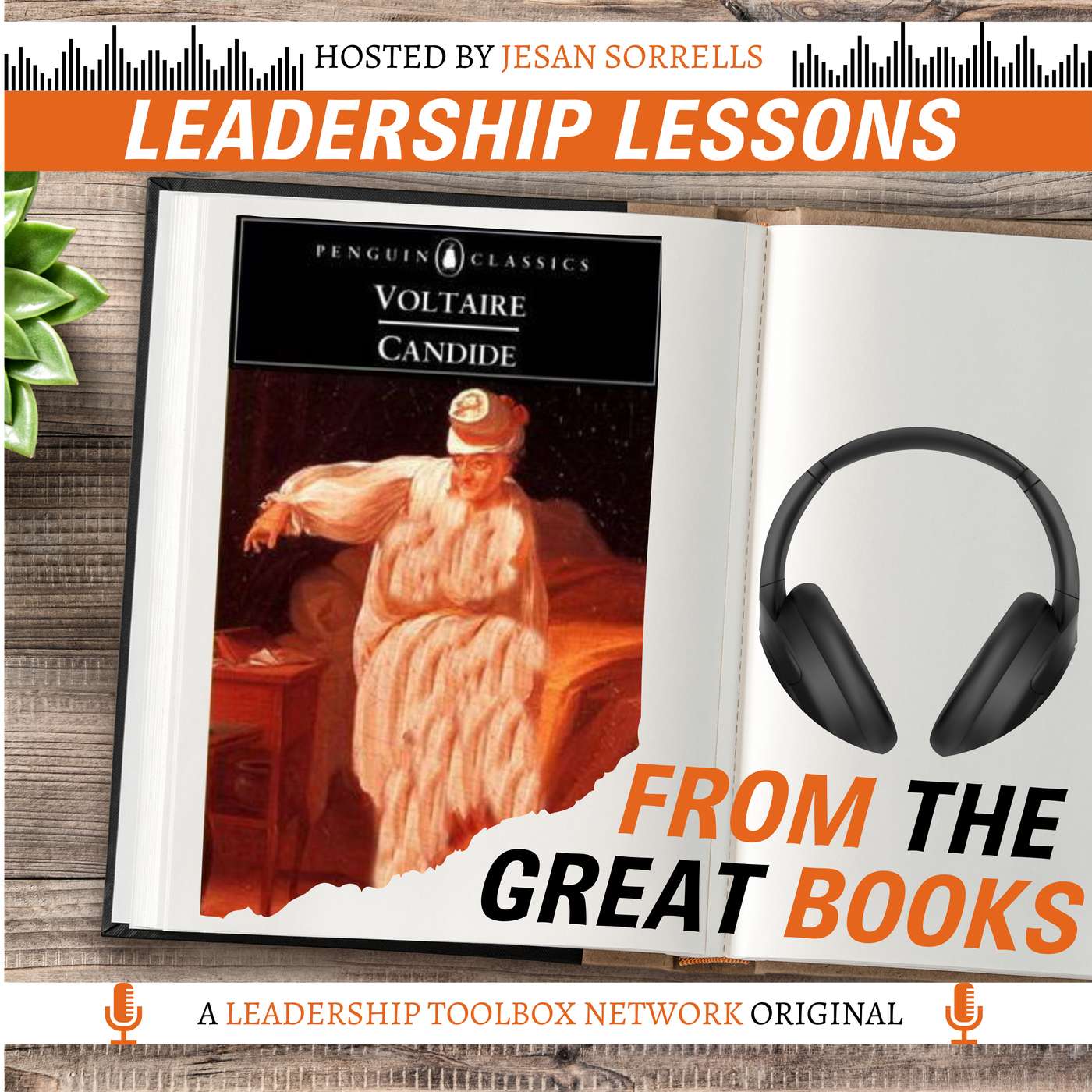
Candide by Francois Voltaire w/Tom Libby & Jesan Sorrells
Candide by Francois Voltaire w/Tom Libby & Jesan Sorrells
---
Dissecting Voltaire’s Candide with Jesan Sorrells and Tom Libby, this episode kicks off Season Five by exploring the absurdities of leadership, the legacy of Enlightenment thinking, and the challenge of sincerity in a meme-driven world. They unpack Voltaire’s satire to reveal practical lessons for modern leaders, including confronting organizational absurdity, distinguishing between moral and physical courage, and the enduring impact of literary wit on Western civilization.
- Book: Candide
- Author: Voltaire
- Guests: Jesan Sorrells, Tom Libby
---
Time Stamped Overview
---
00:00 "Voltaire, Leadership, and Absurdity"
11:11 Voltaire, Swingers, and Pancakes
14:12 "Timeless Stories Often Retold"
17:38 "Reassembling Lost Meaning"
26:36 "The Impact of the Printing Press."
32:50 "Candide: Chapter 2 Overview."
37:58 "Voltaire, War, and Absurdity."
41:50 "Voltaire's Cynicism and Candide."
44:46 "Leaders Are Problem Solvers."
50:55 "Disgust, Pragmatism, and Leadership."
57:16 "Timeless Thinkers and Their Impact."
01:04:07 "Candide's Ordeal and Reflection."
01:08:14 "Limits of Enlightenment and Reason."
01:14:41 Promote Team Builders, Not Performers
01:19:28 "Moral Courage Over Physical Acts."
01:25:34 "Challenges in Leadership Perspective."
01:27:58 "Shift to Prompt-Based Thinking."
01:33:23 "Ironic Detachment in Leadership."
01:41:26 Empathy and Generational Disconnect
01:45:50 "Gen X's Call to Action."
---
Opening and closing themes composed by Brian Sanyshyn of Brian Sanyshyn Music.
---
- Pick up your copy of 12 Rules for Leaders: The Foundation of Intentional Leadership NOW on AMAZON!
- Check out the Leadership Lessons From the Great Books podcast reading list!
---
★ Support this podcast on Patreon ★0:02 Hello, my name is Jesan Sorrells, and this is the Leadership Lessons from the Great Books podcast, episode number 176, opening up a little bit differently than maybe you are normally used to from our book today. In Westphalia, in the castle of my lord, The Baron of Thunder 10tr, there was a young man whom nature had endowed with the gentlest of characters. His face bespoke his soul. His judgment was rather sound in his mind of the simplest. This is the reason, I think, why he was named Tandeed. The old servants of the house suspected that he was the son of my lord, the baron's sister, and of a good and honorable gentleman of the neighborhood, whom that lady never would marry, because he could prove only 71/4 and the rest of his genealogical tree had been lost by the injuries of time.
0:57 My lord, the baron was one of the most powerful lords in Westphalia, for his castle had a door and windows. His great hall was even adorned with a piece of tapestry. All the dogs of his stable yards formed a pack of hounds when necessary. His grooms were his huntsmen. The village vicar was his grand almanor. They all called him my lord and they laughed at the stories he told my lady. The baroness, who weighed about 350 pounds, attracted very great consideration by that fact and did the honors of the house with dignity that made her even more respectable.
1:29 Her daughter, Gunde, age 17, was rosy complexioned, fresh plump, appetizing. The baron's son appeared in all respects worthy of his father. The tutor Panglos was the oracle of the house, and little Candide listened to his lessons with all the candor of his age and character. Pangloss taught metaphysico, theologio, cosmologo, nigolology. He proved admirably that there was no effect without a cause, and that in this the best of all possible worlds. My lord, the baron's castle was the finest of castles, and my lady, the best of all possible baronesses.
2:10 It is demonstrated, he said, that things cannot be otherwise. For everything being made for an end, everything is necessarily for the best end. Note that noses were made to wear spectacles. So we have spectacles. Legs are visibly instituted to be breached, and we have breaches. Stones were formed to be cut to make it into castles. So my lord has a very handsome castle. The greatest baron in the province should be the best house. And pigs being made to be eaten. We eat pork all year round. Consequently, those who have asserted that all is well have said a foolish thing.
2:40 They should have said that all is for the best. Candide listened attentively and believed innocently, for he thought Mademoiselle Cunegonde extremely beautiful, though he never made bold to tell her so. He concluded that after the happiness of being born Baron of Thunder 10 truck, the second degree of happiness was to be Mademoiselle Tonagande, the third to see her every day, and the fourth to listen to Dr. Panglos, the greatest philosopher in the province and consequently in the whole world. One day, Cunegonde, walking to the castle in the little wood they called the park, saw in the bushes Dr. Panglos giving a lesson in experimental physics to her mother's chambermaid, a very pretty and very docile little brunette.
3:21 Since Mademoiselle Cunegonde had much inclination for the sciences, she observed breathlessly the repeated experiments of which she was a witness. She clearly saw the doctor's sufficient reason, the effects and the causes, and returned home all agitated, all pensive, all filled with a desire to be learned. Thinking that she might well be the sufficient reason of young Candide, who might equally well be hers, she met Candide on the way back to the castle and blushed. Candide blushed too. She said good morning to him in a faltering voice, and Candide spoke to her without knowing what he was saying.
3:54 The next day, after dinner, as everyone was leaving the table, Cunegonde and Candide found themselves behind a screen dropped her handkerchief. Candide picked it up. She innocently took his hand. The young man innocently kissed the young lady's hand with a very special vivacity, sensibility and grace. Their lips met, their eyes glowed, their knees trembled, their hands wandered. My lord, the Baron of Thunder Ten Troch passed near the screen, and seeing this cause and this effect, expelled Candide from the castle with great kicks.
4:24 In the behind, Ginogande swooned. She was slapped in the face by my lady, the Baroness, as soon as she had come to herself and all was in consternation in the finest, most agreeable of all possible castles,
4:46 Absurdity and existential dread, and the vagaries of life in institutional systems, the perils of knowledge. These are all themes that leap forth from the short pages of the deeply influential book we opened Season five with just now, a book that, despite its lack of length, more than makes up for in deceptive depth,
5:14 proving that writing from the perspective of assuming that your audience is intelligent enough to get the joke has always been in the wheelhouse of the satirist, the jokester and the comic, and, of course, those willing to wear the literary clothes of those same folks kicking off the Fifth season of our show, we are going to dissect ideas and themes and solutions that for leaders that may lead to the restoration not only of leadership, but maybe even of, dare I say, the entirety of Western civilization itself.
5:50 From a book listed as one of the 100 most influential books ever written by the poet Martin Seymour Smith and literary critic. And he of course was also a biographer, so he knew a little bit about this fellow. We are going to be reading
6:11 from Candide by Voltaire. Leaders, we are past being fooled by the promises of the Enlightenment project. We are weighed down now in our time with ironic detachment which is preventing us from leading with sincerity in this not the best possible world, but I don't think that. But it's the only world we've got.
6:42 And of course, back for this new season of chicanery and shenanigans and tomfoolery along with great books is our co host, Tom Libby, who is by the way, closing in on being with us for 50 episodes. I just told him that before we hit record on this. He was not aware of that. So this is episode number 44 for Tom where he has joined us as co host. So how you doing, Tom? How's your new year going? I am living my best life, as. You mentioned that last year. Yeah, I, I, I, I always, I gotta come up with a new one, right?
7:22 Because I, I used to use, I used to use living the dream. And then I'd say I also have to remind people that nightmares are dreams too. And then I changed it to I'm living my best life because I can't live somebody else's. I've got to find a new one. There's got to be another version of this somewhere that I can, that I could make up or pick up somewhere along the lines. But overall I'm doing pretty good. Hey, son. Thank you for asking. You should tell people that you're living in the best of all possible worlds.
7:47 I was just gonna say because that were you. What do you said? The best of both of all possible worlds. But there's only one. We only have one to live in. We're. Which kind of made me chuckle when you were reading the excerpt here because I'm sitting there thinking to myself, experimental physics in 1750. What was that? Holding up an apple and letting it go to see what gravity does. Like what exactly experimental physics are happening in 1750? Like, anyway, for those of you are who are science buffs, I'm not making that statement as a true question.
8:18 I'm sure there were plenty of actual science things. Science was happening. I'm not. Science was happening. It just made me funny. It just made me laugh that somebody like Voltaire would write that in, in the book. Well, and the thing is, like, experimental physics, even in our own time, in 2026, some what, what like 300 and some odd years later, hasn't really advanced. Advanced much beyond that, except now we just use mathematical models with better computers. That's all that. Exactly, exactly.
8:46 I mean, you had, you know, everybody was trying to. Back at that time, everybody was trying to. To copy off of. Of Isaac Newton's, you know, sort of massive influence. And then you also had. Which people don't understand, and this is not to make this serious, you made a joke. It's a good one. And people back in that time in, in the 1750s were just beginning to sort of figure out, not that the world was round. We already knew that Columbus had, you know, ran across the New World, you know, by that point, but.
9:22 Or what was called the New World by that point, the North American continent. But, but they were, they were trying to figure out at a practical level. So there was practical. There was practical physics, there's practical mathematics, and then there was everything else that was like, not practical. Right. And that's where experimental physics sort of, sort of winds up at. So practical mathematics is like, how do you get around the globe and find like the Northwest Passage, which they still believed was a thing.
9:47 Right. You know, or how do you find like the city of El Dorado, which they talk about actually in, in here. Right. Which they also still believe was a thing. There was enough of the unexplored world still around the experimental physics. Sounded really cool when you said it out loud. Yeah. And it made girls like Cunegonde, you know, made their bosoms heave, you know, and all those, you know, 17th century dresses.
10:14 I don't know. I don't think about that. But I'm married.
10:20 I don't know anything about that. And nor do I need to know anything about that because I am also spoken for.
10:29 In the best of all possible worlds. So we, we covered a lot of information about the literary life of Francois Marie Arouette, AKA Voltaire. In our shorts episode that precedes this episode, which you should go back and listen to, has the title of it, I believe, why do. Why do business leaders read Voltaire? Or why should they read Voltaire instead of Harvard Business Review? So I would encourage you to go back and listen to that. And so we covered a lot of basic information about Him. And so we're not going to go over that right now.
11:04 But what I will say is this. And it was also one of the points that I made in that episode. I'd like to get some of Tom's thoughts on this. Much has been written and talked about Voltaire, particularly during his raucous life and through his death and way past, from misappropriating quotes from his works out of context, all the way to mangled malproisms in the popular culture of the 20th century. I'm thinking of. There's a whole scene in the movie Swingers where Vince Vaugh and Jon Favro are ordering food at the breakfast table in the casino.
11:41 And Jean Favreau, my buddy actually showed me this because I had forgotten about this. My buddy actually showed this to me because he saw that I was reading the book.
11:49 And the, the Jon Favro orders something off of the, off of the menu. It's like pancakes of the age of enlightenment. And he says, he says to the waitress, I'd like pancakes in the age of enlightenment. And then she's like, okay, whatever. And then she takes Vince Vaughn's order and then they walk away, right? And this is Swingers. So, like, Jon Favreau's like, in his 20s, Vince Vaughn is in his 20s. They're all young and thin and, like, still sexy looking. You're so money, you don't even know it.
12:19 And, and, you know, the waitress walks away. And then John Favreau goes, trying to pick up this waitress. And like, how's she going to know a Voltera reference? Why would I assume that a waitress would know a Volter reference? Why did I say age of enlightenment? That's so stupid. This is also the guy who later on in the movie has the whole scene with the, with the answering machine where he's like recalling all the time and trying to fix the answering machine message because he's nervous or whatever.
12:45 He doesn't have his whole thing. And, and, and I don't know. And, and then of course, Vince Vaughn is there to like, sort of calm him down. And Vince Vaughn goes, you know, man, don't even worry about it. It's fine, it's fine, it's fine. Whatever. Like, whatever. And. And then the waitress walks past and he tries to like, change his order or whatever to say something different. And she goes, your pancakes will come out in a minute. Voltaire.
13:12 Or something like that, right? Like, Voltaire would love that. He would have loved that. Yeah, absolutely. And the way this guy was wired,
13:23 his influence over the last, I would say 30 or 40 years has sort of begun to fade from, fade from the, the, at least the, the dominant conscience of, of, of the Western public. Maybe, maybe not like his. So it's the direct link. Maybe. But I think his work in his personality and his thought processes were referenced so frequently that we forget that the reference is his. I think it's not so much that, that it's not being referenced anymore. I just think we're forgetting the source of the reference because as we were joking when, before we, before we hit the record button and I had mentioned that this particular book candidate.
14:08 It's basically a third of the movies ever written. Like. Oh yeah, oh yeah. If you actually go back and read this and think of it in the context of today, you could think of at least a dozen movies right off the top of your head. They'd be like it's the same story as X or same story as Y or same story as Z. And I think what's happening is that we're referencing those movie references or the books rewritten or the books written by today's authors or more recent authors that are still using his work as, as the focal point or the thought.
14:37 So I, to your point, I think we're losing touch with the fact that, that he is being quoted or referenced or whatever. Yes, but I don't think we're, I don't think we're losing his references. If I said that, if I'm saying that right. Yeah. And that gets to my, my other idea that he was such a rare world bending historical talent that you. To your point, and I think this is absolutely valid, we, we now have reached a point where, because look, we're going to go into a lot more of this, but I don't know which.
15:13 How many posts. We are past modernism at this point. We're no longer postmodern. I don't know if we're post post modern or post post post modern. Like, I don't know when that, that clicks in. Can somebody just come up with another term, please, please, come on now. But we are way the hell past modernity, which came directly out of the enlightenment. And the entire. And we'll talk a little bit about this too, but the entire Enlightenment project was built on the idea that human reason could figure out the world.
15:42 That was a very simple way human reason, free inquiry, could figure out the world. We actually had the brains to be able to do that. And of course that came out of the Reformation, which was a direct rebellion against the power of The Catholic Church and the way that the medieval. The medieval, and of course the Renaissance, those two, those two streams combined together to create the Enlightenment. Right. Well, we've gotten a lot out of the Enlightenment. And I always admit to this, like, particularly religious people like myself, who, who, you know, have had to struggle through the Enlightenment for the last 400 years to justify the presence of religion.
16:24 I have to make this point to them. We've gotten a lot out of the Enlightenment. The Enlightenment brought you, like, this podcast. That's what the Enlightenment brought you. Free inquiry and the ability of human reason to figure out the world. I mean, we were joking about experimental physics, but really, like, without free inquiry, you don't get the atomic bomb. Like, you don't get. You don't get the Internet. Without free inquiry, you don't get the cell phones and this podcast mic and the video that we're shooting on you.
16:49 You don't get any of that. Now there are things that are lost in that. And Voltaire, interestingly enough, just like Shakespeare or the Apostle Paul or Socrates or the Founding Fathers, is a victim of his own. Is a victim of the Enlightenment. Success. Right? To your point, the copy of the copy of the copy of the copy. Right? Like, we, we don't even remember the original source code anymore. We're just, We. It was just too successful. Like, it just worked too well. And now we're in this weird position where.
17:23 And this is part of what I'm going to talk about this year on the podcast a lot. We're in this weird position where deconstructionism, which also you see in movies, where you're able to take apart everything. Okay, that's cool. But now we're at this weird middle ground where we have to start putting things back together and we don't know how. We've lost the ability to figure out how to put things back together that have meaning. And you and I have talked about this even when we're talking about, you know, sort of the Native American narratives or we talk about political ideas or theological ideas on this show.
17:58 How do we know how to pull the ideas apart, but we don't know how to restore them and put them back together? And the Enlightenment was the, was the root source code of pulling things apart with human reason, but it wasn't. There was no thing in there because they didn't think they needed it because there were so many things that were together already. So. Yeah, yeah, yeah.
18:21 I think also Candide remains popular to your point because of its, Its, its, its brevity. And its wit and its satirism. Right. So like the first time I ran across this book, I was 10 years old, maybe 11. And I banged through it because I was like, each chapter is only like four pages.
18:43 And I remember like I was reading it, you know, over the last couple of weeks, and I remembered. I, I sort of flashback to when I was a kid and I remember I laughed through this. I laughed at certain parts of this. Just the absurdity of, of certain things that were happening. But now is a. I'm gonna be 50 in like four years now is a, you know, mid-40s. I know, right? Mid-40s year old man. I'm looking at this and I'm not laughing like there's humor in it. I can see the humor in it, but I'm not laughing at it because we're way past the absurdity.
19:16 Like illustrating absurdity by being absurd, which we'll talk about in a little bit. But like, we're on the other side of that. And I don't know, like, we live in a meme driven world. I don't know how we do. How we do satire anymore. Maybe that's a good question to like sort of kick us off with. I was going to ask you, what do you know about Voltaire and Candy? But you sort of, sort of covered that ground a little bit. The, the, the satirical elements of it and the absurdist elements of it are, I think, what makes it
19:47 consistently popular among high school students. Because you first read it in high school, right? Yeah, I was like, I think the first time I set eyes on it, I was maybe 15. So for me, that was a long time ago, people. Libby ain't telling you how old he is.
20:07 Let's, let's just say it was be. No, never mind. I won't even get. It was a long time ago. He was, he was there when the deep magic was laid at the beginning. Of the Internet, folks, actually, I remember the day they announced the AT sign and what it was supposed to be for. So, you know, you're put, you know, h.email.com. yeah, they. They were telling us that this new symbol was. So you get this new thing called email.
20:36 I remember that. That news. That news. That news episode like very clearly like, like it was yesterday.
20:47 So yeah, my kids laugh. You know, my kids laugh because they feel at someday I will be the same joke equivalent to did you know, And God rest her soul, but Betty White died five years ago. And But Betty White, at the time of her. When she. Just before she died, the joke Was that Betty White was older than sliced bread. So she was born before the mass produced sliced bread was actually. So my kids joke that that's going to be me about the Internet. So. But when I'm older, holding gray to my grandkids and great grandkids, they'll be like, hey, he was alive before the Internet.
21:23 And they're gonna go, no way. So anyway, all right, sorry, we can move on. I apologize. No, it's gonna be great. It's gonna be great again. You'll be able to tell your kids. You'll be like Gandalf in Lord of the Rings. You could have like the beard and everything. Like, you know, and you can be like, listen, I was there when the deep magic was laid all the way. When the kid, when the grandkids walk in the house and I demand a hug and I'll be saying, you shall not pass, you shall not give grandpa a hug.
21:55 Okay, so let's, let's bring this back on the rails a little bit. Do you think? Okay, so thinking about Voltaire, think about who he was as, as a writer, as a raconteur, as a man about town. Internationally. He had a hell of a biography which again, we've covered in our shorts episode.
22:16 But do you think he would have been shocked or disappointed at the long term impact of his words
22:26 and of his writing? Because he wrote, he wrote a lot of books. I mean, he had a big impact in his own time. Do you think he would have been surprised that it, it lasted? That's a really good question. You know what, I think he might have been pleasantly surprised, but still not as surprised as I think. I, I think if I. Again, you. We were joking a little bit before we hit the record button on the podcast as well about how I felt this book was essentially an autobiography. Like if you look at his actual life in the book, there's a lot of mirroring that happens.
22:58 So he's, I think one of the reasons he wrote so well is because he wrote about things he really did know about. Right. Like things that, you know, that, that really, that he could speak to from a, from an experimental experiential perspective. Right. Like he experiment, he experienced these things. So I, I think from, if he, if he looked back from his point historically, were there people to your point, you, you mentioned a couple Aripostles, Socrates, etc. I think he would have thought because they wrote similarly from, from their experiences and their, you know, from the heart, so to speak.
23:38 Let's just say it that way, that. And they, they had Some lasting. Some. Some, you know, some la. Lasting terms to that. Could he do the same thing? I think he questioned it for himself. And I think he. I think he thought about it. I really do. I think he thought about, like, what would I have to do to be the next Socrates or to be the next whatever, and how do I need to write? And can I write from that experiential version that will give me the same stickiness. Right. Maybe didn't use those words at that time, but I. I do think he thought about it.
24:10 And again, I think that's one of the reasons why this book in particular, I find a lot of mirroring to his biography. If you look about being stuck in being exiled to England, like being in Prussia, being in like all these things, like, where he. He was kind of forced into some of those things, but once he got there, he made the best of it. He's like, screw it, I'm. I'm here. I'm gonna go kiss. I'm gonna go kiss the Tsar's daughter and you can go fry. Like. And then when he wrote the book about the kissing the Barrett, like getting involved with the baroness's.
24:40 With the Baron's daughter, and, And I'm like, it's the same thing he wrote. He knew what he was writing, like, so anyway. But I think he thought about it. I think he hoped for it. I don't know if he believed it was gonna happen. I. Obviously we can't speak to what his. What his. What was inside is his brain. But based on the writings and all of the. Right. I think he had an idea that if I write this volume, if I write the. If I write this in volume and I write enough, something's gonna stick. Yeah.
25:08 So I do think. I do think he had some sort of preconceived notion that. And again, look at Socrates writing and Aristotle's right. There's a lot of volume there. I think he did have the concept, mentally, that volume equals stickiness, volume longevity. So we, We. We sort of. Because we're. We're now in the backwash of. I mean, what are we. How many years into the Internet are we now? 40, 40, 50 years into the commercial Internet. And the level of social disruption that the commercial Internet has created in comparison to what was before is unbelievable to us living now.
25:51 Can't. Voltaire was born in 1694. Yeah, 1694. 1694. So he was born because the. The printing press officially started churning. Gutenberg started officially churning out bibles in like 1430 or something. 1450 somewhere in there. So he was born 200 and some odd years after the printing press and he started writing another probably 25 years after that. So
26:26 imagine what kind of people we will have 200 years from now on the Internet. Good point. That's sort of where my brain goes with it because I think I do, I hold to, and I want to say this on this episode early, I do hold to the idea that there have been probably two or three world bending, world changing human innovations
26:56 just in the area of science and technology. And the first one is the book, it's the printing press. I mean Gutenberg kind of suspected he had something that revolutionary, but he wasn't quite sure. But without the printing press, you don't get the Protestant Reformation, you don't get the Renaissance, you don't get Vasari's lives of the artists. Like you don't get people knowing about who the hell Michelangelo is, who aren't, who don't live in Italy. You don't get for good or ill, you don't get Columbus coming to North America.
27:28 You just don't get that because there's no curiosity then. Yeah, okay, they wanted to compete with the Chinese, but it would have taken a. But you could have added another 100 years onto that process which would have pushed back a whole bunch of other things. Without the printing press, you don't get the French Revolution for sure. You also don't get the American Revolution without the printing press, you don't get the British revolution which was the Industrial Revolution. The printing press was a world bending technology.
28:00 So is the Internet. Not social media, not the nonsense we build on top of it, not marketing ruining everything. Which marketing marketers ruined the printing press too. They did. Marketers ruin everything. This is what we do. I'm talking about the core technology of being able to connect globally with everybody if you want to and everyone having the opportunity to have a voice. And then you could argue the Internet plus cell phones, but that the core technology of the Internet itself,
28:32 that's one of two just like human innovations that cannot be beat. And so I wonder to your point, like I think Voltaire did have an idea that things were going to be sticky. I agree with you about that. But I don't know if he thought they were going to be sticky across time.
28:53 No, that, no, that's, that's the, the argument I'm making. I think he, I think he at least had the foresight of it. He. It had to have been, it had to be in, it had to be bouncing in his brain around there somewhere. Just the sheer volume that he wrote. Yeah. Right. Because you know when you write at that volume, something's gonna stick. Right. Like that's the whole like the. Into your point about like the Internet today. Think about, think about a guy like Joe Rogan, right? Yeah. How many podcast episodes has that guy recorded?
29:22 Right. When, when the Inter. 100 years from now, when Joe Rogan's long gone, are people still going to be list going back and listening to Joe Rogan's podcast? Possibly. Just the sheer volume of it makes people think there's some value there. Right. Like, so there. That's what I'm getting at. Like, and I, and I think that today we think about legacy differently because of that, because we know it's a lot easier in Voltaire's time. You had to have something published for it to be to that. To get to what I'm talking about being like, he wrote so much so often, so the volume that he wrote, someone still had to publish it.
29:58 And that, that costs money. Today's world in the Internet, you don't need that kind of money to get your stuff out on the Internet. You can own that. You can own some sort of domain. What is it? Hostling or bleepaddy? Whatever. You can go get a. For eight bucks a year or whatever, and you own that domain. You can put whatever you want on it. If you just start pumping it full of content and catches wind of it 100 years from now, like, oh my God, look at the volume of this up. And they re. Something's gonna.
30:25 Something in there will stick to something. Like you just. It's just inevitable at this point. So it's interesting that you brought up Joe Rogan as the Voltaire of our time. I didn't call him that. Hold on, timeout, timeout. I did not call him that. I was just using his, his. The, the, the relation to. The relation to volume, that's all. Yeah, yeah, the relationship. I understand the, the volume. The person putting on the volume of our time. Yeah. So I did, I looked up the AI, looked it up on Google and the Google AI overview says, and I quote, as of early January 2026, there are over 2,690 episodes of the Joe Rogan experience.
31:06 There you go. Then there's a bunch of other gobbledygook after that which we don't care about. And he's going to be recording it for the next 20 years. So God only knows where he's going to land. Right. God only knows where he's Going to land. That's all. That's all I was getting at. He might crack 5,000 episodes. He may. I would not be surprised if he did. So again, that's my point. Right? So 100 years from now, somebody's going to be looking up content, content creators from the early 20s, you know, the early 2000s.
31:35 Joe Rogan's name is going to pop up because of the volume. Like, who's going to beat that volume at this point? It's, it's going to be insanity. But that's what I was. Okay, but. Oh, we'll get to that. Okay, so this now, this now gets into like the core ideas of Candide, which are illustrating absurdity. Sure. Because this is. It's absurd to think that the guy
32:00 who was on Just Shoot. Not Just Shoot me. No. News Radio, who took shots to the face on news radio and hosted Fear Factor.
32:10 Okay, we'll have enough, well produced enough volume of podcasts on this revolutionary technology called the Internet to be referenced 150 years from now as the avatar
32:25 of the public voice of people in the early 21st century. See, and this is again, what you're talking. Voltaire would love the, the absurdity to this. I think, I think he would love the conversation right now. Like, he would be like, yes, I think that this is just. This is, this might just be absurd enough to happen.
32:50 Back to the book, back to Candide by Voltaire. We're going to pick up with chapter two here. Again. Remember, they're short chapters, so, like, you can like, they're literally like four pages, maybe even three. Like, literally, like bang through it in like 10 minutes. This is an afternoon read, so let's find out what happened to Candide after he got kicked out of the the best of all possible castles in the best of all possible worlds. Chapter 2. What became of Candide among the Bulgarians? Candide, expelled from the earthly paradise, walked for a long time without knowing where, weeping, raising his eyes to heaven, turning them often towards the finest of castles which enclose the beautiful future.
33:31 Baroness. He lay down to sleep without supper in the midst of the fields between two furrows. The snow was falling in fat flakes. The next day, Candide, frozen, dragged himself toward the neighboring town which was named Valder Berghoff Trach Nickdorf. With no money, dying of hunger and fatigue, he stopped sadly at the door of an inn. Two men dressed in blue noticed him. Comrade. Oh, said one, there's a very well built young man and he's of the right height. They advanced toward Candide and very civilly invited him to dinner.
34:03 Gentlemen, said Candide, with charming modesty, you do me great honor, but I haven't the money to pay my bill. Ah, sir, said one of the men in blue, persons of your figure and merit never pay for anything. Aren't you 5ft 5? Yes, gentlemen, that is my height, he said with a bow. Ah, sir, sit down to the table. Not only will we pay your expenses, but we will never allow a man like you to lack money. Men are made only to help one another. You are right, said Candide. That is what Monsieur Panglos always told me, and I clearly see that all this is for the best.
34:35 They urge him to accept a few crowns. He takes them and wants to make on a promissory note. They want none. They all sit down to his table. Don't you love tenderly? Oh, yes, he replied, I love Mademoiselle Cunegonde tenderly. No, said one of the gentlemen, we are asking you whether you do not tenderly love the King of the Bulgarians. Not at all, he said, for I have never seen him what? He is the most charming of kings. And you must drink to his health. Oh, most gladly, gentlemen. And he drinks. That is sufficient.
35:09 They say to him, you are now the prop, the support, the defender, the hero of the Bulgarians. Your fortune is made and your glory is assured. They immediately put irons on his legs, and they take him to the regiment. They make him turn right. Turn left. Raise the ramrod. Return the ramrod. Take aim. Fire. March on double. And they give him 30 strokes with a stick. The next day he drills a little less badly, and he gets only 20 strokes. The day after they give him only 10. And he is regarded as a prodigy by his comrades.
35:41 Indeed, completely stupefied, could not yet understand too well how he was a hero. He took it into his head one fine spring day to go for a stroll, walking straight ahead, believing that it was the privilege of the race of humans, as of the race of animals, to use their legs as they please. He had not gone two leagues when up came four other heroes, six feet tall. They overtake him, they bind him, and they put him in a dungeon. He was asked juridictiously, which he liked better, to be beaten 36 times by the whole regiment, or to receive 12 lead bullets at once in his brain.
36:14 In vain he told them that the will is free and that he wanted neither of these. He had to make a choice. By virtue of the gift of God, that is called liberty. He decided to run the gauntlet 36 times. He did it twice. The regiment was made up of 2,000 men that gave him 4,000 strokes of the ramrod which laid open his muscles and nerves from the nape of his neck to his rump. As they were about to proceed to the third run, Candide, at the end of his rope, asked him as a favor to be kind enough to smash into his head.
36:45 He obtained this favorite. They bandage his eyes, they make him kneel. At that moment the king of the Bulgarians passes, inquires about the victim's crimes. And since this king was a man of great genius, he understood from all he learned about Candide that this was a young metaphysician, very ignorant of the ways of this world. And he granted him his pardon with a clemency that will be praised in all newspapers and in all ages. A worthy surgeon cured Candide in three weeks with the emollients prescribed by disor or disorides.
37:13 There it is. He already had a little bit of skin and could walk when the king of the Bulgarians gave battle to the king of the Albarians, close quote. So Candide was in the army now. Not behind a plow. You dig in a ditch. Son of a. You're in the army now.
37:39 This is, this is a prime example. This is why I picked chapter two of illustrating Absurdity by being Absurd. So to Tom's point about Voltaire's biography, Voltaire did run across the King of Prussia. And at that time in Europe, Prussia was its own independent nation state. Prussia had not run across. Well, they hadn't yet gotten to the point where they were willing to wage wars against everybody else on the continent in order to unite Germany into one, into one nation state. Although Frederick the Great was sort of the precursor to some things that were going to happen later on in the very war torn early 19th century.
38:26 Voltaire saw all this coming. And of course he was witness to the marching, the turning, the lifting of the ramrod, the lowering of the ramrod, and wondered, of course, where all of this would lead. He understood that the best way to skewer the present was to demonstrate the massive gap between what was idealized and what was reality. And all of the characters in this book, from Candide to Mademoiselle Cunegonde, there's going to be a blind old maid that you're going to meet in a minute. Maybe we won't get there today, but all these characters in the book, even the characters in El Dorado, lived through absurd situations that Voltaire saw in real life.
39:07 They experienced war, social strife, Natural disasters. This book was published right around the time when an earthquake occurred in lisbon, Portugal, in 1750.
39:23 And in Lisbon, apparently this was like one of the biggest earthquakes that had ever occurred on the European continent and killed a whole bunch of people. I think it's something like. I'm gonna have to check the number, but I think it was somewhere between like 30 and 50,000 people died in this earthquake. And Voltaire was, was. Was taken aback by this, right, because there were many people talk about philosophy and the Enlightenment. There were many people who were exploring all kinds of philosophical ideas during the Enlightenment that were attempting to, of course, get away from the religious wars that were also ravaging Europe at that point.
39:57 And. And one of the ideas was this idea of optimism, this idea that we are living in the best possible world. And of course, Voltaire thought that was absurd. He said, if we're living in the best possible world, how is it that all these people died in this earthquake in Lisbon? Or if we're living in the best possible world, how is it that people are forced into marching in regiment to serve a king? That might be crazy. If we're living in the best possible world, how is it that we still have social strife and we still have.
40:27 We still have rulers who are tyrants, right? And by the way, Voltaire was a monarchist.
40:35 He was a monarchist. So what that means is, by the way, as a monarchist, he saw the divisions in French society as being examples of absurdity and then of themselves. So French society was. Was divided into three parts. There were folks who supported the monarchy and supported the aristocracy. Louis the 15th and all those folks and all of his precursors, Louis XIV, Louis the 13th, you know, what's her name? With. Let the. Let there. Let there be cake, all that, Right? Okay. Then you had the noble class, right?
41:10 And the noble class included landowners and included intellectuals like Voltaire, Rousseau and Diderot and all those other guys who would wind up later on. And. And Voltaire did know some of those folks would later on wind up laying the foundations of the French Revolution. So you had your. Your nobles and your intellectuals, right, Your landowners. And then the third area of society that you had was what was. What was. Well, the third area of society was the church. And so the church owned property.
41:43 We often forget in our modern times, because France is so secular after being. After having the religion smacked out of it during two world wars, that France was once a heavily Catholic country and the Catholic church owned a lot of property in France. They fought a forward movement against the Protestant Reformation that was kind of coming out of Germany and specifically Prussia, interestingly enough, Lutheranism, Calvinism, all of that was coming out of Germany and Switzerland, the area that would later on become Germany and Switzerland.
42:23 They were fighting a, a front, a front robust, you know, crusade level action against all of that. And of course, this was an era where popes out of Italy had, well, they had armies and they used them. So this is the historical context that Voltaire is in. And he's looking at all this and he's saying, this is absurd. If this is the best possible world, what the hell are we doing? And he writes Candide from that perspective. Voltaire believed that we had to be cynical about the absurdity of the world around us if we would ever find the moral courage to confront it and change it.
42:59 This is why it's worthwhile as a reader, as a leader to read Voltaire rather than Harvard Business Review, because think about the world that we are in today. The world that we are in is equally as absurd, perhaps more at scale, I think Voltaire would say, than it was during the, during the time that between 1694 and the publishing of Candeep. And Voltaire was walking around observing things. And it begs the question. No, not begs the question, but it opens up the question which we were going to talk about Tom, about here.
43:34 How can leaders, right,
43:38 expose and face the absurdity just of the day to day ways they have to lead? And we've never actually talked about this on this podcast. I was realizing that when I was reading Candide. Like we've never actually talked in real terms about the absurdities of leadership. We've kind of talked about dichotomies, but there are some literal absurdities that are in leadership. An easy one to think about is we have these HR policies and procedures that we've created. Maybe the founder of the company has created them, or maybe the executive board has come up with them or whatever.
44:11 And then there's this thing that happens that's outside of the
44:17 boundaries that are set by those policies. But it's not unethical, it's not immoral, and it's not illegal. Just outside the boundaries. And if we were in any other possible circumstance, we would just kind of ignore this and leave it alone. But we can't because it's in our business and we haven't. We. I don't think we've ever talked about that, that, that situation, those kinds of situations. And so how do leaders, what can leaders take from Candide in order to handle that? I think So I don't know it, it's so funny that you, you word it like that because I was, I had, I, as I was thinking of the excerpt you read and some of the commentary that you had.
44:57 And I already had some things in my brain that now don't apply. So I'm not sure I'm, when I'm gonna say that or if I'm going to say any of that stuff. But, but, but I, I think to your point, right, like I don't think there's anybody when, when leaders are true leaders, when they are faced with a problem, they try to solve it. So to your point about you've got all these policies and things that, that you deem as your HR playbook or your HR employee handbook or whatever, and if you've come across something that doesn't get addressed in there, how do you like, to your point, do you ignore it?
45:34 Do you just let it go? Leaders are not going to just let it go. That's just not, it's not in their DNA, right? So they're going, they're going to try to find a place in their employee handbook that they can slightly modify to include it so they can address it, so they can handle it and so they can move on, or they're just going to add a chapter in their handbook to address it. Now that being said, that's the, that's the practicality of it. That's, that's the way, right? That's the way leaders are, are built, right?
46:04 They're gonna, they're problem solvers. They're going to look at a problem, they're going to solve it. This, this thing is not in our employee handbook, but we need to address it. And even if somebody says but do we have to address it? It's not in the employee handbook. And they're going to go, if it, if it, if it happens in the confines of our company, it needs to be in the employee handbook, right? Like so the fact that it happened, and I think it goes back to Voltaire's thinking, which is think in provability, in fact, in factualities.
46:34 Don't think in ideals and ideas, right? That, like, that's one of the foundations of his writing, which is like you should be judging something based on what you can see, feel, touch, hear, smell, whatever, not on ideas. An idea is not, is not something that you should throw all of your whimsic, your whim into, right? Like so, same, same scenario here. So if leaders think like that, that they're thinking practic from a Practical standpoint. And they want to see provability. Things that can be, you know, things that can be touched, smelled, saw, heard.
47:10 What I like you can prove that it exists. Right. Then they're going to fix it. They're gonna. They're gonna. They're gonna. They're gonna inevitably rewrite the employee handbook. So. So we are. Yes, they are going to rewrite the employee handbook. And, and you're talking about. So Voltaire. Voltaire loved divisions and classes in society. He was a classicist in a way that we can't understand. Right. So he, he believed in.
47:40 Yes. He believed that, like, all human beings were equal in sort of the John Lockean way of thinking about freedom that the Founding Fathers would eventually codify and like the Constitution and the Declaration of it. He believed in all that. He would have. He would have clapped for all of that. Right? He would have seen America as like the pinnacle end of the Enlightenment project. That's how he would have viewed the American founding. If he'd been alive long enough to. To sort of see. Because he died in 17.
48:09 When did he die? He died in 1778. So he died, what, two years after the signing of the Declaration of Independence. And so he didn't get to see the like, the like fulfillment of that, but he would have clapped for that. Okay,
48:28 but he was also a monarchist and he believed in kings and he believed in classes. He's. He's quoted as saying, I. I do. Did see this in his Wikipedia biography, and I reconfirmed it in other places, but he did believe that the masses. Democracy couldn't work because the masses were idiots, basically. Our forefathers felt the same way. That's why they invented the electoral college. I'm just saying. I'm just saying. I'm just saying, like, there's is. This is the thing. Right? And so. So he believed in a class system.
48:57 Right. Now you're talking about a distinction between, at a class level, between what is practical and pragmatic versus what we see and idealize in business. Right. And so there's. There's a dis. And by the way, we're on the other side of, like, existential dread. So we're on the other side of, like, Camus, who we've covered on this podcast. We're on the other side of deconstructionism. We're just going to tear everything down. And Durinian deconstructionism. We're on the other side of moral relativism.
49:34 Well, you know, if it feels like it's Your truth, Do it. It's fine. By the way, Voltaire would have rejected all that crap. He would have said, if it feels good. What does that even mean? I have no idea. Yeah, he would have yelled it. He would have yelled at Jacques Derrida in French and told him he was a moron, you know, and then like, run away. Actually, he might not have run away. Those old boys, they actually knew how to duel. He would have challenged him to a duel. Like, he did challenge somebody to a duel.
50:00 I believe he did, if I remember correctly. I. I'm trying to remember who it was now. It was like, it was when he was in Prussia. It had something to do with the Prussian king's daughter. Yes. And the way that I can't remember now who he. It doesn't matter. But to your point, he wasn't backing down for people because principal met. Your name meant something at that point in history, Right. You were not going to do anything to muddy your name. And if it meant to defend yourself against, it didn't matter who.
50:30 Didn't matter. So. So we're, we're past all that, right? Our names don't mean anything. One of the great lines in, like, Pulp Fiction, when Bruce Willis is getting on the, getting on the bike and the girl is behind him and she's like. Or not the girl. Like, it's not that scene. There's one other scene in there where she's like, what's your name? And he's like, my name is blah, blah, blah, blah, or whatever. And she's like, what does that mean? He goes, we're Americans, baby. Our names don't mean anything.
50:53 Yeah, there you go. It's. Yeah, like Voltaire would be stunned to the point of disgusted at that, that entire, like, worldview, right? Because it did mean something. So my question is, my clarifying question with all that there is.
51:10 If we have the pragmatism, which I don't disagree with you, I think, I think leaders are pragmatic, but I also think leaders are, like, trapped in this environment of absurdity where. So for instance, I once had an employee, and this was long before COVID and George Floyd and any of that. I once had an employee who shall remain nameless if he's listening to this, to this podcast, but he'll know who he is. When I mentioned this, this incident, who wanted to go and protest in like, some anti racism rally, okay?
51:44 And this was way back. This is before anything happened with COVID This is years ago, like 2017, 2018, back then. And I sat him down. Because there's nothing in that. In my employee manual about any of that. Because I couldn't have. I couldn't. It was only after I developed a relationship with him that I understood where his political leanings were. And so it made sense to me that he would go in that direction. Right. And I literally had to sit him down and I had to say, listen, there's nothing about this in our handbook.
52:21 So I'm going to. This seems very idealistic to me. And you want to change the world. Actually, I think it was 2016. That's right. Because he was a Bernie bro. That's right. That's right. He was a Bernie bro. That's right. And he wanted to go to, like, a rally that was going to turn into some shenanigans in Portland at the time. That's what it was. I remember now. And I literally looked at him and I said, I don't care about your politics. That has absolutely nothing to do with the work that you do here.
52:50 I don't care that you go protest. That's your freedom of speech. That has nothing to do with what you do here. However, I do care because it was a small team. I mean, we were under 25 people. I do care that if you get in trouble and you call me, I can't come bail you out. Like, I'm not doing that. That's a step too far. And when you come here, if you have been in jail,
53:19 that's a problem. You. You don't work here. You don't work here anymore. Yeah,
53:28 that's an absurd. To me, that was an absurd situation. That was a candid level of absurdity because I couldn't under. Number one, I couldn't understand what he was trying to accomplish. But because I thought the fix was in already, which it turned out I was right. But. But. But
53:47 because I'm just older and I just seen more. Right. But. But it illustrated to me the absurdity of dealing with things that are outside of the boundaries. Right. That you might be faced with as a leader. And I literally had to sit there. I couldn't laugh at him because I really did. I wanted to crack up and be like, this is so obvious. How can you. How could you not figure this out? And the absurdity was in that he was idealistically oriented in this direction so genuinely that he couldn't see the absurdity himself.
54:22 And that's what I think leaders struggle with.
54:28 Even more so now on the other side of 2020, because there's all kinds of things that have occurred on the other side of 2020 that I, I couldn't even imagine in 2016. Oh my God. If you had told me like back in 2016 that we would have like all of the things we had post George Floyd and post Covet and all of the kinds of absurdities that have, that have just, we've just sort of like shrugged our shoulders 10 years later and just sort of been like, yeah, okay, that's reality now. I'd have been like, what?
54:53 Yeah, I would not have believed you either, honestly. And that's the absurdity part that I think Voltaire is pointing out with Candy. That's why I think saturation works. That's why memes work across the Internet. And what's amazing to me is people can't figure out why memes work le. And I'm not just talking about like regular people, like people who, we have titles and we call them politicians and policymakers are absolutely flummoxed by meme culture on the Internet. Well, until the 20 something, until the 20 somethings are running for Congress, it won't like we will.
55:29 None of the next generation after the, the, the, the politicians that are in power, right, the next generation behind them are still not going to have an idea behind that. They're not going to have a clue either. It's going to be, it's going to be two generations, three generations away when we start, when you start seeing politicians leverage that stuff. Yeah, the absurdity will disappear, right? Like that's, that's really what it gets to Voltaire's point, right? The absurdity won't disappear. The absurdity will go to a higher level because I don't think the absurdity can disappear.
56:00 Okay, so it might not, but the absurdity that you and I are thinking of right now will disappear. It'll be something else is my point. It'll be more, it'll be less, it'll be different, whatever, but it'll, it'll, it'll morph into something else is I guess, my point. But as we have said on this podcast a thousand times at this point. That the more 44 times, the more. Things change, the more things stay the same. Right? So this is this what I don't think Voltaire would think this is anything new. Like everything like what you're talking about and how he approached the world, the thought about the world, how he was, he was even, even self contradicting at some points with the, the way that he viewed the, the world versus his thoughts on monarchies and, and, and classism and stuff like that.
56:43 And some of, some of his writings would, would literally talk about how that was absurd even as to one. One human being to rule. Overall, he thought that was absurd, but yet supported it. So like. So I think, I think he would. I, I do think they're, they're. If he were alive today, I think there would be things that he would look at us and go, no duh. Like that's the five year old Voltaire. No duh. How do you guys not see that this is normal? Like this is a, this is exactly what you should have expected.
57:16 Like so well, and maybe that's the part of the continuing strength of him because he, he hits on something that so, so you know, in the list of notables that I mentioned along with Voltaire, which he would object to being placed next to the person that I placed him with. But I'm alive and Voltaire is dead. So, so, so you know, Voltaire, the apostle Paul, Shakespeare, Plato, um, St. Augustine, the people that even people that we've read on this show, I mean we've read all those guys on this show.
57:52 Show, right. They all touched on or were able to grasp
58:01 something about a corner of reality that to your point, the masses say no duh or whatever and sort of move past, but they focused in on that and said no, you need to pay attention to this. And that's the power of Voltaire. That's why Voltaire has lasted across time along with all those other folks. And just like those other folks, he will continue to either be referenced. I don't know about being read, I'm still not convinced on that. But he'll be referenced forever and ever. And not forever, but for a long, long time.
58:37 I think it's gonna take a long time for the water to go out on guys like that. And where that relates to leaders and leadership I think is in that leaders have to understand that. I think they're playing on a longer timeline than just. And we haven't really talked about this either, but maybe this year we will more. They have to play on a longer timeline than just the quarterly timeline.
59:05 So I go back to my, my, my story with, you know, my former employee. Like that person I had, I had a lot of impact in that person's life. And that person looked up to me and, and admired me. Right. And looked at me as a figure to be admired. Right. How much impact I had across that person's lifetime, I have no idea. But I do know that for, you know, a very specific narrow window of about.
59:40 Yeah. Five to six years. Like, that person was like, hey, hey, son. What do you think? You know? And I think it goes back to that idea of being able to treat his absurdity as serious rather than as something to be laughed at or something to be satirized. It's become content now. It's, congratulations, it's podcast content now. But, like.
1:00:02 That'S how you know you've made it. See, before you had to be quoted in a book. Now you become podcast fodder, and you've made it. More absurdity.
1:00:16 So instead of saying the more things change, the more things stay the same, we're gonna have to come up with another phrase that we can honor Voltaire with. Like, the more absurd. The more absurd something seems, the more likely it makes sense. Sense, or the more likely it is more likely. I don't know. We'll figure it out. We'll figure it out. We'll figure it out. Well, this is why. This is why this is the first book we're covering in the first episode of this year, because this lays the foundation for where we're gonna go.
1:00:39 Exactly. All right. By the way, I did look up the. The Lisbon earthquake. So I want to kind of grab this information, and we're going to be doing a little bit more of this this year also, since I do have my. I do have my phone attached to the Internet. Wait, we're gonna. We're gonna fact check on. Right on the podcast. Right on the pod. That's amazing. A little bit more of that. Joan, eat your heart out. I'm gonna stop being so lazy.
1:01:07 So the Lisbon earthquake occurred in 1755
1:01:11 and occurred on the morning of Saturday, November 1, the Feast of All Saints, around 9:40 local time. So that was. That's a big Catholic. That's a big Catholic holiday. And it was a 8.5 to, um, 9.0 earthquake. So it was a big earthquake, and it killed 30,000. 30,000 people and apparently
1:01:39 created a. A tsunami that was about 20ft high at Lisbon and 65ft high at Cadiz, Spain, which is a little bit more inland. Modern research indicates that the main seismic source was faulting of the seafloor along the tectonic plate boundaries of the mid Atlantic. So, yeah, and Voltaire said about that. He lamented the destruction of Lisbon in the earthquake. Again, this is according to the AI The AI here on. On Google and criticized the philosophers who thought that, quote, all's well with the world, and the religious folks who thought that it was, quote, unquote, God's will.
1:02:22 So he, he. He hit to the both his left and his right, which was typical for Voltaire.
1:02:30 Speaking of the Lisbon earthquake, we're going to go to chapter six in Candide. Back to the book. This is going to be real short. It's literally two pair, two paragraphs. It's ridiculous how short chapter six is. This is why I picked it for my mid. My mid. My mid. Episode transition here. All right. After the earthquake. So this is chapter six. How they held a fine auto defe to prevent earthquake and how Candide was flogged after the earthquake which had destroyed three quarters of Lisbon. The country's wise men found no more efficacious means of preventing total ruin than to give the people a fine auto da fe.
1:03:07 It was decided by the University of Coimbra that the spectacle of a few persons burned by slow fire in great ceremony is an infallible secret for keeping the earth from quaking. That's the absurdity that he was pointing out. They had consequently seized a Biscayan, convicted of having married his bleepchild's bleepmother and two Portuguese who, when eating a chicken, had taken out the bacon. By the way, there's a note in this. The reason that they picked the two Portuguese who, when eating a chicken, had taken out the bacon was because the taking out of the bacon thus showed that they were Jews and still secretly faithful to Judaism.
1:03:48 After dinner, back to the book. After dinner they came and bound Dr. Panglos and his disciple Candide, the one for having spoken and the other for having listened, with an air of approbation. Both were taken separately into extremely cool apartments in which one was never bothered by the sun. By the way, those are prison cells. A week later, they were each clad in a sanbenito and their heads were adorned with paper miters. Candide's miter and San Benito were painted with flames upside down, with devils that had neither tails nor claws.
1:04:18 But Panglos devils wore claws and tails, and his flames were right side up. Thus dressed, they marched in procession and heard a very pathetic sermon followed by some beautiful music in a droning, plain song. Candide was flogged in time to the singing. The Biscayan and the two men who wouldn't eat the bacon were burned and Panglos was hanged, although this is not the custom. On the same day, the earthquaked again with a fearful crash. Candide, terrified, dumbfounded, bewildered, bleeding and quivering all over, said to himself, if this is the best of all possible worlds, then what are the others?
1:04:52 I could let it pass if I had only been Flogged. If only I had been flogged. That happened also with the Bulgarians. But, oh, my dear Panglos, greatest of all philosophers, was it necessary that I see you hanged without knowing why? Oh, my dear Anabaptist, best of all men, was it necessary that you be drowned in the port? Oh, Mademoiselle Cune, pearl of young ladies, was it necessary that your belly be slit open? By the way, that had happened earlier. He was going back, barely supporting himself, preached at, flogged, absolved and blessed, when an old woman accosted him and said, my son, take courage, follow me.
1:05:31 By the way, there's one other thing you note. Every time there's a new character introduced, the level of absurdity, the ratchet of absurdity goes up higher. So the. The old lady. The old lady proves to have a story that I cannot read on air, by the way, but it is a story that is quite, quite shocking to modern ears.
1:05:56 Even I was surprised when I read it. I was like, oh, they actually wrote this down? Well, I guess all these kinds of things were happening on a regular, so it wasn't a surprise to anyone. Which this leads into sort of my. My Act Two idea here. So, remember I said earlier in the show that. That we've become enlightened. Right. And we're at the end. I. I personally believe, and I'm not the only person to say this, I personally believe that we're at the end of the Enlightenment project. This doesn't mean that we're not discovering new things or that we're.
1:06:29 We're at the end of, like, human invention. I don't. I wouldn't be so bold as to take that position, although Peter Thiel has taken that position. There's been several people to say that the human race has invented what it will invent at this point. Now it's just building a better mouth. Mousetrap. Right, right, right. Several. Several people believe that. Several people believe that. And I think that that's a bunch of nonsense. And not just a little nonsense, like a lot of nonsense. Actually, there's a book that we're going to read, our second book this year.
1:06:57 We're going to be reading a book by Francis Bacon called the Great Installation. And it's. It's going to be interesting because Bacon believed, and he was roughly a. A. What do you call it? Not a peer, but he was operating at the same time that Voltaire was operating, except in England. And Bacon was a person who believed that we actually could resuscitate, we could renew the world, we could take actual knowledge and scientific theory and we could remake the world into something else. And he believed, as many do who say, that we've reached the pinnacle of human enlightenment and that we have no further to go.
1:07:49 He would say to those folks that what we've reached is the peak of mediocrity, actually, and that just by building a better mousetrap, we're just being more and more mediocre. And Peter Thiel, by the way, believes some of this, but then sometimes you'll get him in other interviews, he believes other things. Right, so. Or he'll say other things in answer to the interview's question. So I personally don't hold to that. But I do think that the project of the Enlightenment, which was a project that was believed, that was based on, again, the principles of free inquiry and free human reason, I do think that project is at a close.
1:08:29 I think we are going to have human innovation, but it's going to be built on different principles. And I think that's the direction we're going. And we just don't know what those principles are because no one's laid them out for us yet, because we're all still trying to go back to the Enlightenment because we're like, oh, human reason, that's like the best thing for us to use. Well, you know, at some point, you do have to look around and realize the limits of human reason. And I think we have reached that point, particularly in America, where we're starting to look around and go, what are the limits of human reason here?
1:09:02 You know, what are the limits? Where are the boundaries? And that's a good question to ask because I think that that ultimately opens. Allows you to find a new door into a new place that you didn't. You didn't know existed. But it takes a long time. It's not something that happens at the speed of a tweet. Yeah, you know,
1:09:22 I think the challenges that are in our era, particularly the challenges for leadership in this era that's also partially circling, looking for that new door, are challenges in competence and meaning. But I also think the challenges of courage. And then, of course, there's the tactical areas of leadership and succession and mentoring and coaching and supervision. We for sure, and I've already said this, we for sure know more about the world materially and scientifically than even people in Voltaire's time did.
1:09:51 However, we know a hell of a lot less about people and their motivations than people in Voltaire's time did. And we ignore empirical evidence. It's right in front of our eyes in favor of scientific theories about human nature that very often prove to be mere myths. And then we get mad when people don't live out the myths. Case in point, every riot you've ever seen lately about any political act, and I'll just leave that there.
1:10:22 Technological wizardry has allowed us to hide from facing the hard truths about leading people and Candide. This is another reason why you should probably read it. Candide is about facing hard truths presented, of course, in a way that illustrates the absurdity of those truths, but it cannot tell us how to solve that absurdity. He cannot tell us how to resolve it. Voltaire merely shrugs his shoulders sort of rhetorically at the end of Candide and sort of leaves us to our own devices. And as a person who is a religious person and also a philosophical person, but also a practical, pragmatic person, this will not do for me.
1:11:04 There are hard problems to solve in leadership. Tom and I mentioned some of them already. Competence, meaning courage. Those are hard problems to solve because they're so individualized.
1:11:16 How can leaders have the courage to actually face those hard problems and solve them? Oh, goodness gracious. So how. How can they get the courage? My, my. One of the things that. And I. I've always had this thing like leaders aren't born, they're created. Right? So if you. If you're. If you're not willing to face the hardest challenges, if you're not willing to. To make hard decisions, are you really a leader? Can you. Should you be considered a leader? Are we missing. Are we missing out on a secondary title or a secondary role of somebody that we should be calling them instead of the leader, so to speak.
1:12:05 Because I think that's. I think that's where those people fall. Right. Maybe they're. They're somebody who needs somebody above them to say, you know, pat them on the head and say, what you did was, okay, I'll take it from here. Because I really do want to lead people. I really do want to help people secure, succeed. I really do want to be the person somebody comes to with their challenges. I want people to come to me with their problems. You don't seem to be that person. Right. So when you. So can they build up to it?
1:12:32 Sure. Because I do still believe that leaders are made and not born, so somebody may not be ready for it. This goes directly to a problem that I was talking to a colleague of mine last week about. It wasn't on this podcast, believe it or not, Jeson, what we were talking about. Was the fact that, like, the question that was handed to me was, did you ever work for someplace that promoted you with training behind the promotion? Or were you just given the promotion and expected to lead people because you knew how to do a job that you were doing?
1:13:07 In the current state of state of affairs, I think that is the underlying problem. We take. I'll just take my area of expertise. For example, we take a salesperson. You'll say you have a group of 10 salespeople. Your sales manager leaves, gets fired, quits, whatever. And the instinct is to say, let's take our number one guy or gal and make them the sales manager. Because the thought process is they can make everybody else as good as them. And that is the furthest from the truth I have ever heard in my entire life.
1:13:39 Because what makes a really good sales leader and what makes a really good salesperson are two different things. Are we going to promote that person? First of all, we're going to ask that person. You're going to half the time in those environments where it's only one team. I'm not talking about giant corporations. I'm talking about a small company. One sales team they're going to take. They're basically going to say, hey, son, you're our number one rep. The sales manager just quit. So you're the manager now.
1:14:06 Have a nice day. There's no conversation or interview process or whatever because if they went through an interview process of like, say, the top three salespeople, they might uncover that the third best salesperson is number three because they spend 25% of their time helping everybody else, making everybody else on the team better, Taking the last, the bottom guy or girl on the sales team and trying to coach them up, trying to help them, trying to give them some, like some confidence booster or whatever.
1:14:38 Now, whether they success or fail at that is not their job. But they do it because they want other people around them to be successful. Now you take that person at number three, make them the sales manager. Now guess what happens? Your entire sales team just uplifts because they're going to take the worst sales team, the worst salesperson on that team and try to make them better. The number one person will not do that. The number one person will be like, well, you suck. I'm just going to replace you, right?
1:15:06 So again, I, I go back to, like, some of the absurdities here are companies will promote and have expectations without training, without conversation, without. They'll just hope and pray that this person is going to do a good job. You know, by the way, I would say 8 out of 10 times that person gets fired because they suck as a manager instead of just getting demoted and put them back where they belong. So there are, there are salespeople out there that never want to be sales managers. They just want to do their job and go home because they're really bleepdamn good at it.
1:15:37 You know what? If you own that company, let that person do that. Why. Why are you going to take your best salesperson out of the field? That makes no sense anyway. So go back to what the part of this, the courage part comes from the person who wants it in the first place. Yeah. Okay. You can't force courage onto people. That doesn't exist. And you've seen that. Oh, yeah, sometimes through humanity. But courage comes from the most unlikely places at the most unlikely times, which is where we get some of the.
1:16:11 Most.
1:16:14 Honorable movies out of World War II, stories out of Vietnam. That stuff comes from real courage. If you want that person leading your company then, or if that person starts a company, they're going to have the courage to face the hard, the hard questions. You don't have to teach them that. It comes, it comes from that experience of, I either do this or I die. Which is why, by the way, there's a lot of companies that will go out of their way to hire military veterans. A lot of companies I know will go out of their way for that because they know that they've been in some situations that they've had to make hard decisions or follow hard orders, but still follow them well.
1:16:53 Okay, so. But we, we confuse the. We often confuse, I think, in. To your point about military. Okay. We covered war by Sebastian Younger last year. Right in. And, and one of the things that we. That I noted when I was talking about that book with, with John Hill, AKA Small Mountain, is that I always have to put that in. But one of the things I noted with that was that
1:17:23 we always say courage is not the absence of fear. Right. It's doing what you're afraid of anyway in spite of it. Right. Okay, so. But, but we also don't make a distinction. And by the way, Brene Brown says that courage is a heart. And I agree. It is in. It is in the emotions, it's in the feelings. It's not. It's not a reasoning. I can't reason your way into courage. Okay. I agree with both of those postures. Right. I think we still don't know. We still merge together moral courage and physical courage.
1:17:56 So physical courage is. Physical courage always comes last this is one of the things that I am an hour and 15, almost hours, 16 minutes in. Now I'm going to mention jiu jitsu. This is something that comes in. I mean, we, we, we offered up movies really quick. So we did, you know, it's fine. That's right. So this is something you learn in jiu jitsu, right? So I can have the physical courage to step out on the mat. But that only comes to your point about training. That only comes with training. During which time in training I have had to face my lack of moral courage in going and getting a hard role with somebody who I may not particularly like or who I just don't like their posture towards the game.
1:18:47 Right. It's not that I know that they're going to submit me or that I'm afraid that I'm going to get hit in the face or get choked out. It's not about any of that. It's about, do I have the moral courage to confront before the physical courage even shows up. And we confuse those two things together all the time. And so we hire military veterans. And I agree, there are certain, I mean, I'm in Texas. A lot of firms in Texas chase military veterans. Texas is very military veteran friendly. Texas employers are very military veteran friendly.
1:19:21 They want those people because they confuse, I think, the physical courage with the moral courage. You go talk to any military veteran, man, you know what? They don't talk about the physical courage part. If you ever go talk to any of those guys one on one, you know what they talk about? They talk about the moral complexity, right? Of what it is they did. How do you live with the emotional courage? How do you live with that thing that, not only how you live that thing that you did, but how did you make that emotional decision to get in there and get after it when XYZ thing was happening to your friend?
1:19:58 That's a moral act. That's not a physical act. The physical thing is last. And we, we, we, we, we, we reverse the order because we don't understand causality. We don't understand cause and effect. But I also, but I also think, going back to the training part of it, I also think that the moral, like what you're talking about is true, but training helps you prepare for that. Yes, the more again, back to your jiu jitsu analogy. You get on that mat because you have confidence in your training. You are able to face those moral judgments and that moral compass of yours because you have training and confidence in your training.
1:20:33 The same thing could apply to Leadership, Right. We expect leaders to just be leaders. How many times have you heard, well, just go do it, or just go do it. Like, if you don't have the mental muscle memory to do it, then how the hell are you supposed to. We just inherently want a sales manager to know how to hire and fire salespeople without ever having to show them how to do it. That doesn't make any sense. There's. There's a lackluster. There's a lackluster attempt at building leaders, and we don't do that.
1:21:03 We don't build leaders. We, we want leaders to just show up. Right. So how can leaders get the courage? Well, if you happen to be the leader of a company, then you need an outside source. You need to go find somebody who can help you train to be a better leader. A coach. Coach, a mentor, something like that. Somebody to bounce ideas off of, somebody to run things through. Because if you don't, and you just think you're going to do it on your own, if you are really good at it, God bless you. You are, you're.
1:21:31 You're. You have a gift that most people do not have because most people need to be shown the way and how to do those things, including the military. Why do you think we have ranks? You are a private before you're a sergeant. You're a sergeant before you're a lieutenant. They, There's a reason for that because we need to train you up to get there. Well, and we, and we laud the military. But even there, like, they struggle with. Depending upon which branch you go into or which branch you advance in.
1:21:57 Even there, they struggle with
1:22:02 political
1:22:05 individuals who have more tactical understanding of how to politically advance in a ranking versus moral courage in advancing in a rank. Right? Absolutely. So even, even they struggle with the training gaps there. Right. So, yeah, and then we, we keep. Using the military as an example. But that, that example exists in companies too. Like. Oh yeah, think of, think of any big company you want. I've worked for. I've worked for several, and I shouldn't say several. I've worked for one Fortune 100 company and, and several Fortune 500 companies.
1:22:35 But even in the Fortune 100 company you go from, they hire you at the entry level. They call it entry level for a reason. Like you go from here to here to here to here. And then this one particular company I work for, which I really enjoyed working for, was one of the rare cases where I was a salesperson, got promoted to a sales manager. I could not take hold of my Sales team until I went through their training program. Right, right. So. So this is a thing that I'm a partisan for. I mean, you know me, I'm a partisan for training.
1:23:04 I believe in training. Sure. We have an entire business built around training. You know, you can go check out our advisory group, bjdad advisor group.com. you go check out all that. You go check out Leadership Toolbox. You can go check out HSCD Publishing. We believe in training. Yeah.
1:23:22 I don't know. And this is not a question we have to ask now or something we have to explore because we want to turn our corner here a little bit because we're getting ready to close. But one of the things that we are going to focus on. This is why I listed, you know, succession, mentoring, coaching, supervision. This is why I listed these things. Because at a fundamental level, if your company isn't set up. No, not even set up. If the, if the idea of training being a nice to have is a thing, you will consistently fail in promotions.
1:23:55 Yeah. Of people. And you will consistently set up situations that are going to be absurd for ground level managers and supervisors. Just straight up absurdity. Voltaire level absurdity. Like it'll be literary, what you'll be setting up. What you'll be setting up. It'll be literary worthy. Literary worthy, that's right. You know, and, and the thing is the, the ground level, the tactical guys and girls, you know, women and men in organizations,
1:24:29 don't comment on the absurdity because it's become part of the culture. Yeah, right, agree. And that's the, that's the real, one of the real leadership problems. But I think, I think the other thing too. I think the other thing too. Some of the areas that you're talking, like if in my brain, you don't become a Fortune 100 company and have those kinds of problems. Problems like I don't think you can grow that big and have that level of gap where your, your ground level troops, so to speak, have no support mechanism built, have no training built in.
1:25:03 You kind of have to. In order to get there. You kind of have to. What I'm worried about is the smaller companies that to your point, they don't. Because they, they, they think that they're gonna, they're very block and tackle. Right. Meaning, like, right, we're not going to face that problem until it's actually a problem. We're going to ignore that until it becomes hurtful to our company. We're doing 20 million, we're doing 50 million and we're okay. But until that becomes a real like in your face kind of problem.
1:25:28 Which is basically to your question just a few minutes ago, which is how to. How do leaders get the courage to face the reality? The. One of the problems is we're talking about those size companies. There's no hierarchy where the actual owner of the leader of the company can take a step up, away and say, yeah, I can. Now I can view my company from this holistic, this holistic approach to vanity. And I can take these pieces and do, do this like piece by piece and really judge it. Really take the, Take the bull by the horns and have the courage to look inward into my.
1:25:59 It doesn't happen because they don't feel like they can do that. There's not enough layers for them to do that. And you're to your point about how do you get them to do that? You can't. Like, they have to want. There has to be a want and a desire to do that on their part to be better. Or more importantly, from a leadership perspective, there has to be a desire on their part to want to make their employees better. And if all they're worried about is their employees performing a function, it won't work.
1:26:29 You have to want your employees, your employees to be better. It wasn't, it was, it was one of the major players. Like, it was like a Richard Branson or somebody like somebody like that basically said if you treat your employees a certain way, they won't leave. They won't want to leave. So the idea of continuing to train them should never be a problem. Finding opportunities to train them and, and find training that they want to do, find ways to make them better, find ways to increase their, their value to the company.
1:27:01 Because if they leave, you're not going to be sad by the, by them leaving. You're going to be proud that when they walk out, they're going to be a particular kind of employee to the next person. I can't. I, I was somebody. I, it was somebody famous. Mark Cuban, Richard Branson was one, guys. But like, the thought behind it makes sense. The thought behind it makes sense is my point.
1:27:25 Yeah, yeah, yeah, yeah. No, I, I think that we are, we're in a. There's a bunch of different things in there that we're going to explore over the course of the next, over the course of the season. And I agree. I think we also have. Maybe the question isn't how do we get them to get the courage to face reality. Maybe that isn't the question. Maybe the question is more like how do we prompt those kinds of leaders in those 20 to 50 million dollar a year, you know, revenue businesses who don't feel as though they can step away.
1:27:58 Right. How do we prompt them to step away? Because we're moving in the direction and to sort of close around this, this point a little bit before we move on. But we're moving in the direction of, we're moving away from instruction delivery based thinking and we're moving more in the direction of prompt based thinking. And partially that's because of AI, but it's also because of the nature of how we engage with our technological tools that then, in a virtuous or unvirtuous circle, depending upon your perspective, changes our brains in how we react with other human beings.
1:28:43 And it takes the lag time is huge. Right? But it does eventually show up. So for instance, we didn't have as much social anxiety in the 1990s when every teenager didn't have a cell phone. Now we've got social anxiety up the wazoo and we've only had cell phones at scale for about the last 20 years. It took 20 years for that feedback loop to get built. I think we're at the beginning of building a new feedback loop, but I think that feedback loop has to be around prompting. Right? How do we prompt leaders?
1:29:14 How do we, how do we encourage them? That's part of what this podcast does, but it's also part of what short form video does and other other forms of content delivery that are out there because everybody's trying to experiment with this while they're not using those terms. Well, I hope, I hope part of what this podcast does is gives people the ability to think outside the box. Right? Like, think about the, just the title of this podcast, Leadership Lessons from the Great Books. Who would have thought taught to go read the Great Gatsby or Voltaire's Candy and find actual leadership lessons out of a fictional book that somebody wrote 200 years ago.
1:29:48 Right? Like this. I think you're, I think, I love, I love being a guest on this podcast for that reason. It gives people the freedom, the ability, the encouragement to look for these lessons outside of normal parameters. Look outside the box. Not everything you learn is going to be in this, right? Not everything that you, not everything that you want to learn is going to be in a technology format like. Right? It's okay. And I, I said the same thing to, I say the same thing to, to small business owners all the time.
1:30:19 There's a reason that every athlete on the planet has a coach. I Don't care who you are. LeBron James has a coach. Michael Jordan had a coach. Wayne Gretzky had a coach. Tom Brady had a coach. At every level they played at, they had a coach. Coach. Yep. If your company is at 20 or 30 or 40 or 50 million and you want to continue to grow and you think you have all the answers, you're sadly mistaken. Yeah, you, you yourself as a business. Why do we think business owners that are successful at this level don't need more coaching?
1:30:52 They don't need more people to bounce ideas off. They don't need people outside of their organization to talk to through problems. We need to encourage that out like, we need to encourage that. Small business owners need to know that it's normal. There's, it's not audacity, it's not a flagrant use of money. It's normal to go find and hire a coach, go get somebody. You can pay a few hundred thousand, you know, a few hundred. A few thousand dollars a month or whatever and, and get some real world experience that's beyond you.
1:31:22 Well, it, it has to be, it has to be perceived as at a. Unfortunately, because we've monetized everything out to the nth degree. You know, there has to have an. ROI in the business. I get it. You know, and I, I roll my eyes there. You folks can't see that on the audio because I, I do think there are things that are outside of the roi, and I understand that, that like, we have to be ruthlessly focused on everything inside of the roi because if we're not, we might get distracted and blah, blah, blah, blah, blah, blah, blah, blah, blah.
1:31:51 But what happens if, what happens if spending that $3,000 a month on a business coach just made you a better leader? The ROI is not tangible. Like, it's not. You can't put your hands on a direct impact like. Right. But I will tell you, if you're, if your bottom line goes up year over year and you don't attribute it to having that business coach, there's something wrong with you. Right, right. Yeah. No, exactly. Yeah. No, but you're, you're, but you're, I'm telling you, you're going to, you're going to attribute it to.
1:32:18 Well, our, our, our bottom line is up year over year because we made changes to this process. We increased the budget to this marketing campaign. We did. You're going to give it a, you're going to give it a value to something that you physically did, but not remember that you bounced all those ideas off your business coach and he helped you ideate through what all the pros and cons and ups and downs and what could happen. You made your decision based on real world information, but the physical change in your business is what caused the roi, Right?
1:32:49 It blows my mind that. And that's another absurdity. Exactly. That's another absurdity. Okay, let's turn the corner, let's go into, let's round the corner here. Let's start our close. Part of one thing that also goes along with absurdity is the idea of if we can't solve the problem, right, because maybe the problem's too big. Maybe we don't have access to the owners of those 20 to 30 to 50 million dollar a year businesses. Maybe we don't have the interest in coaching them. Maybe we don't have the skills to coach.
1:33:25 Right. Or maybe we're a person who to Tom's earlier point, just wants to be a leader who shows up, does their work and goes home and has a title maybe or the status of leader, but doesn't really have to, don't really have to put in like any of the, any of the, any of the, the hard work, any of the elbow grease
1:33:45 alongside those kinds of phenomena or part of that phenomena. And this comes out of World War II actually is the phenomena of ironic detachment. And we started exploring this idea a little bit towards the end of last year with Ernest Hemingway with A Farewell to Arms. We kind of talked about this a little bit with Libby Younger, a little bit in War by Sebastian Younger, which I already referenced. We kind of talked about a little bit with George Orwell in 1984, the Big Panel show that we had.
1:34:17 I've come to this thesis over the course of the last couple of years and part of it is a generational thesis that's initially how I started it, but now I think it's actually something that's a more broader cultural thing. And I want to explore a little bit of this with Tom as we close because I think, I think Voltaire would have told, would have told us to watch out for this. So Voltaire begins Candide with hang loss, you know, postulating to Candide the philosopher that this is the best of all possible worlds.
1:34:49 It's a species of optimism, right? Voltaire never dismisses, he satirizes that position of optimism and he lampoons it through satire, but he doesn't fail to take it seriously, nor does he commit the other sin which we have committed in our time. He doesn't separate from it emotionally and just sort of shrug his shoulders and say, to paraphrase from the great band of the 1990s, Nirvana. Oh, well, whatever, nevermind. He doesn't say that either. He doesn't allow himself to be ironically detached from critiquing that optimism because he wants not the optimism to change.
1:35:33 He doesn't care about that. He wants the world to change. And he actually believes that, that his writing can do something. His, his satirical observations, his pointing out an illustrated absurdity by being absurd. He actually believes that that can actually say, do something. And he believes it sincerely. Post World War II in the west, we've been robbed of our ability to be sincere. And it's become an increasing problem over the course of multiple generations, from the boomers all the way down through my generation, Gen X, my generation has sharpened that sense of ironic detachment to a sharp point.
1:36:13 Now, part of that is because we're the generation that was the first latchkey kids. We went through divorce, social, social strife at like an individual level, not a, not an institutional over their level, but like a actual real lived level. And ironic detachment is a nice anchor, but it's also, it's also shield Right, because it protects you. You don't get emotionally involved. Oh, you don't want to change. Okay, whatever. I'm going to go over here and do this thing. You don't want to listen to me, you don't want to take my, you don't want to take my coaching advice at $3,000 a month.
1:36:44 Okay, whatever. I'm going to cash a check and I'm going to go to the next thing, you know. You, you don't want to, you don't want to help me, I don't know, build houses in Patagonia. Okay, whatever. I'm going to go to Patagonia. I'm going to build houses. As a generation, we have sharpened this to a fine point. This is almost. We don't even think about it anymore. The generations behind us, the millennials and the Gen zers specifically, took that to its logical conclusion. And now they just want to burn everything down and have chaos.
1:37:18 Because that's where ironic detachment gets you. Because if it's all, well, whatever, then leadership can be burned down, culture can be burned down, politics can be burned down. All that exists then is anarchy and man against man and every man for themselves. Because it doesn't matter. I, I don't think Gen Z, you know, be careful what you wish for, because they are not ready for every man for himself. But you know what I think Gen X is our, We Wouldn't be like, bring it. Right, Exactly. Because.
1:37:47 Because we're the granddaddies of ironic detachment. Okay, Bring it. Yeah, that's fine. Let's. Let's. As I sometimes joke with my kids, that line from Tombstone, that great line where Kurt Russell hits a very fat Billy Bob Thornton in the bar, right, when he's beating the horse or whatever, he says, go ahead. You go ahead and you pull that smoke wagon and you watch what happens.
1:38:08 And that's the position of Gen X, See? Like, yeah. So Gen X, we're the F. We're the F around and find out, right? Like, bingo. Yes. Like, we were the whole command. You know what? You want to come at me? I don't. Whatever. Right? And then Gen Z, they want to do that, but when the *bleep* hits the fan, excuse my language, they're like, oh, they. They like. They kind of shrink away and move. Like. Whereas we. We go. If we make a mistake, we like, okay, here's a good example. And take the. The fighting out of it.
1:38:40 No, no, taking fighting in back into it. Right? Yeah. Okay. Okay. You're on the street, you're in a bar. You and your wife are in a bar. Guy says something to her, does something to her, whatever. You step to him, he punches you in the mouth, you get knocked out. You're still going home with your wife, by the way. Oh, yeah. But your wife has a different level of respect for you because you stood up for her, right? Win or lose, win or lose, win, lose or draw, your wife is like, I'm. You know, you shouldn't have done that.
1:39:05 You're an idiot. You got knocked out. But I love you because you stood up for me. It's me. And then we're in the back of our minds going, *bleep* damn it, I shouldn't have done that. Like, we always think about it after, right? Like, that guy was twice my size. That guy. Like, that guy knew his. Whatever. Gen Z. First of all, they're not stepping to anyone like that. Or if they do, they back down real fast. Because I notice even, like, even my own son. Now, just for the record here, I am not a big dude.
1:39:34 My son is 6 foot 3, 300 pounds. He could probably step on me really fast and not even think twice about it. But if I really sharply come back at him, he's like, oh, I'm sorry. I didn't mean that way. Like, he just backs down right away, right? Yeah. And then. And then even if they don't and they get smacked in the mouth or they get put down it was, it's, it's still not their fault, right? Like, oh, well, that guy shouldn't have done that. He still shouldn't. He's still wrong. No, that's not how that works.
1:40:02 You got punched in the mouth. You just take your licks and go home. You don't just now, you don't, you don't turn around and say, yeah, but, yeah, but, yeah, but like, I don't, I don't understand it. So that thing, that thing that we have as our generation has aged and this is again, this is part of the thesis that I came to towards the end of next year and we're going to explore a lot of this this year. I came to the conclusion that that was really good when we were young and it was really useful when we were in our 20s and in our 20s.
1:40:33 Yeah, yeah, it was really useful. But now we've entered generationally and societally a place where people who are in our age cohort 45 to 64 or 46 to 65 in that cohort did classic Gen Z cohort. We are now in leadership positions. An ironic detachment doesn't work in leadership. Yeah, I agree. And the thing that we need, and this is going to be really hard for all of us, and this is why I kind of stuttered when I said Western civilization. Maybe the podcast could say Western civilization. Why I get embarrassed about it because you have to be sincere and sincerity requires a certain level of emotional connection to the thing.
1:41:20 Can I just say, like, where you. Can be hurt, by the way, that's a huge thing where you can be hurt. Go ahead. Like, to me, the emotion that is most missing, like, it's not, it's not even, it's empathy. Right. The ability to be empathetic, I think is totally missing in, in a lot of what we're talking about. Right? Like, and I think to your point, our generation, it's not that we don't, we want to be empathetic, but if we find it difficult to be empathetic because it's like, it's, it's almost like one of those like, scenarios where again, if you think about our generation dealing with Gen Z, that's like a perfect example because, because Gen Z has this and they can go research anything they want.
1:42:01 They think they know everything. And our generation is looking at them going, you haven't lived through anything yet. How do you think you know that? Right? Like that. So it's hard for us to empathize with a, with a 20 something these days. Right? Well, and we have. And we have a huge generation in between Gen Z and us, which the millennials who shall go nameless for this, for this moment, for the first time in their entire existence. Yeah. For the first. The first time. The millennials are not the.
1:42:27 We're not vilifying them, leaving them alone. We're leaving them alone for this game. Go ahead. Sorry. Who are also. They are what I call. Or what would be called in, if you were looking at generational. Generational theory. Generational cycle theory, which is where the idea of the fourth attorney comes about or the high. Or whatever. Right. Strauss and how. Right. All that kind of stuff. They are the generation who is the hero generation. They're the generation who, for lack of a better term, are sincere and do want to run off and be a hero and do want to save the world.
1:43:05 Right. These are the people between, you know, the oldest, the youngest end is like 34, 35 now, you know, coming into their mid-40s, who have had a little life. Right? They have. They have a little life. I gotta. Gotta give that to them as a. As a. Is it a younger Gen Z or. I got to give to him. Our younger Gen Xer. Got to give it to him. They've got a little life. Right. They've had a few knocks around. They're a little bit. They got the little bitter sort of patina on them a little bit. Yeah. But they still have hope that the future will work out.
1:43:39 That's because they haven't hit their late 40s yet. Yes, true. But they. But they also. This ironic detachment again. But they also have that genuine. That genuine necessary.
1:43:54 And so we are in a unique position, I think, as leaders. This is something, again, that we're going to explore the podcast as a theme this season through our books. We have an opportunity, and I think this is going to be really hard for us as. So this is my challenge to all my Gen X leaders out there.
1:44:13 Ironic detachment is an anchor and it's weighing us down. I think the fact is, if we don't get our crap together, we're not going to experience a Gen X president. Not going to happen. We're going to get skipped right over. We're going to maybe have another boomer, but it's going to be a boomer. A young boomer like Gavin Newsom is a young boomer. It's going to be like a boomer like that versus like a J.D. vance, who's a millennial through and through. J.D. vance is a millennial through and through.
1:44:40 And that's that's, that's. Those are two perfect examples right now in the political zeitgeist in America. Trump is a boomer. Please. That, that's, that's, that's. That. And there are no gen Zers right now that are. That are even politically savvy at this point. They're just too young a generation. So we will, if we don't get our crap together and cut away this ironic detachment and actually get sincere about something and actually care about something. This is where Marco Rubio as a political actor is so interesting to me, because on the one hand, he plays the boomer game, which we all did, by the way.
1:45:13 We're all. We all did that very well. But you can see in moments where he's not thinking the camera is looking at him, where he's like, okay, yeah, yeah, okay. He chose the company line. But you can tell every once in a while he's like, what the f. What the. Right, Right. And this is. And this is a guy who was called Little Hands. Marco, everybody forgets about this in Trump's first run to the presidency and got blown off the stage. I think he genuinely learned. What the hell? Tulsi Gabbard's another example of a Gen Xer.
1:45:48 Genuinely learned. Like, this is. Okay, okay, fine, if Gen X, actually. And also, it's a basis of numbers, right? We're the smallest generation between the two mountains of the boomers and the millennials. So just on a numbers basis, we won't get one, but we really won't get one if we don't get our crap together. We actually. This is the clarion call. I'm putting it out here at the end of this podcast. We were a generation that was raised in absurdity, and we've become so inured to absurdity that through ironic detachment and through irony and through cynicism, quite frankly, you saw this a little bit in A Farewell to Arms.
1:46:26 We've sort of sharpened that to a point to protect ourselves so we don't get hurt. In order to be sincere, to your point, we have to be empathetic, which means we have to unharden our hearts. And I think that's going to be really hard for us as leaders. But that's a challenge. And the books, the great books can help us do that. So. So I know we're going to. We're going to wrap this up in a second, right? So just for, just for. Just for hoots and hollers, I did something because you said that this year you're going to do a little bit more fact checking on the, on the, you know, because you, you put up a couple times.
1:46:58 So just for fun, I pulled up and I asked Gemini to tell me what the Leadership Lessons from Candid would be and summarize it for me. Right. So I'm not going to read the whole summary, but I want to tell you and you, you tell me how many of these we actually hit and this will be funny. Okay. One is leaders should focus on tangible, productive work they can control rather than worry about global unchangeable problems, reject blind optimism and dogma, adaptability over entitlement, value of experience and knowledge and empathy and humanity in humanism.
1:47:35 So according to Gemini, we hit just about all of those. I think that's pretty funny, actually. That's actually, that's actually pretty good. So in other words, we are the AI Hay, we are. No, I'm just kidding.
1:47:54 We're gonna, we're gonna, we're gonna, we're gonna bring our hard. We're gonna crack our hard Gen X shells and let the light from our hearts shine out this season. Season number five on the Leadership Lessons from the Great Books podcast. But with that,
1:48:18 It.
 Apple Podcasts
 Castbox
 Castro
 Goodpods
 Moon FM
 Overcast
 Pocket Casts
 Podbean
 Podcast Addict
 Podcast Republic
 Spotify