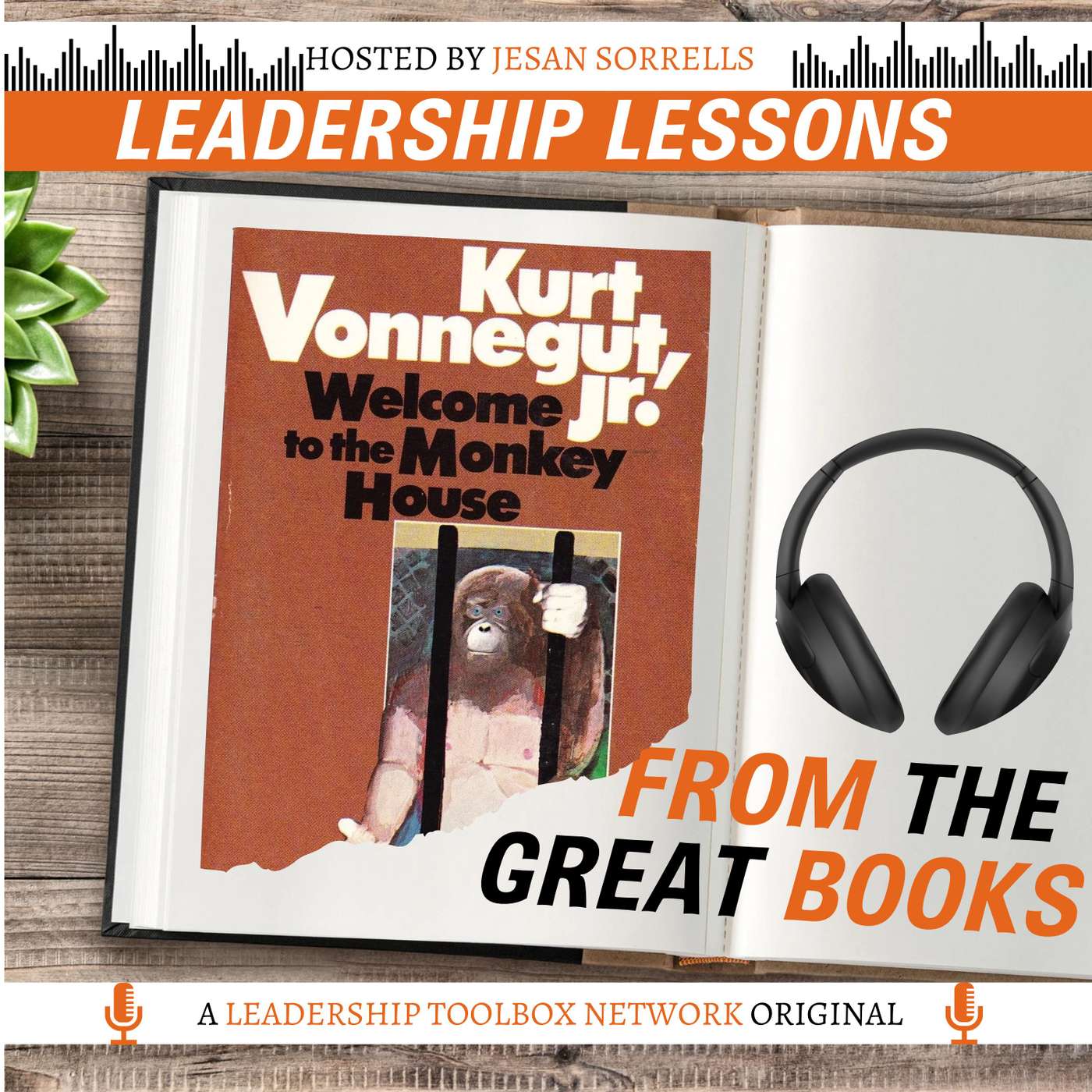
"Harrison Bergeron" by Kurt Vonnegut with Jesan Sorrells and Libby Unger
"Harrison Bergeron" by Kurt Vonnegut with Jesan Sorrells and Libby Unger
---
Diving into Kurt Vonnegut’s Welcome to the Monkey House, Jesan Sorrells and Libby Unger examine the prophetic warnings about conformity, institutional control, and the battle over language and individual agency. The conversation connects the stories “Harrison Bergeron,” “Report on the Barnhouse Effect,” and “Where I Live” to today’s challenges for leaders navigating a culture of safetyism, linguistic manipulation, and technological disruption. Practical takeaways center around preserving individual responsibility, resisting institutional overreach, and regrounding leadership in local, real-world community.
- Book title: Welcome to the Monkey House
- Author: Kurt Vonnegut
- Host: Jesan Sorrells, Guest: Libby Unger
---
Time-Stamped Overview:
---
00:00 Discussing 20th-century sci-fi authors
08:46 Kurt Vonnegut's literary journey
12:12 High school memories and Vonnegut
18:13 Publication dates and context of stories
26:07 Lindsay Clancy's controversial trial
27:31 Jury deadlock in Lindsey Clancy case
34:20 Reflecting on Gloria Steinem's Impact
42:31 Authors and technology of books
47:38 Vonnegut's views on language usage
52:27 Technology, communication, and culture overlap
58:36 Hourglass analogy and chaotic transitions
01:01:24 Impact of 2020 lockdowns
01:05:56 Barnhouse effect report analysis
01:16:06 Discussing global conflict and climate agendas
01:19:58 American culture and equality debate
01:27:48 Reflecting on personal growth
01:32:19 Exploring an abandoned harbor clubhouse
01:34:09 Wendell Berry and localism themes
01:43:28 Local community and cultural shift
----
- Opening theme composed by Felipe Sarro - Bach - Silotti - "Air" from Orchestra Suite No. 3, BWV 1068
- Closing theme composed by Brian Sanyshyn of Brian Sanyshyn Music.
---
- Pick up your copy of 12 Rules for Leaders: The Foundation of Intentional Leadership NOW on AMAZON!
- Check out the Leadership Lessons From the Great Books podcast reading list!
---
- Subscribe to the Leadership Lessons From The Great Books Podcast: https://bit.ly/LLFTGBSubscribe
- Check out Leadership ToolBox at: https://leadershiptoolbox.us/
0:01 Hello, my name is Jesan Sorrells, and this is the Leadership Lessons from the Great Books Podcast, episode number 201.
0:17 Hmm. From our book today, from our collection today, I start off with this. The year was 2081, and everybody was finally equal. They weren't only equal before God and the law. They were equal every which way. Nobody was smarter than anybody else. Nobody was better looking than anybody else. Nobody was stronger or quicker than anybody else. All this equality was due to the 211th, 212th, and 213th Amendments to the Constitution. and to the unceasing vigilance of agents of the United States Handicapper General.
1:00 Some things about living still weren't quite right, though. April, for instance, still drove people crazy by not being springtime. And it was in that clammy month that the HG men took George and Hazel Bergeron's 14-year-old son Harrison away. It was a tragic— it was tragic, all right. But George and Hazel couldn't think about it very hard. Hazel had a perfectly average intelligence, which meant she couldn't think of about anything except in short bursts. And George, while his intelligence was way above normal, had a little mental handicap radio in his ear.
1:32 He was required by law to wear it at all times. It was tuned to a government transmitter. Every 20 seconds or so, the transmitter would send out some sharp noise to keep people like George from taking unfair advantage of their brains. George and Hazel were watching television. There were, there were tears on Hazel's cheeks, which she'd forgotten For the moment, what they were about on the television screen were ballerinas. A buzzer sounded in George's head. His thoughts fled in panic like bandits from a burglar alarm.
2:09 And this is how we open our 201st episode of our podcast today. It sets the stage for where we are going to be going, not only for the remainder of this year, but maybe even for the remainder of this podcast. But we'll see.
2:28 Certain books and certain authors walk with you through various stages of your life. Now, in my life, I constantly revisit Shakespeare, Ernest Hemingway, and even older works such as the Bible and the myths of Greece. And I've talked about that extensively on this show. But authors of the 20th century were writing during the height of collective literacy, when the Reader's Digest Condensed Books had annual printings approaching 10 million copies. At even the lowest level possible, what this means is that most people were reading authors, great authors in the 20th century across all genres.
3:06 And the genre of science fiction was the one that got the least institutional and cultural respect and yet had the deepest penetration. There There were authors who, however, who sought to raise the profile of science fiction, including Isaac Asimov, who we've covered on this show, Robert Heinlein, Arthur C. Clarke, who we haven't, and our author today. He was once quoted as saying, quote, I love this quote from him, no one can simultaneously be a respectable writer and understand how a refrigerator works, close quote.
3:40 Our author today, I guarantee you, didn't understand how a refrigerator worked even during his long lifetime. But he understood the tragedies, the absurdities, and the surrealistic circumstances that surround the people who open the door of that refrigerator every day to assuage their anxieties and their concerns. Today on the show, we're going to discuss themes from a collection of short stories of an author who whom I have been around the block at least 3 times in my life. Once at the age of 15, once again at the age of 30, and now as I knock on the door to 50.
4:20 And each time the trip has become less and less amusing and more and more dismaying, almost at a Stanley Kubrick, a Kubrickian level of dismay. Kicking off our month-long journey, our month-long jog through the science fiction genre, We will today begin to extract lessons from a selection of short stories featured in Welcome to the Monkey House by Kurt Vonnegut Jr.
4:53 Leaders, our innovations might kill us all, but only if we fail to understand with sincerity in this not the best possible world, but the only one we've got, how to actually lead the people who are beneath, around, and walking beside those innovations. And I would add, whether they're in software or in hardware.
5:21 And joining me on the 201st episode of the Leadership Lessons from the Great Book podcast, she did not join us on our 200th episode conversation. She couldn't join us, but that's okay. She's joining us on the first, you know, iteration going back around the sun yet again. Uh, and back from our truncated conversation on Les Misérables, don't worry, we'll be, we'll be picking that back up. Victor Hugo in, uh, in episode number 194 is our advocate for building for the good in public, Libby Hunger. How you doing, Libby?
5:54 Great. I am thrilled to be here. I didn't make it to 200. I did make it to the 100. You did. Yeah, you did. That's okay. Maybe to be here for 201. Maybe, maybe we'll do— maybe you'll do it on every, you know, on the, on the odd ones, like 100, 300, 500, you know. And then I don't know what we're gonna do for the 1,000th episode. I have no idea. I haven't planned ahead that far. I'm fine for the 300. Yeah, yeah, I'll book you. I'll book you for 300. All right, um, so let's start off as we always do, looking at our author, Livvy.
6:28 I have a few notes here on Kurt Vonnegut. So Kurt Vonnegut, I believe, was a prophet of the unraveling American culture during the 20th century. He was born in 1922 and died in 2007. That means he saw everything or experienced everything from the vagaries of the Great Depression and the height of radio, and then all the way through the TV revolution. And knocked right on the door of seeing social media, although didn't live long enough to really see that go to scale. I think that would have scared him poopless, actually, if he'd lived on that.
7:05 It would have confirmed every, every negative thought he had about human beings during the course of the 20th century. He was a child of Silent Generation parents who experienced economic and cultural insecurity during the post-World War I years due to their German background. and their successes and failures in the brewery business in Indianapolis before and after Prohibition and the Great Depression. So Prohibition and the Great Depression really destroyed, really were the twin poles that pushed Vonnegut's parents into a state of— Huh.
7:41 Ennui and depression isn't really the easiest way to say this. I did find out from my research that apparently his father consistently just chase, was trying to rechase, getting back to that, that area of entrepreneurship and ownership in the remainder of his life. And his mother became, according to Vonnegut, um, a bitter woman who tried to sell short stories. And eventually when he was in the army, and actually he was recalled from the army during World War II to come back home because she committed suicide, um, by, uh, by swallowing, uh, some sleeping pills.
8:12 Um, and she was just, I think she was just bitter and angry about the loss of social status that occurred during the Great Depression and couldn't really adapt or adjust. to, to the New World.
8:24 Most notoriously, Vonnegut was enlisted in the Army in 1943 and was captured by the Germans and sent to an internment camp in the city of Dresden, where he experienced the firebombing of the city on February 13th through the 15th in 1945. He survived that firebombing by taking refuge in a meat locker 3 stories underground. That's kind of amazing. And he said later on when he emerged, he was, he was dismayed that they had destroyed this beautiful city, and he couldn't figure out why.
8:58 He didn't publish his first novel until he was 30 in 1952, and that was Player Piano. He wrote, obviously, I mean, he wrote for all of his life, achieving, scratching out minimal success at best, just enough to keep going, and very often Not enough to really keep him, keep him going. I think he was probably a person who, if he had been a writer nowadays, would have been put on SSRIs immediately because he was full of anxiety and depression. But that was what drove him to write the things that he wrote and created inside of him, the innovations and the creativity, and allowed him to see the absurdity and the surrealism around him.
9:36 And it wasn't until his penultimate novel, Slaughterhouse-Five, about the firebombing of Dresden, was published, and that was published in 1969, that he became a household name for the baby boomer generation and the anti-war protest movement. And that was when his popularity began to skyrocket. So, you know, he was writing from '52 to '69 consistently and publishing and getting no traction. And then Slaughterhouse-Five hit, and then that was it. It was a J-curve up and to the right for Vonnegut.
10:06 So that's sort of the background of him as a writer. We always kind of do that, just kind of sort of place him a little bit. Libby, I don't know how much interaction you have with Vonnegut. As I said in my opening, I first stumbled upon him when I was 15 years old. I read a bunch of his stuff from Cat's Cradle all the way to Player Piano, and of course Slaughterhouse-Five. I thought he was funny and amusing, and it was sort of that teenage, like, hahaha, things are absurd. Oh, this adult gets it.
10:35 And then in my 30s, I ran across him again. I read Slaughterhouse-Five again, and I thought, Okay, life's absurd. So what? Like, what are we getting to here? I don't get it. And I still chuckled, you know, with the absurdities and the, and the surrealism that he brought to Slaughterhouse-Five. And then I sort of dipped back into Player Piano and Cat's Cradle a little bit. God Bless You, Mr. Rosewater. I love the title of that, that book. Oh my God. That was another one. Um, but it was less sort of haha teenage impactful for me.
11:11 And now reading Welcome to the Monkey House, and I got a book, um, I was just telling you, um, for our benefit of our listeners, I just got a book that he wrote with, uh, Susan Campbell, or Susan Campbell compiled a bunch of, a bunch of stuff that Vonnegut wrote about writing. So I'm going to read that. As a person approaching 50, um, I have different thoughts on Vonnegut now, and it's less funny and amusing and more weighty and tragic. Um, so Libby, go ahead. What have you got? I yield the floor to the right representative from Oregon.
11:48 Go ahead. I had no idea where you were gonna go with where, you know, with how you interpret it now approaching 50. Um, you're a bit tragic.
12:03 Is, you know, is a good interpretation. I actually, uh, I was like, we're on that track is how I read. Yes. Yeah, I read— I was reading especially the Harrison Bergeron. Um, so my, my experience with Kurt Vonnegut is I went to a super crunchy high school in Portland, Oregon. Very small, only 45 kids in my graduating class. And as you can imagine, all the guys, you know, brooded and intellectualized over Kurt Vonnegut. And as a result, because I was new to Oregon, I was allergic to it. But we were the school that tried to get Ken Kesey to speak at our graduation, and I think we almost did.
13:03 And so for me, it always represented, yeah, counterculture. And when I saw it on your reading list for this year, I was like, you know, I never read that. And I want to— like, what was Kurt Vonnegut about? And when I read Harrison Bergeron, I'm like, why have I never read Kurt Vonnegut? Right? Like, um, and then I was thinking, why, uh, why don't people bring him up like they bring up 1984 or they bring up Atlas Shrugged? And what's really interesting is, you know, the counterculture of the anti-war movement was not bringing up, you know, Atlas Shrugged or 1984.
13:52 Mm-hmm. But they latched on to Ken Kesey and Kurt Vonnegut. And I still am struggling with what the intersection of those 2 movements, because I would really be expecting more like Ken Kesey and, you know, One Who Flew Over the Cuckoo's Nest. Yep. And, you know, one of the takes on that is that institutions know better. Right. Than the individual. And Nurse Ratched is the queen of, you know, knowing better, you know, and protecting one from themself. Yeah. And so then you move into Harrison Bergeron, and we're on, you know, the 210th, 12th, 13th, 14th Amendment, all designed to protect ourselves from your day-to-day life.
14:50 And lo and behold, who is the enforcer of, you know, um, uh, what's the term that they use for keeping you at average intellect? Oh, handicapper. The handicapper. The handicapper. Right, right. Nurse Ratched, I know better, protect you from yourself. The handicapper, Female, I— we know better. You can't— you know, we know better. But it's dangerous for people to be prettier than average, to have more than average intellect. And just—
15:28 I was like, all that comes to mind is the image of, you know, there was an image of equity that was hitting the meme world a couple of years ago. With the size of the fence. And— Oh, yeah. Right. And everyone— people were having trouble seeing over the fence. There was one who could, one who barely could, the other who couldn't. And the answer for equity was to dig a hole so that they were all the same height versus giving someone steps up to see over the fence. And you're seeing this averaging down in school in Oregon, for instance.
16:14 If you know, if you're a person of color, you no longer have to get grades in high school. And this was a law that just recently passed within the last month. And so you want to talk about— Yeah. You want to talk about the bigotry of low expectations. Yeah, we're, we're seeing that. Another thing that's really interesting about Oregon is it used to be like— people used to mock Oregon as the People's Republic of Oregon. Mm-hmm. People haven't talked about that from an absurdity perspective in a very long time.
16:53 And you're seeing this kind of averaging down, you know, like California and their school districts, you know, they're in the bottom 40, you know, 45 to 50%. Right. But this need to not have people feel bad about being less than is, you know, is pretty pervasive through a lot of institutions. And when I was reading The Harrison Bertrand, I'm like, oh my God, how did we get here? Why are people talking about this book? So I think, I think Harrison Bergeron— so Harrison Bergeron was written and published in 1961.
17:33 Right. And, and Slaughterhouse-Five, as I said, you know, in our opening before, didn't come about till '69. So he was probably working on Slaughterhouse-Five. I know that he had had— he'd been trying to figure out a way, Vonnegut had been trying to figure out a way to like talk about what happened in Dresden and work through his emotions about it. And so I know that he had, um, from my research, I know that he had started on Slaughterhouse-Five and he'd abandoned it and started on it again and abandoned it and started on it again and abandoned it.
17:59 And then he finally had to go back to Dresden. I think he traveled there, if I remember correctly, or traveled back to Germany and was like looking around in the '60s and like, oh, okay, this isn't— kind of getting some catharsis there, right? Yeah. But Harris and Bergeron and all the other stories in Welcome to the Monkey House, I mean, if you look at the publication dates, you've got 1961. You've got another story in here that was published in 1951. You've got another one which we're going to talk about, Report on the Barnhouse Effect, which is a fascinating little tale, which was published in 1950, right on the, right on the, the tail end of, or not the tail end, but the beginning of Sputnik and Stalin setting off, setting off his own, his own nukes, testing his own nukes.
18:47 Or one that we're not going to talk about, but which I found to be particularly interesting, Go Back to Your Precious Wife and Son. Which was published in 1962. So these stories were collected together and they represent, I think, a, a, a pantheon of his thoughts, right? A way of him kind of working through, like we have blogging today. Well, we had blogging, right? And I've always used, yeah, Substack now, newsletters, email newsletters, where you're working out ideas in public. Right. And, and, you know, obviously you didn't have blogging or Substack or email newsletters in the '50s.
19:23 So the easiest way to do this as a writer was just to write your short story, put it out there, get it published in some sci-fi magazine somewhere that maybe some kid would see, or maybe some adult would see, and then move on to the next. And I think Vonnegut, I think this is how Vonnegut used the short story genre primarily. Yeah. I think you get to miss Harrison Bergeron if you're using it in that way, because
19:53 And this is now, this is the power of place and time now. In 1961, historically speaking,
20:03 people, the baby boomers were just sort of starting to hit the counterculture. Right. JFK had just been elected president. You know, he hadn't said not quite just, or he had said, bear any burden, pay any price to ensure the survival and the success of liberty. He was the, the, the promise of Camelot to protect institutions and to bring them up to this heroic level was still there. And they didn't know what we know living on the other side of that. They didn't know that 60— November, in November of '63, he was going to be driving an open car in Dallas and that was going to be the end of it.
20:39 They didn't know any of that. They were on the cusp of, I mean, Sputnik had just happened. Kennedy had just announced that we were going to go to space or was going to announce that we were going to go to space. Um, the, uh, the Bay of Pigs hadn't happened yet. You know, Cuba hadn't happened yet. Um, the weed, mass use of weed, college protests, the society hadn't blown apart quite just yet. Like, I think we think of the '50s as like this thing that only happened between like 1949 and 1959. No. Yeah.
21:11 The '50s happened from 1949 all the way up to November of 1963. And that's when the '50s ended. And they ended with that gunshot in Dallas. Yeah. And the parallel that I draw to this is, I think our fourth turning ended with the attempted assassination attempt on Donald Trump in Butler, Pennsylvania in 2024. I think we're done with the fourth turning. We're now in this weird transitional moment to the spring, like in all, but I think it ended there. Like that slammed the door shut. And I'm saying this, by the way, You know, we're recording this 4 days before September 11th, 4 days before the 25th anniversary of September 11th.
21:51 You know, so I think historicity and context matter for Vonnegut. I think he's looking around. I think he had an absurdist mind anyway, but I think the counterculture hooked onto him after '63 because absurdism and surrealism was the only way the baby boomers who are going from being 13 years old, 12 years old, 10 years old in '61, '62, '63. If you were a teenager in the '60s, can you imagine like the whiplash you went through? Right. It must have been insane. And then you went to college and the '70s haven't even happened yet.
22:26 So get ready for that. Get ready for sequined pants and disco. You're gonna love that. Well, but it, um,
22:36 I still see him being a prophet in the same way that Ayn Rand was. He just wasn't as aware of it, maybe. Yeah, I would agree. Right? Like, I agree that he was working through the ideas. Yeah. But, um, in the same way, and maybe use absurd— absurdity to make it more relatable, or Yeah, so that people could digest it, you know, and just say, you know, have it something in the future, you know, versus like fiction. Yep. But if you just look at, you know, the weight of, you know, um, the weight of compliance and the weight of, um, the institution and dumbing you down, it's only once, like Harrison, you know, Harrison you just couldn't stay jailed underneath the weight of— Right.
23:33 Yeah, the weight of the shields and all of that. And the ballerina took her mask off, and in their last moments, they were actually happy and free. You know, this need to be averaged
23:51 and like everyone else, to be safe actually kills the soul and the spirit. And then, you know, in their, in their last moments, they're dancing and kissing. And I think of this as the difference between, uh, China and Beijing and India and Delhi. You know, I'll tell you, I felt a lot safer, like, walking in Beijing. Mm-hmm. Because everyone was extremely orderly and stopped and there was no individuality. It was, you know, it was gray and dark, but you knew you were safe with respect to the crowd.
24:33 But I would much rather live in India. Right. Where, you know, everyone, you know, it's talk, talk, talk, and there's color everywhere. And You know, it's— there's a vibrancy to living in these areas. You know, it's, you know, they're religious and they're family-oriented and community-oriented and they're living their full life, you know, and the expression of humanity versus like Beijing. You've got all the rules and you don't have family and there's no religion and you can't— you know, safe, sure, you know, but there's no life.
25:11 There's no life. Yeah, it's sterile safety. It's so sterile versus the beauty and all that colors and self-expression in India where it— there's self-expression, but you've also got a sense of family and institution and vibrancy. And when I was reading the Harrison Bergeron, it was kind of like the Beijing and then free into the Delhi. Yeah. Well, and it's interesting that you pointed out, and I want to go— I want to focus a little bit on this for just a second. It's interesting that you pointed out that the Handicapper General In Harrison Bergeron is a woman.
25:47 And in One Flew Over the Cuckoo's Nest, Nurse Ratched is a woman. Um, so protectionism. Well, and I do not want to ground this conversation so much in our present time because I want it to be timeless. Yeah. And the trial of Lindsay Clancy is going on right now. Right. And for those of you who will listen to this in the future, Lindsay Clancy is a woman who has Whose trial has taken social media by storm, particularly among females of a certain age and demographic. And she is accused— or no, she is on trial for— I want to be very careful in my language here— she is on trial for allegedly killing her 3 children, and by the way, all under 10, allegedly sending her husband out of the house, allegedly killing her children, and the The defense for this case that her lawyers, her attorneys have mounted is that she was suffering from postpartum depression, was put on SSRIs.
26:52 The SSRIs and the depression combined to make her, to make her not responsible for the murders of her, the alleged murders of her children. And thus she should be acquitted of the charges. The prosecution has taken the tact that, uh, well, people have agency and no matter how many, no matter how depressed you are, no matter, there are plenty of people who are depressed. There are plenty of people who take SSRIs. There are plenty of people with postpartum depression and there are plenty of women who are frustrated by their children and they never murder them.
27:31 Exactly. So we should hold this woman Accountable for and responsible for her actions. And the last I heard, again, not grounding this in anything recent, just giving an overview for those of those folks who are listening. The most recent thing that I heard from my wife, because I really wasn't focusing on this until about, you know, a week ago in any kind of meaningful way. But the last thing I heard from my wife who has been following this is that the jury deadlocked and there might be a mistrial.
28:01 Apparently, one gentleman on the jury was, was holding out for a guilty verdict and everybody else was sort of aligned out of those 12 folks. This is where we're at with that. So we have— and I'm using this to make a point. So we have Lindsey Clancy. We have, as an example, we have, we have, you know, Nurse Ratched and we have the handicapper general in Hermiston Bergeron. Yep.
28:27 There's a critique here about agency and responsibility. Yep. I, I, I'm gonna get in trouble, but what the hell, it's my show. Is this a gendered critique, or is Vonnegut just making a much larger point and using irony and subversive surrealism to just sort of make this point? I don't know that he was thinking about it that deeply, but is there a gendered critique here?
28:55 I just, uh, wearing the lens of today. Yeah. I, I could easily see it back then. You know, nurses were women, right? Right. Yeah. Um, but it was interesting that the handicapper general, you know, was a woman, and it was about dumbing down so everyone feels, you know, comfortable and safe. Right. You combine it, and that's just matriarchy. Right. Yeah. So that's not a hard— my sense is Vonnegut was probably not that deliberative, but intuitively, there's a message there. Yeah. I think, you know, the safetyism, you know, 200 and some odd amendments, you know, because we can't feel, you know, it gets me into the whole like microaggression world too, right?
29:50 It's just like, Just say, like, so they make you uncomfortable? Move on. You know, usually it's a sign that something's new and different. It doesn't mean, you know, that it's scary and bad. Right. But there's no kind of personal, yeah, as you said, acceptance and personal responsibility and we, you know, and for owning your reactions and, you know, and taking care of your situations. As individuals. So it's— it is interesting. And we have gone to the extreme, you know, in a society right now where victims are— where criminals are victims and victims are criminals.
30:29 It's that same kind of concept that I think was so— in the 10 pages of that short story, I was like, it's a prophet. Mm-hmm. I'm trying to go back to thinking what would have gotten him to the handicapper general concept based off of his experience from the 1920s to 1960s, through the end of the '50s. Wearing your history hat, which is a lot more— or brain, which is a lot more robust in this than mine, what is your thought on the— So I think that you have always had, and this is why I asked about a gender critique.
31:18 It's babysitters, right? Yes. Yeah. But even more so than that. So the '50s were the Eisenhower years. Uh-huh. And Eisenhower was sort of the, you know, the World War II general, you know, led D-Day. Became Republican president, you know, led the way on enforcing Brown versus the Board of Education, led the way on setting the table for integration of— or not integration, but
31:56 followed up with Harry Truman's efforts to integrate the armed forces.
32:05 Eisenhower was a heck of a president. And then he closes the door by, by arguing about the— by arguing, by warning people about the military-industrial— warning the American public about the military-industrial complex, which of course proved to be true. Right. He was probably, huh, he was probably the last genuinely, other than maybe Ronald Reagan, even Ronald Reagan sort of shaded the truth sometimes a little bit, I think, because he had to. Eisenhower was probably the last honest Republican we've had in the White House.
32:31 Now, Trump is a different thing. Trump is just bombastic and whatever. He's not, he's taking whatever party will take him. Yeah, yeah, yeah. Yeah, yeah, yeah. He ain't, he ain't that kind of deliberate, sort of honest Eisenhower kind of guy. Okay. So Eisenhower's in the '50s, right? Yeah. But the, but that's the government. The culture underneath Eisenhower though, I think is very much in the 1950s. Just as it is now, because culture comes from the home. And the man in the gray flannel suit leaves the home and goes to the office, but who stays at home?
33:08 Mm-hmm. The woman stays at home. Women in neighborhoods, women in homes, women in communities. Um, Vonnegut was married for 20 years, I think, if I remember correctly, and had 4 kids with, with one woman. Right? So he was, he was not trapped, but he was engaged in domesticity. He wasn't living, leaving his house and then coming back. He was there all day, every day, and could see with, huh, two, two eyes, right? What's happening inside of not just his household, but also all the other households on the block.
33:44 Oh, you're, you're so right. And this is because I, you know, woman's lib child, you know. Which happened all after that. Right, right, right. I'm a woman's lib child. I'm very independent. I want my financial freedom, you know, opportunities, yada, yada, yada. I forget that the world, you know, I used to say that women did rule the world, you know, um, you know, through the family, right? And the strength of, you know, you know, the mom or his wife or whatever. I absolutely, God, what a blind spot.
34:18 Thank you. Well, it's okay. It's all right. I mean, I mean, it's, it's so Gloria Steinem just died a couple of Like last week, right? She was 92. Betty Friedan, who was the queen of first wave feminism, Betty Friedan once said about Gloria Steinem, she's too pretty to basically be up there. She's going to ruin us. And she was right. I mean, Gloria Steinem brought you reproductive rights, quote unquote, which is a, which is a, you know, a mask for what abortion is. Yeah, exactly. And she Right. And Betty Friedan, or not Betty Friedan, but Gloria Steinem brought you the beginnings of the, the feminism that now winds up or washes up at the shores in our time of transgenderism, where now we've done the full circle.
35:07 A man can become a woman and no one can say boo about it. Okay. But Betty Friedan, at the beginning of feminism in the late '50s, early '60s, when she was writing, Betty Friedan cared about 2 things. Number one, breaking stifling domesticity, breaking it. Mm-hmm. And getting men to not, not fulfill their responsibilities. That wasn't it because that was Elizabeth Cady Stanton and all those folks back in the, back in the early 20th century, right? That with the passage of the 19th Amendment. So it was about breaking domesticity for Betty Friedan.
35:43 It was also about Taking that power that she saw, to your point, that women had in their communities and in their neighborhoods and in their family, taking that power because she saw the possibility, taking that power and scaling it up. Yeah. And I don't think Betty Friedan fully understood.
36:03 She couldn't have fully understood where that was going to end up at. She was just looking around, to your point about a blind spot. She was just looking around at the kinds of things that she was seeing. And by the way, I think Vonnegut Jr. was seeing the exact same things. Plus, he had come out of his own family where his mother had ground down his father. Exactly, exactly, exactly. I mean, we all know. Yes, we've all watched that.
36:31 And so he didn't know, I don't think, I don't think he genuinely knew what to do with any of that. Yeah, I agree. Because how do you work through that? And he, the only tool he had was writing. That was— he wasn't gonna go see a therapist. He wasn't gonna do psychedelics. I mean, I love it that you mentioned Orwell and Ayn Rand. You didn't mention Huxley, but, you know, Kesey, Huxley, all these guys. He had to work through that somehow, and writing was the only, the only drug he had. Had to work through it.
36:59 Yeah. I'm so glad. I'm so glad we read this. I now, you know, I was doing a bunch of research, you know, in preparation. I was like, I need to read Slaughterhouse-Five. And, you know, I have the rest of The Monkey House, and I started going through different of the short stories. I'm like, these are just fabulous. I'm— this is fabulous. It's really interesting. But also just the band, the comparison of Kesey and Kurt Vonnegut, and only because— You know, I went to such a super crunchy Portland, Oregon high school where all of that was, you know, just everyone bowed down to the Ken Kesey, Vonnegut gods, you know, as they were doing LSD on a, you know, yeah, on a Friday night.
37:52 On a Friday night. Yeah, yeah, yeah, yeah, yeah, yeah. Yep. I think they refer to it as acid though. Yes, they did refer to it as acid. That's right. Tripping like you would not believe. Anyway, let's get back to the book for just a second. So we're gonna pick up another story here that we have, because this is not just Harris and Bergeron we're going to be focused on. I wanna pick up another story in the collection, Welcome to the Monkey House. New Dictionary. This one I picked because I think the battle of our time that we've been having is over who owns exactly the dictionary, who owns definitions and meanings of words.
38:29 Yep. And I quote from Kurt Vonnegut. I wonder now what Ernest Hemingway's dictionary looked like since he got along so well with dinky words that everybody can spell and truly understand. Mr. Hotchner, was it a frazzled wreck? My own is a tossed salad of instant coffee and tobacco crumbs and India paper, and anybody seeing it might fairly conclude that I ransack it hourly for a vocabulary like Arnold J. Toynbee's. The truth is that I have broken its spine looking up the difference between principal and principal and how to spell Kashmir.
39:00 It is a dear Leviathan left to me by my father, Webster's New International Dictionary of the English Language, based on the International Dictionary of 1890 and 1900. It doesn't have radar in it or Wernher von Braun or sulfathiazole, but I know what they are. One time I actually took Self-entitled. And now I have this enormous and beautiful new bomb from Random House. I don't mean bomb in a pejorative sense, or any dictionary sense for that matter. I mean that the book is heavy and pregnant and makes you think.
39:31 One of the things that makes you think is that any gang of bright people with scads of money behind them can become appalling competitors in the American unabridged dictionary industry. They can make certain that they have all the words the other dictionaries have. then add words which have joined the language since the others were published, and then avoid mistakes that the others have caught particular hell for.
39:52 Random House has thrown in a color atlas of the world as well, and concise dictionaries of French, Spanish, German, and Italian. And would you look at the price? And lausy me, Christmas is coming. When Mario Peh reviewed the savagely bopped 3rd revised edition of the Merriam-Webster for the Times in 1961, He complained of the, quote, residual prudishness, unquote, which still excludes certain 4-letter words, quote, despite their copious appearance in numerous works of contemporary literature, as well as on restroom walls, close quote.
40:23 Random House has satisfied this complaint somewhat. They haven't included enough of the words to allow a Pakistani to decode Last Exit to Brooklyn or Ulysses either, but they have made brave beginnings dealing wisely, I think, with the elementary canal. I found only one abrupt verb for sexually congressing a woman, and we sure have Edward Albee to thank for its currency, though he gets no credit for it. The verb is hump, as in hump the hostess.
40:58 This was, this was another really good one. Who controls the language? Who controls the dictionary? Yeah, well, by also the language, by virtue of controlling the dictionary, right? And yeah, I would have— 5 years ago, I thought that was like really absurd. It's just like, yeah, you're just trying to maintain decorum in, you know, informal writing. And now I'm like, no, they're trying to control the language.
41:32 What's not— we got the, you know, and this is— There are 3 overlapping circles in here, right? So like, it's technology, it's communication, and it's the lived reality of the failure to work through lived reality, right? So like Edward Albee, and I know who he's talking about, the playwright, right? You know, writing about Pardon my use of the— well, my use of the word, my use of the term here, folks, but writing about humping the hostess. Okay. Like everybody knows what that means. And he's writing— he wrote the story in 1967.
42:10 This is amazing. And it's not even really a story. It's more like a dictionary review, which is why I picked it. Like, it's amazing. But it also reveals, to your point, sort of how he was part of the group of folks, some, many of whom were born in the 1920s. Philip K. Dick was born in the '20s. Frank Herbert, who wrote Dune, was born in the '20s. James Baldwin was born in the '20s, right? Like, these guys were trying to square the circle of all those Venn diagrams from like what they see in the dictionary, which is the technology of the book, as we consistently talk about on this podcast, the greatest technology we've created.
42:49 That technology, plus how that actually works and walks out in communication. And we are still doing this today. That's the thing that struck me about this entire sort of book review, even the tongue-in-cheek way it was sort of written. But it's deadly serious at the bottom because,
43:09 I mean, that's why words go in and out of our tech. Words go in and out of our, in and out of our culture all the time. This is why I'm fascinated by linguistics. Like John McWhorter's work. Words go in and out of the language all of the time, and we make decisions, and then we fight brutally about who gets to own those words.
43:30 So absolutely. Yeah, to think that we would own dictionaries for our entire life is just like laughable, right? You'd be so proud of your your well-worn paperback dictionary. And yeah, it wouldn't withstand 24, you know, 24 months nowadays. But back then it was like, oh yeah, these are the words for our life. Well, I think, I think Merriam-Webster still publishes a physical dictionary. I think they still do. I think they still print off one. I bought, I bought some, I bought a couple of dictionaries over the past few years just to see how to, just to track how words change.
44:12 Yep. Even the definitions of words that were defined one way in 1967 are defined a totally different way in damn near 2027. Right. And it's the same word. It's just culture has shifted on the meaning. So, um, I mentioned James Baldwin. Yep. The term Black, nobody of James Baldwin's generation would have used that term to describe themselves racially. They would have used the term, now this is going to make everybody uncomfortable, but this is the term they would have used. They would have used the term Negro.
44:51 Sorry, folks. Like, that's the term they would have used. That was an okay term to use, even in the midst of Jim Crow, even pre-civil rights. Negro was the appropriate term to use. Black didn't enter the lexicon as a substitute for Negro until the 1970s and fully into the 1980s. There were still African-Americans. And by the way, that's another term that hadn't entered into the lexicon either until after the civil rights movement. But there were African-Americans and quite frankly, Negroes. Yeah.
45:22 Who were still calling them, using those terms to refer to themselves. themselves in the '90s, not but 30 years ago. You can still find those words, though, in the dictionary. You could find Negro in the word— in the dictionary, but the definition is totally different now than it was in 1967. And that's just one. You know, some of the research talked about Vonnegut as being somewhat conspiratorial. And
45:53 I can see that in my 2026, '27 lens as well with the dictionary and the use of word changes, right? Like, so Negro to African American to Black, right? And then you have like Caucasian. I'm like, why don't— why isn't Caucasian a choice anymore? Like, why white? You know? And if you look at Black versus white, just it, you know, the contrast, it's used for division. It's a, you know, if you think about how— Mm-hmm. Persuasion is done, it's through storytelling, it's through imagery, and you make a clear black versus white just looking at the colors.
46:29 It's a lot easier divide to create. Oh yeah, need to keep the masses, you know, divided, right? So it is just kind of interesting. Why did we move to black when, you know, blacks aren't black, you know? Right. And whites aren't white. And whites aren't white. different range. And so you do— it does get into why, you know, why are specific words entering a new lexicon and who's making those changes. And I wouldn't have thought about it, you know, until, you know, except for the last 6 years. And it's like it always starts in the elite intellectual schools.
47:13 And why do they need to change the words? Like, what I do. I love John McWhorter too. And, um, it's, it is interesting, you know, to, to watch it because it is a control mechanism whether you know it or not. Like you said, degraded technology. How do you persuade through, you know, through reading and storytelling and imagery? You know, well, and a published dictionary also binds words to a time. Right. So one of the, one of the things that Vonnegut writes about in this, in this review, the new dictionary, is, um, the difference between ain't and, um, what is it?
47:58 Ain't and— Ain't and isn't. Ain't and isn't. That was one. Um, and then the use of— I love this one— the use of like as a conjunction, meaning Do at meaning as, as do like I do, though occasionally found in good writers, is a provincialism and contrary to good usage. And I came up at a time, Mr. Vonnegut, may I call you Mr. Vonnegut? I'll call you Kurt. I think you would appreciate that. Kurt, I came up at a time when like became a substitute for a pause in a sentence. Exactly. So it's not do as I like to do or do as I would do.
48:37 It's not, that's not how like is used as a synonym anymore. Like is now used as a pause, you know, like right here. Yeah. Like, and everybody just sort of accepts that. Well, my grandmother didn't, who was of Kurt Vonnegut's time when she was alive. She would always hit me in the back of the head, either metaphorically when she could no longer reach the top of my head or literally when she could. And she would always say, there'll be no— I loved it how my grandmother put this— there will be no dis here or dat there in this house.
49:06 Like, that ain't gonna happen. And she would say, ain't gonna happen. I'm like, what are you talking about, Grandma? You know? And
49:17 my grandmother was right. Vonnegut was right. Yeah. And so these, even the colloquialisms that we use, whether they're provincial or not, become something different if they're permanently established through the publication of a book. Versus the malleability you see on social media and the malleability you see of words in the internet. And I think this is what has flummoxed, to use another old school word, flummoxed all of us is it used to take 6 months to a year for a word to sort of travel from California to New York and for it to shift its meaning on the way.
50:02 Now it doesn't take 6 months to a year. Now it can happen and it does happen in the space of, in the space of a Google sweep or space of a Google search. Like, that's it. It's done. Right. And I don't think as humans, we know how to deal with that.
50:21 I don't think we have any— Clearly not.
50:26 Like, you just have to look at the Lindsey Clancy Trying to see where the sanity in the world is right now. Right. Well, and we also, we also live in a space where we're highly individualistic and we're also in various ways that are sometimes socially normed or not. We're in various ways in rebellion against hierarchy. Like we've, we've, we've landed at the— Yes and no. I'm really in conflict with this because— Really? Okay. The, the control culture does not feel individualistic at all. It feels like they think they're individualistic.
51:08 Right. Right. But they're not at all. And those who are trying to fight for individualism are being, you know, the live and let live is being, you know, pushed to the side and the individualistic and empathetic crew is saying, no, you must act like this. Yeah. So that's why I think that I, I didn't, I didn't come to terms with this yet, but that's why I think the counterculture, um, who isn't counterculture now, right, still likes the Kesey and the Vonnegut, right? Um, is because they can see Uh, what they wanna see about themselves, right, in these books about individualism, right?
51:58 Like, uh, like Howard Stern is no longer individualistic, but he sure thinks he is. Yeah, right. Yeah, yeah, yeah, yeah, yeah, yeah, yeah, yeah, yeah, yeah, yeah. Like the, the pink-haired trannies think they're individualistic, but they're not. They're trying to get everyone to, to abide you know, by their, by their worldview, you know, so, you know, I'm still, I'm still struggling kind of with that, like, interplay. Well, and I think, I think the interplay exists, as I said, at the, at the intersection of all 3 of those Venn diagrams, or those circles in that Venn diagram, right?
52:36 So in one circle, you have the technology, which now includes not just the book, but it also includes the internet and the phones and everything else, the physical manifestations, right? Then in one, another circle, you have communication, which is all of the different ways we culturally communicate, both verbally and nonverbally, Eastern, Western, because, you know, the internet allows us to be global now, whether we want to be or not. Um, all of that. And then the third circle is culture, right?
53:01 And culture, of course, is always downstream from a worldview. And our worldviews are driven right now by postmodernism. Right. Um, and, and then a touch of, you know, other things like naturalism. theism, you know, occasionally nihilism. And so, you know, culture lives downstream from all that. And inside of culture is government and politics and policy and entertainment and those kinds of things. So we have all these 3 overlapping Venn diagrams, right? And depending upon where we're at in that overlap, I think that determines to what degree as individuals we think we are in rebellion.
53:40 But also to what degree institutions, which are built by individuals, by the way, collecting together, institutions determine where they decide to place their— now I'm going to use a Foucault reference here— where they place their power. Yeah. Not authority, but power. Power. Right. And so I think it's, it's, it's You know, we're not going to submit to the hierarchical structures of the 1950s anymore. And that's part of what's driving us crazy is we have this fantasy of the 1950s, like you were talking about.
54:15 I'm a feminist and I'm independent and I want to be that. If we somehow went back to— forget going back to like the 1900s, the early 1900s, forget like 1918, 1920, forget that. Just to the 1950s in culturally, not governmentally, not policy. but in culturally how we treated women, if we tried to go back to that, it can't be done. I'm sorry. It just, it can't be done. The level of, the level of, of, of control you'd have to engage in at a scale level, institutionally, culturally, it can't be done.
54:50 But, but at a family level, at an individualistic level, I yell at my kids about this sometimes. And sometimes I'm joking. Sometimes I'm not. Just depends on what we're talking about. Out there, it might be 2026. In here, it's 1950. Uh, but you're talking about the counterculture, right? The counterculture is the family, right? Right. The, but the hierarchy is embedded in the consolidation of all these institutions, right? Right. Like, so the ability to work and create a small business is extremely difficult right now.
55:28 Because of all the rules and regulations that the hierarchy is stipulating, is putting on businesses to control and protect workers. So there is— I think this is where the hourglass is flipping now. They talk about how the parties actually flip. Yeah. And I think what we're seeing is the flipping of society in the hourglass right now. Okay. But they articulate— still working on the articulation of it. But there is something about this, the institutionalism, and there is a fight for conformity and—
56:10 not conformity, but control via institutions, big business, politics or government, media, trying to control it all. The counterculture is what you're talking about, which is the family structure, the, you know, the value system, the moral system is really the counterculture. And, you know, it's shocking to say that. But I— will we go back to the 1950s? Not necessarily, but I think there'll be a balancing act of Yeah, people recognizing that gender is hormone-based and not— In your brain. Yeah, right.
56:56 And that there are going to be certain balances that we have to create in family units where it's not maybe the wife only at home acting a certain way. She has opportunities to still work and make a living and own property and have her own bank account, but she's opting for the family unit. because she's deriving more meaning from that. Mm-hmm. And fathers are going back to doing what, you know, instinctually they're designed to do, which is protect and feed and, you know, care for the family, you know, out in the real world.
57:41 So I don't, you know, I think that what we're seeing and why the Fourth Turning in this transition feels messy is because we are— the hourglass is turning over. And what has been working, you know, the hourglass peaked with Howard Stern getting to the top of it and all these elite institutions and globalists and— Yeah. Microaggressions, yo, leading conversations and safetyism. I think the safetyism and that whole counterculture has got to the top of the hourglass in the hierarchy, and now the countervailing forces are coming back, and family and community and all that's going to start taking over.
58:36 I like the visual that you're painting there with your words of a flipping of the hourglass, right? Because if you think about how an hourglass, how the sands come down through an hourglass, at first it's messy and chaotic, to your point about it being a chaotic transition, with each individual grain of sand hitting at a different spot at the bottom of the hourglass and landing. And then everything else sort of compiles on top of it and compiles on top of it until it creates another, another, you know, triangle at the bottom of the, in the bottom of the hourglass.
59:06 And being a visual guy and being an arts, you know, undergraduate major, you know, I gotta, I gotta visualize that in my, in my brain.
59:17 No one grain of sand, just like no one drop of rain, just like no, no one flake of snow blames itself for You know, the avalanche or the flood or the sand on the beach in the hourglass. Yeah. No one grain of sand. And one of the insights that I think leaders can take from reading not just, um, Welcome to the Monkey House, but also The New Dictionary and really taking these short stories seriously is that, um,
59:57 We, we have to, I think, figure out what works for individuals and at scale homes, maybe to communities. But then after that, I think we have to, and this is why I paused before I said it, I think we have to stop trying to scale up individual desires and appetites and perspectives to a larger space. And I think the internet as a piece of technology tempts us greatly to do that because it used to be— Yeah. It used to be that I didn't know how weird I was.
1:00:45 Really, I didn't know how weird I was. And I don't know how weird you are. I have no idea. We're inside of our own houses. Yeah. When we go outside at, you know, the farmer's market or walking down the street or in our cars or at work, we're not talking about how weird we are. We're doing the whole like third level social norm thing. We're all hiding from everyone, right? And it's fine. That's that conformity, that stifling conformity, you know, that I think Vonnegut was opposed to. And I think that you're talking about as well, but we all get to be weird inside of our own houses.
1:01:17 And what the internet does, because now I have this technological device that allows me to connect with other weird people. Yeah. And this is where the transgender contagion, uh, the social contagion around Lindsay Clancy, the social contagions around race, George Floyd, COVID, like COVID was really interesting, right? Because we went from sort of the peak of being able to connect with everybody, being able to connect individually with how weird we are. We went from that to the institution saying, nope, slapping the game shut and saying, you're all going to be shoved in your houses.
1:01:51 And one of the things that I've noted repeatedly that nobody seems to be able to pick up on and go anywhere with is when the lockdowns occurred in— what was it? Started in March and April of 2020.
1:02:09 Everybody collectively lasted about a month.
1:02:14 Whether you were out rioting after that or not, it didn't matter. But we had about a month in us collectively in the United States. And the level of what the government would have had to do with the next level, which is what they did in Australia and China, where they would have had to, they would have had to weld our doors shut or put us in prison camps. Yeah. I say this with absolutely no, this is not irony. This is an absolute sincere statement. I think that proves the fact that the American government didn't do that and state governments didn't do that
1:02:50 is a testament to the remaining strains of Christianity in our culture that we sometimes take for granted because we're always worried. And we should be, by the way. We're always worried when oppression is going to show up. We are constantly monitoring the government because of our free speech and because of what we can do and what we can't do. That's why it only worked for a month with us. That's why the lockdowns only worked for about a month. We got to the end of Netflix at the end of a month.
1:03:20 Like, you can only combine with weird people in your house for so long before you want to, like, before, like, the furry forum that I'm in, I have to go meet the other furries. I know. And I just picked that one because it's whatever, but you could pick anything. Like, I want to go riot about George Floyd because guess what? Like, I want to be with other people. We got to it at the end of the month and we realized that, okay, as individuals, we are atomized, whatever units, but we have to come together.
1:03:47 Now that's an inversion of the thing you're talking about, but it doesn't make it less true. No, but it, what it's actually the balancing act, you know, the, the 2 different sides of this, um, are structure. And rules and, you know, and complete freedom, right? And chaos. And we've gotten to, you know, when there's too much structure, the rebellion happens, right? You know, and the live and let live folks are kind of okay with it until they're not. And that's the thing, you just never know. I'm a Taurus, you know, Tauruses, we're okay with things until we're not.
1:04:27 Until you're not. Never really know when that's gonna happen, you know. But I think that's a good expression of what Americans are, are like as well. And where we are is right now we have way too much weight coming down. Mm-hmm. And, you know, and the rebellion is, is starting back to say, hey, oh no, no, no, no, no, we want our freedom, our freedom back. And so it's always going to be this tension, you know, too much freedom is chaos and uncontrolled, you know, lawlessness and too much control is the lack of individuality in the sense of, you know, of, of being a human.
1:05:07 Right. Um, yet like you lose your, you lose your soul, you become Beijing, right, where you're moving and you're operating, but you're just an ant in the ant farm, right? Um, you know, so I think that's what is kind of what is happening right now. And the family unit, that's just a decent decentralization of, you know, of control, right? Power. And that's where it should be, as this balance between centralization and decentralization. That opens the door to our next story. I love it. Yes. So our next short story, Report on the Barnhouse Effect.
1:05:41 This is something— this was probably out of all the stories other than Harris and Bergeron in this collection, Welcome to the Monkey House from Kurt Vonnegut, this story struck me the deepest and was the least amusing. to me. That's great. Yeah, it starts as a report or a letter written by somebody talking about somebody else. It sort of reminded me a little bit of Fahrenheit 451, a little bit, in sort of how that story is structured, where it's somebody writing about the society in which they see themselves and trying to figure out a A door, trying to figure out where the door on the floor is, right?
1:06:24 Anyway, report on the Barnhouse effect. I'm gonna read a couple of things out of this. Let me begin by saying that I don't know any more about where Professor Arthur Barnhouse is hiding than anyone else does. Save for one short enigmatic message left in my mailbox on Christmas Eve, I have not heard from him since his disappearance a year and a half ago. What's more, readers of this article will be disappointed if they expect to learn how they could bring about the so-called Barnhouse effect. If I were able and willing to give away that secret, I would certainly be something more important than a psychology instructor.
1:07:00 I've been urged to write this report because I did research under the professor's direction and because I was the first to learn of his astonishing discovery. But while I was his student, I was never entrusted with knowledge of how the mental forces could be released and directed. He was unwilling to trust anyone with that information. Hmm. I would like to point out that the term Barnhouse effect is a creation of the popular press and was never used by Professor Barnhouse. The name he chose for the phenomenon was dynamo-psychism, or force of the mind.
1:07:27 I cannot believe that there is a civilized person yet to be convinced that such a force exists, what with its destructive effects on display in every national capital. I think humanity has always had an inkling that this sort of force does exist. It has been common knowledge that some people are luckier than others with inanimate objects like dice. What Professor Barnhouse did was to show that such luck was a measurable force, which in his case could be enormous. By my calculations, the professor was about 55 times more powerful than a Nagasaki-type atomic bomb at the time he went into hiding.
1:07:59 He was not bluffing when, on the eve of Operation Brainstorm, he told General Honus Barker, quote, sitting here at the dinner table, I'm pretty sure I can flatten anything on Earth from Joe Louis to the Great Wall of China. Close quote. With that, the report on the Barnhouse Effect begins. And what you find out is that Professor Barnhouse was
1:08:25 developing a way to move into
1:08:31 manipulate inanimate objects from inkwells to entire cities. And of course, this power was desired to be harnessed by— and I already mentioned Eisenhower in this— the military-industrial complex. However, Mr. Barnhouse. Mr. Barnhouse decided he didn't want to be— he didn't want to be handcuffed. He didn't want to be wrangled. He didn't want to be controlled by the military-industrial complex, whose stand-in was General Honus Barker. And the professor— spoiler alert— decides he's going to leave and that he's not going to be found.
1:09:23 This story is interesting in that it combines a bunch of different ideas together that we've sort of been exploring in our own show, going all the way from The Trial of Adolf Eichmann by Hannah Arendt to our conversations about AI on this show.
1:09:44 We've been worried about our innovations killing us, as I said at the opening. Since the H-bomb. I mean, that just— that blew us away, right? We even talked about this in my review of the movie Oppenheimer that I did with Tom Libby, right? Love that movie. And yeah, it was Oscar-bait. And yeah, no one could have done better. But still, it's— it's— It is— it is a testament to the power of the bomb that it still scares the hell out of us. Damn near 90 years later. Matter of fact, I will point out something.
1:10:18 It's very interesting that we all stopped yelling about, culturally and collectively, yelling about thermonuclear destruction right when the Berlin Wall fell in 1989. But the second the Russians decided they were going to reenter the chat with the invasion of the Ukraine in, what was it, 2014, 2015, all of a sudden talking about nukes was back on the table.
1:10:43 Nuclear weapons don't just drop themselves out of planes. And drones don't just launch themselves over a city. And cars, even the self-driving ones, don't just drive themselves into a group of people. Just like behind Professor Barnhouse. So this is the thing that Vonnegut got to that we are missing even with AI, I think. There's a brain from somewhere back there, and it's a human brain. And very often it's a corrupted brain.
1:11:18 The report on Barnhouse Effect Libby is about a man who avoids being used by other humans to become a weapon by just deciding to not play the game. What happens to leaders? I'll make our turn here when they decide they are going to play another game. Rather than the one placed before them?
1:11:38 Well, you know my obvious answer. I know my— I know your obvious answer. I know what you're gonna say. Yeah, I mean, you have to go out and build it up, build it yourself, right? Right. You know, you don't settle for less, um, or play a game that isn't aligned with your values, right? Um, just because you've— you're scared to do it on your own, right? Um, you need to demonstrate the courage. You know, courage is not the absence of fear, but it's acting, you know, in spite of fear. In spite of it.
1:12:11 Yeah. Um, because it's aligned with your— you know, what you're creating is aligned with your values. Um, but yeah, this was, you know, AGI came up, you know, as I was thinking about this. the, um, the whole nuclear, uh, thing. I, I— it was interesting when you were saying that it had kind of fallen from the wayside, uh, from the vernacular discussion up until the, uh, you, uh, you know, the color revolution in Ukraine. But I actually, I actually think the last time I actually Yeah. Of a public policy person, not a politician, but a public policy person talking about the potential use of nuclear weapons was when, was during the Serbo-Croatian War in the mid-1990s.
1:13:02 And everybody sort of clapped a hand on top of that conversation. And I remember a headline and it might've been from one of, talk about conspiracy theory. It might've been from one of those wonderful full Davos-invited conspiracy organizations like the Trilateral Commission or the CFR, the Council on Foreign Relations, some schmuck there. And yes, I do use that term on purpose, putting it out there to see what was going to happen. I remember the headline being, should we use nukes in Europe? And it got clamped down like that.
1:13:40 20 years later, the Russians now come in. And all of a sudden I'm seeing not just in one place, but it's blooming like 10,000 poppies everywhere, to paraphrase from Pol Pot or Chairman Mao.
1:13:56 Should we use nukes? Is Russia going to use nukes? We're afraid about using nukes. What are the results of nuclear warfare? What is— what would a thermonuclear exchange look like? And the question, of course, I always ask is, Who the hell is seeding this? Like, what is the— to what? I'm— I come from a family of lawyers. I hang around a lot of lawyers. You learn some things. Explains a lot. You learn, you learn some things after a while, right? I was, I was even, I was even supposed to go to law school and I didn't.
1:14:31 I was like, the world doesn't need more barristers. The question is, qui bono? Who benefits from this? And there's no conceivable benefit from having this conversation unless, unless it's the moving of the Overton window. If that's what we're doing, I would assert that Vladimir Putin successfully moved the Overton window with the color revolution. But I don't know to what end. I don't know who benefits from moving the Overton window on that conversation. conversation unless it's to open the door to talking about, to your point, generative AI in terms of world-ending consequences?
1:15:12 Well, so one, I was thinking about when was the last time that it was a big issue before like 2014, and it was Chernobyl, right? Yeah. Fukushima came and went, but it wasn't one of those, oh, we're scared. Yeah. And, you know, in my eyes, when I was just focused on work and not watching the news at all, I probably would have just thought, well, that's because all the nuclear reactors have been disabled, yada, yada, yada. So we're not really afraid of it. But it did show up in 2014. It's been— I was trying to think back to, was it part of the Obama-Iran Uh, did it come up during that?
1:15:55 No, that caught— that's modern-day Iran. Yeah, well, 2014, when he— at the end of his, um, administration. But wait, wait, wait, wait, wait, wait, wait, wait, wait. No, no, yeah, go ahead. I do think— I think there's 2 agendas that are— are— the conspiracy conspirator in me thinks there's 2 agendas that are being pushed by it. One is we need to find a reason to fight in the Middle East. preserve access to oil. And so nuclear war was always one of those go-tos, just like race wars are a go-to, Russia is a go-to.
1:16:31 Those are easy playbooks to really spin up to create reasons for fighting and division. The other one is The whole climate agenda really picked up around 2014. And if nuclear— if nuclear energy is an option, then all of those rare earths that we need to mine from those third world countries are no longer needed for, you know, for batteries and solar and, you know, and windmills and all of the money that was going to be made off of, you know, clean energy. that's stupid.
1:17:15 And, you know, that, you know, if you just think about value per mega— you know, cost per megawatt and reliability and all that kind of fun stuff, nuclear would have been the option that you would pursue. For sure. But there weren't a lot of beneficiaries in the world of— as many beneficiaries in the world of nuclear as there are in, you know, solar batteries that need to be replaced every 20 years. And you've got a great recurring revenue model. You've got all these, you know, rare earth metals that, you know, a lot of people are going to make a lot of money off of, yada, yada, yada.
1:17:51 Mm-hmm. The second that nuclear became popular with these SMRs is when AI needed the power and these unreliable or inefficient mechanisms for power, um, weren't going to meet the, you know, AI needs. Like, data centers can't be powered off of solar. Um, yeah, that's when you got the nuclear SMRs. But, um, the whole reason that I bring— yeah. Oh no, did I freeze? Nope. Did. Can you still hear me? Yes. Okay. Um,
1:18:30 Hold on, hold on, hold on, hold on, hold on, hold
1:18:38 on.
1:18:43 All right. All right. Well, we had a little bit of a disruption, technical glitch, but essentially, you know, nuclear was not something for us to pursue when we needed— when we were investing in windmills and solar-powered batteries. Now we need it for AGI. And so for the greater good, we're now backing these SMRs and
1:19:14 nuclear. But that does go to the bigger question about who decides what technology is, how it should be used for the greater good.
1:19:27 You know, AGI can be used for good, it can be used for bad. Yeah. But, you know, as I look at like Sam Altman and Dario, I can never say Dario's last name. Yeah, they want us to fear, you know, AGI. So that they can control the regulation, but yet they don't want us to fear it so much that we don't embrace it in our everyday life. Right. It's this weird two-step and report on the Barnhouse Effect sort of reveals this too, right? It's this weird two-step that has been going on in American culture since at minimum the '50s, probably further back than that.
1:20:12 I think of the old phrase, right? God made all men, or the old quote, or quip, maybe it's actually a better quip about the American West in the 1880s where God made all men equal, or no, God made all men, but Samuel Colt made all men equal. Like, oh, well, you hear a lot of that a lot in Texas. And it's true. Like, you know, if you're going from the prairie, if you're going from back east out into the prairie, Nebraska, Oklahoma, Iowa, Kansas, you know, Texas with the Comanche back in the, back in the 1860s, 1870s, 1880s, 1890s.
1:20:48 And you were a woman. Yeah. Your best friend was a shotgun or a six-shooter. That was your best, most reliable friend because you know what? Your husband could be killed. Your sons could, could, could be killed or captured. And every single, not every single, the vast majority of women on the Great Plains from back east or immigrant parties coming over from Germany, they all were armed. And the reason I bring that up is because a weapon is just a piece of technology. Yeah. It just sits there inanimate until a human agent acts on it.
1:21:30 And so, From Samuel Colt and even from the Gatling gun, but from Samuel Colt all the way down to AGI now, there's a clear line to be traced on. To your point about what Sam Altman's running around doing, these inventors claiming that they can't be— they need to be constrained by government. Sam Altman running around going, oh dear God, please constrain me. I can't help developing what I'm— shut up. Yeah, we know it's regulatory capture. We know precisely what you're doing, dude. Come on, you're not fooling anybody.
1:22:05 Like, tell it to somebody else who fell off the turnip truck 10 minutes ago, right? Exactly. Like, it ain't me, babe. It ain't me. And by the way, Anthropic, I'm looking at you too. Like, all of you doing the same thing. And it is this— it is this iteration of the disintermediation of consequences. there's a term that always occurs with military or with technology that could be used for military applications, but that the civilian world gets a hold of first, from the revolvers of Samuel Colt all the way to the nuclear, nuclear power plants, all the way to AGI now.
1:22:47 And
1:22:50 what Vonnegut was pointing out was the absurdity of this, I think, at the fundamentally at the bottom. He didn't know what the solution was. I just like, I don't think leaders know what the solution is. I think he thought that part of the solution was just don't play the game. And that's what Barnhouse didn't. That's what this character didn't do. He just, he just like, you know what? Like Bartleby Scrivener, you know what? I'd really rather not. Bartleby the Scrivener and that, that great story by Herman Melville.
1:23:15 Oh, will you do this? No, you know what? I'd really rather not. And I think in general, in our time, the idea of not playing the game— you talked about conformity earlier— is a real— I think that's a real challenge for people to not play the game. It goes along with FOMO. It goes along with all these other dynamics that we have that are, again, at a social contagion level spread to us by the internet. But if you just don't want to play, just don't play. Well, I mean, sadly, I saw the, the preponderance of conformity, you know, 6 years ago, which I was incredibly surprised by.
1:24:01 Right. You know, I really did think as Americans, you know, or human beings, that there would be more common sense with respect to individual health and, uh, and ways to maintain your health, uh, and that we'd be— and that there was such a distrust in the government and health system that people would naturally be calling BS. Mm-hmm. But, um, this need to— it goes to status, and the need to belong is a lot more important to many people than not. And, you know, and there's an animal instinct and a survival instinct associated with that because in theory, you're, you know, in the old days you were more protected, you know, in the bigger group and you were exposed if you were out alone, you know, same like with, you know, pack animals.
1:24:56 Mm-hmm. Um, but, uh, I, I just have a wire, you know, you would, you had said that the reason that Americans, um, couldn't be controlled in the same way that Australians and Europeans were, um, is because of Christianity. And I, I'm not sure that
1:25:20 that's it. I think the people who were driven to go to America all had, yeah, not necessarily a rebellious instinct, but there was a pioneering instinct. And that, you know, I have this desire to go to Scotland, you know, now to see my peeps, you know. And it's more like I want to see the blood that I'm, you know, that I'm birthed from. Braveheart warrior type. And I think that, you know, whether it be the pilgrims or, you know, or others, You know, these were individuals who were—
1:26:06 who couldn't stand within the system and they couldn't conform and they refused to conform. Right. So I just think that's naturally our blood and our system. But I continue to be surprised, and I shouldn't be, at how many people choose who will, um, who will shift their values to justify roles and positions and decisions that they make. And the— and I think it was— who was the, um, the Innovator's Dilemma? Christian— Oh, Clayton Christensen. Clayton Christensen, you know, who had— it was very strong.
1:26:49 He was Mormon, very strong in his principles, and would never— I can't remember if it was like Sundays where he would never work or he just refused. He said, if I make an exception once, it's the first of a million cuts in moving away from my principles. And it is in those small moments that we make decisions that are counter to our value system that will erode and allow us to move away from who we are in order to conform and belong.
1:27:32 And I'm fortunate that I've just never had that ability. There's something in my constitution that if something doesn't feel right to me after I've done it, I can't live with myself. Yeah. And while it doesn't undo the damage that I may have done, names I may have called people, you know, decisions that I may have made, stealing stickers as a young kid, you know, those are things that I can't, you know, I knew were wrong and I couldn't live with myself if I did again, right? So I changed my behaviors.
1:28:11 But it shows up a lot in the corporate environment because I grew up very ambitious and had great goals for myself. But one of my driving— fortunately, I'm extremely curious and I'm more focused on learning and making a positive impact than I am with belonging. Right, right, right. You know, so I One can't go against my values. Um, it just doesn't sit in my body. And, you know, it's the same way that, um, I'm more comfortable being uncomfortable than I am being comfortable. Like, if I'm comfortable, my body is like, get up and move.
1:28:52 Mm-hmm. You know, you need to get out there and get uncomfortable because that's where growth is. Yeah, danger is Danger is in comfort. Yes. Right. Yeah, go ahead. No, no, no. I think that then leads into our last story and our last point as we round the corner here. Because, you know, the last few— the last— this last season, we've been trying to very much focus on what do we do? What are the practical things that we do, right, to restore not only our culture, but to build for the coming spring?
1:29:27 Right. And we started on this idea back with with, with Candide and the great instauration with Francis Bacon. We continued it through our conversations around Shakespeare and around the Constitution. And of course, we're going to continue it, you know, this month as we go through the sci-fi genre, because I do think there's some solutions here. And one of them is— go ahead. Yeah, no, no, no. I know we want to move on, but I also want to go back to
1:29:55 the, the concept of, you know, the institution telling you what good is, right? Yeah. And you knowing it's not. And that's why, like, using your powers to defeat the enemy was good, right? Yet our, you know, our, our hero is like, no, like, doing good— I'm taking myself out of this. You telling me what is good does not, is not good in my heart and in my values. Right. And so, yeah, but these institutions telling you and you not listening to your heart or your instincts is where we lose ourselves as humans.
1:30:41 I think there's another place we lose ourselves and it's something that you said before. You listed status, place, and then geography. I think, I think geography really matters, um, outside of maybe a larger conversation about migration or immigration. I think at a very narrow level, place matters. Yeah. And that's reflected in, in this story, Where I Live. I'll read a couple of things here from this. I think you'll find interesting. From Where I Live. Not very long ago, an encyclopedia salesman stopped by America's oldest library building, which is the lovely Sturgis Library in Barnstable Village on Cape Cod's North Shore.
1:31:17 And he pointed out to the easily alarmed librarian that the library's most recent general reference work was a 1938 Britannica backstopped by a 1910 Americana. He said many important things had happened since 1938, naming, among others, penicillin and Hitler's invasion of Poland. Pause. Just like who owns the dictionary, who owns the Encyclopedia Britannica? Haha. I see you. I see you, Vonnegut. I see you working. Back to the story. Exactly. He was advised to take his astonishment to some of the library's directors.
1:31:47 He was given their names and addresses. There was a Cabot on the list and a Lowell and a Kittredge and some others. The librarian told him that he had a chance of catching several directors all at once if he would go to the Barnstable Yacht Club. So he went down the narrow Yacht Club Road, nearly broke his neck as he hit a series of terrific bumps put in the road to discourage speeders, to kill them if possible. He wanted a martini, wondered if a non-member could get served at the bar. He was appalled to discover that the club was nothing but a shack of 14 feet wide.
1:32:14 And 30 feet long, a touch of the Ozarks in Massachusetts. It contained a hilariously warped ping pong table, a wire lost and found basket with sandy, fragrant contents, and an upright piano that had been under a leak in the roof for years. There wasn't any bar, any telephone, any electricity. There weren't any members there either. To cap it all off, there wasn't a drop of water in the harbor. To the tide, which can be as great as 14 feet, was utterly out. And the so-called yachts, antique wooden Rhodes, 18s, Beetle Cats, and a couple of Boston Whalers were resting on the bluish-brown glurp of the emptied harbor's floor.
1:32:51 Clouds of gulls and terns were yelling about all that glurp and about all the good things in it they were finding to eat. A few men were out there too, digging clams as fat as partridges from the rim of Sandy Neck, the 10-mile-long sand finger that separates the harbor from the ice-cold bay. And ducks and geese and herons and other waterfowl out there too, teeming in the great salt marsh that bounds the harbor on the west. And near the harbor's narrow mouth, a yawl from Marblehead with a 6-foot keel lay on her side, waiting for the water to come back in again.
1:33:22 She should never have come to Barnstable Village, not with a keel like that. This story opens, Welcome to the Monkey House, where I live. And I wanted to talk about this as a close to our conversation today with Libby Unger because Wendell Berry, the American gadfly and writer who, who rhapsodized prosaically about topsoil and everything else from rural Kentucky, was a person who believed— he died at 92 years old, lived a long life, by the way. Same age as the recently departed, as the recently departed Gloria Steinem, interestingly enough.
1:34:08 Hmm. Wendell Berry wrote for the vast majority of his career about the power of place, the power of farming, topsoil, climate. He wrote about the perils of technology and capitalism at scale. He wrote about the primacy of locality. And the need to stay local, at the very minimum to be regional, but to stay local. He wrote from a perspective, um, that included a long chain of authors of the 20th century, from John Steinbeck to Katherine Anne Porter, um, Charles Portis, who wrote True Grit and never left Arkansas, by the way, and Harper Lee, who wrote, you know, To Kill a Mockingbird.
1:34:52 Vonnegut is hooking onto that tradition in Where I Live. Even in the way he describes Barnstable Village, the way he describes the salesman's frustrations, and then eventually a couple pages in, he leaves off from the salesman and goes on to describe the village as a place where everybody knows everybody. And from the perspective of folks outside, nothing much is happening there, and the people inside are just fine with it. It's not that they don't want anymore or they don't have ambitions. It's that they are, as St. Paul might say, satisfied with where they are at.
1:35:29 They are content to be in Barnstable Village, content to be in the place where they are. Now, writers write what they write about and what they know, right? They always write from what they know. And Vonnegut knew about being grounded. And this is the thing I think that we're missing here, grounded in a geography, grounded in a place, grounded in a, in a locality. And this leads to a point that I actually brought up earlier in an earlier episode, probably a couple of years ago with Tom Libby, where I asked this question, um, are there ever going to be any more great regional writers coming out of America?
1:36:05 And I think writing is struggling right now because there aren't a lot of great regional writers because everybody's captured by the internet. Everybody's captured by social media. And so if you're a writer, you feel as though you have to write for this vast expanse of global whatever, when in reality, the best writers of the 20th century, from Toni Morrison to Wendell Berry, wrote specifically about places, specifically about geography, specific about local things happening to local people in local times, and then Those books were published, which is a whole other kind of conversation, and they scaled and found advocates and ambassadors in other places.
1:36:49 So we're going to read Beloved in November on this show. We're going to read Beloved. I was challenged to cover Toni Morrison, and it's fine. We're going to read Beloved. And I'm going to bet that Beloved, from what I've read about Toni Morrison, I'm going to bet it's just about as local as East of Eden was. by John Steinbeck. The locality thing is the thing I think we're missing. The place geography thing is the thing that Wendell Berry was on. And I think that that's what we have to recapture.
1:37:19 So Libby, how can leaders stay local in their mindset and attachment, but also be engaged globally, or at least regionally in the world? And I hate this term, but it is the one we use. The world we live in today.
1:37:34 Well, um, the piece of when— about Wendell Berry that you didn't bring up is that he was a Stan— he was, um, very elite and had a promising career at Stanford University. And he specifically opted out because he yearned for what I would call real life. He decided he wasn't going to play the game anymore. That's right. He went and played a different game. He went and played a different game. And it also goes back to what you were talking about with Vonnegut, um, in that good writers don't know how to create, how to build a, or fix a refrigerator.
1:38:12 Mm-hmm. And the concept is, you know, how do you balance? Yeah, so for me, I, I feel like I've balanced this. Like, I know how to fix things. I understand how life is created. you know, I'm in touch with life, you know, from gardening to, you know, my animals, to being able to fix minor things around the house. But I also had an intellectual education, and I've danced in both worlds. Mm-hmm. And the, you know, and I think you value place and real life the more you'd be— yeah, once you've become detached from it, when you live in the city life and everything, everyone just believes what they read and they ignore their experience.
1:39:04 Mm-hmm. And they, they choose status, um, as dictated by who, based on what values. over real meaning that we get in place. And your place that resonates with me is like my family's, you know, uh, origins in Nebraska. You know, real people with real problems. Right. Um, who are also, you know, my dad would say about my uncle who stayed back, And didn't go to Wall Street, but he understood Main Street. And I think as leaders, we need to— it's about, it's really about understanding all aspects of the world that we operate in.
1:39:59 And there isn't like place and locality
1:40:06 is meaningful if it grounds you in like the real world, in physics of the real world,
1:40:18 in real human endeavors, connection, the true connection to soul-based living. Mm-hmm. We need— that's how you can lead teams is when you understand people's different motivations. And you have motivations that are intellectualized, and you have motivations that are part of the, you know, the physical and 3D world. And we need to be able to bridge both. Wendell Berry bridged both. Yeah. Right? Because he could dance between the intellectual and the physical. Vonnegut also could balance the intellectual with the physical.
1:41:06 And those are the— this almost gets back into the balance that we were talking about earlier between too much structure and not enough. Mm-hmm. Place
1:41:19 in a world that is dictating urban elite values,
1:41:28 does matter if you're going to be grounded, to be away from urban and intellectual states, right? Mm-hmm. Like, that's why Iowa feels so, so attractive when the only one— when one philosophy is the driving force to feel connected, the place you choose really matters. So, as leaders, we need to find a way to balance the intellectual and the ideal with the real. I think what you said there is hugely important. And I'm going to close on this note because I got to wrap up. I'm going to close on this note.
1:42:13 I think that balance that you're talking about, yes, it's what people are seeking. And I think that I think that we will ruthlessly move in that direction over the course of the next turning. I think that's what actually we're going to wind up in. Yeah. I don't know practically how that's going to look like or what that's going to look like, but I do know that that balance will be a thing. So we'll have the AI, we'll have crypto, we'll have whatever is going to happen with VR, we'll have the internet, we'll have social media.
1:42:41 None of those things are going to go away, but Barry represents as does Vonnegut and Steinbeck. And I mentioned Katherine Porter and even Toni Morrison represents the, the, the, the deep psychology, psychologization of how we think about that local grounding. Yep. Um, by the way, you can get local grounding in very practical material ways. Here's a couple of practical material ways. Jiu-jitsu. Jiu-jitsu. Absolutely. It's the first time at jiu-jitsu and we're closing. Look at that. You got me first time.
1:43:17 I was almost out. Um, but yes, jiu-jitsu, um, third places. We've kind of talked a little bit about that here, but those need— those I think will come back. I'm seeing gradual pop-ups all over the country of people trying to revisit that. Um, also it will come in more institutionalized structures in our brain. Yes, churches, um, community centers. Volunteering, none of those things are going to go away. They will just be transformed, I think, into being more concentrated locally rather than being so focused as we have been for the last 25 years of this fourth turning, being so focused on what's happening globally and feeling as though we have to respond to all the things happening globally.
1:44:03 We don't. And Barry gives us a way to, again, psychologize that. Vonnegut in, in Where I Live, and even in Harrison Bergeron and the Barnhouse Report on the Barnhouse Effect, and all the other stories that are in Welcome to the Monkey House gives us a way of grounding that, of psychologizing that, of thinking about that, because we need both ends. We need the practical material stuff that's very hardheaded, but we also need the psychologization of it. We need those 2 things together. And books are going to ground us in, in that way, I think, as well.
1:44:35 All right. I'd like to thank Libby Unger coming on the show today. As usual, always a great conversation, Libby. So fun. And with that, well, we're out.

 Apple Podcasts
 Castbox
 Castro
 Goodpods
 Moon FM
 Overcast
 Pocket Casts
 Podbean
 Podcast Addict
 Podcast Republic
 Spotify